

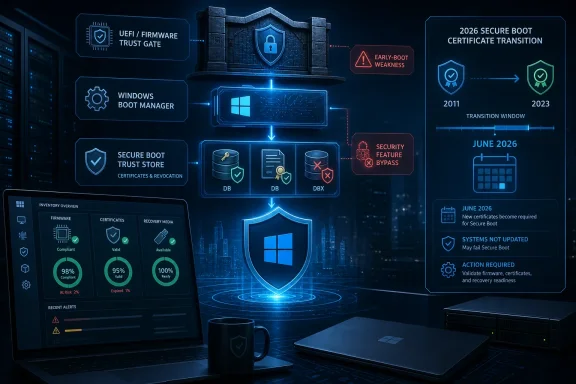
Microsoft has listed CVE-2026-47656 as a Windows Boot Manager security feature bypass vulnerability in the June 2026 security cycle, placing another early-boot weakness in the same operational risk category that has already forced enterprises to rethink Secure Boot maintenance. The interesting part is not that Microsoft patched another boot component. It is that the vulnerability arrives at the exact moment when Windows fleets are already being pushed through certificate, boot manager, and revocation changes that many administrators have learned to treat with caution. CVE-2026-47656 is therefore less a one-off patch note than a reminder that the Windows boot chain has become a live servicing surface.
For years, many Windows administrators treated Secure Boot as a firmware checkbox: enable it in UEFI, validate BitLocker behavior, and move on. That view no longer fits the way Microsoft is servicing the platform. The boot path is now part of the active patching story, with Windows Boot Manager, UEFI certificate authorities, revocation databases, recovery media, and OEM firmware all participating in whether a machine should be considered current.
CVE-2026-47656 lands in that context. A security feature bypass in Windows Boot Manager does not necessarily mean remote code execution, mass wormability, or an exploit that can be launched casually from across the internet. It means a security promise made during startup may be weaker than administrators assumed, and in the boot world that is often enough to matter.
Boot Manager sits before the operating system has fully asserted control. It is part of the chain that decides what can load, what is trusted, and whether later Windows defenses begin from a clean state. When that layer is bypassed, the attacker’s prize is not just one process or one user session. It is leverage over the assumptions that the rest of the security stack depends on.
That is why Microsoft’s phrasing matters. “Security feature bypass” can sound bloodless compared with “remote code execution,” but in the boot chain it points at a class of problem that can undermine measured startup, Secure Boot expectations, BitLocker trust decisions, and virtualization-based security posture. The phrase is bureaucratic; the consequences are architectural.
That puts defenders in the uncomfortable middle ground described by the metric language attached to the vulnerability: how much confidence do we have not merely that a CVE exists, but that the public understands what it is? In this case, the strongest public signal is Microsoft’s own acknowledgement. The vendor has named the affected component and class of impact, but it has not turned the entry into a reverse-engineering roadmap.
That is not the same as uncertainty about whether the vulnerability is real. A vendor-published CVE for Windows Boot Manager is a meaningful confirmation that Microsoft found or received a report of a condition it considers security-relevant. The uncertainty is around exploit mechanics, prerequisites, and operational blast radius.
Security teams should resist two temptations here. The first is panic: sparse detail does not automatically imply a silent catastrophe. The second is complacency: sparse detail also does not mean the issue is academic. With boot-chain vulnerabilities, lack of detail often reflects the sensitivity of the attack surface rather than the insignificance of the bug.
At one end of the spectrum, a vulnerability might be rumored, inferred from a crash, or described by researchers who have incomplete access to the affected system. At the other end, the vendor confirms the defect, ships a fix, and attaches the issue to concrete affected products. CVE-2026-47656 sits closer to the latter because it appears in Microsoft’s own advisory channel, but the public technical details remain intentionally thin.
That distinction matters in patch prioritization. An issue can be confirmed but still poorly understood outside Microsoft. Administrators know the component and impact category, but not necessarily the exact attack path, whether common enterprise controls interrupt it, or how easy post-patch diffing will be for exploit developers.
The practical reading is simple: confidence in existence is high; confidence in public technical completeness is lower. In other words, defenders should treat the vulnerability as real without pretending that the community has already mapped every exploit precondition.
This is especially important for WindowsForum readers who monitor CVSS vectors, exploitability assessments, and patch dashboards. Those fields are useful, but they do not replace architectural judgment. A boot manager bypass in a lightly documented advisory can deserve attention even if it lacks the dramatic markers that usually drive patch urgency.
This is not merely certificate housekeeping. The certificate transition determines whether devices can continue to receive future boot-level protections, including updates to early boot components and revocation lists. Machines may continue to boot after certificate expiration, but that does not mean they remain equally eligible for new Secure Boot protections.
That creates a messy reality for administrators. A Windows Boot Manager vulnerability may be addressed by a normal security update, but the long-term ability to trust and service the boot path depends on firmware state, certificate state, DB and DBX updates, recovery media, and OEM support. The patch is necessary; it may not be sufficient to call the fleet healthy.
This is where the boot-chain story diverges from most Windows patching. If a browser DLL is vulnerable, administrators patch the browser and move on. If the boot trust fabric is aging, mismatched, or partially revoked, the system can end up in a state where the update exists but the operational path to deploying it safely is harder than the advisory implies.
That history matters because it taught enterprises a painful lesson: boot security fixes can be disruptive when they interact with firmware, BitLocker, recovery environments, and installation media. Revocation is powerful precisely because it removes trust from components that may still exist in backups, rescue drives, deployment shares, and older images.
CVE-2026-47656 has not been publicly described as another BlackLotus-style issue, and it would be irresponsible to claim that without evidence. But it belongs to the same conceptual neighborhood. It concerns Windows Boot Manager, a component whose trust relationship is only as strong as the certificates, revocations, and deployment practices around it.
That is why administrators should not evaluate it only as a line item in a Patch Tuesday spreadsheet. The correct question is broader: are the organization’s boot components current, are its Secure Boot certificates ready for the 2026 transition, and are its recovery paths updated so the fix does not strand machines during an incident?
The risk model is also different. Many boot-chain attacks require physical access, administrative control, or a prior compromise. That does not make them irrelevant, but it does mean they usually fit into targeted compromise, device theft, malicious insider scenarios, or persistence after an attacker already has significant access.
The average gaming desktop or family laptop is not suddenly facing a new drive-by bootkit wave simply because CVE-2026-47656 exists. The more realistic concern is delayed maintenance. Machines that drift out of support, miss firmware updates, or remain stuck on old Secure Boot trust anchors become easier to abuse as the ecosystem moves forward.
For enthusiasts, this is also a good moment to audit old habits. If you keep USB installers, rescue media, imaging tools, or dual-boot loaders around, those artifacts are part of your boot environment. A fully patched Windows installation does not automatically make every old bootable stick in a drawer trustworthy.
This is where many organizations have scars. Boot-related updates can trigger recovery prompts, expose firmware bugs, or behave differently across nominally similar devices. A revocation or certificate update that works cleanly on one laptop generation can create a support event on another if the OEM firmware is stale or nonstandard.
Microsoft’s guidance around Secure Boot certificate updates has repeatedly emphasized staged deployment, representative testing, and careful sequencing. That advice applies here even if CVE-2026-47656 itself is delivered through ordinary security updates. The boot chain is a shared boundary between Windows and firmware, and shared boundaries are where neat patch management theory goes to die.
Administrators should also remember that recovery media is infrastructure. If an organization patches endpoints but continues to image devices with old boot managers, outdated WinPE environments, or unsigned tools that depend on legacy trust, it has not solved the operational problem. It has merely moved the problem into the next rebuild, recovery, or incident response exercise.
A boot manager bypass attacks that assumption. Depending on the vulnerability and exploit path, the attacker may be trying to load an older trusted component, tamper with boot policy, disable a protection, or create a pre-OS condition that Windows later inherits. Public information does not establish which of those applies to CVE-2026-47656, but the defensive concern is the same: the earlier the compromise, the harder it is to reason about the integrity of everything afterward.
That is also why would-be attackers pay attention to sparse vendor advisories. Once a patch ships, reverse engineers can compare old and new boot components, study changed code paths, and infer the flaw. The less Microsoft says publicly, the more the patch itself becomes the document.
This dynamic compresses the defender’s timeline. The first few days after disclosure may have little public exploit detail, but that does not mean adversaries are idle. For high-value environments, waiting for a proof-of-concept before prioritizing a boot security update is a poor bargain.
CVE-2026-47656 should push administrators to ask for richer inventory. Which devices still rely on 2011-era Secure Boot certificates? Which models need OEM firmware before certificate updates can complete cleanly? Which servers have maintenance windows that can absorb boot testing? Which deployment images contain older boot managers?
Those are not academic questions. A future boot-level vulnerability may require revocation of components that some organizations still depend on for recovery or deployment. If those dependencies are discovered only after Microsoft tightens the trust chain, the security team will look responsible for an outage caused by years of deferred platform hygiene.
The right way to avoid that trap is to separate detection from remediation. First, inventory certificate and boot status across representative hardware. Then test the full update path on pilot rings. Only then should the organization move toward broad enforcement, especially where revocations or irreversible Secure Boot changes are involved.
A Windows Boot Manager vulnerability on a server is not necessarily easier to exploit than on a client. In some cases it may be harder because physical access is controlled and administrative access is monitored. But the consequences of a compromised boot chain on a server can be more severe, especially where the machine anchors identity, virtualization, backup, or management functions.
Administrators should pay particular attention to clusters and virtualization hosts. Boot changes that are safe on a standalone client can have different consequences when a node participates in high availability, encrypted volumes, secure launch, or hardware attestation. Sequencing matters because you do not want firmware updates, Secure Boot certificate changes, OS security updates, and BitLocker policy changes all competing in the same maintenance window.
The old advice to “patch promptly” is still true, but it is incomplete. For servers, promptness must be paired with rollback planning, recovery key availability, vendor firmware validation, and a clear view of which nodes can safely reboot when. Security debt at boot time is paid in maintenance windows.
A security feature is a control that blocks an attacker from taking the easy path. Bypassing it may not be the full attack chain, but it can remove a critical guardrail. In the boot environment, that guardrail may be the difference between an unsigned or outdated component being rejected and the same component being accepted early enough to shape the rest of startup.
This is why CVE-2026-47656 should not be dismissed merely because the impact category lacks theatrical language. A bypass in Windows Boot Manager belongs to a high-trust component. Even if exploitation requires local access, administrative rights, or specialized conditions, it can matter in exactly the environments where attackers are willing to invest effort.
The cleanest mental model is to treat boot bypasses as persistence and trust issues. They are not always initial access bugs. They are often the means by which a capable attacker survives reboots, evades assumptions, or weakens protections that would otherwise make compromise noisier.
Devices that do not update may continue to run, which is both reassuring and dangerous. Reassuring, because certificate expiration is not expected to make every unprepared machine instantly fail to boot. Dangerous, because “it still boots” is an easy phrase for organizations to mistake for “it is still protected.”
The more accurate view is that unupdated devices may lose access to future boot-level protections. That includes the kind of servicing Microsoft needs when vulnerabilities like CVE-2026-47656, or future Boot Manager issues, require updated trust decisions. A device that can no longer receive the next layer of boot security is not healthy simply because the desktop appears.
This is where Windows administrators need to become more comfortable with certificate state as an operational metric. Patch compliance alone cannot describe whether the boot chain is ready for future mitigations. In 2026, boot trust becomes a fleet health signal.
The danger is not only that old media may fail after revocations. It is also that old media may reintroduce outdated boot components into a supposedly remediated environment. An administrator can patch a fleet thoroughly and still maintain a recovery workflow that depends on the very trust assumptions Microsoft is trying to retire.
This problem becomes sharper when organizations maintain custom boot media for incident response. During a security incident, teams reach for trusted tools under pressure. If those tools were built before the certificate transition or before boot manager revocations, they may become either unusable or unsafe at precisely the wrong moment.
The fix is procedural, not glamorous. Rebuild bootable media with current components, document which images are safe after Secure Boot changes, retire old installers, and test recovery paths on representative hardware. A boot security program that ignores recovery media is incomplete by design.
That inventory should cut across traditional silos. Endpoint teams own laptops and desktops. Server teams own hosts and domain controllers. Security teams own risk. Desktop engineering owns images. Procurement and vendor management own OEM relationships. Secure Boot touches all of them, which means any one team treating it as “not my layer” creates a gap.
The same is true for reporting. Executives do not need a lecture on UEFI variables, but they do need a clear status: what percentage of the fleet is current, what percentage is blocked by firmware or hardware age, what percentage has unknown Secure Boot state, and what the plan is before certificate expiration reduces future protection.
This is the kind of unglamorous work that prevents emergency change freezes later. Boot-chain security is unforgiving because mistakes show up before remote management agents, help desk tools, and endpoint telemetry are fully available. If a device cannot boot, the cloud console is not coming to save it.
A current boot trust chain gives Microsoft and administrators more room to respond to new vulnerabilities. An outdated one narrows the path. If a future mitigation depends on revoking old boot managers or trusting newly signed components, the organizations that delayed certificate work may find themselves choosing between security exposure and operational disruption.
That is the strategic lesson. Microsoft’s Windows security model increasingly assumes that early-boot components can be updated, measured, revoked, and re-trusted over time. Devices that cannot participate cleanly in that process become weaker members of the fleet, even if they run supported versions of Windows.
CVE-2026-47656 is therefore not just another Patch Tuesday entry. It is a stress test of whether organizations have accepted that the boot chain is now part of continuous security operations.
 The Boot Chain Is Now a Monthly Security Boundary
For years, many Windows administrators treated Secure Boot as a firmware checkbox: enable it in UEFI, validate BitLocker behavior, and move on. That view no longer fits the way Microsoft is servicing the platform. The boot path is now part of the active patching story, with Windows Boot Manager, UEFI certificate authorities, revocation databases, recovery media, and OEM firmware all participating in whether a machine should be considered current.CVE-2026-47656 lands in that context. A security feature bypass in Windows Boot Manager does not necessarily mean remote code execution, mass wormability, or an exploit that can be launched casually from across the internet. It means a security promise made during startup may be weaker than administrators assumed, and in the boot world that is often enough to matter.
Boot Manager sits before the operating system has fully asserted control. It is part of the chain that decides what can load, what is trusted, and whether later Windows defenses begin from a clean state. When that layer is bypassed, the attacker’s prize is not just one process or one user session. It is leverage over the assumptions that the rest of the security stack depends on.
That is why Microsoft’s phrasing matters. “Security feature bypass” can sound bloodless compared with “remote code execution,” but in the boot chain it points at a class of problem that can undermine measured startup, Secure Boot expectations, BitLocker trust decisions, and virtualization-based security posture. The phrase is bureaucratic; the consequences are architectural.
Microsoft’s Sparse Disclosure Is Itself Part of the Signal
The public entry for CVE-2026-47656 does not provide a rich technical narrative. That is normal for Microsoft’s Security Update Guide, especially when a vulnerability touches a sensitive platform boundary. The company often publishes enough for defenders to prioritize updates while withholding exploit-friendly detail until patches have had time to propagate.That puts defenders in the uncomfortable middle ground described by the metric language attached to the vulnerability: how much confidence do we have not merely that a CVE exists, but that the public understands what it is? In this case, the strongest public signal is Microsoft’s own acknowledgement. The vendor has named the affected component and class of impact, but it has not turned the entry into a reverse-engineering roadmap.
That is not the same as uncertainty about whether the vulnerability is real. A vendor-published CVE for Windows Boot Manager is a meaningful confirmation that Microsoft found or received a report of a condition it considers security-relevant. The uncertainty is around exploit mechanics, prerequisites, and operational blast radius.
Security teams should resist two temptations here. The first is panic: sparse detail does not automatically imply a silent catastrophe. The second is complacency: sparse detail also does not mean the issue is academic. With boot-chain vulnerabilities, lack of detail often reflects the sensitivity of the attack surface rather than the insignificance of the bug.
Report Confidence Is Not a Trivia Field
The user-facing explanation of the metric gets at something vulnerability dashboards often flatten. “Report confidence” is not a score of how scary a bug sounds. It is a judgment about the credibility and maturity of the information behind the advisory.At one end of the spectrum, a vulnerability might be rumored, inferred from a crash, or described by researchers who have incomplete access to the affected system. At the other end, the vendor confirms the defect, ships a fix, and attaches the issue to concrete affected products. CVE-2026-47656 sits closer to the latter because it appears in Microsoft’s own advisory channel, but the public technical details remain intentionally thin.
That distinction matters in patch prioritization. An issue can be confirmed but still poorly understood outside Microsoft. Administrators know the component and impact category, but not necessarily the exact attack path, whether common enterprise controls interrupt it, or how easy post-patch diffing will be for exploit developers.
The practical reading is simple: confidence in existence is high; confidence in public technical completeness is lower. In other words, defenders should treat the vulnerability as real without pretending that the community has already mapped every exploit precondition.
This is especially important for WindowsForum readers who monitor CVSS vectors, exploitability assessments, and patch dashboards. Those fields are useful, but they do not replace architectural judgment. A boot manager bypass in a lightly documented advisory can deserve attention even if it lacks the dramatic markers that usually drive patch urgency.
Secure Boot’s 2026 Problem Makes Every Boot Bug Louder
The timing is awkward because 2026 is already the year Microsoft has been warning administrators about Secure Boot certificate expiration. The older 2011-era Microsoft Secure Boot certificates begin expiring in 2026, and Microsoft has been steering Windows devices toward newer 2023 certificate authorities. That transition affects the same trust fabric that decides which boot components should be accepted.This is not merely certificate housekeeping. The certificate transition determines whether devices can continue to receive future boot-level protections, including updates to early boot components and revocation lists. Machines may continue to boot after certificate expiration, but that does not mean they remain equally eligible for new Secure Boot protections.
That creates a messy reality for administrators. A Windows Boot Manager vulnerability may be addressed by a normal security update, but the long-term ability to trust and service the boot path depends on firmware state, certificate state, DB and DBX updates, recovery media, and OEM support. The patch is necessary; it may not be sufficient to call the fleet healthy.
This is where the boot-chain story diverges from most Windows patching. If a browser DLL is vulnerable, administrators patch the browser and move on. If the boot trust fabric is aging, mismatched, or partially revoked, the system can end up in a state where the update exists but the operational path to deploying it safely is harder than the advisory implies.
BlackLotus Changed the Default Assumption
The shadow over all of this remains BlackLotus and the Secure Boot bypasses that forced Microsoft into staged boot manager revocations. BlackLotus demonstrated that old but still-trusted boot components could become a durable problem. The fix was not just “ship a new file.” It required a staged process that updated boot components and then revoked older vulnerable ones so they could no longer be used to bypass Secure Boot.That history matters because it taught enterprises a painful lesson: boot security fixes can be disruptive when they interact with firmware, BitLocker, recovery environments, and installation media. Revocation is powerful precisely because it removes trust from components that may still exist in backups, rescue drives, deployment shares, and older images.
CVE-2026-47656 has not been publicly described as another BlackLotus-style issue, and it would be irresponsible to claim that without evidence. But it belongs to the same conceptual neighborhood. It concerns Windows Boot Manager, a component whose trust relationship is only as strong as the certificates, revocations, and deployment practices around it.
That is why administrators should not evaluate it only as a line item in a Patch Tuesday spreadsheet. The correct question is broader: are the organization’s boot components current, are its Secure Boot certificates ready for the 2026 transition, and are its recovery paths updated so the fix does not strand machines during an incident?
The Consumer Risk Is Real but Narrower
For individual Windows users, the likely action is straightforward: install the security updates offered by Windows Update, avoid delaying firmware updates from the device maker, and make sure BitLocker recovery information is backed up before major boot-related changes. Most home users will never need to reason about DBX revocations or certificate authority transitions by hand.The risk model is also different. Many boot-chain attacks require physical access, administrative control, or a prior compromise. That does not make them irrelevant, but it does mean they usually fit into targeted compromise, device theft, malicious insider scenarios, or persistence after an attacker already has significant access.
The average gaming desktop or family laptop is not suddenly facing a new drive-by bootkit wave simply because CVE-2026-47656 exists. The more realistic concern is delayed maintenance. Machines that drift out of support, miss firmware updates, or remain stuck on old Secure Boot trust anchors become easier to abuse as the ecosystem moves forward.
For enthusiasts, this is also a good moment to audit old habits. If you keep USB installers, rescue media, imaging tools, or dual-boot loaders around, those artifacts are part of your boot environment. A fully patched Windows installation does not automatically make every old bootable stick in a drawer trustworthy.
Enterprise IT Has to Patch the State, Not Just the File
In managed environments, CVE-2026-47656 should be handled as part of a boot-chain readiness program rather than an isolated patch. The hardest work is not clicking “install.” It is proving that the boot environment remains consistent across hardware models, firmware versions, BitLocker policies, recovery partitions, deployment media, and server roles.This is where many organizations have scars. Boot-related updates can trigger recovery prompts, expose firmware bugs, or behave differently across nominally similar devices. A revocation or certificate update that works cleanly on one laptop generation can create a support event on another if the OEM firmware is stale or nonstandard.
Microsoft’s guidance around Secure Boot certificate updates has repeatedly emphasized staged deployment, representative testing, and careful sequencing. That advice applies here even if CVE-2026-47656 itself is delivered through ordinary security updates. The boot chain is a shared boundary between Windows and firmware, and shared boundaries are where neat patch management theory goes to die.
Administrators should also remember that recovery media is infrastructure. If an organization patches endpoints but continues to image devices with old boot managers, outdated WinPE environments, or unsigned tools that depend on legacy trust, it has not solved the operational problem. It has merely moved the problem into the next rebuild, recovery, or incident response exercise.
Attackers Like the Places Defenders Cannot See
The appeal of boot-chain attacks is not that they are always easy. It is that success can place malicious code below the layer where many defenders spend most of their time. Endpoint detection, event collection, application control, and user-mode telemetry all assume the operating system came up from a trustworthy base.A boot manager bypass attacks that assumption. Depending on the vulnerability and exploit path, the attacker may be trying to load an older trusted component, tamper with boot policy, disable a protection, or create a pre-OS condition that Windows later inherits. Public information does not establish which of those applies to CVE-2026-47656, but the defensive concern is the same: the earlier the compromise, the harder it is to reason about the integrity of everything afterward.
That is also why would-be attackers pay attention to sparse vendor advisories. Once a patch ships, reverse engineers can compare old and new boot components, study changed code paths, and infer the flaw. The less Microsoft says publicly, the more the patch itself becomes the document.
This dynamic compresses the defender’s timeline. The first few days after disclosure may have little public exploit detail, but that does not mean adversaries are idle. For high-value environments, waiting for a proof-of-concept before prioritizing a boot security update is a poor bargain.
The Patch Tuesday Spreadsheet Hides the Operational Dependencies
Patch management tools are excellent at showing whether a KB is installed. They are less good at showing whether a device’s boot trust chain is modern, its firmware accepts the new certificates, its recovery image is current, and its fallback media will still work after revocations. That visibility gap is one reason boot security work feels more like platform engineering than routine endpoint maintenance.CVE-2026-47656 should push administrators to ask for richer inventory. Which devices still rely on 2011-era Secure Boot certificates? Which models need OEM firmware before certificate updates can complete cleanly? Which servers have maintenance windows that can absorb boot testing? Which deployment images contain older boot managers?
Those are not academic questions. A future boot-level vulnerability may require revocation of components that some organizations still depend on for recovery or deployment. If those dependencies are discovered only after Microsoft tightens the trust chain, the security team will look responsible for an outage caused by years of deferred platform hygiene.
The right way to avoid that trap is to separate detection from remediation. First, inventory certificate and boot status across representative hardware. Then test the full update path on pilot rings. Only then should the organization move toward broad enforcement, especially where revocations or irreversible Secure Boot changes are involved.
Servers Deserve Special Paranoia
Windows Server estates complicate this story because uptime expectations often collide with firmware reality. Servers may run for long periods without firmware maintenance, and some environments are understandably conservative about rebooting domain controllers, Hyper-V hosts, storage nodes, or line-of-business application servers. That conservatism can quietly create a boot-security backlog.A Windows Boot Manager vulnerability on a server is not necessarily easier to exploit than on a client. In some cases it may be harder because physical access is controlled and administrative access is monitored. But the consequences of a compromised boot chain on a server can be more severe, especially where the machine anchors identity, virtualization, backup, or management functions.
Administrators should pay particular attention to clusters and virtualization hosts. Boot changes that are safe on a standalone client can have different consequences when a node participates in high availability, encrypted volumes, secure launch, or hardware attestation. Sequencing matters because you do not want firmware updates, Secure Boot certificate changes, OS security updates, and BitLocker policy changes all competing in the same maintenance window.
The old advice to “patch promptly” is still true, but it is incomplete. For servers, promptness must be paired with rollback planning, recovery key availability, vendor firmware validation, and a clear view of which nodes can safely reboot when. Security debt at boot time is paid in maintenance windows.
Security Feature Bypass Is the Most Misread Severity Label
Microsoft’s “security feature bypass” category often suffers from a perception problem. It sounds like something less urgent than code execution or elevation of privilege. In many cases, however, the bypass is what makes the next stage of compromise viable.A security feature is a control that blocks an attacker from taking the easy path. Bypassing it may not be the full attack chain, but it can remove a critical guardrail. In the boot environment, that guardrail may be the difference between an unsigned or outdated component being rejected and the same component being accepted early enough to shape the rest of startup.
This is why CVE-2026-47656 should not be dismissed merely because the impact category lacks theatrical language. A bypass in Windows Boot Manager belongs to a high-trust component. Even if exploitation requires local access, administrative rights, or specialized conditions, it can matter in exactly the environments where attackers are willing to invest effort.
The cleanest mental model is to treat boot bypasses as persistence and trust issues. They are not always initial access bugs. They are often the means by which a capable attacker survives reboots, evades assumptions, or weakens protections that would otherwise make compromise noisier.
The Certificate Transition Raises the Cost of Drift
The 2026 Secure Boot certificate deadline adds a second layer of urgency. Microsoft’s move from 2011-era certificates to 2023 certificate authorities is not just a date on a lifecycle page. It is a forced modernization of the trust anchors that Windows uses during startup.Devices that do not update may continue to run, which is both reassuring and dangerous. Reassuring, because certificate expiration is not expected to make every unprepared machine instantly fail to boot. Dangerous, because “it still boots” is an easy phrase for organizations to mistake for “it is still protected.”
The more accurate view is that unupdated devices may lose access to future boot-level protections. That includes the kind of servicing Microsoft needs when vulnerabilities like CVE-2026-47656, or future Boot Manager issues, require updated trust decisions. A device that can no longer receive the next layer of boot security is not healthy simply because the desktop appears.
This is where Windows administrators need to become more comfortable with certificate state as an operational metric. Patch compliance alone cannot describe whether the boot chain is ready for future mitigations. In 2026, boot trust becomes a fleet health signal.
Recovery Media Is the Forgotten Attack Surface
Every boot-chain advisory should send someone to inspect the organization’s recovery and deployment media. That includes ISO images, USB installers, WinPE environments, imaging servers, offline repair tools, golden images, and vendor rescue partitions. These assets often age more slowly than the machines they service.The danger is not only that old media may fail after revocations. It is also that old media may reintroduce outdated boot components into a supposedly remediated environment. An administrator can patch a fleet thoroughly and still maintain a recovery workflow that depends on the very trust assumptions Microsoft is trying to retire.
This problem becomes sharper when organizations maintain custom boot media for incident response. During a security incident, teams reach for trusted tools under pressure. If those tools were built before the certificate transition or before boot manager revocations, they may become either unusable or unsafe at precisely the wrong moment.
The fix is procedural, not glamorous. Rebuild bootable media with current components, document which images are safe after Secure Boot changes, retire old installers, and test recovery paths on representative hardware. A boot security program that ignores recovery media is incomplete by design.
The Real Patch Is a Boot-Trust Inventory
CVE-2026-47656 is a single identifier, but the responsible response is a broader inventory of boot trust. The organizations that handle this well will be those that already know which devices are ready for 2023 Secure Boot certificates, which firmware versions are blocking progress, and which operational teams own recovery media.That inventory should cut across traditional silos. Endpoint teams own laptops and desktops. Server teams own hosts and domain controllers. Security teams own risk. Desktop engineering owns images. Procurement and vendor management own OEM relationships. Secure Boot touches all of them, which means any one team treating it as “not my layer” creates a gap.
The same is true for reporting. Executives do not need a lecture on UEFI variables, but they do need a clear status: what percentage of the fleet is current, what percentage is blocked by firmware or hardware age, what percentage has unknown Secure Boot state, and what the plan is before certificate expiration reduces future protection.
This is the kind of unglamorous work that prevents emergency change freezes later. Boot-chain security is unforgiving because mistakes show up before remote management agents, help desk tools, and endpoint telemetry are fully available. If a device cannot boot, the cloud console is not coming to save it.
CVE-2026-47656 Turns a Maintenance Deadline Into a Security Deadline
There is a temptation to see the 2026 certificate transition and CVE-2026-47656 as separate stories. One is lifecycle maintenance; the other is a vulnerability. In practice, they reinforce each other.A current boot trust chain gives Microsoft and administrators more room to respond to new vulnerabilities. An outdated one narrows the path. If a future mitigation depends on revoking old boot managers or trusting newly signed components, the organizations that delayed certificate work may find themselves choosing between security exposure and operational disruption.
That is the strategic lesson. Microsoft’s Windows security model increasingly assumes that early-boot components can be updated, measured, revoked, and re-trusted over time. Devices that cannot participate cleanly in that process become weaker members of the fleet, even if they run supported versions of Windows.
CVE-2026-47656 is therefore not just another Patch Tuesday entry. It is a stress test of whether organizations have accepted that the boot chain is now part of continuous security operations.
The WindowsForum Reader’s Short List for This Specific Bug
CVE-2026-47656 should be read as a confirmed Windows Boot Manager security feature bypass with limited public technical detail, not as a fully mapped public exploit. That combination calls for disciplined urgency: patch, verify, and use the moment to clean up the boot-security work that was already due in 2026.- Install the relevant June 2026 Windows security updates through your normal supported servicing channel and do not wait for public exploit code before acting.
- Confirm that BitLocker recovery keys are escrowed and accessible before broad boot-related changes, especially on managed laptops and servers.
- Check Secure Boot certificate readiness across the fleet, because the 2011-to-2023 certificate transition affects future boot-level protections.
- Validate OEM firmware status on representative hardware before combining Secure Boot certificate work with large-scale operating system patch deployment.
- Rebuild and retire old recovery or deployment media so outdated boot components do not survive outside normal patch compliance reporting.
- Treat sparse public detail as a reason to avoid speculation, not as a reason to downgrade the importance of the affected boot component.
References
- Primary source: MSRC
Published: 2026-06-09T07:00:00-07:00
Security Update Guide - Microsoft Security Response Center
 msrc.microsoft.com
- Official source: support.microsoft.com
Surface Secure Boot Certificates | Microsoft Support
Secure Boot in UEFI firmware verifies pre-boot software using trusted certificates. Microsoft will update expiring Windows Secure Boot certificates starting June 2026 to maintain device protection.support.microsoft.com - Related coverage: sentinelone.com
CVE-2026-26175: Windows Boot Manager Auth Bypass Flaw
CVE-2026-26175 is an authentication bypass vulnerability in Windows Boot Manager. Learn about its impact, affected versions, and mitigation methods.www.sentinelone.com
- Related coverage: thewindowsupdate.com
- Related coverage: arstechnica.com
Microsoft patches Windows to eliminate Secure Boot bypass threat - Ars Technica
File that neutered Secure Boot passed Microsoft's internal review process.arstechnica.com - Official source: techcommunity.microsoft.com
Revoking vulnerable Windows boot managers | Windows IT Pro blog
Learn about the measures Microsoft is taking to help keep you safe from the If you're worried about the BlackLotus UEFI bootkit vulnerability (CVE-2023-24932). techcommunity.microsoft.com

- Related coverage: tbs.tech
- Related coverage: buildings.honeywell.com
The purpose of this document is to identify the patches that have been delivered by Microsoft® which have been tested against Pro-Watch
PDF documentbuildings.honeywell.com
- Related coverage: cow-prod-www-v3.azurewebsites.net
- Official source: microsoft.com
MSRC - Microsoft Security Response Center
The Microsoft Security Response Center is part of the defender community and on the front line of security response evolution. For over twenty years, we have been engaged with security researchers working to protect customers and the broader ecosystem.www.microsoft.com
- Official source: msrc-ppe.microsoft.com
- Official source: learn.microsoft.com
Security Advisories and Bulletins | Microsoft Learn
learn.microsoft.com - Related coverage: sra.io
