

CVE-2026-48567 is a Microsoft-disclosed elevation-of-privilege vulnerability in Azure HorizonDB, the company’s preview PostgreSQL-compatible database service for AI-era applications, published through the MSRC Security Update Guide on June 4, 2026, with public technical detail limited chiefly to its confirmed existence and CVSS context. That scarcity of detail is not an accident; it is the signal. Microsoft has confirmed enough for defenders to treat the issue as real, but not enough for outsiders to reconstruct the bug, measure exploit paths, or judge tenant-to-tenant blast radius. For Azure customers, the important story is less the CVE’s headline category than the uncomfortable timing: a brand-new database service is already being discussed in the language of cloud privilege boundaries.
Azure HorizonDB is not another obscure SKU hiding in the Azure catalog. Microsoft has positioned it as a fully managed, PostgreSQL-compatible database service aimed at modern application workloads, with AI-facing features such as vector support and integration into the company’s broader agent and data stack. In other words, it is meant to sit close to valuable application data and close to the fast-growing systems that will query, transform, and summarize that data.
That makes an elevation-of-privilege vulnerability especially worth watching. EoP bugs are sometimes dismissed as less dramatic than remote code execution because they often require some foothold first. In a cloud database service, however, privilege is the product boundary. The distinction between a constrained database identity, a broader service principal, a management-plane role, and a platform-level capability is exactly where customer trust lives.
The public record for CVE-2026-48567 does not yet provide a satisfying technical narrative. We do not have a root-cause write-up, proof-of-concept code, affected configuration matrix, or a public exploit chain. What we do have is a Microsoft Security Update Guide entry naming Azure HorizonDB and classifying the issue as elevation of privilege. That is enough to put the vulnerability on enterprise watchlists, but not enough to justify panic.
The lack of detail also reflects a familiar managed-service reality. With Windows or Exchange, customers can often map a CVE to a patch, a build number, a registry key, or a file version. With Azure platform services, remediation may happen behind the curtain. The security operation becomes less about deploying a hotfix and more about confirming exposure, reading service health communications, auditing identities, and understanding whether customer action is required.
For security teams, this is where CVSS can mislead if treated as a single number. A base score describes theoretical technical severity under standardized assumptions. Temporal metrics, including report confidence and remediation level, are meant to tell you how mature the public picture is. When the vendor is the primary source and the technical details are sparse, the operational question becomes: what can we know, and what can we only infer?
Microsoft’s acknowledgement increases confidence that the issue exists. It does not automatically tell us whether exploitation is simple, whether customer-created databases are affected, whether cross-tenant isolation is implicated, or whether the vulnerable component is in the control plane, data plane, authentication layer, extension surface, or internal orchestration fabric. Those distinctions are not academic. They determine whether a database owner can mitigate risk by changing role assignments or whether only Microsoft’s platform team can remove the exposure.
This is the uncomfortable asymmetry of cloud security disclosure. The vendor can have perfect internal knowledge and still disclose almost nothing externally, either to prevent weaponization or because the fix is service-side. Customers are then asked to trust the combination of the CVE entry, Azure advisories, and their own logs. That trust may be justified, but it is still a trust dependency.
For HorizonDB, the phrase “elevation of privilege” immediately raises several possibilities, all of which should be treated as hypotheses rather than claims. A flaw could allow a low-privileged database user to perform higher-privileged database operations. It could allow a customer identity to invoke management actions outside its assigned role. It could involve service-managed extensions, backup or restore workflows, replication behavior, or AI integration points. Or it could be entirely internal to Microsoft’s service fabric, with no direct customer exploit path exposed.
That uncertainty is precisely why defenders should not overfit their response to the word “database.” Modern cloud databases are no longer just query endpoints. They are bundles of networking rules, identity integrations, key management paths, backup systems, monitoring pipelines, failover automation, extension ecosystems, and increasingly AI-adjacent retrieval features. Every one of those surrounding systems is a place where “privilege” has a meaning.
The agentic-AI framing makes this even more sensitive. Microsoft is pitching HorizonDB in a world where applications may combine structured records, vector embeddings, model calls, retrieval-augmented generation, and automated workflows. If the database becomes a hub for both business data and AI context, privilege mistakes become more consequential. A user who can move from read-only context access to write permissions, extension control, or administrative metadata could affect far more than a single table.
This is especially true for database services. Developers do not test a PostgreSQL-compatible service by storing imaginary data forever. They migrate schemas, connect applications, evaluate latency, experiment with extensions, and compare cost models. By the time a service is generally available, some customers have already built dependency chains around it.
That is why early CVEs in new managed services deserve attention beyond their individual severity. They offer a glimpse into the maturity of the control plane, the service’s security review process, and the disclosure rhythm customers can expect. A vulnerability in preview is not shocking; preview exists partly to find flaws before broad adoption. But the way the vendor communicates, mitigates, and follows up becomes part of the product’s security reputation.
Microsoft’s cloud security history is full of both strength and scar tissue. Azure has mature identity, monitoring, policy, and key-management systems, but it has also seen high-profile managed-service security episodes over the years. Customers remember incidents where the fix was mostly Microsoft’s problem but the consequences, investigation burden, and assurance work landed on them. CVE-2026-48567 enters that context whether Microsoft wants it to or not.
That does not mean customers have nothing to do. It means the work moves from patch deployment to verification. Azure administrators should check service health notices, subscription-level communications, Azure Advisor recommendations, HorizonDB release notes, and any security notifications tied to affected resources. If Microsoft provides no customer action, the job becomes documenting that fact and confirming that compensating controls are in place.
The second job is identity review. EoP bugs feed on overbroad permissions. Even if the vulnerability requires an existing low-privileged role, many cloud environments have too many “temporary” owners, inherited contributor grants, stale service principals, and automation identities with rights they no longer need. A privilege escalation flaw is less useful when the starting privileges are tightly scoped and monitored.
The third job is logging. In a managed database service, the most valuable evidence may be scattered across Azure Activity Logs, Entra ID sign-in logs, diagnostic logs, database audit trails, private endpoint activity, and application telemetry. If a vendor later expands its advisory to include indicators or suspicious operation names, organizations with logging already enabled will be able to look backward. Those without it will be left with hope and retention gaps.
Inference is useful if handled honestly. HorizonDB is PostgreSQL-compatible and cloud-managed, so database roles, Azure RBAC, managed identities, networking restrictions, private endpoints, customer-managed keys, and diagnostic settings are all plausible control areas to review. But none of those reviews should be described as a fix for CVE-2026-48567 unless Microsoft says so. They are risk-reduction steps around a class of failure.
The distinction matters because vague mitigations can create false confidence. Telling administrators to “restrict access” is sensible, but it may not address a platform-side privilege escalation path. Telling developers to rotate credentials may be prudent after suspected abuse, but it is not a substitute for a vendor patch. Telling executives that “we remediated the CVE” when the vendor has not published customer actions is worse than saying, “Microsoft appears to own the fix; we reduced surrounding exposure and are monitoring.”
This is where WindowsForum’s audience has an advantage. Sysadmins are used to operational ambiguity. They know that the real work is often not the headline patch but the inventory, exception handling, rollback planning, and after-action review. Azure simply changes the terrain. Instead of WSUS and build numbers, the evidence trail runs through resource graphs, tenant logs, portal notices, and cloud control-plane behavior.
Agentic applications tend to accumulate capabilities. A prototype starts with read-only database access, gains write access for memory or workflow state, adds a managed identity to call model services, receives access to a secrets store, and eventually gets enough permissions to orchestrate surrounding resources. If the backing database service then has an EoP flaw, the question is not just what the database user can do. It is what the application identity connected to the database can reach next.
That is the practical lens for CVE-2026-48567. Even without exploit details, organizations evaluating HorizonDB should treat it as a reminder to design AI data systems with blast-radius limits from day one. Separate experimental tenants from production tenants. Use dedicated identities rather than shared service principals. Avoid granting broad Azure Contributor rights to application components. Prefer private networking where possible. Turn on audit trails before the pilot becomes important.
The same logic applies to data classification. Vector stores and AI context databases can contain sensitive material in unfamiliar forms. Embeddings, prompts, retrieval snippets, and generated summaries may not look like traditional regulated records, but they can encode business secrets, customer information, or operational logic. If a privilege bug exposes the ability to read, modify, or influence those stores, the security impact may be harder to assess than a simple table dump.
The disclosure economy has changed. For on-premises software, public patch details help defenders validate remediation and help attackers build exploits. For cloud services, public detail can still help attackers, while defenders may not be able to apply a patch themselves anyway. Vendors therefore have strong incentives to say less, especially when exploitation has not been observed publicly or when the vulnerable path is already mitigated.
But less detail has a cost. Customers cannot easily perform independent risk assessment. They cannot brief leadership with confidence. They cannot tell whether they escaped exposure because they never used a feature, because their region was not affected, because their configuration was safe, or because Microsoft fixed the issue before anyone could exploit it. A cloud provider may own the infrastructure, but customers still own the risk register.
The best middle ground would be richer post-remediation disclosure. Microsoft does not need to publish exploit-ready steps on day one. But after fixes are deployed, customers benefit from knowing the affected surface, whether cross-tenant access was possible, whether logs can reveal attempted abuse, and whether any customer data exposure has been observed. The industry is still inconsistent on that follow-through.
Inventory comes first. If your organization has no HorizonDB resources, the response is simple: record non-exposure and move on. If HorizonDB exists in a sandbox, determine whether it contains real data, which identities can access it, whether public network access is enabled, and whether diagnostic logs are flowing. If it exists near production systems, treat the CVE as a prompt for a targeted access review.
Change management comes next. Preview services have a way of slipping through governance because they are used by innovation teams, data scientists, or developers under deadline pressure. That is not a criticism of those teams; it is a description of how modern platforms spread. A vulnerability entry is a good moment to bring the service back into the same governance model as everything else.
Finally, security teams should avoid theatrical severity inflation. Not every Azure EoP is a tenant-escape catastrophe. Not every sparse MSRC entry hides a disaster. The right posture is disciplined skepticism: assume the vulnerability is real, assume details are incomplete, reduce unnecessary privilege, preserve logs, and wait for vendor clarification without pretending that waiting is the same as doing nothing.
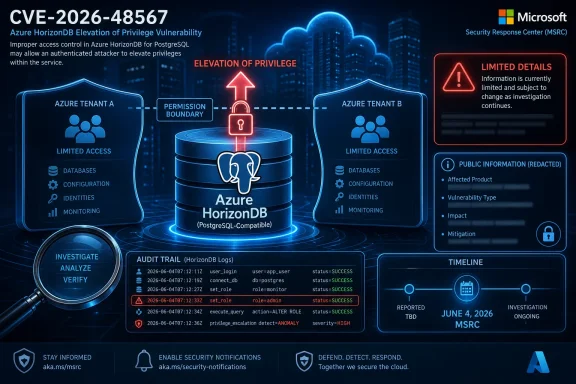 Microsoft’s New Database Enters the Security Ledger Early
Azure HorizonDB is not another obscure SKU hiding in the Azure catalog. Microsoft has positioned it as a fully managed, PostgreSQL-compatible database service aimed at modern application workloads, with AI-facing features such as vector support and integration into the company’s broader agent and data stack. In other words, it is meant to sit close to valuable application data and close to the fast-growing systems that will query, transform, and summarize that data.That makes an elevation-of-privilege vulnerability especially worth watching. EoP bugs are sometimes dismissed as less dramatic than remote code execution because they often require some foothold first. In a cloud database service, however, privilege is the product boundary. The distinction between a constrained database identity, a broader service principal, a management-plane role, and a platform-level capability is exactly where customer trust lives.
The public record for CVE-2026-48567 does not yet provide a satisfying technical narrative. We do not have a root-cause write-up, proof-of-concept code, affected configuration matrix, or a public exploit chain. What we do have is a Microsoft Security Update Guide entry naming Azure HorizonDB and classifying the issue as elevation of privilege. That is enough to put the vulnerability on enterprise watchlists, but not enough to justify panic.
The lack of detail also reflects a familiar managed-service reality. With Windows or Exchange, customers can often map a CVE to a patch, a build number, a registry key, or a file version. With Azure platform services, remediation may happen behind the curtain. The security operation becomes less about deploying a hotfix and more about confirming exposure, reading service health communications, auditing identities, and understanding whether customer action is required.
Report Confidence Is Doing More Work Than the Score
The user-facing text around CVSS Report Confidence sounds bureaucratic, but it matters here. That metric is designed to capture how much confidence exists in both the existence of a vulnerability and the credibility of the known technical details. A vendor-confirmed cloud vulnerability with limited public explanation can sit in an awkward middle ground: real enough to act on, opaque enough to frustrate defenders.For security teams, this is where CVSS can mislead if treated as a single number. A base score describes theoretical technical severity under standardized assumptions. Temporal metrics, including report confidence and remediation level, are meant to tell you how mature the public picture is. When the vendor is the primary source and the technical details are sparse, the operational question becomes: what can we know, and what can we only infer?
Microsoft’s acknowledgement increases confidence that the issue exists. It does not automatically tell us whether exploitation is simple, whether customer-created databases are affected, whether cross-tenant isolation is implicated, or whether the vulnerable component is in the control plane, data plane, authentication layer, extension surface, or internal orchestration fabric. Those distinctions are not academic. They determine whether a database owner can mitigate risk by changing role assignments or whether only Microsoft’s platform team can remove the exposure.
This is the uncomfortable asymmetry of cloud security disclosure. The vendor can have perfect internal knowledge and still disclose almost nothing externally, either to prevent weaponization or because the fix is service-side. Customers are then asked to trust the combination of the CVE entry, Azure advisories, and their own logs. That trust may be justified, but it is still a trust dependency.
Elevation of Privilege Is the Cloud’s Most Underestimated Failure Mode
The security industry tends to reserve its strongest language for pre-authentication remote code execution, internet-facing deserialization bugs, and wormable network flaws. That bias is understandable, but it can underrate privilege escalation in managed cloud services. In Azure, AWS, or Google Cloud, a privilege boundary is not just a local machine boundary. It can be an identity boundary, a subscription boundary, a tenant boundary, or a hidden service-boundary between customer operations and provider automation.For HorizonDB, the phrase “elevation of privilege” immediately raises several possibilities, all of which should be treated as hypotheses rather than claims. A flaw could allow a low-privileged database user to perform higher-privileged database operations. It could allow a customer identity to invoke management actions outside its assigned role. It could involve service-managed extensions, backup or restore workflows, replication behavior, or AI integration points. Or it could be entirely internal to Microsoft’s service fabric, with no direct customer exploit path exposed.
That uncertainty is precisely why defenders should not overfit their response to the word “database.” Modern cloud databases are no longer just query endpoints. They are bundles of networking rules, identity integrations, key management paths, backup systems, monitoring pipelines, failover automation, extension ecosystems, and increasingly AI-adjacent retrieval features. Every one of those surrounding systems is a place where “privilege” has a meaning.
The agentic-AI framing makes this even more sensitive. Microsoft is pitching HorizonDB in a world where applications may combine structured records, vector embeddings, model calls, retrieval-augmented generation, and automated workflows. If the database becomes a hub for both business data and AI context, privilege mistakes become more consequential. A user who can move from read-only context access to write permissions, extension control, or administrative metadata could affect far more than a single table.
Preview Services Still Carry Production Expectations
Azure HorizonDB’s preview status is not a free pass. Enterprises increasingly evaluate preview services with real data, real application prototypes, and sometimes real customers, even if the paperwork says “not for production.” Microsoft knows this; the preview label limits contractual expectations, but it does not erase the operational reality of modern cloud adoption.This is especially true for database services. Developers do not test a PostgreSQL-compatible service by storing imaginary data forever. They migrate schemas, connect applications, evaluate latency, experiment with extensions, and compare cost models. By the time a service is generally available, some customers have already built dependency chains around it.
That is why early CVEs in new managed services deserve attention beyond their individual severity. They offer a glimpse into the maturity of the control plane, the service’s security review process, and the disclosure rhythm customers can expect. A vulnerability in preview is not shocking; preview exists partly to find flaws before broad adoption. But the way the vendor communicates, mitigates, and follows up becomes part of the product’s security reputation.
Microsoft’s cloud security history is full of both strength and scar tissue. Azure has mature identity, monitoring, policy, and key-management systems, but it has also seen high-profile managed-service security episodes over the years. Customers remember incidents where the fix was mostly Microsoft’s problem but the consequences, investigation burden, and assurance work landed on them. CVE-2026-48567 enters that context whether Microsoft wants it to or not.
The Managed-Service Patch May Have Already Happened
For Windows admins, the reflexive question is simple: where is the update? For a managed Azure database, the answer may be less visible. Microsoft may patch the vulnerable service component centrally, roll out mitigation region by region, adjust control-plane behavior, disable a risky path, or update backend infrastructure without exposing a downloadable patch to customers.That does not mean customers have nothing to do. It means the work moves from patch deployment to verification. Azure administrators should check service health notices, subscription-level communications, Azure Advisor recommendations, HorizonDB release notes, and any security notifications tied to affected resources. If Microsoft provides no customer action, the job becomes documenting that fact and confirming that compensating controls are in place.
The second job is identity review. EoP bugs feed on overbroad permissions. Even if the vulnerability requires an existing low-privileged role, many cloud environments have too many “temporary” owners, inherited contributor grants, stale service principals, and automation identities with rights they no longer need. A privilege escalation flaw is less useful when the starting privileges are tightly scoped and monitored.
The third job is logging. In a managed database service, the most valuable evidence may be scattered across Azure Activity Logs, Entra ID sign-in logs, diagnostic logs, database audit trails, private endpoint activity, and application telemetry. If a vendor later expands its advisory to include indicators or suspicious operation names, organizations with logging already enabled will be able to look backward. Those without it will be left with hope and retention gaps.
The Missing Details Are Their Own Risk Category
Security teams often say they want “actionable intelligence,” but CVEs like this expose the problem with that phrase. The most actionable facts may be unavailable: exploit prerequisites, affected regions, vulnerable versions, customer mitigations, and indicators of compromise. That leaves defenders in the business of inference.Inference is useful if handled honestly. HorizonDB is PostgreSQL-compatible and cloud-managed, so database roles, Azure RBAC, managed identities, networking restrictions, private endpoints, customer-managed keys, and diagnostic settings are all plausible control areas to review. But none of those reviews should be described as a fix for CVE-2026-48567 unless Microsoft says so. They are risk-reduction steps around a class of failure.
The distinction matters because vague mitigations can create false confidence. Telling administrators to “restrict access” is sensible, but it may not address a platform-side privilege escalation path. Telling developers to rotate credentials may be prudent after suspected abuse, but it is not a substitute for a vendor patch. Telling executives that “we remediated the CVE” when the vendor has not published customer actions is worse than saying, “Microsoft appears to own the fix; we reduced surrounding exposure and are monitoring.”
This is where WindowsForum’s audience has an advantage. Sysadmins are used to operational ambiguity. They know that the real work is often not the headline patch but the inventory, exception handling, rollback planning, and after-action review. Azure simply changes the terrain. Instead of WSUS and build numbers, the evidence trail runs through resource graphs, tenant logs, portal notices, and cloud control-plane behavior.
HorizonDB’s AI Pitch Raises the Value of Least Privilege
The AI-era database pitch is seductive: keep your operational data, vectors, search, and model-adjacent workflows close together, and developers can build faster with less glue code. That is a legitimate architectural goal. It is also a reason to become more conservative about privilege design, not less.Agentic applications tend to accumulate capabilities. A prototype starts with read-only database access, gains write access for memory or workflow state, adds a managed identity to call model services, receives access to a secrets store, and eventually gets enough permissions to orchestrate surrounding resources. If the backing database service then has an EoP flaw, the question is not just what the database user can do. It is what the application identity connected to the database can reach next.
That is the practical lens for CVE-2026-48567. Even without exploit details, organizations evaluating HorizonDB should treat it as a reminder to design AI data systems with blast-radius limits from day one. Separate experimental tenants from production tenants. Use dedicated identities rather than shared service principals. Avoid granting broad Azure Contributor rights to application components. Prefer private networking where possible. Turn on audit trails before the pilot becomes important.
The same logic applies to data classification. Vector stores and AI context databases can contain sensitive material in unfamiliar forms. Embeddings, prompts, retrieval snippets, and generated summaries may not look like traditional regulated records, but they can encode business secrets, customer information, or operational logic. If a privilege bug exposes the ability to read, modify, or influence those stores, the security impact may be harder to assess than a simple table dump.
Microsoft’s Disclosure Machine Is Built for Scale, Not Comfort
MSRC’s Security Update Guide is designed to publish vulnerability information at massive scale. It is not designed to satisfy every administrator’s curiosity. That is a defensible tradeoff for a vendor responsible for Windows, Azure, Office, developer tools, cloud services, and a galaxy of dependencies. It is also why some cloud CVEs feel underexplained.The disclosure economy has changed. For on-premises software, public patch details help defenders validate remediation and help attackers build exploits. For cloud services, public detail can still help attackers, while defenders may not be able to apply a patch themselves anyway. Vendors therefore have strong incentives to say less, especially when exploitation has not been observed publicly or when the vulnerable path is already mitigated.
But less detail has a cost. Customers cannot easily perform independent risk assessment. They cannot brief leadership with confidence. They cannot tell whether they escaped exposure because they never used a feature, because their region was not affected, because their configuration was safe, or because Microsoft fixed the issue before anyone could exploit it. A cloud provider may own the infrastructure, but customers still own the risk register.
The best middle ground would be richer post-remediation disclosure. Microsoft does not need to publish exploit-ready steps on day one. But after fixes are deployed, customers benefit from knowing the affected surface, whether cross-tenant access was possible, whether logs can reveal attempted abuse, and whether any customer data exposure has been observed. The industry is still inconsistent on that follow-through.
The Windows Admin’s Job Is Becoming Cloud Evidence Management
For many WindowsForum readers, Azure vulnerability response increasingly resembles incident readiness rather than patch management. The administrator’s job is to know what exists, who can touch it, what changed, and what evidence would survive a late-breaking advisory. CVE-2026-48567 is a small case study in that larger shift.Inventory comes first. If your organization has no HorizonDB resources, the response is simple: record non-exposure and move on. If HorizonDB exists in a sandbox, determine whether it contains real data, which identities can access it, whether public network access is enabled, and whether diagnostic logs are flowing. If it exists near production systems, treat the CVE as a prompt for a targeted access review.
Change management comes next. Preview services have a way of slipping through governance because they are used by innovation teams, data scientists, or developers under deadline pressure. That is not a criticism of those teams; it is a description of how modern platforms spread. A vulnerability entry is a good moment to bring the service back into the same governance model as everything else.
Finally, security teams should avoid theatrical severity inflation. Not every Azure EoP is a tenant-escape catastrophe. Not every sparse MSRC entry hides a disaster. The right posture is disciplined skepticism: assume the vulnerability is real, assume details are incomplete, reduce unnecessary privilege, preserve logs, and wait for vendor clarification without pretending that waiting is the same as doing nothing.
The Concrete Moves Before the Next Advisory Lands
CVE-2026-48567 is not yet a story of mass exploitation or emergency weekend patching. It is a story about how defenders should behave when a new managed database service receives a confirmed vulnerability entry before the public technical record catches up. That makes the response narrower, but not optional.- Organizations should first determine whether any Azure HorizonDB resources exist in their tenants, including preview, lab, proof-of-concept, and developer subscriptions.
- Administrators should review Azure RBAC assignments, database roles, managed identities, service principals, and automation accounts associated with HorizonDB deployments.
- Teams should verify that diagnostic logging, Azure Activity Logs, database auditing, and Entra ID sign-in telemetry are enabled and retained long enough to support retrospective investigation.
- Security owners should check Microsoft service health messages, HorizonDB release notes, and subscription notifications for any customer-required mitigation or confirmation that remediation is service-side.
- Developers using HorizonDB for AI or vector workloads should separate experimental data from sensitive production data and avoid granting broad permissions to agent or application identities.
- Risk registers should describe the uncertainty plainly: Microsoft has identified an Azure HorizonDB elevation-of-privilege vulnerability, but public technical details remain limited at this stage.
References
- Primary source: MSRC
Published: 2026-06-04T07:00:00-07:00
Security Update Guide - Microsoft Security Response Center
 msrc.microsoft.com
- Related coverage: aha.org
- Related coverage: caloes.ca.gov
</rdf:Alt> </dc:title> <dc:description> <rdf:Alt> <rdf:li xml:lang="x-default"/> </rdf:Alt> </dc:description> <dc:creator> <rdf:Seq> <rdf:li>Padilla
</rdf:Alt> </dc:description> <dc:creator> <rdf:Seq> <rdf:li>Padilla, Vania@CalOESwww.caloes.ca.gov
- Related coverage: assets.beyondtrust.com
- Official source: microsoft.com
MSRC - Microsoft Security Response Center
The Microsoft Security Response Center is part of the defender community and on the front line of security response evolution. For over twenty years, we have been engaged with security researchers working to protect customers and the broader ecosystem.www.microsoft.com
- Official source: msrc-ppe.microsoft.com
- Official source: learn.microsoft.com
Security Advisories and Bulletins | Microsoft Learn
learn.microsoft.com - Related coverage: deepwiki.com
MSRC API Reference | microsoft/MSRC-Microsoft-Security-Updates-API | DeepWiki
This document provides technical reference information for the Microsoft Security Response Center (MSRC) CVRF API that underlies the MsrcSecurityUpdates PowerShell module. This covers the REST API enddeepwiki.com - Related coverage: datacomm.com
- Related coverage: stackoverflow.com
security - Microsoft CVRF API - Stack Overflow
It has come to my attention that, starting from February 9, 2021,
Microsoft Security Response Center has removed registrations requirements to their CVRF API.
That could be a nice way tostackoverflow.com
- Related coverage: sra.io
- Related coverage: first.org
CVSS v3.1 User Guide
 www.first.org
- Related coverage: sbomify.com
What Is CVSS? Understanding Vulnerability Severity Scoring | Sbomify
Learn what CVSS is, how vulnerability severity scores are calculated, the differences between CVSS v3.1 and v4.0, and how to use CVSS with KEV and SBOMs for prioritization.sbomify.com - Related coverage: windowsnews.ai
CVE-2026-42826: Why Report Confidence Is Key for Azure DevOps Risk - Windows News
Microsoft's CVE-2026-42826 for Azure DevOps highlights a critical CVSS metric: Report Confidence. Learn why this matters for vulnerability prioritization...windowsnews.ai - Related coverage: techradar.com
Microsoft Build 2026 — all the news and updates as it happened | TechRadar
Everything we saw at Microsoft Build 2026www.techradar.com - Official source: azure.microsoft.com
Azure HorizonDB - Pricing | Microsoft Azure
Get Azure HorizonDB pricing information. Try popular services free with an Azure free account, and pay as you go with no upfront costs.azure.microsoft.com
- Official source: techcommunity.microsoft.com
Announcing Azure HorizonDB | Microsoft Community Hub
Affan Dar, Vice President of Engineering, PostgreSQL at MicrosoftCharles Feddersen, Partner Director of Program Management, PostgreSQL at Microsoft Today at... techcommunity.microsoft.com
- Related coverage: techtimes.com
Azure HorizonDB Enters Public Preview: Web IQ Already Powers Copilot and ChatGPT
Azure HorizonDB enters public preview at Microsoft Build 2026 alongside Web IQ, a Bing-rebuilt AI grounding API already powering Copilot and ChatGPT. The PostgreSQL-native database uses a Rust-basedwww.techtimes.com - Related coverage: innfactory.de
Azure HorizonDB - PostgreSQL-Compatible Cloud Database · innFactory - Software Development, Cloud & AI
Azure HorizonDB: PostgreSQL-compatible database with separated compute/storage, multi-zone HA, and native vector search (public preview).innfactory.de - Official source: cdn-dynmedia-1.microsoft.com
Microsofts Expanded Horizons in Security licensed INT003 000345
PDF documentcdn-dynmedia-1.microsoft.com
- Official source: download.microsoft.com
