

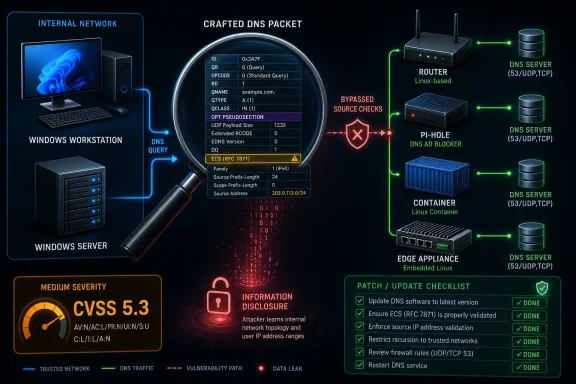
CVE-2026-4893 is a medium-severity information disclosure vulnerability in dnsmasq, published on May 11, 2026, that allows a remote unauthenticated attacker to bypass source checks by sending a crafted DNS packet containing RFC 7871 EDNS Client Subnet information. The bug is not a headline-grabbing Windows kernel zero-day, but it still belongs on the radar of WindowsForum readers because DNS is where tidy platform boundaries often break down. A Windows estate can be fully patched and still depend on Linux appliances, Pi-hole boxes, routers, containers, and edge devices quietly running vulnerable resolver code. That is the real story here: modern Windows security is inseparable from the small open-source components that make the network function.
The oddity of CVE-2026-4893 is that many administrators will encounter it through Microsoft’s Security Update Guide even though the vulnerable component is dnsmasq, a lightweight DNS, DHCP, router-adjacent workhorse far more commonly associated with Linux and embedded networking than with Windows itself. That mismatch is not a mistake so much as a map of how enterprise risk now travels. Microsoft’s security ecosystem does not end at the Windows desktop, the Windows Server role, or the monthly cumulative update.
The Microsoft advisory page for this CVE is sparse in the way modern vulnerability portals often are: a CVE identifier, boilerplate warranty language, and a pointer into the broader security-update machinery. The useful signal is not that Microsoft owns dnsmasq. It is that Microsoft customers increasingly run mixed infrastructure where a third-party DNS flaw can affect Microsoft-managed endpoints, cloud-connected identity flows, developer workstations, and branch-office networks.
That is especially true for organizations using Microsoft Defender, Intune, Azure Arc, Microsoft Sentinel, or vulnerability-management products that ingest external CVE intelligence. A vulnerability can surface in Microsoft tooling because the asset inventory says a workload, appliance, container, or Linux package is present somewhere in the estate. In that sense, CVE-2026-4893 is a reminder that “Microsoft security” is no longer a synonym for “Windows patches.”
The disclaimer pasted into the advisory is easy to ignore, but it also says something about the posture of the platform vendor. Microsoft is acting as a distributor of vulnerability intelligence, not necessarily the originator of the affected code or the final authority on every package version. Administrators should treat the MSRC entry as a starting bell, not a complete remediation plan.
That combination matters because DNS is not just plumbing. DNS queries can reveal internal naming schemes, service topology, private hostnames, split-horizon configurations, and sometimes the shape of an organization’s business processes. A bug that leaks or exposes DNS information may not hand over SYSTEM privileges, but it can lower the cost of reconnaissance.
The vulnerability description is specific. dnsmasq can be tricked into bypassing source checks through a crafted DNS packet using RFC 7871 client subnet information. RFC 7871, better known as EDNS Client Subnet, was designed to let resolvers pass along part of a client’s network location so authoritative DNS services can return geographically or topologically appropriate answers. That convenience becomes dangerous when software trusts the subnet hint more than it should.
The practical risk depends on configuration. A dnsmasq instance bound only to a trusted LAN and shielded by sane firewall policy presents a different exposure than one reachable from untrusted networks, guest Wi-Fi, VPN segments, lab ranges, or the internet. But medium-severity DNS flaws have a habit of being underestimated because they live in places administrators rarely log into after initial setup.
For Windows-heavy shops, the most obvious question is whether Microsoft DNS Server is affected. CVE-2026-4893 is about dnsmasq, not the Windows Server DNS role. But that does not mean a Windows organization can ignore it. Many Windows networks outsource pieces of name resolution to appliances or Linux-based services long before queries ever reach Active Directory-integrated DNS.
Consider the branch office with a low-cost router handling local DHCP and DNS forwarding. Consider the developer laptop running containers that include dnsmasq-derived behavior. Consider a Pi-hole instance used by an IT team for ad blocking and local DNS overrides. Consider network appliances whose firmware bill of materials is not visible in the Microsoft admin center. These are the places where a vulnerability like this hides.
The danger is not that every dnsmasq deployment is suddenly catastrophic. The danger is inventory blindness. If the only patch dashboard an organization trusts is Windows Update compliance, this CVE may never become someone’s ticket.
That design has always carried privacy and trust tradeoffs. A resolver receiving ECS data has to decide how much weight to give a client-subnet field that is, by design, metadata inside a DNS query. Security-sensitive source checks should be anchored to where the packet actually came from, not merely to what the packet claims about a client subnet.
CVE-2026-4893 appears to sit in that uncomfortable seam. If crafted ECS information can influence source validation, then access controls built around source assumptions become less reliable. The result is information disclosure rather than direct compromise, but in DNS terms, disclosure can mean learning which names exist, which internal services resolve, or how a caching resolver behaves.
That is why the bug’s phrasing matters. “Bypass source checks” is not a cosmetic defect. It suggests a boundary decision being made with the wrong input. In security engineering, that class of bug is often more important than the severity number alone implies.
The trap is assuming that a CVE has one universal fixed version. It rarely does. Ubuntu may list one fixed package version for 24.04 LTS, another for 22.04 LTS, and different extended-security versions for older releases. Debian may point to a source package update. Pi-hole may bundle a corrected dnsmasq-related component inside an FTL release. A router vendor may need a firmware image, not an apt command.
For WindowsForum readers, this is where Microsoft’s advisory model can feel both helpful and insufficient. It can tell you a CVE exists and may show up in Microsoft security products, but it will not necessarily tell you how to update the Raspberry Pi under someone’s desk or the branch firewall installed before the current IT team arrived. The remediation path follows the product that ships dnsmasq, not the portal where the CVE first caught your eye.
This is also why software bills of materials are slowly moving from procurement checkbox to operational necessity. If a security team cannot answer where dnsmasq is installed, whether it is exposed, and who owns updates for those systems, the team does not have a vulnerability-management problem. It has an asset-management problem with a vulnerability-management symptom.
A Windows client may query a local forwarder, which forwards to a branch appliance, which forwards to a cloud resolver, which applies policy based on identity, geography, or security classification. A developer workstation may run WSL, Docker, VPN software, endpoint protection, and split-DNS rules at the same time. A server may be “Windows” from the operating-system perspective while depending on Linux-based network services for resolution.
That complexity makes DNS bugs operationally interesting even when the vulnerable code is not on the Windows box. If a dnsmasq forwarder leaks information or mishandles source validation, Windows clients may still be the source of the queries, the subject of the leaked names, or the systems whose connectivity depends on the resolver. The exposure sits between platforms.
The right question for administrators is not “Do we run dnsmasq on Windows?” The better question is “Do any Windows workloads rely on a dnsmasq instance we do not routinely patch?” That shift in wording catches routers, lab networks, local caching layers, Linux VMs, containers, and appliances that a Windows-only patch report would miss.
A dnsmasq service exposed to the public internet is the obvious red flag. So is a resolver reachable from guest networks, unmanaged VPN clients, partner links, or shared lab environments. Internal does not automatically mean safe if the internal network is flat, heavily BYOD, or full of development systems running arbitrary tools.
Even when exploitation yields only limited DNS information, the reconnaissance value can be real. Internal hostnames can reveal naming conventions, environments, product codenames, backup services, authentication infrastructure, or staging systems. Attackers do not need every secret in one step; they need enough structure to make the next step cheaper.
This is why firewall review belongs beside package updates. Patching dnsmasq is the clean fix, but limiting who can query local resolvers is the control that prevents the next resolver bug from becoming urgent. DNS should be intentionally reachable, not accidentally available.
A better patching decision asks four questions. Is dnsmasq reachable from untrusted networks? Does it serve split-horizon or internal-only DNS data? Is it embedded in a product with delayed firmware updates? Does the organization have compensating controls that restrict query sources independently of dnsmasq’s own logic? The answers matter more than the label “medium.”
For a home lab or small business running Pi-hole, the practical answer is straightforward: update promptly, especially if the service is reachable beyond a tightly controlled LAN. For enterprise IT, the answer is to triage by exposure and data sensitivity. A resolver used only inside a protected management subnet is not the same as a branch device answering queries from guest Wi-Fi.
The lesson is not to panic. It is to resist the false comfort of neat severity bands. DNS vulnerabilities often look modest because they do not execute code, but they touch the map attackers use to navigate.
That is good for coverage, but it also invites confusion. A Microsoft advisory entry does not necessarily mean a Windows cumulative update will remediate the issue. It may mean Defender found an affected package on a Linux host. It may mean an Azure-connected machine reports the vulnerable component. It may mean the CVE is present in Microsoft’s vulnerability intelligence feed for customer awareness.
The distinction matters because remediation ownership can fall through the cracks. The Windows team assumes the network team owns the resolver. The network team assumes the Linux team owns the package. The Linux team assumes the appliance vendor owns the firmware. Meanwhile, the vulnerable service keeps answering DNS queries.
CVE-2026-4893 is a small example of a larger governance problem. Security tooling has become cross-platform faster than many organizations’ operating models have. Seeing the CVE is no longer the hard part. Assigning it to the right owner is.
The second move is to audit exposure. dnsmasq should not answer arbitrary clients unless that is a deliberate design choice. Firewall rules, interface bindings, VPN segmentation, and guest-network policies are all part of the control surface. If the service is meant only for a LAN, prove that it is only reachable from that LAN.
The third move is to inspect configuration assumptions around ECS and DNS forwarding. Many environments do not need EDNS Client Subnet behavior internally. Where ECS is enabled or passed through, teams should understand why it is present and whether privacy or policy requirements justify it. Convenience features deserve periodic revalidation.
Finally, administrators should treat this as an opportunity to update the asset inventory. The important deliverable is not merely closing one CVE. It is knowing where dnsmasq lives before the next dnsmasq advisory arrives.
CVE-2026-4893 is best understood as a quiet warning from the infrastructure layer: the modern Microsoft estate is not made only of Microsoft code, and the next meaningful exposure may arrive through a resolver, container, appliance, or Linux package that Windows depends on without naming. The organizations that handle this well will not be the ones that overreact to every medium CVE; they will be the ones that can trace dependencies, assign ownership quickly, and patch the boring components before attackers turn boring into useful.
 Microsoft’s Advisory Trail Points Beyond Microsoft
The oddity of CVE-2026-4893 is that many administrators will encounter it through Microsoft’s Security Update Guide even though the vulnerable component is dnsmasq, a lightweight DNS, DHCP, router-adjacent workhorse far more commonly associated with Linux and embedded networking than with Windows itself. That mismatch is not a mistake so much as a map of how enterprise risk now travels. Microsoft’s security ecosystem does not end at the Windows desktop, the Windows Server role, or the monthly cumulative update.The Microsoft advisory page for this CVE is sparse in the way modern vulnerability portals often are: a CVE identifier, boilerplate warranty language, and a pointer into the broader security-update machinery. The useful signal is not that Microsoft owns dnsmasq. It is that Microsoft customers increasingly run mixed infrastructure where a third-party DNS flaw can affect Microsoft-managed endpoints, cloud-connected identity flows, developer workstations, and branch-office networks.
That is especially true for organizations using Microsoft Defender, Intune, Azure Arc, Microsoft Sentinel, or vulnerability-management products that ingest external CVE intelligence. A vulnerability can surface in Microsoft tooling because the asset inventory says a workload, appliance, container, or Linux package is present somewhere in the estate. In that sense, CVE-2026-4893 is a reminder that “Microsoft security” is no longer a synonym for “Windows patches.”
The disclaimer pasted into the advisory is easy to ignore, but it also says something about the posture of the platform vendor. Microsoft is acting as a distributor of vulnerability intelligence, not necessarily the originator of the affected code or the final authority on every package version. Administrators should treat the MSRC entry as a starting bell, not a complete remediation plan.
A Medium Score Can Still Hit a Sensitive Nerve
CVE-2026-4893 carries a CVSS 3.1 score of 5.3, squarely in the medium band. On paper, that sounds like the sort of issue a busy operations team might defer while it handles remote code execution, privilege escalation, and exploited-in-the-wild browser bugs. The vector tells a more nuanced story: network exploitable, low attack complexity, no privileges required, no user interaction required, but limited to confidentiality impact.That combination matters because DNS is not just plumbing. DNS queries can reveal internal naming schemes, service topology, private hostnames, split-horizon configurations, and sometimes the shape of an organization’s business processes. A bug that leaks or exposes DNS information may not hand over SYSTEM privileges, but it can lower the cost of reconnaissance.
The vulnerability description is specific. dnsmasq can be tricked into bypassing source checks through a crafted DNS packet using RFC 7871 client subnet information. RFC 7871, better known as EDNS Client Subnet, was designed to let resolvers pass along part of a client’s network location so authoritative DNS services can return geographically or topologically appropriate answers. That convenience becomes dangerous when software trusts the subnet hint more than it should.
The practical risk depends on configuration. A dnsmasq instance bound only to a trusted LAN and shielded by sane firewall policy presents a different exposure than one reachable from untrusted networks, guest Wi-Fi, VPN segments, lab ranges, or the internet. But medium-severity DNS flaws have a habit of being underestimated because they live in places administrators rarely log into after initial setup.
The Bug Lives Where Enterprises Forget to Look
dnsmasq is popular precisely because it is small, flexible, and boring. It appears in home routers, lab systems, Linux distributions, development environments, small office gateways, Pi-hole deployments, virtualization setups, and container-heavy networks where teams need quick DNS and DHCP behavior without running a heavyweight service. That ubiquity is why a modest flaw can have a broad blast radius.For Windows-heavy shops, the most obvious question is whether Microsoft DNS Server is affected. CVE-2026-4893 is about dnsmasq, not the Windows Server DNS role. But that does not mean a Windows organization can ignore it. Many Windows networks outsource pieces of name resolution to appliances or Linux-based services long before queries ever reach Active Directory-integrated DNS.
Consider the branch office with a low-cost router handling local DHCP and DNS forwarding. Consider the developer laptop running containers that include dnsmasq-derived behavior. Consider a Pi-hole instance used by an IT team for ad blocking and local DNS overrides. Consider network appliances whose firmware bill of materials is not visible in the Microsoft admin center. These are the places where a vulnerability like this hides.
The danger is not that every dnsmasq deployment is suddenly catastrophic. The danger is inventory blindness. If the only patch dashboard an organization trusts is Windows Update compliance, this CVE may never become someone’s ticket.
EDNS Client Subnet Is the Convenience Layer That Complicated Trust
EDNS Client Subnet exists because the internet is not geographically flat. Content delivery networks, public resolvers, and authoritative DNS providers often want to know roughly where a client is so they can return an answer that improves latency, policy enforcement, or locality. Instead of forwarding a full client IP address, ECS passes a prefix — enough location signal to influence routing, ideally without exposing the entire address.That design has always carried privacy and trust tradeoffs. A resolver receiving ECS data has to decide how much weight to give a client-subnet field that is, by design, metadata inside a DNS query. Security-sensitive source checks should be anchored to where the packet actually came from, not merely to what the packet claims about a client subnet.
CVE-2026-4893 appears to sit in that uncomfortable seam. If crafted ECS information can influence source validation, then access controls built around source assumptions become less reliable. The result is information disclosure rather than direct compromise, but in DNS terms, disclosure can mean learning which names exist, which internal services resolve, or how a caching resolver behaves.
That is why the bug’s phrasing matters. “Bypass source checks” is not a cosmetic defect. It suggests a boundary decision being made with the wrong input. In security engineering, that class of bug is often more important than the severity number alone implies.
Patch Management Has to Follow the Package, Not the Logo
Ubuntu, Debian, Red Hat, SUSE, Pi-hole, NixOS, and other ecosystems moved quickly to track or fix dnsmasq-related issues around this disclosure window. That is how open-source infrastructure patching usually works: upstream lands a fix, distributions backport it, vendors issue advisories, and downstream products absorb the update on their own schedules. The administrator’s job is to know which layer they actually run.The trap is assuming that a CVE has one universal fixed version. It rarely does. Ubuntu may list one fixed package version for 24.04 LTS, another for 22.04 LTS, and different extended-security versions for older releases. Debian may point to a source package update. Pi-hole may bundle a corrected dnsmasq-related component inside an FTL release. A router vendor may need a firmware image, not an apt command.
For WindowsForum readers, this is where Microsoft’s advisory model can feel both helpful and insufficient. It can tell you a CVE exists and may show up in Microsoft security products, but it will not necessarily tell you how to update the Raspberry Pi under someone’s desk or the branch firewall installed before the current IT team arrived. The remediation path follows the product that ships dnsmasq, not the portal where the CVE first caught your eye.
This is also why software bills of materials are slowly moving from procurement checkbox to operational necessity. If a security team cannot answer where dnsmasq is installed, whether it is exposed, and who owns updates for those systems, the team does not have a vulnerability-management problem. It has an asset-management problem with a vulnerability-management symptom.
Windows Administrators Still Own the Resolver Chain
In a classic Active Directory environment, DNS feels like a Windows Server responsibility. Domain controllers publish records, clients use domain DNS servers, Group Policy and DHCP options keep the estate pointed in the right direction, and name resolution becomes part of the identity fabric. That model still exists, but it is increasingly surrounded by hybrid resolver chains.A Windows client may query a local forwarder, which forwards to a branch appliance, which forwards to a cloud resolver, which applies policy based on identity, geography, or security classification. A developer workstation may run WSL, Docker, VPN software, endpoint protection, and split-DNS rules at the same time. A server may be “Windows” from the operating-system perspective while depending on Linux-based network services for resolution.
That complexity makes DNS bugs operationally interesting even when the vulnerable code is not on the Windows box. If a dnsmasq forwarder leaks information or mishandles source validation, Windows clients may still be the source of the queries, the subject of the leaked names, or the systems whose connectivity depends on the resolver. The exposure sits between platforms.
The right question for administrators is not “Do we run dnsmasq on Windows?” The better question is “Do any Windows workloads rely on a dnsmasq instance we do not routinely patch?” That shift in wording catches routers, lab networks, local caching layers, Linux VMs, containers, and appliances that a Windows-only patch report would miss.
The Internet-Facing Resolver Remains the Highest-Risk Shape
Not all vulnerable deployments are equal. The most concerning dnsmasq instance is one reachable by untrusted clients, especially if it was configured to answer only certain source ranges and administrators assumed those checks were sufficient. A source-check bypass is most relevant where source checks carry real security meaning.A dnsmasq service exposed to the public internet is the obvious red flag. So is a resolver reachable from guest networks, unmanaged VPN clients, partner links, or shared lab environments. Internal does not automatically mean safe if the internal network is flat, heavily BYOD, or full of development systems running arbitrary tools.
Even when exploitation yields only limited DNS information, the reconnaissance value can be real. Internal hostnames can reveal naming conventions, environments, product codenames, backup services, authentication infrastructure, or staging systems. Attackers do not need every secret in one step; they need enough structure to make the next step cheaper.
This is why firewall review belongs beside package updates. Patching dnsmasq is the clean fix, but limiting who can query local resolvers is the control that prevents the next resolver bug from becoming urgent. DNS should be intentionally reachable, not accidentally available.
The Severity Number Should Not Decide the Calendar Alone
CVSS is useful, but it is a crude scheduling instrument. CVE-2026-4893 is not the kind of bug that should knock an actively exploited domain-controller RCE out of the emergency lane. It also should not be dumped into a quarterly backlog simply because its score starts with a five.A better patching decision asks four questions. Is dnsmasq reachable from untrusted networks? Does it serve split-horizon or internal-only DNS data? Is it embedded in a product with delayed firmware updates? Does the organization have compensating controls that restrict query sources independently of dnsmasq’s own logic? The answers matter more than the label “medium.”
For a home lab or small business running Pi-hole, the practical answer is straightforward: update promptly, especially if the service is reachable beyond a tightly controlled LAN. For enterprise IT, the answer is to triage by exposure and data sensitivity. A resolver used only inside a protected management subnet is not the same as a branch device answering queries from guest Wi-Fi.
The lesson is not to panic. It is to resist the false comfort of neat severity bands. DNS vulnerabilities often look modest because they do not execute code, but they touch the map attackers use to navigate.
The Microsoft Angle Is Really an Ecosystem Angle
Microsoft’s presence in this story is less about ownership and more about visibility. The company’s security products increasingly act as aggregation points for vulnerabilities across Windows, Linux, containers, cloud assets, and third-party packages. That creates a strange but useful effect: a Windows administrator may learn about an open-source resolver flaw through a Microsoft dashboard.That is good for coverage, but it also invites confusion. A Microsoft advisory entry does not necessarily mean a Windows cumulative update will remediate the issue. It may mean Defender found an affected package on a Linux host. It may mean an Azure-connected machine reports the vulnerable component. It may mean the CVE is present in Microsoft’s vulnerability intelligence feed for customer awareness.
The distinction matters because remediation ownership can fall through the cracks. The Windows team assumes the network team owns the resolver. The network team assumes the Linux team owns the package. The Linux team assumes the appliance vendor owns the firmware. Meanwhile, the vulnerable service keeps answering DNS queries.
CVE-2026-4893 is a small example of a larger governance problem. Security tooling has become cross-platform faster than many organizations’ operating models have. Seeing the CVE is no longer the hard part. Assigning it to the right owner is.
The Practical Response Is Inventory, Exposure, and Update Discipline
The most concrete remediation is to update dnsmasq or the product that embeds it to a fixed release supplied by the relevant distribution or vendor. That may mean applying Linux package updates, upgrading Pi-hole FTL, installing appliance firmware, or rebuilding container images. Administrators should avoid mixing upstream version assumptions with distribution packages because backported fixes often keep older-looking version numbers.The second move is to audit exposure. dnsmasq should not answer arbitrary clients unless that is a deliberate design choice. Firewall rules, interface bindings, VPN segmentation, and guest-network policies are all part of the control surface. If the service is meant only for a LAN, prove that it is only reachable from that LAN.
The third move is to inspect configuration assumptions around ECS and DNS forwarding. Many environments do not need EDNS Client Subnet behavior internally. Where ECS is enabled or passed through, teams should understand why it is present and whether privacy or policy requirements justify it. Convenience features deserve periodic revalidation.
Finally, administrators should treat this as an opportunity to update the asset inventory. The important deliverable is not merely closing one CVE. It is knowing where dnsmasq lives before the next dnsmasq advisory arrives.
The Small Resolver Bug That Tests the Whole Patch Machine
CVE-2026-4893 will not be remembered as the largest security event of 2026, but it is a useful test of whether an organization’s patch process can see beyond Windows Update and beyond vendor branding. The concrete response is simple enough, but the operational questions are broader.- Organizations should identify every dnsmasq deployment, including routers, Pi-hole systems, Linux servers, containers, appliances, and lab networks.
- Administrators should prioritize updates for any resolver reachable from untrusted clients, guest networks, VPN users, or the public internet.
- Windows teams should verify whether Windows clients depend on non-Windows DNS forwarders that are outside normal patch reporting.
- Security teams should not assume an MSRC listing means a Microsoft cumulative update fixes the affected component.
- Network owners should restrict DNS query access so that resolver bugs are not exposed to clients that never needed to reach them.
CVE-2026-4893 is best understood as a quiet warning from the infrastructure layer: the modern Microsoft estate is not made only of Microsoft code, and the next meaningful exposure may arrive through a resolver, container, appliance, or Linux package that Windows depends on without naming. The organizations that handle this well will not be the ones that overreact to every medium CVE; they will be the ones that can trace dependencies, assign ownership quickly, and patch the boring components before attackers turn boring into useful.
References
- Primary source: MSRC
Published: 2026-05-27T01:39:54-07:00
Security Update Guide - Microsoft Security Response Center
 msrc.microsoft.com
- Official source: microsoft.com
MSRC - Microsoft Security Response Center
The Microsoft Security Response Center is part of the defender community and on the front line of security response evolution. For over twenty years, we have been engaged with security researchers working to protect customers and the broader ecosystem.www.microsoft.com
- Related coverage: datacomm.com
- Related coverage: mondoo.com
CVE-2026-4893 | Mondoo Vulnerability Intelligence
CVE-2026-4893 - MEDIUM severity: CVE-2026-4893mondoo.com - Related coverage: cyber.gc.ca
Microsoft security advisory (AV26-489) - Canadian Centre for Cyber Security
Microsoft security advisory (AV26-489)www.cyber.gc.ca
- Related coverage: sentinelone.com
CVE-2026-4893: dnsmasq Information Disclosure Vulnerability
CVE-2026-4893 is an information disclosure vulnerability in dnsmasq. Learn about its impact, affected versions, and mitigation methods.www.sentinelone.com
