

Microsoft published CVE-2026-5260 in the Security Update Guide on May 31, 2026, describing a high-severity GnuTLS flaw in RSA key exchange that affects Azure Linux 3.0’s gnutls package and can expose memory or seriously disrupt availability under specific server-side conditions. The important part for WindowsForum readers is not that GnuTLS suddenly became a Windows vulnerability. It is that Microsoft’s cloud and Linux estate now lives close enough to Windows administration that a bug in a TLS library can show up in the same operational pipeline as Patch Tuesday. The CVE is a reminder that modern Microsoft security is no longer bounded by the Windows kernel, Active Directory, or Edge; it stretches into the Linux packages that underpin Azure images, containers, and hybrid services.
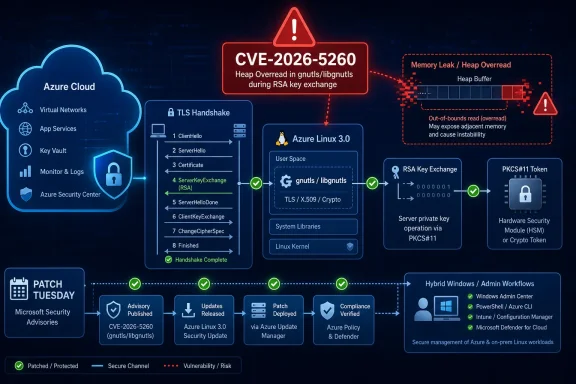
CVE-2026-5260 is, at its core, a memory handling bug in libgnutls. A remote attacker can send an extremely short premaster secret during an RSA key exchange to a server using an RSA key backed by a PKCS#11 token, triggering a short heap overread. The reported impact is information disclosure, with a CVSS 3.1 score of 8.2 and the familiar uncomfortable combination of network attack vector, low complexity, no privileges, and no user interaction.
That scoring explains why the issue deserves attention, but it can also mislead. This is not a universal “every TLS server is doomed” event. The vulnerable path depends on RSA key exchange and PKCS#11-backed RSA keys, which narrows the field considerably compared with a generic TLS parsing flaw.
Still, narrow does not mean negligible. PKCS#11 is exactly the kind of interface that turns up in security-conscious deployments, hardware-backed key storage, appliance-style services, and environments where private keys are not supposed to sit casually on disk. In other words, the affected configuration is specialized, but not exotic.
Microsoft’s Security Update Guide lists the affected Microsoft-side product as Azure Linux 3.0, with the azl3 gnutls package moving from the 3.8.3-11 line to a fixed build listed as 3.8.13-1. That matters because Azure Linux is not a hobby distribution sitting off to the side of Microsoft’s business. It is part of the company’s infrastructure story, and it increasingly matters to customers who may never think of themselves as Linux shops.
The confidentiality impact is rated low, which sounds almost reassuring until one remembers how memory disclosure bugs behave in practice. A heap overread does not usually hand the attacker a neatly labeled secret. It exposes nearby memory, often in small and inconsistent fragments, and the value of those fragments depends on timing, process layout, service behavior, and persistence.
The availability impact is rated high, and that is the part the user-submitted MSRC text rightly emphasizes. The logic is not that one malformed TLS exchange necessarily detonates a server forever. It is that repeated attempts can create a condition severe enough to deny access to the impacted component, especially if the process crashes, restarts, churns memory, or is otherwise pushed into instability.
This is why CVSS sometimes looks strange to practitioners. A vulnerability described as “information disclosure” can score high because the exploit path also has denial-of-service consequences. That is not an error in the scoring so much as a warning that categories like disclosure, corruption, and availability are messier at runtime than they appear in advisory titles.
Old protocol paths survive because compatibility survives. They linger in appliances, internal services, enterprise middleware, industrial systems, load balancers, old application stacks, and “temporary” exceptions that outlive the teams that approved them. They also survive because disabling them can be operationally risky when nobody has a clean inventory of clients.
That is the real lesson of CVE-2026-5260. The bug is not just in a library; it is in the assumption that deprecated cryptographic paths are harmless if they are rarely used. Attackers do not care whether a code path is fashionable. They care whether it is reachable.
PKCS#11 makes the story more interesting because it is often associated with doing the right thing: keeping keys in tokens, modules, HSMs, or similar abstractions rather than leaving them exposed. The vulnerability shows the familiar paradox of security engineering: hardening one layer can create rarely exercised integration paths in another. Those paths may receive less real-world testing than the mainstream configuration, even though they protect more sensitive assets.
That distinction matters. When Microsoft lists a third-party open-source flaw in the Security Update Guide, it is not claiming authorship of the bug. It is telling customers that Microsoft-distributed software contains the vulnerable component and that Microsoft has a supported update path.
For administrators, the practical difference is smaller than the philosophical one. If a Microsoft-supported Azure Linux image or package is in scope, the patch still has to be tracked, tested, deployed, and verified. The fact that the vulnerable code originated upstream does not make it operationally someone else’s problem.
This is the bargain of modern platform ownership. Microsoft gets the benefits of a Linux distribution tailored for Azure workloads, but it also inherits the disclosure tempo of the Linux ecosystem. Customers get a more integrated platform, but they also need to read Microsoft advisories with a wider lens than “does this affect Windows Server?”
CVE-2026-5260 is a useful test case because it involves a security library rather than an end-user feature. TLS libraries are plumbing. They are pulled into services, containers, management components, and application dependencies. When they need attention, the question is not merely “do we run GnuTLS?” but “which running workloads contain this package, and which of them expose the vulnerable handshake path?”
For Windows-heavy shops, this can feel like scope creep. The same team already owns endpoint patching, Windows Server baselines, identity, Defender, Intune, Azure Arc, and whatever remains of the on-premises estate. Now a GnuTLS advisory in Azure Linux becomes part of the same risk conversation.
That is not a temporary annoyance. It is the new normal. The Windows administrator’s world has been absorbed into a hybrid platform world, where Linux packages, container images, cloud host agents, and open-source dependencies are all part of the Microsoft attack surface customers actually operate.
The right triage starts with exposure. Administrators should identify Azure Linux 3.0 systems and images carrying the affected gnutls package, then determine whether those systems run network-facing TLS services using GnuTLS. From there, the RSA key exchange and PKCS#11 condition decides urgency.
This is where dependency management becomes security work rather than software hygiene. A package may be installed without being reachable. A library may be linked by a service that never uses the vulnerable feature. A container image may be vulnerable in a scanner and irrelevant at runtime, or it may be the opposite: missed by a shallow inventory but exposed on a production port.
The CVE’s narrow trigger gives defenders a chance to prioritize intelligently. Internet-facing services, privileged internal control-plane components, and systems terminating TLS with hardware-backed keys deserve the first look. Dormant packages on non-listening hosts can wait behind exposed services, but they should not be forgotten.
A Microsoft security advisory about GnuTLS lands awkwardly in organizations that divide teams by operating system. The Windows team may receive the alert because it comes through Microsoft channels. The Linux team may not notice because it is not a Red Hat or Ubuntu advisory in their usual workflow. The cloud platform team may assume image maintenance covers it automatically.
That is how small bugs become durable risks. Not because nobody cares, but because everyone can plausibly believe someone else owns the component. CVE-2026-5260 is precisely the kind of issue that tests whether an organization’s vulnerability process follows products, packages, workloads, or vendor portals.
The lesson is not that every Windows administrator must become a GnuTLS maintainer. It is that Microsoft-originating security signals now include non-Windows components, and those signals need a routing path. If the Security Update Guide is monitored only for Windows desktop and server updates, it is being read too narrowly.
But Heartbleed left behind one useful lesson: memory disclosure vulnerabilities are often underestimated until someone demonstrates what the leaked bytes contain. A “short” overread may sound trivial, but repeated protocol-level probing can turn small leaks into useful intelligence or service instability. Attackers rarely need elegance if repetition is cheap.
The risk calculus changes again when the affected process handles TLS secrets, authentication material, session state, or application data. Even if the attacker cannot choose exactly what memory is exposed, the defender still has to assume that sensitive fragments may be adjacent at the wrong time. That is why the confidentiality rating is low rather than none.
The availability angle is equally practical. A service that crashes under malformed handshakes can be kept down by a low-cost loop. A service that does not crash may still experience resource churn, watchdog restarts, or degraded capacity. In production, “not remote code execution” is not the same as “not urgent.”
The hard part is proving coverage. Cloud environments accumulate images and containers faster than traditional servers accumulated installed applications. A fixed base image does not update already-running containers. A patched host does not necessarily patch a statically bundled user-space dependency. A clean vulnerability scan in one registry does not prove that every deployment path uses that registry.
Administrators should treat the package update as the start of remediation, not the end. The real endpoint is evidence: package versions on running nodes, rebuilt images in deployment pipelines, restarted services where needed, and scanner results that align with runtime reality. That last phrase matters because vulnerability management tools can be both noisy and blind.
There is also a protocol-hardening opportunity here. If old RSA key exchange remains enabled only for theoretical compatibility, this is a good moment to remove it. Patching the library fixes the known bug; disabling unnecessary legacy negotiation reduces the number of future bugs that can reach production.
The advisory title says information disclosure. The availability metric says high. The affected condition says RSA key exchange with PKCS#11-backed keys. The product table says Azure Linux 3.0. Each statement is accurate, but the operational meaning emerges only when they are read together.
This is a broader problem across the industry. CVE entries are optimized for standardization, not narrative. They tell defenders what happened in the compressed grammar of vulnerability management, then leave each organization to translate that into business risk. Mature teams can do that translation quickly; overstretched teams often cannot.
For this CVE, the translation is reasonably clear. If you run Azure Linux 3.0 systems or containers with GnuTLS in network-facing TLS server roles, patch promptly. If those services use RSA key exchange and PKCS#11-backed RSA keys, prioritize them. If you do not know whether they do, inventory before you reassure yourself.
Those are not abstract governance questions. They decide whether a cloud vulnerability is patched in hours, days, or quarters. They also decide whether Microsoft’s expanding security guidance helps an organization or simply adds another feed to ignore.
There is a temptation to split vulnerability response into neat lanes: Windows patches here, Linux packages there, containers somewhere else, cloud services in another dashboard. Attackers do not respect those lanes. A TLS handshake reaching a vulnerable service does not care which team owns the spreadsheet.
The better model is workload-centered. What service is exposed? What libraries does it use? What keys does it handle? What image or package supplies those libraries? Who can ship the fix? CVE-2026-5260 rewards teams that can answer those questions quickly.
But it is also not a shrug story. Network-reachable, unauthenticated bugs in TLS-facing code deserve prompt attention, especially when the affected scenario involves key-handling infrastructure and the scoring includes high availability impact. The correct response is focused urgency.
That means patching Azure Linux 3.0 gnutls where applicable, checking whether services expose the vulnerable handshake path, and using the event to retire legacy cryptographic compatibility where possible. It also means ensuring that MSRC advisories for Linux packages reach the people who operate Linux workloads, not just the people who patch Windows.
The bigger takeaway is that Microsoft’s security perimeter now includes components many Windows admins did not grow up tracking. The company’s platforms have converged faster than many enterprise processes. CVE-2026-5260 is another small proof point that vulnerability management has to converge too.
 A Linux TLS Bug Lands in Microsoft’s Front Yard
CVE-2026-5260 is, at its core, a memory handling bug in libgnutls. A remote attacker can send an extremely short premaster secret during an RSA key exchange to a server using an RSA key backed by a PKCS#11 token, triggering a short heap overread. The reported impact is information disclosure, with a CVSS 3.1 score of 8.2 and the familiar uncomfortable combination of network attack vector, low complexity, no privileges, and no user interaction.That scoring explains why the issue deserves attention, but it can also mislead. This is not a universal “every TLS server is doomed” event. The vulnerable path depends on RSA key exchange and PKCS#11-backed RSA keys, which narrows the field considerably compared with a generic TLS parsing flaw.
Still, narrow does not mean negligible. PKCS#11 is exactly the kind of interface that turns up in security-conscious deployments, hardware-backed key storage, appliance-style services, and environments where private keys are not supposed to sit casually on disk. In other words, the affected configuration is specialized, but not exotic.
Microsoft’s Security Update Guide lists the affected Microsoft-side product as Azure Linux 3.0, with the azl3 gnutls package moving from the 3.8.3-11 line to a fixed build listed as 3.8.13-1. That matters because Azure Linux is not a hobby distribution sitting off to the side of Microsoft’s business. It is part of the company’s infrastructure story, and it increasingly matters to customers who may never think of themselves as Linux shops.
The CVSS Score Tells the Truth, but Not the Whole Truth
The severity score attached to CVE-2026-5260 is doing two jobs at once. It tells defenders that exploitation is remote and does not require authentication or a victim click. It also encodes the awkward reality that a small memory disclosure can become an availability problem when an attacker can repeat it against a network-facing service.The confidentiality impact is rated low, which sounds almost reassuring until one remembers how memory disclosure bugs behave in practice. A heap overread does not usually hand the attacker a neatly labeled secret. It exposes nearby memory, often in small and inconsistent fragments, and the value of those fragments depends on timing, process layout, service behavior, and persistence.
The availability impact is rated high, and that is the part the user-submitted MSRC text rightly emphasizes. The logic is not that one malformed TLS exchange necessarily detonates a server forever. It is that repeated attempts can create a condition severe enough to deny access to the impacted component, especially if the process crashes, restarts, churns memory, or is otherwise pushed into instability.
This is why CVSS sometimes looks strange to practitioners. A vulnerability described as “information disclosure” can score high because the exploit path also has denial-of-service consequences. That is not an error in the scoring so much as a warning that categories like disclosure, corruption, and availability are messier at runtime than they appear in advisory titles.
RSA Key Exchange Is Supposed to Be Legacy, Yet Legacy Keeps Answering the Door
The phrase RSA key exchange should make many administrators pause. Modern TLS deployments generally prefer forward-secret key exchanges such as ECDHE, and TLS 1.3 removed the old RSA key exchange model entirely. But the security industry has learned, repeatedly, that “legacy” is not a synonym for “absent.”Old protocol paths survive because compatibility survives. They linger in appliances, internal services, enterprise middleware, industrial systems, load balancers, old application stacks, and “temporary” exceptions that outlive the teams that approved them. They also survive because disabling them can be operationally risky when nobody has a clean inventory of clients.
That is the real lesson of CVE-2026-5260. The bug is not just in a library; it is in the assumption that deprecated cryptographic paths are harmless if they are rarely used. Attackers do not care whether a code path is fashionable. They care whether it is reachable.
PKCS#11 makes the story more interesting because it is often associated with doing the right thing: keeping keys in tokens, modules, HSMs, or similar abstractions rather than leaving them exposed. The vulnerability shows the familiar paradox of security engineering: hardening one layer can create rarely exercised integration paths in another. Those paths may receive less real-world testing than the mainstream configuration, even though they protect more sensitive assets.
Microsoft’s Role Is Distribution, Not Original Sin
It would be easy, and wrong, to frame CVE-2026-5260 as a Microsoft TLS failure. The assigning CNA is Red Hat, the vulnerable component is GnuTLS, and the bug sits in libgnutls behavior around RSA key exchange with PKCS#11-backed keys. Microsoft appears here because it ships and maintains affected open-source components in Azure Linux.That distinction matters. When Microsoft lists a third-party open-source flaw in the Security Update Guide, it is not claiming authorship of the bug. It is telling customers that Microsoft-distributed software contains the vulnerable component and that Microsoft has a supported update path.
For administrators, the practical difference is smaller than the philosophical one. If a Microsoft-supported Azure Linux image or package is in scope, the patch still has to be tracked, tested, deployed, and verified. The fact that the vulnerable code originated upstream does not make it operationally someone else’s problem.
This is the bargain of modern platform ownership. Microsoft gets the benefits of a Linux distribution tailored for Azure workloads, but it also inherits the disclosure tempo of the Linux ecosystem. Customers get a more integrated platform, but they also need to read Microsoft advisories with a wider lens than “does this affect Windows Server?”
Azure Linux Makes the Microsoft Patch Surface Wider
Azure Linux, previously known through the CBL-Mariner lineage, occupies an odd place in many enterprise mental models. It is visible enough to appear in Microsoft documentation and container infrastructure, but not always visible enough to be tracked with the same rigor as Windows Server, Ubuntu, or Red Hat Enterprise Linux. That gap is where operational risk likes to live.CVE-2026-5260 is a useful test case because it involves a security library rather than an end-user feature. TLS libraries are plumbing. They are pulled into services, containers, management components, and application dependencies. When they need attention, the question is not merely “do we run GnuTLS?” but “which running workloads contain this package, and which of them expose the vulnerable handshake path?”
For Windows-heavy shops, this can feel like scope creep. The same team already owns endpoint patching, Windows Server baselines, identity, Defender, Intune, Azure Arc, and whatever remains of the on-premises estate. Now a GnuTLS advisory in Azure Linux becomes part of the same risk conversation.
That is not a temporary annoyance. It is the new normal. The Windows administrator’s world has been absorbed into a hybrid platform world, where Linux packages, container images, cloud host agents, and open-source dependencies are all part of the Microsoft attack surface customers actually operate.
The Vulnerability Is Specific, but the Inventory Problem Is General
The most dangerous response to CVE-2026-5260 would be to say, “We do not use PKCS#11-backed RSA keys,” and move on without checking. That may be true. It may also be an assumption based on architecture diagrams that no longer match production.The right triage starts with exposure. Administrators should identify Azure Linux 3.0 systems and images carrying the affected gnutls package, then determine whether those systems run network-facing TLS services using GnuTLS. From there, the RSA key exchange and PKCS#11 condition decides urgency.
This is where dependency management becomes security work rather than software hygiene. A package may be installed without being reachable. A library may be linked by a service that never uses the vulnerable feature. A container image may be vulnerable in a scanner and irrelevant at runtime, or it may be the opposite: missed by a shallow inventory but exposed on a production port.
The CVE’s narrow trigger gives defenders a chance to prioritize intelligently. Internet-facing services, privileged internal control-plane components, and systems terminating TLS with hardware-backed keys deserve the first look. Dormant packages on non-listening hosts can wait behind exposed services, but they should not be forgotten.
The Cloud Has Made “Someone Else’s Linux” a Windows Admin Problem
WindowsForum readers have watched Microsoft’s identity change in public. The company that once treated Linux as a competitive threat now ships Linux, maintains Linux, secures Linux, and builds cloud services around Linux. That transformation has been good for interoperability, but it has also blurred accountability inside IT departments.A Microsoft security advisory about GnuTLS lands awkwardly in organizations that divide teams by operating system. The Windows team may receive the alert because it comes through Microsoft channels. The Linux team may not notice because it is not a Red Hat or Ubuntu advisory in their usual workflow. The cloud platform team may assume image maintenance covers it automatically.
That is how small bugs become durable risks. Not because nobody cares, but because everyone can plausibly believe someone else owns the component. CVE-2026-5260 is precisely the kind of issue that tests whether an organization’s vulnerability process follows products, packages, workloads, or vendor portals.
The lesson is not that every Windows administrator must become a GnuTLS maintainer. It is that Microsoft-originating security signals now include non-Windows components, and those signals need a routing path. If the Security Update Guide is monitored only for Windows desktop and server updates, it is being read too narrowly.
Memory Disclosure Still Deserves Respect After Heartbleed
Security people are understandably cautious about comparing any heap overread to Heartbleed. Most such comparisons are lazy, and CVE-2026-5260 does not appear to be another internet-wide OpenSSL catastrophe. Its affected configuration is much more constrained.But Heartbleed left behind one useful lesson: memory disclosure vulnerabilities are often underestimated until someone demonstrates what the leaked bytes contain. A “short” overread may sound trivial, but repeated protocol-level probing can turn small leaks into useful intelligence or service instability. Attackers rarely need elegance if repetition is cheap.
The risk calculus changes again when the affected process handles TLS secrets, authentication material, session state, or application data. Even if the attacker cannot choose exactly what memory is exposed, the defender still has to assume that sensitive fragments may be adjacent at the wrong time. That is why the confidentiality rating is low rather than none.
The availability angle is equally practical. A service that crashes under malformed handshakes can be kept down by a low-cost loop. A service that does not crash may still experience resource churn, watchdog restarts, or degraded capacity. In production, “not remote code execution” is not the same as “not urgent.”
The Patch Is Straightforward; the Verification Is Not
Microsoft’s listed fix for Azure Linux 3.0 is a package update, which is the best kind of security remediation in theory. Move to the fixed gnutls build, rebuild affected images, redeploy workloads, and verify that the running environment no longer carries the vulnerable version. The mechanics are not mysterious.The hard part is proving coverage. Cloud environments accumulate images and containers faster than traditional servers accumulated installed applications. A fixed base image does not update already-running containers. A patched host does not necessarily patch a statically bundled user-space dependency. A clean vulnerability scan in one registry does not prove that every deployment path uses that registry.
Administrators should treat the package update as the start of remediation, not the end. The real endpoint is evidence: package versions on running nodes, rebuilt images in deployment pipelines, restarted services where needed, and scanner results that align with runtime reality. That last phrase matters because vulnerability management tools can be both noisy and blind.
There is also a protocol-hardening opportunity here. If old RSA key exchange remains enabled only for theoretical compatibility, this is a good moment to remove it. Patching the library fixes the known bug; disabling unnecessary legacy negotiation reduces the number of future bugs that can reach production.
The Advisory Exposes a Weak Spot in Security Communications
MSRC’s page gives defenders the essential facts: CVE number, release date, update date, assigning CNA, weakness category, CVSS vector, affected Azure Linux package, fixed build, and severity. That is enough for machines and vulnerability teams. It is not always enough for humans trying to decide whether to wake someone up.The advisory title says information disclosure. The availability metric says high. The affected condition says RSA key exchange with PKCS#11-backed keys. The product table says Azure Linux 3.0. Each statement is accurate, but the operational meaning emerges only when they are read together.
This is a broader problem across the industry. CVE entries are optimized for standardization, not narrative. They tell defenders what happened in the compressed grammar of vulnerability management, then leave each organization to translate that into business risk. Mature teams can do that translation quickly; overstretched teams often cannot.
For this CVE, the translation is reasonably clear. If you run Azure Linux 3.0 systems or containers with GnuTLS in network-facing TLS server roles, patch promptly. If those services use RSA key exchange and PKCS#11-backed RSA keys, prioritize them. If you do not know whether they do, inventory before you reassure yourself.
Windows Shops Should Read This as a Hybrid-Cloud Drill
For a Windows-first organization, CVE-2026-5260 is less about GnuTLS trivia and more about readiness. Can the team identify Microsoft-supported Linux assets? Can it map package-level advisories to running workloads? Can it distinguish a vulnerable package from an exposed vulnerable service? Can it push a fixed image through production without waiting for a monthly ritual?Those are not abstract governance questions. They decide whether a cloud vulnerability is patched in hours, days, or quarters. They also decide whether Microsoft’s expanding security guidance helps an organization or simply adds another feed to ignore.
There is a temptation to split vulnerability response into neat lanes: Windows patches here, Linux packages there, containers somewhere else, cloud services in another dashboard. Attackers do not respect those lanes. A TLS handshake reaching a vulnerable service does not care which team owns the spreadsheet.
The better model is workload-centered. What service is exposed? What libraries does it use? What keys does it handle? What image or package supplies those libraries? Who can ship the fix? CVE-2026-5260 rewards teams that can answer those questions quickly.
The Most Useful Reading of CVE-2026-5260 Is Operational, Not Theoretical
This is not a panic story. The available facts point to a high-severity but configuration-dependent flaw. There is no need to pretend that every Azure Linux workload is equally exposed, and there is no value in treating every GnuTLS installation as an emergency if the vulnerable path is unreachable.But it is also not a shrug story. Network-reachable, unauthenticated bugs in TLS-facing code deserve prompt attention, especially when the affected scenario involves key-handling infrastructure and the scoring includes high availability impact. The correct response is focused urgency.
That means patching Azure Linux 3.0 gnutls where applicable, checking whether services expose the vulnerable handshake path, and using the event to retire legacy cryptographic compatibility where possible. It also means ensuring that MSRC advisories for Linux packages reach the people who operate Linux workloads, not just the people who patch Windows.
The bigger takeaway is that Microsoft’s security perimeter now includes components many Windows admins did not grow up tracking. The company’s platforms have converged faster than many enterprise processes. CVE-2026-5260 is another small proof point that vulnerability management has to converge too.
The GnuTLS Fix Is a Small Patch With a Large Message
CVE-2026-5260 will probably not be remembered as one of the defining vulnerabilities of 2026. Its scope is too specific, its trigger too conditional, and its remediation too conventional. But it is still a useful signal because it shows how much security context now hides behind a single line in a Microsoft advisory.- Microsoft listed CVE-2026-5260 as affecting Azure Linux 3.0’s gnutls package, with a fixed build identified for remediation.
- The vulnerability involves a heap overread in libgnutls during RSA key exchange when a server uses an RSA key backed by a PKCS#11 token.
- The CVSS 3.1 score is 8.2, driven by remote unauthenticated exploitability and high availability impact despite only low rated confidentiality impact.
- The most exposed systems are likely network-facing TLS services using GnuTLS with the relevant RSA and PKCS#11 configuration, not every machine with the package installed.
- Windows-first IT teams should treat this as a reminder that Microsoft security monitoring now includes Linux packages, Azure images, and hybrid workloads.
- Patching should be paired with runtime verification and, where feasible, removal of legacy RSA key exchange support.
References
- Primary source: MSRC
Published: 2026-06-11T01:43:51-07:00
Security Update Guide - Microsoft Security Response Center
 msrc.microsoft.com
