

CVE-2026-53262 is a Linux kernel vulnerability published on June 25, 2026, covering a use-after-free bug in the PPP-over-L2TP ioctl path, with the underlying fix holding a proper session reference inside
The vulnerability name is almost comically kernel-ish: “l2tp: pppol2tp: hold reference to session in
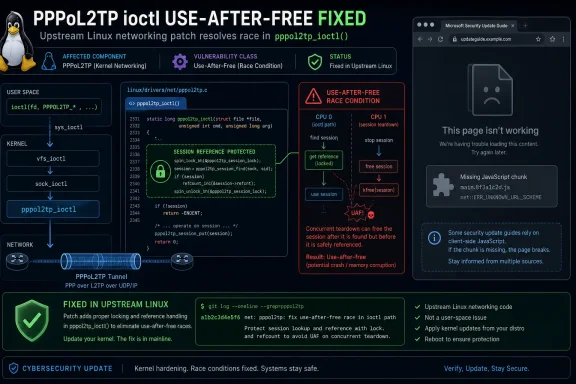
That matters because kernel objects do not live in a polite, single-threaded world. A socket can be closed while another thread is still inside an ioctl path. If that path sleeps while copying data from user space, a second thread can tear down the associated L2TP session. When the first thread resumes, it may dereference memory that has already been freed.
That is the classic use-after-free shape: not glamorous, not new, but still one of the most dangerous bug classes in systems software. In kernel space, a stale pointer is not merely a crash hazard. Depending on reachability, heap layout, and attacker control, it can become a denial-of-service condition or a stepping stone toward privilege escalation.
The published patch fixes the bug by obtaining the session through a safer helper, holding a reference across the ioctl handling, and dropping that reference on exit. The patch also avoids changing fallback behavior for unrelated socket ioctl calls, a small but important sign that the maintainer was not just plugging a memory bug but preserving user-space compatibility.
Security teams should resist two equal and opposite mistakes. The first is treating a broken vendor page as a signal that the vulnerability does not exist. The second is treating every CVE mirrored into a familiar portal as a Windows emergency. CVE-2026-53262 appears to be a Linux kernel CNA record associated with upstream L2TP code, so the practical question is whether you operate Linux systems using PPPoL2TP, not whether Windows Update has suddenly grown a new L2TP crisis.
The confusion is understandable because Microsoft’s security portals are no longer just bulletin pages for Windows patches. They ingest, reference, and display vulnerability information across a broader ecosystem, including open-source components, cloud dependencies, and third-party-adjacent records that matter to Microsoft customers. That ecosystem is useful when it works and maddening when a single-page app fails at the exact moment an administrator needs facts.
The healthy operational response is to separate the source-of-truth layers. The MSRC page may be useful for Microsoft customer guidance, but the technical fix trail for this bug runs through Linux kernel mailing lists and stable kernel commits. If you manage Linux appliances, VPN concentrators, containers with host networking exposure, or custom kernels, the kernel advisory and downstream distribution errata matter more than the broken Microsoft route.
But old plumbing is precisely where boring kernel bugs become operationally relevant. L2TP often sits close to authentication, tunneling, remote access, and network boundary use cases. Even when L2TP is wrapped in IPsec, the kernel still has to parse, route, encapsulate, account for, and tear down sessions correctly.
PPPoL2TP is a Linux implementation detail, but the risk pattern is familiar across operating systems. A user-space process creates or interacts with a socket. The kernel stores protocol-specific session state behind that socket. An ioctl call asks for or sets protocol data. Another thread closes or mutates the socket at just the wrong time. If the kernel code has not taken a reference, a stale pointer can outlive its object.
The fix tells the story. The corrected code fetches the L2TP session through an RCU-safe, refcounted helper rather than reading
This is also why the patch description’s mention of a userfaultfd-induced sleep matters. Kernel copy operations that interact with user memory can sleep. Attackers and fuzzers have become very good at widening those race windows. What once looked like a theoretical thread interleaving can become reproducible when user space can deliberately stall a page fault at a sensitive point.
The practical question is not “does Windows have this exact function?” It does not. The question is whether your estate contains Linux kernels with L2TP support enabled and reachable by untrusted or semi-trusted local users. That includes systems where a local account, container escape boundary, service account, or compromised daemon could exercise PPPoL2TP socket operations.
Use-after-free bugs in kernel networking code often begin life as local or low-adjacent risks rather than Internet-scale disasters. That should lower panic, not priority. Local kernel bugs are often chained after initial compromise, especially in environments where privilege separation is the only thing standing between a foothold and root.
The least useful reaction is brand tribalism. Windows has had its share of L2TP and remote access vulnerabilities. Linux has its share of kernel lifetime bugs. What matters for defenders is whether a protocol stack is enabled, whether an attacker can reach the vulnerable path, whether exploit code appears, and whether a vendor kernel has shipped a stable fix.
This is where asset inventory beats vulnerability theater. A dashboard that says “CVE-2026-53262” without telling you whether PPPoL2TP is enabled on affected hosts is noise. A CMDB or endpoint query that identifies kernels, modules, VPN roles, and distribution patch status is actionable.
That discipline matters because the kernel is full of objects whose lifetimes are shared across interrupt handlers, workqueues, socket callbacks, file descriptors, timers, and user-triggered syscalls. Reference counting is not glamorous, but it is the grammar of safe kernel code. If a function can sleep, and an object can be freed by another path, the function must hold a reference or otherwise prove the object cannot disappear.
The patch also preserves behavior for generic and unknown ioctls. That detail may sound minor, but it reflects a central maintenance tension in mature kernels. Security fixes cannot casually break old user-space expectations. A fix that returns a different error for an unconnected socket, blocks fallback to generic handlers, or emits new warnings in common paths can become its own production incident.
The original patch discussion also notes avoiding noisy
This is the difference between patching for the CVE record and patching for the operating system. The CVE record wants a crisp description. The kernel wants a change that is correct, compatible, quiet, and backportable.
That means the real remediation path is downstream. Administrators should look for distribution advisories and kernel package updates that include the fix for CVE-2026-53262 or the corresponding L2TP patch. If a vendor does not mention the CVE but includes the stable commit in its changelog, that may still be sufficient. If a vendor mentions the CVE but has not shipped the kernel you deploy, it is not.
This is especially important for appliances. VPN devices, SD-WAN boxes, NAS units, routers, and security gateways often run Linux under a polished web interface. Their vendors may lag upstream kernel fixes while still exposing old protocol modules. A CVE like this is a prompt to ask vendors whether PPPoL2TP is present, enabled, and patched.
Kernel module configuration also matters. A system that never loads L2TP or PPPoL2TP code has a smaller practical exposure than a VPN endpoint actively using it. But defenders should be careful with assumptions. Modules can autoload. Legacy VPN packages can pull in dependencies. Containers generally share the host kernel, so containerized services do not bring their own kernel fix.
The right remediation therefore has three layers: identify where the vulnerable code exists, determine whether it is reachable, and patch or disable accordingly. Skipping the first two layers leads to wasted effort. Skipping the third leaves a known memory-safety bug in privileged code.
Single-page application failures are not merely cosmetic in this context. They interrupt workflows during patch windows, incident response calls, and compliance checks. They also push users toward mirrors, screenshots, scraped databases, and social media summaries, some of which may be stale or wrong.
MSRC is hardly alone here. The security industry has layered modern web app complexity on top of documents whose core job is to state affected products, severity, exploitation status, mitigations, and update availability. When the front end fails, the underlying data may still exist through APIs or feeds, but that is cold comfort to an admin staring at “Failed to fetch dynamically imported module.”
The irony is sharp because vulnerability management is already fragmented. CVE records come from CNAs. NVD enrichment may lag. Vendors add their own severity ratings. Distributions backport without always changing upstream version numbers. Third-party scanners map all of that into risk scores. A broken portal page becomes one more ambiguity in a chain that already has too many.
For WindowsForum’s audience, the lesson is practical: do not build a patch decision on a single rendered vendor page. Use vendor portals, but corroborate with upstream advisories, distribution errata, package changelogs, and scanner evidence. A failed web bundle should slow you down only long enough to verify through another channel.
WSL deserves careful wording. WSL 2 uses a Microsoft-provided Linux kernel, but typical WSL developer workflows are unlikely to expose PPPoL2TP in the same way as a VPN server or network appliance. Still, enterprises that standardize WSL images should track kernel updates as part of developer endpoint hygiene, not treat WSL as a toy outside vulnerability management.
Azure and hybrid environments are more likely to matter. Linux VMs running VPN services, PPP daemons, network testing tools, or custom tunneling workloads should be checked. Kubernetes nodes generally should be patched according to node image guidance, because containers share the host kernel and cannot fix kernel vulnerabilities from inside the container image.
For domain admins and endpoint teams, the immediate Windows client action is limited. This is not evidence that Windows’ built-in L2TP/IPsec VPN client is affected by CVE-2026-53262. It is evidence that vulnerability names and vendor portals can cross ecosystem boundaries in ways that confuse triage.
For security teams, the bigger action is to tune detection and inventory. If every Linux kernel CVE mirrored into a Microsoft-facing workflow generates a Windows endpoint emergency, the process is too coarse. If Linux appliances are invisible because the Microsoft console is the primary source of truth, the process is too narrow.
Local kernel vulnerabilities are valuable after an attacker gains code execution as an unprivileged user. They are also relevant in multi-user systems, shared development servers, CI runners, hosting environments, and any service architecture where a compromised low-privilege process can interact with kernel APIs. The rise of userfaultfd-assisted exploitation has made race-window manipulation more practical in some contexts, though distributions may restrict userfaultfd behavior.
The reachability of PPPoL2TP also varies. If the relevant protocol family or module is unavailable to unprivileged users, the risk changes. If a daemon with elevated privileges exposes a path to create or operate these sockets, the risk changes again. If the machine is an appliance whose management plane can be compromised first, a “local” kernel bug becomes part of a broader chain.
There is no need to inflate this into a remote unauthenticated Internet worm. There is also no excuse to dismiss it because the function name looks obscure. Kernel memory bugs in networking subsystems are exactly the kind of issue that disciplined patch programs are meant to absorb before exploit writers turn edge conditions into reliable primitives.
The right language is conditional: systems with affected Linux kernels and reachable PPPoL2TP ioctl paths should prioritize vendor kernel updates, especially where untrusted local users or exposed services exist. Systems without L2TP support, without the module loaded, or with no realistic local attacker path have a lower urgency but should still take the fix through normal kernel maintenance.
This can feel like vulnerability inflation. A small refcount fix in an obscure protocol suddenly appears next to browser zero-days and remote code execution bugs in enterprise dashboards. The problem is not that the CVE exists. The problem is that many tools still treat CVE presence as a substitute for context.
Kernel security is cumulative. The stable tree is a stream of fixes for memory safety, locking, bounds checks, lifetime rules, and protocol correctness. Some receive dramatic writeups. Many do not. The absence of a logo or exploit demo does not mean the patch is irrelevant; the presence of a CVE does not mean every host is equally exposed.
For administrators, that argues for boring excellence. Keep kernels on supported vendor branches. Do not run abandoned appliance firmware. Disable legacy protocol stacks when they are not needed. Restrict local attack surfaces on shared systems. Treat kernel patching as reliability maintenance as much as security response.
For vendors, it argues for better metadata. Tell customers whether L2TP code is built, loadable, enabled, or unreachable. Tell them whether the fix is backported. Tell them whether a reboot is required. Do not force every customer to reverse-engineer kernel config files and changelogs under a maintenance deadline.
CVE-2026-53262 will probably not be remembered as a landmark vulnerability, and that is precisely why it is useful. It shows how a one-line-sounding kernel lifetime bug can travel through upstream patches, stable trees, vendor portals, broken JavaScript routes, scanner queues, and administrator chat rooms before becoming a decision. The organizations that handle it well will not be the ones that panic fastest; they will be the ones that can map a CVE to actual code in actual systems, patch the hosts that need it, ignore the noise that does not, and keep enough skepticism in reserve for the next dashboard that fails to load.
pppol2tp_ioctl() before user-space copy operations can sleep. For WindowsForum readers, the awkward twist is that the report surfaced through Microsoft’s Security Update Guide URL even though the bug itself lives in upstream Linux networking code, not in the Windows L2TP client. The broken MSRC page error is a reminder that modern vulnerability tracking is now a federated, API-driven mess: the security risk may be real, the vendor page may be transiently broken, and administrators still have to decide what to patch before the dashboard finishes loading.
 A Small L2TP Bug Says Something Bigger About Patch Intelligence
The vulnerability name is almost comically kernel-ish: “l2tp: pppol2tp: hold reference to session in pppol2tp_ioctl().” It sounds like an internal code-review note because that is essentially what it is. The issue concerns the Linux kernel’s L2TP subsystem, specifically PPP over L2TP sockets, where an ioctl handler could read session state without safely pinning the object for the duration of the operation.That matters because kernel objects do not live in a polite, single-threaded world. A socket can be closed while another thread is still inside an ioctl path. If that path sleeps while copying data from user space, a second thread can tear down the associated L2TP session. When the first thread resumes, it may dereference memory that has already been freed.
That is the classic use-after-free shape: not glamorous, not new, but still one of the most dangerous bug classes in systems software. In kernel space, a stale pointer is not merely a crash hazard. Depending on reachability, heap layout, and attacker control, it can become a denial-of-service condition or a stepping stone toward privilege escalation.
The published patch fixes the bug by obtaining the session through a safer helper, holding a reference across the ioctl handling, and dropping that reference on exit. The patch also avoids changing fallback behavior for unrelated socket ioctl calls, a small but important sign that the maintainer was not just plugging a memory bug but preserving user-space compatibility.
The MSRC Error Is Annoying, but the Vulnerability Is Not Imaginary
The user-facing symptom here is a Microsoft Security Response Center page that fails to load a dynamically imported JavaScript module namedNotFound.BC50Eiiy.js. That is a front-end failure, not proof that the CVE is bogus. It means the MSRC site attempted to render a vulnerability page and tripped over its own application bundle or route handling.Security teams should resist two equal and opposite mistakes. The first is treating a broken vendor page as a signal that the vulnerability does not exist. The second is treating every CVE mirrored into a familiar portal as a Windows emergency. CVE-2026-53262 appears to be a Linux kernel CNA record associated with upstream L2TP code, so the practical question is whether you operate Linux systems using PPPoL2TP, not whether Windows Update has suddenly grown a new L2TP crisis.
The confusion is understandable because Microsoft’s security portals are no longer just bulletin pages for Windows patches. They ingest, reference, and display vulnerability information across a broader ecosystem, including open-source components, cloud dependencies, and third-party-adjacent records that matter to Microsoft customers. That ecosystem is useful when it works and maddening when a single-page app fails at the exact moment an administrator needs facts.
The healthy operational response is to separate the source-of-truth layers. The MSRC page may be useful for Microsoft customer guidance, but the technical fix trail for this bug runs through Linux kernel mailing lists and stable kernel commits. If you manage Linux appliances, VPN concentrators, containers with host networking exposure, or custom kernels, the kernel advisory and downstream distribution errata matter more than the broken Microsoft route.
L2TP Is Old Plumbing, Which Is Why Bugs Still Matter
L2TP is not fashionable infrastructure. It is the kind of networking protocol that survives because old VPN designs, ISP access systems, embedded gateways, and enterprise compatibility requirements survive. Nobody puts “modern zero-trust L2TP architecture” on a slide deck without expecting raised eyebrows.But old plumbing is precisely where boring kernel bugs become operationally relevant. L2TP often sits close to authentication, tunneling, remote access, and network boundary use cases. Even when L2TP is wrapped in IPsec, the kernel still has to parse, route, encapsulate, account for, and tear down sessions correctly.
PPPoL2TP is a Linux implementation detail, but the risk pattern is familiar across operating systems. A user-space process creates or interacts with a socket. The kernel stores protocol-specific session state behind that socket. An ioctl call asks for or sets protocol data. Another thread closes or mutates the socket at just the wrong time. If the kernel code has not taken a reference, a stale pointer can outlive its object.
The fix tells the story. The corrected code fetches the L2TP session through an RCU-safe, refcounted helper rather than reading
sk_user_data directly. It then ensures l2tp_session_put() is called on return paths. That is the difference between “I saw a pointer once” and “I own a valid reference until I am done.”This is also why the patch description’s mention of a userfaultfd-induced sleep matters. Kernel copy operations that interact with user memory can sleep. Attackers and fuzzers have become very good at widening those race windows. What once looked like a theoretical thread interleaving can become reproducible when user space can deliberately stall a page fault at a sensitive point.
The Bug Class Is More Important Than the Brand Name
For Windows administrators, the temptation is to file this under “not our platform.” That may be mostly true for pure Windows fleets, but it is not the whole story. Modern Windows environments are surrounded by Linux: WSL developer machines, Hyper-V guests, Azure workloads, security appliances, VPN gateways, Kubernetes nodes, storage systems, and vendor-supplied virtual appliances.The practical question is not “does Windows have this exact function?” It does not. The question is whether your estate contains Linux kernels with L2TP support enabled and reachable by untrusted or semi-trusted local users. That includes systems where a local account, container escape boundary, service account, or compromised daemon could exercise PPPoL2TP socket operations.
Use-after-free bugs in kernel networking code often begin life as local or low-adjacent risks rather than Internet-scale disasters. That should lower panic, not priority. Local kernel bugs are often chained after initial compromise, especially in environments where privilege separation is the only thing standing between a foothold and root.
The least useful reaction is brand tribalism. Windows has had its share of L2TP and remote access vulnerabilities. Linux has its share of kernel lifetime bugs. What matters for defenders is whether a protocol stack is enabled, whether an attacker can reach the vulnerable path, whether exploit code appears, and whether a vendor kernel has shipped a stable fix.
This is where asset inventory beats vulnerability theater. A dashboard that says “CVE-2026-53262” without telling you whether PPPoL2TP is enabled on affected hosts is noise. A CMDB or endpoint query that identifies kernels, modules, VPN roles, and distribution patch status is actionable.
The Patch Is a Lesson in Kernel Lifetime Hygiene
The most revealing part of CVE-2026-53262 is not the existence of the stale pointer. It is the narrowness of the fix. The patch does not redesign L2TP, remove ioctls, or invent a new security boundary. It applies the kernel’s usual lifetime-management discipline to a path that failed to follow it consistently.That discipline matters because the kernel is full of objects whose lifetimes are shared across interrupt handlers, workqueues, socket callbacks, file descriptors, timers, and user-triggered syscalls. Reference counting is not glamorous, but it is the grammar of safe kernel code. If a function can sleep, and an object can be freed by another path, the function must hold a reference or otherwise prove the object cannot disappear.
The patch also preserves behavior for generic and unknown ioctls. That detail may sound minor, but it reflects a central maintenance tension in mature kernels. Security fixes cannot casually break old user-space expectations. A fix that returns a different error for an unconnected socket, blocks fallback to generic handlers, or emits new warnings in common paths can become its own production incident.
The original patch discussion also notes avoiding noisy
WARN_ON() behavior in ways that could become a denial-of-service vector. That is a subtle point administrators often miss. Kernel warning paths are not just diagnostics; under some configurations and workloads, they can flood logs, trigger monitoring storms, or expose reliability problems. A security fix that closes one issue while handing attackers a warning-spam lever is incomplete.This is the difference between patching for the CVE record and patching for the operating system. The CVE record wants a crisp description. The kernel wants a change that is correct, compatible, quiet, and backportable.
The Stable Kernel Trail Matters More Than the First Advisory
The upstream patch is only the beginning. Most production systems do not run Linus’ tree, and many do not run unmodified stable kernels either. They run Ubuntu kernels, Debian kernels, Red Hat kernels, SUSE kernels, Android-derived kernels, appliance kernels, or cloud-provider variants with their own backport schedules.That means the real remediation path is downstream. Administrators should look for distribution advisories and kernel package updates that include the fix for CVE-2026-53262 or the corresponding L2TP patch. If a vendor does not mention the CVE but includes the stable commit in its changelog, that may still be sufficient. If a vendor mentions the CVE but has not shipped the kernel you deploy, it is not.
This is especially important for appliances. VPN devices, SD-WAN boxes, NAS units, routers, and security gateways often run Linux under a polished web interface. Their vendors may lag upstream kernel fixes while still exposing old protocol modules. A CVE like this is a prompt to ask vendors whether PPPoL2TP is present, enabled, and patched.
Kernel module configuration also matters. A system that never loads L2TP or PPPoL2TP code has a smaller practical exposure than a VPN endpoint actively using it. But defenders should be careful with assumptions. Modules can autoload. Legacy VPN packages can pull in dependencies. Containers generally share the host kernel, so containerized services do not bring their own kernel fix.
The right remediation therefore has three layers: identify where the vulnerable code exists, determine whether it is reachable, and patch or disable accordingly. Skipping the first two layers leads to wasted effort. Skipping the third leaves a known memory-safety bug in privileged code.
Microsoft’s Portal Problem Is a Defender Workflow Problem
The reported browser error deserves its own criticism because it reflects a recurring weakness in security operations tooling. A vulnerability page should be among the most boring, resilient parts of the web. If an administrator opens a CVE page during triage, the site should degrade gracefully to text, not fail because a hashed JavaScript chunk cannot be fetched.Single-page application failures are not merely cosmetic in this context. They interrupt workflows during patch windows, incident response calls, and compliance checks. They also push users toward mirrors, screenshots, scraped databases, and social media summaries, some of which may be stale or wrong.
MSRC is hardly alone here. The security industry has layered modern web app complexity on top of documents whose core job is to state affected products, severity, exploitation status, mitigations, and update availability. When the front end fails, the underlying data may still exist through APIs or feeds, but that is cold comfort to an admin staring at “Failed to fetch dynamically imported module.”
The irony is sharp because vulnerability management is already fragmented. CVE records come from CNAs. NVD enrichment may lag. Vendors add their own severity ratings. Distributions backport without always changing upstream version numbers. Third-party scanners map all of that into risk scores. A broken portal page becomes one more ambiguity in a chain that already has too many.
For WindowsForum’s audience, the lesson is practical: do not build a patch decision on a single rendered vendor page. Use vendor portals, but corroborate with upstream advisories, distribution errata, package changelogs, and scanner evidence. A failed web bundle should slow you down only long enough to verify through another channel.
Where Windows Shops Should Actually Look
A Windows-heavy shop should first determine whether this CVE touches any Windows-managed Linux estate. That includes Azure Linux VMs, WSL images used for development, Linux build agents, container hosts, VPN appliances, and network devices maintained by infrastructure teams rather than endpoint teams.WSL deserves careful wording. WSL 2 uses a Microsoft-provided Linux kernel, but typical WSL developer workflows are unlikely to expose PPPoL2TP in the same way as a VPN server or network appliance. Still, enterprises that standardize WSL images should track kernel updates as part of developer endpoint hygiene, not treat WSL as a toy outside vulnerability management.
Azure and hybrid environments are more likely to matter. Linux VMs running VPN services, PPP daemons, network testing tools, or custom tunneling workloads should be checked. Kubernetes nodes generally should be patched according to node image guidance, because containers share the host kernel and cannot fix kernel vulnerabilities from inside the container image.
For domain admins and endpoint teams, the immediate Windows client action is limited. This is not evidence that Windows’ built-in L2TP/IPsec VPN client is affected by CVE-2026-53262. It is evidence that vulnerability names and vendor portals can cross ecosystem boundaries in ways that confuse triage.
For security teams, the bigger action is to tune detection and inventory. If every Linux kernel CVE mirrored into a Microsoft-facing workflow generates a Windows endpoint emergency, the process is too coarse. If Linux appliances are invisible because the Microsoft console is the primary source of truth, the process is too narrow.
Exploitability Is the Hard Part, So Do Not Pretend It Is Binary
The public technical description points to a use-after-free reachable through an ioctl path with a race involving socket close and a sleep duringcopy_from_user(). That sounds local because ioctls are issued by processes on the host, not directly by arbitrary packets crossing the network. But “local” is not the same as “unimportant.”Local kernel vulnerabilities are valuable after an attacker gains code execution as an unprivileged user. They are also relevant in multi-user systems, shared development servers, CI runners, hosting environments, and any service architecture where a compromised low-privilege process can interact with kernel APIs. The rise of userfaultfd-assisted exploitation has made race-window manipulation more practical in some contexts, though distributions may restrict userfaultfd behavior.
The reachability of PPPoL2TP also varies. If the relevant protocol family or module is unavailable to unprivileged users, the risk changes. If a daemon with elevated privileges exposes a path to create or operate these sockets, the risk changes again. If the machine is an appliance whose management plane can be compromised first, a “local” kernel bug becomes part of a broader chain.
There is no need to inflate this into a remote unauthenticated Internet worm. There is also no excuse to dismiss it because the function name looks obscure. Kernel memory bugs in networking subsystems are exactly the kind of issue that disciplined patch programs are meant to absorb before exploit writers turn edge conditions into reliable primitives.
The right language is conditional: systems with affected Linux kernels and reachable PPPoL2TP ioctl paths should prioritize vendor kernel updates, especially where untrusted local users or exposed services exist. Systems without L2TP support, without the module loaded, or with no realistic local attacker path have a lower urgency but should still take the fix through normal kernel maintenance.
The CVE Number Is New; the Engineering Problem Is Old
CVE-2026-53262 also reflects a broader shift in Linux kernel vulnerability handling. Since the Linux kernel became more formalized as a CVE Numbering Authority, many fixes that once would have been “just another stable patch” now receive CVE identifiers. That has improved visibility, but it has also increased the number of kernel CVEs that security teams must interpret.This can feel like vulnerability inflation. A small refcount fix in an obscure protocol suddenly appears next to browser zero-days and remote code execution bugs in enterprise dashboards. The problem is not that the CVE exists. The problem is that many tools still treat CVE presence as a substitute for context.
Kernel security is cumulative. The stable tree is a stream of fixes for memory safety, locking, bounds checks, lifetime rules, and protocol correctness. Some receive dramatic writeups. Many do not. The absence of a logo or exploit demo does not mean the patch is irrelevant; the presence of a CVE does not mean every host is equally exposed.
For administrators, that argues for boring excellence. Keep kernels on supported vendor branches. Do not run abandoned appliance firmware. Disable legacy protocol stacks when they are not needed. Restrict local attack surfaces on shared systems. Treat kernel patching as reliability maintenance as much as security response.
For vendors, it argues for better metadata. Tell customers whether L2TP code is built, loadable, enabled, or unreachable. Tell them whether the fix is backported. Tell them whether a reboot is required. Do not force every customer to reverse-engineer kernel config files and changelogs under a maintenance deadline.
The Real Fix Is Less Dramatic Than the Risk Dashboard
The immediate operational story is narrow, but it is concrete.- CVE-2026-53262 is tied to a Linux kernel PPPoL2TP use-after-free in
pppol2tp_ioctl(), not to the Windows L2TP VPN client itself. - The underlying patch holds a proper L2TP session reference across ioctl handling and releases it on all return paths.
- The most relevant systems are Linux hosts or appliances where PPP-over-L2TP support is present and reachable by local or service-level attackers.
- The broken MSRC page is a portal failure, not a reliable indicator that the CVE is invalid or that Windows is directly affected.
- Administrators should verify downstream kernel updates from their Linux distribution, cloud image provider, or appliance vendor rather than relying on a single vulnerability page.
- Environments that do not use L2TP should consider disabling unused modules or legacy VPN components to reduce future attack surface.
CVE-2026-53262 will probably not be remembered as a landmark vulnerability, and that is precisely why it is useful. It shows how a one-line-sounding kernel lifetime bug can travel through upstream patches, stable trees, vendor portals, broken JavaScript routes, scanner queues, and administrator chat rooms before becoming a decision. The organizations that handle it well will not be the ones that panic fastest; they will be the ones that can map a CVE to actual code in actual systems, patch the hosts that need it, ignore the noise that does not, and keep enough skepticism in reserve for the next dashboard that fails to load.
References
- Primary source: MSRC
Published: 2026-06-28T02:06:20-07:00
Security Update Guide - Microsoft Security Response Center
 msrc.microsoft.com
- Official source: microsoft.com
Security Update Guide FAQs
Frequently asked questions on the Security Update Guidewww.microsoft.com
- Related coverage: sentinelone.com
CVE-2026-43080: Linux Kernel L2TP DoS Vulnerability
CVE-2026-43080 is a denial of service vulnerability in the Linux kernel's L2TP module. Learn about its impact, affected versions, and mitigation methods.www.sentinelone.com
- Related coverage: sra.io
- Related coverage: vulnerability.circl.lu
Vulnerability-Lookup
Vulnerability-Lookup - Fast vulnerability lookup correlation from different sources.vulnerability.circl.lu - Related coverage: thesmartscanner.com
@sveltejs/kit has unescaped error message included on error page - CVE-2024-53262 - SmartScanner
The static error.html template for errors contains placeholders that are replaced without escaping the content first.www.thesmartscanner.com
