

CVE-2026-58055 is a newly published medium-severity vulnerability in nghttp2’s nghttpx proxy, disclosed on June 27, 2026, affecting versions through 1.69.0 and allowing HTTP request/response smuggling when an Upgrade request with Content-Length is forwarded to reusable backend connections. The bug is not a flashy remote-code-execution headline, but it sits in one of the web’s most treacherous seams: the boundary between proxy interpretation and backend interpretation. For administrators who run nghttpx as a reverse proxy, gateway, or protocol translation layer, the lesson is blunt. A “medium” CVSS score can still describe a bug that breaks trust between users sharing the same infrastructure.
Request smuggling vulnerabilities usually begin with a simple premise: two components in the same HTTP path disagree about where one message ends and the next begins. That disagreement is often more dangerous than the malformed request itself, because the attacker does not need to compromise either component directly. They need only persuade the front end and the back end to read the same bytes differently.
CVE-2026-58055 follows that pattern, but with a twist that will feel familiar to anyone who has spent time around WebSocket gateways, HTTP/2 bridges, and layered reverse proxy stacks. The issue involves an HTTP/1.1 Upgrade request that also carries a Content-Length header and a body. According to the CVE description, nghttpx forwards that request to reusable keep-alive backend connections, re-adds Upgrade and Connection headers, and passes Content-Length through unchanged.
That combination matters because reusable backend connections are where isolation can quietly fail. A proxy may treat one inbound client request as finished, while the backend may still be parsing bytes that the attacker intended to become the beginning of another request. If a later client’s response is then matched against the wrong request in the queue, the vulnerability stops being abstract parser trivia and becomes cross-client response-queue poisoning.
This is why the advisory’s language is more alarming than the score might suggest. A CVSS 3.1 base score of 5.4 and a CVSS 4.0 base score of 6.3 place it in medium territory, with high attack complexity. But “medium” does not mean “ignore.” It means exploitation depends on deployment shape, backend behavior, and traffic patterns — precisely the sort of variables that make edge infrastructure hard to reason about.
That role is powerful, and it is also fragile. HTTP/1.1 has decades of compatibility baggage; HTTP/2 has different framing rules; WebSocket and other Upgrade-based flows create sanctioned moments where a request stops behaving like an ordinary request. Reverse proxies must decide which headers to preserve, which to synthesize, and which to strip. Those decisions are security boundaries even when they look like plumbing.
CVE-2026-58055 appears to live in one of those boundary decisions. An Upgrade request is already special because it asks to switch protocols. A Content-Length header on such a request introduces another dimension: a body whose length must be interpreted consistently by every hop. Add backend keep-alive reuse, and the proxy is no longer dealing with an isolated one-request-one-connection exchange. It is multiplexing trust over a connection that may soon serve someone else.
The fix referenced by the CVE points to upstream code changes in nghttp2, and that is the practical signal administrators should care about. This is not a theoretical class warning. It is a concrete implementation flaw, with an affected range stated as nghttp2 through 1.69.0 and a public proof-of-concept reference listed in the vulnerability record.
The advisory’s scoring reflects constraints. Attack complexity is high, and exploitation depends on a backend resolving the ambiguous message in the attacker’s favor. An attacker may need to understand the proxy’s forwarding behavior, the backend server’s parser, keep-alive reuse, and timing. That is more demanding than pointing a commodity exploit at a listening daemon.
But HTTP desynchronization bugs have a history of rewarding patient attackers. The payoff is not always server takeover. Sometimes it is cache poisoning, credential theft through response confusion, security-control bypass, or request injection into another user’s session. Those outcomes are hard to model with a single base score because the same parser bug can be harmless in one topology and severe in another.
That is the uncomfortable truth for enterprise defenders. A vulnerability in a reverse proxy does not need to be universally exploitable to be worth urgent review. It only needs to be exploitable in the particular chain your environment happens to run: CDN to proxy, proxy to app server, app server to internal service, with a few long-lived backend sockets quietly carrying everyone’s assumptions.
A robust proxy should avoid forwarding ambiguous request shapes to a backend in a way that leaves interpretation open. That often means rejecting malformed or contradictory messages early, stripping hop-by-hop headers when appropriate, and ensuring that backend requests are serialized in a form the backend will parse exactly as intended. In other words, the proxy must not merely pass traffic. It must commit to an interpretation.
CVE-2026-58055 suggests nghttpx did not fully enforce that commitment for this Upgrade-plus-Content-Length case. The proxy reportedly re-added Upgrade and Connection headers while leaving Content-Length intact, allowing the backend to encounter a request shape whose meaning could diverge from the proxy’s. Once the connection is reusable, any desynchronization can contaminate the next transaction.
That “next transaction” detail is the key operational concern. If the vulnerable behavior affected only a single attacker-controlled connection and a single attacker-controlled response, defenders might reasonably place it lower in the queue. Cross-client response-queue poisoning changes the calculus because it implies one client may influence what another client receives. Shared infrastructure turns a parsing mismatch into a tenant-boundary problem.
For attackers, a PoC compresses research time. It shows the request form, the expected behavior, and the conditions under which the queue can be poisoned. Even if the proof-of-concept does not apply directly to a production stack, it provides a template for adaptation. That is especially true for HTTP smuggling issues, where the real work is often tuning payloads to the exact front-end and back-end parser pair.
For defenders, the same PoC can be useful, but only if handled carefully. Testing request smuggling against production traffic is risky because the act of testing can disrupt connection state or poison queues. Security teams should reproduce the topology in a controlled environment, including the same nghttpx version, backend server, keep-alive settings, and Upgrade-handling paths. A negative result against a simplified lab does not necessarily clear a complex production chain.
The presence of a fix upstream also changes expectations. Once a patch exists, distribution maintainers, container image owners, and platform teams will begin moving at different speeds. That gap between upstream fix and deployed package is where many medium-severity infrastructure bugs become lingering exposures.
The affected software may be present without being obvious. It might arrive through a package dependency, a container base image, a bundled proxy in an appliance, or an internal platform team’s standard gateway image. Administrators who inventory only Windows Server roles and Microsoft patches will miss the parts of the estate that actually terminate and translate web traffic before it reaches IIS, ASP.NET, or internal APIs.
This is particularly relevant for hybrid environments. A Windows authentication front end, a Linux proxy tier, and a mixture of application servers can create exactly the kind of multi-parser path where request smuggling thrives. The vulnerability does not need to “target Windows” to affect Windows users. It needs only to sit in front of the services they use.
For defenders, the right question is not whether CVE-2026-58055 appears in Windows Update. It will not. The right question is whether any externally reachable or semi-trusted HTTP path uses nghttpx through 1.69.0, especially where Upgrade requests are allowed and backend keep-alive reuse is enabled.
Start with direct installations, then move outward. Check Linux servers, reverse proxy hosts, container images, Kubernetes manifests, ingress and egress gateway images, and any internally maintained platform components. Look for nghttpx explicitly, but also look for nghttp2 packages that include the proxy binary. In some distributions, application libraries and proxy utilities may be packaged together or versioned in ways that confuse quick scans.
Version detection also deserves care. The CVE states affected versions through 1.69.0, but downstream packages may backport fixes without changing the upstream-looking version string in the way a scanner expects. Conversely, a container image may report an apparently safe host package while still carrying an older binary inside the image layer. Security teams should verify the actual runtime artifact, not just the package database of the node beneath it.
Configuration review is the next step. Environments that do not expose Upgrade paths, do not reuse backend keep-alive connections in the affected way, or route Upgrade traffic through a different component may have reduced exposure. But reduced exposure is not a substitute for patching. It is a prioritization input, not a permanent risk decision.
This is typical for request smuggling. The vulnerability emerges from disagreement, not from a single bad parser in isolation. A strict backend that rejects the forwarded form may blunt the attack. A permissive backend that accepts the body, treats leftover bytes as the next request, or maintains pipeline state in a predictable way may enable it.
For enterprise teams, this makes validation messy. You cannot assess exposure solely by reading the nghttpx version. You need to understand what sits behind it. That may include nginx, Apache httpd, IIS behind another translation layer, Node.js applications, Java servlet containers, Go servers, custom HTTP stacks, or vendor appliances. Each may handle Upgrade, Content-Length, and connection reuse differently.
This is also why “we do not use WebSockets” is not a complete answer. Upgrade may appear in places administrators do not think of as WebSocket infrastructure, and intermediaries may still accept or forward Upgrade-shaped requests. The safer defensive posture is to reject unnecessary Upgrade requests at the edge and normalize or drop ambiguous bodies before they reach backends.
HTTP/2 and HTTP/3 reduce some classic HTTP/1.1 ambiguity by replacing textual message delimitation with binary framing. But many real deployments terminate newer protocols at the edge and then speak HTTP/1.1 to the backend. That downgrade path can reintroduce old risks under a modern-looking front door. The browser may be speaking cleanly framed HTTP/2, while the origin path still depends on Content-Length, hop-by-hop headers, and connection reuse.
CVE-2026-58055 is a reminder that protocol translation is not just a performance feature. It is a security-sensitive transformation. If a proxy receives one semantic object and forwards another, the difference must be deliberate and safe. If the forwarded object carries ambiguity into a shared backend connection, the proxy has converted an edge case into a cross-client risk.
The industry often treats these bugs as isolated CVEs, but they are better understood as recurring symptoms. We keep rediscovering that lenient parsing and compatibility behavior make excellent exploit surfaces. Every time an intermediary tries to be helpful by preserving dubious input, it risks becoming the component that makes a backend disagreement exploitable.
Security teams should also review whether backend connection reuse is necessary for paths that accept Upgrade traffic. Keep-alive improves performance and is foundational to efficient HTTP infrastructure, but shared connection state is what makes response-queue poisoning plausible. In high-risk paths, isolating certain request classes or disabling reuse for suspicious transitions may be a reasonable temporary measure.
Logging is less straightforward than defenders might like. Request smuggling attempts may not show up as a neat exploit signature in application logs, because the backend may believe it received ordinary requests. Edge logs, proxy debug logs, unusual 400-series responses, mismatched request IDs, and response/request correlation failures may be more revealing. If your observability pipeline assumes one client request maps cleanly to one backend request, this class of bug is exactly where that assumption breaks.
WAF rules can help, but they should not become the entire plan. Blocking Upgrade requests with Content-Length and a body may be sensible if your environment has no legitimate need for that combination. Still, WAFs are themselves HTTP parsers and intermediaries. The long-term fix belongs in the affected proxy and in stricter end-to-end message normalization.
Debian’s security tracker already has an entry for the CVE, and other ecosystem trackers are beginning to mirror the vulnerability. That is the early stage of the patch lifecycle, when scanners may report inconsistent severity, package maintainers may still be triaging backports, and operations teams may see the CVE before a clean patched package is available for their exact platform.
This lag is not an argument for panic. It is an argument for compensating controls and precise scoping. If nghttpx is internet-facing, handles Upgrade traffic, and forwards to permissive HTTP/1.1 backends over reusable connections, treat it as a higher-priority patch than the word “medium” suggests. If nghttpx is present only as an unused binary on an internal host, the risk is materially different.
The mistake would be to wait for every scanner, vendor, and distribution to agree before beginning the inventory. By then, public exploit material has already circulated, and defenders have lost the advantage of time. The first useful action is not changing every system. It is identifying the systems where this parser edge case could become a user-impacting incident.
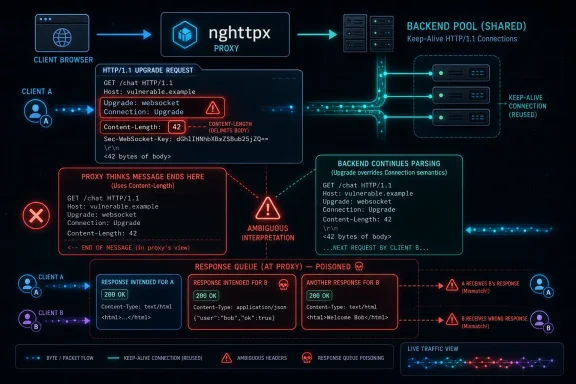 The Dangerous Part Is Not Upgrade, It Is Ambiguity
Request smuggling vulnerabilities usually begin with a simple premise: two components in the same HTTP path disagree about where one message ends and the next begins. That disagreement is often more dangerous than the malformed request itself, because the attacker does not need to compromise either component directly. They need only persuade the front end and the back end to read the same bytes differently.CVE-2026-58055 follows that pattern, but with a twist that will feel familiar to anyone who has spent time around WebSocket gateways, HTTP/2 bridges, and layered reverse proxy stacks. The issue involves an HTTP/1.1 Upgrade request that also carries a Content-Length header and a body. According to the CVE description, nghttpx forwards that request to reusable keep-alive backend connections, re-adds Upgrade and Connection headers, and passes Content-Length through unchanged.
That combination matters because reusable backend connections are where isolation can quietly fail. A proxy may treat one inbound client request as finished, while the backend may still be parsing bytes that the attacker intended to become the beginning of another request. If a later client’s response is then matched against the wrong request in the queue, the vulnerability stops being abstract parser trivia and becomes cross-client response-queue poisoning.
This is why the advisory’s language is more alarming than the score might suggest. A CVSS 3.1 base score of 5.4 and a CVSS 4.0 base score of 6.3 place it in medium territory, with high attack complexity. But “medium” does not mean “ignore.” It means exploitation depends on deployment shape, backend behavior, and traffic patterns — precisely the sort of variables that make edge infrastructure hard to reason about.
nghttpx Lives Where Protocol Assumptions Collide
nghttp2 is best known as a widely used implementation of HTTP/2 machinery, and nghttpx is its proxy component. In many environments, a proxy like nghttpx is not merely passing traffic. It is translating protocols, normalizing headers, terminating client-facing connections, maintaining backend pools, and attempting to make old and new HTTP semantics coexist without frightening the application servers behind it.That role is powerful, and it is also fragile. HTTP/1.1 has decades of compatibility baggage; HTTP/2 has different framing rules; WebSocket and other Upgrade-based flows create sanctioned moments where a request stops behaving like an ordinary request. Reverse proxies must decide which headers to preserve, which to synthesize, and which to strip. Those decisions are security boundaries even when they look like plumbing.
CVE-2026-58055 appears to live in one of those boundary decisions. An Upgrade request is already special because it asks to switch protocols. A Content-Length header on such a request introduces another dimension: a body whose length must be interpreted consistently by every hop. Add backend keep-alive reuse, and the proxy is no longer dealing with an isolated one-request-one-connection exchange. It is multiplexing trust over a connection that may soon serve someone else.
The fix referenced by the CVE points to upstream code changes in nghttp2, and that is the practical signal administrators should care about. This is not a theoretical class warning. It is a concrete implementation flaw, with an affected range stated as nghttp2 through 1.69.0 and a public proof-of-concept reference listed in the vulnerability record.
The CVSS Score Understates the Operational Blast Radius
Security teams have trained themselves to sort vulnerability feeds by severity, exploitability, and asset exposure. That discipline is necessary, but it can be misleading for bugs in shared network intermediaries. A low-availability, low-confidentiality, low-integrity CVSS profile can still be consequential if the affected component sits in front of many applications.The advisory’s scoring reflects constraints. Attack complexity is high, and exploitation depends on a backend resolving the ambiguous message in the attacker’s favor. An attacker may need to understand the proxy’s forwarding behavior, the backend server’s parser, keep-alive reuse, and timing. That is more demanding than pointing a commodity exploit at a listening daemon.
But HTTP desynchronization bugs have a history of rewarding patient attackers. The payoff is not always server takeover. Sometimes it is cache poisoning, credential theft through response confusion, security-control bypass, or request injection into another user’s session. Those outcomes are hard to model with a single base score because the same parser bug can be harmless in one topology and severe in another.
That is the uncomfortable truth for enterprise defenders. A vulnerability in a reverse proxy does not need to be universally exploitable to be worth urgent review. It only needs to be exploitable in the particular chain your environment happens to run: CDN to proxy, proxy to app server, app server to internal service, with a few long-lived backend sockets quietly carrying everyone’s assumptions.
The Upgrade Path Is a Test of Proxy Hygiene
The word “Upgrade” can make this sound like a niche WebSocket problem, but that would be too narrow. Upgrade handling is a stress test for proxy hygiene because it forces intermediaries to decide when ordinary HTTP rules stop applying. If those decisions are inconsistent across the chain, the attacker gets room to maneuver.A robust proxy should avoid forwarding ambiguous request shapes to a backend in a way that leaves interpretation open. That often means rejecting malformed or contradictory messages early, stripping hop-by-hop headers when appropriate, and ensuring that backend requests are serialized in a form the backend will parse exactly as intended. In other words, the proxy must not merely pass traffic. It must commit to an interpretation.
CVE-2026-58055 suggests nghttpx did not fully enforce that commitment for this Upgrade-plus-Content-Length case. The proxy reportedly re-added Upgrade and Connection headers while leaving Content-Length intact, allowing the backend to encounter a request shape whose meaning could diverge from the proxy’s. Once the connection is reusable, any desynchronization can contaminate the next transaction.
That “next transaction” detail is the key operational concern. If the vulnerable behavior affected only a single attacker-controlled connection and a single attacker-controlled response, defenders might reasonably place it lower in the queue. Cross-client response-queue poisoning changes the calculus because it implies one client may influence what another client receives. Shared infrastructure turns a parsing mismatch into a tenant-boundary problem.
Public Proof-of-Concept Code Changes the Clock
The NVD entry lists a public proof-of-concept repository among its references. That does not automatically mean mass exploitation is imminent, and defenders should resist the reflex to treat every PoC as a worm. But public exploit material changes the timeline from “understand the class of bug” to “find out whether we run the affected shape.”For attackers, a PoC compresses research time. It shows the request form, the expected behavior, and the conditions under which the queue can be poisoned. Even if the proof-of-concept does not apply directly to a production stack, it provides a template for adaptation. That is especially true for HTTP smuggling issues, where the real work is often tuning payloads to the exact front-end and back-end parser pair.
For defenders, the same PoC can be useful, but only if handled carefully. Testing request smuggling against production traffic is risky because the act of testing can disrupt connection state or poison queues. Security teams should reproduce the topology in a controlled environment, including the same nghttpx version, backend server, keep-alive settings, and Upgrade-handling paths. A negative result against a simplified lab does not necessarily clear a complex production chain.
The presence of a fix upstream also changes expectations. Once a patch exists, distribution maintainers, container image owners, and platform teams will begin moving at different speeds. That gap between upstream fix and deployed package is where many medium-severity infrastructure bugs become lingering exposures.
Windows Shops Should Care Even If the Bug Is Not “A Windows CVE”
WindowsForum readers may reasonably ask why a vulnerability in nghttp2 deserves attention in a Windows-centered publication. The answer is that modern Windows environments are rarely Windows-only at the network edge. A Microsoft-heavy enterprise may still run Linux reverse proxies, Kubernetes ingress controllers, appliance-based gateways, developer test stacks, or vendor products that embed open-source HTTP components.The affected software may be present without being obvious. It might arrive through a package dependency, a container base image, a bundled proxy in an appliance, or an internal platform team’s standard gateway image. Administrators who inventory only Windows Server roles and Microsoft patches will miss the parts of the estate that actually terminate and translate web traffic before it reaches IIS, ASP.NET, or internal APIs.
This is particularly relevant for hybrid environments. A Windows authentication front end, a Linux proxy tier, and a mixture of application servers can create exactly the kind of multi-parser path where request smuggling thrives. The vulnerability does not need to “target Windows” to affect Windows users. It needs only to sit in front of the services they use.
For defenders, the right question is not whether CVE-2026-58055 appears in Windows Update. It will not. The right question is whether any externally reachable or semi-trusted HTTP path uses nghttpx through 1.69.0, especially where Upgrade requests are allowed and backend keep-alive reuse is enabled.
Asset Inventory Is the First Patch
The obvious mitigation is to update nghttp2/nghttpx to a fixed build once available through your source of record. But the less glamorous mitigation is inventory, and it may matter more in the first 48 hours after disclosure. If you cannot say where nghttpx is deployed, you cannot say whether the CVE matters to you.Start with direct installations, then move outward. Check Linux servers, reverse proxy hosts, container images, Kubernetes manifests, ingress and egress gateway images, and any internally maintained platform components. Look for nghttpx explicitly, but also look for nghttp2 packages that include the proxy binary. In some distributions, application libraries and proxy utilities may be packaged together or versioned in ways that confuse quick scans.
Version detection also deserves care. The CVE states affected versions through 1.69.0, but downstream packages may backport fixes without changing the upstream-looking version string in the way a scanner expects. Conversely, a container image may report an apparently safe host package while still carrying an older binary inside the image layer. Security teams should verify the actual runtime artifact, not just the package database of the node beneath it.
Configuration review is the next step. Environments that do not expose Upgrade paths, do not reuse backend keep-alive connections in the affected way, or route Upgrade traffic through a different component may have reduced exposure. But reduced exposure is not a substitute for patching. It is a prioritization input, not a permanent risk decision.
The Back End Gets a Vote
One of the more important phrases in the CVE description is “a backend that resolves the resulting ambiguous message in the attacker’s favor.” That phrase is doing a lot of work. It means the proxy behavior alone is not the entire exploit; the backend’s HTTP parser and connection handling help decide whether the ambiguity becomes a weapon.This is typical for request smuggling. The vulnerability emerges from disagreement, not from a single bad parser in isolation. A strict backend that rejects the forwarded form may blunt the attack. A permissive backend that accepts the body, treats leftover bytes as the next request, or maintains pipeline state in a predictable way may enable it.
For enterprise teams, this makes validation messy. You cannot assess exposure solely by reading the nghttpx version. You need to understand what sits behind it. That may include nginx, Apache httpd, IIS behind another translation layer, Node.js applications, Java servlet containers, Go servers, custom HTTP stacks, or vendor appliances. Each may handle Upgrade, Content-Length, and connection reuse differently.
This is also why “we do not use WebSockets” is not a complete answer. Upgrade may appear in places administrators do not think of as WebSocket infrastructure, and intermediaries may still accept or forward Upgrade-shaped requests. The safer defensive posture is to reject unnecessary Upgrade requests at the edge and normalize or drop ambiguous bodies before they reach backends.
Request Smuggling Remains the Web’s Parser Tax
HTTP request smuggling has survived multiple generations of protocol hardening because the web is not a single protocol implementation. It is a supply chain of parsers. Browsers, CDNs, WAFs, reverse proxies, service meshes, application servers, frameworks, and legacy gateways all apply their own assumptions to bytes in flight.HTTP/2 and HTTP/3 reduce some classic HTTP/1.1 ambiguity by replacing textual message delimitation with binary framing. But many real deployments terminate newer protocols at the edge and then speak HTTP/1.1 to the backend. That downgrade path can reintroduce old risks under a modern-looking front door. The browser may be speaking cleanly framed HTTP/2, while the origin path still depends on Content-Length, hop-by-hop headers, and connection reuse.
CVE-2026-58055 is a reminder that protocol translation is not just a performance feature. It is a security-sensitive transformation. If a proxy receives one semantic object and forwards another, the difference must be deliberate and safe. If the forwarded object carries ambiguity into a shared backend connection, the proxy has converted an edge case into a cross-client risk.
The industry often treats these bugs as isolated CVEs, but they are better understood as recurring symptoms. We keep rediscovering that lenient parsing and compatibility behavior make excellent exploit surfaces. Every time an intermediary tries to be helpful by preserving dubious input, it risks becoming the component that makes a backend disagreement exploitable.
Mitigation Starts With Refusing Weird Requests
The patch should be the priority, but defensive configuration can reduce risk while patch pipelines move. The core idea is simple: do not allow ambiguous HTTP request forms to reach backend servers. If an Upgrade request carries a body and Content-Length where your application does not require it, reject it. If hop-by-hop headers arrive from untrusted clients, ensure the proxy handles them according to strict rules rather than forwarding them opportunistically.Security teams should also review whether backend connection reuse is necessary for paths that accept Upgrade traffic. Keep-alive improves performance and is foundational to efficient HTTP infrastructure, but shared connection state is what makes response-queue poisoning plausible. In high-risk paths, isolating certain request classes or disabling reuse for suspicious transitions may be a reasonable temporary measure.
Logging is less straightforward than defenders might like. Request smuggling attempts may not show up as a neat exploit signature in application logs, because the backend may believe it received ordinary requests. Edge logs, proxy debug logs, unusual 400-series responses, mismatched request IDs, and response/request correlation failures may be more revealing. If your observability pipeline assumes one client request maps cleanly to one backend request, this class of bug is exactly where that assumption breaks.
WAF rules can help, but they should not become the entire plan. Blocking Upgrade requests with Content-Length and a body may be sensible if your environment has no legitimate need for that combination. Still, WAFs are themselves HTTP parsers and intermediaries. The long-term fix belongs in the affected proxy and in stricter end-to-end message normalization.
Distribution Lag Will Decide Real-World Exposure
The disclosure record identifies nghttp2 through 1.69.0 as affected, but most organizations do not deploy upstream tarballs directly. They deploy distribution packages, container images, Helm charts, vendor appliances, and managed platform components. That means the real exposure window is shaped by maintainers and by internal update discipline.Debian’s security tracker already has an entry for the CVE, and other ecosystem trackers are beginning to mirror the vulnerability. That is the early stage of the patch lifecycle, when scanners may report inconsistent severity, package maintainers may still be triaging backports, and operations teams may see the CVE before a clean patched package is available for their exact platform.
This lag is not an argument for panic. It is an argument for compensating controls and precise scoping. If nghttpx is internet-facing, handles Upgrade traffic, and forwards to permissive HTTP/1.1 backends over reusable connections, treat it as a higher-priority patch than the word “medium” suggests. If nghttpx is present only as an unused binary on an internal host, the risk is materially different.
The mistake would be to wait for every scanner, vendor, and distribution to agree before beginning the inventory. By then, public exploit material has already circulated, and defenders have lost the advantage of time. The first useful action is not changing every system. It is identifying the systems where this parser edge case could become a user-impacting incident.
The Practical Read for CVE-2026-58055 Is Narrow, Not Small
This vulnerability is not a universal internet fire. It has conditions, and those conditions matter. But the conditions are common enough in modern web infrastructure that administrators should not dismiss it as an academic HTTP oddity.- Systems running nghttpx from nghttp2 versions through 1.69.0 should be treated as potentially affected until patched or otherwise verified.
- The highest-risk deployments are reverse proxy paths that accept HTTP/1.1 Upgrade requests and forward them to reusable keep-alive backend connections.
- Backends that parse ambiguous Upgrade-plus-Content-Length requests permissively may turn the proxy behavior into request smuggling or response-queue poisoning.
- Public proof-of-concept material means defenders should assume exploit techniques will be tested and adapted quickly.
- Windows-centric organizations still need to check Linux proxies, containers, appliances, and platform components that front Microsoft workloads.
- Temporary filtering of unusual Upgrade requests can reduce exposure, but it should not replace updating nghttpx to a fixed build.
References
- Primary source: NVD
Published: 2026-06-29T01:06:34-07:00
NVD - CVE-2026-58055
 nvd.nist.gov
- Security advisory: MSRC
Published: 2026-06-29T01:06:34-07:00
Original feed URL
Security Update Guide - Microsoft Security Response Center
 msrc.microsoft.com
- Related coverage: vuldb.com
CVE-2026-58055 nghttp2 HTTP Request request smuggling (EUVD-2026-39975 / Nessus ID 323595)
A vulnerability was found in nghttp2 up to 1.69.0. This vulnerability was named CVE-2026-58055. It is advisable to implement a patch to correct this issue.vuldb.com - Related coverage: vulert.com
HTTP Request Smuggling Vulnerability in nghttp2 Proxy
Learn about the HTTP request smuggling vulnerability in nghttp2 proxy, its impacts, and how to fix it. Stay secure with real-time monitoring from Vulert.vulert.com - Related coverage: i.blackhat.com
us 20 Klein HTTP Request Smuggling In 2020 New Variants New Defenses And New Challenges wp
PDF documenti.blackhat.com
