

CVE-2026-63853 is now tracked as a Linux kernel vulnerability affecting AMDGPU’s VCN 4.0 video-encode path, but the immediate fix is deliberately narrow: newer kernels refuse command-stream submissions that request unsupported 64-bit user-fence writes on the relevant hardware ring. For Windows users, this is not a Windows graphics-driver vulnerability; the practical exposure is limited to systems actually running an affected Linux kernel and AMD’s in-kernel
The National Vulnerability Database published the entry on July 19, 2026, based on a kernel.org record. Its description identifies the fault in
That small patch matters because a GPU driver’s command submission path is a strict boundary between userspace requests and hardware capabilities. If the kernel accepts a synchronization operation that the underlying video engine cannot perform correctly, the result can range from failed video workloads to GPU resets or harder-to-characterize stability and security consequences. NVD has assigned the CVE, but as of July 20 it has not published a CVSS score or vector, and neither NVD nor the upstream record identifies public exploitation.
The affected component is AMD’s Video Core Next, or VCN, block: the dedicated engine AMD GPUs use for hardware video encoding and decoding. Applications normally access this capability indirectly through stacks such as Mesa, FFmpeg, VA-API, Vulkan Video, media frameworks, browsers, remote-desktop software, or transcoding tools. The application does not need to know that the kernel is managing a ring, the queue through which work reaches a particular GPU engine.
A user fence is a synchronization mechanism. It lets software ask the GPU to signal completion by writing a fence value to a userspace-visible memory address. That can avoid needless polling and help coordinate asynchronous GPU work. The issue in CVE-2026-63853 is not that all fence handling is broken; it is that VCN 4.0’s encoder and decoder rings do not support the specific 64-bit user-fence write operation that could be requested through command submission.
The patch does not attempt to emulate a missing hardware feature or alter video bitstreams. Instead, it advertises the limitation to the AMDGPU driver’s ring-function layer. From that point, command streams carrying user fences for this ring are rejected rather than passed to hardware that cannot safely honor them.
That is an important distinction for administrators evaluating operational impact. A patched system may reject an unusual workload that relied on the unsupported request, but it is preferable to accepting a request the video block cannot correctly execute. Most ordinary desktop playback and encode workloads should not suddenly become dependent on an invalid low-level user-fence operation; the practical behavior change is intended to occur at the edge case.
That chronology deserves careful reading. It does not mean every system merely labeled “Linux 6.18” is fixed, nor does it mean any package bearing a newer-looking vendor release string is automatically safe. Enterprise distributions frequently backport security and stability patches without changing the base kernel version in an obvious way. Conversely, a self-built kernel might retain an old driver source file despite a modified version string.
The three stable commits linked from the NVD entry correspond to separate maintenance branches. Administrators should rely on their distribution’s security advisory and package changelog first, then confirm that the vendor kernel incorporates the AMDGPU VCN fix. For custom kernels, the relevant code change is easy to identify: the VCN 4.0 unified encoder ring functions must set
The upstream patch series, posted by AMD engineer Yinjie Yao to the AMD graphics mailing list in late April, explicitly calls out the hardware limitation and identifies the original VCN 4.0 support commit as the regression point. The same larger series applies comparable restrictions across several VCN and JPEG engine generations, but CVE-2026-63853 specifically covers the VCN 4.0 encoder-ring change. That scope should prevent a common error in vulnerability tracking: treating this CVE as a blanket finding for every AMD media engine.
WSL 2 also needs a more precise assessment than “Windows runs Linux, therefore it is vulnerable.” Default WSL graphics acceleration typically presents a virtualized GPU interface to Linux guests rather than loading the native PCI AMDGPU driver and directly programming VCN hardware. In that usual configuration, this particular
The exceptions are the ones IT teams should inventory:
The appropriate response is straightforward: deploy the distribution’s fixed kernel, reboot into it, and verify the running release rather than merely confirming that a newer package was downloaded. Where an immediate kernel update is not available, limiting untrusted access to hardware video-encode workloads is a sensible temporary risk reduction, but it is not a substitute for the driver fix.
CVE-2026-63853 is a reminder that the safest GPU-driver repair is often the least dramatic one: recognize a hardware capability boundary and reject the request before it reaches the engine. The next meaningful milestone is not an emergency Windows update or a speculative CVSS number; it is broad vendor adoption of the 6.18.33 and 7.0.10 stable fixes, with administrators confirming that their deployed Linux kernels contain the corrected VCN 4.0 ring behavior.
amdgpu driver, including dual-boot installations, Linux workstations, certain virtual machines, and custom-kernel WSL deployments.The National Vulnerability Database published the entry on July 19, 2026, based on a kernel.org record. Its description identifies the fault in
drivers/gpu/drm/amd/amdgpu/vcn_v4_0.c: VCN encoder and decoder rings do not support 64-bit user-fence writes, yet the driver had not marked the VCN 4.0 encoder ring as rejecting those requests. The upstream remedy is a one-line functional change, setting no_user_fence = true for that ring.That small patch matters because a GPU driver’s command submission path is a strict boundary between userspace requests and hardware capabilities. If the kernel accepts a synchronization operation that the underlying video engine cannot perform correctly, the result can range from failed video workloads to GPU resets or harder-to-characterize stability and security consequences. NVD has assigned the CVE, but as of July 20 it has not published a CVSS score or vector, and neither NVD nor the upstream record identifies public exploitation.
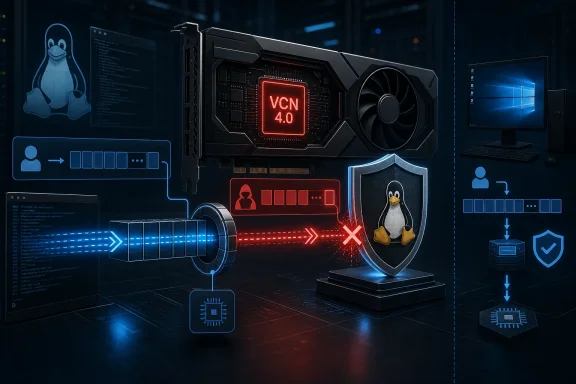 The fix turns an invalid request into a clean rejection
The affected component is AMD’s Video Core Next, or VCN, block: the dedicated engine AMD GPUs use for hardware video encoding and decoding. Applications normally access this capability indirectly through stacks such as Mesa, FFmpeg, VA-API, Vulkan Video, media frameworks, browsers, remote-desktop software, or transcoding tools. The application does not need to know that the kernel is managing a ring, the queue through which work reaches a particular GPU engine.A user fence is a synchronization mechanism. It lets software ask the GPU to signal completion by writing a fence value to a userspace-visible memory address. That can avoid needless polling and help coordinate asynchronous GPU work. The issue in CVE-2026-63853 is not that all fence handling is broken; it is that VCN 4.0’s encoder and decoder rings do not support the specific 64-bit user-fence write operation that could be requested through command submission.
The patch does not attempt to emulate a missing hardware feature or alter video bitstreams. Instead, it advertises the limitation to the AMDGPU driver’s ring-function layer. From that point, command streams carrying user fences for this ring are rejected rather than passed to hardware that cannot safely honor them.
That is an important distinction for administrators evaluating operational impact. A patched system may reject an unusual workload that relied on the unsupported request, but it is preferable to accepting a request the video block cannot correctly execute. Most ordinary desktop playback and encode workloads should not suddenly become dependent on an invalid low-level user-fence operation; the practical behavior change is intended to occur at the edge case.
The version boundary is more useful than the CVE score—for now
According to the NVD record, Linux kernels beginning with version 5.19 are affected until they incorporate the relevant stable-tree fixes. The record identifies fixed version lines through Linux 6.18.33 and Linux 7.0.10, with Linux 7.1 listed as containing the original upstream fix.That chronology deserves careful reading. It does not mean every system merely labeled “Linux 6.18” is fixed, nor does it mean any package bearing a newer-looking vendor release string is automatically safe. Enterprise distributions frequently backport security and stability patches without changing the base kernel version in an obvious way. Conversely, a self-built kernel might retain an old driver source file despite a modified version string.
The three stable commits linked from the NVD entry correspond to separate maintenance branches. Administrators should rely on their distribution’s security advisory and package changelog first, then confirm that the vendor kernel incorporates the AMDGPU VCN fix. For custom kernels, the relevant code change is easy to identify: the VCN 4.0 unified encoder ring functions must set
no_user_fence to true.The upstream patch series, posted by AMD engineer Yinjie Yao to the AMD graphics mailing list in late April, explicitly calls out the hardware limitation and identifies the original VCN 4.0 support commit as the regression point. The same larger series applies comparable restrictions across several VCN and JPEG engine generations, but CVE-2026-63853 specifically covers the VCN 4.0 encoder-ring change. That scope should prevent a common error in vulnerability tracking: treating this CVE as a blanket finding for every AMD media engine.
Windows PCs are generally outside the affected code path
A standard Windows 11 or Windows 10 installation does not use the Linux kernel’samdgpu DRM driver. AMD Software: Adrenalin Edition and the Windows Display Driver Model stack are separate codebases and interfaces. Nothing in the CVE record indicates that AMD’s Windows display driver, Windows hardware-accelerated video APIs, or a Windows application using AMD media acceleration is affected by this Linux-kernel issue.WSL 2 also needs a more precise assessment than “Windows runs Linux, therefore it is vulnerable.” Default WSL graphics acceleration typically presents a virtualized GPU interface to Linux guests rather than loading the native PCI AMDGPU driver and directly programming VCN hardware. In that usual configuration, this particular
amdgpu VCN 4.0 path is unlikely to be in use.The exceptions are the ones IT teams should inventory:
- Linux installations that boot directly on AMD GPU hardware and use the in-kernel AMDGPU driver may be affected if their vendor kernel has not backported the fix.
- Linux virtual machines with direct GPU passthrough may use the affected driver path, depending on the passed-through GPU and guest configuration.
- WSL 2 users who run a custom Microsoft-kernel replacement, attach hardware through specialized virtualization arrangements, or otherwise load native AMDGPU support should verify their actual kernel and driver path rather than assuming the default WSL graphics model applies.
- Media-transcoding and rendering hosts deserve priority because they are the most likely systems to exercise VCN encode queues at scale.
Patch discipline matters more than a rushed workaround
Because NVD has not yet assigned CVSS metrics, organizations should avoid inventing a severity rating from the sparse initial record. There is no documented remote attack vector, no public proof-of-concept cited by NVD, and no claim that ordinary video playback triggers the issue. At the same time, kernel-level GPU command validation is security-sensitive territory, so systems that expose GPU acceleration to untrusted local users, containers, shared build infrastructure, or media-processing tenants should not let the absence of a score become a reason to defer normal patching.The appropriate response is straightforward: deploy the distribution’s fixed kernel, reboot into it, and verify the running release rather than merely confirming that a newer package was downloaded. Where an immediate kernel update is not available, limiting untrusted access to hardware video-encode workloads is a sensible temporary risk reduction, but it is not a substitute for the driver fix.
CVE-2026-63853 is a reminder that the safest GPU-driver repair is often the least dramatic one: recognize a hardware capability boundary and reject the request before it reaches the engine. The next meaningful milestone is not an emergency Windows update or a speculative CVSS number; it is broad vendor adoption of the 6.18.33 and 7.0.10 stable fixes, with administrators confirming that their deployed Linux kernels contain the corrected VCN 4.0 ring behavior.
References
- Primary source: NVD / Linux Kernel
Published: 2026-07-20T01:01:55-07:00
NVD - CVE-2026-63853
 nvd.nist.gov
- Security advisory: MSRC
Published: 2026-07-20T01:01:55-07:00
Original feed URL
Security Update Guide - Microsoft Security Response Center
 msrc.microsoft.com
