

Genpact launched Genpact Deductions Recovery on June 30, 2026, in New York as an Azure-based agentic AI accounts receivable tool for consumer goods companies, designed to identify, validate, and resolve disputed customer deductions across portals, carrier systems, and internal ERP records. The pitch is not merely that AI can read more documents faster than a clerk. It is that a messy, dispute-heavy corner of trade finance is becoming a proving ground for enterprise AI agents. For WindowsForum readers, the story matters because this is exactly where Microsoft wants Azure AI to land: not as a chatbot bolted onto work, but as a transaction-processing layer embedded inside business operations.
Consumer goods deductions are not glamorous, which is precisely why they are important. They sit at the intersection of promotions, logistics, retail compliance, delivery documentation, pricing agreements, and accounts receivable. When a retailer deducts money from an invoice because of a shipment issue, a promotion mismatch, an allowance dispute, or an alleged compliance miss, the supplier has to decide whether the claim is valid and whether it is worth fighting.
That work has traditionally been a swamp of spreadsheets, emails, customer portals, carrier records, internal ERP data, and proof-of-delivery documents. The dollar values may be individually small, but the aggregate leakage can be large enough to become a margin issue. Genpact says consumer goods companies often miss up to 20 percent of preventable deductions and leave more than 30 percent of invalid claims unresolved.
Those numbers should be read as vendor estimates, not neutral industry law. But the underlying problem will be familiar to anyone who has managed finance operations at scale: when process exceptions multiply faster than staff can investigate them, the business begins accepting loss as a cost of complexity. Genpact’s argument is that AI agents can make that complexity economically searchable, comparable, and actionable.
That is a more ambitious claim than “we added generative AI to finance.” It moves the product into the contested territory of autonomous workflow execution, where the system is expected to do more than summarize or classify. It must act inside a process that has financial consequences.
This is also why the deductions market is a plausible place for agentic AI to mature. The process has structure, repeatable documents, known exception types, and measurable outcomes. A model does not need to invent a strategy deck or make a judgment about brand sentiment; it needs to compare records, detect mismatches, follow policy, and escalate exceptions. That is still difficult, but it is a better enterprise AI target than asking a general-purpose assistant to “fix finance.”
Microsoft does not need to own every workflow application if Azure becomes the substrate beneath them. Document extraction, semantic search, model access, orchestration, security, identity, and compliance all become the plumbing on which process-specific agents are built. In this case, Genpact brings the consumer goods finance expertise, while Microsoft supplies the cloud and AI foundation.
For IT leaders, that should sound both promising and familiar. The enterprise software market has spent decades turning business processes into configurable platforms, and Azure is now being positioned as the place where those platforms acquire agentic behavior. The same gravity that once pulled workloads toward Windows Server, SQL Server, Exchange, SharePoint, and Active Directory is being re-created around Azure AI services.
The difference is that AI agents expand the blast radius. A search index that returns a bad result is one kind of problem. An agent that misclassifies a claim, sends the wrong follow-up, or fails to preserve an audit trail is another. That makes governance, identity, logging, and human review as important as model accuracy.
The company says clients using Deductions Recovery could see cycle times reduced by up to 20 percent, annual recoveries increased by up to 15 percent from previously unidentified invalid deductions, and financial leakage reduced by around 1.5 percent. On Genpact’s own product page, the company also frames some outcomes as projections that vary by client circumstances and deployment scope. That caveat is doing real work.
Enterprise AI vendors are increasingly selling outcomes rather than tools. The old SaaS pitch was that software would make work more efficient. The new agentic pitch is that software will recover money, prevent leakage, reduce backlog, and release staff from manual reconciliation. That is more compelling to CFOs, but it also raises the burden of proof.
Deductions management gives buyers a cleaner scorecard than many AI categories. Did invalid claims get found? Did recovery increase? Did cycle time fall? Did the system reduce repeat deductions by identifying root causes? Those are questions finance teams can answer with operational data, not vibes.
That distinction matters. A customer quote is not the same thing as a production benchmark. The careful language suggests enthusiasm without turning the announcement into proof that the system has already transformed Kraft Heinz’s deductions operation at scale.
Still, the reference is important because consumer goods finance is not a laboratory workflow. Large CPG companies deal with powerful retailers, complicated promotions, shipment exceptions, seasonal volume spikes, and a constant negotiation between commercial relationships and financial discipline. If agentic AI can survive there, it has a stronger claim to relevance than yet another demo built around a clean invoice and a perfect PDF.
It also hints at where enterprise AI adoption may really happen. Not through dramatic replacement of departments, but through targeted automation in stubborn processes where outsourcing firms, cloud providers, and enterprise customers already have long-standing relationships.
That means the technical questions for Genpact and Microsoft are less about whether the model can generate fluent explanations and more about whether the system can maintain evidence chains. Which source document supported a match? Which policy rule triggered a resolution path? Which agent acted, when, under whose authority, and with what confidence score? Which exceptions were routed to humans rather than closed automatically?
Enterprise buyers should also scrutinize data boundaries. Deductions data can involve customer agreements, trade terms, pricing arrangements, shipment records, and commercially sensitive dispute history. Pulling that into an AI workflow requires more than encryption at rest and a security slide. It requires a clear model of access control, retention, logging, tenant isolation, and downstream use of extracted data.
The more autonomous these systems become, the more they resemble junior process workers with API access. That is useful, but it is also a governance problem. A bot that can read a customer portal, reconcile a debit memo, and trigger a bill-back needs the same kind of role design and separation of duties that auditors already expect from human finance teams.
The problem is that this flexibility becomes fragility at scale. A deduction analyst can manage a handful of exceptions with spreadsheets and email. A global consumer goods company facing thousands of claims across retailers, carriers, geographies, and promotion calendars eventually accumulates a reconciliation machine that nobody fully owns.
Agentic AI is being inserted into that gap. It promises to preserve some of the flexibility of human exception handling while adding the speed and consistency of automation. That is a seductive proposition, especially in finance functions that have already squeezed headcount and outsourced repetitive work.
But replacing spreadsheet sprawl is never just a technical migration. It is a political one. Teams have to trust the system’s matches, accept its prioritization, and expose the informal workarounds that often keep operations moving. The hardest part of deploying a deductions agent may not be connecting to Azure AI Search or Document Intelligence; it may be forcing the business to define what “valid” and “recoverable” mean across messy commercial realities.
This is not a rejection of outsourcing. It is outsourcing’s next operating system. Genpact can point to its domain knowledge and last-mile process experience, while Microsoft can point to Azure’s scale and AI services. Together, they create a template for how specialized service providers may defend themselves against pure software vendors.
That model has advantages. A company that has spent years handling finance operations may understand deduction disputes better than a startup with a slick agent framework. Domain-specific training, prebuilt workflows, exception libraries, and governance patterns can matter more than generic model performance.
It also has a tension. If the agent does more of the work, customers may ask whether they are buying software, managed services, or a hybrid that is difficult to benchmark. The economics of agentic BPO will depend on whether savings are passed to clients, captured by providers, or reinvested into higher-value services.
If a finance agent pulls from ERP systems, portals, document repositories, and internal records, IT will be involved whether or not the tool sits inside a traditional Windows estate. Microsoft Entra identity, conditional access, data loss prevention, audit logging, and integration with existing business applications become part of the deployment conversation. The AI feature is only one layer of the operational stack.
This is where many organizations will discover that “AI readiness” is really data readiness under a new name. If proof-of-delivery records are inconsistent, customer portals are brittle, ERP data is poorly governed, and deduction reason codes are used inconsistently, an agent may accelerate confusion rather than resolution. AI can reduce manual work, but it cannot magically repair years of process entropy.
The best deployments will likely be the least theatrical. They will start with bounded workflows, clear exception thresholds, measurable recovery targets, and human review for high-risk actions. They will treat agents as controlled process participants, not mystical employees.
That does not make the product unimportant. On the contrary, the launch is significant because it focuses AI on an ugly operational problem with a measurable financial trail. It is a more serious test of enterprise AI than many high-profile productivity demos.
The due diligence burden now shifts to buyers. They should ask how the system handles ambiguous claims, what confidence thresholds trigger escalation, how evidence is preserved, whether actions can be reversed, and how the tool performs across different retailers and ERP environments. They should also ask whether the projected recovery improvements are based on pilots, modeled estimates, or mature production deployments.
In financial workflows, trust is not a mood. It is a control environment.
 Genpact Finds the AI Opportunity Hiding in the Back Office
Consumer goods deductions are not glamorous, which is precisely why they are important. They sit at the intersection of promotions, logistics, retail compliance, delivery documentation, pricing agreements, and accounts receivable. When a retailer deducts money from an invoice because of a shipment issue, a promotion mismatch, an allowance dispute, or an alleged compliance miss, the supplier has to decide whether the claim is valid and whether it is worth fighting.That work has traditionally been a swamp of spreadsheets, emails, customer portals, carrier records, internal ERP data, and proof-of-delivery documents. The dollar values may be individually small, but the aggregate leakage can be large enough to become a margin issue. Genpact says consumer goods companies often miss up to 20 percent of preventable deductions and leave more than 30 percent of invalid claims unresolved.
Those numbers should be read as vendor estimates, not neutral industry law. But the underlying problem will be familiar to anyone who has managed finance operations at scale: when process exceptions multiply faster than staff can investigate them, the business begins accepting loss as a cost of complexity. Genpact’s argument is that AI agents can make that complexity economically searchable, comparable, and actionable.
The Agent Is Being Sold as a Process Worker, Not a Copilot
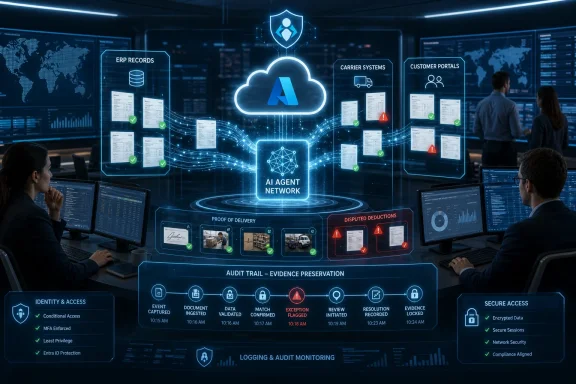
The interesting word in Genpact’s launch is not AI but agentic. The company is not presenting Deductions Recovery as a dashboard that gives analysts better suggestions. It is describing a network of specialized agents that can orchestrate the deduction lifecycle, pull data from multiple systems, match debit memos against supporting records, categorize deductions, and initiate follow-up actions such as bill-backs for unreturned products.That is a more ambitious claim than “we added generative AI to finance.” It moves the product into the contested territory of autonomous workflow execution, where the system is expected to do more than summarize or classify. It must act inside a process that has financial consequences.
This is also why the deductions market is a plausible place for agentic AI to mature. The process has structure, repeatable documents, known exception types, and measurable outcomes. A model does not need to invent a strategy deck or make a judgment about brand sentiment; it needs to compare records, detect mismatches, follow policy, and escalate exceptions. That is still difficult, but it is a better enterprise AI target than asking a general-purpose assistant to “fix finance.”
Microsoft Azure Is the Quiet Power Play
Genpact says the solution runs on Microsoft Azure and uses Azure AI Document Intelligence in Foundry Tools, Azure AI Search, and Azure OpenAI in Foundry Models. That stack matters because it shows how Microsoft’s enterprise AI strategy is increasingly being delivered through partners with deep vertical process knowledge.Microsoft does not need to own every workflow application if Azure becomes the substrate beneath them. Document extraction, semantic search, model access, orchestration, security, identity, and compliance all become the plumbing on which process-specific agents are built. In this case, Genpact brings the consumer goods finance expertise, while Microsoft supplies the cloud and AI foundation.
For IT leaders, that should sound both promising and familiar. The enterprise software market has spent decades turning business processes into configurable platforms, and Azure is now being positioned as the place where those platforms acquire agentic behavior. The same gravity that once pulled workloads toward Windows Server, SQL Server, Exchange, SharePoint, and Active Directory is being re-created around Azure AI services.
The difference is that AI agents expand the blast radius. A search index that returns a bad result is one kind of problem. An agent that misclassifies a claim, sends the wrong follow-up, or fails to preserve an audit trail is another. That makes governance, identity, logging, and human review as important as model accuracy.
Deductions Are a Better AI Test Than Office Theater
Much of the public AI conversation still revolves around writing emails, making slides, or summarizing meetings. Those use cases are visible, but they are not always where the money is. Genpact is aiming at a less photogenic workflow where measurable recovery, cycle time, and leakage reduction can be attached to the product.The company says clients using Deductions Recovery could see cycle times reduced by up to 20 percent, annual recoveries increased by up to 15 percent from previously unidentified invalid deductions, and financial leakage reduced by around 1.5 percent. On Genpact’s own product page, the company also frames some outcomes as projections that vary by client circumstances and deployment scope. That caveat is doing real work.
Enterprise AI vendors are increasingly selling outcomes rather than tools. The old SaaS pitch was that software would make work more efficient. The new agentic pitch is that software will recover money, prevent leakage, reduce backlog, and release staff from manual reconciliation. That is more compelling to CFOs, but it also raises the burden of proof.
Deductions management gives buyers a cleaner scorecard than many AI categories. Did invalid claims get found? Did recovery increase? Did cycle time fall? Did the system reduce repeat deductions by identifying root causes? Those are questions finance teams can answer with operational data, not vibes.
Kraft Heinz Gives the Launch a Useful Reality Check
Kraft Heinz appears in the launch not as a case study with audited savings, but as a major consumer goods name watching the approach with interest. Dylan Jetha, who leads global trade to cash at Kraft Heinz, emphasized visibility and control in complex deductions environments and pointed to Genpact’s use of pre-trained agents as a notable development.That distinction matters. A customer quote is not the same thing as a production benchmark. The careful language suggests enthusiasm without turning the announcement into proof that the system has already transformed Kraft Heinz’s deductions operation at scale.
Still, the reference is important because consumer goods finance is not a laboratory workflow. Large CPG companies deal with powerful retailers, complicated promotions, shipment exceptions, seasonal volume spikes, and a constant negotiation between commercial relationships and financial discipline. If agentic AI can survive there, it has a stronger claim to relevance than yet another demo built around a clean invoice and a perfect PDF.
It also hints at where enterprise AI adoption may really happen. Not through dramatic replacement of departments, but through targeted automation in stubborn processes where outsourcing firms, cloud providers, and enterprise customers already have long-standing relationships.
The Risk Is Not Hallucination Alone
The obvious AI risk is hallucination, but in deductions recovery the sharper risk is process authority. A hallucinated paragraph in a meeting summary is annoying. A wrongly resolved deduction can affect cash, customer relationships, compliance posture, and audit trails.That means the technical questions for Genpact and Microsoft are less about whether the model can generate fluent explanations and more about whether the system can maintain evidence chains. Which source document supported a match? Which policy rule triggered a resolution path? Which agent acted, when, under whose authority, and with what confidence score? Which exceptions were routed to humans rather than closed automatically?
Enterprise buyers should also scrutinize data boundaries. Deductions data can involve customer agreements, trade terms, pricing arrangements, shipment records, and commercially sensitive dispute history. Pulling that into an AI workflow requires more than encryption at rest and a security slide. It requires a clear model of access control, retention, logging, tenant isolation, and downstream use of extracted data.
The more autonomous these systems become, the more they resemble junior process workers with API access. That is useful, but it is also a governance problem. A bot that can read a customer portal, reconcile a debit memo, and trigger a bill-back needs the same kind of role design and separation of duties that auditors already expect from human finance teams.
The Spreadsheet Is the Real Competitor
Genpact is not merely competing with other AI vendors. It is competing with the deeply embedded improvisation layer of corporate work: Excel files, inboxes, shared folders, ERP exports, customer portals, and tribal knowledge. That layer persists because it is flexible, cheap, and under the control of the people who live with the process every day.The problem is that this flexibility becomes fragility at scale. A deduction analyst can manage a handful of exceptions with spreadsheets and email. A global consumer goods company facing thousands of claims across retailers, carriers, geographies, and promotion calendars eventually accumulates a reconciliation machine that nobody fully owns.
Agentic AI is being inserted into that gap. It promises to preserve some of the flexibility of human exception handling while adding the speed and consistency of automation. That is a seductive proposition, especially in finance functions that have already squeezed headcount and outsourced repetitive work.
But replacing spreadsheet sprawl is never just a technical migration. It is a political one. Teams have to trust the system’s matches, accept its prioritization, and expose the informal workarounds that often keep operations moving. The hardest part of deploying a deductions agent may not be connecting to Azure AI Search or Document Intelligence; it may be forcing the business to define what “valid” and “recoverable” mean across messy commercial realities.
Agentic AI Is Becoming the New BPO Wrapper
Genpact’s launch also says something about the future of business process outsourcing. The old BPO model used labor arbitrage, standardized workflows, and process discipline to run back-office operations more cheaply. The new model wraps those same processes in AI agents, cloud services, and outcome metrics.This is not a rejection of outsourcing. It is outsourcing’s next operating system. Genpact can point to its domain knowledge and last-mile process experience, while Microsoft can point to Azure’s scale and AI services. Together, they create a template for how specialized service providers may defend themselves against pure software vendors.
That model has advantages. A company that has spent years handling finance operations may understand deduction disputes better than a startup with a slick agent framework. Domain-specific training, prebuilt workflows, exception libraries, and governance patterns can matter more than generic model performance.
It also has a tension. If the agent does more of the work, customers may ask whether they are buying software, managed services, or a hybrid that is difficult to benchmark. The economics of agentic BPO will depend on whether savings are passed to clients, captured by providers, or reinvested into higher-value services.
Windows Shops Should Read This as an Azure Operations Story
At first glance, a consumer goods deductions tool may seem far from the everyday world of Windows administrators. In practice, it belongs to the same enterprise architecture shift that has been reshaping Microsoft environments for years. Identity, data governance, compliance, endpoint access, and cloud operations are converging around AI-enabled workflows.If a finance agent pulls from ERP systems, portals, document repositories, and internal records, IT will be involved whether or not the tool sits inside a traditional Windows estate. Microsoft Entra identity, conditional access, data loss prevention, audit logging, and integration with existing business applications become part of the deployment conversation. The AI feature is only one layer of the operational stack.
This is where many organizations will discover that “AI readiness” is really data readiness under a new name. If proof-of-delivery records are inconsistent, customer portals are brittle, ERP data is poorly governed, and deduction reason codes are used inconsistently, an agent may accelerate confusion rather than resolution. AI can reduce manual work, but it cannot magically repair years of process entropy.
The best deployments will likely be the least theatrical. They will start with bounded workflows, clear exception thresholds, measurable recovery targets, and human review for high-risk actions. They will treat agents as controlled process participants, not mystical employees.
The Numbers Are Tempting, but the Controls Will Decide the Outcome
Genpact’s headline benefits are easy to understand: faster cycle times, more recoveries, less leakage, fewer recurring deductions, and less manual data entry. Those are exactly the outcomes finance executives want from automation. The danger is that “agentic AI” becomes a premium label for workflows that are only partially autonomous and still depend on substantial human cleanup.That does not make the product unimportant. On the contrary, the launch is significant because it focuses AI on an ugly operational problem with a measurable financial trail. It is a more serious test of enterprise AI than many high-profile productivity demos.
The due diligence burden now shifts to buyers. They should ask how the system handles ambiguous claims, what confidence thresholds trigger escalation, how evidence is preserved, whether actions can be reversed, and how the tool performs across different retailers and ERP environments. They should also ask whether the projected recovery improvements are based on pilots, modeled estimates, or mature production deployments.
In financial workflows, trust is not a mood. It is a control environment.
The Practical Read for IT and Finance Teams
Genpact’s Deductions Recovery launch is best understood as a signpost for where enterprise AI is going: into narrow, expensive, document-heavy processes where a successful deployment can be measured in cash and cycle time. The announcement is not proof that agentic AI has solved accounts receivable, but it is a credible example of how the market is moving beyond chatbot wrappers.- Genpact launched Deductions Recovery on June 30, 2026, as an AI-powered accounts receivable solution aimed at consumer goods deduction disputes.
- The product runs on Microsoft Azure and uses Microsoft’s AI stack for document intelligence, search, and model-driven workflow orchestration.
- The strongest business case is not labor replacement alone, but recovery of invalid deductions that companies may currently miss or abandon.
- The biggest deployment risks are evidence quality, auditability, access control, and over-automation of financially sensitive actions.
- The announcement reinforces Microsoft’s strategy of making Azure the platform layer for industry-specific AI agents built by partners.
- Buyers should treat Genpact’s projected benefits as targets to validate in their own environments, not guaranteed outcomes.
References
- Primary source: Analytics India Magazine
Published: 2026-07-01T09:30:12.568126
Analytics India Magazine — AI & Data Science News
India's leading AI and data science media platform — in-depth coverage of artificial intelligence, machine learning, research and tech business.analyticsindiamag.com
- Related coverage: media.genpact.com
Genpact Introduces Agentic Deductions Solution to Recover Lost Revenue for Consumer Goods Companies - Jun 30, 2026
New solution helps eliminate revenue leakage by accelerating deduction management with agentic AI NEW YORK, June 30, 2026 /PRNewswire/ -- Genpact (NYSE: G), an agentic and advanced technology...media.genpact.com - Related coverage: genpact.com
Genpact Deductions Recovery Solution | Genpact
Recover revenue, reduce leakage, and streamline deductions management with an agentic AI‑driven approach designed for smarter financial operations.www.genpact.com - Official source: marketplace.microsoft.com
Microsoft Marketplace | cloud solutions, AI apps, and agents
marketplace.microsoft.com
- Related coverage: marketscreener.com
- Related coverage: consumergoods.com
Kraft Heinz Puts AI Agents to Work in Deductions Management | Consumer Goods Technology
Learn how Kraft Heinz hopes to recover lost revenue by automating the identification, validation and resolution of disputed deductions.consumergoods.com
- Related coverage: app.dealroom.co
Genpact launches AI deduction solution to recover millions for consumer goods firms | Dealroom.co
Genpact has launched its Deductions Recovery solution, an AI-powered tool designed to help consumer goods companies recover lost revenue by automating deduction management. The solution addresses a sector-wide problem where organisations miss up to 20% of preventable deductions and leave over...app.dealroom.co - Related coverage: nasdaq.com
Genpact Advances AI Innovation with Agentic Accounts Payable Solutions | Nasdaq
--Genpact, a global advanced technology services and solutions company, today announced that the full Genpact AP Suite, an agentic solution set to revolutionize accounts payable, is now available. The Genpact AP Suite is part of Genpact's Service-as-Agentic-Solutions portfolio and powered by...www.nasdaq.com - Related coverage: es.marketscreener.com
- Related coverage: genpact.gcs-web.com

Genpact and Advantage Solutions to Expand Collaboration to Boost Finance and Supply Chain Efficiencies for CPG and Retail Sectors | Genpact Ltd
The Investor Relations website contains information about Genpact Ltd 's business for stockholders, potential investors, and financial analysts.
genpact.gcs-web.com
