

Gothic 1 Remake launched on June 5, 2026 for PC, PlayStation 5, and Xbox Series X|S, and early legacy-hardware testing shows that its PC version is far less forgiving than the 2019 playable teaser suggested. The remake’s minimum GPU target has moved into RTX 2070 and Radeon RX 6700 XT territory, turning what began as a nostalgia project into a very modern Unreal Engine 5 stress test. For players still clinging to GTX 1060s, GTX 1660s, RX 5500 XTs, and other pandemic-era survivors, the message is blunt: the Valley of Mines has been rebuilt, but not for yesterday’s machines.
The original Gothic was never a lightweight game in spirit. Piranha Bytes’ 2001 RPG earned its reputation on a hostile living world, dense NPC routines, faction politics, and a refusal to make the player feel heroic too soon. The remake’s technical problem is that all of those qualities are more expensive to reproduce in 2026 than they were to imply in 2001.
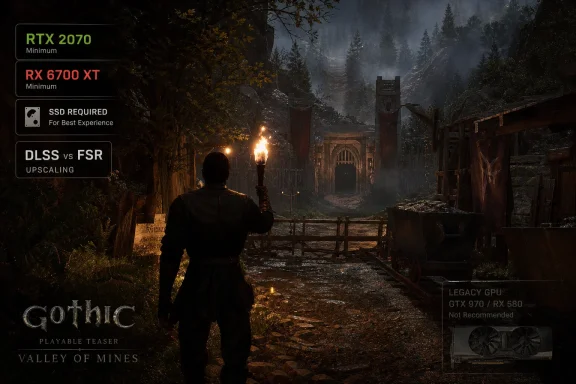
That is why the new PC requirements matter. A minimum spec calling for Windows 10 or 11, 16GB of RAM, DirectX 12, an SSD, and an RTX 2070 or RX 6700 XT-class graphics card is not a mere formality. It says the remake is built around assumptions that older mainstream PCs simply do not satisfy cleanly: fast asset streaming, modern shader pipelines, high-density geometry, and GPU features that became normal only after the Pascal and Polaris years.
The recommended tier pushes further, toward RTX 3070 Ti and Radeon RX 6800 XT-class hardware. That places Gothic 1 Remake in the same practical category as recent big-budget Unreal Engine projects: not impossible to run below spec, but increasingly unwilling to flatter hardware that lacks the memory bandwidth, VRAM, and architectural shortcuts newer engines expect.
The interesting twist is that the remake’s audience is unusually likely to include exactly the players most exposed by this shift. Gothic has a long tail among PC loyalists in Germany, Poland, Russia, and other enthusiast communities where old rigs, heavily modded installs, and patient hardware upgrades are part of the culture. This is not a franchise whose fans all arrive with fresh RTX 40-series cards and ultrawide OLED monitors.
That teaser created an expectation problem. It ran on older PCs well enough for many players to imagine the finished remake as a visually updated but broadly accessible return to the colony. Even if performance was uneven, the technological frame was familiar: Unreal Engine 4, conventional rendering assumptions, and a scope that seemed compatible with lower-end and midrange hardware.
The full project moved in a different direction. THQ Nordic founded Alkimia Interactive in Barcelona to build the remake properly, and as the project grew, the studio shifted from a proof-of-concept into a full-scale RPG production. The remake was no longer just a question of whether the Old Camp looked right. It had to sustain the Valley of Mines as a continuous world with modern lighting, dense vegetation, more detailed settlements, new combat systems, and more elaborate simulation.
That move eventually brought the project into Unreal Engine 5. The engine change is the hinge of the whole hardware discussion. UE5 gives developers a path to richer worlds, more convincing lighting, and more granular environmental detail, but it also tightens the noose around older GPUs, slow storage, and CPUs that already struggled with modern open-world scheduling.
This is the pattern PC players have seen across this generation. The marketing language says “scalable.” The benchmark tables reveal the caveat: scalable downward to a point, but not indefinitely. When a game’s world design assumes SSD streaming and a heavy DX12 renderer, the old model of turning everything to low and brute-forcing 1080p on a GTX 1060 starts to collapse.
The GTX 1060 and GTX 1660 are especially revealing because they represent two different flavors of legacy PC gaming. The GTX 1060 was the defining mainstream card of the late 2010s, a 1080p workhorse that survived far longer than NVIDIA probably expected. The GTX 1660 and 1660-class cards arrived later with improved efficiency, but without the dedicated reconstruction and ray-tracing hardware that increasingly shapes modern game settings.
In a current Unreal Engine 5 title, those cards are not just short on raw power. They are also missing the ecosystem advantages newer NVIDIA cards bring: DLSS support, more modern scheduling behavior, and a better fit for the way developers now think about image reconstruction. If a game leans on temporal upscaling as a normal part of the performance budget, a GTX card is excluded from the best version of that bargain.
AMD’s older cards face a different version of the same problem. The RX 5500 XT can be a capable 1080p card in older games, but its memory configurations, bandwidth limits, and lack of high-end headroom make it vulnerable in dense modern scenes. The RX 6700 XT, by contrast, is not just “newer”; it has the VRAM and raster performance to sit at the remake’s stated minimum line with far more credibility.
That distinction matters because the old language of “minimum requirements” has become muddy. In the DirectX 9 and DirectX 11 eras, minimum often meant ugly but tolerable. In today’s heaviest PC games, minimum can mean the lowest hardware on which the experience still resembles the developer’s intended product. Anything beneath that becomes an experiment.
That is where a lot of older GPUs run out of argument. A GTX 1060 may still launch the game, and it may still produce frames, but it is operating below the level the developers publicly designate as the floor. The result is rarely a graceful linear decline. Instead, players tend to see unstable frame pacing, harsh compromises in resolution scale, smeared temporal anti-aliasing, and big swings between enclosed areas and visually complex outdoor scenes.
The GTX 1660 occupies an awkward middle ground. It has enough muscle to avoid the worst-case behavior of the oldest mainstream cards, but it lacks DLSS and does not have the VRAM cushion or compute headroom that modern reconstruction-heavy pipelines reward. It is the kind of GPU that can make a game technically playable while constantly reminding the player that playability is not the same thing as comfort.
The RTX 2080 Ti is the counterexample that proves the point. It is old by calendar age, but not by class. With far more bandwidth, VRAM, and high-end raster performance than the mainstream cards of its era, it remains much better suited to a demanding remake. It also supports DLSS, which may be the single most important dividing line in this game for NVIDIA users.
That is the uncomfortable lesson for the legacy PC crowd. Generational age matters less than architectural fit and original market tier. A former flagship can survive a new engine generation in a way that a beloved mainstream card cannot.
Open-world games increasingly treat storage as part of the rendering pipeline. If assets cannot arrive quickly enough, the player sees late texture loads, traversal stutter, LOD pop, or momentary stalls that no graphics preset can fully cure. In an RPG like Gothic, where atmosphere depends on moving through camps, forests, caves, and settlements without the world visibly assembling itself in front of the player, those storage hiccups matter.
This is also where older test systems can produce misleading conclusions. A strong GPU paired with a slow SATA SSD or, worse, a hard drive may still show ugly frame pacing that looks like graphics weakness. Conversely, an older CPU can appear more viable when the storage subsystem is not adding its own delays. Benchmarking a modern UE5 game on legacy hardware is not just a GPU contest; it is a platform audit.
The original Gothic community knows this better than most. For decades, PC players have squeezed improbable life out of aging hardware with ini tweaks, unofficial patches, resolution hacks, and mod discipline. But there is no ini file that turns a mechanical drive into a modern streaming device. The remake’s SSD requirement is one of those lines that cannot be argued with nostalgically.
This matters more in Gothic 1 Remake than it might in a corridor shooter. The Valley of Mines is not just a backdrop; it is the game’s central argument. The camps, forests, barriers, ruins, and scavenger-haunted roads are supposed to make the player feel trapped inside a social and physical ecosystem. When low settings strip away depth, fog, shadow fidelity, and fine geometry, the loss is not cosmetic. It weakens the sense of place.
The most damaging compromises are often not the obvious ones. Players can tolerate lower-resolution textures more easily than they can tolerate unstable LOD transitions in a dense forest. They can live with less detailed shadows, but not with constant shimmer on branches, fences, and armor. A remake that depends on atmosphere can survive reduced fidelity; it struggles when the image becomes restless.
That is why benchmarks should not be read only as average FPS tables. A 45 FPS average with consistent frame pacing and stable reconstruction may feel better than a 60 FPS average punctuated by streaming hitches and shimmering foliage. In this game, image stability is part of performance.
That pattern will surprise very few PC graphics watchers. DLSS has become NVIDIA’s escape hatch for demanding games because it is not merely lowering resolution; it is reconstructing detail through a model trained to infer missing image information across frames. In foliage-heavy, high-contrast, geometry-dense environments, that can be the difference between a performance mode that looks acceptable and one that looks like the game has been smeared with wet glass.
The problem is that DLSS access is itself a hardware filter. GTX 1060 and GTX 1660 owners do not get to participate. They can use FSR if the game exposes it broadly, but the reported quality gap in Balanced mode means those users may gain performance at the cost of the very atmospheric detail the remake is trying to sell.
For AMD users, the story is more nuanced. FSR remains valuable because it is vendor-agnostic and gives a wider range of hardware a fighting chance. But if a game’s visual content punishes FSR with noisy foliage, unstable fine detail, and aggressive sharpening halos, then the experience becomes a trade-off rather than a clean rescue. The RX 6700 XT may have enough native strength to avoid leaning too heavily on the ugliest presets, while the RX 5500 XT may not.
The wider industry lesson is hard to miss. Upscaling is no longer an optional bonus feature. It is becoming part of the assumed performance budget, and the quality of that upscaler can define whether an older GPU feels viable. In Gothic 1 Remake, DLSS appears to be less a luxury than a practical dividing line.
The listed minimum processors, Intel’s Core i7-7700K and AMD’s Ryzen 5 1600X, are telling choices. They are not exotic chips, but they represent the point at which older quad-core and early mainstream multi-core systems begin to look vulnerable. The recommended Ryzen 5 3600X suggests the developers want a more modern six-core baseline for smoother behavior.
Legacy platforms such as Z97, X99, X370, and Z270 are useful for benchmarking precisely because they expose the messy reality of old PC ownership. A Haswell-era system with DDR3, an early DDR4 enthusiast platform, and a first-generation Ryzen board can all host GPUs that still seem respectable on paper. But modern games do not stress each platform equally.
Older Intel quad-cores can still post decent averages when lightly threaded, but they are increasingly exposed by background asset streaming, shader compilation, AI, physics, and operating-system overhead. Early Ryzen chips have more threads but weaker per-core performance and memory latency behavior than later Zen generations. The remake’s frame pacing may therefore depend less on heroic peak FPS and more on whether the CPU can keep feeding the renderer without interruptions.
That is the hidden cost of remaking a systemic RPG. You cannot modernize the world visually and behaviorally without increasing the amount of work happening outside the GPU. If Alkimia’s Valley of Mines feels alive, some old processors will pay for that life in stutter.
This distinction is important because PC communities often turn benchmark charts into moral judgments. A card either “runs the game” or it does not. In practice, a legacy GPU may become acceptable after a carefully chosen mix of medium shadows, lower foliage density, reduced volumetrics, restrained texture settings, and a conservative upscaling mode.
But Gothic 1 Remake is not equally sensitive to every setting. Reducing shadow quality may produce a large performance gain while leaving the mood mostly intact. Reducing view distance or foliage quality may damage exploration more obviously. Dropping texture quality below the VRAM comfort point may prevent stutter, but it can also make camps and armor look out of place in a world otherwise built for close inspection.
The smartest legacy-hardware approach is therefore not to drag every slider downward at once. It is to protect image stability first, maintain texture quality within VRAM limits, reduce the most expensive lighting and shadow options, and avoid upscaling presets that turn fine geometry into noise. A stable 40 to 50 FPS with coherent visuals may serve this kind of RPG better than a smeary 60.
That is another reason the RTX 2070-class minimum is meaningful. It gives the developers enough GPU to assume that players can preserve the game’s visual identity while trimming excess. Below that line, the tuning exercise becomes more desperate.
That will not land gently. For some fans, a remake of a 2001 game should feel accessible by default. They will look at the minimum requirements and see bloat, not ambition. They will ask why a game whose original environments ran on ancient hardware now demands an SSD and a GPU that was high-end not so long ago.
The counterargument is that this is not a remaster. It is a ground-up remake trying to make the colony legible to players accustomed to modern animation, lighting, combat feedback, and environmental density. If Alkimia had aimed lower, the same audience might have accused it of producing a timid modernization that failed to justify its existence.
That is the trap of remaking a cult classic. Preserve too much and you are selling nostalgia with new textures. Change too much and you are accused of misunderstanding the original. Modernize the technology and you alienate the hardware base that kept the old game alive. Refuse to modernize and the remake risks looking like a museum piece.
In that sense, the hardware controversy is not separate from the artistic one. It is the technical expression of the remake’s central compromise.
Windows 11 has become the practical baseline for many new PC games, even when Windows 10 remains officially supported. Driver maturity, shader cache behavior, security features, and scheduler changes can all influence performance on older systems. A GTX 1060 in a clean, updated Windows 11 installation may behave differently from the same card in a years-old Windows 10 build full of background utilities.
The driver situation matters too. Modern driver releases often optimize for current architectures and current games while merely preserving support for older ones. That does not mean older cards are abandoned overnight, but it does mean they rarely receive the same depth of tuning as newer GPUs. When a demanding UE5 title arrives, the oldest supported cards can find themselves functionally present but strategically deprioritized.
This is especially relevant for players who treat GPU age as the only variable. A legacy PC is a bundle of constraints: motherboard firmware, memory speed, PCIe generation, storage, thermals, drivers, operating system health, and background processes. The remake’s requirements compress all of those into one practical question: can the machine sustain a steady stream of work without choking?
For WindowsForum readers, that is the useful diagnostic frame. If Gothic 1 Remake stutters on an older rig, the GPU may be guilty, but it is not necessarily acting alone. The entire platform has to be treated as suspect.
For years, the GTX 1060 survived because developers still targeted the previous console generation, cross-gen production kept asset budgets restrained, and temporal upscalers were optional rather than central. That period is ending. New games built around current consoles, SSD streaming, and modern engine features increasingly treat those cards as below the line.
The irony is that the RTX 2080 Ti, a 2018 GPU, may age more gracefully than cheaper cards released later. Its original high-end status gives it enough raw capability and memory to remain useful in games that crush old midrange hardware. The lesson is not new, but UE5 makes it harsher: buying the lower midrange works wonderfully until an engine generation changes the rules.
AMD’s RX 6700 XT emerges as an important marker for the other side of the aisle. It is not new, but its 12GB configurations and strong raster performance make it one of the more credible “minimum modern” cards for demanding 1080p and 1440p gaming. That the remake names it at the minimum level says a lot about where developers believe the practical floor now sits.
This does not mean every new PC game will require an RTX 2070 or RX 6700 XT. It does mean that ambitious open-world projects are increasingly willing to say the quiet part aloud. The bottom of the PC audience is no longer guaranteed a good seat.
That does not absolve the game from optimization scrutiny. PC players are right to expect competent frame pacing, sensible shader compilation behavior, useful graphics menus, and upscalers that are implemented well rather than merely checked off in a feature list. “It is Unreal Engine 5” should not become a universal excuse for stutter or poor scalability.
But there is a difference between bad optimization and an ambitious baseline. A game can be both demanding and reasonably engineered. It can also be demanding and sloppy. The legacy benchmarks help expose which side of that line the remake occupies, but the broader hardware target is not mysterious: this is a game built for modern GPUs, SSDs, and reconstruction-aware rendering.
The painful part is that Gothic’s identity makes the trade-off emotionally charged. Fans do not merely want higher frame rates; they want the colony to feel like the colony. If achieving that means giving the Old Camp more believable lighting, denser clutter, richer materials, and more convincing simulation, many players will accept the cost. Others will reasonably ask why the remake could not scale more gracefully.
That argument will probably define the PC reception as much as combat changes or quest design. In 2026, performance is not a sidebar. It is part of the creative contract.
 The Remake Arrived With a Modern Engine’s Appetite
The original Gothic was never a lightweight game in spirit. Piranha Bytes’ 2001 RPG earned its reputation on a hostile living world, dense NPC routines, faction politics, and a refusal to make the player feel heroic too soon. The remake’s technical problem is that all of those qualities are more expensive to reproduce in 2026 than they were to imply in 2001.That is why the new PC requirements matter. A minimum spec calling for Windows 10 or 11, 16GB of RAM, DirectX 12, an SSD, and an RTX 2070 or RX 6700 XT-class graphics card is not a mere formality. It says the remake is built around assumptions that older mainstream PCs simply do not satisfy cleanly: fast asset streaming, modern shader pipelines, high-density geometry, and GPU features that became normal only after the Pascal and Polaris years.
The recommended tier pushes further, toward RTX 3070 Ti and Radeon RX 6800 XT-class hardware. That places Gothic 1 Remake in the same practical category as recent big-budget Unreal Engine projects: not impossible to run below spec, but increasingly unwilling to flatter hardware that lacks the memory bandwidth, VRAM, and architectural shortcuts newer engines expect.
The interesting twist is that the remake’s audience is unusually likely to include exactly the players most exposed by this shift. Gothic has a long tail among PC loyalists in Germany, Poland, Russia, and other enthusiast communities where old rigs, heavily modded installs, and patient hardware upgrades are part of the culture. This is not a franchise whose fans all arrive with fresh RTX 40-series cards and ultrawide OLED monitors.
The 2019 Teaser Promised Access; the 2026 Game Demands Throughput
The benchmark story begins in December 2019, when THQ Nordic released the Gothic Playable Teaser as a public experiment. It was an unusual move: a publisher effectively asking the old fanbase whether it wanted a remake and whether the proposed direction felt right. The teaser was built in Unreal Engine 4, distributed through Steam to owners of Piranha Bytes and Gothic titles, and designed less as a finished product than as a referendum.That teaser created an expectation problem. It ran on older PCs well enough for many players to imagine the finished remake as a visually updated but broadly accessible return to the colony. Even if performance was uneven, the technological frame was familiar: Unreal Engine 4, conventional rendering assumptions, and a scope that seemed compatible with lower-end and midrange hardware.
The full project moved in a different direction. THQ Nordic founded Alkimia Interactive in Barcelona to build the remake properly, and as the project grew, the studio shifted from a proof-of-concept into a full-scale RPG production. The remake was no longer just a question of whether the Old Camp looked right. It had to sustain the Valley of Mines as a continuous world with modern lighting, dense vegetation, more detailed settlements, new combat systems, and more elaborate simulation.
That move eventually brought the project into Unreal Engine 5. The engine change is the hinge of the whole hardware discussion. UE5 gives developers a path to richer worlds, more convincing lighting, and more granular environmental detail, but it also tightens the noose around older GPUs, slow storage, and CPUs that already struggled with modern open-world scheduling.
This is the pattern PC players have seen across this generation. The marketing language says “scalable.” The benchmark tables reveal the caveat: scalable downward to a point, but not indefinitely. When a game’s world design assumes SSD streaming and a heavy DX12 renderer, the old model of turning everything to low and brute-forcing 1080p on a GTX 1060 starts to collapse.
Legacy GPUs Are No Longer Merely Slow; They Are Feature-Mismatched
The GameGPU legacy test is valuable because it examines the cards many real players still own rather than only the cards reviewers prefer to benchmark. The lineup described ranges from NVIDIA’s GTX 1060 and GTX 1660 through higher-end Turing-era hardware such as the RTX 2080 Ti, and from AMD’s RX 5500 XT up through the RX 6700 XT. That spread is more useful than another chart showing an RTX 4090 flattening the game at 4K.The GTX 1060 and GTX 1660 are especially revealing because they represent two different flavors of legacy PC gaming. The GTX 1060 was the defining mainstream card of the late 2010s, a 1080p workhorse that survived far longer than NVIDIA probably expected. The GTX 1660 and 1660-class cards arrived later with improved efficiency, but without the dedicated reconstruction and ray-tracing hardware that increasingly shapes modern game settings.
In a current Unreal Engine 5 title, those cards are not just short on raw power. They are also missing the ecosystem advantages newer NVIDIA cards bring: DLSS support, more modern scheduling behavior, and a better fit for the way developers now think about image reconstruction. If a game leans on temporal upscaling as a normal part of the performance budget, a GTX card is excluded from the best version of that bargain.
AMD’s older cards face a different version of the same problem. The RX 5500 XT can be a capable 1080p card in older games, but its memory configurations, bandwidth limits, and lack of high-end headroom make it vulnerable in dense modern scenes. The RX 6700 XT, by contrast, is not just “newer”; it has the VRAM and raster performance to sit at the remake’s stated minimum line with far more credibility.
That distinction matters because the old language of “minimum requirements” has become muddy. In the DirectX 9 and DirectX 11 eras, minimum often meant ugly but tolerable. In today’s heaviest PC games, minimum can mean the lowest hardware on which the experience still resembles the developer’s intended product. Anything beneath that becomes an experiment.
The RTX 2070 Minimum Is a Line in the Sand
A minimum requirement of RTX 2070 or RX 6700 XT is unusually aggressive for a remake of a 25-year-old RPG, but it is not arbitrary. It reflects the cost of reinterpreting a compact, systemic early-2000s world through a 2026 visual pipeline. The remake is not simply drawing sharper rocks. It is paying for denser environments, heavier lighting, more complex materials, and a world that has to stream and animate convincingly around the player.That is where a lot of older GPUs run out of argument. A GTX 1060 may still launch the game, and it may still produce frames, but it is operating below the level the developers publicly designate as the floor. The result is rarely a graceful linear decline. Instead, players tend to see unstable frame pacing, harsh compromises in resolution scale, smeared temporal anti-aliasing, and big swings between enclosed areas and visually complex outdoor scenes.
The GTX 1660 occupies an awkward middle ground. It has enough muscle to avoid the worst-case behavior of the oldest mainstream cards, but it lacks DLSS and does not have the VRAM cushion or compute headroom that modern reconstruction-heavy pipelines reward. It is the kind of GPU that can make a game technically playable while constantly reminding the player that playability is not the same thing as comfort.
The RTX 2080 Ti is the counterexample that proves the point. It is old by calendar age, but not by class. With far more bandwidth, VRAM, and high-end raster performance than the mainstream cards of its era, it remains much better suited to a demanding remake. It also supports DLSS, which may be the single most important dividing line in this game for NVIDIA users.
That is the uncomfortable lesson for the legacy PC crowd. Generational age matters less than architectural fit and original market tier. A former flagship can survive a new engine generation in a way that a beloved mainstream card cannot.
The SSD Requirement Is Not Decoration
The storage requirement may look less glamorous than the GPU line, but it is arguably just as important. The remake’s stated need for an SSD, with NVMe recommended, points to a world that expects rapid streaming of geometry, textures, animation data, and scene assets. This is no longer the era where a hard drive merely stretches loading screens.Open-world games increasingly treat storage as part of the rendering pipeline. If assets cannot arrive quickly enough, the player sees late texture loads, traversal stutter, LOD pop, or momentary stalls that no graphics preset can fully cure. In an RPG like Gothic, where atmosphere depends on moving through camps, forests, caves, and settlements without the world visibly assembling itself in front of the player, those storage hiccups matter.
This is also where older test systems can produce misleading conclusions. A strong GPU paired with a slow SATA SSD or, worse, a hard drive may still show ugly frame pacing that looks like graphics weakness. Conversely, an older CPU can appear more viable when the storage subsystem is not adding its own delays. Benchmarking a modern UE5 game on legacy hardware is not just a GPU contest; it is a platform audit.
The original Gothic community knows this better than most. For decades, PC players have squeezed improbable life out of aging hardware with ini tweaks, unofficial patches, resolution hacks, and mod discipline. But there is no ini file that turns a mechanical drive into a modern streaming device. The remake’s SSD requirement is one of those lines that cannot be argued with nostalgically.
Low Settings Preserve the Game, Not the Illusion
The supplied review material describes the minimum settings as playable but visibly compromised, and that is exactly what one should expect from a modern remake forced below its comfort zone. Lighting becomes flatter, shadows lose softness and structure, distant objects drop into simpler models, and atmospheric effects are pared back. The game remains Gothic, but the world no longer has the same visual authority.This matters more in Gothic 1 Remake than it might in a corridor shooter. The Valley of Mines is not just a backdrop; it is the game’s central argument. The camps, forests, barriers, ruins, and scavenger-haunted roads are supposed to make the player feel trapped inside a social and physical ecosystem. When low settings strip away depth, fog, shadow fidelity, and fine geometry, the loss is not cosmetic. It weakens the sense of place.
The most damaging compromises are often not the obvious ones. Players can tolerate lower-resolution textures more easily than they can tolerate unstable LOD transitions in a dense forest. They can live with less detailed shadows, but not with constant shimmer on branches, fences, and armor. A remake that depends on atmosphere can survive reduced fidelity; it struggles when the image becomes restless.
That is why benchmarks should not be read only as average FPS tables. A 45 FPS average with consistent frame pacing and stable reconstruction may feel better than a 60 FPS average punctuated by streaming hitches and shimmering foliage. In this game, image stability is part of performance.
DLSS Turns Reconstruction Into a Class Divide
The upscaling comparison is one of the most important parts of the legacy-hardware story. According to the review material, standard anti-aliasing without scaling produces a soft image, while FSR Balanced introduces more visible instability and sharpening artifacts in complex scenes. DLSS Balanced, by contrast, reportedly preserves more detail and avoids much of the noise seen in AMD’s competing reconstruction path.That pattern will surprise very few PC graphics watchers. DLSS has become NVIDIA’s escape hatch for demanding games because it is not merely lowering resolution; it is reconstructing detail through a model trained to infer missing image information across frames. In foliage-heavy, high-contrast, geometry-dense environments, that can be the difference between a performance mode that looks acceptable and one that looks like the game has been smeared with wet glass.
The problem is that DLSS access is itself a hardware filter. GTX 1060 and GTX 1660 owners do not get to participate. They can use FSR if the game exposes it broadly, but the reported quality gap in Balanced mode means those users may gain performance at the cost of the very atmospheric detail the remake is trying to sell.
For AMD users, the story is more nuanced. FSR remains valuable because it is vendor-agnostic and gives a wider range of hardware a fighting chance. But if a game’s visual content punishes FSR with noisy foliage, unstable fine detail, and aggressive sharpening halos, then the experience becomes a trade-off rather than a clean rescue. The RX 6700 XT may have enough native strength to avoid leaning too heavily on the ugliest presets, while the RX 5500 XT may not.
The wider industry lesson is hard to miss. Upscaling is no longer an optional bonus feature. It is becoming part of the assumed performance budget, and the quality of that upscaler can define whether an older GPU feels viable. In Gothic 1 Remake, DLSS appears to be less a luxury than a practical dividing line.
The CPU Story Is About Simulation, Not Just Frames
Graphics cards will dominate the conversation, but older CPUs deserve equal suspicion. The remake is trying to preserve one of Gothic’s defining traits: a world of NPCs with schedules, factions, routines, and relationships that make the colony feel inhabited rather than staged. That kind of design creates CPU pressure in ways a simpler action game might not.The listed minimum processors, Intel’s Core i7-7700K and AMD’s Ryzen 5 1600X, are telling choices. They are not exotic chips, but they represent the point at which older quad-core and early mainstream multi-core systems begin to look vulnerable. The recommended Ryzen 5 3600X suggests the developers want a more modern six-core baseline for smoother behavior.
Legacy platforms such as Z97, X99, X370, and Z270 are useful for benchmarking precisely because they expose the messy reality of old PC ownership. A Haswell-era system with DDR3, an early DDR4 enthusiast platform, and a first-generation Ryzen board can all host GPUs that still seem respectable on paper. But modern games do not stress each platform equally.
Older Intel quad-cores can still post decent averages when lightly threaded, but they are increasingly exposed by background asset streaming, shader compilation, AI, physics, and operating-system overhead. Early Ryzen chips have more threads but weaker per-core performance and memory latency behavior than later Zen generations. The remake’s frame pacing may therefore depend less on heroic peak FPS and more on whether the CPU can keep feeding the renderer without interruptions.
That is the hidden cost of remaking a systemic RPG. You cannot modernize the world visually and behaviorally without increasing the amount of work happening outside the GPU. If Alkimia’s Valley of Mines feels alive, some old processors will pay for that life in stutter.
Maximum Settings Are a Benchmarking Tool, Not a Buying Guide
The supplied benchmarks were conducted at maximum graphics quality, which is useful for comparing GPUs under a consistent heavy load. It is less useful as a prescription for how owners of older cards should actually play. Maximum settings are where engines reveal their appetite; optimized settings are where players find sanity.This distinction is important because PC communities often turn benchmark charts into moral judgments. A card either “runs the game” or it does not. In practice, a legacy GPU may become acceptable after a carefully chosen mix of medium shadows, lower foliage density, reduced volumetrics, restrained texture settings, and a conservative upscaling mode.
But Gothic 1 Remake is not equally sensitive to every setting. Reducing shadow quality may produce a large performance gain while leaving the mood mostly intact. Reducing view distance or foliage quality may damage exploration more obviously. Dropping texture quality below the VRAM comfort point may prevent stutter, but it can also make camps and armor look out of place in a world otherwise built for close inspection.
The smartest legacy-hardware approach is therefore not to drag every slider downward at once. It is to protect image stability first, maintain texture quality within VRAM limits, reduce the most expensive lighting and shadow options, and avoid upscaling presets that turn fine geometry into noise. A stable 40 to 50 FPS with coherent visuals may serve this kind of RPG better than a smeary 60.
That is another reason the RTX 2070-class minimum is meaningful. It gives the developers enough GPU to assume that players can preserve the game’s visual identity while trimming excess. Below that line, the tuning exercise becomes more desperate.
The Remake Exposes a Cultural Rift in PC Gaming
There is a cultural sting here that pure benchmarks do not capture. Gothic is a PC-first legend, born in an era when the platform’s rough edges were part of the charm. Its fans have spent decades tolerating clumsy controls, brittle quests, community patches, and technical eccentricity because the world itself felt uncompromised. Now the remake asks some of those same players to accept a different kind of uncompromising design: one that leaves older PCs behind.That will not land gently. For some fans, a remake of a 2001 game should feel accessible by default. They will look at the minimum requirements and see bloat, not ambition. They will ask why a game whose original environments ran on ancient hardware now demands an SSD and a GPU that was high-end not so long ago.
The counterargument is that this is not a remaster. It is a ground-up remake trying to make the colony legible to players accustomed to modern animation, lighting, combat feedback, and environmental density. If Alkimia had aimed lower, the same audience might have accused it of producing a timid modernization that failed to justify its existence.
That is the trap of remaking a cult classic. Preserve too much and you are selling nostalgia with new textures. Change too much and you are accused of misunderstanding the original. Modernize the technology and you alienate the hardware base that kept the old game alive. Refuse to modernize and the remake risks looking like a museum piece.
In that sense, the hardware controversy is not separate from the artistic one. It is the technical expression of the remake’s central compromise.
Windows 11, Drivers, and the New Baseline for Old Rigs
The test configuration described in the source material uses Windows 11 25H2, modern NVIDIA and AMD driver branches, and MSI Afterburner for monitoring. That may sound like routine methodology, but it points to a larger issue: legacy hardware is increasingly tested inside a modern software stack that was not designed around it.Windows 11 has become the practical baseline for many new PC games, even when Windows 10 remains officially supported. Driver maturity, shader cache behavior, security features, and scheduler changes can all influence performance on older systems. A GTX 1060 in a clean, updated Windows 11 installation may behave differently from the same card in a years-old Windows 10 build full of background utilities.
The driver situation matters too. Modern driver releases often optimize for current architectures and current games while merely preserving support for older ones. That does not mean older cards are abandoned overnight, but it does mean they rarely receive the same depth of tuning as newer GPUs. When a demanding UE5 title arrives, the oldest supported cards can find themselves functionally present but strategically deprioritized.
This is especially relevant for players who treat GPU age as the only variable. A legacy PC is a bundle of constraints: motherboard firmware, memory speed, PCIe generation, storage, thermals, drivers, operating system health, and background processes. The remake’s requirements compress all of those into one practical question: can the machine sustain a steady stream of work without choking?
For WindowsForum readers, that is the useful diagnostic frame. If Gothic 1 Remake stutters on an older rig, the GPU may be guilty, but it is not necessarily acting alone. The entire platform has to be treated as suspect.
The Valley of Mines Becomes a Benchmark for 2026 PC Reality
There is a temptation to view this as a niche RPG story, relevant only to long-time Gothic fans. That would be a mistake. The remake is another sign that PC gaming’s mainstream hardware floor has moved, and that the old 1080p legends are finally losing their claim to universality.For years, the GTX 1060 survived because developers still targeted the previous console generation, cross-gen production kept asset budgets restrained, and temporal upscalers were optional rather than central. That period is ending. New games built around current consoles, SSD streaming, and modern engine features increasingly treat those cards as below the line.
The irony is that the RTX 2080 Ti, a 2018 GPU, may age more gracefully than cheaper cards released later. Its original high-end status gives it enough raw capability and memory to remain useful in games that crush old midrange hardware. The lesson is not new, but UE5 makes it harsher: buying the lower midrange works wonderfully until an engine generation changes the rules.
AMD’s RX 6700 XT emerges as an important marker for the other side of the aisle. It is not new, but its 12GB configurations and strong raster performance make it one of the more credible “minimum modern” cards for demanding 1080p and 1440p gaming. That the remake names it at the minimum level says a lot about where developers believe the practical floor now sits.
This does not mean every new PC game will require an RTX 2070 or RX 6700 XT. It does mean that ambitious open-world projects are increasingly willing to say the quiet part aloud. The bottom of the PC audience is no longer guaranteed a good seat.
Alkimia Chose Atmosphere Over Backward Compatibility
The most charitable reading of the remake’s hardware demands is that Alkimia made a coherent choice. It could chase maximum compatibility and risk sanding down the world, or it could prioritize a denser, darker, more atmospheric colony and accept that older machines would suffer. The final requirements suggest the studio chose the latter.That does not absolve the game from optimization scrutiny. PC players are right to expect competent frame pacing, sensible shader compilation behavior, useful graphics menus, and upscalers that are implemented well rather than merely checked off in a feature list. “It is Unreal Engine 5” should not become a universal excuse for stutter or poor scalability.
But there is a difference between bad optimization and an ambitious baseline. A game can be both demanding and reasonably engineered. It can also be demanding and sloppy. The legacy benchmarks help expose which side of that line the remake occupies, but the broader hardware target is not mysterious: this is a game built for modern GPUs, SSDs, and reconstruction-aware rendering.
The painful part is that Gothic’s identity makes the trade-off emotionally charged. Fans do not merely want higher frame rates; they want the colony to feel like the colony. If achieving that means giving the Old Camp more believable lighting, denser clutter, richer materials, and more convincing simulation, many players will accept the cost. Others will reasonably ask why the remake could not scale more gracefully.
That argument will probably define the PC reception as much as combat changes or quest design. In 2026, performance is not a sidebar. It is part of the creative contract.
The Colony’s New Admission Price Is Written in Silicon
The practical conclusions are clear enough for anyone deciding whether to install the game on an older Windows box. The remake may run below its stated requirements, but the experience changes character quickly as hardware drops away from the RTX 2070 and RX 6700 XT class. The most important dividing lines are not just average FPS, but VRAM, storage speed, CPU consistency, and access to high-quality reconstruction.- Players with GTX 1060-class hardware should expect severe compromises, especially in image stability, resolution scale, and complex outdoor scenes.
- Players with GTX 1660-class hardware may find a playable path at low or carefully tuned settings, but the lack of DLSS is a major disadvantage.
- RTX 2080 Ti owners are in a much stronger position than the card’s age suggests, largely because former flagship hardware still has the bandwidth and feature support modern games reward.
- RX 5500 XT-class cards sit below the remake’s apparent comfort zone and are likely to depend heavily on reductions that damage the game’s presentation.
- RX 6700 XT-class cards represent the more realistic AMD floor for preserving both performance and the remake’s intended atmosphere.
- An SSD should be treated as mandatory in practice, because storage-related stutter can undermine the experience even when the GPU seems adequate.
References
- Primary source: GameGPU
Published: 2026-06-06T19:10:09.336009
Gothic 1 Remake: Legacy Hardware Benchmarks
We conducted comprehensive performance benchmarking Gothic 1 Remake на эффектных генераторов и видеокартах в роздільніх здатности екрану 1080п и 1440п.en.gamegpu.com
- Related coverage: pcgamer.com
Gothic Remake launch times and release date | PC Gamer
Find out when the Gothic Remake launches in your region so you can make a living in Khorinis as the Nameless Hero.www.pcgamer.com - Related coverage: techspot.com
THQ Nordic launches a playable teaser for a potential Gothic remake | TechSpot
These sequels vary quite a bit in terms of quality, but there's a reason this style of game continues to persist in the form of Elex or...www.techspot.com - Related coverage: screenrant.com
THQ Nordic Releases Gothic Playable Teaser And Asks If Fans Want More
THQ Nordic just released a playable teaser on their Steam page for a potential upcoming remake of the fan-favorite 2001 role-playing game Gothic. screenrant.com
- Related coverage: engadget.com
THQ Nordic drops a playable trailer for a potential 'Gothic' remake
THQ Nordic is testing the waters for a possible reboot of the 2001 fantasy RPG Gothic with a playable trailer. It's hoping for feedback from players on whether it should go ahead with a full rework. The prototype, which is called Gothic Playable Teaser, is free for those who own a game from...www.engadget.com - Related coverage: store.steampowered.com
Gothic 1 Remake no Steam
O regresso de uma lenda - Retorna ao Vale das Minas neste remake fiel do RPG clássico que definiu um género. Explora um mundo aberto orgânico e criado à mão que reage de forma dinâmica às tuas ações numa experiência ímpar e sem restrições.store.steampowered.com
- Related coverage: kitguru.net
THQ Nordic has made a playable teaser for a remake of Gothic | KitGuru
Gothic is an ARPG made by the German studio Piranha Bytes, which launched back in 2001. Earlier thiswww.kitguru.net - Related coverage: keengamer.com
Gothic 1 Remake – PC System Requirements
Review the official Gothic 1 Remake PC system requirements. Compare minimum and recommended specs and see how DLSS 4.5 improves 4K frames.www.keengamer.com - Related coverage: gothic.wiki
- Related coverage: heise.de
"Gothic 1 Remake" will be released on June 5 | heise online
THQ Nordic has set a new release date for the remake of "Gothic 1": the role-playing game is scheduled to be released on June 5, 2026. www.heise.de
- Related coverage: rpgamer.com
THQ Nordic Reimagines Gothic in Playable Teaser - RPGamer
2001 action RPG Gothic may have an opportunity for a full-fledged remake, courtesy of THQ Nordic. Fans who've tried the free playable teaser can let the publisher know of their interest.rpgamer.com - Related coverage: thqnordic.com
- Related coverage: techradar.com
Before The Witcher there was Gothic — and now we know exactly when this legendary RPG is coming back in a new remake | TechRadar
The first gameplay trailer for the Gothic remake has given us a look at some its new features.www.techradar.com
