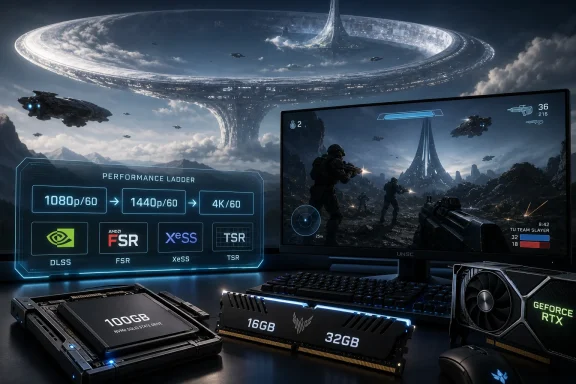
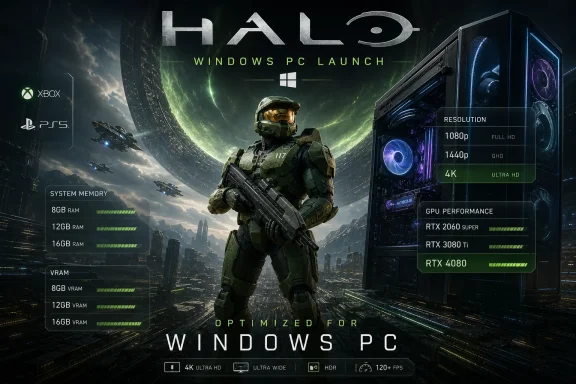
Halo Studios has revealed PC requirements for Halo: Campaign Evolved, launching July 28, 2026, on PlayStation 5, Xbox Series X|S, Windows PC, and Steam, with specs ranging from RTX 2060 Super-class hardware at 1080p to an RTX 4080 for 4K Ultra at 60FPS. The table is less a surprise than a statement of intent: this is not a light-touch nostalgia package. Microsoft is selling Halo’s origin story as a modern cross-platform showcase, and that means heavier GPUs, bigger SSD footprints, account requirements, and a new kind of platform politics. For Windows gamers, the real story is not whether the Master Chief can still sell a remake; it is how expensive Microsoft’s new “play anywhere” Halo actually becomes once the hardware and identity layers are counted.
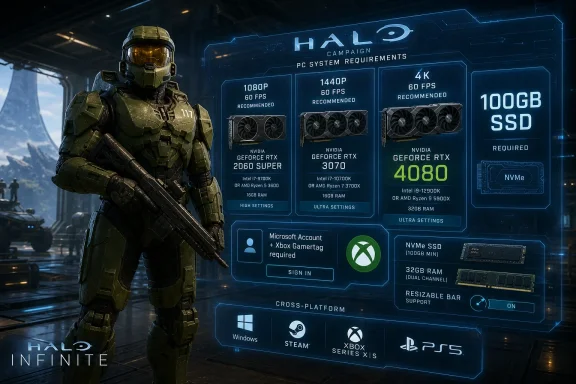
The headline spec is the Ultra tier. Halo Studios lists an AMD Ryzen 9 7900X or Intel Core i9-13900K, 32GB of RAM, 16GB of VRAM, and an Nvidia GeForce RTX 4080 for 4K at 60FPS on Ultra. That is not an absurd enthusiast target in 2026, but it is a very clear signal that Campaign Evolved is being positioned as a high-end PC release rather than a conservative remaster dressed in nicer textures.
The Low tier is more forgiving, but only up to a point. A Ryzen 5 3600 or Core i7-10700K paired with an RTX 2060 Super, Radeon RX 6600, or Intel Arc A580 is the floor for 1080p at 60FPS. That means the remake still welcomes a fair amount of last-generation PC hardware, but it does not pretend that integrated graphics, aging GTX cards, or budget laptops are part of the intended audience.
The Medium tier moves to 1440p at 60FPS with a Ryzen 7 5700X or Core i5-12600K and an RTX 3070 or Radeon RX 7600 XT. The High tier, marked as recommended for 4K at 60FPS, asks for a Ryzen 7 7700 or Core i7-12700K, 32GB of RAM, and a GPU in the RTX 3080 Ti or Radeon RX 9070 class. In other words, the spec sheet’s center of gravity is not 1080p; it is 1440p and 4K.
That matters because Halo has historically been a console-first franchise that became a PC institution through persistence, modding, and sheer cultural gravity. Halo: Combat Evolved helped define the original Xbox in 2001, but its PC afterlife was long and scrappy. Campaign Evolved arrives in a different world, where PC players expect ultrawide support, flexible frame rates, upscaling options, low-latency paths, and clear performance disclosure before they hand over money.
The uncomfortable gap is that a requirements table is still not a benchmark. Halo Studios’ numbers tell players what class of machine to own, but not enough about how those numbers were produced. Was 4K rendered natively? Was upscaling assumed? Is ray tracing enabled at High or Ultra? What does “60FPS” mean in practice: average frame rate, near-locked delivery, or something closer to a marketing target?
That ambiguity has become the defining annoyance of modern PC game launches. Studios now publish spec grids that look precise but often conceal the assumptions that matter most. A 4K output image created with DLSS Quality is not the same workload as native 4K, and a game using aggressive dynamic resolution is not making the same promise as one holding a fixed pixel count.
That scope gives the project permission to demand more from hardware. A rebuilt campaign can push lighting, geometry, materials, animation, and effects in ways that a remaster cannot. It also creates a trap: the more Microsoft markets this as a modern Halo, the more players will judge it against modern PC shooters rather than the sentimental memory of stepping onto Installation 04 for the first time.
The 100GB SSD requirement is part of that shift. For a campaign-focused remake, 100GB is large enough to invite grumbling, especially from players managing fast but finite NVMe drives. It is not shocking in the age of high-resolution assets, but it does underline how far the economics of installation size have drifted from the era when Halo was passed around on discs and LAN-party bravado.
The SSD requirement also quietly retires another old PC gaming assumption. This is not a game built around spinning hard drives and patient loading screens. Whether the engine leans on streaming assets, high-resolution textures, or decompression pipelines, Halo Studios is drawing a line: fast storage is part of the baseline platform now.
For WindowsForum readers, the operating system line is equally telling. The game lists Windows 10 22H2 64-bit and Windows 11, with Resizable BAR recommended. That keeps Windows 10 users in the tent, at least for this release, but the wording makes clear where Microsoft would prefer the enthusiast audience to be. Windows 11 remains the cleaner marketing fit for current gaming PCs, even when Windows 10 continues to function as the stubborn installed base Microsoft cannot wish away.
Resizable BAR is a small phrase with a bigger implication. PC performance is no longer just about buying a GPU and installing a driver. Firmware settings, motherboard support, platform generation, GPU memory behavior, shader compilation, storage speed, and OS scheduling all feed into the experience. A modern PC game’s “minimum” requirement increasingly assumes the user has done a quiet amount of platform maintenance.
From Microsoft’s perspective, the logic is obvious. Cross-play and cross-progression need a common account layer. Achievements, social identity, saved progression, moderation, friend lists, and entitlement management all become simpler if every player exists inside Microsoft’s service graph. The Xbox console is no longer the boundary of Xbox; the account is.
From the player’s perspective, the feeling is less elegant. A Steam user who buys a game on Steam may not appreciate being told that Steam is only the storefront and launcher, while Xbox identity remains the passport. A PlayStation user encountering Halo for the first time may reasonably wonder why Microsoft gets to sit between them and a campaign they bought on Sony’s console.
This is the bargain of Microsoft’s multiplatform era. Xbox games can travel to PlayStation, but they do not arrive as culturally neutral objects. They bring Xbox services with them. That may be acceptable for online co-op and shared progression, but it becomes more contentious when the requirement touches solo play or local couch co-op.
The split-screen account story has already been messy. Reports around the community Q&A initially suggested that PlayStation 5 split-screen would require both players to have PlayStation accounts, linked Microsoft accounts, and PlayStation Plus subscriptions. Subsequent discussion and clarification indicated that PlayStation Plus was not required for local split-screen, but that each local player still needed the relevant platform and Microsoft account linkage.
That correction matters, but so does the confusion. Halo’s couch co-op legacy is built on immediacy: hand someone a controller, pick a profile, and start arguing over who gets the sniper rifle. The more account scaffolding surrounds that ritual, the more it feels like the past has been reconstructed by a compliance department.
That does not mean Xbox hardware is irrelevant, but it does mean the old tribal map has been redrawn. Halo used to be the clearest answer to why someone needed an Xbox. Now Microsoft is betting that Halo can strengthen Xbox as a service brand even when played on Sony’s console. The platform holder is becoming a publisher without fully abandoning the habits of a platform holder.
There is a tension in that identity. Microsoft wants the reach of Steam and PlayStation, the subscription leverage of Game Pass, the social graph of Xbox Live, and the premium optics of a major first-party launch. Each layer is defensible on its own. Together, they can make a game feel less like a product and more like a stack of commercial obligations.
For PlayStation players, the account requirement will be the most visible reminder that Halo remains Microsoft territory. Even if the game runs beautifully on PS5, even if cross-play works, even if the campaign is excellent, the login step will carry symbolic weight. It says: you are welcome here, but you are entering through our door.
For Xbox players, the symbolism cuts the other way. Seeing Halo ship day-and-date on PlayStation may still sting for those who built their console identity around exclusives. Microsoft has spent years telling customers that the future of Xbox is not locked to one box under the television. Campaign Evolved turns that corporate line into something emotionally tangible.
For PC players, this is less shocking. Halo has lived on Windows for decades in one form or another, and Steam users have already navigated Microsoft account requirements in Halo: The Master Chief Collection and Halo Infinite. The difference now is that PC is no longer the odd expansion of a console franchise; it is one of the central platforms Microsoft is designing around.
That is not inherently bad. PC gaming has always included the thrill of hardware ambition, and a flagship remake should be allowed to look expensive. The problem comes when the emotional pitch is “return to the classic” while the technical pitch is “replace half your rig.” Players who remember Halo as a social, accessible, endlessly replayable campaign may find the 2026 version filtered through GPU tiers and account dependencies.
The Low tier is therefore crucial. If Halo Studios can deliver a stable, good-looking 1080p experience on RTX 2060 Super-class hardware, the remake will have a broad enough PC base to avoid feeling like a boutique tech demo. If that tier struggles with stutter, shader compilation hitches, or compromised image quality, the conversation will turn quickly from celebration to skepticism.
The 8GB VRAM minimum is also a sign of the times. For years, 8GB cards were treated as sensible midrange purchases. In newer PC releases, they increasingly occupy the edge of acceptability rather than the comfort zone. Campaign Evolved putting 8GB at Low and Medium but 16GB at High and Ultra suggests texture quality and resolution will be a major dividing line.
That makes the RTX 3070’s position interesting. It appears in the Medium tier for 1440p at 60FPS, despite its 8GB VRAM configuration in many models. That may be reassuring for a large installed base, but it also raises the usual question of whether nominal performance will hold up once high-resolution textures, traversal, effects-heavy combat, and co-op chaos enter the picture.
The 32GB RAM recommendation for 4K is less controversial now than it would have been a few years ago. Enthusiast PCs have largely moved in that direction, and DDR5 platforms have made 32GB a common build target. Still, it marks another psychological step away from the 16GB era that many Windows gamers hoped would last longer.
Unreal Engine 5 can produce lavish lighting, dense geometry, and cinematic environments. It can also produce shader stutter, uneven traversal performance, CPU bottlenecks, and heavy GPU demands when developers do not tame it carefully. PC players have learned to ask not just “is it UE5?” but “how well has this studio handled UE5?”
For Halo, the stakes are unusually high. The original game’s combat rhythm depends on readability: clean silhouettes, predictable physics, legible arenas, and encounters that feel tactical rather than noisy. A technically extravagant remake that muddies those qualities would miss the point. The campaign does not merely need to look modern; it needs to preserve the precision that made the original endure.
The best version of Campaign Evolved would use modern rendering to deepen atmosphere without overwhelming combat clarity. Halo’s art direction has always depended on strong color separation, alien architecture, and the contrast between military hardware and impossible landscapes. If Unreal Engine 5 helps the ring feel vast and strange again, the hardware cost becomes easier to defend.
The worst version would be a familiar modern PC launch: impressive screenshots, inconsistent frame pacing, compilation stutter, vague upscaling assumptions, and a day-one patch treated as a performance plan. Halo Studios cannot afford that. This is not a minor franchise experiment; it is Microsoft reintroducing one of gaming’s most recognizable campaigns to every major current platform.
That is why the spec sheet should be read as a promise the studio now has to keep. The numbers are high enough to create expectations of polish. If you ask for an RTX 4080 at Ultra, you are telling the enthusiast audience that you know exactly what you are doing.
The more difficult group is the 4K audience. High and Ultra both target 4K at 60FPS, but the GPU jump from RTX 3080 Ti to RTX 4080 implies a meaningful visual or performance delta. Without detailed disclosure, players will not know whether Ultra mainly increases shadow resolution and draw distance or whether it enables costly lighting features that dramatically alter frame pacing.
This is where Microsoft and Halo Studios could do themselves a favor before launch. A good PC blog post would explain upscaling modes, frame generation support, ray tracing settings, shader compilation behavior, ultrawide handling, HDR calibration, FOV ranges, mouse input, controller aim assist boundaries, and Steam Deck or handheld expectations. PC players do not need every secret, but they do need enough transparency to make informed choices.
The Windows 10 support line deserves attention as well. Windows 10 22H2 remains listed, which is good news for users who have not moved to Windows 11. But the broader PC gaming ecosystem is gradually optimizing around newer drivers, firmware expectations, security features, and scheduler behavior. If you are building or refreshing a machine for games like this, Windows 11 is clearly where Microsoft wants the future to live.
Resizable BAR being recommended should also push users to check BIOS settings before launch week. Many capable PCs leave performance on the table because firmware features are disabled, outdated, or never configured after a GPU upgrade. The modern Windows gaming checklist is no longer just “install latest driver.” It is “update BIOS, enable the right PCIe features, verify memory profile, check storage health, and then install latest driver.”
That may sound tedious, but it is the reality of high-end PC gaming in 2026. The platform offers flexibility and scale, but it also asks users to be their own technicians. Halo returning to PC as a showcase only sharpens that bargain.
That is why the account requirements matter beyond the usual anti-login grumbling. Local co-op is supposed to be the least bureaucratic form of multiplayer. It is the mode that should survive when servers are busy, subscriptions lapse, and friend lists fail to sync. When local play requires multiple accounts and cross-platform identity linkage, it stops feeling local in the old sense.
Microsoft would argue that modern co-op is inseparable from modern identity. Cross-progression requires knowing who earned what. Cross-play requires consistent trust and safety systems. Shared saves, achievements, entitlements, and moderation all benefit from authenticated players. In a connected ecosystem, anonymous Player Two is an edge case.
But Halo was built on edge cases becoming memories. The sibling without an account, the visiting friend, the roommate who never owned the console, the guest who joined halfway through a level — these were not product-management abstractions. They were the social fabric of the series.
The corrected PlayStation Plus confusion softens the blow, assuming the final launch behavior matches the clarification. Not requiring a paid subscription for local split-screen is the right outcome. But the broader trend remains: even couch co-op now sits inside platform identity systems that were designed for networked services first and living rooms second.
That is the cultural shift Campaign Evolved cannot avoid. It is remaking a game from an era when a console was a mostly self-contained machine. It is launching into an era when every platform wants authentication, telemetry, progression, moderation, and recurring service hooks. The ring is familiar; the gate around it is new.
There is also a version that collapses into the usual modern launch discourse. Players discover hidden upscaling assumptions, shader stutter dominates early impressions, 8GB cards buckle harder than expected, local co-op account friction irritates families, and the conversation becomes less about Halo’s campaign than about the overhead attached to playing it. That would be a self-inflicted wound for a project built around goodwill.
Microsoft has chosen a fascinating release strategy. By launching on Xbox, PC, Steam, and PlayStation 5, it is maximizing reach. By requiring Microsoft identity everywhere, it is preserving platform control. By publishing demanding PC specs, it is chasing technical prestige. By remaking the first Halo campaign, it is leaning on one of the safest emotional assets in gaming.
Those goals are compatible, but only if execution is excellent. A remake can survive being demanding if it is polished. A cross-platform account requirement can survive if it is frictionless. A 100GB install can survive if the content and presentation justify the footprint. A PlayStation debut can survive if Microsoft resists making Sony’s audience feel like second-class visitors to an Xbox service.
Halo fans are not allergic to change. The series has changed engines, studios, business models, platforms, and multiplayer identities before. What they are allergic to is avoidable friction wrapped around something that used to feel immediate.
If Halo Studios gets the PC version right, Campaign Evolved could become the rare remake that justifies both its nostalgia and its system requirements. If it stumbles, the RTX 4080 line and the account login screen will become shorthand for a larger complaint: that Microsoft rebuilt the ring, but could not resist building a tollbooth at the entrance.
 The RTX 4080 Requirement Is Halo’s Real Reveal
The headline spec is the Ultra tier. Halo Studios lists an AMD Ryzen 9 7900X or Intel Core i9-13900K, 32GB of RAM, 16GB of VRAM, and an Nvidia GeForce RTX 4080 for 4K at 60FPS on Ultra. That is not an absurd enthusiast target in 2026, but it is a very clear signal that Campaign Evolved is being positioned as a high-end PC release rather than a conservative remaster dressed in nicer textures.The Low tier is more forgiving, but only up to a point. A Ryzen 5 3600 or Core i7-10700K paired with an RTX 2060 Super, Radeon RX 6600, or Intel Arc A580 is the floor for 1080p at 60FPS. That means the remake still welcomes a fair amount of last-generation PC hardware, but it does not pretend that integrated graphics, aging GTX cards, or budget laptops are part of the intended audience.
The Medium tier moves to 1440p at 60FPS with a Ryzen 7 5700X or Core i5-12600K and an RTX 3070 or Radeon RX 7600 XT. The High tier, marked as recommended for 4K at 60FPS, asks for a Ryzen 7 7700 or Core i7-12700K, 32GB of RAM, and a GPU in the RTX 3080 Ti or Radeon RX 9070 class. In other words, the spec sheet’s center of gravity is not 1080p; it is 1440p and 4K.
That matters because Halo has historically been a console-first franchise that became a PC institution through persistence, modding, and sheer cultural gravity. Halo: Combat Evolved helped define the original Xbox in 2001, but its PC afterlife was long and scrappy. Campaign Evolved arrives in a different world, where PC players expect ultrawide support, flexible frame rates, upscaling options, low-latency paths, and clear performance disclosure before they hand over money.
The uncomfortable gap is that a requirements table is still not a benchmark. Halo Studios’ numbers tell players what class of machine to own, but not enough about how those numbers were produced. Was 4K rendered natively? Was upscaling assumed? Is ray tracing enabled at High or Ultra? What does “60FPS” mean in practice: average frame rate, near-locked delivery, or something closer to a marketing target?
That ambiguity has become the defining annoyance of modern PC game launches. Studios now publish spec grids that look precise but often conceal the assumptions that matter most. A 4K output image created with DLSS Quality is not the same workload as native 4K, and a game using aggressive dynamic resolution is not making the same promise as one holding a fixed pixel count.
A Remake Built for 2026 Cannot Pretend It Is Still 2001
The specs make more sense when viewed through what Campaign Evolved is trying to be. Halo Studios is not merely reissuing the Anniversary edition or bundling another pass at the Master Chief Collection. The studio describes this as a rebuilt campaign with modernized visuals, refined gameplay, expanded weapons and vehicles, new enemies, additional Skulls, and three new missions.That scope gives the project permission to demand more from hardware. A rebuilt campaign can push lighting, geometry, materials, animation, and effects in ways that a remaster cannot. It also creates a trap: the more Microsoft markets this as a modern Halo, the more players will judge it against modern PC shooters rather than the sentimental memory of stepping onto Installation 04 for the first time.
The 100GB SSD requirement is part of that shift. For a campaign-focused remake, 100GB is large enough to invite grumbling, especially from players managing fast but finite NVMe drives. It is not shocking in the age of high-resolution assets, but it does underline how far the economics of installation size have drifted from the era when Halo was passed around on discs and LAN-party bravado.
The SSD requirement also quietly retires another old PC gaming assumption. This is not a game built around spinning hard drives and patient loading screens. Whether the engine leans on streaming assets, high-resolution textures, or decompression pipelines, Halo Studios is drawing a line: fast storage is part of the baseline platform now.
For WindowsForum readers, the operating system line is equally telling. The game lists Windows 10 22H2 64-bit and Windows 11, with Resizable BAR recommended. That keeps Windows 10 users in the tent, at least for this release, but the wording makes clear where Microsoft would prefer the enthusiast audience to be. Windows 11 remains the cleaner marketing fit for current gaming PCs, even when Windows 10 continues to function as the stubborn installed base Microsoft cannot wish away.
Resizable BAR is a small phrase with a bigger implication. PC performance is no longer just about buying a GPU and installing a driver. Firmware settings, motherboard support, platform generation, GPU memory behavior, shader compilation, storage speed, and OS scheduling all feed into the experience. A modern PC game’s “minimum” requirement increasingly assumes the user has done a quiet amount of platform maintenance.
Microsoft’s Cross-Platform Halo Comes With a Login Screen
The most controversial requirement may not be silicon at all. Halo Studios has said a Microsoft account and Xbox gamertag are required to play Halo: Campaign Evolved regardless of platform. That includes Steam and PlayStation 5, and it reflects the company’s desire to keep Halo tied to Xbox identity even as the game itself moves beyond Xbox hardware.From Microsoft’s perspective, the logic is obvious. Cross-play and cross-progression need a common account layer. Achievements, social identity, saved progression, moderation, friend lists, and entitlement management all become simpler if every player exists inside Microsoft’s service graph. The Xbox console is no longer the boundary of Xbox; the account is.
From the player’s perspective, the feeling is less elegant. A Steam user who buys a game on Steam may not appreciate being told that Steam is only the storefront and launcher, while Xbox identity remains the passport. A PlayStation user encountering Halo for the first time may reasonably wonder why Microsoft gets to sit between them and a campaign they bought on Sony’s console.
This is the bargain of Microsoft’s multiplatform era. Xbox games can travel to PlayStation, but they do not arrive as culturally neutral objects. They bring Xbox services with them. That may be acceptable for online co-op and shared progression, but it becomes more contentious when the requirement touches solo play or local couch co-op.
The split-screen account story has already been messy. Reports around the community Q&A initially suggested that PlayStation 5 split-screen would require both players to have PlayStation accounts, linked Microsoft accounts, and PlayStation Plus subscriptions. Subsequent discussion and clarification indicated that PlayStation Plus was not required for local split-screen, but that each local player still needed the relevant platform and Microsoft account linkage.
That correction matters, but so does the confusion. Halo’s couch co-op legacy is built on immediacy: hand someone a controller, pick a profile, and start arguing over who gets the sniper rifle. The more account scaffolding surrounds that ritual, the more it feels like the past has been reconstructed by a compliance department.
The PlayStation Launch Is a Symbol, Not Just a SKU
Halo on PlayStation would once have sounded like a forum hoax. In 2026, it is a business strategy. Campaign Evolved is scheduled for PlayStation 5 alongside Xbox Series X|S and PC, making the remake a visible marker of Microsoft’s transition from console exclusivity toward broader software distribution.That does not mean Xbox hardware is irrelevant, but it does mean the old tribal map has been redrawn. Halo used to be the clearest answer to why someone needed an Xbox. Now Microsoft is betting that Halo can strengthen Xbox as a service brand even when played on Sony’s console. The platform holder is becoming a publisher without fully abandoning the habits of a platform holder.
There is a tension in that identity. Microsoft wants the reach of Steam and PlayStation, the subscription leverage of Game Pass, the social graph of Xbox Live, and the premium optics of a major first-party launch. Each layer is defensible on its own. Together, they can make a game feel less like a product and more like a stack of commercial obligations.
For PlayStation players, the account requirement will be the most visible reminder that Halo remains Microsoft territory. Even if the game runs beautifully on PS5, even if cross-play works, even if the campaign is excellent, the login step will carry symbolic weight. It says: you are welcome here, but you are entering through our door.
For Xbox players, the symbolism cuts the other way. Seeing Halo ship day-and-date on PlayStation may still sting for those who built their console identity around exclusives. Microsoft has spent years telling customers that the future of Xbox is not locked to one box under the television. Campaign Evolved turns that corporate line into something emotionally tangible.
For PC players, this is less shocking. Halo has lived on Windows for decades in one form or another, and Steam users have already navigated Microsoft account requirements in Halo: The Master Chief Collection and Halo Infinite. The difference now is that PC is no longer the odd expansion of a console franchise; it is one of the central platforms Microsoft is designing around.
The Spec Sheet Exposes the New Cost of Nostalgia
Nostalgia is usually sold as comfort. Campaign Evolved is selling nostalgia as an upgrade path. If you want the cleanest, sharpest, highest-preset version of the ring that started it all, Halo Studios is telling you to bring a serious machine.That is not inherently bad. PC gaming has always included the thrill of hardware ambition, and a flagship remake should be allowed to look expensive. The problem comes when the emotional pitch is “return to the classic” while the technical pitch is “replace half your rig.” Players who remember Halo as a social, accessible, endlessly replayable campaign may find the 2026 version filtered through GPU tiers and account dependencies.
The Low tier is therefore crucial. If Halo Studios can deliver a stable, good-looking 1080p experience on RTX 2060 Super-class hardware, the remake will have a broad enough PC base to avoid feeling like a boutique tech demo. If that tier struggles with stutter, shader compilation hitches, or compromised image quality, the conversation will turn quickly from celebration to skepticism.
The 8GB VRAM minimum is also a sign of the times. For years, 8GB cards were treated as sensible midrange purchases. In newer PC releases, they increasingly occupy the edge of acceptability rather than the comfort zone. Campaign Evolved putting 8GB at Low and Medium but 16GB at High and Ultra suggests texture quality and resolution will be a major dividing line.
That makes the RTX 3070’s position interesting. It appears in the Medium tier for 1440p at 60FPS, despite its 8GB VRAM configuration in many models. That may be reassuring for a large installed base, but it also raises the usual question of whether nominal performance will hold up once high-resolution textures, traversal, effects-heavy combat, and co-op chaos enter the picture.
The 32GB RAM recommendation for 4K is less controversial now than it would have been a few years ago. Enthusiast PCs have largely moved in that direction, and DDR5 platforms have made 32GB a common build target. Still, it marks another psychological step away from the 16GB era that many Windows gamers hoped would last longer.
Unreal Engine 5 Is Both Opportunity and Warning Label
Halo’s engine story matters because it sits behind the spec sheet. Halo Studios’ shift away from the old Slipspace-era perception and toward Unreal Engine 5 gives the remake a modern development platform and a recognizable technical vocabulary. It also inherits all the expectations and anxieties now attached to UE5 PC releases.Unreal Engine 5 can produce lavish lighting, dense geometry, and cinematic environments. It can also produce shader stutter, uneven traversal performance, CPU bottlenecks, and heavy GPU demands when developers do not tame it carefully. PC players have learned to ask not just “is it UE5?” but “how well has this studio handled UE5?”
For Halo, the stakes are unusually high. The original game’s combat rhythm depends on readability: clean silhouettes, predictable physics, legible arenas, and encounters that feel tactical rather than noisy. A technically extravagant remake that muddies those qualities would miss the point. The campaign does not merely need to look modern; it needs to preserve the precision that made the original endure.
The best version of Campaign Evolved would use modern rendering to deepen atmosphere without overwhelming combat clarity. Halo’s art direction has always depended on strong color separation, alien architecture, and the contrast between military hardware and impossible landscapes. If Unreal Engine 5 helps the ring feel vast and strange again, the hardware cost becomes easier to defend.
The worst version would be a familiar modern PC launch: impressive screenshots, inconsistent frame pacing, compilation stutter, vague upscaling assumptions, and a day-one patch treated as a performance plan. Halo Studios cannot afford that. This is not a minor franchise experiment; it is Microsoft reintroducing one of gaming’s most recognizable campaigns to every major current platform.
That is why the spec sheet should be read as a promise the studio now has to keep. The numbers are high enough to create expectations of polish. If you ask for an RTX 4080 at Ultra, you are telling the enthusiast audience that you know exactly what you are doing.
Windows Players Need More Than a Pretty Grid
For PC buyers, the practical advice is to treat the requirements as a starting point, not a guarantee. Anyone targeting 1080p at 60FPS should look closely at the Low tier and wait for independent testing before assuming older GPUs below the listed class will be comfortable. Anyone targeting 1440p should assume 8GB VRAM is the lower edge, not a luxury.The more difficult group is the 4K audience. High and Ultra both target 4K at 60FPS, but the GPU jump from RTX 3080 Ti to RTX 4080 implies a meaningful visual or performance delta. Without detailed disclosure, players will not know whether Ultra mainly increases shadow resolution and draw distance or whether it enables costly lighting features that dramatically alter frame pacing.
This is where Microsoft and Halo Studios could do themselves a favor before launch. A good PC blog post would explain upscaling modes, frame generation support, ray tracing settings, shader compilation behavior, ultrawide handling, HDR calibration, FOV ranges, mouse input, controller aim assist boundaries, and Steam Deck or handheld expectations. PC players do not need every secret, but they do need enough transparency to make informed choices.
The Windows 10 support line deserves attention as well. Windows 10 22H2 remains listed, which is good news for users who have not moved to Windows 11. But the broader PC gaming ecosystem is gradually optimizing around newer drivers, firmware expectations, security features, and scheduler behavior. If you are building or refreshing a machine for games like this, Windows 11 is clearly where Microsoft wants the future to live.
Resizable BAR being recommended should also push users to check BIOS settings before launch week. Many capable PCs leave performance on the table because firmware features are disabled, outdated, or never configured after a GPU upgrade. The modern Windows gaming checklist is no longer just “install latest driver.” It is “update BIOS, enable the right PCIe features, verify memory profile, check storage health, and then install latest driver.”
That may sound tedious, but it is the reality of high-end PC gaming in 2026. The platform offers flexibility and scale, but it also asks users to be their own technicians. Halo returning to PC as a showcase only sharpens that bargain.
The Old Couch-Co-Op Promise Meets the Account Era
Halo’s emotional center has never been just the Master Chief. It has been the second controller. The franchise’s mythology is inseparable from split-screen campaigns, living-room trash talk, and the practical magic of two people sharing one screen against impossible odds.That is why the account requirements matter beyond the usual anti-login grumbling. Local co-op is supposed to be the least bureaucratic form of multiplayer. It is the mode that should survive when servers are busy, subscriptions lapse, and friend lists fail to sync. When local play requires multiple accounts and cross-platform identity linkage, it stops feeling local in the old sense.
Microsoft would argue that modern co-op is inseparable from modern identity. Cross-progression requires knowing who earned what. Cross-play requires consistent trust and safety systems. Shared saves, achievements, entitlements, and moderation all benefit from authenticated players. In a connected ecosystem, anonymous Player Two is an edge case.
But Halo was built on edge cases becoming memories. The sibling without an account, the visiting friend, the roommate who never owned the console, the guest who joined halfway through a level — these were not product-management abstractions. They were the social fabric of the series.
The corrected PlayStation Plus confusion softens the blow, assuming the final launch behavior matches the clarification. Not requiring a paid subscription for local split-screen is the right outcome. But the broader trend remains: even couch co-op now sits inside platform identity systems that were designed for networked services first and living rooms second.
That is the cultural shift Campaign Evolved cannot avoid. It is remaking a game from an era when a console was a mostly self-contained machine. It is launching into an era when every platform wants authentication, telemetry, progression, moderation, and recurring service hooks. The ring is familiar; the gate around it is new.
The Real Test Arrives After the Preload
There is a version of this launch that works beautifully. Halo Studios ships a visually rich, stable, configurable PC version; the Low tier holds up; 1440p players get a strong experience; 4K users understand exactly what High and Ultra cost; Steam integration is painless; Microsoft account linking is quick; split-screen behaves sensibly; and Halo’s first full PlayStation moment becomes a milestone rather than a controversy.There is also a version that collapses into the usual modern launch discourse. Players discover hidden upscaling assumptions, shader stutter dominates early impressions, 8GB cards buckle harder than expected, local co-op account friction irritates families, and the conversation becomes less about Halo’s campaign than about the overhead attached to playing it. That would be a self-inflicted wound for a project built around goodwill.
Microsoft has chosen a fascinating release strategy. By launching on Xbox, PC, Steam, and PlayStation 5, it is maximizing reach. By requiring Microsoft identity everywhere, it is preserving platform control. By publishing demanding PC specs, it is chasing technical prestige. By remaking the first Halo campaign, it is leaning on one of the safest emotional assets in gaming.
Those goals are compatible, but only if execution is excellent. A remake can survive being demanding if it is polished. A cross-platform account requirement can survive if it is frictionless. A 100GB install can survive if the content and presentation justify the footprint. A PlayStation debut can survive if Microsoft resists making Sony’s audience feel like second-class visitors to an Xbox service.
Halo fans are not allergic to change. The series has changed engines, studios, business models, platforms, and multiplayer identities before. What they are allergic to is avoidable friction wrapped around something that used to feel immediate.
The Ring Now Comes With a Hardware Checklist
The clearest lesson from the PC requirements is that Halo: Campaign Evolved should be treated as a modern AAA Windows release first and a nostalgia object second. The name may invite sentiment, but the spec sheet demands planning.- Players targeting 1080p at 60FPS should consider the RTX 2060 Super, RX 6600, and Arc A580 class the practical floor rather than a loose suggestion.
- Players targeting 1440p at 60FPS should expect RTX 3070 or RX 7600 XT-class hardware and should watch VRAM behavior closely once independent benchmarks arrive.
- Players targeting 4K at 60FPS should not assume High and Ultra are interchangeable, because the jump to RTX 4080-class hardware suggests a meaningful preset gap.
- Windows users should verify SSD space, Resizable BAR support, firmware settings, and current GPU drivers before launch rather than troubleshooting during preload week.
- Steam and PlayStation buyers should expect Microsoft account and Xbox gamertag requirements as part of the product, not as optional multiplayer extras.
- Anyone buying primarily for split-screen should wait for final launch confirmation of account behavior on their platform, because local co-op is where service requirements feel most intrusive.
If Halo Studios gets the PC version right, Campaign Evolved could become the rare remake that justifies both its nostalgia and its system requirements. If it stumbles, the RTX 4080 line and the account login screen will become shorthand for a larger complaint: that Microsoft rebuilt the ring, but could not resist building a tollbooth at the entrance.
References
- Primary source: Final Weapon
Published: 2026-06-23T20:14:18.219464
Halo: Campaign Evolved Reveals PC Specs
Halo Studios has revealed the PC specs for Halo: Campaign Evolved ahead of its release on July 28.finalweapon.net - Related coverage: windowscentral.com
"Both accounts need PlayStation Plus" — Halo Campaign Evolved’s split‑screen requirement is baffling | Windows Central
Halo's PlayStation debut is exciting, but one couch co-op requirement has left fans questioning what Halo Studios was thinking.www.windowscentral.com - Related coverage: news.xbox.com
Halo: Campaign Evolved Launches July 28, Pre-Orders Available Now - XBOX Wire
Halo: Campaign Evolved launches July 28, 2026, with early access beginning July 23. Find out more, and pre-order today.news.xbox.com - Related coverage: store.steampowered.com
Pre-purchase Halo: Campaign Evolved on Steam
Pre-purchase Halo: Campaign Evolved and get the Foundry Armory Pack, featuring legendary looks for the Master Chief’s iconic Mark V Mjolnir armor.store.steampowered.com
- Related coverage: gematsu.com
Halo: Campaign Evolved - Gematsu
Halo: Campaign Evolved is a first-person shooter video game developed by Halo Studios and published by Xbox Game Studios. About Experience where the legend…www.gematsu.com - Related coverage: gamesradar.com
Halo Campaign Evolved's PS5 port has strict split-screen co-op requirements: both players need PSN memberships and Xbox accounts | GamesRadar+
Update: Halo Studios says it posted incorrect split-screen requirementswww.gamesradar.com
- Related coverage: xbox.com
Halo: Campaign Evolved available 28 July on XBOX and with Game Pass | XBOX
Pre-order Halo: Campaign Evolved and play a faithful yet modernised remake. Available 28th July on XBOX Series X|S, XBOX on PC and with Game Pass.www.xbox.com - Related coverage: halo.fr
[XGS 2026] Halo : Campaign Evolved dévoile ses spécifications PC
Le prochain jeu Halo, qui révise le jeu original pour la deuxième fois, sera disponible sur PC pour une taille deux fois supérieure à celle de Halo Infinite.www.halo.fr - Related coverage: pcgamer.com
Halo Campaign Evolved: All changes and latest news, summarised by humans | PC Gamer
Here's everything we know about Halo: Campaign Evolved, including what's new in the remake of this classic FPS.www.pcgamer.com - Related coverage: wccftech.com
Halo: Campaign Evolved Demands RTX 4080 and 32GB RAM for 4K@60 at Ultra Preset, as UE5 Remake Drops Slipspace Engine
Halo: Campaign Evolved, which dropped the Slipspace engine for Unreal Engine 5, requires an RTX 4080 and 32GB RAM for 4K@60 on Ultra.wccftech.com
- Related coverage: halowaypoint.com
Halo: Campaign Evolved | Halo - Official Site (en)
www.halowaypoint.com
- Related coverage: windowsforum.com
Halo Campaign Evolved PC Requirements: RTX 4080, 32GB RAM for 4K/60 Ultra | Windows Forum
Halo Studios confirmed on June 7, 2026, that Halo: Campaign Evolved will launch July 28 on Windows PC, Xbox Series X|S, and PlayStation 5, with Premium and...windowsforum.com - Related coverage: dsogaming.com
Official PC Requirements for Halo: Campaign Evolved Released
Microsoft has revealed the official PC system requirements for its upcoming remake of the first Halo game, Halo: Campaign Evolved.www.dsogaming.com - Related coverage: support.halowaypoint.com
What is Halo Infinite? – Halo Support
Halo Infinite is a first-person shooter available on: Microsoft Windows, Xbox One, Xbox One S, Xbox One X, Xbox Series X and Series S....support.halowaypoint.com - Related coverage: thegeek.games
Halo: Campaign Evolved: Could It Bring Even an RTX 5090 to Its Knees? [VIDEO] - theGeek.games
theGeek.games When it comes to the Halo Studios remake, it’s important to clarify the situation if we were to run it on a PC.thegeek.games - Related coverage: systemrequirementslab.com
Halo: Campaign Evolved system requirements | Can I Run Halo: Campaign Evolved
Check the system requirements. Can I Run it? Test your specs and rate your gaming PC.www.systemrequirementslab.com
- Related coverage: muycomputer.com
Halo: Campaign Evolved tiene problemas de rendimiento, el sino del Unreal Engine 5
Los requisitos de Halo: Campaign Evolved dejaron claro que es un juego exigente. Este título no utiliza un motor propio, como ocurría con Halo Infinite, sino que está basado en el Unreal Engine 5, un motor gráfico que, como ya saben nuestros lectores habituales, suele dar serios problemas de... www.muycomputer.com