

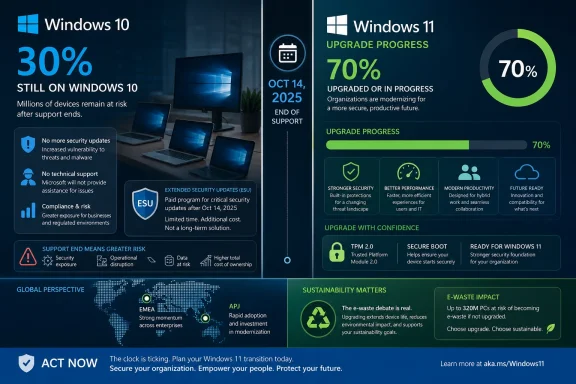
HP told investors this week that roughly 30 percent of its PC installed base was still running Windows 10 after Microsoft ended standard support on October 14, 2025, and the company now sees that unfinished migration as a near-term sales tailwind. That is the plain business fact behind a much messier industry story. The Windows 11 refresh cycle has not failed, but it has become slower, more regional, and more politically charged than Microsoft’s hardware partners hoped. For users and IT departments, the question is no longer whether Windows 10 is old; it is why so many working PCs still have no painless path forward.
HP’s latest comments are striking because they say the quiet part aloud. Windows 10’s end of support was not merely a lifecycle milestone; for the PC industry, it was supposed to be a demand-generation event. Every unsupported Windows 10 machine represented a potential Windows 11 machine, and for vendors like HP, many of those upgrades would require new hardware.
Ketan Patel, HP’s president of personal systems, described the remaining Windows 10 base as an opportunity in the short run. CFO Karen Parkhill framed the same trend through geography, saying the Windows 11 refresh in EMEA and APJ had caught up with North America. That matters because the PC market has been waiting for a synchronized corporate replacement cycle after the pandemic-era boom and bust.
The catch is that the tailwind exists only because the migration has been stubbornly incomplete. If Windows 11 had followed the rhythm of past Windows transitions, HP would not still be talking about three in ten customers waiting on the runway. The business opportunity is inseparable from the adoption problem.
This is why HP’s upbeat investor language has a slightly paradoxical edge. A slow migration hurts Microsoft’s platform-management ambitions, frustrates security teams, and leaves users in a limbo of paid or conditional updates. But it also gives PC makers another quarter, another fiscal year, another sales script.
Microsoft’s problem is that Windows 10 aged into competence. By the time its support clock ran out, it was not obviously broken for many people. It booted, patched, launched Office, joined domains, ran browsers, handled accounting software, drove label printers, and stayed out of the way.
Windows 11, by contrast, has had to justify itself against an unusually high bar: not “is it better than a disaster?” but “is it worth disrupting something that works?” The answer may be yes for many organizations, especially on newer hardware and managed fleets. But it has not been a universally obvious yes, and that distinction has slowed the refresh.
For ordinary users, the upgrade calculus is even less romantic. A new centered taskbar, a revised Settings app, Copilot branding, and a stricter security baseline do not automatically translate into a compelling reason to replace a functioning laptop. The OS can be technically superior and still fail to feel urgent.
But that security line also changed the emotional and economic meaning of the upgrade. For millions of users, Windows 11 was not an install button. It was a message that their otherwise functional PC was out of bounds.
That is where the resentment begins. A machine that can run Windows 10 smoothly, browse the web, stream video, handle email, and support everyday productivity may still be blocked from Windows 11 because of a CPU support list or firmware requirement. From Microsoft’s point of view, that device sits outside the future security model. From the owner’s point of view, it has been declared obsolete by policy rather than failure.
The distinction matters because it affects trust. Users accept that batteries degrade, disks fail, and old systems eventually become impractical. They are less forgiving when a vendor-imposed boundary appears before the hardware itself has reached the end of its useful life.
This does not mean every old Windows 10 PC should remain in service forever. Unsupported endpoints carry real risks, and ancient hardware can impose hidden costs in power consumption, performance, downtime, and management complexity. But the Windows 11 cutoff created a class of machines that were not ancient in the way consumers understand the word.
The result was a political fight over what counts as responsible lifecycle management. Microsoft framed the transition as a security modernization. Critics framed it as premature obsolescence. Both arguments contain truth, but they speak to different constituencies: one to CISOs and platform engineers, the other to consumers, schools, small businesses, and environmental regulators.
Microsoft’s decision to offer more accommodating extended support terms for consumers in the European Economic Area was not just a regional policy footnote. It was a sign that the company understood the optics had shifted. The Windows 10 retirement was no longer only a technical deadline; it had become a test case for whether software vendors can unilaterally shorten the practical life of hardware.
ESU changes the character of the deadline. October 14, 2025, was marketed for years as the end of Windows 10 support, but the real-world outcome is a set of branching paths. Some users upgrade to Windows 11. Some buy new hardware. Some enroll in extended updates. Some do nothing. Some are protected by regional concessions. Some are protected by corporate licensing arrangements that their employees may barely understand.
That fragmentation is not fatal, but it complicates the security story. A clean cutoff is easy to message. A conditional extension is harder. It leaves users asking whether Windows 10 is truly unsafe, unsafe only without ESU, acceptable for another year, tolerable in a managed environment, or merely inconvenient to Microsoft’s roadmap.
For IT departments, ESU is both relief and tax. It buys time for application testing, procurement cycles, hardware budgeting, and awkward edge cases. But it also formalizes the cost of delay. Every month spent on Windows 10 becomes a managed exception rather than business as usual.
Large organizations often know exactly which machines need replacing. The harder question is whether replacing them this quarter produces enough value to beat other claims on the budget. Security teams may want the old endpoints gone; finance teams may see a fleet that still depreciates, still works, and still supports revenue-generating staff.
That conflict is sharper in 2026 because device spending is not the hottest line in IT. Software, cloud infrastructure, AI tooling, and datacenter capacity are soaking up attention and capital. A laptop refresh competes with subscriptions, security platforms, GPU-backed services, and every vendor’s promise of automation.
The Windows 11 migration therefore lands in a market where the PC is essential but less glamorous. Nobody wants insecure endpoints. Nobody wants to explain a breach involving unsupported systems. But many organizations also do not want to spend millions replacing devices just to arrive at an operating system that users may experience as only modestly different.
That argument may eventually prove correct, but it has not yet solved the replacement problem. Many customers still lack a killer local AI workload that justifies a premium device purchase. The industry has spent two years telling buyers that AI PCs are inevitable, while buyers have reasonably asked what they can do on Monday morning that their current machines cannot.
There are credible answers in some niches. Developers, creators, security tools, accessibility features, transcription, summarization, and privacy-sensitive local processing may all benefit from more capable client hardware. But a broad commercial refresh does not run on theoretical use cases. It runs on measurable productivity, manageable risk, and procurement-friendly pricing.
For now, AI PCs strengthen the sales deck more than they transform the endpoint estate. They give HP and its peers a future-facing story beyond “your old operating system is out of support.” But the urgency still comes from Windows 10’s expiration, not from a mass realization that every employee needs local generative AI acceleration.
The Windows ecosystem’s historic strength was compatibility. Its historic weakness was also compatibility. Supporting an enormous range of old hardware and software made Windows ubiquitous, but it also made the platform harder to secure and modernize. Windows 11 was Microsoft’s attempt to draw a line and say the next era would not carry every old assumption forward.
That is a defensible platform strategy. It is also one that imposes costs outside Microsoft’s balance sheet. Users pay in hardware replacement, IT pays in migration labor, and the environment pays if devices are retired before their physical usefulness is exhausted. A technically rational security baseline can still be socially and economically disruptive.
The uncomfortable truth is that Microsoft is trying to move a billion-device ecosystem as if it were a managed platform. It is not. Windows lives in homes, hospitals, factories, schools, kiosks, labs, small offices, and forgotten back rooms. A rule that makes sense at Redmond scale can become messy at human scale.
But a large share of the remaining base is there for structural reasons. Their PCs cannot upgrade. Their organizations have not completed testing. Their budgets have not cleared. Their applications depend on old drivers or vendor support. Their replacement hardware is tied to lease cycles. Their users are remote, distributed, or operationally difficult to touch.
There is also a quiet user-experience factor. Windows 11 has improved since launch, but it has not entirely escaped the perception that Microsoft used the transition to advance its own priorities: cloud accounts, telemetry, Copilot integration, subscription nudges, and interface changes that were not always requested. For enthusiasts, those details matter. For IT pros, they become support tickets.
The migration lag is therefore an accumulated verdict. It says Windows 11 is good enough for many, necessary for some, and still not compelling or accessible enough for all. That is not a disaster. But it is not the clean victory lap Microsoft and OEMs wanted either.
This does not make HP villainous. PC vendors operate in a cyclical, low-margin market where refresh waves matter. They need reasons for customers to replace machines, and OS transitions have long been among the most reliable. If a customer must buy a Windows 11-capable system, HP would rather sell it than watch Dell, Lenovo, or Apple take the order.
Still, the alignment is hard to miss. Microsoft wants a more secure, more modern Windows base. OEMs want replacement demand. Enterprises want manageable risk at predictable cost. Users want their working machines to keep working. Those interests overlap, but they are not identical.
The Windows 10 story exposes the seams. The party with the strategic platform goal is not always the party paying for the hardware. The party selling the hardware is not always the party absorbing the migration labor. The party using the device may have the least say of all.
Europe adds another complication because regulatory pressure has made the Windows 10 transition more politically visible. The EEA concession on consumer ESU undercuts the idea that Microsoft’s original approach was immovable. When enough pressure gathered around e-waste and user choice, the policy changed.
That is a lesson regulators will remember. If software support deadlines can force hardware replacement at scale, they become fair game for consumer-protection and sustainability scrutiny. Windows 10 may not be the last operating system lifecycle to attract that kind of attention.
For Microsoft, this means future platform transitions will need a stronger public-interest argument. Security is powerful, but it cannot be asserted as a magic word that ends the debate. The company will have to show why a requirement matters, whom it affects, and what off-ramps exist for users whose hardware remains functional.
The first task is visibility. Organizations that still do not know which devices are on Windows 10, which are Windows 11-capable, and which are blocked by hardware requirements are already late. The second task is prioritization, because not every old endpoint carries the same risk or business value.
The hardest cases are often the least glamorous. A shared PC connected to a scanner. A lab machine with a vendor-certified driver stack. A branch-office desktop that nobody budgeted to replace. A field laptop that checks in rarely. These systems are where lifecycle policy becomes operational friction.
The temptation is to treat ESU as a blanket solution. It is not. It reduces security exposure while buying time, but it does not modernize hardware, solve compatibility debt, or eliminate the need for a plan. It is a bridge, not a destination.
For Microsoft, the danger is not that users will all abandon Windows. They will not. The danger is that upgrades become associated with coercion rather than improvement. Once that perception sets in, every future requirement is viewed through suspicion, even when the technical case is strong.
For OEMs, the risk is different. A forced refresh can pull demand forward, but it can also teach buyers to extend depreciation cycles, consider alternative platforms, or separate endpoint strategy from vendor marketing. A customer who feels pushed may still buy, but not with enthusiasm.
For users, the lesson is blunt: ownership of a PC increasingly depends on a stack of external support decisions. The hardware may be yours, but its practical life is shaped by firmware standards, OS policies, cloud-account requirements, update programs, and regional regulatory outcomes. That is the modern PC bargain, and Windows 10 has made it visible.
But the persistence of a 30 percent Windows 10 base shows the deadline did not create a clean migration. It created a long tail. That long tail is now monetized through new PCs, managed through ESU, argued over by regulators, and lived with by users who have not yet moved.
This is how major platform transitions increasingly work. They do not end on the date printed in the lifecycle document. They enter a second phase in which exceptions, extensions, concessions, and economic realities define the outcome.
The PC industry can call that a tailwind. Administrators may call it debt. Environmental advocates may call it waste. Users may call it annoying. All of them are describing the same phenomenon from different sides.
That pool will shrink, but the manner of its shrinking matters. If it turns into thoughtful fleet modernization, with secure hardware, realistic budgets, and clear user benefits, the Windows 11 transition will look more successful in hindsight than it feels in the moment. If it turns into rushed procurement and avoidable disposal, it will reinforce every criticism of forced obsolescence.
The best outcome for HP is not merely that customers buy new PCs. It is that they believe the purchases were necessary, valuable, and timed well. A refresh cycle built on resentment is still revenue, but it is not loyalty.
That distinction will matter as AI PCs enter the same conversation. If customers already feel burned by the Windows 11 cutoff, they will be harder to convince that the next hardware wave is about empowerment rather than another vendor-driven reset.
 HP Finds Growth in the Upgrade Microsoft Could Not Force
HP’s latest comments are striking because they say the quiet part aloud. Windows 10’s end of support was not merely a lifecycle milestone; for the PC industry, it was supposed to be a demand-generation event. Every unsupported Windows 10 machine represented a potential Windows 11 machine, and for vendors like HP, many of those upgrades would require new hardware.Ketan Patel, HP’s president of personal systems, described the remaining Windows 10 base as an opportunity in the short run. CFO Karen Parkhill framed the same trend through geography, saying the Windows 11 refresh in EMEA and APJ had caught up with North America. That matters because the PC market has been waiting for a synchronized corporate replacement cycle after the pandemic-era boom and bust.
The catch is that the tailwind exists only because the migration has been stubbornly incomplete. If Windows 11 had followed the rhythm of past Windows transitions, HP would not still be talking about three in ten customers waiting on the runway. The business opportunity is inseparable from the adoption problem.
This is why HP’s upbeat investor language has a slightly paradoxical edge. A slow migration hurts Microsoft’s platform-management ambitions, frustrates security teams, and leaves users in a limbo of paid or conditional updates. But it also gives PC makers another quarter, another fiscal year, another sales script.
Windows 10 Became Too Useful to Retire Cleanly
Windows 10 was never a beloved product in the nostalgic sense of Windows XP or Windows 7, but it became something more durable: the default operating environment for a decade of work. It ran on a wide range of hardware, absorbed years of cumulative updates, and became the stable baseline for offices, schools, home users, point-of-sale setups, small businesses, and industrial oddities that rarely appear in glossy PC marketing.Microsoft’s problem is that Windows 10 aged into competence. By the time its support clock ran out, it was not obviously broken for many people. It booted, patched, launched Office, joined domains, ran browsers, handled accounting software, drove label printers, and stayed out of the way.
Windows 11, by contrast, has had to justify itself against an unusually high bar: not “is it better than a disaster?” but “is it worth disrupting something that works?” The answer may be yes for many organizations, especially on newer hardware and managed fleets. But it has not been a universally obvious yes, and that distinction has slowed the refresh.
For ordinary users, the upgrade calculus is even less romantic. A new centered taskbar, a revised Settings app, Copilot branding, and a stricter security baseline do not automatically translate into a compelling reason to replace a functioning laptop. The OS can be technically superior and still fail to feel urgent.
The Hardware Line Turned an OS Upgrade Into a PC Replacement
The most consequential Windows 11 decision remains Microsoft’s hardware floor. TPM 2.0, Secure Boot, supported CPUs, and related requirements made security the stated foundation of the new operating system. Microsoft’s argument was not frivolous: modern Windows security depends on hardware-backed protections that are far easier to standardize when the installed base is not dragging a long tail of older machines behind it.But that security line also changed the emotional and economic meaning of the upgrade. For millions of users, Windows 11 was not an install button. It was a message that their otherwise functional PC was out of bounds.
That is where the resentment begins. A machine that can run Windows 10 smoothly, browse the web, stream video, handle email, and support everyday productivity may still be blocked from Windows 11 because of a CPU support list or firmware requirement. From Microsoft’s point of view, that device sits outside the future security model. From the owner’s point of view, it has been declared obsolete by policy rather than failure.
The distinction matters because it affects trust. Users accept that batteries degrade, disks fail, and old systems eventually become impractical. They are less forgiving when a vendor-imposed boundary appears before the hardware itself has reached the end of its useful life.
The Environmental Argument Landed Because It Felt True
European campaigners seized on that gap between physical usefulness and software eligibility. Their argument was simple enough to travel: if functioning PCs are pushed out of support because they cannot meet a new operating system’s requirements, software policy becomes an e-waste accelerator. That charge resonated because it matched what many users could see in front of them.This does not mean every old Windows 10 PC should remain in service forever. Unsupported endpoints carry real risks, and ancient hardware can impose hidden costs in power consumption, performance, downtime, and management complexity. But the Windows 11 cutoff created a class of machines that were not ancient in the way consumers understand the word.
The result was a political fight over what counts as responsible lifecycle management. Microsoft framed the transition as a security modernization. Critics framed it as premature obsolescence. Both arguments contain truth, but they speak to different constituencies: one to CISOs and platform engineers, the other to consumers, schools, small businesses, and environmental regulators.
Microsoft’s decision to offer more accommodating extended support terms for consumers in the European Economic Area was not just a regional policy footnote. It was a sign that the company understood the optics had shifted. The Windows 10 retirement was no longer only a technical deadline; it had become a test case for whether software vendors can unilaterally shorten the practical life of hardware.
Extended Security Updates Turn Delay Into a Product
The Extended Security Updates program is Microsoft’s safety valve. It lets users and organizations stay on Windows 10 past the official support deadline while continuing to receive security updates, at least for a defined period and under defined terms. For businesses, paid post-support coverage is familiar territory. For consumers, the Windows 10 program is more unusual and more revealing.ESU changes the character of the deadline. October 14, 2025, was marketed for years as the end of Windows 10 support, but the real-world outcome is a set of branching paths. Some users upgrade to Windows 11. Some buy new hardware. Some enroll in extended updates. Some do nothing. Some are protected by regional concessions. Some are protected by corporate licensing arrangements that their employees may barely understand.
That fragmentation is not fatal, but it complicates the security story. A clean cutoff is easy to message. A conditional extension is harder. It leaves users asking whether Windows 10 is truly unsafe, unsafe only without ESU, acceptable for another year, tolerable in a managed environment, or merely inconvenient to Microsoft’s roadmap.
For IT departments, ESU is both relief and tax. It buys time for application testing, procurement cycles, hardware budgeting, and awkward edge cases. But it also formalizes the cost of delay. Every month spent on Windows 10 becomes a managed exception rather than business as usual.
The Enterprise Refresh Is a Budget Conversation Wearing a Security Badge
HP’s comments about regional demand point to a familiar enterprise reality: OS migrations do not happen just because a vendor says they should. They happen when budgets, procurement windows, application readiness, device availability, and internal risk calculations align. Windows 10’s deadline supplied pressure, but pressure is not the same as capacity.Large organizations often know exactly which machines need replacing. The harder question is whether replacing them this quarter produces enough value to beat other claims on the budget. Security teams may want the old endpoints gone; finance teams may see a fleet that still depreciates, still works, and still supports revenue-generating staff.
That conflict is sharper in 2026 because device spending is not the hottest line in IT. Software, cloud infrastructure, AI tooling, and datacenter capacity are soaking up attention and capital. A laptop refresh competes with subscriptions, security platforms, GPU-backed services, and every vendor’s promise of automation.
The Windows 11 migration therefore lands in a market where the PC is essential but less glamorous. Nobody wants insecure endpoints. Nobody wants to explain a breach involving unsupported systems. But many organizations also do not want to spend millions replacing devices just to arrive at an operating system that users may experience as only modestly different.
AI PCs Are the Second Sales Pitch, Not the Rescue
HP, like other PC makers, has another argument ready: the AI PC. If the Windows 11 refresh is the near-term tailwind, on-device AI is supposed to be the longer-term growth engine. The pitch is that workloads will move closer to the edge, local inference will reduce latency or cloud cost, and PCs with neural processing units will become the new standard.That argument may eventually prove correct, but it has not yet solved the replacement problem. Many customers still lack a killer local AI workload that justifies a premium device purchase. The industry has spent two years telling buyers that AI PCs are inevitable, while buyers have reasonably asked what they can do on Monday morning that their current machines cannot.
There are credible answers in some niches. Developers, creators, security tools, accessibility features, transcription, summarization, and privacy-sensitive local processing may all benefit from more capable client hardware. But a broad commercial refresh does not run on theoretical use cases. It runs on measurable productivity, manageable risk, and procurement-friendly pricing.
For now, AI PCs strengthen the sales deck more than they transform the endpoint estate. They give HP and its peers a future-facing story beyond “your old operating system is out of support.” But the urgency still comes from Windows 10’s expiration, not from a mass realization that every employee needs local generative AI acceleration.
Microsoft’s Security Bet Still Has a Credible Core
It is easy to caricature Windows 11’s hardware requirements as a cynical gift to OEMs, but that misses part of the story. Microsoft has spent years trying to harden Windows against credential theft, firmware attacks, ransomware, driver abuse, and kernel-level compromise. Hardware-backed security is not decorative in that fight.The Windows ecosystem’s historic strength was compatibility. Its historic weakness was also compatibility. Supporting an enormous range of old hardware and software made Windows ubiquitous, but it also made the platform harder to secure and modernize. Windows 11 was Microsoft’s attempt to draw a line and say the next era would not carry every old assumption forward.
That is a defensible platform strategy. It is also one that imposes costs outside Microsoft’s balance sheet. Users pay in hardware replacement, IT pays in migration labor, and the environment pays if devices are retired before their physical usefulness is exhausted. A technically rational security baseline can still be socially and economically disruptive.
The uncomfortable truth is that Microsoft is trying to move a billion-device ecosystem as if it were a managed platform. It is not. Windows lives in homes, hospitals, factories, schools, kiosks, labs, small offices, and forgotten back rooms. A rule that makes sense at Redmond scale can become messy at human scale.
The Windows 11 Lag Is Not Just User Stubbornness
Calling Windows 10 users “holdouts” is emotionally satisfying but analytically lazy. Some are certainly procrastinating. Some ignored years of warnings. Some are running unsupported systems because they do not understand the risk or do not want to learn.But a large share of the remaining base is there for structural reasons. Their PCs cannot upgrade. Their organizations have not completed testing. Their budgets have not cleared. Their applications depend on old drivers or vendor support. Their replacement hardware is tied to lease cycles. Their users are remote, distributed, or operationally difficult to touch.
There is also a quiet user-experience factor. Windows 11 has improved since launch, but it has not entirely escaped the perception that Microsoft used the transition to advance its own priorities: cloud accounts, telemetry, Copilot integration, subscription nudges, and interface changes that were not always requested. For enthusiasts, those details matter. For IT pros, they become support tickets.
The migration lag is therefore an accumulated verdict. It says Windows 11 is good enough for many, necessary for some, and still not compelling or accessible enough for all. That is not a disaster. But it is not the clean victory lap Microsoft and OEMs wanted either.
OEMs Are Winning From a Problem They Did Not Create
HP did not set Windows 11’s requirements, and it did not decide Windows 10’s support deadline. But it benefits from both. That is the awkward position of the OEM ecosystem: PC makers profit when software policy turns old hardware into a liability.This does not make HP villainous. PC vendors operate in a cyclical, low-margin market where refresh waves matter. They need reasons for customers to replace machines, and OS transitions have long been among the most reliable. If a customer must buy a Windows 11-capable system, HP would rather sell it than watch Dell, Lenovo, or Apple take the order.
Still, the alignment is hard to miss. Microsoft wants a more secure, more modern Windows base. OEMs want replacement demand. Enterprises want manageable risk at predictable cost. Users want their working machines to keep working. Those interests overlap, but they are not identical.
The Windows 10 story exposes the seams. The party with the strategic platform goal is not always the party paying for the hardware. The party selling the hardware is not always the party absorbing the migration labor. The party using the device may have the least say of all.
The Regional Split Shows Policy Can Change the Market
HP’s mention of EMEA and APJ strength is more than a sales geography note. It suggests that the refresh cycle is uneven, shaped by regional economics, regulation, installed-base age, and local enterprise behavior. North America may have moved earlier in some segments, while other regions are now catching up.Europe adds another complication because regulatory pressure has made the Windows 10 transition more politically visible. The EEA concession on consumer ESU undercuts the idea that Microsoft’s original approach was immovable. When enough pressure gathered around e-waste and user choice, the policy changed.
That is a lesson regulators will remember. If software support deadlines can force hardware replacement at scale, they become fair game for consumer-protection and sustainability scrutiny. Windows 10 may not be the last operating system lifecycle to attract that kind of attention.
For Microsoft, this means future platform transitions will need a stronger public-interest argument. Security is powerful, but it cannot be asserted as a magic word that ends the debate. The company will have to show why a requirement matters, whom it affects, and what off-ramps exist for users whose hardware remains functional.
Sysadmins Are Left Managing the Afterlife
For administrators, the Windows 10 afterlife is now a practical problem rather than a philosophical one. The estate must be segmented, inventoried, remediated, replaced, enrolled, isolated, or retired. “Still on Windows 10” is not a single status; it covers everything from a lightly used home PC to a mission-critical workstation tied to specialized equipment.The first task is visibility. Organizations that still do not know which devices are on Windows 10, which are Windows 11-capable, and which are blocked by hardware requirements are already late. The second task is prioritization, because not every old endpoint carries the same risk or business value.
The hardest cases are often the least glamorous. A shared PC connected to a scanner. A lab machine with a vendor-certified driver stack. A branch-office desktop that nobody budgeted to replace. A field laptop that checks in rarely. These systems are where lifecycle policy becomes operational friction.
The temptation is to treat ESU as a blanket solution. It is not. It reduces security exposure while buying time, but it does not modernize hardware, solve compatibility debt, or eliminate the need for a plan. It is a bridge, not a destination.
The Real Cost Is Trust in the Upgrade Compact
Every successful platform depends on an implicit compact: users accept change because the vendor keeps the system useful, secure, and reasonably respectful of their investment. Windows 10’s retirement has strained that compact. Not broken it, but strained it.For Microsoft, the danger is not that users will all abandon Windows. They will not. The danger is that upgrades become associated with coercion rather than improvement. Once that perception sets in, every future requirement is viewed through suspicion, even when the technical case is strong.
For OEMs, the risk is different. A forced refresh can pull demand forward, but it can also teach buyers to extend depreciation cycles, consider alternative platforms, or separate endpoint strategy from vendor marketing. A customer who feels pushed may still buy, but not with enthusiasm.
For users, the lesson is blunt: ownership of a PC increasingly depends on a stack of external support decisions. The hardware may be yours, but its practical life is shaped by firmware standards, OS policies, cloud-account requirements, update programs, and regional regulatory outcomes. That is the modern PC bargain, and Windows 10 has made it visible.
The Numbers Say the Deadline Worked, Just Not Neatly
HP’s results show that the Windows 11 refresh is producing revenue. The company reported higher year-over-year revenue and profit for its fiscal second quarter, and personal systems remain tied to the broader replacement cycle. From a business standpoint, the deadline is doing part of what it was supposed to do.But the persistence of a 30 percent Windows 10 base shows the deadline did not create a clean migration. It created a long tail. That long tail is now monetized through new PCs, managed through ESU, argued over by regulators, and lived with by users who have not yet moved.
This is how major platform transitions increasingly work. They do not end on the date printed in the lifecycle document. They enter a second phase in which exceptions, extensions, concessions, and economic realities define the outcome.
The PC industry can call that a tailwind. Administrators may call it debt. Environmental advocates may call it waste. Users may call it annoying. All of them are describing the same phenomenon from different sides.
The 30 Percent Figure Is the Part HP Cannot Afford to Waste
HP’s disclosure is useful because it gives shape to a market that is often discussed in abstractions. Three in ten is not a rounding error. It is a massive pool of machines, budgets, security decisions, and user habits still unresolved after the official Windows 10 deadline.That pool will shrink, but the manner of its shrinking matters. If it turns into thoughtful fleet modernization, with secure hardware, realistic budgets, and clear user benefits, the Windows 11 transition will look more successful in hindsight than it feels in the moment. If it turns into rushed procurement and avoidable disposal, it will reinforce every criticism of forced obsolescence.
The best outcome for HP is not merely that customers buy new PCs. It is that they believe the purchases were necessary, valuable, and timed well. A refresh cycle built on resentment is still revenue, but it is not loyalty.
That distinction will matter as AI PCs enter the same conversation. If customers already feel burned by the Windows 11 cutoff, they will be harder to convince that the next hardware wave is about empowerment rather than another vendor-driven reset.
The Windows 10 Hangover Has a Few Hard Lessons
The Windows 10-to-11 migration is no longer a future deadline; it is an active cleanup operation. The remaining work is less about marketing and more about triage, communication, and trust.- HP’s estimate that roughly 30 percent of its installed base remains on Windows 10 shows that the post-deadline migration is still a large commercial event, not a completed transition.
- Microsoft’s hardware requirements made Windows 11 a security modernization project, but they also turned many otherwise usable PCs into replacement candidates.
- Extended Security Updates reduce immediate risk, but they also transform delayed upgrades into a managed cost with an expiration date.
- Regional concessions in Europe show that lifecycle policy can bend when consumer, environmental, and regulatory pressure becomes strong enough.
- AI PCs may support the next wave of premium hardware sales, but they have not yet replaced Windows 10’s end of support as the clearest reason many customers are buying.
- IT departments should treat remaining Windows 10 machines as an exception population that needs inventory, risk ranking, and a funded exit plan.
References
- Primary source: The Register
Published: Thu, 28 May 2026 14:15:00 GMT
Three in ten HP customers still clinging to Windows 10
Refresh cycle sluggishness is a tailwind, insists PC giant's money peoplewww.theregister.com - Official source: support.microsoft.com
Windows 10 notification: “Your device has reached the end of service” | Microsoft Support
Windows 10 notification: “Your device has reached the end of service”support.microsoft.com - Official source: microsoft.com
End of support for Windows 10, Windows 8.1, and Windows 7 | Microsoft Windows
Make a smooth transition to Windows 11 from your unsupported operating system with help from Microsoft. Enjoy the benefits of upgrading to a Windows 11 PC.www.microsoft.com - Official source: learn.microsoft.com
Extended Security Updates (ESU) program for Windows 10 | Microsoft Learn
Learn about the Extended Security Updates (ESU) program for Windows 10. The ESU program gives customers the option to receive security updates for Windows 10.learn.microsoft.com - Related coverage: windowscentral.com
Microsoft backtracks, makes Windows 10 ESU program free in the EEA | Windows Central
In a major move, Microsoft is making access to Windows 10's extended support updates free for regions in the European Economic Area. No cloud backup required.www.windowscentral.com - Related coverage: tomsguide.com
Windows 10 End of Life: Microsoft releases final update — everything you need to know | Tom's Guide
So long, Windows 10www.tomsguide.com
- Related coverage: tomshardware.com
Windows 10 support ends today — here's who's affected and what you need to do | Tom's Hardware
Update if you can, upgrade if you can't, or at least get the extended support license.www.tomshardware.com - Related coverage: techradar.com
Microsoft in 2025: year in review | TechRadar
Microsoft pushed AI even harder this year – and Windows 11 users rebelledwww.techradar.com - Related coverage: pcgamer.com
- Related coverage: atomicdata.com
- Related coverage: transparity.com
- Related coverage: euroconsumers.org
