

WashingtonExec named David Guffey, Intel Corp.’s director for U.S. Special Operations Command and intelligence community accounts, to its Top DOW Execs to Watch in 2026 list for his work moving AI-at-the-edge capabilities into defense missions through partnerships and emerging Intel technologies. The interesting part is not the executive-watchlist ceremony; it is the way Intel is trying to translate its manufacturing comeback story into a battlefield computing story. Guffey’s profile sits at the intersection of three campaigns that rarely move at the same speed: tactical AI, defense procurement, and Intel’s 18A process bet. If Intel can make those timelines converge, the company’s federal business becomes more than another sales channel — it becomes a test case for whether American silicon strategy can survive contact with the edge.
For years, the default mental image of defense computing was a data center, a cloud region, or a command post with enough connectivity to send work somewhere else. The newer pitch is more austere. Put useful AI near the operator, make it function when the network is degraded or absent, and design it for the ugly physical conditions where missions actually happen.
That is why Guffey’s emphasis on “AI at the tactical edge” matters. It is not a marketing phrase borrowed from enterprise cloud decks; it describes a practical constraint. Special operations teams, intelligence users, and conventional forces increasingly want machine assistance in places where bandwidth is scarce, latency is dangerous, and the assumption of a clean uplink is fantasy.
Intel’s advantage in this argument is not that it owns AI as a category. It does not. Nvidia still dominates the popular imagination around AI acceleration, hyperscalers are building custom silicon, and Arm-based systems continue to push into low-power edge deployments. Intel’s more specific claim is that it can offer a continuum of compute — from data center processors to PC-class chips to ruggedized edge platforms — that defense integrators can wrap into mission systems.
That is a narrower claim, but potentially a more useful one. Defense customers do not buy benchmarks in isolation. They buy supply chains, lifecycle support, integration paths, security postures, and confidence that a capability will still be supportable long after the demo video has aged badly.
That is the gap Guffey is being credited with trying to close. The WashingtonExec profile says he helped bring advanced AI-at-the-edge capabilities to defense users through partnerships and emerging technologies, with an emphasis on disconnected environments. That last phrase is doing the heavy lifting. A disconnected environment is not merely a bad Wi-Fi day; it is the normal operating condition for many of the missions that most need faster machine-assisted decisions.
At the tactical edge, the value of AI is not abstract productivity. It is triage. It is reducing the amount of sensor data a person must stare at. It is surfacing anomalies, compressing decision loops, and giving operators something closer to actionable context before the moment disappears.
That is also why the “cognitive workload” language in Guffey’s profile is worth taking seriously. The most credible defense AI efforts are not framed as replacing human judgment. They are framed as reducing the burden on people already making high-consequence decisions under fatigue, threat, and incomplete information. The difference is not semantic; it is the difference between a tool that gets adopted and a tool that gets quietly bypassed.
For defense users, those details matter less as slogans than as system-level consequences. Better performance per watt can mean smaller systems, longer battery life, less heat, or more local inference before a device needs to phone home. In a data center, efficiency affects cost and density. At the edge, it can affect whether the capability is usable at all.
Intel’s 18A products also carry symbolic weight. Panther Lake brings the process into client and AI PC territory, while Clearwater Forest pushes it toward dense server infrastructure. That gives Intel a way to tell defense customers a unified story: the same manufacturing comeback that powers future PCs and servers can also support mission systems spanning handheld devices, edge nodes, and data centers.
The risk, of course, is that a unified story is not the same as a unified delivery schedule. Intel’s recent history has made customers wary of roadmaps that depend on manufacturing execution. Defense buyers, in particular, are allergic to promises that cannot be turned into supported, certified, fieldable systems. Guffey’s challenge is therefore not just explaining 18A’s capabilities. It is helping customers understand which parts of the technology stack are real, available, and appropriate for mission timelines.
That is especially true in special operations and intelligence environments, where requirements can be brutally specific. A system may need to be portable, quiet, power-efficient, secure, locally operable, and compatible with existing mission workflows. It may also need to survive procurement scrutiny without losing the agility that made it useful in the first place.
This is where Intel’s government go-to-market operation becomes strategically important. The company needs people who can translate between silicon roadmaps and mission needs without pretending that one automatically solves the other. Guffey’s reported role is precisely in that translation layer, where a defense customer’s operational problem becomes a partner ecosystem’s engineering target.
The word “ecosystem” is overused in technology, but here it is accurate. Tactical AI depends on a chain of companies, each solving a different part of the problem. If one link fails — power, thermal design, model optimization, ruggedization, security accreditation, sustainment — the whole capability can remain stuck in prototype theater.
That tension defines the market Guffey is operating in. Special operations users may be more willing than traditional programs to experiment with emerging tools, but experiments do not automatically become durable capabilities. A laptop demo, a rugged edge box, or a disconnected AI assistant can impress users and still fail to cross the valley between innovation funding and scaled procurement.
Intel’s opportunity is that defense leaders increasingly understand the danger of sending every AI workload back to a centralized cloud. Contested logistics, electronic warfare, satellite vulnerabilities, and data sovereignty concerns all push more compute toward the edge. But Intel’s burden is proving that its platforms can make that shift practical without increasing operational complexity beyond what units can support.
This is where vendor rhetoric must be separated from observed impact. “AI-enabled” is now stamped on almost everything. The meaningful test is whether a system helps a unit make better decisions under constraints, with less operator burden, while fitting into real mission workflows. That is a higher bar than showing that a model can run locally.
Microsoft has been pushing Windows into an AI PC era where local neural processing becomes part of the platform expectation. Intel’s client roadmap, including 18A-based chips, is tied directly to that shift. The defense version is more extreme, but the underlying question is familiar to every IT admin: which workloads should stay local, which should go to the cloud, and how do you secure the boundary between them?
The answer is becoming less ideological and more situational. Some AI workloads belong in large data centers. Others need to run near the user because latency, privacy, cost, or connectivity demand it. Defense simply exposes the logic in harsher form. If a model must assist a warfighter in a disconnected environment, the cloud is not the operating assumption; it is a luxury.
That has implications for Windows devices as well. As local AI hardware becomes more common, endpoint governance becomes more complicated. Admins will need to think not only about CPU and memory, but also about model deployment, data leakage, local acceleration, driver trust, and telemetry boundaries. The tactical edge is an early warning system for problems that will eventually arrive in more ordinary enterprise fleets.
That gives Intel a story that overseas foundry competitors cannot easily replicate in U.S. government accounts. If Intel can deliver advanced process technology manufactured in the United States at credible scale, it becomes a strategic supplier in a way that goes beyond normal vendor competition. That does not mean it wins automatically. It means the conversation starts on unusually favorable terrain.
The challenge is that sovereignty does not excuse weak execution. Defense customers may prefer trusted domestic supply, but they still need performance, availability, software maturity, and long-term support. A secure supply chain attached to late or underpowered products is not enough. Intel must make the sovereign-compute argument and the product-performance argument at the same time.
Guffey’s role, viewed through that lens, is not merely to sell chips into accounts. It is to help Intel convert national industrial policy into mission capability. That is a much harder job than account coverage, because it requires alignment between manufacturing, product groups, integrators, government buyers, and end users who may care far more about mission fit than semiconductor strategy.
Nvidia has a powerful position because it owns so much of the AI developer mindshare. Arm-based platforms have strong arguments in power-constrained environments. Cloud providers can bundle AI services into procurement vehicles that look convenient to government buyers. Smaller defense-focused AI companies can move faster and tailor products more directly to mission niches.
Intel’s counter is breadth. It can participate in data center modernization, endpoint refresh, edge computing, and partner-led rugged systems without asking the customer to treat each layer as a separate universe. That breadth is valuable if it reduces integration friction. It is merely decorative if the software experience, developer support, or partner execution falls short.
This is why partnerships matter as much as process nodes. A great chip that is hard to deploy will lose to a good-enough system that arrives integrated, secure, and supportable. In defense, the “best” technology is often the one that survives acquisition, accreditation, training, and field use.
Guffey’s portfolio — U.S. Special Operations Command and intelligence community accounts — is especially consequential because those customers often sit near the front edge of operational technology demand. They are not the whole defense market, but they can influence it. Capabilities proven in those environments can migrate into broader military use, especially when conventional forces face similar pressure to process more data faster.
That is why the “Why Watch” framing is not just flattering. It points to a market signal. Intel wants federal buyers and integrators to see its edge AI work as operationally relevant now, not as an eventual byproduct of consumer AI PCs or data center CPUs.
The risk for Intel is that Washington has heard many versions of this story before. Every vendor says it is mission-focused. Every vendor says it reduces complexity. Every vendor says it accelerates decisions. The winners will be the companies whose tools are still being used after the exercise ends, the pilot funding expires, and the network goes sideways.
That is a subtle but important point. The defense market does not need AI theater. It needs tools that can be trained on, maintained, secured, updated, and trusted under pressure. A capability that dazzles in a controlled demo but requires heroic support in the field is not a capability; it is a liability with a good pitch deck.
Intel’s hardware story can help, but hardware alone cannot solve trust. Model behavior, data provenance, cybersecurity, human-machine interface design, and operational doctrine all matter. Edge AI becomes useful only when the system around the silicon is disciplined enough to make the silicon’s performance meaningful.
That is where executives like Guffey become more important than the usual “sales leader” label suggests. In a market this complex, the person connecting users, partners, and product teams can materially shape whether a promising technology becomes a fielded tool or another abandoned experiment.
Intel’s 2026 defense story is a wager that advanced domestic manufacturing, partner-led ruggedization, and local AI inference can meet the Pentagon’s demand for faster decisions in worse conditions. David Guffey’s profile gives that wager a human face, but the outcome will be decided by systems in the field, not names on a list. If Intel can turn 18A-era silicon into trusted tactical capability, it will have done more than win another government account; it will have shown that the next phase of AI infrastructure is not only in the cloud, but wherever the mission runs out of signal.
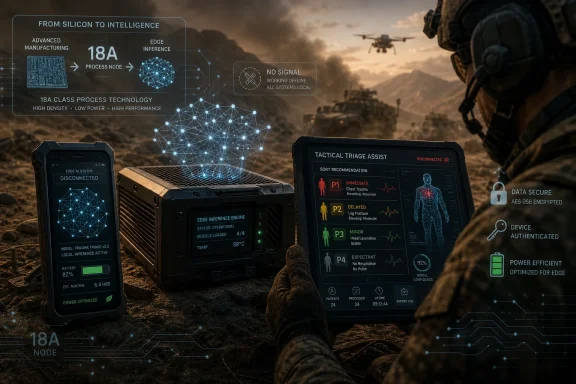 Intel’s Defense Pitch Is No Longer Just About Bigger Servers
For years, the default mental image of defense computing was a data center, a cloud region, or a command post with enough connectivity to send work somewhere else. The newer pitch is more austere. Put useful AI near the operator, make it function when the network is degraded or absent, and design it for the ugly physical conditions where missions actually happen.That is why Guffey’s emphasis on “AI at the tactical edge” matters. It is not a marketing phrase borrowed from enterprise cloud decks; it describes a practical constraint. Special operations teams, intelligence users, and conventional forces increasingly want machine assistance in places where bandwidth is scarce, latency is dangerous, and the assumption of a clean uplink is fantasy.
Intel’s advantage in this argument is not that it owns AI as a category. It does not. Nvidia still dominates the popular imagination around AI acceleration, hyperscalers are building custom silicon, and Arm-based systems continue to push into low-power edge deployments. Intel’s more specific claim is that it can offer a continuum of compute — from data center processors to PC-class chips to ruggedized edge platforms — that defense integrators can wrap into mission systems.
That is a narrower claim, but potentially a more useful one. Defense customers do not buy benchmarks in isolation. They buy supply chains, lifecycle support, integration paths, security postures, and confidence that a capability will still be supportable long after the demo video has aged badly.
The Tactical Edge Is Where AI Hype Meets Mud, Heat, and Silence
The phrase real-time AI sounds almost effortless in commercial settings. In the field, it becomes a series of compromises. A model that performs beautifully in a lab may be too power-hungry for a mobile kit, too fragile for intermittent connectivity, too slow for a contested environment, or too dependent on data pipelines that do not exist outside a controlled network.That is the gap Guffey is being credited with trying to close. The WashingtonExec profile says he helped bring advanced AI-at-the-edge capabilities to defense users through partnerships and emerging technologies, with an emphasis on disconnected environments. That last phrase is doing the heavy lifting. A disconnected environment is not merely a bad Wi-Fi day; it is the normal operating condition for many of the missions that most need faster machine-assisted decisions.
At the tactical edge, the value of AI is not abstract productivity. It is triage. It is reducing the amount of sensor data a person must stare at. It is surfacing anomalies, compressing decision loops, and giving operators something closer to actionable context before the moment disappears.
That is also why the “cognitive workload” language in Guffey’s profile is worth taking seriously. The most credible defense AI efforts are not framed as replacing human judgment. They are framed as reducing the burden on people already making high-consequence decisions under fatigue, threat, and incomplete information. The difference is not semantic; it is the difference between a tool that gets adopted and a tool that gets quietly bypassed.
Intel 18A Turns a Sales Profile Into a Strategic Bet
The profile’s mention of Intel’s 18A process technology pulls the story out of the narrow world of account management and into Intel’s broader corporate drama. Intel has spent years trying to reestablish manufacturing credibility, and 18A is central to that effort. The node is designed around technologies such as RibbonFET gate-all-around transistors and PowerVia backside power delivery, both meant to improve performance and efficiency at a time when power is often the limiting factor.For defense users, those details matter less as slogans than as system-level consequences. Better performance per watt can mean smaller systems, longer battery life, less heat, or more local inference before a device needs to phone home. In a data center, efficiency affects cost and density. At the edge, it can affect whether the capability is usable at all.
Intel’s 18A products also carry symbolic weight. Panther Lake brings the process into client and AI PC territory, while Clearwater Forest pushes it toward dense server infrastructure. That gives Intel a way to tell defense customers a unified story: the same manufacturing comeback that powers future PCs and servers can also support mission systems spanning handheld devices, edge nodes, and data centers.
The risk, of course, is that a unified story is not the same as a unified delivery schedule. Intel’s recent history has made customers wary of roadmaps that depend on manufacturing execution. Defense buyers, in particular, are allergic to promises that cannot be turned into supported, certified, fieldable systems. Guffey’s challenge is therefore not just explaining 18A’s capabilities. It is helping customers understand which parts of the technology stack are real, available, and appropriate for mission timelines.
Partnerships Are the Only Way Edge AI Reaches the Warfighter
The WashingtonExec profile highlights Intel’s work with partners such as Ultralife, and that detail is more revealing than it may first appear. Intel does not deliver tactical capability alone. Chips have to become boards, rugged systems, power architectures, software stacks, sensor packages, and supportable deployments.That is especially true in special operations and intelligence environments, where requirements can be brutally specific. A system may need to be portable, quiet, power-efficient, secure, locally operable, and compatible with existing mission workflows. It may also need to survive procurement scrutiny without losing the agility that made it useful in the first place.
This is where Intel’s government go-to-market operation becomes strategically important. The company needs people who can translate between silicon roadmaps and mission needs without pretending that one automatically solves the other. Guffey’s reported role is precisely in that translation layer, where a defense customer’s operational problem becomes a partner ecosystem’s engineering target.
The word “ecosystem” is overused in technology, but here it is accurate. Tactical AI depends on a chain of companies, each solving a different part of the problem. If one link fails — power, thermal design, model optimization, ruggedization, security accreditation, sustainment — the whole capability can remain stuck in prototype theater.
The Pentagon Wants Speed, but It Still Buys Like the Pentagon
The defense market has become fluent in the language of speed. Every major technology pitch now promises faster decisions, faster deployment, faster integration, and faster iteration. But the institutional machinery that buys and fields technology still moves through budgeting cycles, compliance regimes, cybersecurity requirements, and operational testing.That tension defines the market Guffey is operating in. Special operations users may be more willing than traditional programs to experiment with emerging tools, but experiments do not automatically become durable capabilities. A laptop demo, a rugged edge box, or a disconnected AI assistant can impress users and still fail to cross the valley between innovation funding and scaled procurement.
Intel’s opportunity is that defense leaders increasingly understand the danger of sending every AI workload back to a centralized cloud. Contested logistics, electronic warfare, satellite vulnerabilities, and data sovereignty concerns all push more compute toward the edge. But Intel’s burden is proving that its platforms can make that shift practical without increasing operational complexity beyond what units can support.
This is where vendor rhetoric must be separated from observed impact. “AI-enabled” is now stamped on almost everything. The meaningful test is whether a system helps a unit make better decisions under constraints, with less operator burden, while fitting into real mission workflows. That is a higher bar than showing that a model can run locally.
Windows and the Edge Are Quietly Part of the Same Story
For WindowsForum readers, the defense angle may seem far away from everyday Windows administration. It is not. The same forces shaping tactical edge computing are also reshaping enterprise endpoints, AI PCs, local inference, endpoint management, and hybrid cloud architecture.Microsoft has been pushing Windows into an AI PC era where local neural processing becomes part of the platform expectation. Intel’s client roadmap, including 18A-based chips, is tied directly to that shift. The defense version is more extreme, but the underlying question is familiar to every IT admin: which workloads should stay local, which should go to the cloud, and how do you secure the boundary between them?
The answer is becoming less ideological and more situational. Some AI workloads belong in large data centers. Others need to run near the user because latency, privacy, cost, or connectivity demand it. Defense simply exposes the logic in harsher form. If a model must assist a warfighter in a disconnected environment, the cloud is not the operating assumption; it is a luxury.
That has implications for Windows devices as well. As local AI hardware becomes more common, endpoint governance becomes more complicated. Admins will need to think not only about CPU and memory, but also about model deployment, data leakage, local acceleration, driver trust, and telemetry boundaries. The tactical edge is an early warning system for problems that will eventually arrive in more ordinary enterprise fleets.
Intel’s Comeback Story Needs Customers Who Care About Sovereignty
Intel’s federal pitch also benefits from a geopolitical tailwind. Governments increasingly care where chips are designed, manufactured, packaged, and supported. The defense market cares most of all. Supply-chain assurance is not a patriotic slogan in this context; it is a risk-management requirement.That gives Intel a story that overseas foundry competitors cannot easily replicate in U.S. government accounts. If Intel can deliver advanced process technology manufactured in the United States at credible scale, it becomes a strategic supplier in a way that goes beyond normal vendor competition. That does not mean it wins automatically. It means the conversation starts on unusually favorable terrain.
The challenge is that sovereignty does not excuse weak execution. Defense customers may prefer trusted domestic supply, but they still need performance, availability, software maturity, and long-term support. A secure supply chain attached to late or underpowered products is not enough. Intel must make the sovereign-compute argument and the product-performance argument at the same time.
Guffey’s role, viewed through that lens, is not merely to sell chips into accounts. It is to help Intel convert national industrial policy into mission capability. That is a much harder job than account coverage, because it requires alignment between manufacturing, product groups, integrators, government buyers, and end users who may care far more about mission fit than semiconductor strategy.
The Real Competition Is the Full Stack
It is tempting to frame Intel’s edge AI push as a chip fight. That is too simple. The real competition is over the full stack: silicon, systems, software, models, deployment tooling, security, power, ruggedization, and lifecycle support.Nvidia has a powerful position because it owns so much of the AI developer mindshare. Arm-based platforms have strong arguments in power-constrained environments. Cloud providers can bundle AI services into procurement vehicles that look convenient to government buyers. Smaller defense-focused AI companies can move faster and tailor products more directly to mission niches.
Intel’s counter is breadth. It can participate in data center modernization, endpoint refresh, edge computing, and partner-led rugged systems without asking the customer to treat each layer as a separate universe. That breadth is valuable if it reduces integration friction. It is merely decorative if the software experience, developer support, or partner execution falls short.
This is why partnerships matter as much as process nodes. A great chip that is hard to deploy will lose to a good-enough system that arrives integrated, secure, and supportable. In defense, the “best” technology is often the one that survives acquisition, accreditation, training, and field use.
The Watchlist Signals a Washington Sales Race, Not Just an Executive Profile
WashingtonExec’s watchlist format naturally spotlights individuals, but the underlying story is institutional. Companies want visible leaders attached to priority accounts because the federal technology market is increasingly relationship-driven and mission-specific. The days when a vendor could simply throw hardware over the wall and wait for refresh cycles are fading.Guffey’s portfolio — U.S. Special Operations Command and intelligence community accounts — is especially consequential because those customers often sit near the front edge of operational technology demand. They are not the whole defense market, but they can influence it. Capabilities proven in those environments can migrate into broader military use, especially when conventional forces face similar pressure to process more data faster.
That is why the “Why Watch” framing is not just flattering. It points to a market signal. Intel wants federal buyers and integrators to see its edge AI work as operationally relevant now, not as an eventual byproduct of consumer AI PCs or data center CPUs.
The risk for Intel is that Washington has heard many versions of this story before. Every vendor says it is mission-focused. Every vendor says it reduces complexity. Every vendor says it accelerates decisions. The winners will be the companies whose tools are still being used after the exercise ends, the pilot funding expires, and the network goes sideways.
The Hard Part Is Making AI Boring Enough to Trust
The most mature version of edge AI will not feel futuristic. It will feel boring, dependable, and obvious. It will run when needed, fail gracefully when it cannot, explain enough of itself to support human judgment, and avoid turning operators into babysitters for fragile software.That is a subtle but important point. The defense market does not need AI theater. It needs tools that can be trained on, maintained, secured, updated, and trusted under pressure. A capability that dazzles in a controlled demo but requires heroic support in the field is not a capability; it is a liability with a good pitch deck.
Intel’s hardware story can help, but hardware alone cannot solve trust. Model behavior, data provenance, cybersecurity, human-machine interface design, and operational doctrine all matter. Edge AI becomes useful only when the system around the silicon is disciplined enough to make the silicon’s performance meaningful.
That is where executives like Guffey become more important than the usual “sales leader” label suggests. In a market this complex, the person connecting users, partners, and product teams can materially shape whether a promising technology becomes a fielded tool or another abandoned experiment.
The Guffey Profile Shows Where Intel Wants the 2026 Conversation to Go
The concrete readout from the profile is simple, but the implications are broader.- David Guffey is being positioned as a federal technology leader to watch because Intel wants tactical edge AI to be seen as a live defense priority in 2026.
- Intel’s 18A process is central to the company’s argument that it can deliver more efficient compute across data centers, handheld systems, and edge platforms.
- The defense value proposition depends less on raw AI branding than on whether systems can operate in disconnected, contested, and power-constrained environments.
- Partnerships with rugged systems and mission-technology companies are essential because Intel’s silicon must be converted into deployable capabilities.
- Windows administrators should watch this space because the same local-versus-cloud AI tradeoffs are coming to enterprise endpoints and AI PCs.
- Intel’s opportunity is significant, but its credibility will depend on execution, availability, integration quality, and field-proven usefulness rather than roadmap language.
Intel’s 2026 defense story is a wager that advanced domestic manufacturing, partner-led ruggedization, and local AI inference can meet the Pentagon’s demand for faster decisions in worse conditions. David Guffey’s profile gives that wager a human face, but the outcome will be decided by systems in the field, not names on a list. If Intel can turn 18A-era silicon into trusted tactical capability, it will have done more than win another government account; it will have shown that the next phase of AI infrastructure is not only in the cloud, but wherever the mission runs out of signal.
References
- Primary source: WashingtonExec
Published: Sun, 14 Jun 2026 16:22:43 GMT
Top DOW Execs to Watch in 2026: Intel Corp.'s David Guffey | WashingtonExec
David Guffey, Intel Corp. David Guffey Director of U.S. Special Operations Command and IC accounts, Intel Corp. One of David Guffey's biggest recent ac ... washingtonexec.com
- Related coverage: newsroom.intel.com
英特爾公布Panther Lake架構:首款採用18A製程打造的AI PC平台 - Newsroom
Panther Lake將於今年稍晚在英特爾位於亞利桑那州的最新晶圓廠進入量產階段,展現公司持續強化美國技術和製造領導地位的決心newsroom.intel.com - Related coverage: tomshardware.com
Intel Xeon 6+ ‘Clearwater Forest’ puts 18A in the data center with up to 288 cores, 576 MB of L3 cache — new Xeon 6990E+ is 30% faster per thread than 192-core AMD Epyc 9965, says Intel | Tom's Hardware
Intel’s dense Xeon 6+ design marks the first time 18A is being deployed in the data center.www.tomshardware.com - Related coverage: datacenterdynamics.com
Intel details Clearwater Forest data center processor architecture, announces new Arizona Fab 52 is fully operational - DCD
Will be the first Intel 18A-based server processorwww.datacenterdynamics.com - Related coverage: techradar.com
Intel expands Xeon 6 lineup with 288-core Clearwater Forest Xeon 6+ targeting AI workloads in 5G networks | TechRadar
288-core design targets efficiency gains across telecom and data centerswww.techradar.com - Related coverage: pcgamer.com
New report claims Intel is 'struggling' to supply laptop CPUs based on its latest 18A node after speaking to Computex sources | PC Gamer
But it might not be because there's a problem with 18A itself.www.pcgamer.com
- Related coverage: pcworld.com
Intel reveals its 2026 PC processor plans | PCWorld
Following the debut of the Intel Panther Lake chip later in 2025, Intel will launch Nova Lake to begin shipping in 2026.www.pcworld.com - Related coverage: windowscentral.com
Everything you need to know about Intel Panther Lake | Windows Central
Intel Panther Lake is right around the corner. Here's everything we know so far about the next-gen computer chips known as Intel Core Ultra (Series 3).www.windowscentral.com - Related coverage: xda-developers.com
Intel Panther Lake CPU: Architecture, specs and a 2026 launch
Architecture, specs, and 2026 launch plans for Intel's Panther Lake CPU, featuring 18A process, Xe3 GPU, NPU, and IPU. www.xda-developers.com
- Related coverage: intel.com
Enhancing Defense Capabilities with Edge Runner AI
Intel and EdgeRunner AI deliver secure, offline, role-specific AI assistants for defense missions worldwide. www.intel.com
- Related coverage: hardwareluxx.de
Intel CEO Lip-Bu Tan: Intel bestätigt Pläne für Panther Lake, Nova Lake, Clearwater Forest und Intel 18A - Hardwareluxx
Intel CEO Lip-Bu Tan: Pläne bestärkt Pläne für Panther Lake, Nova Lake, Clearwater Forest und Intel 18A. www.hardwareluxx.de
- Related coverage: wccftech.com
Hands-On With The First "Intel 18A" Chips: Panther Lake & Clearwater Forest at Fab 52, Detailed Look at PTL RVP & DevKit, On-Site Demos
At Tech Tour 2025, we had a hands-on with Intel's first 18A chips, Panther Lake & Clearwater Forest, along with several platforms using them.wccftech.com - Related coverage: techzine.nl
Intel onthult Panther Lake en Clearwater Forest: eerste chips op 18A-procedé - Techzine.nl
Intel onthult Panther Lake en Clearwater Forest: eerste processors op 18A-node uit nieuwe Arizona-fabriek markeren mijlpaal voor VS-chipproductie. www.techzine.nl
- Related coverage: download.intel.com
- Related coverage: newsroom.intel.cn
最新进展. Intel 18A产品,成功点亮. – 新闻发布室
 newsroom.intel.cn
- Related coverage: news.pm-global.co.uk
Intel Announces Strategic Reorganization and Refocusing of Foundry Operations
PMG Newsnews.pm-global.co.uk
