

Interact’s Autumn 2025 release tightens the intranet’s grip on the center of work by shipping agentic AI that listens, alerts, and surfaces recognition — plus a Microsoft Copilot connector and prebuilt HR/IT integrations that promise to reduce context‑switching and turn informal workplace chatter into actionable signals.
Enterprise intranets have long been pitched as the “single pane of glass” for company knowledge, transactional HR/IT tasks, and internal communications. In practice, employees still hop between email, chat, HR portals, ITSM systems, and knowledge bases — losing focus and time along the way. Interact’s Autumn 2025 launch positions the company to reclaim that central surface by combining classic intranet features with agentic AI — autonomous, multi‑step software agents that analyze streams of employee communication, surface trends, and act as a managed conduit between the intranet and other enterprise systems.
The vendor framing (three outcomes: move work along, know where your focus is needed, make success the norm) is straightforward: reduce tool fragmentation, give leaders a real‑time pulse of culture and risk, and make recognition both visible and actionable. Interact’s public materials and the GlobeNewswire release spell out the new headings and functionality in plain terms.
(For readers implementing this stack: treat Interact’s Autumn 2025 features as a compelling invitation to pilot, not a turnkey fix. Validate the permission model, retention policy, and audit outputs before flipping any agent from listen to act.
Source: The Manila Times Interact's Enterprise Employee Experience Platform Adds Agentic AI to Drive Employee Listening at Scale
 Background
Enterprise intranets have long been pitched as the “single pane of glass” for company knowledge, transactional HR/IT tasks, and internal communications. In practice, employees still hop between email, chat, HR portals, ITSM systems, and knowledge bases — losing focus and time along the way. Interact’s Autumn 2025 launch positions the company to reclaim that central surface by combining classic intranet features with agentic AI — autonomous, multi‑step software agents that analyze streams of employee communication, surface trends, and act as a managed conduit between the intranet and other enterprise systems.The vendor framing (three outcomes: move work along, know where your focus is needed, make success the norm) is straightforward: reduce tool fragmentation, give leaders a real‑time pulse of culture and risk, and make recognition both visible and actionable. Interact’s public materials and the GlobeNewswire release spell out the new headings and functionality in plain terms.
What Interact announced — the feature set
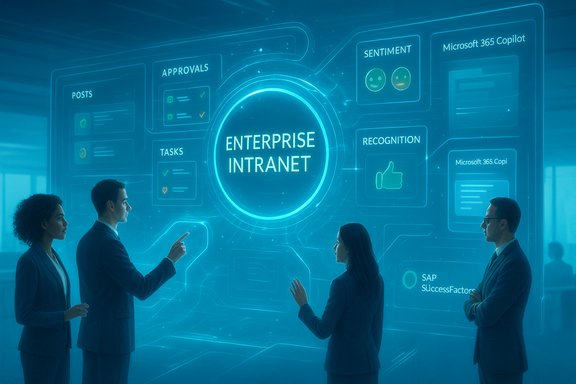
Interact’s public announcement bundles several headline items. Each will be summarized, then examined for technical feasibility and operational risk.- Microsoft Copilot Connector — a connector that exposes intranet content into Microsoft 365 Copilot in a permission‑aware way so employees can get answers inline without leaving Microsoft apps.
- Signal Agent — an always‑on agentic AI that scans posts, comments, and forum discussions to detect sentiment shifts, trending topics, and potential compliance or operational risks; it routes alerts to Internal Comms, HR, IT, or Security.
- Recognition Agent — an agent that detects moments of praise within internal channels and routes those with context to the appropriate managers, aiming to amplify recognition especially for frontline teams.
- Marketplace integrations (out‑of‑the‑box connectors) — prebuilt connectors for SAP SuccessFactors and ServiceNow that surface HR/IT self‑service (PTO checks, task lists, ticket submission) inside the intranet.
- Enhanced workplace social tools — usability and social features to improve discovery, commenting, and interaction on the intranet surface.
Market and platform context — why this matters now
Two platform trends make this release both plausible and strategically timed:- Microsoft’s Copilot and agent strategy has matured through 2024–2025 with extensibility primitives (custom connectors, tenant‑scoped permissioning, and agent frameworks) that let vendors surface tenant knowledge into Copilot experiences. This general platform movement reduces the engineering friction for partners who want to provide permission‑aware intranet content inside Copilot. Independent reporting on Copilot’s expanding features confirms Microsoft’s push to make Copilot integrable and extensible across tenant data.
- Agentic AI — systems that can reason across steps, call tools, and act on behalf of users — has moved from research demos to practical enterprise deployments. Platform vendors are shipping identity, lifecycle, and governance features that make managed agents feasible in corporate tenants. Business Insider and industry analysis have reported Microsoft’s internal roadmap work (Tenant Copilot, Agent Factory) and the broader trend of treating agents as first‑class objects in enterprise directories. That industry context explains why Interact frames these features as agentic rather than simple analytics.
Verifying the claims — what’s factual and what needs vendor validation
The central claims in Interact’s announcement fall into two categories: verifiable platform integrations and vendor‑performance claims that require customer validation.- The press release and newswire syndications confirm Interact’s Autumn 2025 bundle and the names of the features: Signal Agent, Recognition Agent, Microsoft Copilot Connector, and SuccessFactors/ServiceNow connectors. The GlobeNewswire item is available publicly and has been republished by multiple outlets. This confirms the announcement itself.
- The statement that Interact is a Microsoft Cloud AI Partner and that the Copilot Connector exposes permission‑aware intranet content to Microsoft 365 Copilot is a vendor claim whose feasibility is supported by Microsoft’s Copilot extensibility — but the exact operational model (where the connector runs, how permissions are enforced at query time, and audit/logging behavior) must be validated in each customer’s procurement and pilot. Public platform documentation shows the primitives exist; vendor implementation details determine whether the promised permission‑aware answers are actually enforced at runtime. Verify hosting model (tenant‑hosted vs vendor‑hosted), network topology, and audit outputs before production.
- Claims about the Signal and Recognition Agents’ accuracy, false positive rates, and safety behaviors are not independently verifiable from the press release. The vendor provides anecdotally positive early access feedback, but no independent accuracy figures, model providers, or retention policies are published in the release. These are critical operational facts customers must demand in writing. Treat the press release as a product snapshot rather than an audited performance statement.
- Confirm model provenance: which model provider(s) power the agents, and are any customer queries or outputs used to further train vendor models?
- Confirm permission enforcement architecture: is permissioning enforced at query time (runtime) or only at indexing time? Ask for a tenant‑scoped demonstration.
- Confirm logging and audit trails: query logs, agent actions, and decision provenance must be exportable to your SIEM and eDiscovery systems.
- Confirm retention and privacy defaults: what transcripts are retained, for how long, and are they anonymized or pseudonymized when surfaced to broader teams?
Security, privacy and governance implications
Agentic listening systems change the governance calculus. The Signal Agent is designed to be “always‑on” and to surface sentiment shifts and potential risks from colloquial channels — a capability that can accelerate response but that also raises material privacy, legal, and cultural risks.- Privacy and trust: Continuous monitoring of internal communications, even if restricted to intranet posts and public forums, can be perceived as surveillance if employees aren’t informed and policies aren’t explicit. Legal and HR teams must define scope (which channels are monitored), data access (who sees raw transcripts), opt‑out mechanisms, and appeal paths. Failure to do this can erode trust and increase regulatory exposure.
- False positives and misinterpretation: Sentiment detection is brittle — sarcasm, idioms, and cross‑cultural phrasing can easily be misclassified. Automatically escalating false alarms to Security or HR can waste time and harm relationships. Design conservative thresholds and require human review before consequential actions.
- Auditability and model provenance: For regulated industries, you must know which model generated a given alert, what evidence (source snippets, timestamps, participants) was used, and whether the model used any external training data derived from customer inputs. Without these disclosures, audits and legal defensibility are difficult. Recent academic work on governing agentic systems stresses user‑level agent registration, access control tokens, and cryptographic controls to bound agent behavior — approaches enterprises should demand.
- Operational security: Agent connectors that can create ServiceNow tickets or read HRIS data are valuable but also high‑risk. Ensure least‑privilege connectors, test for injection or privilege escalation risks, and export all agent activity to your SOC for continuous monitoring.
Practical rollout plan (recommended sequence)
- Pilot and scope (4–8 weeks)
- Choose a bounded business unit or frontline cohort.
- Run Signal Agent in alert‑only mode and Recognition Agent in recommendation mode (no auto‑routing) to collect telemetry.
- Governance and security (parallel)
- Assign agent owners, register agents in directory controls, and add agents to access reviews.
- Require vendor to provide data flow diagrams, retention policies, and model provider details before any production deployment.
- Operationalize (8–16 weeks)
- Integrate agent alerts with defined playbooks: who receives what alert, SLA for human review, and escalation criteria.
- Validate SuccessFactors/ServiceNow connectors for exact supported versions and operation modes (read vs read/write).
- Measure and iterate (ongoing)
- Track false positive rate, manager response time to surfaced recognition, ticket automation outcomes, and employee trust metrics.
- Audit agent logs quarterly and conduct a privacy impact assessment before expanding scope.
Strengths — why this could move the needle
- Reduced context switching: Surfacing HR/IT tasks and intranet knowledge within Microsoft 365 Copilot and the intranet reduces friction for frontline staff and knowledge workers, a clear usability win when implemented with proper permissioning.
- Operationalized listening: Passive, continuous listening can detect emergent issues faster than periodic surveys and manual monitoring, enabling earlier interventions for safety, compliance or morale problems. When combined with ticketing connectors, insight→action loops can close faster.
- Recognition amplification: Automatically surfacing and routing praise reduces invisible, ephemeral recognition and can make manager responses more timely — a measurable lever for engagement, especially among deskless or frontline workers.
Limitations and unresolved questions
- Accuracy & transparency: Vendor claims about detection are anecdotal in the public release. Customers need precision/recall numbers and example false positives/negatives and should measure these in a pilot.
- Data residency and hosting model: The press release does not specify whether connectors or agent compute and logs run in tenant‑controlled infrastructure or are vendor‑hosted. Those deployment choices materially affect compliance and risk. Demand contractual clarity.
- Legal exposure: In jurisdictions with strong employee privacy laws, continuous monitoring raises statutory issues. Companies must consult counsel and create explicit policies before enabling listening beyond public intranet channels.
- Costs and predictability: Agentic systems can incur ongoing inference costs and licensing (Copilot seats, agent runtime), and unpredictability in load can cause surprise bills. Budget for model compute and runtime monitoring.
How to evaluate Interact’s claims during procurement
- Insist on technical demos that show tenant‑scoped permission enforcement in real time (not just indexing).
- Require the vendor to disclose the model provider(s), whether data is retained or used to fine‑tune models, and where logs live.
- Run the Signal Agent in shadow mode for a defined period and compare flagged events to human triage outcomes.
- Ask for integration test results with your specific SuccessFactors/ServiceNow versions and for a sample mapping of HR/IT workflows the connectors can support.
Conclusion
Interact’s Autumn 2025 release aligns tightly with the current enterprise trajectory: intranets reasserted as the central work surface, and agentic AI used to extract signal from the noise of everyday collaboration. The business case is real — fewer context switches, faster discovery of emerging problems, and timely recognition can all improve productivity and culture. The technical feasibility of the Copilot Connector is supported by Microsoft’s platform progress, and the agentic features are consistent with industry trends toward managed enterprise agents. However, the release is primarily a vendor product announcement. Operational safety, legal compliance, and the real reliability of Signal and Recognition Agents are not proven in the press materials. Organizations considering these features must pilot conservatively, demand transparency on model provenance and retention, architect least‑privilege connectors, and bake in human review before any automated escalation or action. When deployed with clear governance, auditability, and human‑in‑the‑loop controls, these agentic capabilities can reduce gridlock and make the invisible visible — but without those controls they risk eroding trust and creating regulatory exposure.(For readers implementing this stack: treat Interact’s Autumn 2025 features as a compelling invitation to pilot, not a turnkey fix. Validate the permission model, retention policy, and audit outputs before flipping any agent from listen to act.
Source: The Manila Times Interact's Enterprise Employee Experience Platform Adds Agentic AI to Drive Employee Listening at Scale
