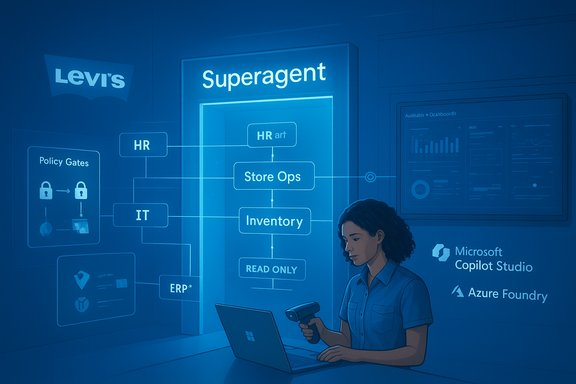
Levi Strauss & Co. has joined forces with Microsoft to build an Azure‑native, Teams‑embedded “superagent” — a single conversational portal that will orchestrate a network of specialized AI subagents to automate store, warehouse and corporate workflows as the company pursues a direct‑to‑consumer (DTC) transformation and broader AI‑first modernization of its operations.
Levi’s announcement, published jointly via Microsoft’s newsroom and Levi’s investor relations channels on November 17, 2025, positions the partnership as both a vendor deployment of Microsoft’s Copilot family and as a deeper architectural engagement with Azure AI Foundry, Copilot Studio and agentic AI orchestration. The initiative includes an Azure‑based orchestrator that surfaces within Microsoft Teams as a conversational “superagent,” plus multiple behind‑the‑scenes subagents aimed at HR, IT, retail operations and other functions. The company says the system is now in pilot and will expand into broader rollouts in 2026, after a holiday‑season pilot in about 60 U.S. stores. This move is consistent with Microsoft’s public roadmap of agentic capabilities — Copilot Studio’s multi‑agent orchestration, the Agent Service and the Azure AI Foundry suite — which provide the tooling for assembling, routing and governing teams of AI agents at enterprise scale. Microsoft has been positioning Azure AI Foundry as the unified “agent factory” for building, securing and operating agentic applications.
Levi’s move to embed a superagent into Teams and to standardize development on Azure gives it speed and integration advantages, but also concentrates responsibility: vendor tooling and enterprise governance must work in tandem. If Levi demonstrates measurable operational improvements during the 2025–2026 rollout while maintaining a conservative, auditable approach to agent actions, the project could become a reference architecture for retail. Conversely, premature expansion without adequate controls will expose the company to the same AI governance pitfalls other major enterprises have had to correct.
The next six months of the holiday‑season pilot and the early 2026 broader rollout will be the crucial signal window: clear, auditable metrics and evidence of controlled action‑capable agents will validate the promise; otherwise, the program will join a growing list of ambitious AI initiatives where execution and governance determined the outcome.
Conclusion
Levi Strauss & Co.’s public commitment to a Microsoft‑built superagent is a high‑profile case of retail embracing agentic AI in pursuit of modern, DTC‑first operations. The technical foundations are credible and align with Microsoft’s multi‑agent roadmap, and the potential benefits — faster store service, reduced manual work, and accelerated developer velocity — are tangible. Yet the biggest challenges are not purely technical: governance, model safety, privacy and careful operationalization will determine whether this initiative becomes a durable competitive advantage or a costly experiment. The pilot results expected over the next six to twelve months will be the clearest test of whether agentic orchestration scales safely and usefully for a global retailer.
Source: Microsoft Source Levi Strauss & Co. partners with Microsoft to develop next-gen superagent - Source
 Background
Levi’s announcement, published jointly via Microsoft’s newsroom and Levi’s investor relations channels on November 17, 2025, positions the partnership as both a vendor deployment of Microsoft’s Copilot family and as a deeper architectural engagement with Azure AI Foundry, Copilot Studio and agentic AI orchestration. The initiative includes an Azure‑based orchestrator that surfaces within Microsoft Teams as a conversational “superagent,” plus multiple behind‑the‑scenes subagents aimed at HR, IT, retail operations and other functions. The company says the system is now in pilot and will expand into broader rollouts in 2026, after a holiday‑season pilot in about 60 U.S. stores. This move is consistent with Microsoft’s public roadmap of agentic capabilities — Copilot Studio’s multi‑agent orchestration, the Agent Service and the Azure AI Foundry suite — which provide the tooling for assembling, routing and governing teams of AI agents at enterprise scale. Microsoft has been positioning Azure AI Foundry as the unified “agent factory” for building, securing and operating agentic applications. What Levi and Microsoft are actually building
The superagent architecture (high level)
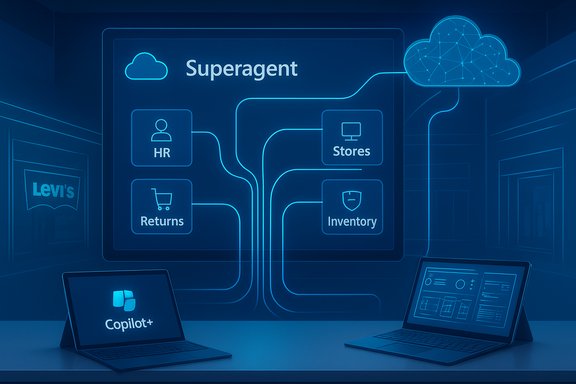
Levi’s “superagent” is described as an orchestrator UI embedded in Microsoft Teams that receives conversational prompts from employees and routes those prompts to appropriate subagents. The pattern is a hierarchical multi‑agent architecture:- A single conversational portal (the superagent) is the user’s entry point.
- Domain‑specific subagents (HR, IT, stores, returns, inventory, security, etc. handle specialized tasks and return structured answers or actions.
- The orchestrator aggregates, prioritizes and returns responses — or escalates to human operators when necessary.
Platform components Levi cites
Levi’s communications list specific Microsoft products and features that form the technology stack:- Microsoft 365 Copilot and Copilot Studio for agent design and user integration.
- Azure AI Foundry and Semantic Kernel for building, orchestrating and grounding agents.
- Microsoft Teams as the UI/portal for the superagent.
- Surface Copilot+ PCs running Windows 11 for device‑level AI acceleration and a dedicated Copilot key for quick access.
- Azure Migrate and GitHub Copilot used during migration and development phases.
Why Levi is doing this: the business rationale
Levi frames the project as a line‑of‑business modernization to accelerate its pivot to direct‑to‑consumer (DTC) sales, improve store experience, reduce time spent on routine tasks, and increase employee productivity. The press materials highlight several concrete intents:- Speed up answers to frontline queries (product attributes, returns, store procedures).
- Free store employees from repetitive administrative work so they can focus on customer engagement.
- Centralize contextualized knowledge and automate common cross‑functional processes (for example, HR onboarding or IT ticket triage).
Verification of key claims
The most load‑bearing technical and timeline claims in Levi’s announcement were cross‑checked against independent and vendor documents:- The partnership and the Teams‑embedded superagent announcement are documented in Microsoft’s press release and Levi’s investor newsroom dated November 17, 2025.
- Copilot Studio’s multi‑agent orchestration and Azure AI Foundry Agent Service are publicly described by Microsoft and were demonstrated at Build 2025 and subsequent product blog posts. These services explicitly support agent‑to‑agent calls, model integrations and enterprise observability.
- Surface Copilot+ PCs and the Copilot key are part of Microsoft’s Copilot+ hardware initiative and documentation, which details hardware NPUs, device features and the Copilot key mapping behavior. Windows management guidance explains Copilot key behavior and admin remap options.
- Azure Migrate is the standard Microsoft service for discovery and lift‑and‑shift migration planning and is commonly used by enterprises moving on‑prem workloads to Azure. Levi reports using Azure Migrate during its migration phases.
What this means technically for Levi’s IT stack
Identity, access, and security
Agentic systems that act across HR, IT and operational tools require strong identity and least‑privilege enforcement. Levi’s press materials state the company will maintain a zero‑trust security model and use policy orchestration and security agents as part of the Azure stack. That aligns with standard enterprise practice — Azure and Microsoft provide identity and policy primitives (Entra ID, Purview, Conditional Access) that can be integrated into agent flows to ensure on‑behalf‑of access and proper auditing. Implementing Entra Agent IDs, token pass‑through and OBO patterns will be essential.Observability and compliance
Agentic environments multiply telemetry: model decisions, tool calls, chain‑of‑thought traces, and user interactions all need to be logged and monitored. Azure AI Foundry advertises built‑in observability and tracing for agent performance, cost and safety metrics — features Levi will need to activate and tune to meet regulatory and internal audit requirements. Red‑teaming and AgentOps practices are also becoming standard to detect unsafe or privacy‑violating behavior.Device and endpoint considerations
Rolling out Surface Copilot+ PCs and Windows 11 across stores and corporate offices introduces heterogeneity in compute and capability. Copilot+ devices provide on‑device NPUs and a Copilot key, but not all features are universally available on non‑Copilot+ machines, so Levi’s IT will need a mixed‑device strategy and careful feature gating via Intune. Microsoft’s documentation on Copilot+ and Copilot key behavior gives administrators control over defaults and mappings.Benefits — practical and strategic
- Improved frontline efficiency: consolidating knowledge and actions into one conversational interface reduces context‑switching for store associates and support staff.
- Faster issue resolution: specialized subagents can orchestrate toolchains — for example, a returns subagent can query inventory, create reverse logistics paperwork, and log the case — all from a single prompt.
- Developer velocity: GitHub Copilot and Copilot Studio accelerate building, testing and shipping agent logic and assist Levi’s engineering teams with observability and release management workflows.
- Platform consolidation: moving workloads to Azure and using Foundry reduces integration friction when mixing models, tools and data sources, and centralizes governance controls.
Risks, gaps and open questions
While the technical vision is coherent and leverages mature Microsoft tooling, several material risks deserve attention:- Model hallucinations and incorrect actions: Agentic systems that act (not just answer) can take the wrong actions — making inventory adjustments, initiating refunds, or changing access controls — with business consequences. Guardrails, human‑in‑the‑loop checks and failure modes must be explicit and enforced. The industry is still developing robust, standardized methods to prevent and compensate for hallucinations in multi‑agent workflows.
- Data privacy and grounding: Agents that answer employee queries by pulling from private documents require strict grounding and permission checks. Incorrect grounding can leak PII or confidential business data. Microsoft’s SharePoint and Entra integrations can help, but correct configuration and periodic audits are mandatory.
- Vendor lock‑in and platform dependency: Designing a superagent around Azure, Copilot Studio and Microsoft Teams delivers tight integration and speed to value, but it increases dependency on a single cloud and SaaS ecosystem. This raises negotiation, cost and resilience concerns for long‑term IT strategy.
- Governance, auditability and regulatory exposure: Agents that autonomously interact with HR or financial workflows must comply with labor, privacy and financial reporting rules across jurisdictions. Multinational retail operations complicate compliance and require robust AgentOps, change management and traceability.
- Security surface expansion: Each agent, subagent and tool invocation creates a new attack surface. Automated red‑teaming, tool‑calling policies and runtime monitoring are necessary to reduce risk. Microsoft has announced model safety leaderboards and agent red‑teaming tooling, but these are evolving capabilities that must be adopted and operationalized by Levi’s security teams.
- Employee impact and change management: Automation can deliver productivity but also raises workforce questions — retraining, job redefinition and morale. Public statements about productivity gains are vendor‑aligned claims; Levi will need transparent change programs and metrics to evaluate real human outcomes.
- Timeline and scale risk: Levi states pilots in 60 stores with a broader 2026 rollout, but enterprise rollouts of agentic systems often require iterative hardening. Real‑world operational complexity can extend timelines and costs; past Levi targets (such as a $10B revenue goal) have previously been pushed out as market conditions changed, indicating caution when evaluating optimistic projections.
How successful rollouts look: practical recommendations for Levi’s IT and leadership
- Start small, instrument everything. Deploy constrained, read‑only subagents (for Q&A) first, then expand to action‑capable agents once safe behavior is proven.
- Implement AgentOps and continuous red‑teaming. Use purpose‑built observability dashboards, incident playbooks and scheduled adversarial testing to uncover unsafe behaviors before production impact.
- Harden identity and permissioning. Use Entra on‑behalf‑of flows, short‑lived tokens and granular API scopes so agents can only access what their prompts require.
- Define human escalation and rollback paths. Any agent that can modify business data should include explicit human confirmation or circuit breakers.
- Provide retraining and upskilling programs. Equip store and corporate employees with clear guidance on when to trust the agent, when to escalate, and how to audit agent responses.
- Measure the right KPIs. Focus on error rates, time to resolution, rework frequency, customer NPS lift and unplanned manual interventions. Public claims should be backed by these metrics before being repeated externally.
- Prepare for multi‑cloud or fallback strategies. Evaluate interoperability patterns (open protocols such as the Model Context Protocol) to reduce absolute lock‑in and enable portability.
Broader industry context: Microsoft’s agent strategy and the rise of agentic AI in retail
Microsoft has publicly embraced the concept of an “agent factory” — a platform approach for enterprises to create many custom agents — and has been rolling agentic features across Copilot Studio, GitHub Copilot and Azure AI Foundry since Build 2025. Industry reporting and internal leaks earlier in 2025 described Microsoft’s internal push to normalize agents as first‑class development artifacts and to expose standard protocols (like MCP) for tool calling and agent interoperability. Levi’s program is one of the higher‑profile customer examples of enterprise adoption at retail scale. Retail is an especially natural fit for agentic AI because stores combine high volumes of repetitive queries (returns, product facts, sizing), numerous operational workflows, and distributed staff who benefit from conversational tools embedded in their collaboration platform (Teams). But retail also spans complex supply chains, third‑party point‑of‑sale systems, and labor/regulatory regimes — which creates integration and governance complexity unique to the sector.Short‑term vs long‑term outcomes to watch
Short‑term (next 6–12 months)- Successful pilot metrics: reduced average handle time for store queries, fewer escalations to managers, and measurable developer productivity improvements from GitHub Copilot.
- Security baselining: activation of logging, AgentOps dashboards and initial red‑team results.
- Broader deployment across global stores and integration with omnichannel systems (e‑commerce, CRM, inventory).
- Evidence of operational cost savings and improvements in customer engagement attributable to agentic automation.
- Enterprise‑level maturity in governance, cross‑agent coordination and possibly productizing subagents as repeatable assets across other retail brands or departments.
- The economic question: measurable contribution to Levi’s DTC revenue mix and trajectory toward stated strategic revenue goals — which historically have shifted in timing.
Final assessment: promising, but governance defines success
Levi’s Microsoft partnership is a textbook example of how iconic retail brands are experimenting with agentic AI to modernize operations and accelerate DTC ambitions. The technical components cited — Copilot Studio, Azure AI Foundry, Teams embedding, Surface Copilot+ devices, and Azure migration tooling — are mature, productized offerings that provide a credible foundation for enterprise adoption. However, the real determinant of success will be the governance, testing and human‑centric operational practices Levi implements during the pilot and rollout. Agentic systems can deliver rapid productivity gains, but they also introduce new failure modes, privacy risks and compliance requirements that are not solved by technology alone. Organizations that treat agentic AI as an operational discipline — with continuous red‑teaming, strict identity and permissioning, transparent KPIs and human escalation — will capture the upside. Those that deploy without robust AgentOps and audits risk costly errors and reputational harm.Levi’s move to embed a superagent into Teams and to standardize development on Azure gives it speed and integration advantages, but also concentrates responsibility: vendor tooling and enterprise governance must work in tandem. If Levi demonstrates measurable operational improvements during the 2025–2026 rollout while maintaining a conservative, auditable approach to agent actions, the project could become a reference architecture for retail. Conversely, premature expansion without adequate controls will expose the company to the same AI governance pitfalls other major enterprises have had to correct.
The next six months of the holiday‑season pilot and the early 2026 broader rollout will be the crucial signal window: clear, auditable metrics and evidence of controlled action‑capable agents will validate the promise; otherwise, the program will join a growing list of ambitious AI initiatives where execution and governance determined the outcome.
Conclusion
Levi Strauss & Co.’s public commitment to a Microsoft‑built superagent is a high‑profile case of retail embracing agentic AI in pursuit of modern, DTC‑first operations. The technical foundations are credible and align with Microsoft’s multi‑agent roadmap, and the potential benefits — faster store service, reduced manual work, and accelerated developer velocity — are tangible. Yet the biggest challenges are not purely technical: governance, model safety, privacy and careful operationalization will determine whether this initiative becomes a durable competitive advantage or a costly experiment. The pilot results expected over the next six to twelve months will be the clearest test of whether agentic orchestration scales safely and usefully for a global retailer.
Source: Microsoft Source Levi Strauss & Co. partners with Microsoft to develop next-gen superagent - Source