

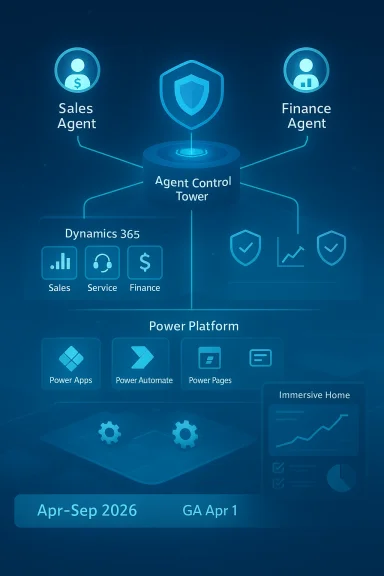
Microsoft’s 2026 release wave 1 is shaping up to be less a routine feature dump than a clear signal that agentic AI is becoming the organizing principle across the company’s business applications stack. The official plans, published on March 18, 2026, cover Dynamics 365, Microsoft Power Platform, and role-based Copilot offerings for the April-to-September release window, with general availability beginning April 1, 2026. Microsoft is not just adding AI to individual workflows; it is tightening the loop between data, automation, governance, and execution so that agents can increasingly act inside core business processes rather than merely comment on them.
Microsoft has been telegraphing this direction for more than a year, but the 2026 release wave 1 plans make it unmistakable. The company is no longer treating Copilot as a single productivity layer that helps people write emails or summarize meetings. Instead, it is framing Copilot, Copilot Studio, and the Dynamics 365 application family as a shared platform for agent-based work, where software can observe, reason, recommend, and in some cases act.
That shift matters because Microsoft’s enterprise portfolio is unusually broad. Dynamics 365 spans sales, service, finance, supply chain, commerce, HR, and operations. Power Platform supplies the low-code substrate that makes automation and app-building accessible to non-developers. Microsoft 365 Copilot, meanwhile, sits on top of the daily work layer where users live in Outlook, Teams, Excel, Word, and PowerPoint. When all three layers start speaking the language of agents, the platform story becomes much more coherent.
The timing is also important. Microsoft’s release plan pages say these are capabilities that may not yet be fully released and that timelines can change, which is a standard Microsoft disclaimer but an important reminder for buyers. Even so, the company is already positioning the release wave as a production-era change, not a lab experiment. The general availability start date of April 1, 2026, means enterprises are expected to begin planning around these features now, not later.
A second thread running through the announcement is governance. Microsoft is not pushing agentic features in isolation; it is pairing them with admin controls, telemetry, evaluation, risk checks, and security tooling. That is a telling move. As enterprises get more comfortable with AI-generated output, the next battleground becomes who can trust, monitor, and constrain the agents that generate it.
Finally, the 2026 wave reflects a market reality that has been building since the first wave of Copilot launches: productivity AI is now expected to do more than assist. Customers increasingly want systems that can gather context from multiple sources, manage multi-step tasks, and deliver work products that are closer to completion. Microsoft’s latest plans suggest the company believes the next competitive edge will come from turning AI from a conversational helper into a managed, enterprise-grade execution layer.
It also reflects how Microsoft wants enterprises to think about AI procurement. If agents can be planned, monitored, and governed across multiple business domains, then the buyer may prefer one integrated stack over a patchwork of tools. That gives Microsoft a chance to sell the story of operational coherence, not just feature richness. That is a subtle but powerful sales argument.
That distinction may sound procedural, but it is strategically significant. Enterprises do not fear AI because it is clever; they fear it because it can be unpredictable, opaque, or too permissive. By offering release-wave controls, Microsoft is trying to reduce the adoption friction that often slows down enterprise AI deployments.
The result is a more complete enterprise AI stack. Microsoft can now tell a story that starts with data access, moves through workflow automation, and ends in governance and evaluation. That is a much stronger position than merely saying Copilot can draft text faster.
That is important because sales software has historically suffered from low adoption. If sellers have to switch apps constantly or manually reconcile what is in CRM with what is buried in email, they naturally resist using the system. By making Copilot the front door to sales work, Microsoft is trying to make CRM feel more like a live workspace than a database.
This matters because service is where AI has some of the fastest measurable ROI. Faster case handling, better intent recognition, and more consistent knowledge delivery can reduce handling time and improve customer satisfaction. But these gains depend on trust, which is why Microsoft emphasizes supervision and telemetry alongside autonomy.
That is why the broader service stack matters. If the same Copilot layer can help with case classification, knowledge retrieval, supervisor support, and escalation logic, then the platform begins to reduce operational friction across the entire service chain. The danger, of course, is that poorly governed automation will simply scale bad decisions faster. That is the tradeoff every service leader will need to watch.
The significance is straightforward: finance teams spend enormous time on repeatable, rules-heavy work. If AI can reduce the manual burden while keeping outputs auditable, the productivity upside is real. But the bar is high, because finance automation must remain explainable and deterministic enough for control frameworks and audits.
Field Service also gets attention, with improved mobile usability and reliability plus the Scheduling Operations Agent. That combination suggests Microsoft wants to push AI deeper into the last mile of service delivery, where schedules, technician availability, and customer expectations are tightly coupled. If the agent can make scheduling more consistent, it can create immediate operational value.
ERP buyers will care about the practical consequences more than the branding. If Microsoft can show that agents improve process compliance, reduce cycle time, and lower manual intervention without making audit trails opaque, it will strengthen the platform’s case. If not, “agentic ERP” risks sounding like a glossy slogan rather than an operating model.
The opportunity here is to lower the barrier between an idea and an enterprise workflow. Many business teams do not need a fully custom software project; they need something good enough to orchestrate tasks, approvals, and contextual data. Power Apps has long served that need, and AI now gives it a faster front end.
That dual use is a recurring theme across this release wave. Microsoft wants customers to see AI not merely as a creative force but as a governance helper. In practice, that can make the platform more attractive to IT teams that are wary of handing too much freedom to makers.
This is where the platform starts to feel genuinely agentic. A workflow that can author itself, optimize itself, and recover from failures is more than a rules engine. It becomes a system that can keep business processes running even when conditions shift, which is exactly the kind of operational resilience enterprises are looking for.
Multi-agent systems can specialize. One agent can gather context, another can draft a response, a third can validate policy or compliance, and a fourth can trigger a workflow. Microsoft’s release plan suggests it wants Copilot Studio to be the place where those roles are assembled and managed rather than improvised by one-off scripts.
The significance here goes beyond QA. Evaluation becomes the bridge between experimentation and production. If organizations can measure correctness, behavior, and multi-turn performance before release, then agentic systems become more governable and less scary. That, more than any flashy demo, is what will determine adoption.
In enterprise terms, this is smart. The companies most eager to adopt AI are often the same companies with the strictest compliance obligations. If Microsoft can make governance built-in rather than bolted on, it lowers the organizational cost of saying yes to AI.
The business rationale is simple. Sales people do not want another destination; they want fewer places to look. By moving summaries and actions into the flow of work, Microsoft makes the Copilot experience feel more native and more indispensable.
This also highlights a broader strategic move: Microsoft wants business users to stay inside Microsoft 365 even when the task originates in ERP or finance systems. That keeps the user anchored in the productivity suite while reducing the need to bounce between transactional and analytical tools.
That specificity also helps Microsoft justify premium packaging. If Copilot becomes a bundle of role-specific, governed experiences rather than a generic add-on, the company can argue that the software is not just a chatbot but a business system. That is a far stronger value proposition.
For enterprises, interoperability is the difference between a controlled AI architecture and a collection of clever demos. If context can move cleanly between agents and business systems, then workflows become easier to maintain, govern, and scale. If not, every use case turns into a bespoke integration project.
That design choice reflects a deeper truth: agents are becoming operational assets. As soon as organizations rely on them to move work forward, they need dashboards, status views, and escalation paths just as they would for any other critical workload. Microsoft is building that assumption into the product.
It is also where smaller rivals may struggle. Point solutions can move faster on a single workflow, but it is harder for them to match a full-stack story that spans identity, data, app development, governance, and security. Microsoft is betting that enterprises will ultimately value that completeness more than isolated brilliance.
The upside is also organizational. If the same vendor provides sales, service, finance, automation, and governance, procurement becomes simpler and IT can standardize policies more easily. The cost is dependency, of course, but Microsoft is clearly willing to make the case that integration is worth it.
Still, consumers should not assume all of this will surface in their own subscriptions. A lot of the most consequential updates sit behind role-based packaging, enterprise admin controls, or workload-specific entitlements. That makes the 2026 wave much more of an enterprise story than a consumer one.
And once that frame is in place, Microsoft can keep expanding what “Copilot” means without making each new feature feel like a separate invention. That is how platform brands become durable. The label stays familiar even as the capabilities underneath it evolve rapidly.
The opportunity set is broad because the release wave spans multiple layers of the stack. That gives Microsoft multiple places to drive adoption, from makers in Power Platform to sellers in Dynamics 365 to finance teams in Microsoft 365 Copilot. The breadth also makes it easier to cross-sell once one part of the platform gains traction.
There is also a governance risk. Microsoft is adding the right controls, but controls only help if they are actually configured, monitored, and enforced by customers. In large organizations, that is often the hardest part, especially when departments move faster than central IT or security teams.
The other thing to watch is how quickly Microsoft turns the language of agents into measurable business outcomes. It is easy to market autonomy; it is harder to prove that autonomy reduces cycle time, improves quality, lowers cost, or increases revenue in durable ways. If Microsoft can show that its agentic stack improves those metrics in sales, service, finance, and operations, it will have a much stronger case than a generic AI story ever could.
Source: Cloud Wars Microsoft Unveils Agentic AI Push Across D365, Power Platform and M365 Copilot in 2026 Release Wave 1
 Background
Microsoft has been telegraphing this direction for more than a year, but the 2026 release wave 1 plans make it unmistakable. The company is no longer treating Copilot as a single productivity layer that helps people write emails or summarize meetings. Instead, it is framing Copilot, Copilot Studio, and the Dynamics 365 application family as a shared platform for agent-based work, where software can observe, reason, recommend, and in some cases act.That shift matters because Microsoft’s enterprise portfolio is unusually broad. Dynamics 365 spans sales, service, finance, supply chain, commerce, HR, and operations. Power Platform supplies the low-code substrate that makes automation and app-building accessible to non-developers. Microsoft 365 Copilot, meanwhile, sits on top of the daily work layer where users live in Outlook, Teams, Excel, Word, and PowerPoint. When all three layers start speaking the language of agents, the platform story becomes much more coherent.
The timing is also important. Microsoft’s release plan pages say these are capabilities that may not yet be fully released and that timelines can change, which is a standard Microsoft disclaimer but an important reminder for buyers. Even so, the company is already positioning the release wave as a production-era change, not a lab experiment. The general availability start date of April 1, 2026, means enterprises are expected to begin planning around these features now, not later.
A second thread running through the announcement is governance. Microsoft is not pushing agentic features in isolation; it is pairing them with admin controls, telemetry, evaluation, risk checks, and security tooling. That is a telling move. As enterprises get more comfortable with AI-generated output, the next battleground becomes who can trust, monitor, and constrain the agents that generate it.
Finally, the 2026 wave reflects a market reality that has been building since the first wave of Copilot launches: productivity AI is now expected to do more than assist. Customers increasingly want systems that can gather context from multiple sources, manage multi-step tasks, and deliver work products that are closer to completion. Microsoft’s latest plans suggest the company believes the next competitive edge will come from turning AI from a conversational helper into a managed, enterprise-grade execution layer.
The New Shape of Microsoft’s Release Wave
The headline is not simply that Microsoft has new features. The real story is that the company is reorganizing its business applications narrative around a set of agentic patterns that are meant to repeat across products. In practical terms, that means the same ideas show up in sales, service, finance, supply chain, app development, and governance. Microsoft is making a platform bet, not a point-feature bet.A unified AI vocabulary
Microsoft’s release language is intentionally consistent. Across the official pages, the company talks about agentic experiences, daily command centers, conversational intelligence, evaluation, and governance. That consistency is not accidental; it helps buyers see a family resemblance between what might otherwise look like unrelated product updates.It also reflects how Microsoft wants enterprises to think about AI procurement. If agents can be planned, monitored, and governed across multiple business domains, then the buyer may prefer one integrated stack over a patchwork of tools. That gives Microsoft a chance to sell the story of operational coherence, not just feature richness. That is a subtle but powerful sales argument.
Release planning as strategy
The release wave format matters here because it gives Microsoft a way to introduce AI in controlled increments. The company’s plan pages separate features that are enabled automatically from those that require admin or maker action, which is especially important when automation can touch sensitive workflows. In other words, Microsoft is pairing speed with control.That distinction may sound procedural, but it is strategically significant. Enterprises do not fear AI because it is clever; they fear it because it can be unpredictable, opaque, or too permissive. By offering release-wave controls, Microsoft is trying to reduce the adoption friction that often slows down enterprise AI deployments.
What changed versus prior waves
The 2025 release waves were already moving in this direction, but 2026 looks more mature. Earlier waves introduced role-based Copilot experiences, automation in sales and finance, and foundational governance improvements. The 2026 wave advances those ideas by making the agent model feel more systemic and less experimental.The result is a more complete enterprise AI stack. Microsoft can now tell a story that starts with data access, moves through workflow automation, and ends in governance and evaluation. That is a much stronger position than merely saying Copilot can draft text faster.
Dynamics 365 Sales and Customer Service Get Smarter
Dynamics 365 is one of the clearest examples of Microsoft’s agentic push. In Sales, the company is extending Copilot so users can work with data from both CRM and Microsoft 365 sources, including email and meeting summaries. That makes the sales workflow feel less fragmented and gives sellers a better shot at understanding account context without jumping between systems.Sales as a command center
Microsoft 365 Copilot for Sales is becoming, in Microsoft’s words, the seller’s daily command center. The official plans point to richer Sales Chat and Sales Home experiences, configurable record summaries, contextual support in Outlook and Teams, and improved email and meeting intelligence. The direction is clear: sales reps should spend less time hunting for information and more time acting on it.That is important because sales software has historically suffered from low adoption. If sellers have to switch apps constantly or manually reconcile what is in CRM with what is buried in email, they naturally resist using the system. By making Copilot the front door to sales work, Microsoft is trying to make CRM feel more like a live workspace than a database.
Customer service gets more autonomous
Dynamics 365 Customer Service is also getting deeper agentic capabilities, including stronger Copilot integration and richer supervisor tooling. Microsoft says it is building on the four AI agents that reached general availability in October 2025 and expanding their telemetry and autonomy. That suggests customer service is moving from assisted triage toward more self-directed workflow execution.This matters because service is where AI has some of the fastest measurable ROI. Faster case handling, better intent recognition, and more consistent knowledge delivery can reduce handling time and improve customer satisfaction. But these gains depend on trust, which is why Microsoft emphasizes supervision and telemetry alongside autonomy.
Why it matters for contact centers
Contact centers are especially sensitive to the balance between automation and empathy. Microsoft’s updates to Dynamics 365 Contact Center point to enhanced self-service, which can improve efficiency if the underlying intents are handled correctly. Yet self-service only works when the model understands enough of the customer’s issue to route or resolve it correctly.That is why the broader service stack matters. If the same Copilot layer can help with case classification, knowledge retrieval, supervisor support, and escalation logic, then the platform begins to reduce operational friction across the entire service chain. The danger, of course, is that poorly governed automation will simply scale bad decisions faster. That is the tradeoff every service leader will need to watch.
Finance, Supply Chain, and ERP Become More Agentic
Finance and operations are where Microsoft’s AI strategy becomes most operationally serious. These are not glamorous use cases, but they are the ones that make or break enterprise adoption because they sit closest to control, compliance, and money. Microsoft’s 2026 wave adds more automation, more context, and more agentic orchestration to these workloads.Finance wants fewer manual loops
Microsoft says finance enhancements in the new wave introduce greater automation into financial processes. In the role-based Copilot offerings, the company is also expanding Finance Agent capabilities so users can handle reconciliation, variance analysis, data preparation in Excel, and customer communication from Outlook. That is a meaningful shift from mere assistance to workflow acceleration.The significance is straightforward: finance teams spend enormous time on repeatable, rules-heavy work. If AI can reduce the manual burden while keeping outputs auditable, the productivity upside is real. But the bar is high, because finance automation must remain explainable and deterministic enough for control frameworks and audits.
Supply chain gets more hands-free
On the supply chain side, Microsoft is adding AI-powered picking, stock rebalancing, and hands-free scanning. Those are not just convenience features; they are attempts to improve throughput and reduce errors in environments where small delays can cascade into real costs. For warehouse and logistics workers, the quality of AI matters less in abstract model terms and more in whether it reduces wasted motion.Field Service also gets attention, with improved mobile usability and reliability plus the Scheduling Operations Agent. That combination suggests Microsoft wants to push AI deeper into the last mile of service delivery, where schedules, technician availability, and customer expectations are tightly coupled. If the agent can make scheduling more consistent, it can create immediate operational value.
Business Central and ERP evolution
Business Central is being positioned as part of the move toward “agentic ERP,” which is a phrase Microsoft is clearly hoping will stick. The implication is that ERP systems should not only record transactions but also help initiate, optimize, and monitor them. That is a notable change in the role of enterprise systems of record.ERP buyers will care about the practical consequences more than the branding. If Microsoft can show that agents improve process compliance, reduce cycle time, and lower manual intervention without making audit trails opaque, it will strengthen the platform’s case. If not, “agentic ERP” risks sounding like a glossy slogan rather than an operating model.
Power Platform Becomes the Factory for Agents
Power Platform is where Microsoft can democratize the agent story. It is the layer that turns strategic AI ambition into something makers, admins, and analysts can actually build, test, and govern. The 2026 release wave 1 plans show Microsoft moving quickly to make that stack more powerful and more controlled at the same time.Power Apps and generative pages
Power Apps is gaining expanded AI features and more flexibility for creating generative pages. That sounds incremental, but it is strategically important because app creation is one of the fastest ways to turn AI from a demo into a business tool. If users can compose apps more naturally, Microsoft can drive broader adoption of its ecosystem.The opportunity here is to lower the barrier between an idea and an enterprise workflow. Many business teams do not need a fully custom software project; they need something good enough to orchestrate tasks, approvals, and contextual data. Power Apps has long served that need, and AI now gives it a faster front end.
Power Pages and security agents
Power Pages is getting enhanced AI tooling and security agents, which broadens the platform’s appeal for external-facing sites and low-code portals. That is a meaningful addition because security around public or semi-public web surfaces is a perennial headache for enterprises. Microsoft is effectively arguing that AI can help build sites while also helping defend them.That dual use is a recurring theme across this release wave. Microsoft wants customers to see AI not merely as a creative force but as a governance helper. In practice, that can make the platform more attractive to IT teams that are wary of handing too much freedom to makers.
Power Automate gets self-healing
Power Automate’s new agent-based features are especially interesting because they target authoring, optimization, and self-healing. The inclusion of desktop flows and Copilot Studio-driven actions in cloud flows means Microsoft is pushing AI deeper into hybrid automation scenarios that cross legacy and modern systems.This is where the platform starts to feel genuinely agentic. A workflow that can author itself, optimize itself, and recover from failures is more than a rules engine. It becomes a system that can keep business processes running even when conditions shift, which is exactly the kind of operational resilience enterprises are looking for.
Copilot Studio and Governance Become the Control Layer
Copilot Studio is arguably the most strategically important part of Microsoft’s 2026 plan because it is where agents are created, tuned, evaluated, and governed. The company is betting that enterprises will not just use agents; they will build them, supervise them, and increasingly try to scale them. That requires a serious control layer.Multi-agent orchestration
One of the biggest updates is support for multi-agent orchestration. That matters because real business processes rarely map cleanly to a single agent or a single prompt. They involve multiple roles, systems, escalation paths, and approvals, which is why orchestration is the next logical step after simple chat-based assistants.Multi-agent systems can specialize. One agent can gather context, another can draft a response, a third can validate policy or compliance, and a fourth can trigger a workflow. Microsoft’s release plan suggests it wants Copilot Studio to be the place where those roles are assembled and managed rather than improvised by one-off scripts.
Evaluation is no longer optional
Microsoft is also adding more robust evaluation features for agents used in Microsoft 365 Copilot workflows. The Learn documentation says agents for Microsoft 365 Copilot evaluation is meant to replace manual, ad hoc testing with scalable, standardized evaluation practices that reduce production risk. That is a major tell: Microsoft knows enterprises will not deploy at scale without testing discipline.The significance here goes beyond QA. Evaluation becomes the bridge between experimentation and production. If organizations can measure correctness, behavior, and multi-turn performance before release, then agentic systems become more governable and less scary. That, more than any flashy demo, is what will determine adoption.
Governance is becoming productized
Microsoft Power Platform governance and administration are getting admin controls for agent security, real-time risk assessment in Copilot Studio, and AI-powered governance agents that automate tenant monitoring and remediation. That is a strong sign that Microsoft sees governance as a product category, not an afterthought.In enterprise terms, this is smart. The companies most eager to adopt AI are often the same companies with the strictest compliance obligations. If Microsoft can make governance built-in rather than bolted on, it lowers the organizational cost of saying yes to AI.
Role-Based Copilots Move Closer to the Work
Microsoft 365 Copilot’s role-based agents are another pillar of the 2026 wave, especially in sales and finance. The company is clearly trying to transform Copilot from a general assistant into a set of role-specific command centers that know the vocabulary, workflows, and obligations of particular jobs.Sales Agent gets richer context
Sales Agent is being positioned as the seller’s daily command center, with richer Sales Chat and Sales Home experiences, improved record summaries, and tighter integrations with Outlook and Teams. That means sellers can pull account context and meeting intelligence from their everyday tools rather than relying on separate CRM rituals.The business rationale is simple. Sales people do not want another destination; they want fewer places to look. By moving summaries and actions into the flow of work, Microsoft makes the Copilot experience feel more native and more indispensable.
Finance Agent goes into the spreadsheet workflow
Finance Agent is being built as a role-based Copilot experience that brings financial intelligence and ERP access into the Microsoft 365 layer. The official materials point to everyday tasks such as reconciliation and variance analysis, which are exactly the kinds of repetitive but high-value jobs where AI can save time without replacing judgment.This also highlights a broader strategic move: Microsoft wants business users to stay inside Microsoft 365 even when the task originates in ERP or finance systems. That keeps the user anchored in the productivity suite while reducing the need to bounce between transactional and analytical tools.
Why role-based AI wins attention
Role-based AI is usually more compelling than generic chat because it understands work context better. A seller and a finance analyst may both use “Copilot,” but they need different data, different guardrails, and different workflows. Microsoft’s release wave shows it understands that enterprise buyers prefer specificity over one-size-fits-all branding.That specificity also helps Microsoft justify premium packaging. If Copilot becomes a bundle of role-specific, governed experiences rather than a generic add-on, the company can argue that the software is not just a chatbot but a business system. That is a far stronger value proposition.
Model Context Protocol and the Infrastructure Layer Matter
One of the more technical pieces of the release wave is Microsoft’s attention to Model Context Protocol, or MCP, in finance and operations. This may not grab headlines outside the technical audience, but it is exactly the kind of plumbing that decides whether agentic AI is practical at scale.Why MCP is strategically important
MCP is about structured context sharing between tools, models, and environments. When Microsoft says it is improving MCP servers, it is really saying it wants a cleaner way for agents and systems to exchange context safely and consistently. That makes the AI layer more interoperable and less brittle.For enterprises, interoperability is the difference between a controlled AI architecture and a collection of clever demos. If context can move cleanly between agents and business systems, then workflows become easier to maintain, govern, and scale. If not, every use case turns into a bespoke integration project.
Immersive Home and agent oversight
Microsoft is also introducing Immersive Home, an adaptive landing page for agent management and workflow monitoring. That may sound like a UI detail, but it is actually a statement about how Microsoft expects businesses to interact with fleets of agents. They need a home base, a monitoring surface, and a place to inspect ongoing work.That design choice reflects a deeper truth: agents are becoming operational assets. As soon as organizations rely on them to move work forward, they need dashboards, status views, and escalation paths just as they would for any other critical workload. Microsoft is building that assumption into the product.
The infrastructure story behind the headlines
The infrastructure layer is often less visible than the app layer, but it tends to be where competitive advantage compounds. Microsoft’s release wave suggests the company knows it must provide not only AI features but also the tooling to make those features maintainable in production. That is where control, compliance, and system design converge.It is also where smaller rivals may struggle. Point solutions can move faster on a single workflow, but it is harder for them to match a full-stack story that spans identity, data, app development, governance, and security. Microsoft is betting that enterprises will ultimately value that completeness more than isolated brilliance.
Enterprise vs. Consumer Impact
Although the release wave is focused on business applications, the downstream implications differ sharply between enterprise and consumer users. For enterprises, the story is governance, productivity, and workflow control. For consumers, the visible effect is indirect, because the real changes happen inside workplace systems and subscriptions.Enterprise buyers get the most immediate value
Enterprises stand to gain the most because they control the data, the workflows, and the licensing stack. They can use the release wave to rationalize how AI is deployed across CRM, ERP, collaboration, and low-code development. That makes it easier to pilot agents in one department and scale them across the organization if the results are good.The upside is also organizational. If the same vendor provides sales, service, finance, automation, and governance, procurement becomes simpler and IT can standardize policies more easily. The cost is dependency, of course, but Microsoft is clearly willing to make the case that integration is worth it.
Consumers see the story through Microsoft 365
For consumer and prosumer users, the changes are less dramatic in the short term but still important. When role-based Copilots improve in the enterprise, the underlying UX patterns often influence broader Microsoft 365 expectations, especially around summaries, contextual assistance, and task execution. The public face of Copilot benefits from this constant refinement even when the deeper features are business-specific.Still, consumers should not assume all of this will surface in their own subscriptions. A lot of the most consequential updates sit behind role-based packaging, enterprise admin controls, or workload-specific entitlements. That makes the 2026 wave much more of an enterprise story than a consumer one.
The brand effect
The broader brand effect may be even more significant than the features themselves. By making Copilot the common language across business apps, Microsoft is teaching the market to think of AI as a native layer inside work software rather than a separate product category. That is a powerful long-term framing move.And once that frame is in place, Microsoft can keep expanding what “Copilot” means without making each new feature feel like a separate invention. That is how platform brands become durable. The label stays familiar even as the capabilities underneath it evolve rapidly.
Strengths and Opportunities
Microsoft’s 2026 release wave 1 has several clear strengths. The most obvious is that it connects AI capability to business process value instead of stopping at assistant-style novelty. The second is that it pairs automation with governance, which is the right combination for enterprise buyers who need to move carefully.The opportunity set is broad because the release wave spans multiple layers of the stack. That gives Microsoft multiple places to drive adoption, from makers in Power Platform to sellers in Dynamics 365 to finance teams in Microsoft 365 Copilot. The breadth also makes it easier to cross-sell once one part of the platform gains traction.
- Stronger workflow automation across sales, service, finance, and operations.
- Better contextual AI through tighter integration with Microsoft 365 data and activities.
- More governable agent deployment via evaluation, admin controls, and risk assessment.
- Lower maker friction in Power Apps, Power Pages, and Power Automate.
- Improved role specificity for sales and finance users.
- A clearer platform story for enterprise buyers seeking fewer vendors.
- Potential ROI acceleration in repetitive, high-volume workflows where automation is easiest to justify.
Risks and Concerns
The biggest risk is that Microsoft’s agentic vision could outrun real-world readiness. Many enterprises still struggle with data quality, workflow consistency, and change management, which means a smarter agent does not automatically translate into better outcomes. If the underlying process is messy, automation can simply scale the mess.There is also a governance risk. Microsoft is adding the right controls, but controls only help if they are actually configured, monitored, and enforced by customers. In large organizations, that is often the hardest part, especially when departments move faster than central IT or security teams.
- Overpromising autonomy before agents are reliable enough for critical tasks.
- Governance complexity if admin controls are powerful but difficult to operationalize.
- Workflow brittleness when upstream data or permissions are inconsistent.
- Vendor lock-in as more of the enterprise AI stack converges inside Microsoft.
- User trust issues if AI-generated summaries or actions are inaccurate or opaque.
- Adoption fatigue if buyers see too many overlapping Copilot surfaces without clear differentiation.
- Integration overhead for customers trying to connect legacy systems to newer agentic workflows.
Looking Ahead
The next few months will tell us whether Microsoft’s 2026 release wave 1 becomes a meaningful inflection point or just another ambitious roadmap. The official milestones already show that the company expects these capabilities to move into customer environments during the April-to-September window, so the real test will be execution, not announcement. Enterprises will want to see which features arrive on time, which ones remain previews, and which ones earn repeat usage.The other thing to watch is how quickly Microsoft turns the language of agents into measurable business outcomes. It is easy to market autonomy; it is harder to prove that autonomy reduces cycle time, improves quality, lowers cost, or increases revenue in durable ways. If Microsoft can show that its agentic stack improves those metrics in sales, service, finance, and operations, it will have a much stronger case than a generic AI story ever could.
- Feature delivery timing across Dynamics 365, Power Platform, and Copilot offerings.
- Adoption of Copilot Studio governance and evaluation tools by enterprise admins and makers.
- Customer traction for role-based Copilots in sales and finance.
- The quality of agentic outcomes in service, supply chain, and ERP workflows.
- Competitive responses from Salesforce, ServiceNow, Google, and other enterprise AI vendors.
Source: Cloud Wars Microsoft Unveils Agentic AI Push Across D365, Power Platform and M365 Copilot in 2026 Release Wave 1
Last edited:
