

Most Microsoft 365 configuration drift happens when a tenant’s current security settings gradually diverge from the baseline an MSP or IT team originally deployed, often through small operational changes that accumulate over months without centralized review. That is the core warning in an MSSP Alert guest post from Augmentt, and it lands because it describes the least glamorous part of cloud security: the day-after-day erosion of controls that once looked solid. The dangerous setting is rarely dramatic when it changes. It becomes dramatic later, when an attacker finds that the exception is still open.
The Microsoft 365 security story is usually told through phishing kits, token theft, OAuth consent abuse, and ransomware crews. But the quieter story is administrative entropy. Tenants are living systems, and living systems drift unless someone—or something—keeps pulling them back toward policy.
The most useful thing about the configuration drift argument is that it relocates risk from the abstract to the operational. Drift is not a mysterious technical failure. It is what happens when a support ticket, a troubleshooting session, a VIP request, or a rushed app rollout changes a control that nobody later revisits.
An executive is traveling and cannot complete MFA, so an exception is granted. A conditional access policy blocks a line-of-business app, so a technician temporarily disables it. External sharing is loosened so a client can get a project out the door. An admin role is assigned for a migration and remains in place because the migration finished on a Friday afternoon.
None of those moments necessarily reflects incompetence. In fact, most of them reflect the normal pressure of IT service delivery: restore access, meet the deadline, keep the client productive. The risk is that Microsoft 365 remembers the exception long after the humans have forgotten the reason.
That makes configuration drift particularly treacherous for managed service providers. An internal IT department may have a manageable number of tenants and a decent memory of why exceptions exist. An MSP managing 50, 100, or 500 tenants has no such luxury. At that scale, undocumented change becomes a probability function.
The baseline is the intent. The tenant is the reality. Configuration drift is the widening gap between the two.
That gap matters because many of the most important Microsoft 365 defenses are configuration-dependent. Conditional Access decides when a sign-in should be blocked, challenged, or allowed. MFA registration and authentication method policies shape how hard it is to turn stolen credentials into access. Exchange Online rules determine whether mail can be forwarded or manipulated. SharePoint and Teams policies decide how easily data leaves the organization. Defender settings influence how much suspicious behavior is surfaced before it becomes an incident.
A tenant can pass an onboarding checklist in January and be materially weaker by June without any one person feeling they “changed security.” That is why drift is not housekeeping. It is an attack surface that grows under the cover of normal administration.
A well-designed conditional access architecture usually has layers: baseline protections for all users, stronger requirements for administrators, device or location conditions, emergency access accounts, and controlled exclusions. The trouble begins when those exclusions stop being rare, reviewed, and documented. A policy with too many exceptions is not a policy; it is a suggestion with footnotes.
MSPs see this in predictable ways. A client has an old scanner, an accounting connector, or a custom integration that fails under a stricter policy. The business does not want a security lecture; it wants the workflow restored. The technician carves out an exception, and the tenant moves one notch away from the intended state.
Over time, the control plane becomes a sedimentary record of past emergencies. Nobody set out to create an insecure tenant. They simply kept solving local problems, one at a time, until the global design was no longer true.
Drift reopens those doors in subtle ways. A tenant may have blocked legacy authentication during a security hardening project, only to later re-enable a protocol for compatibility. A single exception made for one application can survive beyond the app’s life span. A migration can leave behind a service account that nobody wants to touch because nobody is entirely sure what it still does.
This is the kind of risk that looks minor in the moment and indefensible after a compromise. If an attacker uses a path that the MSP’s own baseline said should be blocked, the uncomfortable question is not whether the baseline was good. It is why the tenant was allowed to stop matching it.
The arithmetic is unforgiving. If one client generates a handful of configuration changes each month, an MSP with dozens of clients is dealing with hundreds of potential drift events. If every event requires a technician to remember the baseline, inspect the setting, determine business justification, document the exception, schedule a review, and remediate when appropriate, manual control collapses quickly.
That collapse is not always visible as chaos. It may look like normal tickets being closed, normal reports being sent, and normal security meetings being held. The danger is that the service looks mature from the outside while the configuration state underneath is diverging.
This is where drift becomes more than a technical failure mode. It becomes a liability problem. If a client experiences a breach and the post-incident review finds that an MFA exception, external sharing relaxation, stale privileged role, or disabled policy enabled the attack, the conversation moves from “How did this happen?” to “Who was responsible for noticing?”
Microsoft 365 moves too quickly for that rhythm. A quarterly audit can identify drift, but it cannot reliably prevent exposure. If a policy is disabled in February and reviewed in May, the audit may be accurate and still three months too late.
Manual tenant review also does not scale cleanly. Even a diligent MSP that rotates through tenants can only inspect a slice of its estate at a time. By the time the last client has been checked, the first few may already have changed. The process produces a reassuring spreadsheet, but the spreadsheet is a photograph of a moving object.
The deeper problem is that audits often capture the existence of controls, not their operational integrity. “MFA enabled” is not the same as “MFA enforced for the right users, without excessive exclusions, through acceptable methods, with legacy paths blocked.” Drift lives in those qualifications.
Continuous monitoring changes the nature of the control. Instead of asking, “Did we check this tenant recently?” the MSP can ask, “Is this tenant currently aligned with the baseline?” That shift matters because Microsoft 365 security is not merely about having the right policy written down. It is about knowing when the real tenant stops obeying it.
The best implementations treat drift management as a closed loop. A baseline is defined. Tenant settings are continuously compared against it. Deviations are flagged. Some are automatically remediated. Others are routed into change management because the business may have a valid reason for the exception. Either way, the deviation becomes visible and accountable.
Automation also creates a cleaner distinction between authorized variance and unmanaged drift. Not every difference from baseline is inherently wrong. Some clients have regulatory, licensing, geographic, or operational reasons to differ. But those differences should be explicit, documented, reviewed, and time-bounded where possible. The enemy is not flexibility. The enemy is forgotten flexibility.
That means the baseline must cover identity, access, mail, collaboration, administrative privilege, logging, alerting, and security tooling. It should define how MFA is enforced, how privileged roles are assigned, how external sharing is constrained, how legacy authentication is blocked, how Defender protections are configured, and how exceptions are approved. It should also define what happens when Microsoft introduces new controls or changes defaults.
This is where many organizations stumble. They write a baseline as a collection of best intentions rather than a set of measurable states. “Use strong MFA” is not a drift control. “Require phishing-resistant MFA for privileged roles, prohibit SMS for admins, and review break-glass accounts on a defined cadence” is much closer to a control that can be monitored.
A baseline also needs ownership. If every technician can alter core security settings under ticket pressure, but nobody owns the policy consequence, drift is inevitable. Change management may sound bureaucratic, but in cloud security it is often the only difference between a legitimate exception and a future incident report.
Microsoft can provide defaults, recommendations, policy engines, logs, and security scores. It cannot know that an MFA exception granted to a traveling executive was supposed to expire after two weeks. It cannot know that a service account belongs to a retired integration. It cannot know that an external sharing relaxation was meant for one project and not a permanent change in data exposure.
The result is a tension built into Microsoft 365 security. Microsoft gives customers extraordinary administrative flexibility because tenants must support many kinds of organizations. Attackers benefit when that flexibility becomes ungoverned. MSPs are paid to stand in the middle and turn flexibility back into control.
That job is getting harder, not easier. The Microsoft 365 ecosystem keeps expanding, and each new control plane creates more places where a tenant can deviate from policy. Entra ID, Exchange Online, SharePoint, Teams, Defender, Purview, Intune, and third-party SaaS integrations all create configuration state. Security posture is now a graph of dependencies, not a single checklist.
This is why reporting matters. Not vanity dashboards, but evidence that the MSP can show: this is the baseline, these are the deviations, these were remediated automatically, these were approved exceptions, and these require client action. Drift management becomes more credible when it is visible as a service output rather than buried in technician activity.
Good reporting also protects both sides of the relationship. If a client insists on weakening a control, the MSP can document the decision and its risk. If a technician changes a setting, the system can show when it happened and whether it was corrected. If a breach occurs, the conversation starts from facts rather than memory.
The hard truth is that many MSP-client relationships still operate on an implicit trust model: “We set this up securely.” Drift demands a stronger claim: “We continuously verify that it remains secure, and here is what changed.”
Augmentt’s positioning fits a broader movement in the MSP tooling market toward multi-tenant security posture management. The appeal is obvious: one console to define baselines, compare tenants, detect deviations, remediate settings, and produce reports that make the work legible to clients. That is not the only way to address drift, but it reflects the direction of travel.
The caution is that tooling cannot substitute for judgment. An automated platform can detect that a setting differs from the baseline, but the MSP must still decide what the baseline should be, which deviations are acceptable, and when automatic remediation could break a business process. Blind enforcement can create outages; blind tolerance creates risk.
The better model is policy-driven automation with human governance. Machines should catch the drift quickly. Humans should decide when the drift represents an approved business reality rather than a mistake. The mature MSP will need both.
This matters for how MSPs package and price their services. If Microsoft 365 security is sold as a one-time setup, drift is practically guaranteed to turn that setup into a stale artifact. If it is sold as a managed posture discipline, drift becomes part of the service model rather than an embarrassing surprise.
The same point applies to internal IT teams. A company does not need to be an MSP to suffer from drift. The same forces apply in a single tenant: urgent requests, undocumented exceptions, incomplete handoffs, and stale privileges. The difference is that internal teams may have fewer tenants but deeper political pressure from executives and departments that want exceptions.
The uncomfortable lesson is that nobody gets to “set and forget” Microsoft 365 security. The platform is too central, too changeable, and too attractive to attackers. A tenant either has a mechanism for staying aligned with policy, or it is slowly becoming misaligned.
The settings most likely to matter are the ones that connect identity to data. Conditional Access exclusions, MFA exceptions, admin role assignments, external sharing policies, mailbox forwarding rules, OAuth app permissions, and legacy protocol allowances all deserve continuous scrutiny. These controls sit close to the paths attackers actually use.
There is also a psychological trap here. Organizations tend to investigate events, not states. A phishing email, failed login burst, or malware alert feels like security activity. A configuration quietly sitting in the wrong state does not. Drift wins because it does not announce itself.
That is why the MSP Alert piece’s closing line is effective: every Microsoft 365 tenant drifts; the question is whether you find out before or after something breaks. The phrase is vendor-friendly, but the underlying warning is hard to dispute.
A practical drift program starts with a clear baseline and ends with proof. The middle is continuous monitoring, exception handling, remediation, and reporting. If that sounds mundane, that is because much of real security is mundane until the day it prevents something expensive.
The most important takeaways are concrete rather than philosophical:
The Microsoft 365 security story is usually told through phishing kits, token theft, OAuth consent abuse, and ransomware crews. But the quieter story is administrative entropy. Tenants are living systems, and living systems drift unless someone—or something—keeps pulling them back toward policy.
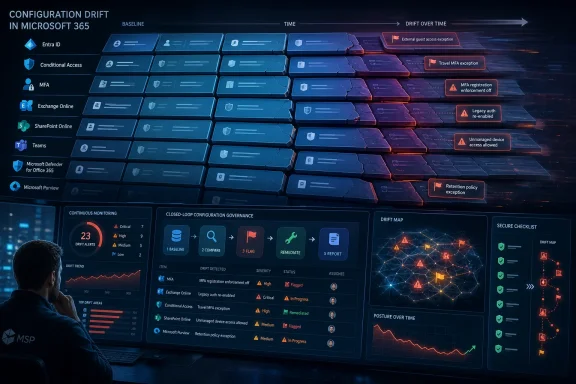 The Breach Often Starts as a Ticket, Not an Exploit
The most useful thing about the configuration drift argument is that it relocates risk from the abstract to the operational. Drift is not a mysterious technical failure. It is what happens when a support ticket, a troubleshooting session, a VIP request, or a rushed app rollout changes a control that nobody later revisits.An executive is traveling and cannot complete MFA, so an exception is granted. A conditional access policy blocks a line-of-business app, so a technician temporarily disables it. External sharing is loosened so a client can get a project out the door. An admin role is assigned for a migration and remains in place because the migration finished on a Friday afternoon.
None of those moments necessarily reflects incompetence. In fact, most of them reflect the normal pressure of IT service delivery: restore access, meet the deadline, keep the client productive. The risk is that Microsoft 365 remembers the exception long after the humans have forgotten the reason.
That makes configuration drift particularly treacherous for managed service providers. An internal IT department may have a manageable number of tenants and a decent memory of why exceptions exist. An MSP managing 50, 100, or 500 tenants has no such luxury. At that scale, undocumented change becomes a probability function.
Microsoft 365 Is Secure Only If the Tenant Still Resembles the Design
The phrase security baseline can sound reassuringly static, as if a hardened tenant remains hardened until someone makes an obvious mistake. Microsoft 365 does not work that way. It is a fast-moving bundle of identity, mail, collaboration, endpoint, compliance, and application controls, all changing under the pressure of Microsoft updates, business demands, licensing choices, and administrator intervention.The baseline is the intent. The tenant is the reality. Configuration drift is the widening gap between the two.
That gap matters because many of the most important Microsoft 365 defenses are configuration-dependent. Conditional Access decides when a sign-in should be blocked, challenged, or allowed. MFA registration and authentication method policies shape how hard it is to turn stolen credentials into access. Exchange Online rules determine whether mail can be forwarded or manipulated. SharePoint and Teams policies decide how easily data leaves the organization. Defender settings influence how much suspicious behavior is surfaced before it becomes an incident.
A tenant can pass an onboarding checklist in January and be materially weaker by June without any one person feeling they “changed security.” That is why drift is not housekeeping. It is an attack surface that grows under the cover of normal administration.
Conditional Access Is Where Good Intentions Go to Die
Conditional Access is one of Microsoft 365’s most important security control planes because it turns identity context into policy. It can require MFA, demand compliant devices, block risky locations, restrict sessions, and prevent legacy authentication pathways from bypassing modern defenses. It is also one of the easiest places for practical exceptions to become permanent weaknesses.A well-designed conditional access architecture usually has layers: baseline protections for all users, stronger requirements for administrators, device or location conditions, emergency access accounts, and controlled exclusions. The trouble begins when those exclusions stop being rare, reviewed, and documented. A policy with too many exceptions is not a policy; it is a suggestion with footnotes.
MSPs see this in predictable ways. A client has an old scanner, an accounting connector, or a custom integration that fails under a stricter policy. The business does not want a security lecture; it wants the workflow restored. The technician carves out an exception, and the tenant moves one notch away from the intended state.
Over time, the control plane becomes a sedimentary record of past emergencies. Nobody set out to create an insecure tenant. They simply kept solving local problems, one at a time, until the global design was no longer true.
Legacy Authentication Is the Drift Vector That Refuses to Die
Legacy authentication remains a useful example because it exposes the difference between “we have MFA” and “MFA actually protects this access path.” Older protocols and clients can bypass modern authentication controls, which is why Microsoft and security practitioners have spent years pushing tenants away from basic authentication and toward stronger identity enforcement.Drift reopens those doors in subtle ways. A tenant may have blocked legacy authentication during a security hardening project, only to later re-enable a protocol for compatibility. A single exception made for one application can survive beyond the app’s life span. A migration can leave behind a service account that nobody wants to touch because nobody is entirely sure what it still does.
This is the kind of risk that looks minor in the moment and indefensible after a compromise. If an attacker uses a path that the MSP’s own baseline said should be blocked, the uncomfortable question is not whether the baseline was good. It is why the tenant was allowed to stop matching it.
The MSP Scale Problem Turns Drift Into a Business Risk
Configuration drift is an operational risk for any organization, but it becomes a business model risk for MSPs. The MSP promise is consistency at scale: clients receive a managed, repeatable security practice that is better than what they could cheaply build alone. Drift attacks that promise because it makes every tenant slowly become a snowflake again.The arithmetic is unforgiving. If one client generates a handful of configuration changes each month, an MSP with dozens of clients is dealing with hundreds of potential drift events. If every event requires a technician to remember the baseline, inspect the setting, determine business justification, document the exception, schedule a review, and remediate when appropriate, manual control collapses quickly.
That collapse is not always visible as chaos. It may look like normal tickets being closed, normal reports being sent, and normal security meetings being held. The danger is that the service looks mature from the outside while the configuration state underneath is diverging.
This is where drift becomes more than a technical failure mode. It becomes a liability problem. If a client experiences a breach and the post-incident review finds that an MFA exception, external sharing relaxation, stale privileged role, or disabled policy enabled the attack, the conversation moves from “How did this happen?” to “Who was responsible for noticing?”
The Audit Is Too Slow for the Cloud
The traditional answer to configuration control is the periodic audit. Once a quarter, or once a year, someone reviews settings against a checklist and fixes what has changed. That model fit a slower era of IT, where infrastructure changes were less frequent and administrative boundaries were clearer.Microsoft 365 moves too quickly for that rhythm. A quarterly audit can identify drift, but it cannot reliably prevent exposure. If a policy is disabled in February and reviewed in May, the audit may be accurate and still three months too late.
Manual tenant review also does not scale cleanly. Even a diligent MSP that rotates through tenants can only inspect a slice of its estate at a time. By the time the last client has been checked, the first few may already have changed. The process produces a reassuring spreadsheet, but the spreadsheet is a photograph of a moving object.
The deeper problem is that audits often capture the existence of controls, not their operational integrity. “MFA enabled” is not the same as “MFA enforced for the right users, without excessive exclusions, through acceptable methods, with legacy paths blocked.” Drift lives in those qualifications.
Automation Is Not a Luxury Layer Anymore
The Augmentt piece is, unsurprisingly, an argument for automated monitoring and remediation. That vendor framing should not distract from the underlying point: at MSP scale, drift detection has to become continuous or it becomes performative.Continuous monitoring changes the nature of the control. Instead of asking, “Did we check this tenant recently?” the MSP can ask, “Is this tenant currently aligned with the baseline?” That shift matters because Microsoft 365 security is not merely about having the right policy written down. It is about knowing when the real tenant stops obeying it.
The best implementations treat drift management as a closed loop. A baseline is defined. Tenant settings are continuously compared against it. Deviations are flagged. Some are automatically remediated. Others are routed into change management because the business may have a valid reason for the exception. Either way, the deviation becomes visible and accountable.
Automation also creates a cleaner distinction between authorized variance and unmanaged drift. Not every difference from baseline is inherently wrong. Some clients have regulatory, licensing, geographic, or operational reasons to differ. But those differences should be explicit, documented, reviewed, and time-bounded where possible. The enemy is not flexibility. The enemy is forgotten flexibility.
Baselines Must Be Opinionated Enough to Matter
A weak baseline is almost as dangerous as no baseline because it gives everyone the comfort of standardization without the protection. MSPs cannot manage drift effectively unless they first decide what “good” looks like in enough detail to be enforceable.That means the baseline must cover identity, access, mail, collaboration, administrative privilege, logging, alerting, and security tooling. It should define how MFA is enforced, how privileged roles are assigned, how external sharing is constrained, how legacy authentication is blocked, how Defender protections are configured, and how exceptions are approved. It should also define what happens when Microsoft introduces new controls or changes defaults.
This is where many organizations stumble. They write a baseline as a collection of best intentions rather than a set of measurable states. “Use strong MFA” is not a drift control. “Require phishing-resistant MFA for privileged roles, prohibit SMS for admins, and review break-glass accounts on a defined cadence” is much closer to a control that can be monitored.
A baseline also needs ownership. If every technician can alter core security settings under ticket pressure, but nobody owns the policy consequence, drift is inevitable. Change management may sound bureaucratic, but in cloud security it is often the only difference between a legitimate exception and a future incident report.
Microsoft’s Shared Responsibility Model Has a Configuration Footnote
Microsoft secures the cloud platform, but customers and their providers remain responsible for much of what happens inside the tenant. That shared responsibility model is familiar enough to be a cliché, yet configuration drift is where many organizations feel its sharpest edge.Microsoft can provide defaults, recommendations, policy engines, logs, and security scores. It cannot know that an MFA exception granted to a traveling executive was supposed to expire after two weeks. It cannot know that a service account belongs to a retired integration. It cannot know that an external sharing relaxation was meant for one project and not a permanent change in data exposure.
The result is a tension built into Microsoft 365 security. Microsoft gives customers extraordinary administrative flexibility because tenants must support many kinds of organizations. Attackers benefit when that flexibility becomes ungoverned. MSPs are paid to stand in the middle and turn flexibility back into control.
That job is getting harder, not easier. The Microsoft 365 ecosystem keeps expanding, and each new control plane creates more places where a tenant can deviate from policy. Entra ID, Exchange Online, SharePoint, Teams, Defender, Purview, Intune, and third-party SaaS integrations all create configuration state. Security posture is now a graph of dependencies, not a single checklist.
Drift Is Also a Reporting Problem
Clients rarely buy “configuration hygiene” as an emotional concept. They understand incidents, insurance requirements, compliance findings, and executive risk. That creates an incentive problem for MSPs: the most important drift work may be invisible precisely when it is working.This is why reporting matters. Not vanity dashboards, but evidence that the MSP can show: this is the baseline, these are the deviations, these were remediated automatically, these were approved exceptions, and these require client action. Drift management becomes more credible when it is visible as a service output rather than buried in technician activity.
Good reporting also protects both sides of the relationship. If a client insists on weakening a control, the MSP can document the decision and its risk. If a technician changes a setting, the system can show when it happened and whether it was corrected. If a breach occurs, the conversation starts from facts rather than memory.
The hard truth is that many MSP-client relationships still operate on an implicit trust model: “We set this up securely.” Drift demands a stronger claim: “We continuously verify that it remains secure, and here is what changed.”
The Security Tooling Market Has Found a Real Pain Point
It is easy to roll one’s eyes at security vendors discovering yet another category of risk. Configuration drift, however, is not a marketing invention. It is a real consequence of cloud administration at scale, and Microsoft 365 is a particularly fertile environment for it because the platform is both mission-critical and highly configurable.Augmentt’s positioning fits a broader movement in the MSP tooling market toward multi-tenant security posture management. The appeal is obvious: one console to define baselines, compare tenants, detect deviations, remediate settings, and produce reports that make the work legible to clients. That is not the only way to address drift, but it reflects the direction of travel.
The caution is that tooling cannot substitute for judgment. An automated platform can detect that a setting differs from the baseline, but the MSP must still decide what the baseline should be, which deviations are acceptable, and when automatic remediation could break a business process. Blind enforcement can create outages; blind tolerance creates risk.
The better model is policy-driven automation with human governance. Machines should catch the drift quickly. Humans should decide when the drift represents an approved business reality rather than a mistake. The mature MSP will need both.
The Tenant That Stays Secure Is the Tenant That Keeps Being Re-secured
Security teams often talk as if hardening is an event. In Microsoft 365, hardening is better understood as a recurring act of maintenance. The tenant is never permanently done because users change, applications change, licenses change, Microsoft changes, and business exceptions accumulate.This matters for how MSPs package and price their services. If Microsoft 365 security is sold as a one-time setup, drift is practically guaranteed to turn that setup into a stale artifact. If it is sold as a managed posture discipline, drift becomes part of the service model rather than an embarrassing surprise.
The same point applies to internal IT teams. A company does not need to be an MSP to suffer from drift. The same forces apply in a single tenant: urgent requests, undocumented exceptions, incomplete handoffs, and stale privileges. The difference is that internal teams may have fewer tenants but deeper political pressure from executives and departments that want exceptions.
The uncomfortable lesson is that nobody gets to “set and forget” Microsoft 365 security. The platform is too central, too changeable, and too attractive to attackers. A tenant either has a mechanism for staying aligned with policy, or it is slowly becoming misaligned.
The Settings That Look Small Are the Ones to Watch
The most concrete lesson from the drift discussion is that small configuration changes deserve more respect. They are not merely administrative details. In a cloud identity environment, they can determine whether stolen credentials become a blocked sign-in, a limited session, or full access to mail and files.The settings most likely to matter are the ones that connect identity to data. Conditional Access exclusions, MFA exceptions, admin role assignments, external sharing policies, mailbox forwarding rules, OAuth app permissions, and legacy protocol allowances all deserve continuous scrutiny. These controls sit close to the paths attackers actually use.
There is also a psychological trap here. Organizations tend to investigate events, not states. A phishing email, failed login burst, or malware alert feels like security activity. A configuration quietly sitting in the wrong state does not. Drift wins because it does not announce itself.
That is why the MSP Alert piece’s closing line is effective: every Microsoft 365 tenant drifts; the question is whether you find out before or after something breaks. The phrase is vendor-friendly, but the underlying warning is hard to dispute.
The MSP Playbook Has to Treat Drift as Evidence, Not Vibes
MSPs that want to turn drift from liability into advantage need to make it measurable. The goal is not to claim perfect security. It is to show disciplined control over change in an environment where uncontrolled change is the default.A practical drift program starts with a clear baseline and ends with proof. The middle is continuous monitoring, exception handling, remediation, and reporting. If that sounds mundane, that is because much of real security is mundane until the day it prevents something expensive.
The most important takeaways are concrete rather than philosophical:
- Configuration drift is the gap between the Microsoft 365 security posture a provider intended to deploy and the posture that actually exists today.
- Drift usually comes from ordinary operational pressure, including troubleshooting, executive exceptions, app compatibility, migrations, and undocumented temporary changes.
- Conditional Access, MFA enforcement, legacy authentication, privileged roles, external sharing, and Defender configurations are among the most consequential drift zones.
- Periodic manual audits are too slow for MSP-scale Microsoft 365 operations because tenant state can change faster than humans can re-check it.
- Automation is most useful when it detects deviations continuously, remediates safe cases quickly, and escalates business exceptions into documented change control.
- The strongest MSPs will treat drift reporting as client-facing evidence that security posture is being managed continuously, not merely configured once.
References
- Primary source: MSSP Alert
Published: Mon, 01 Jun 2026 13:00:00 GMT
What is configuration drift — And why it’s your biggest M365 security risk | native | MSSP Alert
Understanding what drift is, how it happens, and what it takes to stay ahead of it is foundational to delivering a credible M365 security practice.www.msspalert.com - Official source: learn.microsoft.com
Baseline security mode settings | Microsoft Learn
Discover how to configure Baseline Security Mode settings in Microsoft 365 to enhance security, protect data, and ensure safe collaboration.learn.microsoft.com - Official source: microsoft.com
Microsoft Entra Conditional Access | Microsoft Security
Explore Microsoft and Azure Conditional Access policies and features in Microsoft Entra ID, including key factors such as device, location, and risk level.www.microsoft.com
- Related coverage: coreview.com
2026 Guide: Microsoft 365 Configuration Drift Tools
A 2026 buyer’s guide to Microsoft 365 configuration drift tools—what to monitor, where native controls fall short, and how to choose for audit readiness and recovery.www.coreview.com - Related coverage: inforcer.com
How to Manage Configuration Drift Across Multiple M365 Tenants
When MSPs have more tenants, configuration drift becomes harder to manage. Multi-tenant management platforms let you enforce a baseline for every tenant.www.inforcer.com - Related coverage: augmentt.com
M365 Updates March 2026: What MSPs Need to Know
March 2026 M365 updates: key changes across Intune, Entra ID, Defender, Copilot, Teams, and Purview with enforcement deadlines MSPs must act on.www.augmentt.com
- Related coverage: tminus365.com
- Related coverage: blueisland-group.com
</rdf:Alt> </dc:title> <dc:creator> <rdf:Seq> <rdf:li>Michael Kiss
PDF documentblueisland-group.com
