

Mozilla’s Over The Edge 2.0 report argues that Microsoft Copilot can bypass a user’s chosen default browser and display web content through Microsoft Edge, extending the long-running Windows browser-default dispute into AI. The practical concern is no longer limited to which application opens an ordinary link: it is which browser engine controls the web experience initiated through an increasingly prominent Windows assistant.
Published on July 14, 2026, the research was commissioned by Mozilla and conducted by deceptive-design specialists Dr. Harry Brignull and Cennydd Bowles. As detailed by Mozilla and reported by Analytics India Magazine, the researchers tested Windows 10 and Windows 11 experiences in the United States, India, the United Kingdom and Germany.
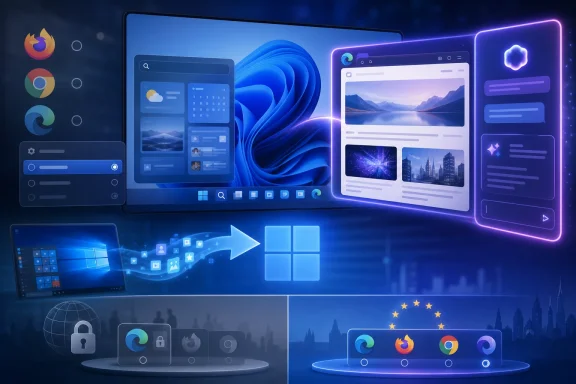
Their conclusion is that Windows users still encounter interference when downloading, selecting and continuing to use a browser other than Edge. Copilot adds a consequential new route around that selection because links surfaced by the assistant may open inside an Edge-rendered panel rather than the Windows default browser.
Traditional browser competition revolves around familiar controls: the preinstalled browser, download prompts, default-app settings and links launched by other applications. Copilot changes that model by placing an assistant between the user and the web.
A user may ask Copilot to research a product, explain a topic or locate a service rather than opening Firefox, Chrome or Edge first. If the resulting link remains inside a Microsoft-controlled panel, the user’s default browser has effectively become irrelevant for that interaction.
That distinction will become more important as assistants evolve from chat boxes into agents capable of browsing sites and completing tasks. Microsoft already promotes Edge features that allow Copilot to use page content, browser tabs and browsing context, while its newer Browse with Copilot functionality can navigate and interact with pages on a user’s behalf.
This makes the browser more than a window used to display the assistant’s answer. It can become part of the assistant’s execution environment, determining which browser features, identity system, security controls and data policies apply.
For Windows administrators, the immediate issue is whether setting Firefox or Chrome as the organizational default produces consistent behavior across every Windows surface. A default that works for an Outlook email but is ignored by Copilot, Windows Search or Widgets is not truly system-wide in the way most users and IT departments would understand the term.
Mozilla’s report identifies continuing concerns including:
That outcome is understandable at a narrow technical level: Windows cannot launch an application that was not transferred to the new installation. The design question is whether the migration process clearly explains what will happen, helps reinstall the former browser and restores the original preference instead of silently presenting Edge as the new default.
Analytics India Magazine highlights this risk for India, where it says 43% of Windows PCs remained on Windows 10 during the first quarter of 2026. A large migration population gives browser makers a strong reason to care about how Windows 11 handles defaults after Windows 10 upgrades and backup restoration.
Mozilla is not a neutral observer in this dispute. Firefox directly competes with Edge, and every additional prompt, failed migration or Microsoft-controlled link surface potentially affects its usage. The report’s value therefore rests on the documented user journeys and regional comparisons, not merely Mozilla’s characterization of Microsoft’s motives.
Germany was used as the representative European Economic Area market in the tests. Mozilla says several design patterns found in the United States and India were absent or reduced on the EEA configuration following changes associated with the European Union’s Digital Markets Act.
Copilot-related data controls also differed by market. According to Mozilla, some settings that defaulted to on in the United States and India defaulted to off in the EEA and the United Kingdom. The UK result shows that the regional picture is more complicated than a single European Windows edition, but it also demonstrates that Microsoft can alter individual defaults according to local regulatory requirements.
Microsoft has previously made broader EEA-specific Windows changes, including allowing Edge to be uninstalled and enabling Windows web-search experiences to work with third-party providers. Existing default-browser selections are also treated more consistently in parts of the regulated Windows experience.
That weakens any argument that deep Edge integration is technically unavoidable. Windows already contains the mechanisms needed to offer more browser choice; Microsoft simply does not deploy all of them globally.
Kush Amlani, Mozilla’s global competition and regulatory lead, said Microsoft has demonstrated that it can respect user choice when regulators are watching. Mozilla wants those protections extended to every market rather than reserved for jurisdictions capable of compelling a change.
Browser preference is generally shaped by repeated convenience. Preinstallation, account synchronization, password storage, workplace policy and familiarity exert more influence than a single research publication. Microsoft’s advantage is precisely that Windows can place Edge and Copilot at numerous small decision points where continuing with the provided option is easier than switching.
The report may have more immediate influence on regulators, enterprise architects and browser vendors than on individual consumers. India is considering stronger digital competition rules, and Mozilla is explicitly presenting Microsoft’s EEA implementation as proof that regulatory intervention can change product design.
Enterprise IT teams also have reasons to audit these behaviors independently. Organizations that standardize on Chrome or Firefox should test links opened from Copilot, Windows Search, Widgets, Outlook and Microsoft 365 applications rather than assuming the default-app setting governs them all. Browser policies can control parts of Edge and Copilot, but administrators need to verify actual behavior on the Windows builds and regional configurations they deploy.
Mozilla’s report does not establish that users are abandoning Edge or switching to Firefox because of Copilot. It does, however, show how AI can become a new default above the browser default—an interface that decides how web content is opened before Windows ever consults the preference the user selected.
The next browser battle may therefore be decided less by the icon pinned to the taskbar than by the assistant handling the request. Unless Microsoft makes Copilot, Search, Widgets and Windows migration consistently honor third-party defaults, choosing another browser will continue to mean less than Windows’ settings page suggests.
Published on July 14, 2026, the research was commissioned by Mozilla and conducted by deceptive-design specialists Dr. Harry Brignull and Cennydd Bowles. As detailed by Mozilla and reported by Analytics India Magazine, the researchers tested Windows 10 and Windows 11 experiences in the United States, India, the United Kingdom and Germany.
Their conclusion is that Windows users still encounter interference when downloading, selecting and continuing to use a browser other than Edge. Copilot adds a consequential new route around that selection because links surfaced by the assistant may open inside an Edge-rendered panel rather than the Windows default browser.
 Copilot Turns Browser Choice Into an AI Question
Traditional browser competition revolves around familiar controls: the preinstalled browser, download prompts, default-app settings and links launched by other applications. Copilot changes that model by placing an assistant between the user and the web.A user may ask Copilot to research a product, explain a topic or locate a service rather than opening Firefox, Chrome or Edge first. If the resulting link remains inside a Microsoft-controlled panel, the user’s default browser has effectively become irrelevant for that interaction.
That distinction will become more important as assistants evolve from chat boxes into agents capable of browsing sites and completing tasks. Microsoft already promotes Edge features that allow Copilot to use page content, browser tabs and browsing context, while its newer Browse with Copilot functionality can navigate and interact with pages on a user’s behalf.
This makes the browser more than a window used to display the assistant’s answer. It can become part of the assistant’s execution environment, determining which browser features, identity system, security controls and data policies apply.
For Windows administrators, the immediate issue is whether setting Firefox or Chrome as the organizational default produces consistent behavior across every Windows surface. A default that works for an Outlook email but is ignored by Copilot, Windows Search or Widgets is not truly system-wide in the way most users and IT departments would understand the term.
The Report Documents Pressure Beyond Copilot
Copilot is the new element, but the researchers say the broader pattern remains familiar. Windows and Edge still control several points along the journey from discovering an alternative browser to keeping it as the default.Mozilla’s report identifies continuing concerns including:
- Windows Search and Widgets can open web results through Edge rather than the selected default browser.
- Edge can display its own promotional messaging when a user visits Google’s Chrome download page.
- Windows can continue prompting users to adopt Edge after another browser has been selected.
- Windows Backup may not consistently retain a user’s previous browser choice during migration from Windows 10 to Windows 11.
That outcome is understandable at a narrow technical level: Windows cannot launch an application that was not transferred to the new installation. The design question is whether the migration process clearly explains what will happen, helps reinstall the former browser and restores the original preference instead of silently presenting Edge as the new default.
Analytics India Magazine highlights this risk for India, where it says 43% of Windows PCs remained on Windows 10 during the first quarter of 2026. A large migration population gives browser makers a strong reason to care about how Windows 11 handles defaults after Windows 10 upgrades and backup restoration.
Mozilla is not a neutral observer in this dispute. Firefox directly competes with Edge, and every additional prompt, failed migration or Microsoft-controlled link surface potentially affects its usage. The report’s value therefore rests on the documented user journeys and regional comparisons, not merely Mozilla’s characterization of Microsoft’s motives.
Europe Shows That Windows Can Behave Differently
The report’s strongest evidence is not that Microsoft integrates Edge into Windows, but that it has already created a less aggressive experience in regions where regulation requires one.Germany was used as the representative European Economic Area market in the tests. Mozilla says several design patterns found in the United States and India were absent or reduced on the EEA configuration following changes associated with the European Union’s Digital Markets Act.
Copilot-related data controls also differed by market. According to Mozilla, some settings that defaulted to on in the United States and India defaulted to off in the EEA and the United Kingdom. The UK result shows that the regional picture is more complicated than a single European Windows edition, but it also demonstrates that Microsoft can alter individual defaults according to local regulatory requirements.
Microsoft has previously made broader EEA-specific Windows changes, including allowing Edge to be uninstalled and enabling Windows web-search experiences to work with third-party providers. Existing default-browser selections are also treated more consistently in parts of the regulated Windows experience.
That weakens any argument that deep Edge integration is technically unavoidable. Windows already contains the mechanisms needed to offer more browser choice; Microsoft simply does not deploy all of them globally.
Kush Amlani, Mozilla’s global competition and regulatory lead, said Microsoft has demonstrated that it can respect user choice when regulators are watching. Mozilla wants those protections extended to every market rather than reserved for jurisdictions capable of compelling a change.
A Report Alone Will Not Reshape Browser Share
Whether Over The Edge 2.0 changes browser preferences is a different question from whether it documents meaningful product behavior. Most Windows users will never read the report, inspect Copilot’s rendering engine or distinguish between a system panel and a full Edge window.Browser preference is generally shaped by repeated convenience. Preinstallation, account synchronization, password storage, workplace policy and familiarity exert more influence than a single research publication. Microsoft’s advantage is precisely that Windows can place Edge and Copilot at numerous small decision points where continuing with the provided option is easier than switching.
The report may have more immediate influence on regulators, enterprise architects and browser vendors than on individual consumers. India is considering stronger digital competition rules, and Mozilla is explicitly presenting Microsoft’s EEA implementation as proof that regulatory intervention can change product design.
Enterprise IT teams also have reasons to audit these behaviors independently. Organizations that standardize on Chrome or Firefox should test links opened from Copilot, Windows Search, Widgets, Outlook and Microsoft 365 applications rather than assuming the default-app setting governs them all. Browser policies can control parts of Edge and Copilot, but administrators need to verify actual behavior on the Windows builds and regional configurations they deploy.
Mozilla’s report does not establish that users are abandoning Edge or switching to Firefox because of Copilot. It does, however, show how AI can become a new default above the browser default—an interface that decides how web content is opened before Windows ever consults the preference the user selected.
The next browser battle may therefore be decided less by the icon pinned to the taskbar than by the assistant handling the request. Unless Microsoft makes Copilot, Search, Widgets and Windows migration consistently honor third-party defaults, choosing another browser will continue to mean less than Windows’ settings page suggests.
References
- Primary source: analyticsindiamag.com
Published: 2026-07-15T11:41:34.559303+00:00
AIM — AI & Data Science News
India's leading AI and data science media platform — in-depth coverage of artificial intelligence, machine learning, research and tech business.analyticsindiamag.com
- Related coverage: github.blog
Browser tools for GitHub Copilot in VS Code are generally available - GitHub Changelog
Browser tools in VS Code are now generally available. Agents can now drive a real browser, navigate web apps, and feed findings back into the chat.github.blog
- Related coverage: techradar.com
‘Going too far without user consent’: Mozilla blasts Microsoft’s AI creep as user backlash forces Copilot to be scaled back | TechRadar
Stinging criticism aimed at Microsoftwww.techradar.com - Related coverage: pcgamer.com
Mozilla says 'Microsoft goes too far' with Copilot, right before reassuring that you can turn off Firefox's 'AI enhancements' | PC Gamer
Is AI integration really so inescapable?www.pcgamer.com - Related coverage: windowscentral.com
"Repeated choices to serve their business over their customers": Mozilla accuses Microsoft of using 'dark patterns' to force its Copilot AI on Windows 11 users | Windows Central
The Firefox maker says Microsoft's new "intentional" plans for Copilot were only triggered by overwhelming backlash.www.windowscentral.com
