

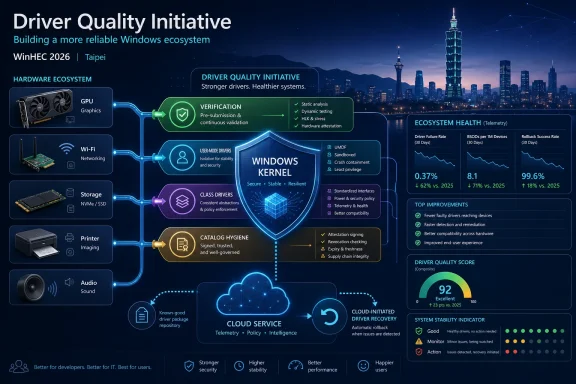
Microsoft announced the Driver Quality Initiative at WinHEC 2026 in Taipei on May 14, framing it as a Windows-wide program to improve driver reliability, security, lifecycle management, and performance across the vast hardware ecosystem that depends on third-party driver code. The announcement matters because Microsoft is no longer treating bad drivers as an unavoidable tax on PC diversity. It is trying to turn driver quality from a partner promise into a measurable, enforceable distribution system. For Windows users and IT departments, that could mean fewer mysterious crashes, fewer broken peripherals, and a more aggressive Microsoft hand in deciding which low-level code gets to run.
The striking thing about the Driver Quality Initiative is not that Microsoft discovered drivers are important. Windows users have known that for decades, usually at the exact moment a GPU update, storage controller package, Wi-Fi driver, printer stack, or vendor utility turns a working PC into a troubleshooting exercise.
What is new is Microsoft’s willingness to describe driver quality as an ecosystem problem that Windows itself must manage, not merely a vendor problem that happens to land on Microsoft’s platform. That distinction matters. A driver failure rarely feels like a Realtek problem, an Intel problem, an AMD problem, a printer vendor problem, or an OEM problem to the person staring at a blue screen. It feels like Windows failed.
That is the political center of the announcement. Microsoft still needs hardware diversity to keep Windows relevant across gaming rigs, enterprise fleets, workstations, handhelds, kiosks, laptops, and industrial machines. But it also knows that diversity loses its charm when the bargain becomes “your PC can run anything, including the thing that breaks it.”
DQI is Microsoft’s attempt to keep the Windows ecosystem broad while making the dangerous parts less improvisational. It is less a single feature than a governance model: fewer drivers in kernel mode, stronger partner verification, cleaner Windows Update catalog management, and broader telemetry-backed measures of what “quality” actually means.
That makes the venue important. WinHEC is where Microsoft speaks to the people who make Windows real: OEMs, silicon vendors, device makers, and driver developers. A Windows feature can be announced at Build, a consumer flourish can appear at a Surface event, but driver policy belongs in the room with the partners who ship code into the operating system’s most privileged layers.
Microsoft’s language around DQI is full of partnership rhetoric, but the subtext is sharper. The company is telling the hardware ecosystem that Windows quality will increasingly be judged by evidence, not assurances. The drivers that pass today’s nominal bar may not be enough for tomorrow’s Windows baseline.
That is why this announcement sits naturally beside Microsoft’s Windows Resiliency Initiative and the broader Secure Future Initiative. The company has spent the last two years trying to convince customers that it can make Windows more resilient without making it less useful. Drivers are the hardest version of that promise because they sit where compatibility, performance, security, and vendor autonomy all collide.
Microsoft’s stated direction is clear. It wants more third-party driver work to move either into user mode or into Microsoft-authored class drivers. That does not mean kernel-mode drivers vanish. Storage, graphics, security, networking, and hardware enablement still require low-level access in many scenarios. But Microsoft is trying to reduce the amount of bespoke partner code that gets to live in the blast radius of the Windows kernel.
This is not just a security argument. It is a reliability argument. User-mode driver failures can often be isolated, restarted, or handled without taking down the operating system. Kernel-mode failures are more likely to produce the kind of crash that sends an end user to Reddit, an admin to Event Viewer, and a vendor to a support script.
The class-driver push is equally important. Microsoft cited investments such as SoundWire Device Class for Audio, I3C class driver work, USB Ethernet class support, and enhancements to existing Windows 11 class drivers. The point is to replace bespoke vendor plumbing with standardized Microsoft-maintained plumbing where possible.
That is a very old Windows dream, but it is newly urgent. Every custom driver is not merely a feature enabler; it is a maintenance obligation, a signing problem, a telemetry surface, a security risk, and a future compatibility question. The more Windows can absorb common device behavior into first-party class drivers, the less the ecosystem depends on thousands of slightly different implementations of the same basic job.
DQI is broader than endpoint security software, but the lesson transfers. Windows has historically allowed a great deal of privileged third-party code because that openness made the platform powerful. Security products could inspect deeply. Hardware vendors could tune aggressively. Enterprise tools could hook into the system in ways that made Windows adaptable.
The cost of that openness is that Windows inherits the operational discipline of every company whose code it allows into privileged paths. One weak link can become a platform incident. The modern Microsoft answer is not to close Windows entirely, but to add friction, measurement, and fallback mechanisms where trust used to be enough.
That is the real meaning of “raising the bar.” It means Microsoft wants to reserve the right to say that a partner, driver, or distribution path is no longer good enough simply because it once cleared a legacy threshold. The PC ecosystem may welcome this in public, but some vendors will dislike the operational cost.
Microsoft’s trust pillar tries to close that gap. Stronger partner verification, expanded automated analysis, and updated Windows Hardware Compatibility Program requirements are all signals that Microsoft wants signing to become part of a wider trust chain. The vendor must be known. The submission must be tested. The driver must be observed. The distribution must be reversible.
That is a more modern model because driver risk is not static. A driver that behaves on one hardware cohort can fail on another. A release that looks safe in a lab can produce sleep, thermals, battery, or performance problems in the field. A package that was acceptable three years ago may not belong on a hardened 2026 Windows system.
Microsoft has already been tightening this area through Windows Driver Policy changes that block or phase out trust in older cross-signed kernel drivers on systems where the policy applies. DQI fits the same pattern: legacy trust is being replaced by current compliance.
For admins, this is both good news and a source of work. The good news is that Windows should become less tolerant of dubious kernel code. The work is that older peripherals, line-of-business tools, lab hardware, and vendor utilities may need fresh WHCP-signed drivers or explicit remediation plans.
That authority has been contentious. Enthusiasts have long complained about Windows Update replacing vendor-installed graphics drivers, offering older packages, or installing hardware drivers at inconvenient moments. IT administrators have their own version of the complaint: a driver that looks correct in broad targeting can be wrong for a particular fleet image, dock, BIOS level, or peripheral mix.
Microsoft’s response is not to retreat from driver distribution. It is to make the catalog more curated, more telemetry-driven, and more lifecycle-aware. “Catalog hygiene” sounds bureaucratic, but in Windows terms it means removing stale, low-quality, superseded, poorly targeted, or risky packages from the path of least resistance.
That could matter more than any single new driver test. A driver ecosystem can fail not only by shipping bad code, but by leaving too many old packages lying around for Windows Update to match incorrectly. The wrong “compatible” driver can be just as disruptive as an obviously broken one.
Microsoft is also moving toward faster issue analysis through driver symbols and better software bill of materials alignment. Those details may sound like compliance plumbing, but they reflect an important shift: Microsoft wants the driver ecosystem to be diagnosable at speed. In a world where a bad driver can become a global incident by breakfast, slow attribution is itself a quality failure.
Microsoft says DQI will expand driver quality measurement to include stability, functionality, performance, and power and thermal impact. That is exactly the right direction, because modern PC quality is often death by a thousand small regressions rather than a single catastrophic crash.
Laptop users know this especially well. A Wi-Fi driver that keeps reconnecting, an audio driver that mishandles sleep resume, a GPU package that increases idle power draw, or a storage driver that behaves badly under Modern Standby can turn a premium machine into a support burden without ever producing a dramatic failure screen.
For enterprise IT, those non-crash failures are expensive precisely because they are ambiguous. A thermal complaint may look like hardware. A battery complaint may look like user behavior. A Teams audio issue may look like an app problem. A resume failure may look like firmware. The driver may sit underneath all of it, invisible until telemetry connects the pattern.
The challenge is that measuring more dimensions gives Microsoft more power to throttle or reject drivers, but also increases the risk of opaque decisions. Partners will want predictable methodology. Admins will want explainability. Users will simply want the machine to stop misbehaving.
The enthusiast complaint is not merely nostalgia for control panels and vendor installers. It is a rational response to years of mismatches between what Windows thinks is best and what a specific user knows is best for a specific machine. Gamers want current GPU drivers. Creators may need certified studio branches. Developers and testers may intentionally run prerelease hardware packages. A one-size-fits-all driver policy can collide with all of them.
DQI does not automatically solve that. In fact, a more assertive Microsoft driver regime could create new tension if Windows Update becomes better at rejecting bad drivers but not better at respecting intentional user choices. A clean catalog is useful. A paternalistic catalog is irritating.
The best version of DQI would make Windows Update more trustworthy without making it more stubborn. It would reduce accidental downgrades, improve targeting, expose clearer driver provenance, and give advanced users and admins better policy controls. The worst version would bury more decisions in cloud-side systems and ask users to trust the same black box that annoyed them in the first place.
Microsoft’s burden is not only to improve driver quality. It must prove that higher quality will not mean less agency.
Historically, a bad driver often required vendor action. The hardware maker identified or acknowledged the issue, submitted a new package, and waited for it to make its way through the distribution path. In the meantime, users might manually roll back, search vendor forums, block updates, or live with broken hardware.
Cloud-initiated recovery changes the posture. If Windows Update can identify a driver as unhealthy and automatically replace it with a previous or stable version, Microsoft becomes more than the distributor of the bad update. It becomes the recovery coordinator.
That is an important philosophical shift. Software deployment systems are judged not only by whether they prevent failure, but by how quickly and cleanly they recover when prevention fails. Windows Update has long been able to pause, throttle, expire, or supersede packages, but automatic recovery for driver failures makes the rollback loop more visible and more central.
The feature also reveals Microsoft’s practical understanding of the problem. No quality program will catch every bad driver before release. The ecosystem is too large, the hardware combinations too varied, and the usage patterns too unpredictable. Resilience requires a fast undo button.
That can work. Vendors care about reach. If the cleanest path to broad Windows Update distribution requires better telemetry, stronger signing, fresher packages, faster symbols, and improved performance measures, many will comply. The Windows ecosystem has always been shaped by access to Microsoft’s channels.
But incentives only work if the alternative is worse. DQI implies that outdated, low-quality, poorly measured, or poorly maintained drivers will lose status over time. They may be deprecated, removed from preferred distribution, blocked under certain policies, or pushed toward replacement by class drivers.
That will hit vendors unevenly. Large silicon companies and major OEMs already have the engineering staff to meet higher requirements. Smaller device makers, industrial vendors, and niche hardware companies may struggle, especially if their Windows driver maintenance has been minimal for years.
This is where the Windows community should watch carefully. A more secure and reliable platform is worth pursuing, but driver tightening can strand old hardware. Microsoft will frame this as progress. Users with a beloved audio interface, lab instrument, printer, scanner, capture card, or specialty adapter may experience it as abandonment.
At the same time, admins will need to understand which drivers in their fleets are legacy, cross-signed, vendor-supplied, WHCP-certified, Windows Update-delivered, or pinned by policy. The days when a working driver could be ignored indefinitely are ending, especially on systems subject to newer Windows security policies.
That matters for organizations with specialized hardware. Manufacturing, healthcare, education, broadcast, engineering, and government environments often have peripherals that outlive their driver maintenance windows. Those devices may work perfectly from a business perspective and still fail Microsoft’s modern trust model.
The practical response is inventory. IT teams should know which kernel-mode drivers are present, which vendors publish them, how they are signed, whether current WHCP-certified versions exist, and whether Windows Update offers supported alternatives. Waiting until enforcement blocks a driver is the worst possible discovery mechanism.
Microsoft’s challenge is to provide enough tooling and transparency that DQI feels like a managed transition rather than a surprise compatibility trap. If admins can see risk early, they can plan. If they cannot, the initiative will be blamed for every broken peripheral it exposes.
Raising the bar on driver trust, signing, analysis, and lifecycle management is therefore not cosmetic. It closes a real class of risk. It also aligns Windows with a broader industry move toward measured boot, virtualization-based security, memory integrity, stronger code integrity policies, and default-deny thinking around privileged software.
But security initiatives fail politically when they break working systems without a clear path forward. Microsoft knows this, which is why DQI is being framed around phased states and partner collaboration rather than a sudden cutoff. Still, the direction is unmistakable: old trust paths are being narrowed.
The best security outcome is boring. Users never see the unsafe driver because Windows blocks it, replaces it, or steers the vendor toward a safer model before the failure reaches the desktop. The worst outcome is a wave of confusing device failures blamed on “Windows updates,” even when the root cause is an abandoned driver.
This is the balance Microsoft must strike. Security cannot remain optional at the kernel boundary, but compatibility is the reason Windows is Windows. DQI is a test of whether Microsoft can harden the platform without making the PC feel less like a PC.
DQI is Microsoft’s bid to reduce that randomness. It does so by pushing the ecosystem toward fewer custom kernel components, clearer trust requirements, cleaner update catalogs, and broader measures of real-world quality. None of that is glamorous, but it is exactly the sort of plumbing work Windows needs.
The risk is that Microsoft overestimates how much trust it currently has. Users who have fought Windows Update over drivers may not immediately believe that a more powerful Microsoft driver system is good news. Admins who have seen hardware compatibility regressions will want dashboards and controls, not slogans.
That is why the initiative’s success will be measured in absence. Fewer blue screens. Fewer broken docks. Fewer battery mysteries. Fewer audio and Wi-Fi regressions. Fewer vendor advisories telling users to manually undo something Windows Update did automatically. If Microsoft is right, DQI will be most visible when nobody has to think about it.
Source: Thurrott.com Microsoft Announces Driver Quality Initiative for Windows
 Microsoft Is Finally Naming the Problem Windows Users Already Know
The striking thing about the Driver Quality Initiative is not that Microsoft discovered drivers are important. Windows users have known that for decades, usually at the exact moment a GPU update, storage controller package, Wi-Fi driver, printer stack, or vendor utility turns a working PC into a troubleshooting exercise.What is new is Microsoft’s willingness to describe driver quality as an ecosystem problem that Windows itself must manage, not merely a vendor problem that happens to land on Microsoft’s platform. That distinction matters. A driver failure rarely feels like a Realtek problem, an Intel problem, an AMD problem, a printer vendor problem, or an OEM problem to the person staring at a blue screen. It feels like Windows failed.
That is the political center of the announcement. Microsoft still needs hardware diversity to keep Windows relevant across gaming rigs, enterprise fleets, workstations, handhelds, kiosks, laptops, and industrial machines. But it also knows that diversity loses its charm when the bargain becomes “your PC can run anything, including the thing that breaks it.”
DQI is Microsoft’s attempt to keep the Windows ecosystem broad while making the dangerous parts less improvisational. It is less a single feature than a governance model: fewer drivers in kernel mode, stronger partner verification, cleaner Windows Update catalog management, and broader telemetry-backed measures of what “quality” actually means.
WinHEC Returns With a More Defensive Mission
Microsoft’s first WinHEC since 2018 is not arriving in the same Windows world. In 2018, Windows 10 was still the service-model operating system Microsoft hoped would settle the platform’s future. In 2026, Windows 11 is mature, Windows 10 is in the rearview mirror for most commercial planning, and the PC is being pulled simultaneously toward AI hardware, tighter security baselines, and an unusually vocal user backlash against quality regressions.That makes the venue important. WinHEC is where Microsoft speaks to the people who make Windows real: OEMs, silicon vendors, device makers, and driver developers. A Windows feature can be announced at Build, a consumer flourish can appear at a Surface event, but driver policy belongs in the room with the partners who ship code into the operating system’s most privileged layers.
Microsoft’s language around DQI is full of partnership rhetoric, but the subtext is sharper. The company is telling the hardware ecosystem that Windows quality will increasingly be judged by evidence, not assurances. The drivers that pass today’s nominal bar may not be enough for tomorrow’s Windows baseline.
That is why this announcement sits naturally beside Microsoft’s Windows Resiliency Initiative and the broader Secure Future Initiative. The company has spent the last two years trying to convince customers that it can make Windows more resilient without making it less useful. Drivers are the hardest version of that promise because they sit where compatibility, performance, security, and vendor autonomy all collide.
The Kernel Is Where Microsoft’s Patience Runs Out
The most important pillar of DQI is architecture, because architecture decides whether a failure is contained or catastrophic. Kernel-mode drivers are powerful because they run with deep operating-system privileges. That same power makes them dangerous: a bug, poor memory handling, flawed update, or malicious abuse can destabilize the entire machine.Microsoft’s stated direction is clear. It wants more third-party driver work to move either into user mode or into Microsoft-authored class drivers. That does not mean kernel-mode drivers vanish. Storage, graphics, security, networking, and hardware enablement still require low-level access in many scenarios. But Microsoft is trying to reduce the amount of bespoke partner code that gets to live in the blast radius of the Windows kernel.
This is not just a security argument. It is a reliability argument. User-mode driver failures can often be isolated, restarted, or handled without taking down the operating system. Kernel-mode failures are more likely to produce the kind of crash that sends an end user to Reddit, an admin to Event Viewer, and a vendor to a support script.
The class-driver push is equally important. Microsoft cited investments such as SoundWire Device Class for Audio, I3C class driver work, USB Ethernet class support, and enhancements to existing Windows 11 class drivers. The point is to replace bespoke vendor plumbing with standardized Microsoft-maintained plumbing where possible.
That is a very old Windows dream, but it is newly urgent. Every custom driver is not merely a feature enabler; it is a maintenance obligation, a signing problem, a telemetry surface, a security risk, and a future compatibility question. The more Windows can absorb common device behavior into first-party class drivers, the less the ecosystem depends on thousands of slightly different implementations of the same basic job.
The CrowdStrike Shadow Is Long, Even When Microsoft Does Not Say It Loudly
Microsoft does not need to make every resiliency announcement about the 2024 CrowdStrike outage for the industry to hear the echo. That incident exposed a reality Microsoft had long understood but could no longer soft-pedal: when trusted kernel-level code fails at scale, the resulting outage is not a normal app crash. It is infrastructure weather.DQI is broader than endpoint security software, but the lesson transfers. Windows has historically allowed a great deal of privileged third-party code because that openness made the platform powerful. Security products could inspect deeply. Hardware vendors could tune aggressively. Enterprise tools could hook into the system in ways that made Windows adaptable.
The cost of that openness is that Windows inherits the operational discipline of every company whose code it allows into privileged paths. One weak link can become a platform incident. The modern Microsoft answer is not to close Windows entirely, but to add friction, measurement, and fallback mechanisms where trust used to be enough.
That is the real meaning of “raising the bar.” It means Microsoft wants to reserve the right to say that a partner, driver, or distribution path is no longer good enough simply because it once cleared a legacy threshold. The PC ecosystem may welcome this in public, but some vendors will dislike the operational cost.
Trust Is Becoming a Supply Chain, Not a Signature
Driver signing has always carried a certain psychological weight for Windows users. Signed sounds safe. Unsigned sounds reckless. But in practice, a signature proves provenance and integrity more than quality. It tells Windows who vouched for the package and whether it has been tampered with, not whether the driver will behave well on a specific laptop with a specific firmware version after a specific cumulative update.Microsoft’s trust pillar tries to close that gap. Stronger partner verification, expanded automated analysis, and updated Windows Hardware Compatibility Program requirements are all signals that Microsoft wants signing to become part of a wider trust chain. The vendor must be known. The submission must be tested. The driver must be observed. The distribution must be reversible.
That is a more modern model because driver risk is not static. A driver that behaves on one hardware cohort can fail on another. A release that looks safe in a lab can produce sleep, thermals, battery, or performance problems in the field. A package that was acceptable three years ago may not belong on a hardened 2026 Windows system.
Microsoft has already been tightening this area through Windows Driver Policy changes that block or phase out trust in older cross-signed kernel drivers on systems where the policy applies. DQI fits the same pattern: legacy trust is being replaced by current compliance.
For admins, this is both good news and a source of work. The good news is that Windows should become less tolerant of dubious kernel code. The work is that older peripherals, line-of-business tools, lab hardware, and vendor utilities may need fresh WHCP-signed drivers or explicit remediation plans.
Windows Update Is Becoming the Driver Judge, Not Just the Delivery Truck
The lifecycle pillar may sound like catalog housekeeping, but it is one of the most consequential parts of the announcement. Windows Update is not just a pipe. For most users, and many managed fleets, it is the primary authority deciding which driver lands on which device.That authority has been contentious. Enthusiasts have long complained about Windows Update replacing vendor-installed graphics drivers, offering older packages, or installing hardware drivers at inconvenient moments. IT administrators have their own version of the complaint: a driver that looks correct in broad targeting can be wrong for a particular fleet image, dock, BIOS level, or peripheral mix.
Microsoft’s response is not to retreat from driver distribution. It is to make the catalog more curated, more telemetry-driven, and more lifecycle-aware. “Catalog hygiene” sounds bureaucratic, but in Windows terms it means removing stale, low-quality, superseded, poorly targeted, or risky packages from the path of least resistance.
That could matter more than any single new driver test. A driver ecosystem can fail not only by shipping bad code, but by leaving too many old packages lying around for Windows Update to match incorrectly. The wrong “compatible” driver can be just as disruptive as an obviously broken one.
Microsoft is also moving toward faster issue analysis through driver symbols and better software bill of materials alignment. Those details may sound like compliance plumbing, but they reflect an important shift: Microsoft wants the driver ecosystem to be diagnosable at speed. In a world where a bad driver can become a global incident by breakfast, slow attribution is itself a quality failure.
Quality Is No Longer Just “Did It Crash?”
The most refreshing part of DQI is Microsoft’s admission that driver quality cannot be reduced to crash counts. A driver can avoid blue screens and still make Windows worse. It can drain battery, spike thermals, break sleep, reduce throughput, produce intermittent device failures, increase latency, or degrade performance only under specific workloads.Microsoft says DQI will expand driver quality measurement to include stability, functionality, performance, and power and thermal impact. That is exactly the right direction, because modern PC quality is often death by a thousand small regressions rather than a single catastrophic crash.
Laptop users know this especially well. A Wi-Fi driver that keeps reconnecting, an audio driver that mishandles sleep resume, a GPU package that increases idle power draw, or a storage driver that behaves badly under Modern Standby can turn a premium machine into a support burden without ever producing a dramatic failure screen.
For enterprise IT, those non-crash failures are expensive precisely because they are ambiguous. A thermal complaint may look like hardware. A battery complaint may look like user behavior. A Teams audio issue may look like an app problem. A resume failure may look like firmware. The driver may sit underneath all of it, invisible until telemetry connects the pattern.
The challenge is that measuring more dimensions gives Microsoft more power to throttle or reject drivers, but also increases the risk of opaque decisions. Partners will want predictable methodology. Admins will want explainability. Users will simply want the machine to stop misbehaving.
The Enthusiast Problem Will Not Disappear
Windows enthusiasts are right to greet any driver initiative with cautious optimism rather than applause. Microsoft has promised safer driver delivery before, and Windows Update has not always earned trust with users who manually manage GPU packages, chipset drivers, audio stacks, or specialized peripherals.The enthusiast complaint is not merely nostalgia for control panels and vendor installers. It is a rational response to years of mismatches between what Windows thinks is best and what a specific user knows is best for a specific machine. Gamers want current GPU drivers. Creators may need certified studio branches. Developers and testers may intentionally run prerelease hardware packages. A one-size-fits-all driver policy can collide with all of them.
DQI does not automatically solve that. In fact, a more assertive Microsoft driver regime could create new tension if Windows Update becomes better at rejecting bad drivers but not better at respecting intentional user choices. A clean catalog is useful. A paternalistic catalog is irritating.
The best version of DQI would make Windows Update more trustworthy without making it more stubborn. It would reduce accidental downgrades, improve targeting, expose clearer driver provenance, and give advanced users and admins better policy controls. The worst version would bury more decisions in cloud-side systems and ask users to trust the same black box that annoyed them in the first place.
Microsoft’s burden is not only to improve driver quality. It must prove that higher quality will not mean less agency.
Cloud Recovery Turns Driver Failure Into a Service Problem
The Driver Quality Initiative lands alongside Microsoft’s related work on Cloud-Initiated Driver Recovery, a system designed to roll back problematic drivers delivered through Windows Update when they are rejected during evaluation. That feature is not identical to DQI, but the two ideas belong to the same strategic turn.Historically, a bad driver often required vendor action. The hardware maker identified or acknowledged the issue, submitted a new package, and waited for it to make its way through the distribution path. In the meantime, users might manually roll back, search vendor forums, block updates, or live with broken hardware.
Cloud-initiated recovery changes the posture. If Windows Update can identify a driver as unhealthy and automatically replace it with a previous or stable version, Microsoft becomes more than the distributor of the bad update. It becomes the recovery coordinator.
That is an important philosophical shift. Software deployment systems are judged not only by whether they prevent failure, but by how quickly and cleanly they recover when prevention fails. Windows Update has long been able to pause, throttle, expire, or supersede packages, but automatic recovery for driver failures makes the rollback loop more visible and more central.
The feature also reveals Microsoft’s practical understanding of the problem. No quality program will catch every bad driver before release. The ecosystem is too large, the hardware combinations too varied, and the usage patterns too unpredictable. Resilience requires a fast undo button.
Vendors Are Being Offered Incentives, But Also a Warning
Microsoft says partners welcome an open methodology, phased lifecycle states, and incentive-based distribution. That language is carefully chosen. It suggests Microsoft is not starting with punishment; it is building a system where higher-quality drivers receive better distribution outcomes.That can work. Vendors care about reach. If the cleanest path to broad Windows Update distribution requires better telemetry, stronger signing, fresher packages, faster symbols, and improved performance measures, many will comply. The Windows ecosystem has always been shaped by access to Microsoft’s channels.
But incentives only work if the alternative is worse. DQI implies that outdated, low-quality, poorly measured, or poorly maintained drivers will lose status over time. They may be deprecated, removed from preferred distribution, blocked under certain policies, or pushed toward replacement by class drivers.
That will hit vendors unevenly. Large silicon companies and major OEMs already have the engineering staff to meet higher requirements. Smaller device makers, industrial vendors, and niche hardware companies may struggle, especially if their Windows driver maintenance has been minimal for years.
This is where the Windows community should watch carefully. A more secure and reliable platform is worth pursuing, but driver tightening can strand old hardware. Microsoft will frame this as progress. Users with a beloved audio interface, lab instrument, printer, scanner, capture card, or specialty adapter may experience it as abandonment.
Enterprise IT Gets Fewer Fires and More Policy Homework
For enterprise administrators, DQI is likely to be a net positive, but not a passive one. Better driver quality reduces help-desk noise, deployment failures, and those maddening device-specific issues that evade normal patch management logic. A more disciplined driver ecosystem also supports security baselines that increasingly assume untrusted kernel code is unacceptable.At the same time, admins will need to understand which drivers in their fleets are legacy, cross-signed, vendor-supplied, WHCP-certified, Windows Update-delivered, or pinned by policy. The days when a working driver could be ignored indefinitely are ending, especially on systems subject to newer Windows security policies.
That matters for organizations with specialized hardware. Manufacturing, healthcare, education, broadcast, engineering, and government environments often have peripherals that outlive their driver maintenance windows. Those devices may work perfectly from a business perspective and still fail Microsoft’s modern trust model.
The practical response is inventory. IT teams should know which kernel-mode drivers are present, which vendors publish them, how they are signed, whether current WHCP-certified versions exist, and whether Windows Update offers supported alternatives. Waiting until enforcement blocks a driver is the worst possible discovery mechanism.
Microsoft’s challenge is to provide enough tooling and transparency that DQI feels like a managed transition rather than a surprise compatibility trap. If admins can see risk early, they can plan. If they cannot, the initiative will be blamed for every broken peripheral it exposes.
Security Wins Only If Compatibility Does Not Become Chaos
Microsoft’s security case is strong. Kernel drivers are a favored target for attackers because they offer powerful access and can undermine the operating system’s protections. Vulnerable signed drivers have been abused for years in bring-your-own-vulnerable-driver attacks, where malware uses legitimate but flawed drivers to gain privileges or disable defenses.Raising the bar on driver trust, signing, analysis, and lifecycle management is therefore not cosmetic. It closes a real class of risk. It also aligns Windows with a broader industry move toward measured boot, virtualization-based security, memory integrity, stronger code integrity policies, and default-deny thinking around privileged software.
But security initiatives fail politically when they break working systems without a clear path forward. Microsoft knows this, which is why DQI is being framed around phased states and partner collaboration rather than a sudden cutoff. Still, the direction is unmistakable: old trust paths are being narrowed.
The best security outcome is boring. Users never see the unsafe driver because Windows blocks it, replaces it, or steers the vendor toward a safer model before the failure reaches the desktop. The worst outcome is a wave of confusing device failures blamed on “Windows updates,” even when the root cause is an abandoned driver.
This is the balance Microsoft must strike. Security cannot remain optional at the kernel boundary, but compatibility is the reason Windows is Windows. DQI is a test of whether Microsoft can harden the platform without making the PC feel less like a PC.
The Real Test Is Whether Windows Feels Less Random
The most important word in Microsoft’s announcement may be “predictable,” even if it is not the flashiest. Windows users can forgive a lot when behavior is predictable. They can plan around a driver model, a policy requirement, a certification rule, or an update cadence. What drives users mad is randomness: a driver that changes itself, a device that disappears, a sleep state that works until Tuesday, a printer that breaks after a cumulative update, a GPU that rolls back without consent.DQI is Microsoft’s bid to reduce that randomness. It does so by pushing the ecosystem toward fewer custom kernel components, clearer trust requirements, cleaner update catalogs, and broader measures of real-world quality. None of that is glamorous, but it is exactly the sort of plumbing work Windows needs.
The risk is that Microsoft overestimates how much trust it currently has. Users who have fought Windows Update over drivers may not immediately believe that a more powerful Microsoft driver system is good news. Admins who have seen hardware compatibility regressions will want dashboards and controls, not slogans.
That is why the initiative’s success will be measured in absence. Fewer blue screens. Fewer broken docks. Fewer battery mysteries. Fewer audio and Wi-Fi regressions. Fewer vendor advisories telling users to manually undo something Windows Update did automatically. If Microsoft is right, DQI will be most visible when nobody has to think about it.
The Driver Bar Is Moving, and Everyone Gets Measured
Microsoft’s announcement is not a magic fix for Windows driver pain, but it is a clear signal that the company is changing the rules of participation. The practical implications are concrete enough that users, admins, and vendors should start treating DQI as more than conference rhetoric.- Windows driver quality is being redefined beyond crash avoidance to include performance, functionality, power, thermals, and real-world stability.
- Microsoft wants fewer third-party kernel-mode drivers where user-mode drivers or Microsoft-authored class drivers can do the job safely.
- Windows Update catalog hygiene is becoming a quality-control mechanism, not just a storage cleanup exercise.
- Hardware partners that maintain current, well-measured, WHCP-aligned drivers are likely to gain distribution advantages over vendors relying on legacy packages.
- IT administrators should inventory kernel-mode drivers now, especially for specialized hardware and older peripherals that may not survive stricter policy enforcement.
- Enthusiasts should watch whether Microsoft pairs stricter driver quality controls with better transparency and user choice, because reliability gains will not excuse silent driver downgrades or opaque update decisions.
Source: Thurrott.com Microsoft Announces Driver Quality Initiative for Windows
