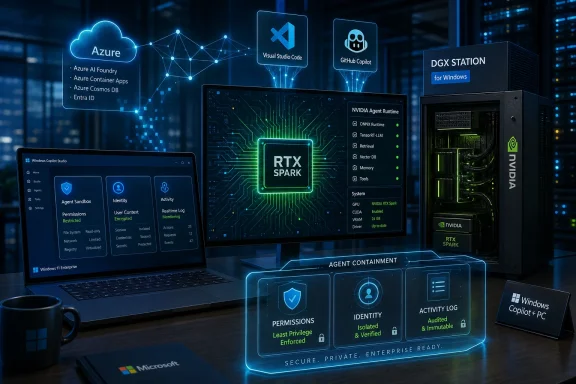
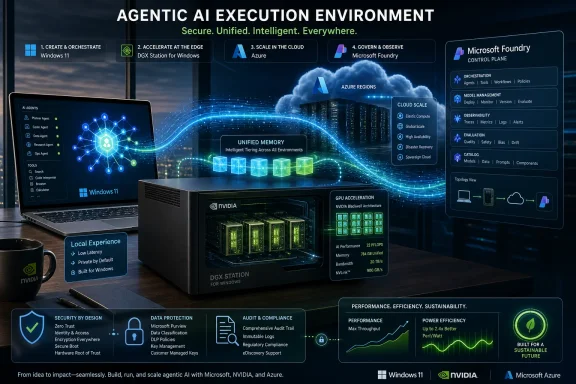
Nvidia and Microsoft used Microsoft Build 2026 to expand their AI partnership into a unified stack spanning Windows PCs, deskside DGX systems, Azure infrastructure, Microsoft Foundry, and Nvidia’s model and runtime software for agentic AI workloads. The announcement is not merely another GPU procurement story. It is an attempt to make Windows, Azure, and Nvidia silicon feel like one continuous execution environment for agents that can reason, call tools, handle private data, and move between local and cloud compute. If it works, the PC stops being just the client for AI and becomes one of the places where the AI actually lives.
For most of the generative AI boom, Windows has been treated as the window through which users access intelligence running somewhere else. Copilot, ChatGPT, Claude, Gemini, and enterprise chatbots have mostly depended on cloud models that sit at arm’s length from the local machine. That architecture made sense when models were too large, too expensive, and too fast-moving to bring onto ordinary PCs.
The Build announcement signals a more ambitious bet: that the next phase of AI will need a stack that is not split cleanly between “device” and “cloud.” Agentic systems are supposed to watch context, use tools, query private files, automate workflows, and keep working over long sessions. That creates an awkward engineering problem if all sensitive context has to leave the device, all reasoning has to happen in a remote data center, and all local applications have to be controlled through brittle user-interface hacks.
Nvidia’s answer is to put more of the AI factory on the user’s desk. Microsoft’s answer is to make Windows and Azure the identity, policy, runtime, and developer fabric around that factory. The companies are not simply selling faster chips; they are attempting to define where agentic AI runs and who controls the path between local inference, enterprise governance, and cloud-scale training.
That is why the phrase unified accelerated computing stack matters. It sounds like vendor boilerplate, but the ambition is concrete. Nvidia wants its hardware, CUDA software, NIM microservices, Nemotron models, Cosmos simulation tools, and secure runtime components to be present from a Windows laptop to an Azure cluster. Microsoft wants those capabilities to be governed through the platform layers IT departments already know: Windows, Entra-style identity, Microsoft Foundry, GitHub, Fabric, Azure Kubernetes Service, and the Azure data center.
This is not a normal “AI PC” refresh. The first wave of AI PCs leaned heavily on neural processing units that were useful for camera effects, transcription, light model execution, and power-efficient background tasks. RTX Spark is aimed at a different class of workload: local agents with enough memory and accelerator performance to handle larger models, richer contexts, and more demanding multimodal work.
The important specification is not only the petaflop figure. It is the memory. Agentic AI is hungry for context, and context becomes expensive when a machine needs to keep long conversations, codebases, project documents, embeddings, tool outputs, and model state close to the accelerator. A Windows PC with 128GB of unified memory starts to look less like a productivity laptop and more like a compact workstation for local inference.
That does not mean every user will run a frontier model on a notebook. It does mean Microsoft and Nvidia are preparing for a world in which some agents should remain local by default. A legal team analyzing privileged documents, a developer working against unreleased source code, a designer iterating on confidential assets, or an administrator testing automation against internal scripts may not want every step mediated by a remote service.
The story here is privacy, latency, and control — but also lock-in. A local agent that depends on Nvidia runtimes, Windows security primitives, and Microsoft developer services is still part of a commercial ecosystem. The cloud may not be the only place the agent runs, but the stack remains deeply curated.
The phrase “deskside supercomputer” has always carried a whiff of marketing theater. But in this case, the category serves a real purpose. Enterprises want to experiment with agents that touch proprietary workflows, regulated data, design files, source repositories, and internal applications. Moving every experiment to a shared cloud environment can introduce procurement friction, governance review, data movement, cost uncertainty, and latency.
DGX Station for Windows gives Microsoft a way to say that Windows scales from the laptop to the workstation to the cloud. That is strategically important. For years, high-end AI development culture has clustered around Linux, containers, remote clusters, and notebooks pointed at cloud GPUs. A Windows-native DGX Station is an argument that enterprise AI development does not have to leave the Microsoft estate to become serious.
It is also a reminder that the AI PC category is bifurcating. One branch is about making ordinary PCs better at AI-adjacent tasks. The other is about bringing specialized AI infrastructure closer to knowledge workers and developers. DGX Station for Windows belongs firmly in the second camp.
The cost profile will decide how broad that market becomes. DGX-class machines are not impulse purchases, and most organizations will still rely on cloud GPUs for elastic scale. But for teams that need predictable access, local data residency, or high-end prototyping without queueing for shared resources, a Windows deskside system has a clearer role than it might have had two years ago.
That makes the security model the center of the product. A chatbot that hallucinates is embarrassing. An agent that hallucinates while holding permissions to a mailbox, file share, terminal, CAD workspace, CRM system, or production dashboard is a different category of risk. The industry has spent the past two years demonstrating that large language models can be tricked by prompt injection, confused by untrusted data, and overconfident in ambiguous contexts.
Microsoft’s role is to bind this runtime story to Windows primitives: identity, containment, policy, and end-to-end security capabilities. Nvidia’s role is to supply the acceleration and AI software layer that agent developers want. Together, they are proposing a model where agents can run locally while still being governed by enterprise controls.
That is the right direction, but it is not yet a solved problem. Secure runtimes can constrain tools, isolate processes, and enforce policies, but they cannot magically make probabilistic systems understand intent the way a human administrator does. Enterprises will need audit trails, permission boundaries, approval flows, red-teaming, model evaluation, and incident response practices that assume agents will eventually do surprising things.
The most interesting question is whether OpenShell becomes an actual standard-like layer or another vendor-specific runtime wrapper. If developers can target it broadly and IT can reason about it consistently, it could become meaningful infrastructure. If it is mainly a way to keep agent workloads optimized for Nvidia hardware and Microsoft distribution channels, its technical value may arrive bundled with strategic dependency.
This reflects a broader shift in enterprise AI. The first wave of deployments often treated the model as the product. The second wave treats the model as one component in a managed system that includes retrieval, tools, memory, evaluation, policy, monitoring, cost controls, identity, and deployment routing. Foundry is Microsoft’s attempt to own that orchestration layer.
For IT departments, the appeal is obvious. Nobody wants a separate governance model for every AI vendor, every model family, and every deployment target. If Microsoft can make Foundry the place where enterprises compare models, deploy agents, enforce policy, and observe behavior, the underlying diversity of models becomes less chaotic.
For Nvidia, Foundry distribution helps turn its open models into enterprise options rather than developer curiosities. Nemotron competes in a crowded field, but Microsoft’s catalog and enterprise sales channel make it easier for organizations to try those models without constructing a bespoke deployment pipeline. The same logic applies to Cosmos and physical AI tooling: access matters, and access through Azure matters a great deal.
The tension is that “open” in this context does not necessarily mean frictionless or neutral. Open models deployed through a cloud catalog still inherit the economics, permissions, telemetry, and operational assumptions of the platform. Enterprises may gain flexibility at the model layer while deepening dependence at the control-plane layer.
Physical AI has different requirements from chat. It needs simulation, synthetic data, sensor fusion, validation, safety testing, and deployment pipelines that connect digital twins to real-world machines. Mistakes are not just wrong answers; they can become broken equipment, unsafe behavior, or expensive downtime.
Nvidia has spent years building this side of the house with Omniverse, Isaac, Cosmos, and simulation-oriented infrastructure. Microsoft brings Azure scale, enterprise relationships, data services, and the ability to integrate these workflows into existing industrial IT environments. The partnership is therefore not limited to Windows enthusiasts getting faster local agents. It is also about making Azure a host for the next generation of simulated and embodied AI systems.
This is where the stack story becomes most credible. A robotics team may use local workstations for development, Azure for training or simulation bursts, Foundry for model governance, Fabric for data, Nvidia tools for acceleration, and Windows PCs for operator interfaces or engineering workflows. The value proposition is not that one machine does everything. It is that the workflow does not fracture every time the workload changes size.
The market will decide whether that integration is elegant or merely dense. Industrial customers are notoriously pragmatic. They will tolerate complexity when it produces measurable throughput, safety, or cost improvements, but they will not buy agentic branding alone.
Training captured the early imagination of the AI infrastructure boom, but inference is where costs can become relentless. Agents intensify the problem because they may perform many model calls, tool calls, planning steps, retrieval passes, and verification loops for a single user-visible task. A conventional chatbot answer might be one interaction. An agentic workflow can become dozens or hundreds of computational steps.
That makes performance per watt more than a sustainability talking point. It is a margin structure. If Microsoft can deliver more inference per megawatt, it can support more agent workloads without proportionally increasing power demand, data center footprint, or operating cost. Nvidia’s roadmap is therefore not only about bigger chips; it is about keeping the economics of AI from collapsing under usage growth.
The Azure angle also explains why Microsoft needs the local PC story. Even with better data center efficiency, not every AI action should run in the cloud. Local inference can reduce latency, preserve privacy, and offload some demand from centralized infrastructure. The ideal Microsoft-Nvidia world is not cloud versus edge. It is a scheduler’s dream: run the task wherever it makes the most sense, while keeping the developer and governance model consistent.
That vision is attractive, but it depends on abstractions that are still maturing. Developers will need tools that decide when to use a small local model, a larger local model, a hosted open model, or a frontier cloud model. Enterprises will need policies that encode not just who can use AI, but where particular data and actions are allowed to travel.
For AI-focused buyers, the tradeoff may be acceptable. If the primary workloads are model inference, development environments, modern creative tools, browser-based applications, and Microsoft’s own ecosystem, Arm may be less of a barrier. For enterprises with decades of legacy software and hardware peripherals, it remains a procurement question rather than a benchmark question.
Microsoft has been here before. It has repeatedly tried to move Windows beyond the x86 assumptions that define the PC industry. The difference in 2026 is that AI gives the company a stronger reason to push. Unified memory, power efficiency, local model execution, and accelerator-centric design are easier to sell when the workload is no longer just Office, browsers, and Teams.
Nvidia benefits from the same shift. Its strongest position in PCs has historically been the GPU, especially for gaming, visualization, and accelerated professional workloads. RTX Spark suggests a more central role, where Nvidia is not merely attached to the Windows PC but helps define the system architecture.
That will not thrill every incumbent. Intel, AMD, Qualcomm, and Apple all have their own stories about local AI, memory architecture, NPUs, GPUs, and developer ecosystems. The Microsoft-Nvidia announcement raises the competitive stakes because it frames high-end Windows AI hardware as a vertically integrated stack rather than a commodity PC category.
The risk is that developers are being asked to bet on a fast-changing abstraction layer. Agent frameworks, model routing tools, context protocols, evaluation systems, and secure runtimes are evolving quickly. What looks like the obvious stack in June 2026 may look overbuilt, under-specified, or oddly proprietary by 2027.
That is not a reason to ignore the announcement. It is a reason to approach it the way serious IT teams approach any platform shift: by separating durable primitives from marketing wrappers. Local inference, hardware-backed isolation, identity-aware agent permissions, model observability, and hybrid deployment are likely to matter for years. Specific runtime names, model families, and product packaging may change faster.
The best early uses will be bounded. Coding agents that operate inside repositories with explicit permissions, document agents limited to approved stores, creative agents constrained to local assets, simulation workflows with clear validation stages, and administrative agents that require approval before taking destructive actions are all plausible. Open-ended autonomous agents with broad access to enterprise systems remain a governance problem disguised as a productivity demo.
Microsoft and Nvidia know this. That is why the announcement emphasizes identity, policy, containment, enterprise controls, and secure runtimes. The companies are trying to reassure buyers that agentic AI will not be a shadow-IT free-for-all. Whether that reassurance survives contact with real deployments is the next test.
But IT buyers should read the announcement less like a stock note and more like an operating-model proposal. The core claim is that agentic AI will require a coherent stack from endpoint to data center. If that claim is right, the winners will not simply be the companies with the fastest chips or largest models. They will be the companies that make AI usable, governable, observable, and economically tolerable at scale.
That gives Microsoft a natural advantage in enterprises already standardized on its identity, productivity, security, and cloud tools. It gives Nvidia a natural advantage wherever accelerated compute, model optimization, and AI infrastructure density matter. The partnership is powerful because it joins two kinds of incumbency: Microsoft’s control of the enterprise software surface and Nvidia’s control of the AI acceleration substrate.
The counterargument is equally important. Enterprises may resist handing too much of the AI stack to two vendors, especially when the regulatory, security, and cost implications are still unclear. Open-source models, alternative clouds, AMD accelerators, custom silicon, Apple’s local AI direction, and internal platform engineering teams will all pressure the Microsoft-Nvidia story from different angles.
The practical result is likely to be hybrid in both the technical and commercial sense. Many organizations will use Microsoft and Nvidia because the integration is convenient and the performance is compelling. Some will deliberately keep parts of their stack portable to avoid lock-in. The smartest buyers will do both.
Organizations still need to answer basic questions. Which agents are allowed to act without approval? Which data can be processed locally, in Azure, or by third-party models? How are prompts, tool calls, and outputs logged? How are model updates validated? Who owns failures when an agent follows a policy but produces a bad outcome? What happens when local agents conflict with cloud agents?
These questions are not footnotes. They are the difference between a useful automation layer and a new class of operational risk. The Microsoft-Nvidia stack gives enterprises more tools to answer them, but it does not remove the need for disciplined architecture.
There is also a skills gap. Windows administrators, cloud engineers, security teams, developers, data scientists, and compliance officers will all touch agentic systems. The organizations that succeed will not be the ones that buy the biggest workstation first. They will be the ones that treat agents as software systems with lifecycle management, permissions, testing, monitoring, rollback, and accountability.
That may be the underappreciated significance of the announcement. By embedding agentic AI into Windows, Foundry, Azure, and Nvidia’s hardware roadmap, Microsoft and Nvidia are pulling AI out of the experimental lab and into the ordinary machinery of enterprise IT. Once that happens, the boring parts become the important parts.
 Microsoft and Nvidia Are Trying to Collapse the AI Stack
For most of the generative AI boom, Windows has been treated as the window through which users access intelligence running somewhere else. Copilot, ChatGPT, Claude, Gemini, and enterprise chatbots have mostly depended on cloud models that sit at arm’s length from the local machine. That architecture made sense when models were too large, too expensive, and too fast-moving to bring onto ordinary PCs.The Build announcement signals a more ambitious bet: that the next phase of AI will need a stack that is not split cleanly between “device” and “cloud.” Agentic systems are supposed to watch context, use tools, query private files, automate workflows, and keep working over long sessions. That creates an awkward engineering problem if all sensitive context has to leave the device, all reasoning has to happen in a remote data center, and all local applications have to be controlled through brittle user-interface hacks.
Nvidia’s answer is to put more of the AI factory on the user’s desk. Microsoft’s answer is to make Windows and Azure the identity, policy, runtime, and developer fabric around that factory. The companies are not simply selling faster chips; they are attempting to define where agentic AI runs and who controls the path between local inference, enterprise governance, and cloud-scale training.
That is why the phrase unified accelerated computing stack matters. It sounds like vendor boilerplate, but the ambition is concrete. Nvidia wants its hardware, CUDA software, NIM microservices, Nemotron models, Cosmos simulation tools, and secure runtime components to be present from a Windows laptop to an Azure cluster. Microsoft wants those capabilities to be governed through the platform layers IT departments already know: Windows, Entra-style identity, Microsoft Foundry, GitHub, Fabric, Azure Kubernetes Service, and the Azure data center.
The PC Is Being Recast as an Agent Host, Not an App Launcher
The headline consumer hardware is RTX Spark, Nvidia’s new Windows PC platform for personal AI agents. The pitch is bold: systems with up to 1 petaflop of AI performance, up to 128GB of unified memory, and enough local capability to run serious models without constantly round-tripping to the cloud. Microsoft, Dell, HP, Lenovo, ASUS, MSI, and other OEMs are expected to bring systems to market, with Surface joining the rollout.This is not a normal “AI PC” refresh. The first wave of AI PCs leaned heavily on neural processing units that were useful for camera effects, transcription, light model execution, and power-efficient background tasks. RTX Spark is aimed at a different class of workload: local agents with enough memory and accelerator performance to handle larger models, richer contexts, and more demanding multimodal work.
The important specification is not only the petaflop figure. It is the memory. Agentic AI is hungry for context, and context becomes expensive when a machine needs to keep long conversations, codebases, project documents, embeddings, tool outputs, and model state close to the accelerator. A Windows PC with 128GB of unified memory starts to look less like a productivity laptop and more like a compact workstation for local inference.
That does not mean every user will run a frontier model on a notebook. It does mean Microsoft and Nvidia are preparing for a world in which some agents should remain local by default. A legal team analyzing privileged documents, a developer working against unreleased source code, a designer iterating on confidential assets, or an administrator testing automation against internal scripts may not want every step mediated by a remote service.
The story here is privacy, latency, and control — but also lock-in. A local agent that depends on Nvidia runtimes, Windows security primitives, and Microsoft developer services is still part of a commercial ecosystem. The cloud may not be the only place the agent runs, but the stack remains deeply curated.
DGX Station for Windows Brings the Data Center Aesthetic to the Office
If RTX Spark is the personal-agent machine, DGX Station for Windows is the enterprise flex. Nvidia describes it as a deskside AI supercomputer based on the GB300 Grace Blackwell Ultra Desktop Superchip, designed to run models with up to 1 trillion parameters and arrive later this year. It is meant for developers, researchers, engineers, data scientists, and enterprise teams that need local horsepower but do not necessarily want to wait on scarce cloud capacity for every experiment.The phrase “deskside supercomputer” has always carried a whiff of marketing theater. But in this case, the category serves a real purpose. Enterprises want to experiment with agents that touch proprietary workflows, regulated data, design files, source repositories, and internal applications. Moving every experiment to a shared cloud environment can introduce procurement friction, governance review, data movement, cost uncertainty, and latency.
DGX Station for Windows gives Microsoft a way to say that Windows scales from the laptop to the workstation to the cloud. That is strategically important. For years, high-end AI development culture has clustered around Linux, containers, remote clusters, and notebooks pointed at cloud GPUs. A Windows-native DGX Station is an argument that enterprise AI development does not have to leave the Microsoft estate to become serious.
It is also a reminder that the AI PC category is bifurcating. One branch is about making ordinary PCs better at AI-adjacent tasks. The other is about bringing specialized AI infrastructure closer to knowledge workers and developers. DGX Station for Windows belongs firmly in the second camp.
The cost profile will decide how broad that market becomes. DGX-class machines are not impulse purchases, and most organizations will still rely on cloud GPUs for elastic scale. But for teams that need predictable access, local data residency, or high-end prototyping without queueing for shared resources, a Windows deskside system has a clearer role than it might have had two years ago.
OpenShell Is the Quiet Part of the Announcement
The hardware grabs attention, but the more consequential layer may be Nvidia OpenShell, described as a secure runtime for autonomous agents. Runtime language is dull until one remembers what agents are supposed to do. They are not merely producing text; they are expected to take actions, invoke tools, interact with files, operate software, and run over long periods with partial autonomy.That makes the security model the center of the product. A chatbot that hallucinates is embarrassing. An agent that hallucinates while holding permissions to a mailbox, file share, terminal, CAD workspace, CRM system, or production dashboard is a different category of risk. The industry has spent the past two years demonstrating that large language models can be tricked by prompt injection, confused by untrusted data, and overconfident in ambiguous contexts.
Microsoft’s role is to bind this runtime story to Windows primitives: identity, containment, policy, and end-to-end security capabilities. Nvidia’s role is to supply the acceleration and AI software layer that agent developers want. Together, they are proposing a model where agents can run locally while still being governed by enterprise controls.
That is the right direction, but it is not yet a solved problem. Secure runtimes can constrain tools, isolate processes, and enforce policies, but they cannot magically make probabilistic systems understand intent the way a human administrator does. Enterprises will need audit trails, permission boundaries, approval flows, red-teaming, model evaluation, and incident response practices that assume agents will eventually do surprising things.
The most interesting question is whether OpenShell becomes an actual standard-like layer or another vendor-specific runtime wrapper. If developers can target it broadly and IT can reason about it consistently, it could become meaningful infrastructure. If it is mainly a way to keep agent workloads optimized for Nvidia hardware and Microsoft distribution channels, its technical value may arrive bundled with strategic dependency.
Foundry Becomes the Control Plane for Model Abundance
On the cloud side, Microsoft is adding more Nvidia models and tooling to Microsoft Foundry, its platform for building, deploying, observing, and governing AI applications and agents. The model lineup includes Nvidia Nemotron reasoning models, speech and safety tools, Cosmos models for physical AI and simulation, and Earth-2 models for weather and risk analysis, alongside models from major providers such as OpenAI and Anthropic.This reflects a broader shift in enterprise AI. The first wave of deployments often treated the model as the product. The second wave treats the model as one component in a managed system that includes retrieval, tools, memory, evaluation, policy, monitoring, cost controls, identity, and deployment routing. Foundry is Microsoft’s attempt to own that orchestration layer.
For IT departments, the appeal is obvious. Nobody wants a separate governance model for every AI vendor, every model family, and every deployment target. If Microsoft can make Foundry the place where enterprises compare models, deploy agents, enforce policy, and observe behavior, the underlying diversity of models becomes less chaotic.
For Nvidia, Foundry distribution helps turn its open models into enterprise options rather than developer curiosities. Nemotron competes in a crowded field, but Microsoft’s catalog and enterprise sales channel make it easier for organizations to try those models without constructing a bespoke deployment pipeline. The same logic applies to Cosmos and physical AI tooling: access matters, and access through Azure matters a great deal.
The tension is that “open” in this context does not necessarily mean frictionless or neutral. Open models deployed through a cloud catalog still inherit the economics, permissions, telemetry, and operational assumptions of the platform. Enterprises may gain flexibility at the model layer while deepening dependence at the control-plane layer.
Physical AI Is Where the Partnership Stops Looking Like Office Automation
The agentic AI conversation often defaults to software agents: email triage, coding assistants, document summarizers, spreadsheet operators, and workflow bots. Nvidia’s inclusion of Cosmos, Omniverse-related tooling, simulation blueprints, and Azure’s Physical AI Toolchain points to a larger target. The companies are preparing for agents that do not only manipulate documents but help train robots, vehicles, factories, warehouses, and industrial systems.Physical AI has different requirements from chat. It needs simulation, synthetic data, sensor fusion, validation, safety testing, and deployment pipelines that connect digital twins to real-world machines. Mistakes are not just wrong answers; they can become broken equipment, unsafe behavior, or expensive downtime.
Nvidia has spent years building this side of the house with Omniverse, Isaac, Cosmos, and simulation-oriented infrastructure. Microsoft brings Azure scale, enterprise relationships, data services, and the ability to integrate these workflows into existing industrial IT environments. The partnership is therefore not limited to Windows enthusiasts getting faster local agents. It is also about making Azure a host for the next generation of simulated and embodied AI systems.
This is where the stack story becomes most credible. A robotics team may use local workstations for development, Azure for training or simulation bursts, Foundry for model governance, Fabric for data, Nvidia tools for acceleration, and Windows PCs for operator interfaces or engineering workflows. The value proposition is not that one machine does everything. It is that the workflow does not fracture every time the workload changes size.
The market will decide whether that integration is elegant or merely dense. Industrial customers are notoriously pragmatic. They will tolerate complexity when it produces measurable throughput, safety, or cost improvements, but they will not buy agentic branding alone.
Azure’s Rubin Commitment Is Really About Power, Not Prestige
Microsoft has also approved Nvidia’s Vera Rubin platform for use in Azure data centers, with claims of sharply improved inference efficiency and a major increase in work per megawatt. That detail may sound like the usual hyperscaler arms race, but it points to one of the hard constraints shaping AI deployment: electricity.Training captured the early imagination of the AI infrastructure boom, but inference is where costs can become relentless. Agents intensify the problem because they may perform many model calls, tool calls, planning steps, retrieval passes, and verification loops for a single user-visible task. A conventional chatbot answer might be one interaction. An agentic workflow can become dozens or hundreds of computational steps.
That makes performance per watt more than a sustainability talking point. It is a margin structure. If Microsoft can deliver more inference per megawatt, it can support more agent workloads without proportionally increasing power demand, data center footprint, or operating cost. Nvidia’s roadmap is therefore not only about bigger chips; it is about keeping the economics of AI from collapsing under usage growth.
The Azure angle also explains why Microsoft needs the local PC story. Even with better data center efficiency, not every AI action should run in the cloud. Local inference can reduce latency, preserve privacy, and offload some demand from centralized infrastructure. The ideal Microsoft-Nvidia world is not cloud versus edge. It is a scheduler’s dream: run the task wherever it makes the most sense, while keeping the developer and governance model consistent.
That vision is attractive, but it depends on abstractions that are still maturing. Developers will need tools that decide when to use a small local model, a larger local model, a hosted open model, or a frontier cloud model. Enterprises will need policies that encode not just who can use AI, but where particular data and actions are allowed to travel.
The Windows Opportunity Comes With an Arm Complication
RTX Spark also pulls Windows deeper into the Arm conversation. Nvidia’s Grace CPU heritage and unified memory approach point toward systems that are not conventional x86 laptops with a discrete GPU bolted on. That matters because Windows on Arm has improved substantially, but it still carries the baggage of compatibility, driver support, enterprise imaging, VPN clients, endpoint tools, and niche applications that behave differently outside the x86 comfort zone.For AI-focused buyers, the tradeoff may be acceptable. If the primary workloads are model inference, development environments, modern creative tools, browser-based applications, and Microsoft’s own ecosystem, Arm may be less of a barrier. For enterprises with decades of legacy software and hardware peripherals, it remains a procurement question rather than a benchmark question.
Microsoft has been here before. It has repeatedly tried to move Windows beyond the x86 assumptions that define the PC industry. The difference in 2026 is that AI gives the company a stronger reason to push. Unified memory, power efficiency, local model execution, and accelerator-centric design are easier to sell when the workload is no longer just Office, browsers, and Teams.
Nvidia benefits from the same shift. Its strongest position in PCs has historically been the GPU, especially for gaming, visualization, and accelerated professional workloads. RTX Spark suggests a more central role, where Nvidia is not merely attached to the Windows PC but helps define the system architecture.
That will not thrill every incumbent. Intel, AMD, Qualcomm, and Apple all have their own stories about local AI, memory architecture, NPUs, GPUs, and developer ecosystems. The Microsoft-Nvidia announcement raises the competitive stakes because it frames high-end Windows AI hardware as a vertically integrated stack rather than a commodity PC category.
Developers Get Power, but Also Another Platform Bet
For developers, the immediate appeal is straightforward. A machine with serious local AI compute can make experimentation faster, cheaper, and more private. A Foundry-backed cloud path can turn prototypes into managed deployments. Nvidia’s model catalog and runtime stack can reduce the amount of glue code needed to move from demo to production.The risk is that developers are being asked to bet on a fast-changing abstraction layer. Agent frameworks, model routing tools, context protocols, evaluation systems, and secure runtimes are evolving quickly. What looks like the obvious stack in June 2026 may look overbuilt, under-specified, or oddly proprietary by 2027.
That is not a reason to ignore the announcement. It is a reason to approach it the way serious IT teams approach any platform shift: by separating durable primitives from marketing wrappers. Local inference, hardware-backed isolation, identity-aware agent permissions, model observability, and hybrid deployment are likely to matter for years. Specific runtime names, model families, and product packaging may change faster.
The best early uses will be bounded. Coding agents that operate inside repositories with explicit permissions, document agents limited to approved stores, creative agents constrained to local assets, simulation workflows with clear validation stages, and administrative agents that require approval before taking destructive actions are all plausible. Open-ended autonomous agents with broad access to enterprise systems remain a governance problem disguised as a productivity demo.
Microsoft and Nvidia know this. That is why the announcement emphasizes identity, policy, containment, enterprise controls, and secure runtimes. The companies are trying to reassure buyers that agentic AI will not be a shadow-IT free-for-all. Whether that reassurance survives contact with real deployments is the next test.
Wall Street Sees a Growth Story; IT Sees an Operating Model
TipRanks framed part of the news through analyst sentiment on Nvidia and Microsoft shares, and it is not hard to understand why investors like the narrative. Nvidia gets another route to sell high-value silicon and software. Microsoft gets more reasons for enterprises to consume Azure, Foundry, Windows, GitHub, Fabric, and Surface-class devices. Both companies get to position themselves at the center of agentic AI rather than as suppliers to someone else’s platform.But IT buyers should read the announcement less like a stock note and more like an operating-model proposal. The core claim is that agentic AI will require a coherent stack from endpoint to data center. If that claim is right, the winners will not simply be the companies with the fastest chips or largest models. They will be the companies that make AI usable, governable, observable, and economically tolerable at scale.
That gives Microsoft a natural advantage in enterprises already standardized on its identity, productivity, security, and cloud tools. It gives Nvidia a natural advantage wherever accelerated compute, model optimization, and AI infrastructure density matter. The partnership is powerful because it joins two kinds of incumbency: Microsoft’s control of the enterprise software surface and Nvidia’s control of the AI acceleration substrate.
The counterargument is equally important. Enterprises may resist handing too much of the AI stack to two vendors, especially when the regulatory, security, and cost implications are still unclear. Open-source models, alternative clouds, AMD accelerators, custom silicon, Apple’s local AI direction, and internal platform engineering teams will all pressure the Microsoft-Nvidia story from different angles.
The practical result is likely to be hybrid in both the technical and commercial sense. Many organizations will use Microsoft and Nvidia because the integration is convenient and the performance is compelling. Some will deliberately keep parts of their stack portable to avoid lock-in. The smartest buyers will do both.
The Build Announcement Is a Roadmap, Not a Deployment Plan
The danger with agentic AI announcements is that they compress several years of platform work into a single keynote moment. Build makes the future look packaged. Real-world deployment will be messier.Organizations still need to answer basic questions. Which agents are allowed to act without approval? Which data can be processed locally, in Azure, or by third-party models? How are prompts, tool calls, and outputs logged? How are model updates validated? Who owns failures when an agent follows a policy but produces a bad outcome? What happens when local agents conflict with cloud agents?
These questions are not footnotes. They are the difference between a useful automation layer and a new class of operational risk. The Microsoft-Nvidia stack gives enterprises more tools to answer them, but it does not remove the need for disciplined architecture.
There is also a skills gap. Windows administrators, cloud engineers, security teams, developers, data scientists, and compliance officers will all touch agentic systems. The organizations that succeed will not be the ones that buy the biggest workstation first. They will be the ones that treat agents as software systems with lifecycle management, permissions, testing, monitoring, rollback, and accountability.
That may be the underappreciated significance of the announcement. By embedding agentic AI into Windows, Foundry, Azure, and Nvidia’s hardware roadmap, Microsoft and Nvidia are pulling AI out of the experimental lab and into the ordinary machinery of enterprise IT. Once that happens, the boring parts become the important parts.
The Signal Beneath the Silicon
The concrete lesson from Build is that the AI PC is no longer a single category. It now stretches from efficient local assistants to workstation-class development boxes and cloud-connected agent platforms. That breadth is the point of the Microsoft-Nvidia alliance.- RTX Spark is designed to make local Windows agents more plausible by combining high AI throughput with large unified memory and offline capability.
- DGX Station for Windows brings Nvidia’s GB300-class AI infrastructure into a Windows deskside form factor for teams that need local access to very large models.
- Nvidia OpenShell and Microsoft’s Windows security primitives are the critical pieces to watch because agents need containment and policy more than they need another demo.
- Microsoft Foundry is becoming the enterprise control plane where model choice, governance, deployment, and observability converge.
- Azure’s Vera Rubin support shows that inference efficiency and power density are now central to the economics of agentic AI.
- The partnership is powerful, but enterprises should treat it as a platform bet that requires portability planning, governance design, and careful workload selection.
References
- Primary source: TipRanks
Published: Tue, 02 Jun 2026 21:40:53 GMT
Nvidia and Microsoft Roll Out Unified Stack for Agentic AI Across Windows and Azure - TipRanks.com
Nvidia ($NVDA) and Microsoft ($MSFT) are deepening their partnership to power the next wave of agentic AI. The two companies are rolling out a unified accelerated c...www.tipranks.com
- Related coverage: tomshardware.com
Nvidia unveils RTX Spark Superchip for laptops and desktop PCs at Computex 2026 – new platform promises to turn Windows into an agentic AI OS with Arm CPU, Blackwell GPU, and 128GB unified memory | Tom's Hardware
Over 30 laptops and 10 desktops coming this fall with "the most efficent platform ever built"www.tomshardware.com - Related coverage: axios.com
Microsoft debuts Nvidia-powered Microsoft Surface Ultra laptop
Microsoft is trying again to redefine the PC for the AI era.www.axios.com
- Related coverage: windowscentral.com
Surface Laptop Ultra: Microsoft and NVIDIA reveal the 128GB RAM, mini‑LED, RTX Spark powerhouse redefining Windows on Arm | Windows Central
Uncompromising raw NVIDIA N1x power meets legendary Surface craft, but can people afford it?www.windowscentral.com - Related coverage: pcgamer.com
Nvidia sets out roadmap for RTX Spark, its new PC platform, which also gives us a better idea of when to expect next-gen RTX GPUs | PC Gamer
Rubin in 2028, Feynman in 2030.www.pcgamer.com - Related coverage: nvidianews.nvidia.com
NVIDIA DGX Station for Windows Puts a Trillion-Parameter AI Supercomputer on Every Enterprise Desk | NVIDIA Newsroom
NVIDIA today announced NVIDIA DGX Station™ for Windows, the world’s most powerful deskside AI supercomputer designed to build, run and connect always-on AI agents to Windows applications and workflows, capable of running frontier AI models of up to 1 trillion parameters locally.nvidianews.nvidia.com
- Related coverage: blogs.nvidia.com
NVIDIA Partners With Microsoft on Unified Stack for Agentic AI Deployment, From Windows Devices to Cloud to Local | NVIDIA Blog
At Microsoft Build, NVIDIA founder and CEO Jensen Huang joined Microsoft chairman and CEO Satya Nadella's keynote via livestream from Taipei to discuss the expanded partnership.blogs.nvidia.com - Related coverage: nvidia.com
NVIDIA DGX Station for Windows — GB300 Deskside AI Supercomputing
NVIDIA DGX Station brings GB300 AI supercomputing to Windows — up to 748 GB coherent memory, 20 PFLOPS FP4 compute, and the NVIDIA AI software stack. Run up to 1T-parameter models locally.www.nvidia.com - Related coverage: investor.nvidia.com
NVIDIA Corporation - NVIDIA and Microsoft Reinvent Windows PCs for the Age of Personal AI
RTX Spark — a 1-Petaflop Superchip, the Full CUDA and RTX Ecosystem, and Windows-Native Agents — a New Beginning for Personal Computers News Summary: NVIDIA RTX Spark powers the world’s first Windows PCs purpose-built for personal agents, featuring 1 petaflop of AI performance, industry-leading...investor.nvidia.com - Related coverage: technetbooks.com
NVIDIA Launches DGX Station for Windows with GB300 Grace Blackwell Architecture | Technetbook
NVIDIA introduces DGX Station for Windows, a deskside supercomputer running 1,000,000,000,000 parameter AI models locally using GB300 Grace Blackwellwww.technetbooks.com
- Related coverage: blogs.nvidia.de
NVIDIA kündigt die DGX Station für Windows
Den weltweit leistungsstärksten Deskside-KI-Supercomputer für die Entwicklung und den Betrieb von Agenten unter Windows.blogs.nvidia.de - Official source: blogs.windows.com
Introducing a powerful new chapter for Windows PCs, accelerated by NVIDIA RTX Spark
Today at NVIDIA GTC, Microsoft and NVIDIA announced the world’s most powerful and efficient thin-and-light Windows PCs ever. Accelerated by NVIDIA RTX Sparkblogs.windows.com - Official source: azure.microsoft.com
Microsoft’s strategic AI datacenter planning enables seamless, large-scale NVIDIA Rubin deployments | Microsoft Azure Blog
Read how NVIDIA’s next-generation systems slot directly into infrastructure that has anticipated its requirements years ahead of the industry. azure.microsoft.com
- Related coverage: techradar.com
MSI launches $85,000 XpertStation WS300 with Nvidia GB300 Ultra and massive memory that redefines local AI performance | TechRadar
Data center class performance delivered directly to the desktopwww.techradar.com - Related coverage: ltec-biz.com
25R 0698 15AI Computer Nvidia GB10 Grace Blackwell in NVIDIA DGX Spark Package and Main PCB detailed analysis
PDF documentwww.ltec-biz.com
- Related coverage: signal65.com
- Related coverage: hub.tdsynnex.com
- Official source: blogs.microsoft.com
Microsoft at NVIDIA GTC: New solutions for Microsoft Foundry, Azure AI infrastructure and Physical AI - The Official Microsoft Blog
Microsoft combines accelerated computing with cloud scale engineering to bring advanced AI capabilities to our customers. For years, we’ve worked with NVIDIA to integrate hardware, software and infrastructure to power many of today’s most important AI breakthroughs. What’s new at NVIDIA GTC...blogs.microsoft.com - Official source: techcommunity.microsoft.com
NVIDIA Nemotron 3 Super Now Available on Microsoft Foundry: Open, Efficient Reasoning for Agentic AI | Microsoft Community Hub
Today, we’re announcing the availability of NVIDIA Nemotron 3 Super NIM in Microsoft Foundry, expanding the set of open,... techcommunity.microsoft.com
- Official source: devblogs.microsoft.com
What's new in Microsoft Foundry | Build Edition | Microsoft Foundry Blog
Microsoft Build 2026 brings a major set of Microsoft Foundry updates for developers building agents: hosted runtimes, Toolboxes, memory, Voice Live, Foundry IQ, new models, managed compute, and trust, evaluation, and observability tools.devblogs.microsoft.com - Official source: news.microsoft.com
- Related coverage: itpro.com
Nvidia targets open source interoperability with new model coalitions, agentic frameworks | IT Pro
Nvidia has announced a raft of open source initiatives at its 2026 GTC conference, which analysts have hailed as a sign of the company's long-term goals.www.itpro.com