

Milo: Paws & Buoys is listed for Windows with a June 18, 2026 release date, published under LayerWare, Bad Minions, and Little Giant, with TrueAchievements currently surfacing the game page, screenshots, wishlist option, and forum hooks but little public detail beyond platform and release metadata. That sparseness is the story: another small Windows release has arrived first as an achievement-tracking object, not as a traditional marketing campaign. For PC players inside the Xbox ecosystem, the listing is less a reveal than a signal that Microsoft’s Windows gaming catalog continues to be filled by low-cost, fast-moving indie releases. The question is not whether Milo will be the next breakout hit; it is what games like this tell us about the increasingly automated storefront economy around Windows, Xbox identity, and achievements.
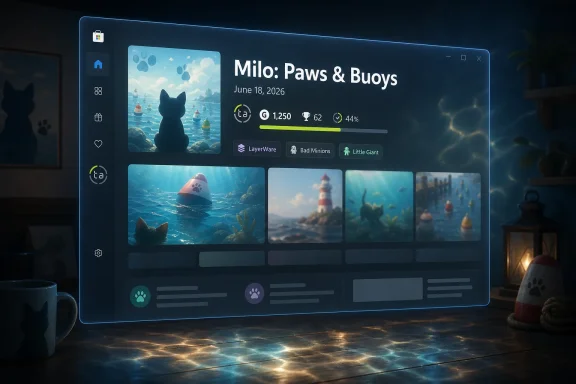
The modern small-game launch often begins with a database entry. A page goes live, a release date appears, screenshots are indexed, and the community can follow, wishlist, discuss, or wait for achievements to populate. Milo: Paws & Buoys fits that pattern almost too neatly: name, platform, date, publisher stack, screenshots, and little else.
That is not unusual anymore. For a certain tier of Windows releases, discovery starts less with a trailer and more with metadata. The game becomes visible to players because achievement hunters, storefront watchers, and price trackers notice the listing before the developer or publisher makes a broader case for why anyone should care.
The name does a lot of immediate work. “Paws” suggests an animal protagonist or pet-friendly theme; “Buoys” points toward water, navigation, or light puzzle interaction. Whether the final game leans cozy, puzzle, arcade, or casual adventure, the title is engineered for the part of the market that understands tone before mechanics.
That may sound dismissive, but it is not. On Windows in 2026, small games are often bought and completed in the space between larger releases. A good title, a readable thumbnail, a short achievement list, and a modest price can matter more than an elaborate campaign.
That makes Windows a strange but important platform category. Steam still dominates PC discovery in the public imagination, but Microsoft’s Windows storefront has its own audience: players who care about Xbox identity on PC, want achievements attached to their profile, or buy low-friction Windows versions of small games that also appear on console.
For developers and publishers, that audience is attractive because it behaves differently from the broader PC market. A game with modest art, short runtime, and clear achievements can find buyers if it offers a clean completion path. A release may be judged less on whether it competes with the day’s biggest PC hits and more on whether it respects the bargain it appears to be offering.
The risk is that Windows becomes a backchannel for shovelware accusations. When too many small releases arrive with thin promotion, similar pricing, and rapid achievement completions, players begin to read the catalog defensively. They ask not “Is this charming?” but “Is this another Gamerscore vehicle?”
Milo arrives in that climate. It may turn out to be a neat little game. But its first impression is shaped by the wider marketplace before anyone even sees the full achievement list.
That throughput has become a defining feature of the lower end of the Xbox and Windows digital marketplace. These publishers can package, certify, price, and release games quickly enough that each individual title carries less marketing weight. The catalog becomes the brand.
There is nothing inherently wrong with that. The industry has always had budget labels, arcade compilations, casual portals, and fast-turnaround releases. What has changed is that achievements make the business model visible in a way old PC budget shelves never did.
Every game becomes a measurable object: how many achievements, how much Gamerscore, how long to complete, how often discounted, whether title updates add more points, and whether the Windows version stacks separately from the Xbox version. That is why a small page for Milo: Paws & Buoys can attract attention before a press kit does. The community is trained to see structure.
This is one of the oddest consequences of Microsoft’s long-running achievement system. It turned games into persistent records of behavior, and it turned small games into opportunities for optimization. A cozy puzzle game can be evaluated like a maintenance task: buy, complete, log, move on.
That can flatten the artistic identity of small releases. A game called Milo: Paws & Buoys sounds like it wants to be approached gently, probably with some mix of cute presentation and low-stress play. Yet the ecosystem surrounding it may immediately reduce it to questions of completion time and Gamerscore efficiency.
Developers know this, publishers know this, and players know this. The result is a market where games sometimes appear designed around the achievement economy rather than merely participating in it. When that happens, achievements stop being a reward layer and become the product’s main sales pitch.
The healthier version is when both sides of the bargain hold. A small game can be approachable, easy to finish, and still have enough craft to justify its presence. The concern is not that short games exist; the concern is that weak games can hide behind short completions.
This is increasingly common across minor Windows and Xbox releases. Storefronts and tracking sites can ingest basic assets faster than the surrounding editorial context can form. A game page becomes live, but the argument for the game is left unfinished.
That creates a burden on players. Instead of reading a coherent pitch, they infer from tags, name, publisher history, screenshot composition, file size, achievement list, and price. The most committed users become amateur catalog analysts because the storefront does not do enough interpretation for them.
It also creates a burden on communities like TrueAchievements. Their pages are not just databases anymore; they are discovery surfaces. When an obscure Windows title appears there, the community is likely to produce the first useful public intelligence: estimated completion time, bug reports, achievement notes, and whether the Windows build behaves properly.
That dynamic is efficient, but it is also backwards. Players should not have to wait for achievement hunters to perform quality assurance by purchase.
Small Windows releases like Milo: Paws & Buoys show both the strength and weakness of Microsoft’s position. The strength is account continuity. A Windows game can matter to an Xbox player because it feeds the same profile and achievement history. That is a real advantage, and it gives small games a reason to exist outside Steam.
The weakness is discoverability. Microsoft’s ecosystem can make a game technically available without making it meaningfully legible. If a player first encounters Milo through a tracking site rather than the Microsoft Store itself, that says something about where discovery authority has migrated.
In practice, the Xbox achievement community often does Microsoft’s PC catalog work for it. It identifies new releases, flags pricing, compares stacks, and warns about broken achievements. That is valuable community labor, but it also points to a gap Microsoft has never fully closed.
The Windows storefront does not need to become Steam to be useful. But it does need to make the case for its small games more clearly, especially as the catalog fills with releases that look similar at a glance.
Players are tired, hardware is expensive, and not every gaming session needs to be a 90-minute negotiation with systems, currencies, seasonal content, and live-service obligations. A small game about an animal and buoys can be appealing precisely because it does not promise a universe. It promises a manageable mood.
That market is real on PC, and it is not limited to children or casual players in the dismissive old sense. Plenty of experienced players use small cozy titles as palate cleansers between demanding games. Achievement hunters may treat them as completions, but others simply want something gentle that runs on a laptop and does not ask for a subscription.
The challenge is differentiation. The cozy label has become crowded enough that charm is no longer enough. A small game needs a mechanical hook, a visual identity, or a particularly polished sense of pacing to avoid dissolving into the weekly release stream.
Milo has the title for that market. The unknown is whether it has the design discipline.
That separate-stack possibility is one of the quiet economic engines of small releases. If a game launches on Xbox and Windows with distinct achievement lists, completion-focused players may buy both. The game’s effective audience doubles not through traditional platform expansion, but through profile incentives.
This is where Microsoft’s ecosystem gets complicated. On one hand, separate Windows releases give PC players access and developers another SKU. On the other hand, when games are designed or marketed mainly around repeatable Gamerscore, the system begins to look less like cross-platform convenience and more like points arbitrage.
The best defense is quality. If Milo: Paws & Buoys is enjoyable, the existence of a Windows version is simply good news. If it is thin and priced chiefly for stackers, it will reinforce the cynicism that already surrounds parts of the budget achievement market.
That is the tightrope every small Windows release walks now. It is not enough to be harmless. The game must prove it is not merely metadata with a price tag.
For a game like Milo, that can be a blessing. A small release can receive more practical attention from achievement communities than it would from conventional games media. Within hours or days of launch, players may know whether the game is stable, how long it takes, and whether it is worth buying at full price.
But completion culture also distorts reception. A game that takes 30 minutes may be praised if its achievements are efficient and criticized if it asks for repetition. A game that is charming but slow may be treated as worse than a forgettable game that awards points quickly.
That is not the fault of any one site or community. It is the predictable outcome of a system that turns play into permanent account history. Once numbers attach to identity, some players will optimize for the numbers.
The useful thing about Milo: Paws & Buoys is that it gives us another small case study in that tension. The game may be modest, but the market around it is anything but simple.
That timing can help a small Windows title, but only if the price and presentation are right. Players browsing during a sale period are more willing to take a chance on a cute unknown game. They are also less patient with anything that looks interchangeable.
Summer is also when backlogs become psychological enemies. A small, finishable Windows game can sell itself as relief. If Milo launches cleanly and cheaply, the date could work in its favor.
Yet release timing cannot compensate for missing context. If the game arrives with little description, no clear trailer, and no visible hook beyond screenshots, it risks being noticed only by the narrowest slice of achievement watchers. That may be enough for the business model, but it is not the same as building an audience.
Those details matter more than the marketing copy. A lightweight puzzle or casual game should launch quickly, scale properly, respect keyboard and controller input, and synchronize achievements reliably. If it cannot do those things, its modest scope becomes less a defense than an indictment.
Windows users should also watch whether the game is sold as Play Anywhere, whether saves roam, whether the achievement list is separate from any console version, and whether the Store page makes system requirements clear. These are not glamorous details, but they determine whether a small game feels frictionless or disposable.
The irony is that simple games often expose platform friction more sharply than complex ones. Nobody is surprised when a sprawling AAA PC port has settings menus and edge cases. But when a tiny casual game stumbles over basic Windows expectations, the failure feels larger than the file size.
The bigger story is the system that makes such a listing meaningful. The Windows gaming catalog is increasingly populated by games that surface first through achievement infrastructure, price trackers, and community databases. These are not side channels anymore; for many players, they are the real storefront.
That changes what “news” means. A new page is news because it creates a new object for completionists, bargain hunters, and Windows catalog watchers to evaluate. A screenshot is news because it is evidence. A publisher name is news because it implies a release pattern.
This is the unglamorous underside of platform abundance. Microsoft can boast a broad digital catalog, but abundance without curation becomes a sorting problem. Communities solve that problem informally, and in doing so they become more trusted than the storefronts they orbit.
Milo may be a perfectly pleasant little game. But before it gets to be judged as a game, it has to pass through the machinery of catalog skepticism.
The best small games understand constraint as a virtue. They pick one idea, execute it cleanly, and leave before the charm curdles. If Milo: Paws & Buoys is a tidy puzzle game, a relaxed aquatic adventure, or a clever casual diversion, it could be exactly the kind of release that benefits from Windows visibility and achievement-community attention.
But the market has trained players to be cautious. A cute name can hide a thoughtful design, or it can hide a minimal product assembled for quick certification and easy points. The difference will become clear only when the game launches and players can test its mechanics, performance, and achievement behavior.
That is why the early listing is interesting but incomplete. It opens the door; it does not make the case. The case still has to be made by the game.
 The Game Appears Before the Pitch
The modern small-game launch often begins with a database entry. A page goes live, a release date appears, screenshots are indexed, and the community can follow, wishlist, discuss, or wait for achievements to populate. Milo: Paws & Buoys fits that pattern almost too neatly: name, platform, date, publisher stack, screenshots, and little else.That is not unusual anymore. For a certain tier of Windows releases, discovery starts less with a trailer and more with metadata. The game becomes visible to players because achievement hunters, storefront watchers, and price trackers notice the listing before the developer or publisher makes a broader case for why anyone should care.
The name does a lot of immediate work. “Paws” suggests an animal protagonist or pet-friendly theme; “Buoys” points toward water, navigation, or light puzzle interaction. Whether the final game leans cozy, puzzle, arcade, or casual adventure, the title is engineered for the part of the market that understands tone before mechanics.
That may sound dismissive, but it is not. On Windows in 2026, small games are often bought and completed in the space between larger releases. A good title, a readable thumbnail, a short achievement list, and a modest price can matter more than an elaborate campaign.
Windows Has Become the Quiet Half of the Xbox Catalog
The TrueAchievements listing matters because it places Milo: Paws & Buoys inside a very particular ecosystem. This is not just “a PC game.” It is a Windows game visible to a community built around Xbox achievements, completion tracking, Gamerscore, guides, leaderboards, and the social machinery of finishing games efficiently.That makes Windows a strange but important platform category. Steam still dominates PC discovery in the public imagination, but Microsoft’s Windows storefront has its own audience: players who care about Xbox identity on PC, want achievements attached to their profile, or buy low-friction Windows versions of small games that also appear on console.
For developers and publishers, that audience is attractive because it behaves differently from the broader PC market. A game with modest art, short runtime, and clear achievements can find buyers if it offers a clean completion path. A release may be judged less on whether it competes with the day’s biggest PC hits and more on whether it respects the bargain it appears to be offering.
The risk is that Windows becomes a backchannel for shovelware accusations. When too many small releases arrive with thin promotion, similar pricing, and rapid achievement completions, players begin to read the catalog defensively. They ask not “Is this charming?” but “Is this another Gamerscore vehicle?”
Milo arrives in that climate. It may turn out to be a neat little game. But its first impression is shaped by the wider marketplace before anyone even sees the full achievement list.
The Publisher Stack Is Part of the Message
LayerWare, Bad Minions, and Little Giant being attached to the listing tells experienced achievement watchers something, even if it does not yet tell them everything. Small publishers often operate as catalog specialists, moving compact games across Xbox, Windows, and sometimes other platforms with tight release schedules. The business model is not secrecy; it is throughput.That throughput has become a defining feature of the lower end of the Xbox and Windows digital marketplace. These publishers can package, certify, price, and release games quickly enough that each individual title carries less marketing weight. The catalog becomes the brand.
There is nothing inherently wrong with that. The industry has always had budget labels, arcade compilations, casual portals, and fast-turnaround releases. What has changed is that achievements make the business model visible in a way old PC budget shelves never did.
Every game becomes a measurable object: how many achievements, how much Gamerscore, how long to complete, how often discounted, whether title updates add more points, and whether the Windows version stacks separately from the Xbox version. That is why a small page for Milo: Paws & Buoys can attract attention before a press kit does. The community is trained to see structure.
Achievements Turn Small Games Into Scheduled Events
For achievement-focused players, the release date is not merely an availability marker. June 18, 2026 becomes a potential planning date: a day to check price, stack availability, completion estimates, unobtainable flags, and whether the game launches with a clean list. The game is entertainment, but it is also calendar material.This is one of the oddest consequences of Microsoft’s long-running achievement system. It turned games into persistent records of behavior, and it turned small games into opportunities for optimization. A cozy puzzle game can be evaluated like a maintenance task: buy, complete, log, move on.
That can flatten the artistic identity of small releases. A game called Milo: Paws & Buoys sounds like it wants to be approached gently, probably with some mix of cute presentation and low-stress play. Yet the ecosystem surrounding it may immediately reduce it to questions of completion time and Gamerscore efficiency.
Developers know this, publishers know this, and players know this. The result is a market where games sometimes appear designed around the achievement economy rather than merely participating in it. When that happens, achievements stop being a reward layer and become the product’s main sales pitch.
The healthier version is when both sides of the bargain hold. A small game can be approachable, easy to finish, and still have enough craft to justify its presence. The concern is not that short games exist; the concern is that weak games can hide behind short completions.
The Screenshot-First Reveal Is a Symptom of Storefront Minimalism
The latest public-facing material for Milo: Paws & Buoys appears to center on screenshots rather than a detailed description, trailer, or developer commentary. Screenshots are useful, but they are also the minimum viable marketing asset. They show that a game exists; they rarely explain why it matters.This is increasingly common across minor Windows and Xbox releases. Storefronts and tracking sites can ingest basic assets faster than the surrounding editorial context can form. A game page becomes live, but the argument for the game is left unfinished.
That creates a burden on players. Instead of reading a coherent pitch, they infer from tags, name, publisher history, screenshot composition, file size, achievement list, and price. The most committed users become amateur catalog analysts because the storefront does not do enough interpretation for them.
It also creates a burden on communities like TrueAchievements. Their pages are not just databases anymore; they are discovery surfaces. When an obscure Windows title appears there, the community is likely to produce the first useful public intelligence: estimated completion time, bug reports, achievement notes, and whether the Windows build behaves properly.
That dynamic is efficient, but it is also backwards. Players should not have to wait for achievement hunters to perform quality assurance by purchase.
Microsoft’s PC Storefront Still Lives in Steam’s Shadow
The broader context is unavoidable: Windows is the world’s default PC gaming operating system, but Microsoft’s own PC gaming storefront remains only one part of the PC economy. Steam sets the cultural tempo. Epic competes with giveaways and exclusives. GOG owns a preservation-friendly niche. Microsoft has Game Pass and Xbox identity, but its store still struggles to become the first place many PC players look.Small Windows releases like Milo: Paws & Buoys show both the strength and weakness of Microsoft’s position. The strength is account continuity. A Windows game can matter to an Xbox player because it feeds the same profile and achievement history. That is a real advantage, and it gives small games a reason to exist outside Steam.
The weakness is discoverability. Microsoft’s ecosystem can make a game technically available without making it meaningfully legible. If a player first encounters Milo through a tracking site rather than the Microsoft Store itself, that says something about where discovery authority has migrated.
In practice, the Xbox achievement community often does Microsoft’s PC catalog work for it. It identifies new releases, flags pricing, compares stacks, and warns about broken achievements. That is valuable community labor, but it also points to a gap Microsoft has never fully closed.
The Windows storefront does not need to become Steam to be useful. But it does need to make the case for its small games more clearly, especially as the catalog fills with releases that look similar at a glance.
The Cozy-Aquatic Niche Is Crowded for a Reason
Even without a full description, Milo: Paws & Buoys lands in a naming space that feels familiar: cute character, gentle wordplay, water imagery, low-threat adventure. That is not accidental. Cozy and casual games have become one of the most durable counterweights to the industry’s obsession with scale.Players are tired, hardware is expensive, and not every gaming session needs to be a 90-minute negotiation with systems, currencies, seasonal content, and live-service obligations. A small game about an animal and buoys can be appealing precisely because it does not promise a universe. It promises a manageable mood.
That market is real on PC, and it is not limited to children or casual players in the dismissive old sense. Plenty of experienced players use small cozy titles as palate cleansers between demanding games. Achievement hunters may treat them as completions, but others simply want something gentle that runs on a laptop and does not ask for a subscription.
The challenge is differentiation. The cozy label has become crowded enough that charm is no longer enough. A small game needs a mechanical hook, a visual identity, or a particularly polished sense of pacing to avoid dissolving into the weekly release stream.
Milo has the title for that market. The unknown is whether it has the design discipline.
The Windows Version Could Matter More Than the Xbox Version
The page in question is specifically for Windows, and that distinction matters. A Windows release can serve as a standalone product, a companion stack to an Xbox release, or part of a broader cross-platform rollout. For achievement players, the Windows label can be especially important because it may indicate separate achievements from the console version.That separate-stack possibility is one of the quiet economic engines of small releases. If a game launches on Xbox and Windows with distinct achievement lists, completion-focused players may buy both. The game’s effective audience doubles not through traditional platform expansion, but through profile incentives.
This is where Microsoft’s ecosystem gets complicated. On one hand, separate Windows releases give PC players access and developers another SKU. On the other hand, when games are designed or marketed mainly around repeatable Gamerscore, the system begins to look less like cross-platform convenience and more like points arbitrage.
The best defense is quality. If Milo: Paws & Buoys is enjoyable, the existence of a Windows version is simply good news. If it is thin and priced chiefly for stackers, it will reinforce the cynicism that already surrounds parts of the budget achievement market.
That is the tightrope every small Windows release walks now. It is not enough to be harmless. The game must prove it is not merely metadata with a price tag.
Completion Culture Is Both Audience and Distortion Field
TrueAchievements is one of the most important communities for understanding how Xbox and Windows releases are consumed. Its users are not merely casual observers; they are specialists in turning game systems into shared knowledge. They discover broken achievements quickly, produce solutions, estimate completion times, and build social pressure around finishing what others abandon.For a game like Milo, that can be a blessing. A small release can receive more practical attention from achievement communities than it would from conventional games media. Within hours or days of launch, players may know whether the game is stable, how long it takes, and whether it is worth buying at full price.
But completion culture also distorts reception. A game that takes 30 minutes may be praised if its achievements are efficient and criticized if it asks for repetition. A game that is charming but slow may be treated as worse than a forgettable game that awards points quickly.
That is not the fault of any one site or community. It is the predictable outcome of a system that turns play into permanent account history. Once numbers attach to identity, some players will optimize for the numbers.
The useful thing about Milo: Paws & Buoys is that it gives us another small case study in that tension. The game may be modest, but the market around it is anything but simple.
The Release Date Lands in a Busy Summer Window
A June 18, 2026 release date puts Milo: Paws & Buoys in the early summer corridor, a period that can be forgiving for small digital games. The major holiday release crush is far away, school breaks expand casual play time, and platform storefronts often lean into sales, themed promotions, and lighter releases.That timing can help a small Windows title, but only if the price and presentation are right. Players browsing during a sale period are more willing to take a chance on a cute unknown game. They are also less patient with anything that looks interchangeable.
Summer is also when backlogs become psychological enemies. A small, finishable Windows game can sell itself as relief. If Milo launches cleanly and cheaply, the date could work in its favor.
Yet release timing cannot compensate for missing context. If the game arrives with little description, no clear trailer, and no visible hook beyond screenshots, it risks being noticed only by the narrowest slice of achievement watchers. That may be enough for the business model, but it is not the same as building an audience.
The Practical Questions Windows Players Should Ask
For WindowsForum readers, the practical angle is straightforward. This is a Windows game in the Xbox-adjacent catalog, which means the relevant concerns are not just “Does it look cute?” but “How does it behave on PC?” Small releases can be delightful, but they can also ship with rough windowing, controller detection issues, cloud-save gaps, broken achievements, or inconsistent Xbox app behavior.Those details matter more than the marketing copy. A lightweight puzzle or casual game should launch quickly, scale properly, respect keyboard and controller input, and synchronize achievements reliably. If it cannot do those things, its modest scope becomes less a defense than an indictment.
Windows users should also watch whether the game is sold as Play Anywhere, whether saves roam, whether the achievement list is separate from any console version, and whether the Store page makes system requirements clear. These are not glamorous details, but they determine whether a small game feels frictionless or disposable.
The irony is that simple games often expose platform friction more sharply than complex ones. Nobody is surprised when a sprawling AAA PC port has settings menus and edge cases. But when a tiny casual game stumbles over basic Windows expectations, the failure feels larger than the file size.
The Real Story Is the Catalog, Not the Cat
It would be easy to overstate Milo: Paws & Buoys as an individual news event. Based on what is publicly visible now, it is a small Windows release with a cute name, a firm date, and limited detail. That is not nothing, but it is not a blockbuster reveal.The bigger story is the system that makes such a listing meaningful. The Windows gaming catalog is increasingly populated by games that surface first through achievement infrastructure, price trackers, and community databases. These are not side channels anymore; for many players, they are the real storefront.
That changes what “news” means. A new page is news because it creates a new object for completionists, bargain hunters, and Windows catalog watchers to evaluate. A screenshot is news because it is evidence. A publisher name is news because it implies a release pattern.
This is the unglamorous underside of platform abundance. Microsoft can boast a broad digital catalog, but abundance without curation becomes a sorting problem. Communities solve that problem informally, and in doing so they become more trusted than the storefronts they orbit.
Milo may be a perfectly pleasant little game. But before it gets to be judged as a game, it has to pass through the machinery of catalog skepticism.
The Small Windows Release Has to Earn Its Whimsy
There is still room for optimism here. Cute, compact Windows games are not a problem in themselves. They are part of what keeps PC gaming broad, affordable, and strange. Not every release needs ray tracing, battle passes, or a content roadmap.The best small games understand constraint as a virtue. They pick one idea, execute it cleanly, and leave before the charm curdles. If Milo: Paws & Buoys is a tidy puzzle game, a relaxed aquatic adventure, or a clever casual diversion, it could be exactly the kind of release that benefits from Windows visibility and achievement-community attention.
But the market has trained players to be cautious. A cute name can hide a thoughtful design, or it can hide a minimal product assembled for quick certification and easy points. The difference will become clear only when the game launches and players can test its mechanics, performance, and achievement behavior.
That is why the early listing is interesting but incomplete. It opens the door; it does not make the case. The case still has to be made by the game.
What to Watch When Milo Swims Into the Windows Store
The useful way to approach Milo: Paws & Buoys is neither hype nor cynicism. It is to treat the listing as an early signal and wait for the concrete details that separate a charming budget release from another disposable catalog entry.- The Windows release is currently dated for June 18, 2026, making it a near-term launch rather than a vague upcoming placeholder.
- The listing identifies LayerWare, Bad Minions, and Little Giant, placing the game in the fast-moving small-publisher ecosystem that achievement hunters already monitor closely.
- The public page emphasizes screenshots and basic metadata more than a detailed gameplay pitch, so players should wait for clearer mechanics, pricing, and achievement information.
- The Windows platform label matters because it may affect Xbox profile integration, achievement stacking, cloud behavior, and whether PC players get a distinct version.
- The game’s reception will likely depend less on its cute premise than on polish, fair pricing, reliable achievements, and whether it offers more than a quick completion.
References
- Primary source: TrueAchievements
Published: 2026-06-12T04:20:14.968897
Milo: Paws & Buoys (Windows) News and Videos | TrueAchievements
All the latest Milo: Paws & Buoys (Windows) news, sales, achievements, videos and screenshots.www.trueachievements.com
- Related coverage: mobygames.com
Milo (1995) - MobyGames
On a world far away, many millennia ago, a race of advanced beings discovered the 'keys to the universe'. This enabled them to transcend space and time, and so they embarked on a journey to the far ends of the Cosmos. Before leaving their home world,...www.mobygames.com
