

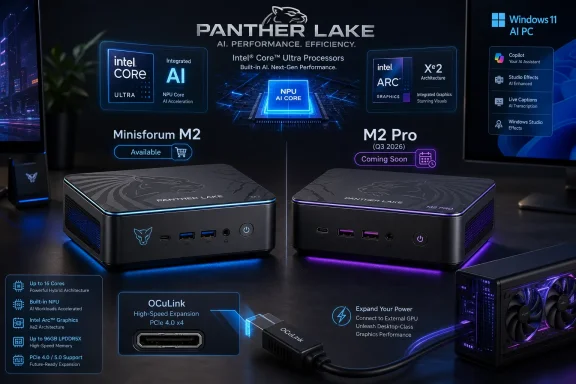
Minisforum’s M2 Pro mini-PC was previewed at CES 2026 as a palm-sized Panther Lake system with Intel Core Ultra X9 388H silicon and Arc B390 graphics, but as of June 7, 2026, the machine still has no firm retail ship date beyond an expected Q3 2026 window. That delay matters because the cheaper standard M2 has already gone on sale, giving buyers a real product to compare against a more exciting promise. The M2 Pro is the box enthusiasts want to benchmark; the M2 is the box Minisforum is actually willing to sell today. In the gap between the two sits the modern mini-PC market’s favorite tension: ambition now, inventory later.
The standard Minisforum M2 is not a consolation prize in the old sense. It is a compact Panther Lake mini-PC with a Core Ultra 7 356H, a quoted 90 TOPS of combined AI performance, modern I/O, and a starting price of $575 as a barebones unit. A 32GB RAM and 1TB SSD configuration has been listed around $1,039, which places it firmly in premium mini-PC territory rather than impulse-buy NUC replacement land.
But the M2 is also plainly not the model that made the room turn its head at CES. That was the M2 Pro, the more muscular sibling built around Intel’s Core Ultra X9 388H and its higher-end Arc B390 graphics. Minisforum’s positioning is obvious: sell a capable Panther Lake system now, keep the halo product warm for later, and hope that enthusiasts remain interested long enough for the Pro to arrive.
This is not an unfamiliar pattern in the mini-PC world. Vendors often use trade shows to stake out the upper edge of what they intend to build, then bring a more conservative SKU to market first. The problem is that the standard M2 is now real enough to buy, while the M2 Pro remains a spec sheet with a calendar attached.
For WindowsForum readers, that distinction is not academic. A mini-PC that ships in May can become a homelab node, a developer workstation, a compact creator box, or a living-room PC in June. A mini-PC that ships “sometime in Q3” is still a plan, and plans do not run Hyper-V, WSL, Proxmox, Docker, Lightroom, Plex, or a local model.
The standard M2’s Core Ultra 7 356H is being marketed around 90 TOPS of total AI throughput, split between a 50 TOPS neural processing unit and additional throughput from the integrated GPU. That number is not a universal performance guarantee, and it should not be treated like a Cinebench score. TOPS figures depend heavily on precision, model type, software support, and whether the workload can actually use the available accelerator.
Still, the direction is meaningful. Intel, AMD, Qualcomm, Apple, and Nvidia are all pushing the same idea from different angles: more inference should happen on the device. For consumers, that means offline features, faster response times, and less dependence on cloud services. For businesses, it means privacy, compliance, cost control, and the ability to keep sensitive prompts and documents inside the network.
The M2 Pro raises the stakes because it is expected to double the quoted AI ceiling to 180 TOPS when configured with the Core Ultra X9 388H and Arc B390 graphics. That is the kind of number that makes a mini-PC look less like a secondary desktop and more like a small inference workstation. Whether real applications can use all of that efficiently is the question reviewers will need to answer when the hardware finally appears.
Intel’s Xe3 graphics architecture is expected to bring a substantial uplift over Lunar Lake’s already impressive integrated graphics. Lunar Lake proved that Intel could build an iGPU that did more than display the desktop and limp through esports titles. Panther Lake’s higher-end graphics configurations push further into territory that used to require a separate graphics card, at least for lightweight creative work and mainstream 1080p gaming.
The language around Arc B390 can be confusing because it is described in some coverage as “discrete-class” while still living inside the processor package as integrated graphics. That phrasing is marketing, but it is not meaningless. The goal is to make the graphics block powerful enough that many users who once needed a low-profile GPU or a larger small-form-factor desktop can now stay inside a compact box.
This is also where the M2 Pro’s delay becomes more painful. The standard M2 can demonstrate Panther Lake as an everyday platform. The Pro is the machine that can test Intel’s larger claim: that the modern integrated GPU can collapse whole categories of entry-level discrete graphics use cases into a single compact system.
The presence of OCuLink is especially interesting because it speaks directly to enthusiasts who have grown tired of treating Thunderbolt as the only external GPU path. Thunderbolt and USB4 are flexible, convenient, and widely supported, but they carry protocol overhead and bandwidth limits that can blunt GPU performance. OCuLink is less elegant as a consumer connector, but its appeal is brutally simple: it exposes PCIe lanes more directly.
That makes the M2 Pro potentially more flexible than its size suggests. On its own, it could serve as a powerful compact Windows workstation. With an OCuLink-connected external GPU, it could become a much more capable gaming or rendering setup while still leaving the main PC small enough to mount behind a display or tuck beside a monitor arm.
This is the kind of design choice that separates a merely tidy mini-PC from a machine built for enthusiasts. Minisforum is not pretending that every buyer will be satisfied by the integrated GPU forever. It is giving the user a path to grow, and in a form factor this small, that path matters.
There is also a cautionary note. Early mini-PC coverage often blends details from related models, preproduction announcements, regional listings, and vendor slides. The standard M2 is listed by Minisforum with dual DDR5 SO-DIMM support rather than LPDDR5X, and some reports differ on storage slot counts depending on model and configuration. Buyers should treat the final product page, not CES shorthand, as the authority when money changes hands.
That matters because memory is not a minor detail in an AI-branded PC. Local models are often constrained less by raw NPU performance than by RAM capacity, memory bandwidth, software compatibility, and GPU acceleration paths. A system advertised as an “AI mini-PC” can look spectacular in TOPS marketing and still feel ordinary if the model a user wants to run spills beyond available memory or lacks optimized runtime support.
The same is true of storage. Multiple M.2 slots can turn a mini-PC into a credible workstation or small server, especially if one drive carries the operating system and another handles data sets, project files, virtual machines, or local model weights. But again, the exact slot count and lane arrangement should be checked against the shipping configuration rather than assumed from launch coverage.
That vision is compelling for exactly the audience that is most skeptical of it. Enthusiasts and IT pros understand the value of local compute. They also understand the risks of opaque telemetry, cloud dependency, vendor lock-in, and features that work beautifully in a demo but awkwardly in production.
A dedicated Copilot button on a mini-PC is therefore both a convenience and a symbol. It says Microsoft and its hardware partners want AI access to feel as ordinary as opening the Start menu. It also reminds administrators that new input paths, background services, microphones, and assistant integrations must be governed with policy, not vibes.
For business users, the interesting part is not whether a button launches Copilot. It is whether the system can run useful local workflows under predictable controls. If Panther Lake can accelerate transcription, document classification, code assistance, malware triage, image analysis, or retrieval-augmented generation without sending sensitive data outside the environment, then the AI PC becomes easier to justify.
The better argument is that not every AI job deserves a round trip to the cloud. A local model can be good enough for summarizing internal notes, generating first drafts, searching a personal corpus, classifying files, extracting entities, or assisting with routine scripts. When latency, privacy, or recurring inference costs matter, local compute becomes attractive even if the model is smaller.
This is where mini-PCs have a particular advantage. A laptop is personal, portable, and thermally constrained. A tower workstation is powerful, expensive, and physically intrusive. A mini-PC with strong CPU, GPU, NPU, RAM, and networking sits in the middle: small enough to deploy widely, capable enough to run useful workloads, and cheap enough to experiment with before standardizing.
The M2 Pro’s promise is that it could become a desktop-class local AI appliance without requiring a desktop-class footprint. That is why the Q3 window is worth watching. If Minisforum hits it with sane pricing and stable firmware, the machine could become one of the more interesting Panther Lake systems of the year.
That is not necessarily a problem. Enthusiasts will pay for density, especially if the box offers strong graphics, 10GbE, multiple fast storage options, and OCuLink. The problem is that the M2 Pro has to compete not only with other mini-PCs, but with discounted gaming laptops, compact desktops, used workstations, and small-form-factor builds that can accept standard GPUs.
The standard M2’s pricing gives us the first hint of Minisforum’s strategy. At $575 barebones, it is not chasing the cheapest mini-PC category. It is selling Panther Lake as a premium platform. At $1,039 configured with 32GB of RAM and a 1TB SSD, it is asking buyers to value the compact chassis, modern I/O, and AI branding alongside conventional performance.
The M2 Pro will have less room for ambiguity. If it launches too high, it becomes a niche halo device for people who specifically want Panther Lake’s top graphics in the smallest practical footprint. If it lands close enough to the standard M2, it could make the cheaper system feel like the impatient buyer’s option.
Intel has a lot riding on Panther Lake because it is more than another mobile CPU generation. It is part of the company’s effort to prove that its client roadmap can compete on performance, efficiency, graphics, manufacturing credibility, and AI acceleration all at once. Every visible system matters because every shipping design becomes evidence that the platform is real.
Mini-PC vendors are especially useful in that story. They can move faster than the largest OEMs, take bigger risks with ports and cooling, and serve enthusiast audiences that obsess over benchmarks, thermals, firmware updates, and Linux compatibility. When they deliver, they create grassroots credibility. When they slip, they reinforce the sense that the platform is still waiting for its moment.
That is why the M2 Pro’s absence is notable. Five months after CES, the more modest M2 is available, but the model that best demonstrates Panther Lake’s graphics and AI ambitions remains pending. The delay does not doom the product, but it does shift the burden of proof onto the eventual launch.
But the standard M2 is not the machine that will define this product family. It is the floor, not the ceiling. The M2 Pro is the version that asks whether a mini-PC can combine strong local AI throughput, genuinely useful integrated graphics, high-speed networking, fast external expansion, and workstation-like memory and storage flexibility.
That distinction matters because mini-PC buyers are often buying against constraints. They want less noise, less desk clutter, less power draw, and less physical intrusion without giving up too much performance. The M2 Pro’s appeal is not that it beats a tower. It is that it might make a tower unnecessary for more people.
Until it ships, however, it remains a more compelling idea than a product. That is the hard line every enthusiast has to draw. Specs can be impressive, but availability is a feature.
 Minisforum Has Shipped the Sensible Box Before the Exciting One
The standard Minisforum M2 is not a consolation prize in the old sense. It is a compact Panther Lake mini-PC with a Core Ultra 7 356H, a quoted 90 TOPS of combined AI performance, modern I/O, and a starting price of $575 as a barebones unit. A 32GB RAM and 1TB SSD configuration has been listed around $1,039, which places it firmly in premium mini-PC territory rather than impulse-buy NUC replacement land.But the M2 is also plainly not the model that made the room turn its head at CES. That was the M2 Pro, the more muscular sibling built around Intel’s Core Ultra X9 388H and its higher-end Arc B390 graphics. Minisforum’s positioning is obvious: sell a capable Panther Lake system now, keep the halo product warm for later, and hope that enthusiasts remain interested long enough for the Pro to arrive.
This is not an unfamiliar pattern in the mini-PC world. Vendors often use trade shows to stake out the upper edge of what they intend to build, then bring a more conservative SKU to market first. The problem is that the standard M2 is now real enough to buy, while the M2 Pro remains a spec sheet with a calendar attached.
For WindowsForum readers, that distinction is not academic. A mini-PC that ships in May can become a homelab node, a developer workstation, a compact creator box, or a living-room PC in June. A mini-PC that ships “sometime in Q3” is still a plan, and plans do not run Hyper-V, WSL, Proxmox, Docker, Lightroom, Plex, or a local model.
Panther Lake Turns the Mini-PC Into an AI Appliance
The reason anyone cares about this box is Panther Lake. Intel’s Core Ultra Series 3 generation is the company’s latest attempt to make the PC feel less like a passive endpoint and more like a local compute appliance. The pitch is not just faster CPU cores or a better GPU; it is a broader package of CPU, GPU, and NPU resources meant to handle AI workloads locally.The standard M2’s Core Ultra 7 356H is being marketed around 90 TOPS of total AI throughput, split between a 50 TOPS neural processing unit and additional throughput from the integrated GPU. That number is not a universal performance guarantee, and it should not be treated like a Cinebench score. TOPS figures depend heavily on precision, model type, software support, and whether the workload can actually use the available accelerator.
Still, the direction is meaningful. Intel, AMD, Qualcomm, Apple, and Nvidia are all pushing the same idea from different angles: more inference should happen on the device. For consumers, that means offline features, faster response times, and less dependence on cloud services. For businesses, it means privacy, compliance, cost control, and the ability to keep sensitive prompts and documents inside the network.
The M2 Pro raises the stakes because it is expected to double the quoted AI ceiling to 180 TOPS when configured with the Core Ultra X9 388H and Arc B390 graphics. That is the kind of number that makes a mini-PC look less like a secondary desktop and more like a small inference workstation. Whether real applications can use all of that efficiently is the question reviewers will need to answer when the hardware finally appears.
The Arc B390 Is the Real Reason to Wait
The M2’s Core Ultra 7 356H is the sensible choice for people who need a compact Windows system with current-generation silicon. The M2 Pro’s Core Ultra X9 388H is the aspirational choice for people who want to see how far an integrated graphics platform can stretch before it starts behaving like a low-end discrete GPU. That is where Intel’s Arc B390 matters.Intel’s Xe3 graphics architecture is expected to bring a substantial uplift over Lunar Lake’s already impressive integrated graphics. Lunar Lake proved that Intel could build an iGPU that did more than display the desktop and limp through esports titles. Panther Lake’s higher-end graphics configurations push further into territory that used to require a separate graphics card, at least for lightweight creative work and mainstream 1080p gaming.
The language around Arc B390 can be confusing because it is described in some coverage as “discrete-class” while still living inside the processor package as integrated graphics. That phrasing is marketing, but it is not meaningless. The goal is to make the graphics block powerful enough that many users who once needed a low-profile GPU or a larger small-form-factor desktop can now stay inside a compact box.
This is also where the M2 Pro’s delay becomes more painful. The standard M2 can demonstrate Panther Lake as an everyday platform. The Pro is the machine that can test Intel’s larger claim: that the modern integrated GPU can collapse whole categories of entry-level discrete graphics use cases into a single compact system.
OCuLink Is the Escape Hatch Enthusiasts Actually Care About
Mini-PCs live and die by expansion, and Minisforum knows it. A compact chassis is attractive until the first time a user discovers that their workload needs more GPU than the motherboard can provide. That is why the M2 family’s external GPU support is more than a footnote.The presence of OCuLink is especially interesting because it speaks directly to enthusiasts who have grown tired of treating Thunderbolt as the only external GPU path. Thunderbolt and USB4 are flexible, convenient, and widely supported, but they carry protocol overhead and bandwidth limits that can blunt GPU performance. OCuLink is less elegant as a consumer connector, but its appeal is brutally simple: it exposes PCIe lanes more directly.
That makes the M2 Pro potentially more flexible than its size suggests. On its own, it could serve as a powerful compact Windows workstation. With an OCuLink-connected external GPU, it could become a much more capable gaming or rendering setup while still leaving the main PC small enough to mount behind a display or tuck beside a monitor arm.
This is the kind of design choice that separates a merely tidy mini-PC from a machine built for enthusiasts. Minisforum is not pretending that every buyer will be satisfied by the integrated GPU forever. It is giving the user a path to grow, and in a form factor this small, that path matters.
The Spec Sheet Is Strong, but the Details Need Discipline
The broader M2 spec story is attractive: modern Intel silicon, high memory ceilings, fast storage, USB4, HDMI, DisplayPort, SD card support, and both 2.5GbE and 10GbE networking. For homelab users, that networking combination alone is enough to raise an eyebrow. A small Windows or Linux box with 10GbE can become a surprisingly useful storage, virtualization, development, or media node.There is also a cautionary note. Early mini-PC coverage often blends details from related models, preproduction announcements, regional listings, and vendor slides. The standard M2 is listed by Minisforum with dual DDR5 SO-DIMM support rather than LPDDR5X, and some reports differ on storage slot counts depending on model and configuration. Buyers should treat the final product page, not CES shorthand, as the authority when money changes hands.
That matters because memory is not a minor detail in an AI-branded PC. Local models are often constrained less by raw NPU performance than by RAM capacity, memory bandwidth, software compatibility, and GPU acceleration paths. A system advertised as an “AI mini-PC” can look spectacular in TOPS marketing and still feel ordinary if the model a user wants to run spills beyond available memory or lacks optimized runtime support.
The same is true of storage. Multiple M.2 slots can turn a mini-PC into a credible workstation or small server, especially if one drive carries the operating system and another handles data sets, project files, virtual machines, or local model weights. But again, the exact slot count and lane arrangement should be checked against the shipping configuration rather than assumed from launch coverage.
Local AI Is the Sales Pitch, but Windows Still Has to Earn It
The M2 and M2 Pro arrive in a Windows ecosystem that is still trying to explain what the AI PC is for. Microsoft’s Copilot branding, dedicated AI keys, microphone arrays, and local inference promises all point in the same direction. The PC is being recast as an always-available assistant that can summarize, transcribe, search, generate, classify, and automate without sending every request to a cloud data center.That vision is compelling for exactly the audience that is most skeptical of it. Enthusiasts and IT pros understand the value of local compute. They also understand the risks of opaque telemetry, cloud dependency, vendor lock-in, and features that work beautifully in a demo but awkwardly in production.
A dedicated Copilot button on a mini-PC is therefore both a convenience and a symbol. It says Microsoft and its hardware partners want AI access to feel as ordinary as opening the Start menu. It also reminds administrators that new input paths, background services, microphones, and assistant integrations must be governed with policy, not vibes.
For business users, the interesting part is not whether a button launches Copilot. It is whether the system can run useful local workflows under predictable controls. If Panther Lake can accelerate transcription, document classification, code assistance, malware triage, image analysis, or retrieval-augmented generation without sending sensitive data outside the environment, then the AI PC becomes easier to justify.
The Cloud Is Not Going Away, but It Is Losing Its Monopoly
The strongest argument for the M2 Pro is not that it will replace cloud AI. It will not. Large frontier models, massive context windows, and centralized enterprise AI platforms will continue to live in data centers because that is where the largest compute pools and orchestration systems reside.The better argument is that not every AI job deserves a round trip to the cloud. A local model can be good enough for summarizing internal notes, generating first drafts, searching a personal corpus, classifying files, extracting entities, or assisting with routine scripts. When latency, privacy, or recurring inference costs matter, local compute becomes attractive even if the model is smaller.
This is where mini-PCs have a particular advantage. A laptop is personal, portable, and thermally constrained. A tower workstation is powerful, expensive, and physically intrusive. A mini-PC with strong CPU, GPU, NPU, RAM, and networking sits in the middle: small enough to deploy widely, capable enough to run useful workloads, and cheap enough to experiment with before standardizing.
The M2 Pro’s promise is that it could become a desktop-class local AI appliance without requiring a desktop-class footprint. That is why the Q3 window is worth watching. If Minisforum hits it with sane pricing and stable firmware, the machine could become one of the more interesting Panther Lake systems of the year.
Pricing Will Decide Whether the M2 Pro Is a Halo Product or a Real One
The reported $699 starting point for the M2 Pro sounds aggressive, but the word “starting” is doing a great deal of work. A barebones price tells only part of the story. By the time a buyer adds enough memory and storage to make a local AI machine useful, the final cost can move quickly into premium mini-PC or entry workstation territory.That is not necessarily a problem. Enthusiasts will pay for density, especially if the box offers strong graphics, 10GbE, multiple fast storage options, and OCuLink. The problem is that the M2 Pro has to compete not only with other mini-PCs, but with discounted gaming laptops, compact desktops, used workstations, and small-form-factor builds that can accept standard GPUs.
The standard M2’s pricing gives us the first hint of Minisforum’s strategy. At $575 barebones, it is not chasing the cheapest mini-PC category. It is selling Panther Lake as a premium platform. At $1,039 configured with 32GB of RAM and a 1TB SSD, it is asking buyers to value the compact chassis, modern I/O, and AI branding alongside conventional performance.
The M2 Pro will have less room for ambiguity. If it launches too high, it becomes a niche halo device for people who specifically want Panther Lake’s top graphics in the smallest practical footprint. If it lands close enough to the standard M2, it could make the cheaper system feel like the impatient buyer’s option.
Minisforum’s Timing Problem Is Intel’s Timing Problem, Too
The M2 Pro delay is not just a Minisforum story. It reflects a broader reality of modern PC launches, where chip announcements, OEM previews, software readiness, firmware maturity, and retail availability often arrive on different schedules. The industry wants a clean narrative; buyers get a staggered rollout.Intel has a lot riding on Panther Lake because it is more than another mobile CPU generation. It is part of the company’s effort to prove that its client roadmap can compete on performance, efficiency, graphics, manufacturing credibility, and AI acceleration all at once. Every visible system matters because every shipping design becomes evidence that the platform is real.
Mini-PC vendors are especially useful in that story. They can move faster than the largest OEMs, take bigger risks with ports and cooling, and serve enthusiast audiences that obsess over benchmarks, thermals, firmware updates, and Linux compatibility. When they deliver, they create grassroots credibility. When they slip, they reinforce the sense that the platform is still waiting for its moment.
That is why the M2 Pro’s absence is notable. Five months after CES, the more modest M2 is available, but the model that best demonstrates Panther Lake’s graphics and AI ambitions remains pending. The delay does not doom the product, but it does shift the burden of proof onto the eventual launch.
The Standard M2 Is the Practical Buy, but Not the Story
For buyers who need a machine now, the standard M2 is the obvious answer. It is available, it is compact, and it brings enough Panther Lake capability to make sense for a modern Windows setup. If the workload is office productivity, development, media, light content creation, remote administration, or experimentation with smaller local models, waiting for the M2 Pro may be unnecessary.But the standard M2 is not the machine that will define this product family. It is the floor, not the ceiling. The M2 Pro is the version that asks whether a mini-PC can combine strong local AI throughput, genuinely useful integrated graphics, high-speed networking, fast external expansion, and workstation-like memory and storage flexibility.
That distinction matters because mini-PC buyers are often buying against constraints. They want less noise, less desk clutter, less power draw, and less physical intrusion without giving up too much performance. The M2 Pro’s appeal is not that it beats a tower. It is that it might make a tower unnecessary for more people.
Until it ships, however, it remains a more compelling idea than a product. That is the hard line every enthusiast has to draw. Specs can be impressive, but availability is a feature.
The Small Box That Has to Prove a Big Claim
The M2 Pro story reduces to a handful of concrete facts that matter more than the launch gloss. The machine is exciting because it compresses several high-end trends into one tiny chassis, but the case for buying it cannot be made until Minisforum turns the promise into inventory.- The standard Minisforum M2 is already on sale, starting at $575 barebones and rising to around $1,039 in a 32GB RAM and 1TB SSD configuration.
- The M2 Pro is expected in Q3 2026, but Minisforum has not provided a firm public retail date.
- The standard M2 uses Intel’s Core Ultra 7 356H and is marketed around 90 TOPS of combined AI performance.
- The M2 Pro is expected to use up to a Core Ultra X9 388H with Arc B390 graphics and a quoted 180 TOPS total AI ceiling.
- OCuLink support is the enthusiast-friendly feature that could let the system outgrow its integrated graphics without abandoning the mini-PC form factor.
- Buyers should verify final memory, storage, and configuration details against the shipping product page because early mini-PC reporting often mixes preproduction and regional specifications.
References
- Primary source: gagadget.com
Published: 2026-06-07T11:50:18.637191
Minisforum M2 Pro: Panther Lake power in a palm-sized box — when it arrives
Minisforum's M2 Pro mini-PC was one of the most interesting announcements at CES 2026, yet five months later it remains unavailable — while a more affordable sigagadget.com
- Related coverage: gizmochina.com
Minisforum launches M2 Mini PC with Intel Core Ultra 7 356H & up to 128GB RAM - Gizmochina
Minisforum launches the M2 mini PC with an Intel Core Ultra 7 356H chip. It features dual 2.5G LAN, dual SSD slots, and up to 128GB RAM for local AI tasks. www.gizmochina.com
- Related coverage: store.minisforum.com
MINISFORUM M2 | Intel Core Ultra 7 356H Mini PC | Dual DDR5 | NPU 50 TOPS + GPU 40 TOPS
The MINISFORUM M2 356 is an ultra-small mini PC packing 90 TOPS of hybrid AI power (NPU 50 + GPU 40). It supports dual DDR5 memory up to 128GB and features Wi-Fi 7 + Bluetooth 5.4. Big performance, tiny footprint. store.minisforum.com
- Related coverage: notebookcheck.net
Minisforum intros EliteMini M2 Pro as new Panther Lake mini PC with capable Arc B390 iGPU - Notebookcheck News
The Minisforum EliteMini M2 Pro was quietly unveiled at CES 2026, now over, and it's one of the first mini PCs powered by the Panther Lake SoC series. It can be equipped with up to an Intel Core Ultra X9 388H, which brings the capable Arc B390 iGPU. www.notebookcheck.net
- Related coverage: minisforum.com
MINISFORUM M2 | Mini PC Intel Core Ultra 7 356H | Doble DDR5 | NPU 50 TOPS + GPU 40 TOPS
El MINISFORUM M2 356 es un mini PC ultracompacto que ofrece 90 TOPS de potencia híbrida de IA (NPU 50 + GPU 40). Soporta memoria DDR5 dual de hasta 128GB y cuenta con Wi-Fi 7 + Bluetooth 5.4. Gran rendimiento, tamaño reducido. www.minisforum.com
- Related coverage: videocardz.com
- Related coverage: chinasmartbuy.com
Minisforum M2 Mini PC con Core Ultra 7 356H e 128 GB RAM
Minisforum lancia M2, mini PC con Core Ultra 7 356H, doppio 2,5G LAN e fino a 128 GB di RAM. Prezzo da 575 dollari.www.chinasmartbuy.com - Related coverage: notebookcheck.pl
Minisforum wprowadza EliteMini M2 Pro jako nowy mini PC Panther Lake z wydajnym iGPU Arc B390 - Notebookcheck.pl
Minisforum EliteMini M2 Pro został po cichu zaprezentowany na targach CES 2026, które już się zakończyły, i jest to jeden z pierwszych mini komputerów PC zasilanych przez serię SoC Panther Lake. Można go wyposażyć nawet w procesor Intel Core Ultra X9 388H, który zapewnia wydajną kartę graficzną... www.notebookcheck.pl
- Related coverage: techradar.com
Minisforum’s long-delayed M2 Pro is still missing, but a cheaper Panther Lake mini PC quietly arrives with surprising compromises | TechRadar
Minisforum shipped the M2 mini PC, but the M2 Pro remains a mysterywww.techradar.com - Related coverage: tomshardware.com
Intel officially releases Xeon 600 chips, announces new vPro Panther Lake CPUs — ‘all-new’ vPro platform goes all-in on AI | Tom's Hardware
OEM and retail units are now available, plus new W890-chipset motherboards.www.tomshardware.com - Related coverage: tomsguide.com
Intel unleashes 14 Panther Lake CPUs — here's what to expect from the new Core Ultra 3 chips | Tom's Guide
Intel just unveiled 10+ new Core Ultra Series 3 laptop chips during its CES 2026 keynote. These new Panther Lake CPUs make big promises in terms of battery life and performance. Here's what you need to know.www.tomsguide.com
