Momentum Expands Teams Operator Connect to 27 EU Countries for Native Admin Voice

Momentum expanded its Microsoft Teams Operator Connect service across 27 European countries on June 2, 2026, making native Teams voice administration available to multinational customers through the Microsoft Teams Admin Center across both North America and Europe. The announcement is not just another carrier footprint update. It is a signal that Teams Phone has moved deeper into the phase where enterprise voice is less about dial tone and more about administrative gravity. Whoever controls the console, the compliance workflow, and the number lifecycle increasingly controls the customer relationship.

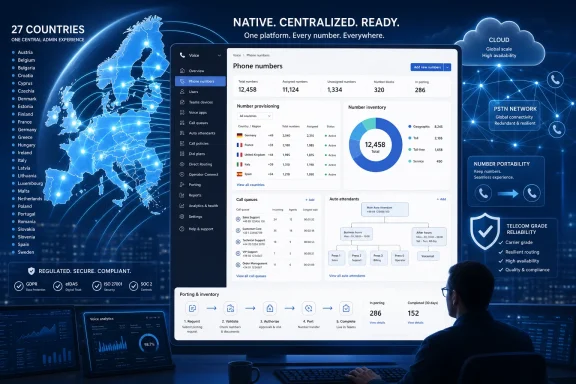
Tech dashboard showing telecom and Microsoft Teams admin features with a live Europe map and call routing flow.Microsoft Teams Voice Keeps Eating the PBX From the Admin Console Out​

For years, the migration from legacy PBX systems to Microsoft Teams Phone has been framed as a user-experience story: one app for chat, meetings, and calls. That was always only half true. The more important shift has been operational, because Teams Phone changes who owns voice inside an organization.
Traditional enterprise telephony lived in a world of carrier portals, PBX specialists, session border controllers, dial plans, and regional procurement quirks. Teams Phone dragged much of that into the Microsoft 365 orbit, where identity, licensing, policy, and collaboration already live. Operator Connect was Microsoft’s compromise between buying phone service directly from Microsoft and letting every enterprise keep building bespoke Direct Routing architectures.
Momentum’s European expansion matters because it leans into that compromise. The company is promising that in-country numbers across 27 European markets can be surfaced in the Teams Admin Center, with native management for users, call queues, auto attendants, resource accounts, and reserved numbers. In plain English, the pitch is that an admin should not need to jump between one portal for France, another for Germany, a different carrier for the Netherlands, and a spreadsheet for everything else.
That is the kind of dull administrative consolidation that rarely makes consumer headlines but gets the attention of IT departments. Voice migrations fail less often because the dial pad is confusing and more often because number inventory, emergency calling, porting, service numbers, and regional compliance become a swamp. Momentum is selling a way to drain part of that swamp.

Operator Connect Was Built for the Enterprise Middle Ground​

Microsoft’s Teams Phone options have always represented different degrees of control and complexity. Calling Plans put Microsoft closest to the carrier role. Direct Routing gives enterprises maximum flexibility, especially where they already have telecom contracts, SBC investments, or complex call-routing needs. Operator Connect sits in the middle: Microsoft-certified operators provide PSTN connectivity while Teams remains the administrative control plane.
That middle ground is exactly where many global organizations want to land. They do not necessarily want Microsoft to be their only carrier, and they often cannot use Microsoft Calling Plans everywhere they operate. But they also do not want to own every moving part of a Direct Routing deployment in every country.
Operator Connect appeals because it turns carrier connectivity into something that looks more like a Teams-native service. Operators upload numbers into the tenant, admins assign them in Teams, and service numbers can be used for functions like call queues and auto attendants. The promise is not that telecom disappears. The promise is that telecom becomes less weird for the Microsoft 365 team that now has to run it.
Momentum’s announcement is carefully written around that promise. The company emphasizes “no middleware,” “no separate portal,” and “one consistent operating model.” Those phrases are doing heavy commercial work. They are aimed at organizations that have discovered that Teams Phone is easy to demo and much harder to standardize across a dozen legal entities, regulatory regimes, and incumbent carrier relationships.

Europe Is Where Unified Voice Strategies Go to Be Tested​

A European expansion is more complicated than adding pins to a marketing map. Europe is dense with markets that look close together geographically but remain distinct for numbering, emergency services, porting rules, data handling, taxation, and procurement. A U.S.-centric voice rollout can tolerate some centralization assumptions that quickly become fragile once the project crosses the Atlantic.
That is why the number 27 is useful but not sufficient on its own. Coverage matters, but operational maturity matters more. A provider can claim availability in many countries while still leaving customers to discover uneven porting timelines, limited number types, inconsistent support models, or awkward escalation paths. Enterprises do not buy “Europe” as a single voice market; they buy working numbers in specific countries with specific obligations.
Momentum’s argument is that its European infrastructure, built following its acquisition of Horizon, gives it a more credible platform for this kind of regional voice service. That acquisition context matters. Operator Connect is not just a Microsoft checkbox. The operator must have the underlying carrier relationships, network capability, support process, and local experience to make the Teams-native layer useful.
For customers, the meaningful question is not whether Momentum can light up a tenant in a supported country. It is whether the service behaves predictably when a port is delayed, a call queue needs a service number, an office closes, a subsidiary is acquired, or emergency address data needs correction. The Teams Admin Center may be the front door, but the plumbing behind it still decides whether the experience feels modern or merely re-skinned.

The Single-Tenant Pitch Is the Real Product​

The most strategically important line in Momentum’s announcement is not about country count. It is the claim that a single Teams tenant can combine Operator Connect Europe, domestic Operator Connect, and international Direct Routing without forcing a single global standard. That reflects how real enterprises actually operate.
A clean-sheet global Teams Phone deployment is rare. Most large organizations arrive with inherited carriers, local office contracts, M&A residue, analog devices, contact center integrations, and regional exceptions that no diagram can politely erase. The fantasy of one provider everywhere often collides with the reality of sunk contracts and local requirements.
Momentum’s mixed-region message is therefore pragmatic. It tells customers they can adopt Operator Connect where it makes sense, keep Direct Routing where they must, and avoid turning the entire voice estate into an all-or-nothing migration. This is not as elegant as a single global carrier story, but it is more believable.
That flexibility also makes the service easier to pilot. An enterprise can move selected European markets onto Operator Connect without dismantling every existing voice path. If the admin experience, support response, and number management prove reliable, the footprint can expand. If not, the tenant is not necessarily trapped in a single architectural bet.

“Native” Is a Word Doing Battle With Telecom History​

Momentum repeatedly describes the experience as native. That word deserves scrutiny, because in enterprise software it often means “integrated enough that the vendor hopes you stop asking where the seams are.” In Teams Phone, native administration is genuinely valuable, but it does not abolish the underlying responsibilities of telephony.
Admins still need to understand number usage types, emergency calling obligations, service numbers, porting windows, licensing requirements, and the difference between user numbers and numbers assigned to voice applications. Operator Connect reduces the number of places where those tasks are performed. It does not make them optional.
The value of native management is consistency. A Teams administrator who already knows how to assign a number, configure a call queue, or manage an auto attendant should not need to relearn the basics for every country. That matters in lean IT organizations where the “telecom team” is now one overworked Microsoft 365 admin with a PowerShell history and a pile of tickets.
But there is a danger in overselling simplicity. Voice remains one of the least forgiving workloads in the enterprise. Email can retry, chat can lag, and a SharePoint file can sync later. A failed inbound call to a sales line, help desk, clinic, or executive office is immediately visible and politically expensive. Teams-native administration helps, but carrier execution still has to be boringly excellent.

Direct Routing Is Not Dead, but Its Job Description Is Shrinking​

Every Operator Connect expansion invites the same quiet question: does this make Direct Routing less relevant? The answer is yes and no. Direct Routing is not going away, but its role is becoming more specialized.
Direct Routing remains important for complex environments. Organizations with custom SBC logic, unusual integrations, legacy PBX coexistence, survivability requirements, contact center dependencies, or regulatory constraints may still need the control it provides. For some global enterprises, Direct Routing is less a choice than a consequence of accumulated telecom history.
But for mainstream Teams Phone adoption, Operator Connect continues to erode Direct Routing’s appeal. If an approved operator can provide numbers directly into Teams, support service numbers, and handle the PSTN side without forcing the customer to manage SBC infrastructure, many organizations will choose that over architectural purity. The less differentiated the voice requirement, the harder it becomes to justify maintaining more moving parts.
Momentum’s announcement implicitly recognizes this boundary. It does not claim that customers must standardize everything on Operator Connect. Instead, it says customers can mix Operator Connect and Direct Routing in one tenant. That is a smart position because it sells modernization without insulting the messy reality of enterprise networks.

The Carrier Market Is Following Microsoft’s Center of Gravity​

The competitive context is just as important as Momentum’s own footprint. Operator Connect has become a crowded field, with telecom providers, UCaaS vendors, managed service providers, and global voice specialists all trying to attach themselves to Microsoft’s collaboration stack. That is because Teams has become the place where many enterprises already spend their administrative day.
This changes the carrier relationship. In the old model, the carrier sold trunks, minutes, numbers, and sometimes managed equipment. In the Teams Phone model, the carrier is increasingly judged by how cleanly it integrates into Microsoft’s environment. The administrative surface has shifted, and carriers that cannot meet customers there risk becoming invisible utilities.
Momentum is trying to position itself as more than a commodity PSTN provider. The company describes itself as a global managed services provider, highlights more than 34,000 connected locations across more than 60 countries, and points to partnerships with over 500 suppliers. That language is aimed at buyers who want someone to absorb the operational complexity behind a simplified Microsoft-facing experience.
The risk for providers in this market is sameness. Everyone says they make Teams voice simple. Everyone says they support global enterprises. Everyone says they reduce portal sprawl. The differentiation will come from the unglamorous details: porting reliability, number availability, support competence, billing clarity, regulatory handling, and whether the provider can help customers out of trouble at 3 a.m.

Admin Convenience Is Now a Procurement Argument​

The most revealing part of the announcement is the emphasis on the Teams Admin Center. Not call quality. Not codecs. Not network architecture. Admin experience.
That is not because call quality no longer matters. It is because baseline voice quality is assumed until proven otherwise. The buyer’s anxiety has moved up the stack, from “will the call connect?” to “can we operate this consistently across the business?”
A unified admin model has real cost implications. It can reduce training overhead, shrink the number of specialist workflows, simplify audits, and make moves, adds, and changes less dependent on obscure carrier processes. It also gives IT leadership a cleaner story to tell: voice becomes part of the Microsoft 365 operating model rather than a separate kingdom with its own rituals.
Still, procurement teams should treat “single partner” claims carefully. A single commercial relationship does not automatically mean a single operational reality. Behind any multinational voice service are local carriers, porting authorities, numbering rules, and support dependencies. Momentum may be the accountable partner, but customers should still test the countries that matter most to them rather than assuming the map tells the whole story.

The Security and Compliance Story Is Implied, Not Finished​

For WindowsForum’s IT-pro audience, the compliance angle is where the announcement deserves a second reading. Voice services are not just collaboration tools. They touch emergency calling, regulated communications, retention policies, identity, and business continuity. Moving voice into Teams can simplify governance in some areas while concentrating risk in others.
Operator Connect can improve control by tying phone number assignment and user identity more closely to Microsoft 365 administration. That can make onboarding and offboarding cleaner, especially when combined with Entra ID lifecycle processes and Teams policies. A user’s communications footprint can become easier to reason about when voice is no longer managed in an entirely separate system.
But consolidation also raises the stakes of tenant hygiene. Conditional access, administrator roles, audit logging, number assignment permissions, and change management all become more consequential when Teams is not merely a meeting app but the front end for business telephony. A compromised admin account or sloppy role assignment can affect more than chat settings.
Momentum’s announcement does not dwell on this, and that is typical for a press release focused on service availability. Enterprises evaluating the offering should push deeper. They should ask how support access is controlled, how emergency location data is handled, what audit trails are available, how number changes are approved, and how incidents are escalated across regions.

The Hidden Work Starts Before the First Number Ports​

A Teams Operator Connect rollout can look deceptively simple in a product demo. Select an operator, enable countries, acquire or port numbers, assign them to users, and configure voice applications. The real project starts before any of that.
Organizations need a clean inventory of existing numbers, owners, call flows, hunt groups, analog lines, fax dependencies, contact center paths, emergency locations, and executive exceptions. They need to know which numbers are actually used, which are published externally, which are tied to compliance obligations, and which belong to offices that no longer exist. Many voice estates are archaeological digs pretending to be spreadsheets.
This is where managed service providers can earn their margin. The value is not just providing numbers in Teams. It is helping customers rationalize the mess that predates Teams. Without that work, Operator Connect can become a more modern front end for the same old confusion.
Momentum’s managed or unmanaged options acknowledge that customers differ in their appetite for operational responsibility. Some enterprises want a provider deeply involved in design, migration, and ongoing administration. Others want the carrier connection and prefer to run the Microsoft side themselves. The important thing is matching the support model to the customer’s actual internal capability, not to an optimistic org chart.

Microsoft Wins Even When the Carrier Gets the Press Release​

There is a broader platform lesson here: Microsoft does not need to provide every phone number itself to win the enterprise voice transition. It needs Teams to be the place where voice is administered, governed, and experienced. Operator Connect advances that goal by letting carriers compete inside Microsoft’s frame.
That is classic platform leverage. Microsoft certifies and structures the ecosystem, operators bring telecom reach, and customers get a menu of providers that still reinforces Teams as the hub. The more carriers invest in Operator Connect, the more defensible Teams Phone becomes as the default enterprise voice path.
For Momentum, the opportunity is to capture customers who want that Microsoft-native model but need broader geographic support than a domestic-only service can provide. For Microsoft, the win is subtler but larger. Every such expansion makes Teams Phone feel less like an add-on and more like the expected endpoint for corporate calling.
This also puts pressure on rival collaboration and UCaaS platforms. Voice used to be a wedge into collaboration. Now collaboration is a wedge into voice. If the enterprise already lives in Teams, competing providers have to prove not just that their calling is good, but that their administrative model is worth leaving the Microsoft gravity well.

Momentum’s Europe Move Is Really a Bet on Fewer Exceptions​

The practical significance of this launch will depend on execution, but the direction is clear. Momentum is betting that multinational customers are tired of treating every country as a separate voice project. The company is offering a model in which Europe becomes less of a patchwork and more of an extension of the same Teams Phone operating pattern customers use in North America.
That does not eliminate regional complexity. It does not make every port painless or every telecom edge case disappear. It does, however, attack one of the biggest barriers to Teams Phone standardization: the gap between a clean Microsoft admin story and the messy international reality of phone numbers.
For IT leaders, the right read is neither hype nor dismissal. This is not a revolutionary new Teams feature. It is infrastructure and service coverage catching up with how enterprises already want to manage collaboration. In enterprise IT, that kind of catch-up often matters more than a flashy product launch.

The Teams Phone Map Now Has Fewer Blank Spaces​

Momentum’s announcement leaves customers with several concrete points to evaluate before treating the new footprint as a migration green light. The marketing promise is coherent, but Teams voice projects are won or lost in the operational details.
  • Momentum says its Operator Connect service is now available across 27 European countries, extending its Teams voice footprint beyond North America.
  • The service is designed to surface in-country numbers directly inside the Microsoft Teams Admin Center for assignment and management.
  • The offering supports Teams-native voice applications such as call queues and auto attendants through resource account and reserve DID capabilities.
  • Customers can mix Operator Connect Europe, domestic Operator Connect, and international Direct Routing inside a single Teams tenant.
  • The strongest fit is likely to be multinational organizations that want fewer carrier portals, fewer regional exceptions, and a more consistent Microsoft 365 administration model.
  • Enterprises should still validate country-level number availability, porting timelines, emergency calling support, service-number behavior, and escalation procedures before committing major sites.
Momentum’s European Operator Connect expansion is best understood as part of the long normalization of Teams as enterprise telephony infrastructure, not merely collaboration software with a dial pad. The old PBX world is not vanishing all at once, and Direct Routing will keep its place where complexity demands it. But the center of gravity is moving toward services that make voice look, feel, and operate like the rest of Microsoft 365. The next phase of the market will be decided less by who can claim the largest map and more by who can make that map behave predictably when real enterprises start moving their numbers across it.

References​

  1. Primary source: newswire.com
    Published: Tue, 02 Jun 2026 13:00:00 GMT
  2. Official source: learn.microsoft.com
  3. Official source: support.microsoft.com
  4. Official source: microsoft.com
  5. Related coverage: calltower.com
  6. Related coverage: gammagroup.co
  1. Related coverage: prnewswire.com
  2. Related coverage: businesswire.com
  3. Related coverage: globenewswire.com
  4. Related coverage: nuwave.com
  5. Related coverage: telnyx.com
  6. Related coverage: operatorconnect.teliacompany.com
  7. Official source: adoption.microsoft.com
  8. Related coverage: audiocodes.com
  9. Related coverage: info.calltower.com
 

Momentum expanded its Microsoft Teams Operator Connect service across 27 European countries on June 2, 2026, giving multinational customers a native Teams Phone route for in-country numbers, call queues, auto attendants, and unified number management through the Microsoft Teams Admin Center. That sounds like a product announcement, and it is. But it is also a useful marker for where enterprise telephony is headed: away from bespoke regional voice projects and toward Teams as the control plane for the boring, regulated, stubbornly local world of phone numbers. The prize is administrative simplicity; the risk is that simplicity can hide just how much telecom complexity still sits underneath.

A telecom dashboard graphic shows cloud-based phone number management across 27 European countries.Momentum Is Selling Less Telephony, and More Standardization​

The old enterprise voice migration was usually described as a move from PBX hardware to cloud calling. That framing was always too small. The bigger shift has been from telephony as a site-by-site infrastructure project to telephony as an identity, policy, and administration layer inside Microsoft 365.
Momentum’s European expansion leans directly into that change. The company says customers can now manage in-country DIDs across 27 European countries in the Teams Admin Center, with support for number types used by call queues, auto attendants, and reserved capacity. The claim is not that Teams suddenly became a better softphone. The claim is that a company operating across North America and Europe can make Teams voice look operationally consistent across regions that historically forced different carriers, portals, contracts, escalation paths, and number-management habits.
That is why the most important phrase in the announcement is not “Europe” or even “Operator Connect.” It is “one consistent operating model.” Multinational IT departments are not short on ways to place calls. They are short on ways to make voice behave like the rest of the Microsoft cloud stack: centrally governed, delegated, auditable, and boring enough to scale.
There is a commercial story here too. Momentum says the European service is built on infrastructure gained through its Horizon acquisition, which suggests this is not merely a reseller badge slapped onto Microsoft’s Operator Connect directory. It is an attempt to turn regional footprint into a cross-Atlantic managed-service proposition, aimed at customers that do not want to stitch together a local carrier strategy one country at a time.

Operator Connect Won Because Direct Routing Asked Too Much of Too Many Customers​

Microsoft Teams Phone has never had just one path to the public telephone network. Customers can buy Microsoft Calling Plans where available, keep their own carriers through Direct Routing, or use Operator Connect with a Microsoft-approved operator. Each path has its constituency, and each carries a different balance of control, cost, responsibility, and operational burden.
Direct Routing remains powerful because it lets enterprises connect Teams to existing carriers and session border controllers. It is flexible, familiar to telecom engineers, and often attractive for organizations with complex call flows, legacy infrastructure, or negotiated carrier contracts. But the price of that flexibility is that somebody has to own the plumbing.
Operator Connect is Microsoft’s answer for the broad middle of the market: companies that want carrier choice without becoming Teams voice infrastructure specialists. The model places certified operators into the Teams Admin Center workflow. Admins enable an operator, select countries or regions, work with the operator on number acquisition or porting, and then assign those numbers inside Teams.
Momentum’s announcement is therefore less about inventing a new Teams voice model than expanding the map where that model can be practical. Europe is exactly where this matters. A North American Teams Phone deployment can often be made to look deceptively simple; a European deployment immediately runs into country-specific number rules, emergency calling requirements, porting processes, language expectations, regulatory regimes, and local carrier realities.
The market has already told Microsoft and its partners what it wants: less SBC babysitting for common use cases, less carrier fragmentation, and fewer admin surfaces. Operator Connect does not abolish telecom complexity. It moves much of it behind a certified operator relationship and exposes the part IT wants to touch inside Teams.

The Teams Admin Center Is Becoming the New PBX Room​

For years, the PBX room was a physical and cultural place. It was where voice engineers lived, where phone extensions were sacred objects, and where moves, adds, and changes had their own rituals. In the Teams era, that center of gravity has shifted into the Teams Admin Center, PowerShell, identity policy, and licensing.
Momentum is explicitly betting on that shift. The company is highlighting native number provisioning into the Teams Admin Center, native configuration for call queues and auto attendants, and no separate portal for everyday administration. That is not just a convenience claim. It is a statement about who should be able to administer voice.
When phone numbers show up in Teams, the operational audience changes. A Microsoft 365 administrator can assign a number, check a user’s Teams mode, connect voice policy to identity, and manage calling alongside meetings, messaging, and collaboration. Telecom no longer disappears, but it becomes part of the Microsoft administrative fabric rather than a separate discipline guarded by a different vendor console.
That has obvious appeal for companies that have already standardized on Teams as the collaboration layer. If a help desk can create a user, assign licenses, apply policies, and provision a phone number without leaving the Microsoft management universe, the cost of voice administration falls. The same is true for distributed IT teams supporting multiple countries. A consistent workflow does not eliminate local telecom obligations, but it reduces the number of bespoke operational playbooks.
The danger is that the Teams Admin Center can make voice look simpler than it is. Phone numbers are still regulated resources. Emergency calling still depends on address data and local rules. Porting still involves incumbent carriers, lead times, validation, and occasional pain. The admin experience may be native, but the service underneath remains a hybrid of Microsoft cloud control and operator-owned telecom execution.

Europe Is the Test Case for Cloud Voice’s Grand Promise​

Europe is not just another region on a coverage map. It is the place where cloud voice vendors must prove that “global” does not merely mean “available in several countries.” Businesses operating across Europe encounter a dense patchwork of numbering authorities, emergency-services obligations, data-handling expectations, national telecom practices, and procurement preferences.
That is why 27-country coverage matters if it holds up in practice. A multinational can tolerate local quirks; it cannot tolerate having every country become a separate voice architecture. The more countries a provider can support through a common Teams-native model, the easier it becomes to define standard build patterns, training, escalation, governance, and lifecycle management.
Momentum’s pitch is aimed at precisely that pain. A company with users in the United States, Canada, the United Kingdom, Germany, France, the Netherlands, Spain, and other European markets does not want to maintain a different carrier interface for each country unless it has a compelling reason. It wants in-country numbers, compliant calling, predictable porting, consistent support, and a way to administer the result without turning every local office into its own telecom project.
There is also a post-pandemic reality at work. Many organizations normalized Teams as the daily work surface during the remote-work boom, then discovered that voice was the last major collaboration workload still fragmented across legacy systems. The easy Teams migrations were chat, meetings, and file collaboration. Voice was harder because voice touches public networks, emergency services, fax-like edge cases, contact centers, reception desks, analog devices, and human expectations formed over decades.
Operator Connect is Microsoft’s attempt to make that last mile less intimidating. Momentum’s European expansion is a partner-level attempt to make it more geographic. The combination is powerful because it tells IT leaders that Teams Phone can be a regional standardization project rather than a country-by-country science experiment.

The Native Experience Is the Product​

Momentum’s announcement repeatedly uses the word “native,” and that repetition is doing real work. In enterprise software, “native” often sounds like marketing padding. In Teams telephony, it is closer to the whole value proposition.
A native Teams voice experience means administrators are not constantly translating between Microsoft’s view of the world and a carrier portal’s view of the world. It means numbers can be surfaced where users, policies, and voice applications already live. It means call queues and auto attendants are configured through Teams constructs rather than through a separate voice overlay that behaves like Teams only at the edge.
That distinction matters because plenty of Teams telephony offerings can technically make calls work. The more important question is where the source of truth resides. If number inventory, assignment, routing logic, support status, and voice-app configuration are scattered between Microsoft, a carrier portal, a managed-service provider, and a spreadsheet maintained by a regional office, the deployment has recreated the old PBX mess in cloud form.
The promise of Operator Connect is that the operator still provides the PSTN service, but Microsoft’s administrative plane becomes more authoritative for day-to-day work. Momentum is pushing that promise by saying there is no middleware and no separate portal to learn. That will appeal to IT departments trying to reduce operational variance, especially those that have already trained staff on Teams Phone administration.
Still, “native” should not be confused with “Microsoft does everything.” Operator Connect remains a partnership model. The carrier relationship, number acquisition, porting, emergency calling details, and service commitments involve the operator. The more countries involved, the more important it becomes to ask exactly where Microsoft’s control ends and the provider’s process begins.

The Patchwork Problem Is Real, Even When the Announcement Overstates the Cure​

Garcia’s quoted line about avoiding a patchwork of in-country carriers will resonate with anyone who has run a European voice estate. It is also worth treating carefully. No single provider fully abolishes the local nature of telecom.
Even when a customer buys through one managed-services partner, calls still terminate into national networks. Number availability still depends on local numbering plans. Porting still depends on losing carriers and country-specific documentation. Emergency calling still has jurisdictional rules. Regulatory changes can still arrive unevenly across markets.
What Momentum can plausibly reduce is not the existence of local telecom complexity, but the customer’s direct exposure to it. That is a meaningful distinction. Enterprises do not need every underlying service to be literally uniform; they need the experience of consuming, administering, supporting, and governing that service to be standardized enough to operate efficiently.
This is where managed-service providers earn or lose trust. If Momentum can shield customers from country-level friction while preserving visibility when something goes wrong, the offering has strategic value. If the single partner model merely inserts another layer between the customer and the carrier reality, the simplicity story weakens quickly.
The best version of this model gives IT one front door without creating a black box. Admins should know which numbers exist, where they are assigned, what service type they use, how emergency addressing is handled, which country rules apply, how porting timelines differ, and what escalation path exists when calls fail. Teams-native management is useful. Teams-native opacity is not.

Mixed-Region Flexibility Is the Quietly Important Feature​

One of Momentum’s more practical claims is that a single Teams tenant can combine Operator Connect Europe, domestic Operator Connect, and international Direct Routing. That detail deserves more attention than the average product bullet will receive.
Real enterprise environments are messy. A company may want Operator Connect in countries where it is mature, Direct Routing where it has legacy SBC investments, Microsoft Calling Plans for small offices, and specialized carrier arrangements for regulated or high-volume locations. No sensible global voice strategy assumes every site flips to the same model on the same day.
Mixed-region flexibility acknowledges that reality. It lets an organization move toward standardization without pretending that standardization is a single cutover event. A North American headquarters might already use Momentum for Operator Connect, while European subsidiaries still run local carrier contracts or Direct Routing. The ability to bring European numbers into the same broad operating model lowers the migration barrier.
This also matters for risk management. Voice migrations are unforgiving because users notice failures instantly. Email can be delayed, file sync can be retried, and chat outages may be absorbed for a short time. A phone number that does not ring, a queue that drops calls, or an emergency call path configured incorrectly becomes a visible incident.
A hybrid model gives IT room to sequence the work. The organization can migrate lower-risk user populations first, keep complex contact centers or regulated sites on existing architectures, and gradually bring more countries under Operator Connect as confidence grows. The strategic direction may be standardization, but the operational method should be incrementalism.

The Admin Win Depends on Licensing, Governance, and Boring Prep Work​

The Teams Phone story always sounds cleanest before licensing and readiness enter the room. Users need appropriate Teams Phone capabilities. They need to be in the right Teams mode. Numbers need to be acquired, ported, assigned, and mapped to emergency information. Voice policies, calling policies, dial plans, resource accounts, and service numbers all need to match the organization’s real workflows.
Momentum’s announcement highlights Resource Account and Reserve DIDs, which is important because business telephony is not just one number per person. Reception lines, call queues, auto attendants, shared service desks, branch-office main numbers, after-hours routing, and future capacity all require planning. The difference between a tidy pilot and a production voice estate is often found in these non-user numbers.
For administrators, the practical value of native number types is that voice applications can be built more directly in Teams. A call queue needs a number, resource accounts, agents, routing behavior, hours, overflow handling, and reporting expectations. An auto attendant needs menus, holidays, language choices, and escalation paths. If these elements can be provisioned with fewer cross-platform handoffs, the operational burden falls.
But Teams Phone governance is not automatic. Enterprises still need naming standards, delegated administration rules, number inventory discipline, emergency-address ownership, lifecycle processes, and change control. They need to decide who can create a call queue, who can assign numbers, who owns country-level compliance, and how exceptions are documented.
The organizations that benefit most from Operator Connect are not necessarily the ones with the fewest telecom skills. They are the ones disciplined enough to turn a simpler admin model into a governed service. Without that discipline, the Teams Admin Center becomes just another place where sprawl accumulates.

Microsoft’s Partner Model Is Turning Telecom Into a Cloud Marketplace​

Operator Connect is part of a broader Microsoft pattern: move customer-facing administration into Microsoft 365, certify partners for the underlying service, and make the marketplace compete on coverage, support, price, and integration quality. It is a cloud-platform move applied to telephone numbers.
For Microsoft, this is attractive because it expands Teams Phone without requiring Microsoft to become the primary telecom operator everywhere. Microsoft can offer its own Calling Plans in selected markets, but Operator Connect lets the company harness carriers and managed-service providers where local expertise matters. The model also keeps Teams at the center of the user and admin experience, which strengthens Microsoft 365 stickiness.
For partners, the bargain is more complicated. Operator Connect gives providers access to Teams customers who want a sanctioned, integrated path to PSTN calling. But it also pressures them to compete inside Microsoft’s frame. Differentiation shifts away from “we can connect voice to Teams” and toward footprint, provisioning speed, support quality, regulatory competence, reporting, managed services, and migration execution.
Momentum’s European expansion fits that competitive moment. The company is not merely saying it supports Teams voice; many providers can say that. It is saying it can be a single partner across North America and a broad European footprint, with a native admin model and optional managed support. That is a bid for enterprise standardization budgets, not just telecom spend.
This also explains why coverage announcements have become a genre of their own. The number of supported countries is a proxy for enterprise usefulness, even though it does not tell the whole story. A provider with fewer countries but deeper local execution may outperform a broader provider in specific markets. But for a CIO trying to rationalize voice across regions, the first filter is often whether a vendor can cover enough of the map to be worth a strategic conversation.

The Real Competition Is Not Just Other Operators​

Momentum will compete with other Operator Connect providers, but the more interesting competition is architectural. Enterprises choosing Teams Phone still weigh Operator Connect against Direct Routing, Microsoft Calling Plans, mobile-first Teams integration, contact-center platforms, and doing nothing yet.
Doing nothing remains a stubborn competitor. Many organizations still have working PBXs, survivable branch appliances, local SIP trunks, and carrier contracts that are annoying but understood. Replacing them requires budget, project time, user communication, testing, and executive tolerance for the occasional ugly porting day. The cloud voice business often underestimates the inertia of systems that are old but functional.
Direct Routing also remains a rational choice for organizations with complex requirements. If a company has heavy SBC customization, specialized compliance recording, analog dependencies, unusual routing rules, or countries not well served by Operator Connect, it may keep Direct Routing for longer than Microsoft’s preferred story suggests. Operator Connect’s simplicity is strongest when the customer’s requirements fit the model.
Microsoft Calling Plans have their own appeal for smaller or simpler deployments, particularly where Microsoft’s coverage, pricing, and support expectations align. The fewer countries and edge cases involved, the more attractive it can be to buy directly from Microsoft. But multinational organizations often need carrier flexibility, number portability expertise, and local support that a pure Calling Plan approach may not satisfy.
Then there is the contact-center question. Teams-native call queues and auto attendants are sufficient for many business workflows, but they are not a universal replacement for advanced contact-center platforms. Enterprises should avoid treating Operator Connect as a magic wand for every voice-adjacent workload. It is a PSTN connectivity and administration model; the application layer still needs honest evaluation.

The Security Story Is Administrative, Not Magical​

Cloud voice announcements often imply that consolidation improves security, and sometimes it does. Fewer portals, fewer unmanaged credentials, fewer undocumented trunks, and clearer administrative boundaries can reduce risk. Moving voice administration into Microsoft 365 can also put it closer to conditional access, role-based administration, audit logs, and established identity governance.
But Operator Connect does not make phone fraud, misconfiguration, or social engineering disappear. Voice remains a target because phone numbers are tied to identity, customer trust, password resets, executive impersonation, and financial workflows. A compromised admin account with voice privileges can still do damage. A poorly governed call forwarding policy can still create exposure. A rushed port can still create business interruption.
The security upside comes from standardization and visibility. If an organization can see its numbers, assignments, operators, and voice apps in a consistent administrative environment, it has a better chance of detecting drift. If it can delegate permissions narrowly and review changes, it reduces the blast radius of mistakes. If it can retire legacy trunks and forgotten PBX integrations, it eliminates old attack surfaces.
That is why the managed-service layer matters. Some customers will want Momentum to run much of the voice operation; others will want to self-administer after implementation. The right answer depends on internal skill, risk tolerance, and operating model. What matters is that responsibility is explicit. “Managed or unmanaged” is useful only if both sides understand exactly who owns monitoring, changes, porting, emergency updates, incident response, and compliance evidence.

The Fine Print Will Decide Whether This Feels Global​

The announcement says Momentum Teams Operator Connect Europe is available now. Availability, however, is one of those words that can carry a lot of freight in telecom. It can mean ready for new number orders in a country, ready for porting, ready for specific number types, ready for emergency calling workflows, or ready after a qualification process.
Enterprises should therefore read “27 countries” as the start of due diligence, not the end. Which countries are included? Are both new numbers and ported numbers supported? Are toll-free and service numbers available everywhere? How are emergency addresses handled country by country? Are there restrictions on proof of local presence? What are the expected porting intervals? Which languages does support cover?
The most successful Teams Phone migrations start with this unglamorous inventory work. IT needs to know every number range, every main line, every queue, every fax dependency, every elevator phone, every alarm line, every receptionist workflow, every executive assistant scenario, and every contact-center exception. The cloud project fails when the organization discovers late that “phone system” meant more than user DIDs.
Momentum’s support for reserve numbers is a nod to that operational reality. Enterprises need capacity planning, not just live assignment. A growing business may need number blocks for future hires, office moves, seasonal queues, or regional expansion. Treating numbers as managed inventory rather than incidental artifacts is a sign of maturity.
The European angle makes this even more important. A one-size-fits-all rollout plan will break against local documentation, incumbent-carrier behavior, and emergency-service rules. The value of a provider like Momentum is not merely that it can list countries, but that it can help customers move through those differences without losing the benefits of a common Teams operating model.

The Horizon Acquisition Now Has a Teams Phone Plotline​

Momentum’s reference to Horizon is more than corporate backstory. Acquisitions in the managed-services and telecom space are often justified with vague language about scale and customer value. Here, the strategic logic is clearer: European infrastructure becomes a foundation for selling Teams Operator Connect to customers that already think in transatlantic terms.
That matters because Teams voice is increasingly bought as part of a broader workplace modernization program. A company standardizing on Microsoft 365 security, Teams collaboration, managed network services, and cloud contact-center integrations may prefer a provider that can bundle implementation and operations across domains. Momentum’s corporate positioning around connect, secure, collaborate, and engage is built for that kind of sale.
The flip side is integration risk. Customers should ask how fully Horizon’s infrastructure, processes, support teams, provisioning systems, and regulatory capabilities have been absorbed into Momentum’s Operator Connect offer. In telecom, the difference between a cohesive platform and a federation of acquired assets shows up during porting, outage response, billing disputes, and edge-case provisioning.
If Momentum executes well, the Horizon acquisition gives it a stronger European spine at exactly the moment Teams Phone standardization is becoming more attractive. If execution is uneven, customers may experience the very fragmentation the company says it is solving. The announcement is a promise of operational unity; the market will judge it by operational details.
For WindowsForum readers, that distinction should sound familiar. Microsoft ecosystems are full of offerings where the admin surface looks unified before the underlying operations fully catch up. The sensible posture is neither cynicism nor blind trust. It is disciplined validation.

For IT Shops, the Best Migration Plan Is Still a Skeptical One​

The case for Momentum’s expanded Operator Connect is strongest for organizations that already live in Teams and want to reduce regional voice fragmentation. The case is weaker for organizations with highly customized telephony, unsupported country needs, entrenched carrier economics, or contact-center requirements that exceed Teams-native voice applications.
A proper evaluation should start with architecture, not price. Which users need PSTN calling? Which numbers are tied to business-critical workflows? Which countries need local presentation? Which sites require survivability? Which analog services remain? Which compliance recording or retention rules apply? Which help desk will own day-two administration?
Only after that should procurement compare providers. Country coverage is necessary, but support model, porting competence, emergency-calling process, service-level commitments, escalation quality, and administrative transparency matter just as much. A cheaper voice provider that mishandles number inventory can become expensive very quickly.
Pilot design also deserves care. A good pilot is not merely a handful of friendly users making outbound calls. It should test number assignment, inbound routing, call queues, auto attendants, emergency-address handling, delegated administration, support tickets, porting communication, and rollback procedures. It should include at least one realistic branch or department workflow, not just IT staff calling each other.
The goal is not to prove that Teams can make a phone call. That question has been answered. The goal is to prove that the organization can operate Teams Phone at scale, across countries, with fewer moving parts than the system it replaces.

The 27-Country Claim Gives CIOs a New Checklist​

Momentum’s announcement is most useful when treated as a forcing function for practical planning. If Teams is already the collaboration standard, the question is no longer whether cloud voice is coming. It is how much of the old voice estate can be brought under a common Microsoft-centered operating model without losing local reliability.
  • Momentum’s June 2, 2026 expansion makes its Microsoft Teams Operator Connect service available across 27 European countries, extending its pitch beyond North America into a broader transatlantic voice strategy.
  • The core administrative promise is that phone numbers and Teams voice applications can be managed natively through the Teams Admin Center rather than through a separate carrier portal for routine work.
  • The strongest customer fit is a multinational organization that wants to standardize Teams Phone operations while preserving enough flexibility to mix Operator Connect and Direct Routing where needed.
  • The main due-diligence questions are country coverage details, number-porting rules, emergency-calling processes, service-number support, support escalation, and the operational maturity of the managed-service layer.
  • The announcement does not eliminate telecom complexity; it shifts more of that complexity to Momentum and exposes a simpler operating surface to Microsoft 365 administrators.
  • The migration risk is lowest when IT treats Teams Phone as a governed voice platform, not as a quick add-on to an existing Teams deployment.
Momentum’s European Operator Connect expansion is not a revolution in calling, and that is precisely why it matters. Enterprise voice modernization has reached the stage where the winning moves are less about novelty than about coverage, governance, and operational repeatability. If Momentum can turn its European footprint into a genuinely native, supportable Teams Phone experience, it will give IT leaders one more reason to retire the regional voice patchwork; if not, it will become another reminder that the cloud can simplify the console long before it simplifies the underlying work.

References​

  1. Primary source: ACCESS Newswire
    Published: Tue, 02 Jun 2026 13:09:07 GMT
  2. Official source: learn.microsoft.com
  3. Official source: microsoft.com
  4. Related coverage: telnyx.com
  5. Official source: microsoftteamsphonesystem.co.uk
  6. Related coverage: nuwave.com
  1. Official source: techcommunity.microsoft.com
  2. Related coverage: bics.com
  3. Related coverage: docs.8x8.com
  4. Related coverage: pure-ip.com
  5. Related coverage: audiocodes.com
  6. Related coverage: 0e190a550a8c4c8c4b93-fcd009c875a5577fd4fe2f5b7e3bf4eb.ssl.cf2.rackcdn.com
  7. Official source: adoption.microsoft.com
  8. Related coverage: globalservices.bt.com
 

Momentum announced on June 3, 2026, that it is expanding Microsoft Teams Operator Connect service to 27 European countries, giving multinational customers a native Teams Phone option for regional numbers, call queues, auto attendants, and number management inside the Microsoft Teams Admin Center. The announcement is not just another carrier coverage update; it is a sign that Teams voice is moving from “collaboration add-on” to enterprise telephony control plane. For Windows shops already living in Microsoft 365, the promise is seductive: fewer portals, fewer regional contracts, fewer hand-built Direct Routing exceptions. The risk is that the simplicity Microsoft and its partners sell at the admin layer can obscure the stubborn complexity underneath: regulation, emergency calling, number portability, carrier accountability, and regional operational reality.

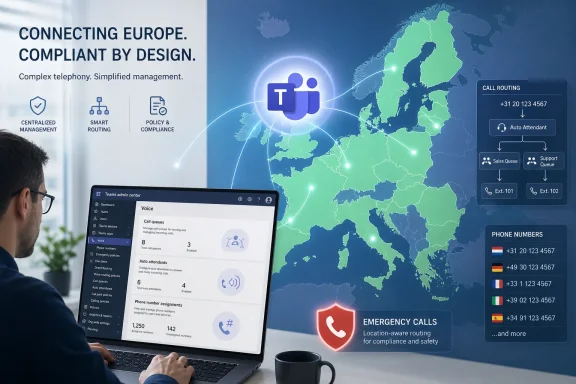
Businessman monitors an interactive Europe call-routing dashboard with compliant telephony features.Microsoft Teams Voice Is Becoming a Geography Problem​

Microsoft Teams long ago escaped the meeting room. In many organizations, it is now the default workspace: chat, calendar, files, meetings, webinars, contact center integrations, and increasingly the office phone system. That last step has always been the most politically and technically complicated, because telephony is not merely software. It is a regulated, country-by-country business built on numbering plans, emergency services, porting rules, lawful intercept expectations, local carrier relationships, and decades of PBX muscle memory.
Momentum’s European expansion matters because it attacks the least glamorous but most consequential obstacle in Teams Phone adoption: geographic consistency. A company can standardize on Teams globally for messaging in an afternoon, but voice deployment often stalls when the business asks whether the same model works in Amsterdam, Dublin, Paris, Frankfurt, Madrid, and Milan. Suddenly the neat Microsoft 365 tenant meets a world of local numbering, national rules, and procurement departments that already have legacy voice contracts in place.
Operator Connect was Microsoft’s answer to that tension. Instead of forcing every enterprise to run its own session border controllers through Direct Routing, or forcing every customer into Microsoft Calling Plans where available, Operator Connect lets certified carriers plug their PSTN services into Teams in a more native, Microsoft-administered way. The carrier still provides the phone service, but the Teams Admin Center becomes the place where many day-to-day number and user operations happen.
Momentum is now saying that model is available across 27 European countries through infrastructure inherited from its Horizon acquisition. That is the important clause. This is not pitched as a greenfield partnership stitched together only for marketing purposes, but as an extension of a European operating base the company bought in early 2024 when it acquired Netherlands-based Horizon Telecom.

The Horizon Deal Now Looks Like the Real Product Launch​

When Momentum acquired Horizon Telecom, the obvious story was footprint. A U.S.-rooted managed services provider wanted a stronger European presence, and Horizon brought carrier-neutral managed voice, network, and migration expertise. At the time, that could have been read as another MSP roll-up in a consolidating market.
With this Operator Connect expansion, the acquisition looks more strategic. Momentum did not merely buy customers and contracts; it bought the scaffolding needed to sell a more credible multinational Teams Phone story. In enterprise communications, the difference between “we can support Europe” and “we operate European infrastructure” is enormous. One sounds like a sales territory. The other sounds like an operational model.
The phrase “27 European countries” does useful marketing work, but the deeper message is standardization. Momentum wants customers to view Teams voice not as a set of national telecom projects but as a single program that can span North America and Europe. That is exactly how CIOs and IT service owners prefer to buy platforms: one governance model, one support path, one roadmap, and one management experience wherever possible.
That does not mean one carrier relationship magically erases every local difference. It means Momentum is trying to package those differences behind a common administrative surface. For Microsoft-centric IT departments, that surface is the Teams Admin Center, and the more work that can be done there, the less telephony feels like a separate kingdom.

The Teams Admin Center Becomes the New PBX Console​

The most practical claim in Momentum’s announcement is not “Europe.” It is “native.” Customers are being told that in-country DIDs can flow into the Teams Admin Center, where admins can manage assignments alongside other Teams voice functions. Resource account and reserve number support also matters because real business telephony is not just one number per employee. It includes call queues, auto attendants, reception flows, shared lines, departmental numbers, and numbers held for future use.
That is where Operator Connect has an advantage over many Direct Routing deployments. Direct Routing can be powerful and flexible, especially for complex estates, but it often leaves admins juggling carrier portals, SBC configuration, PowerShell, internal documentation, and tribal knowledge. Operator Connect tries to collapse more of that into the Microsoft management plane.
For WindowsForum readers who administer Microsoft 365 tenants, the appeal is obvious. Assigning a number in the same environment where users, policies, Teams settings, and voice apps already live is simpler than maintaining a parallel telecom inventory. It also lowers the barrier for organizations that do not have a dedicated voice engineering team anymore, which is increasingly common as PBX specialists retire or get reassigned into broader collaboration roles.
But the Admin Center is not magic. Microsoft’s own Operator Connect model still assumes a commercial and operational relationship with the carrier. Number reservation, porting, emergency services, and country-specific requirements do not vanish because a number appears in Teams. They are abstracted, not abolished.

Direct Routing Is Not Dead, But Its Default Status Is Fading​

There was a time when Direct Routing was the serious enterprise answer for Teams voice. If you had an existing carrier contract, complex routing policies, analog devices, contact center dependencies, or a staged migration plan, Direct Routing gave you the flexibility to bring Teams into the voice estate without surrendering control. It also gave consultants and voice engineers plenty to do.
Operator Connect changes the default conversation. Instead of asking why an enterprise would trust a Microsoft-certified operator to manage PSTN integration, IT leaders increasingly ask why they should keep running SBCs for ordinary user calling if a certified provider can make the service visible in Teams. That shift is not ideological; it is operational. Organizations are tired of bespoke infrastructure when the business requirement is often just reliable calling, familiar administration, and supportable number management.
Momentum’s announcement explicitly keeps room for hybrid reality. The company says a single Teams tenant can combine European Operator Connect, domestic Operator Connect, and international Direct Routing. That is the correct posture because large enterprises rarely move in clean architectural lines. They migrate by country, by contract expiration, by acquired business unit, by regulatory constraint, and by whichever legacy system finally becomes too expensive to nurse along.
The result is not a sudden death for Direct Routing but a narrowing of its role. Direct Routing remains useful where customization, unusual call flows, legacy integration, or carrier independence outweigh simplicity. Operator Connect becomes the cleaner option for the growing middle: organizations that want Teams Phone without becoming telecom infrastructure operators.

The European Expansion Is Really About Procurement Discipline​

Telephony modernization often fails for reasons that have little to do with codecs, dial plans, or Microsoft licensing. It fails because the organization cannot align procurement, legal, security, local offices, and central IT. Every country has someone who knows “the phone system,” and that person often has legitimate concerns about emergency calling, porting windows, reception workflows, and local carrier support.
A 27-country Operator Connect footprint gives central IT a stronger argument. Instead of negotiating country-by-country transformations, the business can define a standard operating model and then handle exceptions. That does not remove local diligence, but it changes the default from fragmentation to consolidation.
This is where managed service providers see opportunity. Microsoft provides the platform, but many enterprises still want someone else to own the messy migration plan: inventorying numbers, validating emergency addresses, coordinating ports, testing call queues, training admins, and supporting rollback scenarios. Momentum is not just selling dial tone. It is selling a reduction in organizational friction.
That is also why the “managed or unmanaged” option in the announcement matters. Some organizations want self-service control after initial provisioning. Others want a partner to run the voice service because they no longer maintain in-house telecom expertise. The same Operator Connect architecture can support both buying motions, and that flexibility is likely to be more valuable than any single feature checkbox.

The Hidden Stakes Are Emergency Calling and Accountability​

Every Teams Phone story eventually reaches emergency calling. In chat and meetings, a bad configuration is annoying. In voice, especially PSTN voice, a bad configuration can become a safety and compliance problem. The more countries involved, the more careful administrators must be about emergency address assignment, service availability, and local regulatory expectations.
Momentum’s pitch of native Teams management should therefore be read with an administrator’s skepticism. The interface may be unified, but the obligations are not identical across countries. Emergency calling in a multinational estate is not a “set it and forget it” feature; it is a governance process that must survive office moves, hybrid work policies, number reassignments, and mergers.
Accountability is the other hidden stake. When Teams Phone breaks, users do not distinguish between Microsoft, the carrier, the managed service provider, the network, the firewall, the headset, or the local ISP. They just say Teams calling is down. Operator Connect can simplify the architecture, but it can also create a new dependency chain where Microsoft and the operator must coordinate quickly when something fails.
This is why enterprises should evaluate more than coverage maps. They should ask how incidents are triaged, what telemetry is available, how porting escalations work, how local regulatory issues are handled, and whether support teams understand both Microsoft 365 administration and carrier operations. The winning providers in this market will not merely have flags on a map. They will have credible operational answers when calls fail at 8:55 on a Monday morning.

Microsoft Wins Even When the Carrier Gets the Contract​

The strategic winner in Operator Connect is Microsoft. Even when the PSTN revenue goes to Momentum or another carrier, the administrative gravity moves toward Teams. The more phone numbers, call queues, and business workflows live inside Teams, the harder it becomes to treat Microsoft 365 as just productivity software.
This is the platform play. Microsoft does not need to be the only carrier to make Teams the center of enterprise voice. It needs Teams to become the place where voice is governed. Operator Connect advances that goal because it lets Microsoft support carrier choice while keeping the customer inside Microsoft’s management experience.
That distinction matters for regulators and customers alike. Microsoft Calling Plans are straightforward in supported markets, but they can raise concerns about coverage, cost, and vendor concentration. Direct Routing preserves flexibility but pushes complexity onto the customer. Operator Connect sits between those poles: carrier choice with Microsoft-native administration.
Momentum’s expansion helps Microsoft by making that middle path more plausible for multinational customers. If Operator Connect is available only in scattered markets, global IT teams still need a patchwork strategy. If more providers can offer broad regional coverage, Teams Phone becomes easier to defend as a global standard.

Smaller IT Teams Are the Real Target Audience​

Large enterprises will get the headlines, but the most interesting impact may be on mid-market and distributed organizations. These are companies big enough to have multiple countries, acquisitions, remote offices, and customer-facing call flows, but not always big enough to retain deep voice engineering talent. For them, the old PBX-to-Teams migration was intimidating because it looked like a telecom project wearing a collaboration badge.
Operator Connect lowers that intimidation factor. If an admin can manage users and phone numbers inside Teams, and a provider can handle the carrier side, the migration becomes more approachable. That does not make it trivial, but it moves the work into a management model many Microsoft 365 teams already understand.
This is also where the unified admin experience has cultural value. IT departments are trying to reduce the number of niche systems that only one person understands. A phone system that lives partly in a carrier portal, partly in an SBC, partly in PowerShell, and partly in an old spreadsheet is fragile. A phone system with more visible state inside Teams is easier to document, audit, and hand off.
The caveat is licensing. Teams Phone still requires the right Microsoft licenses, and calling services still require operator agreements. Operator Connect simplifies architecture; it does not make enterprise telephony free. Buyers should model total cost across Microsoft licensing, carrier charges, managed services, porting effort, support, and any remaining Direct Routing or analog requirements.

The Carrier Market Is Being Rewritten Around Microsoft’s Interface​

Momentum’s move is part of a broader reshaping of business telecom. Carriers used to differentiate heavily through portals, PBX features, private network integration, and proprietary hosted voice platforms. Now many of them must compete inside Microsoft’s orbit, where the customer increasingly wants Teams to be the front end.
That changes what a carrier sells. Reliability, coverage, porting competence, emergency calling support, compliance, and migration services become more important than owning the user interface. The carrier’s portal may still matter for advanced operations, billing, reporting, and support, but the day-to-day admin expectation shifts toward Teams.
For some carriers, this is uncomfortable. The more native the Teams experience becomes, the less visible the carrier feels to end users. But invisibility can be a feature if the operator becomes the trusted utility behind the platform. Enterprises do not necessarily want their voice provider to be conspicuous; they want calls to work, numbers to port correctly, and support to answer when the weird stuff happens.
Momentum appears to be betting that managed services and multinational execution are the differentiators. That is a rational bet. In a Microsoft-centered voice market, the provider that wins is not always the one with the flashiest phone features. It is often the one that makes the migration less painful and the steady-state operation less weird.

The Admin Simplicity Story Needs a Reality Check​

There is a danger in every “single pane of glass” pitch. It can imply that complexity has been eliminated when it has only been relocated. Operator Connect can make Teams Phone easier to administer, but administrators should still treat voice as a production service with dependencies, change control, monitoring, and business continuity planning.
Number inventories need to be clean before migration. Call queues and auto attendants need to be tested with real business scenarios, not just lab calls. Reception desks, shared numbers, fax remnants, elevators, alarms, door phones, and analog adapters need to be discovered before the porting date, not after. International sites need local validation from people who understand how calls are actually answered and transferred.
The most painful Teams Phone projects are rarely the ones where the technology cannot work. They are the ones where the organization discovers too late that the “phone system” was also a workflow database, a receptionist script, a branch-office identity system, and a pile of undocumented exceptions. Operator Connect does not eliminate that discovery work. It gives organizations a cleaner destination once the work is done.
Momentum’s mixed-region flexibility is therefore a useful admission. A serious provider knows customers will not standardize everything overnight. The best migrations will be staged, reversible where possible, and honest about what remains outside the new model.

The Windows Admin’s Checklist Gets Shorter, Not Empty​

For Windows and Microsoft 365 administrators, the practical takeaway is that Teams Phone is becoming less exotic. The more Operator Connect providers expand regional footprints, the more Teams voice becomes a normal part of tenant administration rather than a special telecom island. That is good news for teams trying to consolidate tools, but it also means Microsoft 365 admins inherit more responsibility for voice outcomes.
The operational questions are changing. Instead of “Can Teams be a phone system?” the better question is “Which calling model belongs in which country, for which users, under which support arrangement?” That is a more mature question, and it reflects where the market has moved.
Organizations considering Momentum’s expanded service should not evaluate it as a press-release checkbox. They should map it against real deployment needs: countries required, number types, porting timelines, emergency services, support hours, reporting, integration with contact centers, and coexistence with existing Direct Routing. The right answer may be Momentum, another Operator Connect provider, Direct Routing, Microsoft Calling Plans, or a mix.
The encouraging part is that the choice is becoming less binary. A single Teams tenant can support multiple models, which means organizations can modernize voice without forcing every site through the same door at the same time. That is how real enterprise IT works: standardize where possible, preserve exceptions where necessary, and keep reducing the exception list over time.

Momentum’s 27-Country Bet Puts Teams Voice on a Shorter Leash​

Momentum’s European expansion should be read as a practical milestone, not a revolution. It does not reinvent Teams Phone, and it does not erase the complexity of European telecom. It does, however, make the native Teams voice model more credible for organizations that previously had to stitch together regional providers or keep Direct Routing alive longer than they wanted.
The concrete takeaways are straightforward:
  • Momentum has expanded Microsoft Teams Operator Connect availability to 27 European countries, extending its Teams voice pitch beyond North America.
  • The service is built on European infrastructure associated with Momentum’s Horizon acquisition, giving the announcement more substance than a simple coverage claim.
  • Phone numbers and common voice workflows can be managed more natively through the Microsoft Teams Admin Center, reducing reliance on separate telecom tooling for routine administration.
  • Direct Routing remains important for complex or legacy scenarios, but Operator Connect is becoming the simpler default for many standard Teams Phone deployments.
  • Enterprises should still scrutinize emergency calling, porting, support escalation, licensing, and country-specific requirements before treating the offering as a turnkey global voice answer.
  • Microsoft benefits strategically because Operator Connect keeps carrier choice alive while making Teams the administrative center of enterprise telephony.
The direction of travel is clear: business voice is being pulled into the Microsoft 365 management orbit, one carrier footprint at a time. Momentum’s 27-country European expansion does not settle every technical or regulatory question, but it shortens the distance between a multinational Teams deployment and a multinational Teams phone system. For IT departments, that means fewer excuses to leave voice modernization untouched — and more pressure to govern Teams Phone with the same seriousness they already apply to identity, email, endpoint security, and collaboration.

References​

  1. Primary source: Telecom Reseller / Technology Reseller News
    Published: 2026-06-03T17:42:08.279522
  2. Official source: learn.microsoft.com
  3. Related coverage: barchart.com
  4. Related coverage: windowsforum.com
  5. Related coverage: gomomentum.eu
  6. Related coverage: prnewswire.com
  1. Related coverage: docs.8x8.com
  2. Official source: techcommunity.microsoft.com
  3. Official source: microsoftteamsphonesystem.co.uk
  4. Related coverage: uctoday.com
  5. Official source: microsoft.com
  6. Official source: cdn-dynmedia-1.microsoft.com
  7. Related coverage: gomomentum.com
  8. Related coverage: assets.ctfassets.net
  9. Official source: adoption.microsoft.com
  10. Related coverage: live.euronext.com
 

Back
Top