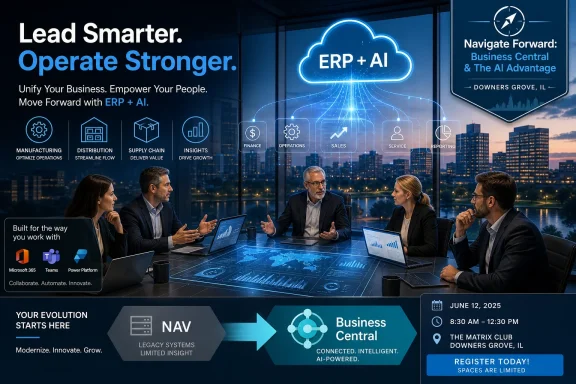
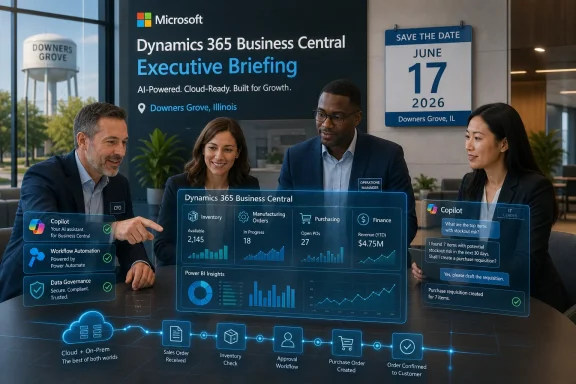
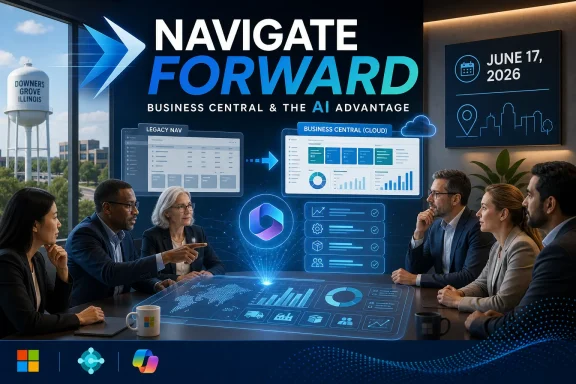
Western Computer and Microsoft will host “Navigate Forward: Business Central & The AI Advantage” at Microsoft’s Downers Grove, Illinois office on Wednesday, June 17, 2026, beginning at noon, for manufacturing, distribution, finance, operations, and IT leaders evaluating Dynamics 365 Business Central and AI-enabled ERP modernization. The announcement is a partner event notice, but the timing makes it more than a calendar item. It lands at the point where Microsoft’s old NAV installed base is being pushed by support deadlines, cloud economics, and a suddenly unavoidable AI sales pitch. For many midmarket firms, the real question is no longer whether ERP will move toward the cloud; it is whether that move can be made without turning a working business system into an expensive science project.
For years, the migration argument around Dynamics NAV was familiar: the software was aging, customizations were hard to maintain, and Business Central offered a cleaner path into Microsoft’s cloud stack. That argument still exists, but it now arrives wrapped in a much larger claim. Microsoft is no longer selling Business Central merely as the successor to NAV; it is positioning Business Central as the operating layer for AI-assisted finance, supply chain, manufacturing, and reporting.
That shift matters because ERP systems are where corporate aspiration usually meets operational reality. A manufacturer can experiment with generative AI in marketing or customer support with limited blast radius. It cannot casually experiment with the ledger, inventory availability, vendor payments, production scheduling, or sales order fulfillment.
Western Computer’s Downers Grove event is aimed exactly at that tension. The agenda promises Business Central and Copilot demonstrations, migration guidance for NAV users, modernization strategies for manufacturers and distributors, and discussion of automation, reporting, and AI readiness. In other words, it is not just a product showcase; it is an attempt to translate Microsoft’s broad AI narrative into the grimier language of warehouse turns, month-end close, purchase orders, shop-floor constraints, and executive dashboards.
That translation is where partners like Western Computer matter. Microsoft can build the platform, but most midmarket ERP decisions are won or lost in partner-led discovery, data cleanup, customization analysis, user training, and go-live support. A live event at a Microsoft office, with both Microsoft and partner experts in the room, is designed to reduce the sense that “AI ERP” is just another licensing bundle looking for a problem.
The problem is that the support clock keeps moving. Dynamics NAV 2018, the final NAV release, left mainstream support in January 2023 and is scheduled to reach the end of extended support in January 2028. Earlier NAV versions are already further down the lifecycle road. For companies still running NAV 2015, NAV 2016, NAV 2017, or NAV 2018, the migration window is no longer comfortably distant.
The catch is that ERP migration is not a weekend upgrade. Moving from NAV to Business Central may involve rewriting or retiring customizations, converting older C/AL logic into AL extensions, rationalizing reporting, revisiting integrations, and deciding how much of the old process should survive. A business that waits until 2027 to begin serious planning may discover that the support deadline is the least of its problems.
That is why the event’s focus on NAV end-of-support is more significant than the marketing copy suggests. Microsoft and its partners are trying to pull customers forward before urgency curdles into panic. ERP customers do not want to be told they are obsolete; they want a credible path that preserves business continuity while reducing technical debt.
But the move should not be mistaken for a simple rename. Business Central online is governed by Microsoft’s release cadence and cloud architecture. Extensions replace many older customization patterns. Administration, security, integration, and reporting assumptions change. The system is designed for continuous improvement, but that means customers must become comfortable with continuous change.
For IT leaders, that can be both relief and threat. Relief comes from shedding aging infrastructure, old client dependencies, fragile custom code, and local upgrade projects that consume months. The threat comes from giving up some of the control that made on-premises NAV feel safe: frozen versions, local modifications, and slower change windows.
Manufacturing and distribution firms are especially sensitive to this trade-off. Their ERP systems often connect to barcode systems, EDI, shipping platforms, warehouse hardware, quality processes, production planning tools, and third-party industry add-ons. A cloud ERP migration is therefore not just a finance project or a CIO project. It is an operating-model decision.
That is the uncomfortable truth behind the phrase AI readiness. Many companies want to ask AI systems strategic questions, but their ERP environment may still contain duplicate vendors, inconsistent item descriptions, undocumented custom fields, manual journal workarounds, aging reports, and integrations held together by institutional memory. AI does not magically fix that. In some cases, it simply makes bad data easier to act on at higher speed.
Business Central’s 2026 release wave has made Microsoft’s direction clear. The product is moving toward more embedded AI, more autonomous agents, and deeper use of Copilot in everyday ERP work. Microsoft has described investments around agents, payables automation, expense management, item insights, reporting, governance, Power Platform integration, and model-context connectivity for developers and makers.
That direction is compelling, but it also changes the modernization conversation. A NAV-to-Business Central migration cannot be judged only by whether old screens and reports can be replicated. The better question is whether the new environment creates a trustworthy operational data layer that can support automation without losing auditability.
Western Computer is leaning into that role. The company describes itself as a Microsoft Dynamics partner with more than 35 years of experience across ERP, CRM, BI, cloud, and AI solutions, with particular emphasis on manufacturing and distribution. Its announcement also points to Microsoft Inner Circle status and repeated G2 customer satisfaction recognition in Microsoft consulting services.
Those badges are not the story by themselves. The story is that ERP modernization now requires both product knowledge and change-management credibility. Customers need to know not just what Microsoft has shipped, but how a migration unfolds, what can be automated safely, which customizations should be preserved, and which should be killed with ceremony.
The quote from Western Computer CEO Kristen Sage gets at the buyer anxiety. Companies have AI on the roadmap, she argues, but are stuck on where to start, what it will cost, and how long it will take. That is the right framing because it shifts the AI conversation from wonder to implementation math.
But manufacturing and distribution are not cloud-adoption fairy tales. The more operationally embedded the ERP system, the more complicated the migration. A distributor with complex pricing, rebate structures, EDI flows, and warehouse automation cannot simply “move to SaaS” without testing the edges. A manufacturer with routings, bills of material, quality holds, subcontracting, serial tracking, and shop-floor dependencies must validate that the new system reflects how work actually moves.
That is where many modernization programs get into trouble. Executives approve the migration as a technology refresh. The business experiences it as a forced redesign of daily work. Users who were promised efficiency encounter changed screens, changed approvals, changed reports, and changed responsibility boundaries.
The better migration story is more honest. Business Central is not just a place to host old NAV logic in a newer container. It is an opportunity to simplify process debt, retire brittle customizations, and build better reporting and automation. But every simplification has an owner, and every retired workaround was probably compensating for a real operational need.
Yet ERP AI is not the same as drafting an email. If an AI assistant suggests the wrong vendor match, summarizes inventory incorrectly, misreads an exception, or accelerates an approval that should have been reviewed, the cost is not merely embarrassing. It can become a financial-control issue, a customer-service issue, or a compliance issue.
That is why administrators should treat AI adoption as a governance project before they treat it as a productivity project. Permissions, data access, audit trails, approval workflows, retention policies, and exception handling all become more important when software begins making suggestions inside core systems of record. The old ERP rule still applies: automation should make the right process faster, not make a messy process harder to see.
Microsoft’s pitch includes security, compliance, and responsible AI language, and those commitments matter. But implementation choices still belong to customers and partners. The practical question is not whether Copilot is safe in the abstract. It is whether a specific organization’s configuration, data model, permission design, and process controls are mature enough to use it responsibly.
That is especially true for midmarket companies with lean IT teams. The promise of fewer vendors, common identity, familiar productivity tools, shared reporting surfaces, and low-code automation is attractive. If Business Central can become the operational core while Power Platform handles workflows and Power BI handles analytics, Microsoft can present a coherent modernization path that competitors struggle to match.
But stack gravity can also become lock-in by another name. Once ERP, reporting, workflow, identity, collaboration, and AI all flow through Microsoft services, the cost of leaving rises. Customers may accept that trade-off, but they should understand it. The choice is not merely between NAV and Business Central; it is between a heavily customized legacy estate and a more standardized Microsoft cloud operating model.
For many organizations, the latter will be the better choice. The older estate may be familiar, but it is often expensive to maintain, difficult to secure, and dependent on a shrinking pool of specialized knowledge. Still, the decision deserves clear-eyed analysis rather than AI-era inevitability.
This is not cynicism. It is how serious ERP buyers evaluate risk. They should want to see how Business Central handles exceptions, how Copilot explains its suggestions, where human approval remains mandatory, how audit trails are preserved, and how administrators can limit feature exposure while users build confidence.
The same applies to migration strategy. A credible partner should be able to discuss phased rollout, data migration, testing, reporting replacement, integration mapping, user adoption, and post-go-live support. It should also be willing to say when a customization is too expensive to preserve or when a process should change rather than be rebuilt exactly as before.
That is where an onsite event has potential value. The hallway conversations may matter as much as the sessions. Buyers can compare concerns, ask uncomfortable questions, and listen for whether the answers sound like implementation experience or brochure language.
Chicago’s manufacturing and distribution ecosystem makes the Downers Grove venue sensible. The Midwest still has deep concentrations of industrial, logistics, wholesale, and supply-chain businesses. Many of these companies are exactly the kind of organizations that adopted NAV because it was flexible, partner-friendly, and adaptable to midmarket needs.
Those same strengths can make migration harder. The more successfully NAV was tailored to the business, the more careful the Business Central transition must be. A generic cloud migration playbook will not do. The work is in deciding what the business has outgrown, what it still depends on, and what Microsoft’s newer platform can now handle natively.
The national subtext is that Microsoft’s partner ecosystem is being mobilized to convert legacy ERP customers before the end-of-support cliff gets too close. Events like this are part education, part sales motion, and part risk management. Microsoft does not want NAV customers drifting to competitors because the migration story felt too vague or too late.
That tolerance has limits. Aging ERP tends to accumulate hidden costs: unsupported components, difficult reporting, manual reconciliations, brittle integrations, security exposure, and dependence on a small group of employees or consultants who understand the custom environment. These costs rarely arrive as one dramatic invoice. They seep into operations as delay, fragility, and missed opportunity.
AI changes the inertia equation because it widens the gap between systems that can participate in the next phase of automation and systems that cannot. A company does not need to believe every Copilot promise to recognize that modern ERP data will become more valuable when connected to workflow, analytics, and AI services. The danger for NAV holdouts is not only losing support. It is being stuck with a system that cannot easily join the next operational model.
Still, fear is a poor migration strategy. Companies should not move because a deadline or a demo scared them. They should move because they have a staged plan, a realistic budget, executive sponsorship, cleaned-up data, and a clear understanding of which business outcomes matter.
That convergence creates opportunity for customers that have been waiting for a more mature Business Central platform. Microsoft’s release waves have continued to add functionality, governance improvements, reporting enhancements, developer capabilities, and AI features. For some NAV customers, the case for waiting is getting weaker.
It also creates pressure. Once Microsoft and its partners frame modernization around AI advantage, organizations may feel compelled to accelerate without doing the preparatory work that ERP projects demand. The phrase “AI advantage” can be useful if it forces a serious conversation about data and process. It becomes dangerous if it turns migration into a branding exercise.
The companies that benefit most will likely be the ones that treat AI as an outcome of modernization, not its starting point. Clean data, simplified process, secure access, reliable integrations, and trusted reporting come first. Copilot and agents become more valuable after the foundation is in place.
The value of a session like this is not that it can answer every migration question in an afternoon. It is that it can help leaders separate three conversations that often get tangled together: the support lifecycle problem, the cloud ERP architecture problem, and the AI adoption problem. They are related, but they are not identical.
The organizations that leave with a better inventory of their risks will have gained something real. The organizations that leave merely impressed by demos may still be at the beginning. ERP modernization rewards disciplined skepticism.
 Microsoft’s ERP Pitch Has Become an AI Pitch
For years, the migration argument around Dynamics NAV was familiar: the software was aging, customizations were hard to maintain, and Business Central offered a cleaner path into Microsoft’s cloud stack. That argument still exists, but it now arrives wrapped in a much larger claim. Microsoft is no longer selling Business Central merely as the successor to NAV; it is positioning Business Central as the operating layer for AI-assisted finance, supply chain, manufacturing, and reporting.That shift matters because ERP systems are where corporate aspiration usually meets operational reality. A manufacturer can experiment with generative AI in marketing or customer support with limited blast radius. It cannot casually experiment with the ledger, inventory availability, vendor payments, production scheduling, or sales order fulfillment.
Western Computer’s Downers Grove event is aimed exactly at that tension. The agenda promises Business Central and Copilot demonstrations, migration guidance for NAV users, modernization strategies for manufacturers and distributors, and discussion of automation, reporting, and AI readiness. In other words, it is not just a product showcase; it is an attempt to translate Microsoft’s broad AI narrative into the grimier language of warehouse turns, month-end close, purchase orders, shop-floor constraints, and executive dashboards.
That translation is where partners like Western Computer matter. Microsoft can build the platform, but most midmarket ERP decisions are won or lost in partner-led discovery, data cleanup, customization analysis, user training, and go-live support. A live event at a Microsoft office, with both Microsoft and partner experts in the room, is designed to reduce the sense that “AI ERP” is just another licensing bundle looking for a problem.
NAV’s Long Goodbye Is Finally Becoming a Planning Problem
Dynamics NAV occupies a strange place in Microsoft’s business applications history. It is old enough to be considered legacy, but it remains entrenched enough that many organizations still trust it more than the cloud services meant to replace it. That is not irrational. NAV implementations often contain years of industry-specific process knowledge, custom code, reporting logic, and informal workarounds that never made it into documentation.The problem is that the support clock keeps moving. Dynamics NAV 2018, the final NAV release, left mainstream support in January 2023 and is scheduled to reach the end of extended support in January 2028. Earlier NAV versions are already further down the lifecycle road. For companies still running NAV 2015, NAV 2016, NAV 2017, or NAV 2018, the migration window is no longer comfortably distant.
The catch is that ERP migration is not a weekend upgrade. Moving from NAV to Business Central may involve rewriting or retiring customizations, converting older C/AL logic into AL extensions, rationalizing reporting, revisiting integrations, and deciding how much of the old process should survive. A business that waits until 2027 to begin serious planning may discover that the support deadline is the least of its problems.
That is why the event’s focus on NAV end-of-support is more significant than the marketing copy suggests. Microsoft and its partners are trying to pull customers forward before urgency curdles into panic. ERP customers do not want to be told they are obsolete; they want a credible path that preserves business continuity while reducing technical debt.
Business Central Is the Successor, but Not a Clone
Business Central’s appeal is that it gives Microsoft a modern, cloud-managed successor to NAV while keeping enough functional continuity to make the move plausible. It covers finance, purchasing, sales, inventory, warehouse operations, manufacturing, projects, service management, and reporting. It integrates with Microsoft 365, Power BI, Power Platform, Dataverse, and the wider Dynamics ecosystem.But the move should not be mistaken for a simple rename. Business Central online is governed by Microsoft’s release cadence and cloud architecture. Extensions replace many older customization patterns. Administration, security, integration, and reporting assumptions change. The system is designed for continuous improvement, but that means customers must become comfortable with continuous change.
For IT leaders, that can be both relief and threat. Relief comes from shedding aging infrastructure, old client dependencies, fragile custom code, and local upgrade projects that consume months. The threat comes from giving up some of the control that made on-premises NAV feel safe: frozen versions, local modifications, and slower change windows.
Manufacturing and distribution firms are especially sensitive to this trade-off. Their ERP systems often connect to barcode systems, EDI, shipping platforms, warehouse hardware, quality processes, production planning tools, and third-party industry add-ons. A cloud ERP migration is therefore not just a finance project or a CIO project. It is an operating-model decision.
Copilot Turns ERP Modernization Into a Data Quality Test
The most important part of Microsoft’s AI push in Business Central is not the chatbot itself. It is the implication that ERP data must become cleaner, more connected, and more intelligible if companies want useful AI outcomes. Copilot can summarize, suggest, reconcile, draft, analyze, and guide only to the extent that the underlying system is configured and governed well enough to support those actions.That is the uncomfortable truth behind the phrase AI readiness. Many companies want to ask AI systems strategic questions, but their ERP environment may still contain duplicate vendors, inconsistent item descriptions, undocumented custom fields, manual journal workarounds, aging reports, and integrations held together by institutional memory. AI does not magically fix that. In some cases, it simply makes bad data easier to act on at higher speed.
Business Central’s 2026 release wave has made Microsoft’s direction clear. The product is moving toward more embedded AI, more autonomous agents, and deeper use of Copilot in everyday ERP work. Microsoft has described investments around agents, payables automation, expense management, item insights, reporting, governance, Power Platform integration, and model-context connectivity for developers and makers.
That direction is compelling, but it also changes the modernization conversation. A NAV-to-Business Central migration cannot be judged only by whether old screens and reports can be replicated. The better question is whether the new environment creates a trustworthy operational data layer that can support automation without losing auditability.
The Partner Event Format Is Doing Strategic Work
There is a reason this event is not just a webinar. Microsoft’s business applications strategy increasingly depends on partners who can turn platform features into industry-specific adoption. Manufacturing and distribution customers rarely buy ERP from a feature matrix alone. They buy confidence that someone understands inventory valuation, production variances, landed cost, demand planning, substitutions, vendor lead times, warehouse exceptions, and the political economy of replacing spreadsheet rituals.Western Computer is leaning into that role. The company describes itself as a Microsoft Dynamics partner with more than 35 years of experience across ERP, CRM, BI, cloud, and AI solutions, with particular emphasis on manufacturing and distribution. Its announcement also points to Microsoft Inner Circle status and repeated G2 customer satisfaction recognition in Microsoft consulting services.
Those badges are not the story by themselves. The story is that ERP modernization now requires both product knowledge and change-management credibility. Customers need to know not just what Microsoft has shipped, but how a migration unfolds, what can be automated safely, which customizations should be preserved, and which should be killed with ceremony.
The quote from Western Computer CEO Kristen Sage gets at the buyer anxiety. Companies have AI on the roadmap, she argues, but are stuck on where to start, what it will cost, and how long it will take. That is the right framing because it shifts the AI conversation from wonder to implementation math.
The Cloud Is the Easy Part Until It Touches the Factory Floor
Microsoft’s preferred answer to NAV aging is Business Central online, and for many organizations that will be the rational endpoint. Cloud ERP reduces the burden of infrastructure maintenance, keeps customers closer to Microsoft’s latest features, and makes integration with Microsoft 365, Power Platform, and Copilot more natural. It also fits the subscription economics Microsoft has spent years building across its commercial portfolio.But manufacturing and distribution are not cloud-adoption fairy tales. The more operationally embedded the ERP system, the more complicated the migration. A distributor with complex pricing, rebate structures, EDI flows, and warehouse automation cannot simply “move to SaaS” without testing the edges. A manufacturer with routings, bills of material, quality holds, subcontracting, serial tracking, and shop-floor dependencies must validate that the new system reflects how work actually moves.
That is where many modernization programs get into trouble. Executives approve the migration as a technology refresh. The business experiences it as a forced redesign of daily work. Users who were promised efficiency encounter changed screens, changed approvals, changed reports, and changed responsibility boundaries.
The better migration story is more honest. Business Central is not just a place to host old NAV logic in a newer container. It is an opportunity to simplify process debt, retire brittle customizations, and build better reporting and automation. But every simplification has an owner, and every retired workaround was probably compensating for a real operational need.
AI Raises the Stakes for Governance
Copilot in ERP is appealing because it promises to reduce friction in routine work. Users can get help with analysis, generate text, reconcile accounts, surface insights, and potentially rely on agents for more structured business processes. For overburdened finance and operations teams, that sounds less like a gimmick and more like overdue relief.Yet ERP AI is not the same as drafting an email. If an AI assistant suggests the wrong vendor match, summarizes inventory incorrectly, misreads an exception, or accelerates an approval that should have been reviewed, the cost is not merely embarrassing. It can become a financial-control issue, a customer-service issue, or a compliance issue.
That is why administrators should treat AI adoption as a governance project before they treat it as a productivity project. Permissions, data access, audit trails, approval workflows, retention policies, and exception handling all become more important when software begins making suggestions inside core systems of record. The old ERP rule still applies: automation should make the right process faster, not make a messy process harder to see.
Microsoft’s pitch includes security, compliance, and responsible AI language, and those commitments matter. But implementation choices still belong to customers and partners. The practical question is not whether Copilot is safe in the abstract. It is whether a specific organization’s configuration, data model, permission design, and process controls are mature enough to use it responsibly.
The Microsoft Stack Is Becoming the ERP Argument
Business Central’s strongest selling point may not be any single ERP feature. It is Microsoft’s stack gravity. A company already standardized on Microsoft 365, Teams, Excel, Power BI, Azure, Entra ID, Power Automate, and Power Apps has a strong incentive to keep ERP inside that orbit.That is especially true for midmarket companies with lean IT teams. The promise of fewer vendors, common identity, familiar productivity tools, shared reporting surfaces, and low-code automation is attractive. If Business Central can become the operational core while Power Platform handles workflows and Power BI handles analytics, Microsoft can present a coherent modernization path that competitors struggle to match.
But stack gravity can also become lock-in by another name. Once ERP, reporting, workflow, identity, collaboration, and AI all flow through Microsoft services, the cost of leaving rises. Customers may accept that trade-off, but they should understand it. The choice is not merely between NAV and Business Central; it is between a heavily customized legacy estate and a more standardized Microsoft cloud operating model.
For many organizations, the latter will be the better choice. The older estate may be familiar, but it is often expensive to maintain, difficult to secure, and dependent on a shrinking pool of specialized knowledge. Still, the decision deserves clear-eyed analysis rather than AI-era inevitability.
ERP Buyers Need Demos That Show Failure Modes
Live demos are useful, but only if they move beyond the polished happy path. A Copilot demo that summarizes clean data in a pristine tenant is not enough. Prospective customers should ask what happens when vendor records conflict, when item data is inconsistent, when a custom process breaks a standard flow, or when an approval requires human judgment rather than pattern recognition.This is not cynicism. It is how serious ERP buyers evaluate risk. They should want to see how Business Central handles exceptions, how Copilot explains its suggestions, where human approval remains mandatory, how audit trails are preserved, and how administrators can limit feature exposure while users build confidence.
The same applies to migration strategy. A credible partner should be able to discuss phased rollout, data migration, testing, reporting replacement, integration mapping, user adoption, and post-go-live support. It should also be willing to say when a customization is too expensive to preserve or when a process should change rather than be rebuilt exactly as before.
That is where an onsite event has potential value. The hallway conversations may matter as much as the sessions. Buyers can compare concerns, ask uncomfortable questions, and listen for whether the answers sound like implementation experience or brochure language.
Downers Grove Is a Local Event With a National Subtext
The location gives the announcement a regional flavor, but the underlying issue is national and, really, global. Across the Microsoft customer base, old Dynamics installations remain embedded in companies that are big enough to need serious ERP but not always big enough to absorb enterprise-scale transformation pain. That is precisely the market Business Central is built to capture.Chicago’s manufacturing and distribution ecosystem makes the Downers Grove venue sensible. The Midwest still has deep concentrations of industrial, logistics, wholesale, and supply-chain businesses. Many of these companies are exactly the kind of organizations that adopted NAV because it was flexible, partner-friendly, and adaptable to midmarket needs.
Those same strengths can make migration harder. The more successfully NAV was tailored to the business, the more careful the Business Central transition must be. A generic cloud migration playbook will not do. The work is in deciding what the business has outgrown, what it still depends on, and what Microsoft’s newer platform can now handle natively.
The national subtext is that Microsoft’s partner ecosystem is being mobilized to convert legacy ERP customers before the end-of-support cliff gets too close. Events like this are part education, part sales motion, and part risk management. Microsoft does not want NAV customers drifting to competitors because the migration story felt too vague or too late.
The Real Competition Is Inertia
Business Central competes with other ERP platforms, of course, but the most stubborn competitor is inertia. If NAV still closes the books, ships orders, supports purchasing, and keeps the warehouse moving, executives may hesitate to fund a disruptive migration. The old system’s flaws become tolerable because they are known.That tolerance has limits. Aging ERP tends to accumulate hidden costs: unsupported components, difficult reporting, manual reconciliations, brittle integrations, security exposure, and dependence on a small group of employees or consultants who understand the custom environment. These costs rarely arrive as one dramatic invoice. They seep into operations as delay, fragility, and missed opportunity.
AI changes the inertia equation because it widens the gap between systems that can participate in the next phase of automation and systems that cannot. A company does not need to believe every Copilot promise to recognize that modern ERP data will become more valuable when connected to workflow, analytics, and AI services. The danger for NAV holdouts is not only losing support. It is being stuck with a system that cannot easily join the next operational model.
Still, fear is a poor migration strategy. Companies should not move because a deadline or a demo scared them. They should move because they have a staged plan, a realistic budget, executive sponsorship, cleaned-up data, and a clear understanding of which business outcomes matter.
What the Downers Grove Agenda Really Signals
The most useful way to read Western Computer’s announcement is not as an isolated event notice, but as a snapshot of where Microsoft’s ERP ecosystem is headed. The NAV migration story, the Business Central cloud story, and the Copilot AI story are converging into one sales and implementation motion.That convergence creates opportunity for customers that have been waiting for a more mature Business Central platform. Microsoft’s release waves have continued to add functionality, governance improvements, reporting enhancements, developer capabilities, and AI features. For some NAV customers, the case for waiting is getting weaker.
It also creates pressure. Once Microsoft and its partners frame modernization around AI advantage, organizations may feel compelled to accelerate without doing the preparatory work that ERP projects demand. The phrase “AI advantage” can be useful if it forces a serious conversation about data and process. It becomes dangerous if it turns migration into a branding exercise.
The companies that benefit most will likely be the ones that treat AI as an outcome of modernization, not its starting point. Clean data, simplified process, secure access, reliable integrations, and trusted reporting come first. Copilot and agents become more valuable after the foundation is in place.
The Practical Reading for NAV Shops Heading to Downers Grove
For attendees, the event should be approached less like a product launch and more like a working session for strategic due diligence. The strongest questions will be specific: which NAV versions are in scope, what customizations exist, what integrations are business-critical, what reports executives actually use, and where manual processes create measurable cost.The value of a session like this is not that it can answer every migration question in an afternoon. It is that it can help leaders separate three conversations that often get tangled together: the support lifecycle problem, the cloud ERP architecture problem, and the AI adoption problem. They are related, but they are not identical.
The organizations that leave with a better inventory of their risks will have gained something real. The organizations that leave merely impressed by demos may still be at the beginning. ERP modernization rewards disciplined skepticism.
The AI Advantage Belongs to the Prepared, Not the Enthusiastic
The Downers Grove event is a signpost for a broader shift in Microsoft’s business applications strategy. Business Central is now being sold not just as the next stop after NAV, but as the place where midmarket ERP, Microsoft 365 productivity, Power Platform automation, and Copilot-era AI are supposed to meet.- Dynamics NAV customers should treat January 2028 as a planning deadline, not a distant support footnote.
- Business Central migration should include process redesign, data cleanup, reporting strategy, and integration mapping rather than a narrow technical upgrade plan.
- Copilot demonstrations should be judged by how they handle exceptions, permissions, auditability, and messy operational data.
- Manufacturing and distribution firms should involve operations leaders early because ERP modernization will change daily work outside the IT department.
- Microsoft partners will be decisive in whether the AI-enabled ERP pitch becomes a practical roadmap or another cloud transformation slogan.
References
- Primary source: Weekly Voice
Published: 2026-06-09T15:44:10.446865
Western Computer and Microsoft to Host Navigate Forward: Business Central & The AI Advantage Event in Downers Grove, IL
Manufacturing and distribution leaders invited to explore ERP modernization, AI, and the future of Dynamics 365 Business Central at Microsoft's Downers Grove officeCHICAGO, June 9, 2026 /PRNewswire… weeklyvoice.com
- Related coverage: windowscentral.com
Build 2026 only makes sense if you remember Build 2025: a look back at the groundwork of the "age of AI agents" | Windows Central
Microsoft’s latest announcements build directly on the architecture it introduced a year ago.www.windowscentral.com - Official source: learn.microsoft.com
New and planned features for Dynamics 365 Business Central, 2026 release wave 1 | Microsoft Learn
Summary of planned features for Dynamics 365 Business Central.learn.microsoft.com - Related coverage: randgroup.com
Top 12 Copilot Features in Dynamics 365 Business Central | Rand Group
Discover the top Copilot features in Dynamics 365 Business Central and learn how AI streamlines financials, operations, and decision-making. www.randgroup.com
- Related coverage: iesgp.com
A Complete Guide to Microsoft Dynamics NAV
Microsoft Dynamics NAV is a powerful tool when used right. Read on to learn how to make the best out of NAV with the complete guide to Dynamics NAV. www.iesgp.com
- Related coverage: dynamicssmartz.com
Dynamics 365 Business Central Copilot Features 2026: AI Capabilities Explained
Explore Dynamics 365 Business Central Copilot features 2026, including AI capabilities, automation, and real-time insights for smarter business decisions.www.dynamicssmartz.com
- Related coverage: softwareconnect.com
Dynamics Nav (formerly Navision) (End of Life) + Alternatives
Microsoft Dynamics NAV, formerly Navision, is no longer sold and is now part of Dynamics 365 Business Central. Explore ERP alternatives.softwareconnect.com - Related coverage: techradar.com
Microsoft 365 confirms new premium tier focused on AI and productivity | TechRadar
Microsoft adds new E7 plan to cope with AI usagewww.techradar.com - Related coverage: tipsa.net
- Related coverage: navins.eu
- Related coverage: yesdynamic.com