

NTT DATA said on May 18, 2026, that it has signed a definitive agreement to acquire Santa Clara-based WinWire, a Microsoft-focused services partner specializing in agentic AI, Azure AI, data engineering, and cloud-native application development. The deal is not just another systems-integrator tuck-in; it is a bet that enterprise AI will be won less by flashy demos than by firms that can wire models into governed workflows. For Microsoft customers, the acquisition matters because it adds more than 1,000 Azure engineers and specialists to one of Microsoft’s major global services partners. For IT leaders, it is another sign that the AI services market is consolidating around data platforms, cloud estates, and the unglamorous work of production deployment.
The phrase “enterprise AI” has become so inflated that it can describe anything from a chatbot pilot to a full redesign of business operations. NTT DATA’s planned acquisition of WinWire cuts through that fog by revealing where the services market thinks the real money is: the layer between Microsoft’s AI platform ambitions and the messy reality of customer environments.
WinWire is not being bought because it has a consumer app, a foundational model, or a headline-grabbing research lab. It is being bought because it has people who know how to build on Azure, modernize data estates, and turn experimental AI into repeatable enterprise systems. That is the less glamorous but more durable part of the AI cycle.
The timing is important. Enterprises have spent the last two years experimenting with copilots, custom chatbots, retrieval-augmented generation, and internal productivity assistants. Many of those projects impressed executives in demos but stalled when they met identity systems, compliance requirements, fragmented data, security reviews, and change-management realities.
NTT DATA’s message is that the next phase belongs to firms that can make AI operational. WinWire gives it a deeper bench in Microsoft Fabric, Azure AI Foundry, data engineering, cloud-native development, and the fashionable but still slippery category of agentic AI. In plain terms, NTT DATA is buying delivery capacity for the part of AI that starts after the proof of concept.
But a platform strategy only works if customers can implement it. That is where the global systems integrators come in. Microsoft can sell the architecture, provide the cloud services, and build the developer tooling, but it still needs partners to translate those offerings into working systems inside banks, hospitals, manufacturers, software companies, retailers, and public-sector agencies.
That partner layer is now becoming strategically critical. Enterprises do not simply “turn on” agentic AI. They need data pipelines, permission boundaries, monitoring, model evaluation, workflow integration, audit trails, user training, and fallback procedures. The larger the organization, the more likely its AI bottleneck is not model access but systems integration.
NTT DATA already had a substantial Microsoft practice, with a long-running partnership, a global Microsoft cloud business unit, and tens of thousands of Microsoft certifications. WinWire adds a more specialized profile: Azure-native engineering, data modernization, and AI frameworks aimed at enterprise adoption. The acquisition therefore looks less like diversification and more like concentration.
That concentration says something about the Microsoft ecosystem in 2026. The winners are not merely the partners who can resell licenses or migrate workloads. They are the ones who can help customers rationalize data, build governed AI applications, and manage them after launch. In the AI era, implementation credibility is becoming a sales weapon.
WinWire’s pitch around its Agentic AI @ Scale framework fits the current enterprise mood. Companies do not want another sandbox chatbot that summarizes documents. They want systems that can triage tickets, prepare claims, monitor supply chains, reconcile records, assist developers, orchestrate approvals, and surface exceptions before they become operational problems.
That ambition is where agentic AI becomes meaningful. The agent is not magic; it is a layer of reasoning and orchestration sitting on top of APIs, databases, workflows, identity systems, and business rules. If those foundations are weak, the agent becomes a risk multiplier. If they are strong, the agent becomes a new interface to existing enterprise machinery.
This is why WinWire’s data engineering and cloud-native application work may matter more than the agentic branding. AI agents need reliable data, clean integration points, and constrained permissions. A services firm that can modernize the data estate and application layer is better positioned to deploy agents safely than one that merely knows how to wire a model into a chat window.
For WindowsForum readers, the Microsoft angle is especially relevant. Many enterprise environments are already built around Active Directory or Entra ID, Microsoft 365, Teams, SharePoint, SQL Server, Power Platform, Windows endpoints, and Azure infrastructure. Agentic AI in those environments will not be a standalone product category. It will arrive as an extension of the Microsoft stack that admins already govern.
The second wave is less forgiving. When an AI system touches customer data, regulatory workflows, financial decisions, clinical records, code repositories, or employee records, the standards change. IT leaders need to know who can access the system, what it can do, what data it used, what it logged, how it fails, and how it can be audited.
That is why “operationalize AI at scale” is more than press-release filler, even if it sounds like it was assembled in a conference room. The problem is real. Enterprises have accumulated AI experiments faster than they have built the operating model to govern them.
NTT DATA’s acquisition of WinWire is a response to that gap. The company is adding delivery capacity in areas that determine whether AI survives contact with enterprise IT: data platforms, application modernization, Azure engineering, managed services, and industry-specific implementation. The deal implicitly acknowledges that the hard part of AI adoption is no longer proving that models can be useful. The hard part is making them dependable, secure, and economically justified.
This is also where the transaction fits into a broader services-market pattern. Large integrators are racing to package AI adoption into repeatable offerings because customers do not want every deployment to be a bespoke science project. They want accelerators, reference architectures, compliance patterns, and managed services that reduce risk and time to value.
NTT DATA’s acquisition of WinWire should be read in that context. The company is not merely expanding headcount. It is strengthening its ability to co-sell and co-deliver with Microsoft in the areas Microsoft most wants to grow. That includes AI infrastructure, data modernization, cloud-native apps, security, and managed services.
WinWire’s status as a Microsoft partner and its history of Microsoft Partner of the Year recognition make it a channel asset as much as an engineering asset. In the Microsoft world, partner credibility is not just about technical capability; it affects field alignment, customer confidence, and access to joint go-to-market motion.
The 1,000-plus Azure engineers and Microsoft specialists are therefore a central part of the story. AI demand has created a talent crunch in cloud architecture, data engineering, security, and applied AI development. Buying a firm with an existing bench is faster than hiring one engineer at a time.
For Microsoft, the deal is useful because it gives a major global partner more capacity to turn Microsoft AI demand into deployed projects. For NTT DATA, it strengthens a Microsoft practice that can compete against other global integrators chasing the same budgets. For customers, it may mean broader access to specialized Microsoft AI skills, though the quality of delivery will still depend on integration, retention, and execution after the acquisition closes.
NTT DATA described the deal as advancing its North America leadership position, and that is not accidental language. The U.S. enterprise market is dense with Azure customers, regulated industries, software firms, healthcare organizations, and large corporate IT estates that are ripe for AI modernization but difficult to transform.
WinWire’s vertical focus appears particularly relevant in healthcare and software and digital platforms. Those sectors have strong demand for AI but also high integration complexity. Healthcare organizations face privacy, clinical workflow, interoperability, and governance constraints. Software companies face pressure to embed AI into products while modernizing their own engineering and data platforms.
The acquisition gives NTT DATA a more specialized wedge into those accounts. Instead of pitching generic AI transformation, it can bring industry accelerators, Microsoft alignment, and delivery teams that already understand sector-specific patterns. That is the difference between selling AI as a concept and selling it as an implementation path.
Still, the promise will have to survive the integration process. Services acquisitions can lose value if key talent departs, if delivery cultures clash, or if the acquired firm’s entrepreneurial speed gets buried inside a larger organization. NTT DATA’s challenge will be to scale WinWire’s capabilities without flattening the traits that made WinWire worth buying.
AI is likely to amplify that pattern. A department can now procure or build AI-enabled tools faster than central IT can classify risk. Developers can embed model calls into applications. Business users can create automations with low-code platforms. Vendors can bolt copilots onto existing products. The result is a growing surface area of AI systems that may touch sensitive data, make recommendations, trigger actions, or influence decisions.
This is why the Microsoft context matters so much. Many enterprises will prefer to keep AI inside a familiar governance perimeter, even if that means accepting Microsoft’s platform gravity. Entra ID, Purview, Defender, Azure policy, Fabric governance, and Microsoft 365 compliance controls give administrators a framework they already understand.
But consolidation around Microsoft does not eliminate risk. It can also create lock-in, cost surprises, and architectural monoculture. If every workflow, data product, agent, and application modernization effort gets pulled toward one cloud ecosystem, organizations may gain coherence at the expense of flexibility.
NTT DATA and WinWire will therefore be selling more than technology implementation. They will be selling trust. Customers will expect them to define boundaries, design governance, and explain when Microsoft-native AI is the right answer — and when it is simply the most convenient answer for the partner ecosystem.
That is where administrators and architects will feel the impact. The success of enterprise AI depends heavily on the foundations they manage: identity hygiene, endpoint security, data classification, access control, device compliance, logging, patching, and network architecture. AI does not bypass those disciplines. It raises their stakes.
If an AI agent can summarize documents, open tickets, query systems, draft responses, or trigger workflows, then identity and permissions become even more consequential. Least privilege stops being a best-practice slogan and becomes a control on what automated systems can infer or do. Poorly managed access rights become fuel for poorly bounded AI behavior.
The same is true for data governance. Microsoft Fabric and Azure AI Foundry can provide powerful tools, but they do not magically fix inconsistent data ownership, stale SharePoint sites, over-permissive file shares, or poorly classified records. AI makes hidden data problems visible because it gives users new ways to retrieve, combine, and act on information.
NTT DATA’s acquisition of WinWire signals that more of this work will be packaged as transformation programs. Administrators should expect AI projects to arrive with a services wrapper, a Microsoft architecture diagram, and an executive mandate. The practical question will be whether IT is brought in early enough to shape the controls or late enough only to inherit the risk.
That reality is pushing AI toward managed operations. Enterprises will need monitoring, evaluation, incident response, cost controls, security reviews, retraining processes, and continuous improvement. In other words, AI systems are becoming infrastructure, not one-off innovation projects.
This is familiar territory for global systems integrators. They built businesses around managing applications, infrastructure, cloud estates, security operations, and business processes. AI gives them a new layer to manage, but the commercial model is recognizable: design the system, integrate it, operate it, optimize it, and expand it.
WinWire strengthens NTT DATA’s ability to play that full lifecycle. Its cloud-native development and data engineering skills help with the build phase. Its AI frameworks and accelerators help with repeatability. NTT DATA’s scale and managed-services machinery help with long-term operation.
The most interesting question is whether customers will accept AI managed services as readily as they accepted infrastructure outsourcing. Some will welcome the expertise because AI operations require scarce skills. Others will worry about handing too much strategic process knowledge to external providers, especially when AI systems sit close to decision-making and intellectual property.
NTT DATA will need to retain WinWire’s talent, align sales teams, preserve customer relationships, and integrate delivery methods. The company will also need to clarify how WinWire’s frameworks fit into NTT DATA’s broader AI offerings. If the integration is too loose, the acquisition may become a brand extension with limited leverage. If it is too heavy-handed, NTT DATA risks diluting the specialist capability it wanted.
Customers should watch for signs of continuity. Do WinWire teams remain visible in delivery? Do existing clients keep their account relationships? Are the AI frameworks integrated into NTT DATA’s global offerings without becoming generic slideware? Does Microsoft continue to amplify the combined practice in the field?
There is also the matter of pricing. Specialized AI engineering is expensive, and large integrators do not usually make transformation programs cheaper. The value proposition will have to rest on risk reduction, speed, and scale rather than bargain delivery.
That is not necessarily a problem. Many enterprises will pay for confidence if the alternative is an internal AI portfolio full of pilots that never land. But the burden of proof will shift from strategic intent to measurable outcomes: reduced cycle times, improved service quality, lower operational cost, better compliance, faster development, or new revenue.
Enterprise technology markets do not move in straight lines. Budgets depend on macro conditions, regulatory pressure, board priorities, cloud costs, security incidents, and the ability of vendors to prove return on investment. AI may be transformative, but CFOs still ask ordinary questions.
The strongest argument for the NTT DATA-WinWire combination is that it addresses that proof problem. AI value is easier to defend when it is tied to specific workflows, industry processes, and measurable business outcomes. A generic AI platform story may win attention; a claims-processing improvement, support-cost reduction, developer-productivity gain, or revenue-cycle acceleration wins budget.
That is why industry specialization matters. Enterprises do not want to be told that agentic AI can transform everything. They want to know where it can safely improve the processes they actually run. The more regulated or complex the industry, the more implementation knowledge matters.
The risk is that agentic AI becomes the new digital transformation — a phrase broad enough to justify nearly any project. If that happens, customers will struggle to distinguish serious engineering from marketing theater. NTT DATA’s acquisition gives it more credibility, but credibility will ultimately come from deployed systems that survive production scrutiny.
NTT DATA’s planned purchase of WinWire is a reminder that the next phase of AI will be fought in the plumbing: data platforms, permissions, applications, workflows, managed operations, and industry-specific delivery. Microsoft has built much of the platform surface area, but customers still need help turning that surface area into working systems. If NTT DATA can integrate WinWire without smothering it, the deal could become a useful marker of where enterprise AI is heading — away from isolated demos, toward governed automation that lives inside the infrastructure IT teams already run.
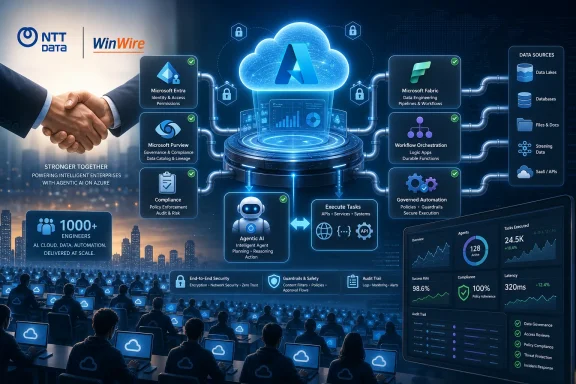 NTT DATA Is Buying the Missing Middle of Enterprise AI
The phrase “enterprise AI” has become so inflated that it can describe anything from a chatbot pilot to a full redesign of business operations. NTT DATA’s planned acquisition of WinWire cuts through that fog by revealing where the services market thinks the real money is: the layer between Microsoft’s AI platform ambitions and the messy reality of customer environments.WinWire is not being bought because it has a consumer app, a foundational model, or a headline-grabbing research lab. It is being bought because it has people who know how to build on Azure, modernize data estates, and turn experimental AI into repeatable enterprise systems. That is the less glamorous but more durable part of the AI cycle.
The timing is important. Enterprises have spent the last two years experimenting with copilots, custom chatbots, retrieval-augmented generation, and internal productivity assistants. Many of those projects impressed executives in demos but stalled when they met identity systems, compliance requirements, fragmented data, security reviews, and change-management realities.
NTT DATA’s message is that the next phase belongs to firms that can make AI operational. WinWire gives it a deeper bench in Microsoft Fabric, Azure AI Foundry, data engineering, cloud-native development, and the fashionable but still slippery category of agentic AI. In plain terms, NTT DATA is buying delivery capacity for the part of AI that starts after the proof of concept.
Microsoft’s AI Stack Needs an Army, Not Just a Platform
Microsoft has spent the last several years turning Azure into the control plane for enterprise AI. Azure OpenAI Service, Azure AI Foundry, Microsoft Fabric, Copilot Studio, Power Platform, Microsoft 365 Copilot, Defender, Purview, and Entra all point toward the same strategic picture: Microsoft wants AI to live inside its cloud, productivity, security, and data platforms.But a platform strategy only works if customers can implement it. That is where the global systems integrators come in. Microsoft can sell the architecture, provide the cloud services, and build the developer tooling, but it still needs partners to translate those offerings into working systems inside banks, hospitals, manufacturers, software companies, retailers, and public-sector agencies.
That partner layer is now becoming strategically critical. Enterprises do not simply “turn on” agentic AI. They need data pipelines, permission boundaries, monitoring, model evaluation, workflow integration, audit trails, user training, and fallback procedures. The larger the organization, the more likely its AI bottleneck is not model access but systems integration.
NTT DATA already had a substantial Microsoft practice, with a long-running partnership, a global Microsoft cloud business unit, and tens of thousands of Microsoft certifications. WinWire adds a more specialized profile: Azure-native engineering, data modernization, and AI frameworks aimed at enterprise adoption. The acquisition therefore looks less like diversification and more like concentration.
That concentration says something about the Microsoft ecosystem in 2026. The winners are not merely the partners who can resell licenses or migrate workloads. They are the ones who can help customers rationalize data, build governed AI applications, and manage them after launch. In the AI era, implementation credibility is becoming a sales weapon.
Agentic AI Is the Slogan, Workflow Automation Is the Prize
The most marketable phrase in the announcement is “agentic AI,” and it deserves both attention and skepticism. The term generally refers to AI systems that can pursue goals, call tools, coordinate steps, and act with some degree of autonomy rather than merely answering prompts. It is a useful concept, but it is also a magnet for overclaiming.WinWire’s pitch around its Agentic AI @ Scale framework fits the current enterprise mood. Companies do not want another sandbox chatbot that summarizes documents. They want systems that can triage tickets, prepare claims, monitor supply chains, reconcile records, assist developers, orchestrate approvals, and surface exceptions before they become operational problems.
That ambition is where agentic AI becomes meaningful. The agent is not magic; it is a layer of reasoning and orchestration sitting on top of APIs, databases, workflows, identity systems, and business rules. If those foundations are weak, the agent becomes a risk multiplier. If they are strong, the agent becomes a new interface to existing enterprise machinery.
This is why WinWire’s data engineering and cloud-native application work may matter more than the agentic branding. AI agents need reliable data, clean integration points, and constrained permissions. A services firm that can modernize the data estate and application layer is better positioned to deploy agents safely than one that merely knows how to wire a model into a chat window.
For WindowsForum readers, the Microsoft angle is especially relevant. Many enterprise environments are already built around Active Directory or Entra ID, Microsoft 365, Teams, SharePoint, SQL Server, Power Platform, Windows endpoints, and Azure infrastructure. Agentic AI in those environments will not be a standalone product category. It will arrive as an extension of the Microsoft stack that admins already govern.
The Deal Reflects a Shift From AI Pilots to AI Operations
The first wave of generative AI adoption was forgiving. A small team could build a prototype with a model API, a document index, and a web interface. The project could be impressive even if it lacked production hardening, lifecycle management, or enterprise security controls.The second wave is less forgiving. When an AI system touches customer data, regulatory workflows, financial decisions, clinical records, code repositories, or employee records, the standards change. IT leaders need to know who can access the system, what it can do, what data it used, what it logged, how it fails, and how it can be audited.
That is why “operationalize AI at scale” is more than press-release filler, even if it sounds like it was assembled in a conference room. The problem is real. Enterprises have accumulated AI experiments faster than they have built the operating model to govern them.
NTT DATA’s acquisition of WinWire is a response to that gap. The company is adding delivery capacity in areas that determine whether AI survives contact with enterprise IT: data platforms, application modernization, Azure engineering, managed services, and industry-specific implementation. The deal implicitly acknowledges that the hard part of AI adoption is no longer proving that models can be useful. The hard part is making them dependable, secure, and economically justified.
This is also where the transaction fits into a broader services-market pattern. Large integrators are racing to package AI adoption into repeatable offerings because customers do not want every deployment to be a bespoke science project. They want accelerators, reference architectures, compliance patterns, and managed services that reduce risk and time to value.
The Microsoft Channel Is Consolidating Around AI Delivery Capacity
Microsoft’s partner ecosystem has always been crowded, but AI is changing the hierarchy inside it. Traditional licensing and migration work still matters, yet the center of gravity is moving toward partners that can drive consumption of Azure AI services, Fabric workloads, security products, and business applications.NTT DATA’s acquisition of WinWire should be read in that context. The company is not merely expanding headcount. It is strengthening its ability to co-sell and co-deliver with Microsoft in the areas Microsoft most wants to grow. That includes AI infrastructure, data modernization, cloud-native apps, security, and managed services.
WinWire’s status as a Microsoft partner and its history of Microsoft Partner of the Year recognition make it a channel asset as much as an engineering asset. In the Microsoft world, partner credibility is not just about technical capability; it affects field alignment, customer confidence, and access to joint go-to-market motion.
The 1,000-plus Azure engineers and Microsoft specialists are therefore a central part of the story. AI demand has created a talent crunch in cloud architecture, data engineering, security, and applied AI development. Buying a firm with an existing bench is faster than hiring one engineer at a time.
For Microsoft, the deal is useful because it gives a major global partner more capacity to turn Microsoft AI demand into deployed projects. For NTT DATA, it strengthens a Microsoft practice that can compete against other global integrators chasing the same budgets. For customers, it may mean broader access to specialized Microsoft AI skills, though the quality of delivery will still depend on integration, retention, and execution after the acquisition closes.
WinWire Gives NTT DATA a Sharper North American Edge
WinWire is headquartered in Santa Clara, California, with delivery centers in India, a structure that fits neatly into the global delivery model used by major IT services firms. That geography matters. North America remains one of the most competitive markets for Microsoft cloud and AI transformation, and a Bay Area presence carries symbolic and practical weight.NTT DATA described the deal as advancing its North America leadership position, and that is not accidental language. The U.S. enterprise market is dense with Azure customers, regulated industries, software firms, healthcare organizations, and large corporate IT estates that are ripe for AI modernization but difficult to transform.
WinWire’s vertical focus appears particularly relevant in healthcare and software and digital platforms. Those sectors have strong demand for AI but also high integration complexity. Healthcare organizations face privacy, clinical workflow, interoperability, and governance constraints. Software companies face pressure to embed AI into products while modernizing their own engineering and data platforms.
The acquisition gives NTT DATA a more specialized wedge into those accounts. Instead of pitching generic AI transformation, it can bring industry accelerators, Microsoft alignment, and delivery teams that already understand sector-specific patterns. That is the difference between selling AI as a concept and selling it as an implementation path.
Still, the promise will have to survive the integration process. Services acquisitions can lose value if key talent departs, if delivery cultures clash, or if the acquired firm’s entrepreneurial speed gets buried inside a larger organization. NTT DATA’s challenge will be to scale WinWire’s capabilities without flattening the traits that made WinWire worth buying.
The Real Risk Is Not That AI Fails, but That It Becomes Another Sprawl Layer
Enterprise IT has seen this movie before. Virtualization, cloud, mobile, SaaS, analytics, and low-code platforms all promised speed and flexibility. Each also created new forms of sprawl when adoption moved faster than governance.AI is likely to amplify that pattern. A department can now procure or build AI-enabled tools faster than central IT can classify risk. Developers can embed model calls into applications. Business users can create automations with low-code platforms. Vendors can bolt copilots onto existing products. The result is a growing surface area of AI systems that may touch sensitive data, make recommendations, trigger actions, or influence decisions.
This is why the Microsoft context matters so much. Many enterprises will prefer to keep AI inside a familiar governance perimeter, even if that means accepting Microsoft’s platform gravity. Entra ID, Purview, Defender, Azure policy, Fabric governance, and Microsoft 365 compliance controls give administrators a framework they already understand.
But consolidation around Microsoft does not eliminate risk. It can also create lock-in, cost surprises, and architectural monoculture. If every workflow, data product, agent, and application modernization effort gets pulled toward one cloud ecosystem, organizations may gain coherence at the expense of flexibility.
NTT DATA and WinWire will therefore be selling more than technology implementation. They will be selling trust. Customers will expect them to define boundaries, design governance, and explain when Microsoft-native AI is the right answer — and when it is simply the most convenient answer for the partner ecosystem.
Windows Admins Will Feel This Through Identity, Endpoints, and Data Governance
For the Windows and Microsoft infrastructure crowd, deals like this can seem distant until they arrive as projects. A board-level AI strategy becomes a Teams integration. A customer-service agent becomes an Entra permissions review. A data modernization program becomes a Fabric rollout. A productivity initiative becomes a Microsoft 365 Copilot governance debate.That is where administrators and architects will feel the impact. The success of enterprise AI depends heavily on the foundations they manage: identity hygiene, endpoint security, data classification, access control, device compliance, logging, patching, and network architecture. AI does not bypass those disciplines. It raises their stakes.
If an AI agent can summarize documents, open tickets, query systems, draft responses, or trigger workflows, then identity and permissions become even more consequential. Least privilege stops being a best-practice slogan and becomes a control on what automated systems can infer or do. Poorly managed access rights become fuel for poorly bounded AI behavior.
The same is true for data governance. Microsoft Fabric and Azure AI Foundry can provide powerful tools, but they do not magically fix inconsistent data ownership, stale SharePoint sites, over-permissive file shares, or poorly classified records. AI makes hidden data problems visible because it gives users new ways to retrieve, combine, and act on information.
NTT DATA’s acquisition of WinWire signals that more of this work will be packaged as transformation programs. Administrators should expect AI projects to arrive with a services wrapper, a Microsoft architecture diagram, and an executive mandate. The practical question will be whether IT is brought in early enough to shape the controls or late enough only to inherit the risk.
The Services Industry Is Turning AI Into Managed Infrastructure
One underappreciated part of the announcement is NTT DATA’s managed-services angle. Building an AI system is one problem. Running it is another. Models change, prompts drift, data sources evolve, permissions shift, APIs break, and business processes mutate.That reality is pushing AI toward managed operations. Enterprises will need monitoring, evaluation, incident response, cost controls, security reviews, retraining processes, and continuous improvement. In other words, AI systems are becoming infrastructure, not one-off innovation projects.
This is familiar territory for global systems integrators. They built businesses around managing applications, infrastructure, cloud estates, security operations, and business processes. AI gives them a new layer to manage, but the commercial model is recognizable: design the system, integrate it, operate it, optimize it, and expand it.
WinWire strengthens NTT DATA’s ability to play that full lifecycle. Its cloud-native development and data engineering skills help with the build phase. Its AI frameworks and accelerators help with repeatability. NTT DATA’s scale and managed-services machinery help with long-term operation.
The most interesting question is whether customers will accept AI managed services as readily as they accepted infrastructure outsourcing. Some will welcome the expertise because AI operations require scarce skills. Others will worry about handing too much strategic process knowledge to external providers, especially when AI systems sit close to decision-making and intellectual property.
The Press Release Is Optimistic Because the Integration Problem Is Hard
Every acquisition announcement promises synergy, expanded capability, and faster customer outcomes. The language is predictable because the strategic logic has to be compressed into phrases that satisfy customers, employees, partners, and regulators. The harder question is what happens after the deal closes.NTT DATA will need to retain WinWire’s talent, align sales teams, preserve customer relationships, and integrate delivery methods. The company will also need to clarify how WinWire’s frameworks fit into NTT DATA’s broader AI offerings. If the integration is too loose, the acquisition may become a brand extension with limited leverage. If it is too heavy-handed, NTT DATA risks diluting the specialist capability it wanted.
Customers should watch for signs of continuity. Do WinWire teams remain visible in delivery? Do existing clients keep their account relationships? Are the AI frameworks integrated into NTT DATA’s global offerings without becoming generic slideware? Does Microsoft continue to amplify the combined practice in the field?
There is also the matter of pricing. Specialized AI engineering is expensive, and large integrators do not usually make transformation programs cheaper. The value proposition will have to rest on risk reduction, speed, and scale rather than bargain delivery.
That is not necessarily a problem. Many enterprises will pay for confidence if the alternative is an internal AI portfolio full of pilots that never land. But the burden of proof will shift from strategic intent to measurable outcomes: reduced cycle times, improved service quality, lower operational cost, better compliance, faster development, or new revenue.
The AI Market Forecasts Are Huge, but Budgets Still Need Proof
The announcement cites analyst expectations that the global AI market could grow from hundreds of billions of dollars to several trillion over the next decade. Forecasts like that help explain the urgency behind the deal, but they should not be mistaken for guaranteed customer spending.Enterprise technology markets do not move in straight lines. Budgets depend on macro conditions, regulatory pressure, board priorities, cloud costs, security incidents, and the ability of vendors to prove return on investment. AI may be transformative, but CFOs still ask ordinary questions.
The strongest argument for the NTT DATA-WinWire combination is that it addresses that proof problem. AI value is easier to defend when it is tied to specific workflows, industry processes, and measurable business outcomes. A generic AI platform story may win attention; a claims-processing improvement, support-cost reduction, developer-productivity gain, or revenue-cycle acceleration wins budget.
That is why industry specialization matters. Enterprises do not want to be told that agentic AI can transform everything. They want to know where it can safely improve the processes they actually run. The more regulated or complex the industry, the more implementation knowledge matters.
The risk is that agentic AI becomes the new digital transformation — a phrase broad enough to justify nearly any project. If that happens, customers will struggle to distinguish serious engineering from marketing theater. NTT DATA’s acquisition gives it more credibility, but credibility will ultimately come from deployed systems that survive production scrutiny.
The Microsoft Ecosystem Gets a Bigger AI Delivery Machine
The immediate facts are straightforward, but the implications are broader for Microsoft customers and partners.- NTT DATA has signed a definitive agreement to acquire WinWire, and the transaction remains subject to customary closing conditions and regulatory approvals.
- WinWire is expected to add more than 1,000 Azure engineers and Microsoft specialists to NTT DATA after closing.
- The acquisition strengthens NTT DATA’s Microsoft practice in Azure AI, Microsoft Fabric, Azure AI Foundry, data engineering, cloud-native applications, and agentic AI.
- The deal reflects a market shift from AI experimentation toward governed, production-scale deployment inside enterprise workflows.
- Microsoft benefits indirectly because a larger NTT DATA practice can help turn Azure and Microsoft AI demand into implemented customer projects.
- Enterprise IT teams should expect more AI programs to arrive through Microsoft-aligned services engagements that touch identity, data governance, security, endpoint management, and application modernization.
NTT DATA’s planned purchase of WinWire is a reminder that the next phase of AI will be fought in the plumbing: data platforms, permissions, applications, workflows, managed operations, and industry-specific delivery. Microsoft has built much of the platform surface area, but customers still need help turning that surface area into working systems. If NTT DATA can integrate WinWire without smothering it, the deal could become a useful marker of where enterprise AI is heading — away from isolated demos, toward governed automation that lives inside the infrastructure IT teams already run.
References
- Primary source: IT Voice Media Pvt. Ltd.
Published: Mon, 18 May 2026 07:56:05 GMT
NTT DATA Announces Intent to Acquire WinWire to Scale Enterprise AI Adoption and Accelerate Industry Transformation with Microsoft
NTT DATA, a global leader in AI, digital business and IT services, today announced it has signed a definitive agreement to acquire WinWire, an award-winning Microsoft partner specializing in Agentic AI, AI on Azure, data engineering and cloud-native development as foundational capabilities for...www.itvoice.in - Related coverage: services.global.ntt
Microsoft | NTT DATA
Modernize your IT environment to optimize your operations, increase profitability and prepare your data for transformative technologies.services.global.ntt
- Related coverage: us.nttdata.com
NTT DATA Becomes Microsoft Global System Integrator Partner, Driving Innovation in the Cloud Domain
NTT DATA announces its designation as Microsoft Global System Integrator Partner.us.nttdata.com
- Related coverage: intelligentcio.com
- Related coverage: unite.ai
NTT DATA Acquires WinWire to Expand Agentic AI and Microsoft Azure Enterprise Transformation Capabilities – Unite.AI
NTT DATA has announced plans to acquire WinWire, a Santa Clara-based Microsoft partner focused on agentic AI, Azure-native development, cloud modernization, and enterprise data engineering. The deal reflects a broader sh...www.unite.ai
- Official source: microsoft.com

- Related coverage: nttdata.com
Agentic AI with Microsoft | NTT DATA Group
Accelerate transformation with trusted AI agents - built, deployed and managed by NTT DATA. www.nttdata.com
- Related coverage: rcpmag.com
NTT DATA Plans Acquisition of WinWire to Expand Enterprise AI Services -- Redmond Channel Partner
Deal is aimed at accelerating AI adoption and Microsoft-focused transformation initiatives across industries.rcpmag.com
