

NTT DATA has signed a definitive agreement to acquire WinWire, a Santa Clara-based Microsoft partner focused on Azure, data engineering, cloud-native development and agentic AI, in a deal announced in May 2026, with closing subject to customary approvals and financial terms undisclosed. The acquisition is not just another services roll-up wearing an AI badge. It is a bet that the next phase of enterprise AI will be won less by flashy demos than by armies of specialists who can wire Azure, Fabric, applications, data pipelines, security controls and business processes into something durable. For Microsoft customers, the signal is clear: the partner ecosystem is consolidating around production AI, and the cost of standing still is rising.
The headline number is simple: more than 1,000 Azure engineers and AI specialists are expected to join NTT DATA’s Microsoft practice once the transaction closes. That matters because enterprise AI has moved into the awkward middle stage where boardrooms are enthusiastic, pilots are everywhere, and actual operational transformation remains stubbornly difficult.
WinWire gives NTT DATA a concentrated Microsoft services shop with credibility in Azure, AI, data engineering and cloud-native development. NTT DATA already had global scale; what it is buying here is density. The company wants more Microsoft-specific muscle in North America, and WinWire is built almost exactly for that job.
This is also a geography play. NTT DATA has made clear that the U.S. is one of its most important markets, and WinWire’s North American focus makes the deal more than a generic capability acquisition. In services, proximity to enterprise buyers still matters, especially when the work touches regulated data, vertical workflows and long-running modernization programs.
The deal’s undisclosed price is less important than the strategic posture. NTT DATA is effectively saying that the Microsoft AI market is not a side practice. It is a core battleground where global integrators need specialist talent, partner awards, industry templates and delivery credibility at scale.
This is where companies like WinWire fit. The modern Microsoft stack now stretches from Azure infrastructure to Microsoft Fabric, Azure AI Foundry, GitHub, Power Platform, Dynamics, Microsoft 365 and security tooling. A customer can buy the ingredients from Microsoft, but assembling them into production systems is where partners make their money.
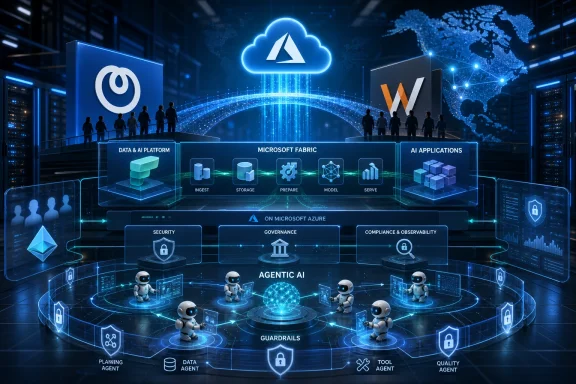
The industry’s vocabulary has shifted accordingly. The phrase agentic AI has become the favored shorthand for systems that do more than answer prompts: they plan, trigger workflows, call tools, retrieve enterprise data and act within defined guardrails. Whether the term remains fashionable or burns out like earlier enterprise buzzwords, the implementation problem is real.
That implementation problem is labor-intensive. Someone has to map legacy processes, clean data, connect APIs, define permissions, test outputs, monitor drift, document risk and persuade business units to change how work gets done. The more ambitious the AI promise, the more boring—and valuable—the integration work becomes.
NTT DATA’s acquisition is therefore a vote for the services layer of AI. It assumes that enterprises will not simply flip a Microsoft switch and become AI-native. They will need a partner ecosystem large enough to turn product capability into operational change.
The company’s background in healthcare, life sciences, high tech and software-oriented industries gives NTT DATA more than extra headcount. It brings domain patterns. In enterprise AI, domain patterns matter because generic automation often collapses when it meets sector-specific compliance, data quality and workflow complexity.
A hospital system, a pharmaceutical company and a software vendor may all use Azure, but they do not have the same risk model or operational rhythm. A model that drafts a document, summarizes a case, flags an anomaly or routes a support ticket must be evaluated against the business context in which it operates. That is where vertical delivery experience becomes more than sales decoration.
NTT DATA also gains a Microsoft partner with a history of awards and recognition. Awards are not the same thing as execution, but in channel ecosystems they are useful signals. They tell enterprise customers that Microsoft has seen the partner operate inside its orbit and is comfortable enough to promote the relationship.
The cultural alignment language around acquisitions is easy to dismiss, because every buyer says it. But in services acquisitions, culture is not fluff. The acquired asset walks out the door if the people leave, and the value of 1,000 specialists depends on whether they remain engaged after the deal closes.
NTT DATA is positioning the WinWire deal as a way to help customers move from experimentation to enterprise-wide deployment. That is the right framing because the bottleneck is no longer curiosity. It is industrialization.
The difference between a pilot and a platform is governance. A pilot can live in a sandbox with friendly users and hand-picked data. A platform has to survive identity controls, audit trails, data residency requirements, security monitoring, cost management and business continuity planning.
Microsoft has plenty of technology aimed at that platform layer, but customers still need help deciding which parts to use and how to connect them. Fabric may become the data foundation. Azure AI Foundry may provide model and agent tooling. Microsoft 365 Copilot may reshape office workflows. Security and compliance tools may define what the system is allowed to see and do.
That orchestration is where NTT DATA wants to play. The company’s pitch is full-stack: infrastructure, applications, data, AI, managed services and security under one roof. WinWire sharpens the Microsoft edge of that pitch.
That makes agentic AI a dangerous thing to implement casually. A chatbot that gives a bad answer is a problem. An agent that takes a bad action inside a business process can become an incident.
For WindowsForum readers, this is where the story intersects with the practical world of IT operations. The more AI agents touch Microsoft environments, the more identity, permissions, endpoint posture, logging and data classification become central to AI governance. Azure AI projects are not isolated from Entra ID, Defender, Purview, endpoint management or the broader Microsoft security stack.
The partner that builds the agent may also shape the operational risk. If an integrator understands only the AI layer, it may miss the messy enterprise dependencies beneath it. If it understands the broader Microsoft estate, it has a better chance of designing systems that IT teams can actually operate.
This is one reason NTT DATA’s full-stack rhetoric is not entirely empty. Agentic AI makes infrastructure, data architecture and security architecture more important, not less. The more autonomous the software becomes, the more disciplined the surrounding platform must be.
This pattern played out in cloud migration, cybersecurity, Salesforce implementation, ServiceNow, data analytics and DevOps. AI is now moving through the same cycle at higher speed. The difference is that AI transformation touches more parts of the enterprise at once, which makes multidisciplinary delivery capacity especially valuable.
For Microsoft, consolidation among capable partners is not necessarily bad news. Microsoft needs global systems integrators that can take Azure AI into complex enterprise accounts, especially where direct product sales are not enough. A larger NTT DATA Microsoft practice gives Microsoft another channel for turning platform ambition into customer deployments.
For smaller Microsoft partners, the message is more complicated. Specialization remains valuable, but scale is becoming a competitive requirement for the largest enterprise deals. Customers want niche expertise, yet they also want global delivery, support coverage, managed services and financial stability.
That tension will likely drive more acquisitions. Boutique AI and Azure firms with strong vertical practices, repeatable frameworks or scarce engineering talent will attract attention from larger players trying to avoid being left behind. The market is not just hiring; it is harvesting.
That paradox is not new. Cloud computing promised abstraction, but cloud migration created a decade of consulting work. Low-code tools promised business self-service, but enterprises still needed governance, integration and professional services. AI will automate portions of development and operations, but it also creates new categories of design, oversight and remediation work.
NTT DATA is not buying WinWire because AI has made engineers irrelevant. It is buying WinWire because the demand for Azure AI engineers exceeds the supply of people who understand both the tooling and the enterprise context. That is the labor reality behind the automation story.
For IT departments, this should temper expectations. AI may accelerate delivery, but it will not eliminate architecture. It may help generate code, but it will not decide governance models. It may summarize documentation, but it will not negotiate risk tolerance between legal, security and business owners.
The most successful enterprise AI programs will probably look less like magic and more like disciplined platform engineering. They will have reusable components, clear ownership, security baselines, cost controls and monitoring. That is not glamorous, but it is where value survives contact with production.
That creates opportunity and pressure. Organizations already invested in Microsoft tooling may find it easier to adopt AI features across productivity, security, analytics and application development. They may also find themselves confronting architectural debt that was tolerable before AI exposed it.
Identity hygiene becomes more important when AI systems can retrieve and reason over enterprise data. Data classification becomes more important when copilots and agents can surface information across repositories. Endpoint management becomes more important when AI-enabled workflows depend on trusted devices and secure access.
This is not just a CIO-level concern. Sysadmins and IT pros will be asked to support environments where AI is no longer a novelty but a layer woven into applications and workflows. They will need to understand what data an agent can access, what actions it can take, where logs are stored and how incidents are investigated.
NTT DATA’s expanded Microsoft practice will be selling into that exact anxiety. The promise will be speed, scale and business outcomes. The practical question for customers will be whether the partner also helps them build maintainable systems that IT can govern after the consultants leave.
NTT DATA will need to keep WinWire’s specialists motivated while folding them into a much larger organization. That is not automatic. Large integrators offer global reach and bigger accounts, but they can also bury specialists under process, reporting layers and margin targets.
Customers will watch for continuity. If WinWire teams remain intact and gain access to NTT DATA’s broader resources, the deal could strengthen delivery. If key leaders depart or customers feel lost inside a larger machine, the acquisition could blunt the very specialization NTT DATA wanted to buy.
There is also the question of differentiation. Every major systems integrator is now claiming AI transformation, Microsoft depth and industry-specific accelerators. NTT DATA must prove that adding WinWire creates something more coherent than a larger slide deck.
The closing timeline matters less than the first year after closing. That is when the combined company will have to show whether it can translate specialist capability into repeatable, global delivery without diluting what made WinWire attractive.
The channel war is not only about who has the most certifications. It is about who can package AI into industry outcomes without overpromising. Enterprises are increasingly impatient with generic AI workshops and proof-of-concept theater. They want claims tied to measurable productivity, revenue, risk reduction or customer experience.
That is why NTT DATA emphasizes full-stack capability. If AI value depends on modern data platforms, application modernization, security operations and managed services, then a provider with breadth can argue that it owns more of the outcome. WinWire helps make that argument more credible in Microsoft-heavy accounts.
Still, breadth can be a weakness if it becomes vagueness. The strongest AI services firms will be those that can say precisely what they do, where they have done it before and how they manage risk. Customers should demand that specificity.
The market is moving too fast for slogans to carry much weight. The winners will be the firms that can turn Microsoft’s AI platform into boringly reliable enterprise systems. That is the unglamorous prize NTT DATA is chasing.
 NTT DATA Is Buying Delivery Capacity, Not Just Another Logo
The headline number is simple: more than 1,000 Azure engineers and AI specialists are expected to join NTT DATA’s Microsoft practice once the transaction closes. That matters because enterprise AI has moved into the awkward middle stage where boardrooms are enthusiastic, pilots are everywhere, and actual operational transformation remains stubbornly difficult.WinWire gives NTT DATA a concentrated Microsoft services shop with credibility in Azure, AI, data engineering and cloud-native development. NTT DATA already had global scale; what it is buying here is density. The company wants more Microsoft-specific muscle in North America, and WinWire is built almost exactly for that job.
This is also a geography play. NTT DATA has made clear that the U.S. is one of its most important markets, and WinWire’s North American focus makes the deal more than a generic capability acquisition. In services, proximity to enterprise buyers still matters, especially when the work touches regulated data, vertical workflows and long-running modernization programs.
The deal’s undisclosed price is less important than the strategic posture. NTT DATA is effectively saying that the Microsoft AI market is not a side practice. It is a core battleground where global integrators need specialist talent, partner awards, industry templates and delivery credibility at scale.
The Microsoft AI Stack Has Become a Services Market
Microsoft’s AI strategy is not merely about selling Copilot subscriptions or Azure consumption. It depends on customers moving data into usable platforms, modernizing applications, securing identities, building governance models and rethinking business processes around automation. That is not a product motion alone; it is a consulting and integration motion.This is where companies like WinWire fit. The modern Microsoft stack now stretches from Azure infrastructure to Microsoft Fabric, Azure AI Foundry, GitHub, Power Platform, Dynamics, Microsoft 365 and security tooling. A customer can buy the ingredients from Microsoft, but assembling them into production systems is where partners make their money.
The industry’s vocabulary has shifted accordingly. The phrase agentic AI has become the favored shorthand for systems that do more than answer prompts: they plan, trigger workflows, call tools, retrieve enterprise data and act within defined guardrails. Whether the term remains fashionable or burns out like earlier enterprise buzzwords, the implementation problem is real.
That implementation problem is labor-intensive. Someone has to map legacy processes, clean data, connect APIs, define permissions, test outputs, monitor drift, document risk and persuade business units to change how work gets done. The more ambitious the AI promise, the more boring—and valuable—the integration work becomes.
NTT DATA’s acquisition is therefore a vote for the services layer of AI. It assumes that enterprises will not simply flip a Microsoft switch and become AI-native. They will need a partner ecosystem large enough to turn product capability into operational change.
WinWire Brings the Kind of Specialization Global Integrators Keep Trying to Build
WinWire is not being acquired because it is a household name. It is being acquired because it is a Microsoft-focused specialist with enough scale, vertical experience and partner validation to matter inside a much larger company. That profile is increasingly attractive in a market where general-purpose digital transformation language no longer impresses buyers.The company’s background in healthcare, life sciences, high tech and software-oriented industries gives NTT DATA more than extra headcount. It brings domain patterns. In enterprise AI, domain patterns matter because generic automation often collapses when it meets sector-specific compliance, data quality and workflow complexity.
A hospital system, a pharmaceutical company and a software vendor may all use Azure, but they do not have the same risk model or operational rhythm. A model that drafts a document, summarizes a case, flags an anomaly or routes a support ticket must be evaluated against the business context in which it operates. That is where vertical delivery experience becomes more than sales decoration.
NTT DATA also gains a Microsoft partner with a history of awards and recognition. Awards are not the same thing as execution, but in channel ecosystems they are useful signals. They tell enterprise customers that Microsoft has seen the partner operate inside its orbit and is comfortable enough to promote the relationship.
The cultural alignment language around acquisitions is easy to dismiss, because every buyer says it. But in services acquisitions, culture is not fluff. The acquired asset walks out the door if the people leave, and the value of 1,000 specialists depends on whether they remain engaged after the deal closes.
The Real Prize Is Moving Customers From Pilots to Platforms
The enterprise AI market has a pilot problem. Many organizations have experimented with chatbots, document assistants, code helpers and internal knowledge tools. Far fewer have embedded AI into repeatable workflows that survive compliance review, budget scrutiny and day-two operations.NTT DATA is positioning the WinWire deal as a way to help customers move from experimentation to enterprise-wide deployment. That is the right framing because the bottleneck is no longer curiosity. It is industrialization.
The difference between a pilot and a platform is governance. A pilot can live in a sandbox with friendly users and hand-picked data. A platform has to survive identity controls, audit trails, data residency requirements, security monitoring, cost management and business continuity planning.
Microsoft has plenty of technology aimed at that platform layer, but customers still need help deciding which parts to use and how to connect them. Fabric may become the data foundation. Azure AI Foundry may provide model and agent tooling. Microsoft 365 Copilot may reshape office workflows. Security and compliance tools may define what the system is allowed to see and do.
That orchestration is where NTT DATA wants to play. The company’s pitch is full-stack: infrastructure, applications, data, AI, managed services and security under one roof. WinWire sharpens the Microsoft edge of that pitch.
Agentic AI Makes the Integration Problem Bigger
Agentic AI is often marketed as a leap toward autonomous enterprise systems. The reality is more restrained but still consequential. These systems can coordinate tasks, interact with software tools and make decisions within boundaries, but they are only as reliable as the workflows, data and controls around them.That makes agentic AI a dangerous thing to implement casually. A chatbot that gives a bad answer is a problem. An agent that takes a bad action inside a business process can become an incident.
For WindowsForum readers, this is where the story intersects with the practical world of IT operations. The more AI agents touch Microsoft environments, the more identity, permissions, endpoint posture, logging and data classification become central to AI governance. Azure AI projects are not isolated from Entra ID, Defender, Purview, endpoint management or the broader Microsoft security stack.
The partner that builds the agent may also shape the operational risk. If an integrator understands only the AI layer, it may miss the messy enterprise dependencies beneath it. If it understands the broader Microsoft estate, it has a better chance of designing systems that IT teams can actually operate.
This is one reason NTT DATA’s full-stack rhetoric is not entirely empty. Agentic AI makes infrastructure, data architecture and security architecture more important, not less. The more autonomous the software becomes, the more disciplined the surrounding platform must be.
Microsoft’s Partner Economy Is Entering Its Consolidation Phase
The WinWire deal fits a familiar pattern in enterprise technology. A platform vendor creates a fast-growing market. Specialist partners emerge around the new opportunity. Larger integrators then acquire the specialists to gain credibility, talent and customer access before the market matures.This pattern played out in cloud migration, cybersecurity, Salesforce implementation, ServiceNow, data analytics and DevOps. AI is now moving through the same cycle at higher speed. The difference is that AI transformation touches more parts of the enterprise at once, which makes multidisciplinary delivery capacity especially valuable.
For Microsoft, consolidation among capable partners is not necessarily bad news. Microsoft needs global systems integrators that can take Azure AI into complex enterprise accounts, especially where direct product sales are not enough. A larger NTT DATA Microsoft practice gives Microsoft another channel for turning platform ambition into customer deployments.
For smaller Microsoft partners, the message is more complicated. Specialization remains valuable, but scale is becoming a competitive requirement for the largest enterprise deals. Customers want niche expertise, yet they also want global delivery, support coverage, managed services and financial stability.
That tension will likely drive more acquisitions. Boutique AI and Azure firms with strong vertical practices, repeatable frameworks or scarce engineering talent will attract attention from larger players trying to avoid being left behind. The market is not just hiring; it is harvesting.
The Deal Also Reveals Microsoft’s Dependence on Human Infrastructure
AI marketing often suggests that software is about to reduce the need for human labor across technology delivery. This acquisition points in the opposite direction. To sell enterprise AI, the ecosystem needs more skilled people, not fewer.That paradox is not new. Cloud computing promised abstraction, but cloud migration created a decade of consulting work. Low-code tools promised business self-service, but enterprises still needed governance, integration and professional services. AI will automate portions of development and operations, but it also creates new categories of design, oversight and remediation work.
NTT DATA is not buying WinWire because AI has made engineers irrelevant. It is buying WinWire because the demand for Azure AI engineers exceeds the supply of people who understand both the tooling and the enterprise context. That is the labor reality behind the automation story.
For IT departments, this should temper expectations. AI may accelerate delivery, but it will not eliminate architecture. It may help generate code, but it will not decide governance models. It may summarize documentation, but it will not negotiate risk tolerance between legal, security and business owners.
The most successful enterprise AI programs will probably look less like magic and more like disciplined platform engineering. They will have reusable components, clear ownership, security baselines, cost controls and monitoring. That is not glamorous, but it is where value survives contact with production.
Windows Shops Should Watch the Azure Center of Gravity
For Windows-centric organizations, the acquisition matters because Microsoft’s AI push increasingly pulls the whole estate toward Azure-connected services. Even when the user-facing experience appears inside Windows, Microsoft 365 or familiar business applications, the enabling architecture often lives in cloud identity, data and AI services.That creates opportunity and pressure. Organizations already invested in Microsoft tooling may find it easier to adopt AI features across productivity, security, analytics and application development. They may also find themselves confronting architectural debt that was tolerable before AI exposed it.
Identity hygiene becomes more important when AI systems can retrieve and reason over enterprise data. Data classification becomes more important when copilots and agents can surface information across repositories. Endpoint management becomes more important when AI-enabled workflows depend on trusted devices and secure access.
This is not just a CIO-level concern. Sysadmins and IT pros will be asked to support environments where AI is no longer a novelty but a layer woven into applications and workflows. They will need to understand what data an agent can access, what actions it can take, where logs are stored and how incidents are investigated.
NTT DATA’s expanded Microsoft practice will be selling into that exact anxiety. The promise will be speed, scale and business outcomes. The practical question for customers will be whether the partner also helps them build maintainable systems that IT can govern after the consultants leave.
The Risks Are in the Integration, Not the Announcement
Acquisitions in services businesses are easy to announce and hard to integrate. The value is concentrated in people, client relationships, delivery methods and partner status. If those assets do not transfer cleanly, the strategic logic can evaporate.NTT DATA will need to keep WinWire’s specialists motivated while folding them into a much larger organization. That is not automatic. Large integrators offer global reach and bigger accounts, but they can also bury specialists under process, reporting layers and margin targets.
Customers will watch for continuity. If WinWire teams remain intact and gain access to NTT DATA’s broader resources, the deal could strengthen delivery. If key leaders depart or customers feel lost inside a larger machine, the acquisition could blunt the very specialization NTT DATA wanted to buy.
There is also the question of differentiation. Every major systems integrator is now claiming AI transformation, Microsoft depth and industry-specific accelerators. NTT DATA must prove that adding WinWire creates something more coherent than a larger slide deck.
The closing timeline matters less than the first year after closing. That is when the combined company will have to show whether it can translate specialist capability into repeatable, global delivery without diluting what made WinWire attractive.
The AI Gold Rush Is Becoming a Channel War
The WinWire acquisition is part of a larger contest among global services firms to own the enterprise AI implementation layer. Accenture, Capgemini, Cognizant, Deloitte, IBM, Infosys, TCS, Wipro and others are all competing for the same transformation budgets. Microsoft is one of the most important platforms in that contest.The channel war is not only about who has the most certifications. It is about who can package AI into industry outcomes without overpromising. Enterprises are increasingly impatient with generic AI workshops and proof-of-concept theater. They want claims tied to measurable productivity, revenue, risk reduction or customer experience.
That is why NTT DATA emphasizes full-stack capability. If AI value depends on modern data platforms, application modernization, security operations and managed services, then a provider with breadth can argue that it owns more of the outcome. WinWire helps make that argument more credible in Microsoft-heavy accounts.
Still, breadth can be a weakness if it becomes vagueness. The strongest AI services firms will be those that can say precisely what they do, where they have done it before and how they manage risk. Customers should demand that specificity.
The market is moving too fast for slogans to carry much weight. The winners will be the firms that can turn Microsoft’s AI platform into boringly reliable enterprise systems. That is the unglamorous prize NTT DATA is chasing.
The WinWire Deal Gives Microsoft Customers a Clearer Signal
The practical lesson from this acquisition is that enterprise AI is moving into its build-out phase. The hype cycle is still loud, but the money is shifting toward implementation capacity, vertical expertise and operational governance.- NTT DATA is acquiring WinWire to add more than 1,000 Azure engineers and AI specialists to its Microsoft-focused cloud and AI delivery business.
- The deal strengthens NTT DATA’s position in North America, where Microsoft Azure, Fabric and AI services are central to enterprise modernization programs.
- WinWire’s value lies in its Microsoft specialization, industry experience and agentic AI delivery frameworks, not merely in its headcount.
- Microsoft customers should expect more partner-led AI programs that combine data engineering, application modernization, security and managed services.
- The acquisition’s success will depend on whether NTT DATA preserves WinWire’s specialist culture while scaling it across larger global accounts.
References
- Primary source: crn.com
Published: Tue, 19 May 2026 13:48:50 GMT
NTT Data To Snap Up WinWire To Supercharge Its Microsoft AI Push
NTT Data is looking to significantly increase its Microsoft AI business in the U.S. by acquiring WinWire and its 1,000-plus Microsoft engineers and AI specialists.www.crn.com - Related coverage: itpro.com
NTT Data to acquire WinWire in enterprise AI services push | ChannelPro
The deal will expand the firm's Microsoft practice and AI capabilities with an additional 1,000 Azure engineers and specialistswww.itpro.com - Related coverage: us.nttdata.com
NTT DATA Announces Intent to Acquire WinWire | NTT DATA
NTT DATA announces plans to acquire WinWire to expand Microsoft-focused AI and cloud capabilities, accelerating enterprise AI adoption, scaling Azure expertise, and driving industry transformation worldwide. us.nttdata.com
- Related coverage: winwire.com
Press Release
Stay updated with WinWire's latest news and announcements. Read our press releases for recent updates and milestoneswww.winwire.com
- Related coverage: gateiolink.net
Buy/Sell Bitcoin, Ethereum and 4,700+ Altcoins | Cryptocurrency Exchange | Gate.com
Gate - Leading cryptocurrency exchange with over 4,700 cryptocurrencies & stablecoins such as Bitcoin ✓ Ethereum ✓ Dogecoin ✓ Start trading crypto with Gate.com now!www.gateiolink.net - Related coverage: telcomagazine.com
NTT DATA Expands Microsoft AI Footprint with WinWire Deal | Telco Magazine
NTT DATA is adding 1,000 skilled Azure specialists and Microsoft engineers as operators push for enterprise AI platforms and cloud-native transformation telcomagazine.com
- Related coverage: windowsforum.com
NTT DATA Acquires WinWire to Scale Production AI on Microsoft Azure | Windows Forum
NTT DATA announced on May 18, 2026, that it has signed a definitive agreement to acquire WinWire, a Santa Clara-based Microsoft partner with delivery...windowsforum.com - Related coverage: businesschief.com
NTT Data Acquires WinWire Amid AI Market Growth | Business Chief
NTT Data will absorb 1,000 Microsoft Azure Engineers, enhancing its global business unit for cloud transformation businesschief.com
- Related coverage: venturebeat.com
Sverica Capital Management Announces Sale of WinWire to NTT DATA | VentureBeat
SAN FRANCISCO--(BUSINESS WIRE)--May 18, 2026-- Sverica Capital Management LP [https://cts.businesswire.com/ct/CT?id=smartlink&url=https%3A%2F%2Fc212.venturebeat.com
- Related coverage: services.global.ntt
2194310641
Blue and gold particles swirling together, forming a dynamic sphere against a stark black backdrop, creating a captivating visual representation of energy and movementservices.global.ntt
