

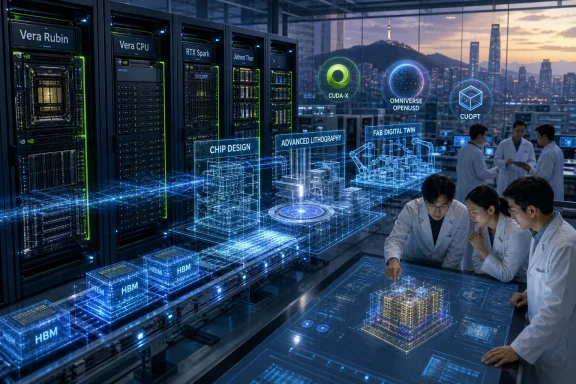
NVIDIA and SK hynix announced on June 7, 2026, in Seoul a multiyear technology partnership to co-develop next-generation memory for AI factories, spanning Vera Rubin systems, Vera CPUs, RTX Spark PCs and Jetson Thor robotics platforms while applying NVIDIA software to semiconductor design and manufacturing. The date matters because this is not a routine supplier press release dressed up for the AI boom. It is NVIDIA admitting, in the language of partnership rather than panic, that memory has become one of the governing constraints on the next phase of computing. The company that made GPUs the scarce resource of the AI era is now organizing the industry around the parts that keep those GPUs fed.
For the first two years of the generative AI buildout, the market treated accelerators as the center of the universe. If a cloud provider could get enough NVIDIA GPUs, the thinking went, it could train larger models, serve more inference, and climb the next rung of the AI hierarchy. That was always an incomplete picture, but it was convenient enough while the bottleneck was obvious.
Now the constraint has moved closer to the physics of the system. Modern AI accelerators are not merely compute engines; they are enormous memory bandwidth machines. A model can have all the theoretical floating-point throughput in the world and still stumble if weights, activations, cache data, and intermediate results cannot move quickly enough.
That is why high-bandwidth memory, or HBM, has turned into the quiet kingmaker of the AI supply chain. HBM is expensive, complex to stack and package, and brutally demanding to qualify with the accelerators it serves. It is also indispensable for the data center systems that NVIDIA, AMD, hyperscalers, and national AI programs are trying to deploy at scale.
The NVIDIA–SK hynix agreement is best understood as a response to that reality. It is not just a purchase order. It is a coordination mechanism for a world where memory roadmaps and GPU roadmaps can no longer be designed in isolation.
A conventional supplier relationship starts with a standard component and asks whether it can be made available in sufficient volume. This partnership starts with NVIDIA’s architecture and asks what memory must become to make that architecture practical. The center of gravity shifts from procurement to design.
That shift is familiar to anyone who watched Apple pull more of its silicon destiny in-house, or Tesla turn battery supply into a strategic operating system rather than a commodity input. NVIDIA is not manufacturing DRAM wafers itself, but it is increasingly acting like the company that defines the economic shape of the stack. If CUDA shaped the software side of accelerated computing, memory co-design may shape the physical side of AI infrastructure.
This is why the partnership is bigger than SK hynix winning another customer. NVIDIA is using its demand, platform roadmap, and software leverage to make sure memory development tracks the systems it wants to sell. That is a powerful position, and it raises a blunt question for the rest of the industry: if memory becomes optimized around NVIDIA’s cadence, everyone else may find themselves adapting to a supply chain NVIDIA helped script.
But the deeper prize is influence. Memory manufacturers have often lived downstream of system designers, responding to demand signals and standards bodies while competing on process execution, yield, and price. In this arrangement, SK hynix gets pulled upstream into NVIDIA’s platform planning.
That is strategically valuable. If SK hynix can help shape what next-generation memory looks like for NVIDIA’s systems, it is not merely filling orders; it is helping define the requirements competitors must chase. The distinction between supplier and platform partner starts to blur.
It also gives SK hynix a broader story for investors and customers. The company is not simply riding a temporary HBM wave. It can argue that it is embedded in the architecture of AI infrastructure itself, from cloud-scale training to edge robotics and so-called personal AI systems. In a memory business where booms eventually turn into gluts, that narrative matters.
The AI market is also unusually voracious. Training frontier models consumes massive memory capacity, but inference at scale may prove even more demanding over time because it runs continuously and fans out across many services. Add agentic systems, multimodal workloads, and robotics into the mix, and memory demand stops looking like a spike. It starts looking like a new baseline.
This is why the partnership explicitly refers to extended development cycles, advanced fabrication, and capital investment. Those are not throwaway phrases. They are the ingredients of a bottleneck that cannot be solved by enthusiasm or clever marketing.
The broader PC market should pay attention. When wafer starts, packaging lines, and investment dollars tilt toward AI memory, conventional DRAM and client components feel the squeeze. Enthusiasts looking at DDR5 prices, laptop buyers seeing bill-of-materials pressure, and OEMs planning refresh cycles are all downstream of the same allocation battle.
NVIDIA’s preferred phrase, “AI factories,” can sound like branding, but it captures something real. These installations are not generic server rooms with some GPUs bolted in. They are tightly engineered systems where compute, memory, interconnect, cooling, power delivery, and software scheduling all have to work as one machine.
That systems view explains why NVIDIA cares about SK hynix’s manufacturing process as much as its output. The announcement includes NVIDIA CUDA-X libraries, PhysicsNeMo, Omniverse, OpenUSD, and cuOpt as tools SK hynix will use to accelerate simulation, TCAD workflows, computational lithography, and fab optimization. NVIDIA is not merely buying memory; it is selling the idea that NVIDIA software can improve the factories that produce memory.
There is a pleasing circularity to that pitch. AI needs better chips; better chips need better simulation; better simulation runs on accelerated computing; accelerated computing is NVIDIA’s kingdom. If SK hynix can use NVIDIA tools to improve memory design and manufacturing, the supply chain becomes another proof point for NVIDIA’s full-stack thesis.
The risk, of course, is dependency. The more a supplier’s design and factory workflow relies on a customer’s software ecosystem, the more the relationship starts to resemble an operating environment rather than a commercial contract. For SK hynix, the bargain may be worth it. For the industry, it is another sign that NVIDIA’s influence now extends well beyond the GPU socket.
The Vera CPU element is especially important. NVIDIA has spent years making the GPU the gravitational center of accelerated computing, but its data center ambitions increasingly require control over the broader compute complex. Pairing Vera CPUs with memory codeveloped alongside SK hynix gives NVIDIA another way to reduce uncertainty in system design.
RTX Spark and Jetson Thor widen the aperture. NVIDIA is not limiting the partnership to hyperscale training clusters. It is also pointing to personal AI computers and robotics platforms, markets where memory requirements may differ from giant data center accelerators but still benefit from tight integration.
That breadth tells us how NVIDIA sees the next decade. AI is not one market; it is an architecture spreading across cloud infrastructure, workstations, edge devices, robots, industrial systems, and consumer-facing machines. If memory becomes a co-designed element across that entire map, NVIDIA gains a lever that is both technical and commercial.
Still, the optics are significant. SK hynix is being showcased not as an interchangeable supplier but as a strategic partner. In markets as supply-constrained as HBM, that status can influence customer confidence, engineering priority, and investor perception.
Samsung, for its part, has the scale and manufacturing depth to remain formidable, while Micron brings a U.S.-based supply-chain angle that matters in an era of industrial policy and export controls. But SK hynix has been unusually well positioned in HBM, and NVIDIA’s public embrace reinforces that advantage.
The competitive consequence is not that other memory makers are shut out. It is that the bar for participation keeps rising. Supplying AI memory is no longer just about producing fast DRAM; it is about meeting packaging requirements, power targets, thermal constraints, roadmap timing, and system-level validation under one of the most demanding customers in technology.
If AI data centers absorb more advanced memory capacity, client memory markets can tighten. If packaging and substrate capacity are prioritized for HBM and accelerator modules, other components may face longer lead times or higher prices. If OEMs expect memory costs to remain elevated, they may ship base configurations with less RAM, charge more for upgrades, or delay aggressive price cuts.
That does not mean every Windows PC is about to become unaffordable because NVIDIA signed a deal with SK hynix. The market is more complicated than that, and conventional DRAM is not the same product as HBM. But fabs and capital budgets are connected, and manufacturers must choose where to put their most profitable capacity.
The effect may be most visible in workstations and AI PCs. Microsoft, OEMs, and silicon vendors have spent the last two years encouraging users to think about local AI capability, NPUs, larger memory footprints, and on-device models. Those ambitions collide with a market where memory is being repriced by the data center. The more serious local AI becomes, the less plausible it is to treat 16GB as an indefinitely comfortable baseline.
For sysadmins, the consequence is procurement uncertainty. Memory-heavy servers, developer workstations, virtualization hosts, and local inference boxes may become harder to budget if pricing keeps moving. The boring spreadsheet line item called RAM is becoming strategic again.
This is not science fiction, but it is also not magic. Semiconductor manufacturing already depends on modeling, simulation, inspection, process control, and massive data flows. AI can help compress iteration cycles, identify process anomalies, optimize equipment movement, and improve design workflows. The challenge is that fabs are unforgiving environments where small errors become expensive quickly.
Digital twins are particularly attractive because they offer a way to test operational decisions before making them in the physical fab. Moving tools, scheduling maintenance, routing autonomous robots, and optimizing material flow are all problems where simulation can save time and reduce risk. NVIDIA’s Omniverse and related technologies give it a vocabulary for turning those industrial problems into accelerated computing workloads.
The irony is hard to miss. The AI boom has strained the semiconductor supply chain, and now AI is being proposed as part of the method for expanding and optimizing that supply chain. If it works, even partially, the industry gets a reinforcing loop: better AI tools improve chip production, which improves AI hardware, which runs better AI tools.
But the timeline should be treated carefully. Factory transformation is slower than software deployment. Fabs are capital monuments, not app stores. The partnership may help SK hynix improve design and manufacturing efficiency, but it will not instantly flood the market with memory.
This is rational. When products require years of planning and tens of billions in capital, arm’s-length buying becomes too risky. Customers want guaranteed access; suppliers want demand visibility; both sides want engineering alignment before money is poured into capacity.
But that rationality has consequences. Smaller buyers can get crowded out. Competing architectures may struggle to secure equally optimized supply. The largest platforms become stronger because they can coordinate the resources needed to build the next generation, while challengers must assemble what remains.
For enterprise customers, this creates a paradox. NVIDIA’s orchestration may improve reliability for those buying into the NVIDIA ecosystem, but it may also reinforce dependence on that ecosystem. Standardization, portability, and multi-vendor sourcing become harder when the best-performing systems are the product of private co-design arrangements.
That is the shape of the AI hardware market now. It is less like the old PC component world, where parts could be mixed and matched with relative ease, and more like aerospace or telecom infrastructure, where long-term supplier relationships define what is possible.
Local AI workloads are memory hungry. Even modest models require room to breathe, and more capable on-device systems will need larger pools of fast memory shared among CPUs, GPUs, and NPUs. Microsoft’s Windows AI push, Copilot+ PC branding, and the broader shift toward local inference all presume that client systems will have enough memory to make those features feel useful rather than ornamental.
At the same time, the richest customers in the world are bidding aggressively for memory to feed data center accelerators. That creates an awkward squeeze for PC makers: they need to raise baseline memory to make AI PCs credible, but their component costs may rise because AI infrastructure is consuming the industry’s attention and capacity.
The result could be a period of strange product segmentation. Premium laptops may move faster toward 32GB defaults, while budget systems remain stuck with configurations that age poorly. Workstation-class Windows machines may become more expensive just as developers, creators, and engineers need more local memory for AI-assisted workflows.
Windows users have seen this movie before with GPUs. A technology once associated with gaming became essential to AI and professional workloads, distorting availability and pricing for everyone else. Memory is not identical, but the pattern is familiar enough to make the warning credible.
NVIDIA’s greatest strength has never been any single chip. It has been the combination of hardware, software, developer adoption, interconnect, systems engineering, and release cadence. That integrated model lets the company turn technical choices into ecosystem facts.
Memory co-development extends that model into another layer. If NVIDIA can influence how memory is designed, validated, simulated, manufactured, and allocated, it can reduce friction across its future platforms. Competitors can still build fast accelerators, but they must also solve the same memory problem without NVIDIA’s market power.
This is where the partnership becomes strategically sharp. NVIDIA is not merely reacting to shortage; it is using shortage to deepen its control over the infrastructure stack. Scarcity gives dominant platforms a reason to integrate further, and integration gives them more power when the next scarcity arrives.
The danger for customers is lock-in disguised as optimization. The best systems may be the ones built through the tightest partnerships, but the tighter the partnership, the less modular the market becomes. Enterprise IT will need to balance performance gains against long-term flexibility.
 The AI Boom Has Found Its Hard Limit in Memory
For the first two years of the generative AI buildout, the market treated accelerators as the center of the universe. If a cloud provider could get enough NVIDIA GPUs, the thinking went, it could train larger models, serve more inference, and climb the next rung of the AI hierarchy. That was always an incomplete picture, but it was convenient enough while the bottleneck was obvious.Now the constraint has moved closer to the physics of the system. Modern AI accelerators are not merely compute engines; they are enormous memory bandwidth machines. A model can have all the theoretical floating-point throughput in the world and still stumble if weights, activations, cache data, and intermediate results cannot move quickly enough.
That is why high-bandwidth memory, or HBM, has turned into the quiet kingmaker of the AI supply chain. HBM is expensive, complex to stack and package, and brutally demanding to qualify with the accelerators it serves. It is also indispensable for the data center systems that NVIDIA, AMD, hyperscalers, and national AI programs are trying to deploy at scale.
The NVIDIA–SK hynix agreement is best understood as a response to that reality. It is not just a purchase order. It is a coordination mechanism for a world where memory roadmaps and GPU roadmaps can no longer be designed in isolation.
NVIDIA Is No Longer Just Buying Parts
The most revealing detail in the announcement is not that SK hynix will supply memory to NVIDIA platforms. It is that the companies will co-develop memory for specific NVIDIA product lines: Vera Rubin AI supercomputers, Vera CPUs, RTX Spark-powered personal AI computers, and Jetson Thor robotics platforms. That wording matters.A conventional supplier relationship starts with a standard component and asks whether it can be made available in sufficient volume. This partnership starts with NVIDIA’s architecture and asks what memory must become to make that architecture practical. The center of gravity shifts from procurement to design.
That shift is familiar to anyone who watched Apple pull more of its silicon destiny in-house, or Tesla turn battery supply into a strategic operating system rather than a commodity input. NVIDIA is not manufacturing DRAM wafers itself, but it is increasingly acting like the company that defines the economic shape of the stack. If CUDA shaped the software side of accelerated computing, memory co-design may shape the physical side of AI infrastructure.
This is why the partnership is bigger than SK hynix winning another customer. NVIDIA is using its demand, platform roadmap, and software leverage to make sure memory development tracks the systems it wants to sell. That is a powerful position, and it raises a blunt question for the rest of the industry: if memory becomes optimized around NVIDIA’s cadence, everyone else may find themselves adapting to a supply chain NVIDIA helped script.
SK hynix Gets More Than Volume
For SK hynix, the deal looks like a triumph of timing and specialization. The company has spent years building credibility in advanced memory, particularly HBM, and the AI boom has rewarded that focus. In a market once seen as brutally cyclical and margin-constrained, SK hynix has found itself sitting on one of the scarcest ingredients in modern computing.But the deeper prize is influence. Memory manufacturers have often lived downstream of system designers, responding to demand signals and standards bodies while competing on process execution, yield, and price. In this arrangement, SK hynix gets pulled upstream into NVIDIA’s platform planning.
That is strategically valuable. If SK hynix can help shape what next-generation memory looks like for NVIDIA’s systems, it is not merely filling orders; it is helping define the requirements competitors must chase. The distinction between supplier and platform partner starts to blur.
It also gives SK hynix a broader story for investors and customers. The company is not simply riding a temporary HBM wave. It can argue that it is embedded in the architecture of AI infrastructure itself, from cloud-scale training to edge robotics and so-called personal AI systems. In a memory business where booms eventually turn into gluts, that narrative matters.
The Shortage Is Not a Glitch in the Cycle
Jensen Huang’s warning that memory shortages could last “quite a few years” should be read less as drama and more as supply-chain arithmetic. Advanced memory is not something the industry can summon by flipping a switch. It requires fabs, equipment, packaging capacity, substrate planning, testing, qualification, and years of capital discipline.The AI market is also unusually voracious. Training frontier models consumes massive memory capacity, but inference at scale may prove even more demanding over time because it runs continuously and fans out across many services. Add agentic systems, multimodal workloads, and robotics into the mix, and memory demand stops looking like a spike. It starts looking like a new baseline.
This is why the partnership explicitly refers to extended development cycles, advanced fabrication, and capital investment. Those are not throwaway phrases. They are the ingredients of a bottleneck that cannot be solved by enthusiasm or clever marketing.
The broader PC market should pay attention. When wafer starts, packaging lines, and investment dollars tilt toward AI memory, conventional DRAM and client components feel the squeeze. Enthusiasts looking at DDR5 prices, laptop buyers seeing bill-of-materials pressure, and OEMs planning refresh cycles are all downstream of the same allocation battle.
The Data Center Is Eating the Memory Industry
AI infrastructure is often described as if it were a software revolution that happens to need hardware. The hardware reality is more severe: AI data centers are becoming factories that turn electricity, silicon, networking, and memory bandwidth into tokens. In that equation, memory is not a side component. It is one of the main production inputs.NVIDIA’s preferred phrase, “AI factories,” can sound like branding, but it captures something real. These installations are not generic server rooms with some GPUs bolted in. They are tightly engineered systems where compute, memory, interconnect, cooling, power delivery, and software scheduling all have to work as one machine.
That systems view explains why NVIDIA cares about SK hynix’s manufacturing process as much as its output. The announcement includes NVIDIA CUDA-X libraries, PhysicsNeMo, Omniverse, OpenUSD, and cuOpt as tools SK hynix will use to accelerate simulation, TCAD workflows, computational lithography, and fab optimization. NVIDIA is not merely buying memory; it is selling the idea that NVIDIA software can improve the factories that produce memory.
There is a pleasing circularity to that pitch. AI needs better chips; better chips need better simulation; better simulation runs on accelerated computing; accelerated computing is NVIDIA’s kingdom. If SK hynix can use NVIDIA tools to improve memory design and manufacturing, the supply chain becomes another proof point for NVIDIA’s full-stack thesis.
The risk, of course, is dependency. The more a supplier’s design and factory workflow relies on a customer’s software ecosystem, the more the relationship starts to resemble an operating environment rather than a commercial contract. For SK hynix, the bargain may be worth it. For the industry, it is another sign that NVIDIA’s influence now extends well beyond the GPU socket.
Vera Rubin Turns Memory Into a Platform Decision
The Vera Rubin generation is the natural backdrop for this deal. NVIDIA’s roadmap is moving into systems where CPUs, GPUs, networking, and memory are coordinated at a scale that makes old component boundaries feel quaint. In that world, memory selection is not an afterthought; it is a platform decision.The Vera CPU element is especially important. NVIDIA has spent years making the GPU the gravitational center of accelerated computing, but its data center ambitions increasingly require control over the broader compute complex. Pairing Vera CPUs with memory codeveloped alongside SK hynix gives NVIDIA another way to reduce uncertainty in system design.
RTX Spark and Jetson Thor widen the aperture. NVIDIA is not limiting the partnership to hyperscale training clusters. It is also pointing to personal AI computers and robotics platforms, markets where memory requirements may differ from giant data center accelerators but still benefit from tight integration.
That breadth tells us how NVIDIA sees the next decade. AI is not one market; it is an architecture spreading across cloud infrastructure, workstations, edge devices, robots, industrial systems, and consumer-facing machines. If memory becomes a co-designed element across that entire map, NVIDIA gains a lever that is both technical and commercial.
Competition Remains, but the Center of Gravity Is Clear
It would be a mistake to read this partnership as SK hynix becoming NVIDIA’s only memory partner. Samsung and Micron remain crucial players, and NVIDIA has every reason to avoid betting its roadmap on a single supplier. The AI industry is too large, too politically exposed, and too capital-intensive for a one-vendor memory strategy.Still, the optics are significant. SK hynix is being showcased not as an interchangeable supplier but as a strategic partner. In markets as supply-constrained as HBM, that status can influence customer confidence, engineering priority, and investor perception.
Samsung, for its part, has the scale and manufacturing depth to remain formidable, while Micron brings a U.S.-based supply-chain angle that matters in an era of industrial policy and export controls. But SK hynix has been unusually well positioned in HBM, and NVIDIA’s public embrace reinforces that advantage.
The competitive consequence is not that other memory makers are shut out. It is that the bar for participation keeps rising. Supplying AI memory is no longer just about producing fast DRAM; it is about meeting packaging requirements, power targets, thermal constraints, roadmap timing, and system-level validation under one of the most demanding customers in technology.
Windows Users Will Feel This Indirectly Before They See It Directly
WindowsForum readers may reasonably ask what a Korean memory partnership for AI factories has to do with their next desktop, laptop, workstation, or server refresh. The answer is: more than it first appears. Memory allocation at the top of the market has a way of cascading downward.If AI data centers absorb more advanced memory capacity, client memory markets can tighten. If packaging and substrate capacity are prioritized for HBM and accelerator modules, other components may face longer lead times or higher prices. If OEMs expect memory costs to remain elevated, they may ship base configurations with less RAM, charge more for upgrades, or delay aggressive price cuts.
That does not mean every Windows PC is about to become unaffordable because NVIDIA signed a deal with SK hynix. The market is more complicated than that, and conventional DRAM is not the same product as HBM. But fabs and capital budgets are connected, and manufacturers must choose where to put their most profitable capacity.
The effect may be most visible in workstations and AI PCs. Microsoft, OEMs, and silicon vendors have spent the last two years encouraging users to think about local AI capability, NPUs, larger memory footprints, and on-device models. Those ambitions collide with a market where memory is being repriced by the data center. The more serious local AI becomes, the less plausible it is to treat 16GB as an indefinitely comfortable baseline.
For sysadmins, the consequence is procurement uncertainty. Memory-heavy servers, developer workstations, virtualization hosts, and local inference boxes may become harder to budget if pricing keeps moving. The boring spreadsheet line item called RAM is becoming strategic again.
The Fab Itself Becomes an AI Workload
The second half of the NVIDIA–SK hynix partnership may prove as important as the first. NVIDIA is pitching its software stack as a way to accelerate semiconductor design and improve fab operations. That includes simulation, computational lithography, factory digital twins, optimization, and potentially agentic workflows that reason over manufacturing data.This is not science fiction, but it is also not magic. Semiconductor manufacturing already depends on modeling, simulation, inspection, process control, and massive data flows. AI can help compress iteration cycles, identify process anomalies, optimize equipment movement, and improve design workflows. The challenge is that fabs are unforgiving environments where small errors become expensive quickly.
Digital twins are particularly attractive because they offer a way to test operational decisions before making them in the physical fab. Moving tools, scheduling maintenance, routing autonomous robots, and optimizing material flow are all problems where simulation can save time and reduce risk. NVIDIA’s Omniverse and related technologies give it a vocabulary for turning those industrial problems into accelerated computing workloads.
The irony is hard to miss. The AI boom has strained the semiconductor supply chain, and now AI is being proposed as part of the method for expanding and optimizing that supply chain. If it works, even partially, the industry gets a reinforcing loop: better AI tools improve chip production, which improves AI hardware, which runs better AI tools.
But the timeline should be treated carefully. Factory transformation is slower than software deployment. Fabs are capital monuments, not app stores. The partnership may help SK hynix improve design and manufacturing efficiency, but it will not instantly flood the market with memory.
The Supply Chain Is Becoming a Club, Not a Marketplace
There is a broader industrial story here, and it is uncomfortable for anyone who prefers open commodity markets. AI infrastructure is pushing the semiconductor industry toward deeper alliances among a small number of dominant firms. NVIDIA works with TSMC for advanced manufacturing, with packaging and substrate suppliers for module assembly, with hyperscalers for deployment, with networking partners for scale-out systems, and now with memory makers for roadmap-aligned supply.This is rational. When products require years of planning and tens of billions in capital, arm’s-length buying becomes too risky. Customers want guaranteed access; suppliers want demand visibility; both sides want engineering alignment before money is poured into capacity.
But that rationality has consequences. Smaller buyers can get crowded out. Competing architectures may struggle to secure equally optimized supply. The largest platforms become stronger because they can coordinate the resources needed to build the next generation, while challengers must assemble what remains.
For enterprise customers, this creates a paradox. NVIDIA’s orchestration may improve reliability for those buying into the NVIDIA ecosystem, but it may also reinforce dependence on that ecosystem. Standardization, portability, and multi-vendor sourcing become harder when the best-performing systems are the product of private co-design arrangements.
That is the shape of the AI hardware market now. It is less like the old PC component world, where parts could be mixed and matched with relative ease, and more like aerospace or telecom infrastructure, where long-term supplier relationships define what is possible.
The PC Industry Should Stop Pretending Memory Is Boring
For years, consumer PC marketing treated memory as a number on a spec sheet: 8GB, 16GB, 32GB, maybe faster DDR5 if the buyer cared. Enthusiasts knew better, but the mass market could get away with indifference. AI is ending that complacency.Local AI workloads are memory hungry. Even modest models require room to breathe, and more capable on-device systems will need larger pools of fast memory shared among CPUs, GPUs, and NPUs. Microsoft’s Windows AI push, Copilot+ PC branding, and the broader shift toward local inference all presume that client systems will have enough memory to make those features feel useful rather than ornamental.
At the same time, the richest customers in the world are bidding aggressively for memory to feed data center accelerators. That creates an awkward squeeze for PC makers: they need to raise baseline memory to make AI PCs credible, but their component costs may rise because AI infrastructure is consuming the industry’s attention and capacity.
The result could be a period of strange product segmentation. Premium laptops may move faster toward 32GB defaults, while budget systems remain stuck with configurations that age poorly. Workstation-class Windows machines may become more expensive just as developers, creators, and engineers need more local memory for AI-assisted workflows.
Windows users have seen this movie before with GPUs. A technology once associated with gaming became essential to AI and professional workloads, distorting availability and pricing for everyone else. Memory is not identical, but the pattern is familiar enough to make the warning credible.
NVIDIA’s Advantage Is Coordination
The obvious reading of the deal is that NVIDIA wants more memory. The better reading is that NVIDIA wants less uncertainty. In a market where demand is outrunning supply, the ability to coordinate roadmaps may be as valuable as the parts themselves.NVIDIA’s greatest strength has never been any single chip. It has been the combination of hardware, software, developer adoption, interconnect, systems engineering, and release cadence. That integrated model lets the company turn technical choices into ecosystem facts.
Memory co-development extends that model into another layer. If NVIDIA can influence how memory is designed, validated, simulated, manufactured, and allocated, it can reduce friction across its future platforms. Competitors can still build fast accelerators, but they must also solve the same memory problem without NVIDIA’s market power.
This is where the partnership becomes strategically sharp. NVIDIA is not merely reacting to shortage; it is using shortage to deepen its control over the infrastructure stack. Scarcity gives dominant platforms a reason to integrate further, and integration gives them more power when the next scarcity arrives.
The danger for customers is lock-in disguised as optimization. The best systems may be the ones built through the tightest partnerships, but the tighter the partnership, the less modular the market becomes. Enterprise IT will need to balance performance gains against long-term flexibility.
The Next Upgrade Cycle Will Be Decided in the Memory Aisle
The practical lessons from this deal are not limited to investors or semiconductor executives. They reach into procurement, system design, PC buying, and platform strategy. The memory shortage is not a side story to the AI boom; it is one of the mechanisms by which the boom will be paced.- NVIDIA and SK hynix are tying memory development directly to NVIDIA’s future AI platforms, not merely expanding a conventional supply agreement.
- The partnership covers cloud-scale infrastructure, CPUs, personal AI computers, and robotics, which shows how broadly NVIDIA expects AI memory demand to spread.
- SK hynix gains more than volume because co-development gives it influence over the technical requirements of future AI systems.
- AI tools are being pushed into chip design and fab operations, but those improvements will take time to affect real-world supply.
- Windows PC buyers and IT departments should expect memory pricing and configuration decisions to remain more volatile as data center demand competes for industry capacity.
- The deal strengthens NVIDIA’s role as an orchestrator of AI infrastructure, which may improve performance while increasing ecosystem dependence.
References
- Primary source: iNews Zoombangla
Published: 2026-06-25T18:00:19.565362
NVIDIA and SK Hynix Partner to Solve AI Memory Shortage
NVIDIA and SK Hynix announce multi-year partnership to develop custom memory for AI infrastructure addressing global supply shortage.inews.zoombangla.com - Related coverage: tomshardware.com
SK hynix files to raise up to $29 billion in historic Nasdaq listing — all proceeds going to advanced AI memory fabs and EUV tool orders | Tom's Hardware
New capacity won't come online until 2027 at the earliest.www.tomshardware.com - Related coverage: techradar.com
Yes, the bad news on the RAM crisis has been relentless lately — but Asus and SK Hynix just gave us glimmers of hope that some relief could be on the horizon | TechRadar
Asus product price hikes will calm down, and a big memory chip maker is set to focus more on consumer RAM than AIwww.techradar.com - Related coverage: investor.nvidia.com
NVIDIA Corporation - NVIDIA and SK hynix Announce Multiyear Technology Partnership to Advance Memory for AI Factories
Collaboration Supports Next-Generation Memory Codevelopment With NVIDIA’s AI Infrastructure Roadmap and Expands Supply for the Accelerating Global AI Factory Buildout News Summary: NVIDIA and SK hynix announce multiyear technology partnership for next-generation memory aligned to NVIDIA’s AI...investor.nvidia.com - Related coverage: techtimes.com
Nvidia and SK hynix Sign Multiyear Memory Pact: Why Your Next PC's RAM Just Got More Expensive to Build
Nvidia and SK hynix locked their roadmaps together on June 7 — co-developing memory for AI supercomputers, RTX Spark PCs and robots, and steering the supplier’s next-generation capacity toward AIwww.techtimes.com - Related coverage: huaweicentral.com
SK Hynix will supply memory chip for Nvidia Vera Rubin, CPUs, RTX Spark and more
SK Hynix today announced that it will supply new-generation memory chip products for Vera Rubin AI Supercomputers by Nvidia, CPUs, RTX Spark-powered PCs, and robotic platforms. The company will take this step under a multi-year tech alliance. Nvidia and SK Hynix partnered over a multi-year...www.huaweicentral.com
- Related coverage: fortune.com
Nvidia’s CEO says new Vera chip will use SK Hynix’s memory chips | Fortune
“We had a very big year this year with SK Hynix, and we are preparing for a very, very large second half of the year and next year.”fortune.com
- Related coverage: edgen.dev.edgen.tech
- Related coverage: trendforce.com
[News] SK hynix to Supply Memory for NVIDIA Vera CPU as Partnership Deepens; Samsung Meeting in Spotlight
Following confirmation that the “big three” memory makers—Samsung Electronics, SK hynix, and Micron—have secured HBM4 supply approval for NVIDIA’s Ver...www.trendforce.com - Related coverage: hothardware.com
NVIDIA And SK Hynix Partner On Multi-Year Advanced AI Memory Agreement | HotHardware
The new multi-year agreement aims to secure long-term memory supply for NVIDIA’s expanding AI product roadmap.hothardware.com
- Related coverage: cincodias.elpais.com
Nvidia y SK Hynix firman un acuerdo para desarrollar conjuntamente chips de IA | Empresas | Cinco Días
El trato refuerza al grupo surcoreano frente a su gran rival, Samsung Electronicscincodias.elpais.com - Related coverage: windowscentral.com
AI datacenters to use 70% of all DRAM production in 2026 | Windows Central
There's apparently no limit to how high memory prices will climb in the coming years, and that's bad news for more than just the PC market.www.windowscentral.com - Related coverage: soitec.com
