Nvidia Arm Windows PCs in 2026: Microsoft’s Biggest Platform Challenge

Microsoft and Nvidia are expected to unveil the first Windows PCs powered by Nvidia-designed Arm chips during Computex in Taipei and Microsoft Build in San Francisco in early June 2026, marking Nvidia’s most direct attempt yet to enter the Windows client processor market. The move is not just another AI PC launch. It is a bid to redraw the Windows hardware map around Arm, local AI acceleration, and GPU-class branding that Intel and AMD can no longer treat as background noise.
For Windows users, the interesting part is not that another chip vendor wants a laptop logo. It is that Microsoft appears ready to give Nvidia the kind of platform runway that Qualcomm spent years trying to earn. If the first machines arrive with Surface, Dell, or other top-tier OEM backing, the Windows PC business may be entering its most consequential architectural contest since the original Copilot+ PC rollout.
A futuristic laptop at a tech expo screen shows NPU AI acceleration stats and compatibility checks.Nvidia Stops Being the Expensive Part Inside Someone Else’s PC​

Nvidia has spent decades as the company that made PCs faster, louder, hotter, and more desirable — but usually as the add-on, not the foundation. Its GPUs defined gaming rigs, creator workstations, CUDA development boxes, and eventually AI servers, but the Windows client CPU socket remained someone else’s kingdom. Intel owned it by default, AMD fought its way back into it, and Qualcomm spent the last several years trying to convince Windows users that Arm could be more than a battery-life curiosity.
That is why the reported Nvidia N1 and N1X moment matters. If these chips debut as expected, Nvidia is not merely selling graphics into a Windows notebook. It is selling the compute identity of the whole machine: CPU, GPU, AI acceleration, media, power management, and the developer story around all of it.
That shift is bigger than a silicon press release because modern laptops are no longer assembled around a simple CPU hierarchy. They are sold as platforms. Apple taught the industry that lesson with M-series Macs, where the chip became the product story, the performance story, and the battery-life story all at once. Microsoft has wanted a Windows equivalent for years, but Windows’ greatest strength — hardware diversity — has also made that message harder to package.
Nvidia gives Microsoft a different kind of weapon. Qualcomm brought credible Arm efficiency and finally made Windows on Arm feel less experimental. Nvidia brings a brand that gamers, developers, AI researchers, and enterprise buyers already associate with high-performance compute. The question is whether that brand can survive the brutal reality of Windows laptop expectations.

Microsoft’s Timing Says This Is About the Platform, Not Just the PC​

The timing around Computex and Build is almost too neat. Computex is where hardware vendors announce the future in aluminum, vapor chambers, and spec sheets. Build is where Microsoft tells developers which future they are supposed to code for. A coordinated Nvidia-Microsoft reveal across those two venues would be a signal that this is not a one-off OEM experiment.
Microsoft has already laid the groundwork with Windows 11 version 26H1, a release positioned for new silicon rather than a broad consumer feature wave. That matters because Windows historically bends slowly around new processor architectures. Driver models, emulation layers, security requirements, AI runtimes, firmware standards, and OEM imaging all have to move together. A chip can be impressive in isolation and still fail as a PC if the operating system treats it like an exception.
This is the piece that veteran Windows watchers should focus on. Microsoft does not need another AI PC sticker. It needs a reason for developers and administrators to believe that Windows on Arm is no longer a parallel track with caveats. A high-profile Nvidia entrance could help Microsoft argue that Arm is becoming a mainstream Windows target rather than a Qualcomm-specific island.
The company also needs to keep the Copilot+ PC category from hardening into a marketing promise with uneven practical value. The first Copilot+ wave made the NPU the star of the spec sheet, with 40 TOPS becoming the threshold number that buyers learned whether they wanted to or not. But the market has been waiting for software that makes local AI hardware feel indispensable. Nvidia’s arrival raises the stakes because it brings a much stronger expectation of local acceleration, developer tooling, and GPU-adjacent AI performance.

The Shadow Over This Launch Is Apple Silicon​

Every Windows-on-Arm story eventually runs into the same comparison: Apple already did this. It moved the Mac to Arm, controlled the hardware and operating system, translated old apps with surprising competence, and gave users better battery life without making the product feel like a compatibility science project. The Windows ecosystem has never had that luxury.
Microsoft’s challenge is harder because it must support an enormous back catalog of Win32 software, enterprise agents, peripherals, games, anti-cheat systems, VPN clients, security tools, accessibility software, printer drivers, and vendor utilities. The PC is not a curated garden. It is a yard sale with mission-critical dependencies.
That is why Nvidia cannot simply show a beautiful benchmark and declare victory. The first Nvidia Windows PCs will be judged by the dullest possible workflows: Does the corporate VPN install? Does the external dock behave? Does Excel with ancient add-ins run properly? Does the conference-room audio driver stop vanishing after sleep? Does the game launch without an anti-cheat tantrum? Does the battery estimate mean anything after six months?
If Nvidia and Microsoft get those details right, the comparison to Apple becomes less embarrassing and more useful. Windows does not need to become macOS. It needs to prove that an Arm laptop can be a normal Windows laptop first and an AI showcase second.

Intel and AMD Now Face a Different Kind of Threat​

Intel and AMD have already been fighting the AI PC war on familiar terrain. They are improving NPUs, refreshing laptop platforms, pushing battery-life claims, and packaging CPUs and integrated graphics into ever more capable designs. That competition was intense but legible. Everyone knew the players and the upgrade cadence.
Nvidia changes the emotional temperature of the market. It has a developer ecosystem around CUDA, a dominant AI brand, and a gaming halo that still carries weight even when the product is not a discrete GPU. A Windows laptop with Nvidia silicon will be judged partly on laptop metrics, but also on the fantasy that it might bring more of Nvidia’s AI and graphics stack into thinner, longer-lasting machines.
That fantasy may outrun the first-generation reality. Arm laptop chips live within thermal and power limits, and Nvidia cannot magically put a desktop RTX experience into a fanless ultraportable. But perception matters in the PC channel. Buyers often make choices based on platform confidence as much as raw performance, and Nvidia is one of the few companies whose logo can change that conversation overnight.
Intel’s risk is strategic. It has spent years recovering from manufacturing delays and competition from AMD, only to find the client market shifting toward AI accelerators and efficiency narratives that weaken the old CPU-first frame. AMD’s risk is different: it has strong CPU and GPU assets but lacks Nvidia’s AI software gravity. Both companies can respond technically. The question is whether they can respond narratively.

The OEMs Will Decide Whether This Becomes Real​

A chip platform becomes a market only when OEMs ship enough machines, at enough prices, with enough configurations, for buyers to stop treating it as exotic. That is where the rumored Dell and possible Surface involvement becomes important. A single showcase laptop is a demo. A Surface device is a statement. A Dell commercial machine is a procurement conversation.
Enterprise IT does not adopt platforms because a keynote looked good. It adopts them when lifecycle support, firmware servicing, docking compatibility, Windows Autopilot behavior, endpoint management, security baselines, and repair programs stop looking risky. Nvidia and Microsoft can impress enthusiasts quickly, but administrators will need a slower kind of persuasion.
That persuasion will depend on boring guarantees. Will these machines get predictable driver updates through Windows Update and OEM channels? Will Nvidia’s control software stay out of the way in managed environments? Will Arm-native versions of security and management tools be ready? Will vendors clearly distinguish native, emulated, accelerated, and unsupported workloads?
Microsoft has been here before. Windows RT failed because it asked users to accept Windows branding without Windows compatibility. Early Windows on Arm systems failed because they promised portability but delivered too many edge-case compromises. The Snapdragon X generation improved the story dramatically, but the shadow of those earlier attempts remains. Nvidia’s launch must avoid any sense that Windows users are being asked to beta-test an ecosystem.

The AI PC Still Needs Its Killer Habit​

The industry has spent two years trying to make “AI PC” sound like a category rather than a purchasing department acronym. The hardware has improved faster than the everyday use case. Studio effects, local image generation, live captions, recall-style memory features, and background blur are useful, but they have not yet created the same visceral upgrade pressure that SSDs, high-refresh displays, or all-day battery life once did.
Nvidia’s entry could either fix that problem or expose it. If the company can bring compelling local AI workloads to Windows laptops — not just demos, but repeatable daily advantages — it will make the Copilot+ category feel less abstract. Developers might get faster local model testing. Creators might get better generative tools without constant cloud round-trips. Gamers might see AI upscaling and frame-generation technologies tied more deeply into portable systems. Knowledge workers might get assistants that operate across local files with lower latency and better privacy controls.
But none of that is guaranteed. AI features can easily become a showroom layer over a conventional PC, impressive for five minutes and ignored after five days. The difference between capability and habit is where Microsoft has struggled. Windows is full of features users technically have and rarely seek out.
The best version of this launch would show Nvidia and Microsoft focusing less on “TOPS” as a magic number and more on workflows people already understand. Faster video editing. Better battery life under Teams. Local search that works. Development environments that run cleanly. Games that do not punish the new architecture. AI that saves time without demanding trust it has not earned.

Compatibility Is the Wall Every Windows Reinvention Hits​

For enthusiasts, the first reviews will be a benchmark festival. For IT pros, they will be a compatibility audit. That gap explains why Windows transitions are so hard. A platform can win a synthetic performance chart and still lose the deployment meeting.
The biggest issue is not whether Arm-native apps exist in 2026. Many do, and the situation is far better than it was in the Windows RT or early Windows 10 on Arm era. The issue is the long tail: helper services, browser extensions, kernel drivers, old installers, license managers, audio plug-ins, line-of-business apps, shell extensions, game launchers, and security modules.
Emulation can hide much of that complexity until it cannot. When it fails, it tends to fail in ways that ordinary buyers interpret as “this PC is weird.” That is deadly. The Windows brand is built on the promise that whatever strange thing you need to run will probably run. Arm Windows machines must preserve that expectation or clearly set boundaries before the sale.
Nvidia has one advantage here: developers already pay attention when Nvidia enters a market. If the launch comes with serious tooling, documentation, SDK support, and a visible path for native optimization, software vendors may move faster than they did for prior Windows Arm waves. But the burden is still on Microsoft to make the platform feel coherent.

Gamers Will Be Curious, Skeptical, and Mostly Correct​

The word Nvidia guarantees gamer attention, but gaming may be the trickiest part of the story. A Windows laptop powered by Nvidia Arm silicon sounds, at first blush, like the dream of a portable machine with great graphics and great battery life. The reality will depend on GPU architecture, driver maturity, game compatibility, anti-cheat support, storefront behavior, and whether developers optimize for the platform.
PC gaming is not just DirectX. It is launchers, overlays, mods, capture tools, input utilities, shader compilation, kernel-level anti-cheat systems, and years of assumptions about x86 Windows. If Nvidia can make a large portion of the library run well, it will have a compelling story. If major games fail because of anti-cheat or translation problems, the Nvidia logo will not save the experience.
Still, gaming gives Nvidia a lever Qualcomm never had at the same scale. Even if the first N1X systems are pitched primarily as AI PCs or premium productivity machines, buyers will ask what they can play. OEMs will ask how to market them. Developers will ask whether this is a new target worth supporting.
The smart expectation is not “RTX gaming laptop replacement.” It is a new category of thin Windows machine with better-than-usual integrated graphics, AI-assisted rendering features, and a compatibility story that will take time to mature. If Nvidia overpromises, it will create backlash. If it underpromises and performs well, it could create momentum.

Windows on Arm Finally Gets a Second Anchor Tenant​

Until now, modern Windows on Arm has been overwhelmingly associated with Qualcomm. That was both a strength and a limitation. Qualcomm invested heavily, improved performance, and gave Microsoft a serious hardware partner. But a platform tied too closely to one silicon vendor can look less like an ecosystem and more like a special program.
Nvidia gives Windows on Arm a second anchor tenant with very different strengths. Qualcomm’s story is mobile heritage, modem expertise, and efficiency. Nvidia’s story is accelerated computing, AI software, graphics, and developer gravity. Those stories can coexist, and their coexistence helps Microsoft more than either vendor alone.
For Microsoft, the strategic prize is optionality. If Windows on Arm becomes a multi-vendor category, Microsoft gains leverage over the future of PC hardware without abandoning Intel and AMD. It can push developers toward Arm-native support, pressure x86 vendors to improve efficiency and AI performance, and present Windows as a platform that spans architectures rather than a legacy system dragged into the AI era.
That is the strongest argument for taking this launch seriously even before products ship. The first machines may be expensive. They may be limited. They may have rough edges. But if they prove that another major silicon vendor can enter the Windows Arm market with Microsoft’s backing, the center of gravity moves.

The Old Wintel Bargain Keeps Fraying​

For decades, the PC business ran on an implicit bargain: Microsoft supplied Windows, Intel supplied the dominant CPU platform, OEMs supplied variation, and customers accepted the rhythm. AMD periodically disrupted the performance story, but the architecture stayed familiar. The rise of AI PCs, Arm laptops, and Apple Silicon has made that bargain feel less permanent.
Microsoft is no longer content to let the CPU roadmap define the Windows roadmap. It wants local AI features, secure execution paths, dedicated accelerators, cloud-connected agents, and hardware capabilities that map directly to Windows services. That means Microsoft increasingly cares not just whether a PC can run Windows, but whether it can run the version of Windows Microsoft wants to sell next.
Nvidia fits that ambition because it thinks in platforms, not parts. It sells hardware, software stacks, developer tools, cloud instances, model optimization paths, and ecosystem lock-in. That makes it a natural ally for Microsoft’s AI-era Windows strategy — and a potential source of tension if Nvidia’s own stack becomes too dominant inside the PC.
The irony is that Windows’ openness is both the reason Nvidia can enter and the reason Microsoft must be careful. If the PC becomes a collection of semi-exclusive AI hardware experiences, users may face a new fragmentation problem: some features for Qualcomm, some for Nvidia, some for AMD, some for Intel, and a haze of branding around all of it. Microsoft’s job is to make the differences meaningful without making Windows feel inconsistent.

The Real Test Begins After the Keynote​

The first wave of reactions will be predictable. Investors will see another AI growth vector. Enthusiasts will argue about benchmarks. OEM watchers will parse model numbers. Windows skeptics will say they have heard this Arm story before. All of them will be partly right.
The more useful test comes later, when the review units leave controlled demos and meet messy daily use. Battery life under mixed workloads will matter more than keynote claims. Sleep reliability will matter more than AI slogans. App compatibility will matter more than theoretical native performance. Thermals, fan noise, pricing, repairability, and driver cadence will decide whether these systems become recommended purchases or interesting footnotes.
Microsoft and Nvidia also need to explain who these PCs are for. If they are premium AI developer machines, say that. If they are MacBook competitors, prove it with battery life and app polish. If they are creator laptops, show the workflows. If they are enterprise devices, bring the management story. Vague “new era” language can open a launch, but it cannot carry a product cycle.
The best possible outcome is a first generation that is honest about its strengths. A Windows Arm machine does not have to beat every Intel, AMD, Qualcomm, and Apple device at once. It has to be excellent for a clear group of buyers and normal enough for everyone else to trust the direction.

The Practical Read for WindowsForum Readers​

The noise around this launch will be loud because the companies involved are loud. Underneath it, the story is concrete: Nvidia may finally become a primary Windows PC silicon vendor, and Microsoft appears willing to make room for that future at the OS level.
  • The first Nvidia-powered Windows PCs are expected to be shown around Computex and Microsoft Build in early June 2026.
  • The likely chips are Arm-based Nvidia designs commonly discussed as N1 and N1X, with laptops expected to be the first major showcase.
  • Windows 11 version 26H1 appears tied to new silicon enablement, making this more than a routine OEM refresh.
  • The biggest success factors will be app compatibility, driver maturity, battery life, thermals, and OEM support rather than peak AI benchmark numbers.
  • Intel and AMD remain deeply entrenched, but Nvidia’s arrival would give Microsoft a stronger multi-vendor Windows on Arm story.
  • Buyers should wait for independent testing before treating these systems as safe replacements for x86 Windows laptops in gaming, enterprise, or specialized professional workflows.
If Microsoft and Nvidia execute well, this launch will be remembered less as the arrival of a few new PCs and more as the moment Windows on Arm stopped being a single-vendor bet. If they stumble, it will reinforce every old suspicion about compatibility, marketing-first AI, and Windows hardware fragmentation. Either way, the next phase of the PC wars is no longer about whether AI belongs in the laptop; it is about which silicon vendors get to define what a Windows laptop is.

References​

  1. Primary source: intellectia.ai
    Published: 2026-05-30T03:40:35.700426
  2. Related coverage: axios.com
  3. Related coverage: tomsguide.com
  4. Related coverage: nvidianews.nvidia.com
  5. Related coverage: tomshardware.com
  6. Related coverage: windowslatest.com
 

Microsoft and NVIDIA are expected to use Computex 2026 in Taipei and Microsoft Build in San Francisco to unveil the first Windows PCs built around NVIDIA’s long-rumored Arm-based N1-class laptop silicon, reviving an old Windows-on-Arm ambition with a far stronger partner than Microsoft had in the Surface RT era. The teaser phrase is doing a lot of work: “a new era of PC” is not just launch-event poetry, but a bet that the next Windows hardware reset can be sold through AI, graphics, and brand gravity rather than CPU architecture alone. Microsoft has tried this trick before. This time, the stakes are higher because the old Wintel bargain is no longer the only plausible center of the PC universe.

A Windows PC laptop display at a trade show with Nvidia and Microsoft Build branding in the background.Microsoft’s Oldest Hardware Dream Keeps Returning in New Packaging​

The Surface RT was not merely a bad product. It was a warning label on Microsoft’s belief that Windows could be stretched across architectures without breaking the social contract users thought they had with the PC.
That machine promised a Windows tablet with laptop familiarity, long battery life, and a modern app model. What buyers often discovered instead was a device that looked like Windows but could not run the Windows software they expected. The desktop was present, but mostly as a museum exhibit for Office and system utilities. For many users, that was worse than a clean break.
The lesson Microsoft appeared to learn was tactical: do not ship an Arm PC before the software ecosystem is ready. The lesson the company seems to have learned more deeply, however, was strategic: do not abandon the idea. Apple later proved that a mainstream desktop operating system could move to Arm if the silicon, translation layer, developer tools, and hardware story all arrived as one coordinated campaign.
That Apple Silicon comparison has haunted Windows for years. Windows still owns the broad PC market, but Apple owns the cleanest modern story about why a laptop can be fast, quiet, efficient, and coherent. Microsoft’s problem is not that Windows PCs lack great processors. It is that Windows PCs lack a single story that feels as convincing as “the chip, the OS, and the machine were designed for each other.”
NVIDIA gives Microsoft another chance to tell that story. It also gives Microsoft a way to avoid framing Windows on Arm as a Qualcomm-only bet, or worse, as a compromise architecture waiting for x86 to catch up on battery life.

NVIDIA Brings the Halo Microsoft Could Not Manufacture Alone​

The reason this rumor has more oxygen than the average laptop-chip leak is simple: NVIDIA is no longer just a GPU vendor. It is the company most closely associated with the AI boom, and that association has enormous marketing value even before anyone benchmarks a single laptop.
That matters because Copilot+ PCs have suffered from a branding problem as much as a technical one. Microsoft launched the category with a promise that local AI processing would redefine the PC, but the first wave struggled to explain why ordinary users should care. The most memorable early controversy was not a magical AI workflow, but Recall, a feature whose privacy implications overshadowed the pitch Microsoft wanted to make.
NVIDIA’s arrival changes the optics. A Windows laptop with an NVIDIA Arm SoC is not automatically better than a Snapdragon X, Intel Core Ultra, or AMD Ryzen AI machine. But it is instantly easier to explain to shoppers: this is the AI company putting its own silicon inside a PC.
That is not a substitute for performance, compatibility, battery life, thermals, drivers, OEM execution, and price. It is, however, a formidable opening argument. PC makers have spent decades buying into the “Intel Inside” model because silicon branding can move units. NVIDIA is one of the few companies that can plausibly create a new sticker with similar emotional pull.
The likely pitch writes itself: NVIDIA Inside for the AI PC age. That phrase will make Intel wince, but it will make retailers and OEM marketing departments salivate.

The Wintel Marriage Is No Longer Exclusive​

Microsoft and Intel are not breaking up. They are too deeply entangled across enterprise fleets, driver ecosystems, OEM roadmaps, management tooling, gaming, and decades of user expectation. But the relationship has clearly changed from marriage to open arrangement.
For most of the PC era, Intel was not just a supplier to Windows. It was the gravitational field around which the Windows hardware ecosystem moved. AMD mattered, sometimes greatly, but Intel set the cadence, the thermals, the motherboard assumptions, and the enterprise buying comfort zone. Microsoft could flirt with Arm, but the money lived on x86.
The AI PC scramble has made that old arrangement feel less inevitable. Qualcomm forced the issue by giving Windows on Arm its most credible modern hardware platform. AMD and Intel responded with NPUs and increasingly aggressive mobile parts. Apple remained the uncomfortable proof that Arm laptops could be premium, mainstream, and developer-relevant at the same time.
NVIDIA now threatens to scramble the hierarchy further. It is not coming in as a small architecture experiment. It is coming in as the company whose GPUs underpin much of the AI infrastructure boom, whose developer ecosystem around CUDA remains one of the strongest moats in computing, and whose brand already means performance to gamers and creators.
That does not make Intel irrelevant. Intel’s current rebound, market valuation, manufacturing ambitions, and renewed partnership chatter all matter. But the symbolism is brutal: just as Intel looks newly credible again, Microsoft appears ready to share the stage with NVIDIA for what may be the most important Windows silicon story of the year.

Surface RT Failed Because It Asked Users to Forgive Too Much​

The lazy reading of Surface RT is that Arm was the problem. The sharper reading is that Microsoft tried to sell absence as elegance.
The machine lacked the application compatibility that defined Windows. It lacked the app-store momentum that defined the iPad. It lacked the performance headroom to make users feel they were trading one strength for another. And it carried the Surface name before that brand had earned the benefit of the doubt.
Microsoft also misjudged how literal users would be about Windows. If a device has a desktop, a taskbar, File Explorer, and a Start screen, users expect their Windows applications to run. Telling them that this was technically Windows but not that Windows was the kind of distinction that matters inside Redmond and infuriates everyone else.
A modern NVIDIA-powered Windows-on-Arm device would enter a very different world. Browser apps are stronger. Native Arm64 software is more common. Microsoft’s x86 translation story is far better. Developers have had years of Apple Silicon pressure pushing them to think beyond one desktop architecture. The PC itself has also become more cloud-connected, subscription-backed, and service-mediated.
But the old trap remains. If Microsoft and NVIDIA overpromise a no-compromise Windows PC and users find that their games, peripherals, VPN clients, shell extensions, creative plugins, or management agents still behave strangely, the nostalgia will turn ugly fast. Surface RT is not just history. It is the comparison waiting in every review draft.

Copilot+ PCs Made the Right Bet Before the Pitch Was Ready​

Copilot+ PCs were supposed to mark Microsoft’s modern hardware reset. They did, but not cleanly.
The underlying idea was sound: move AI workloads onto local neural processors, define a baseline for next-generation Windows experiences, and push the PC industry toward efficiency and responsiveness rather than raw plugged-in performance. Qualcomm’s Snapdragon X chips gave that launch a technical anchor. Microsoft finally had Windows-on-Arm hardware that felt serious rather than apologetic.
The problem was that the category asked users to buy into a future whose killer apps were still vague. Live captions, image generation, background effects, and local semantic search are useful, but they are not obviously equivalent to the leap from hard drives to SSDs or from low-resolution displays to Retina-class panels. Meanwhile, Recall became the feature everyone discussed, and not in the way Microsoft wanted.
That left Copilot+ PCs in an awkward middle state. They were meaningful for the platform, promising for battery life, and important for developers. But they did not become the cultural reset Microsoft needed. The words “AI PC” still too often sound like a vendor incentive program in search of a user problem.
NVIDIA could help fix the pitch by making the local AI story feel less abstract. If the company can bring credible GPU acceleration, mature drivers, creator workflows, and perhaps a clearer path for local model execution, the category becomes more than an NPU checkbox. It becomes a machine for people who already associate NVIDIA with doing hard compute locally.
That is the best-case version. The worst-case version is another badge war: NPU TOPS, Copilot keys, AI wallpapers, and demos that look impressive on stage but fade into ordinary laptop use by week two.

The Real Fight Is Not Arm Versus x86, but Coherence Versus Drift​

Architecture debates are catnip for enthusiasts, but most buyers do not care whether their laptop runs Arm or x86. They care whether it is fast, cool, quiet, compatible, repairable enough, affordable enough, and still useful in four years.
That is why Apple’s achievement with the M-series was not simply moving Macs to Arm. It was reducing the number of excuses in the system. Battery life improved. Performance improved. Fan noise dropped. App compatibility was handled well enough that most users did not have to become architecture hobbyists. The platform story felt unified.
Windows has the opposite problem. It is powerful because it is broad, but that breadth makes every transition messy. Microsoft has to support ancient Win32 software, modern Store apps, enterprise agents, gaming anti-cheat systems, USB oddities, printer drivers, accessibility tools, virtualization stacks, and OEM utilities of wildly varying quality. A Windows architecture shift is not a keynote. It is a landfill excavation.
NVIDIA’s potential advantage is that it can bring discipline to a specific slice of the market. A premium laptop, maybe a Surface, maybe partner devices from Dell, Lenovo, ASUS, or others, could be tuned around a known SoC, known graphics stack, and known AI capabilities. That would not solve Windows fragmentation, but it could create a flagship experience with fewer weak links.
That is what Microsoft needs. Not another broad declaration that the PC has entered a new era, but a machine that makes the old era feel tired.

NVIDIA’s PC CPU Ambition Is Also a GPU Strategy​

If NVIDIA enters mainstream Windows laptop silicon, it will not be doing so out of sentimental attachment to CPU sockets. The CPU is the door. The GPU, AI stack, software ecosystem, and developer gravity are the house.
A full NVIDIA SoC gives the company a way to shape the entire performance envelope of a mobile PC. It can decide how graphics, memory, AI acceleration, media engines, power management, and software tools fit together. That is very different from selling a discrete GPU into someone else’s platform and hoping the rest of the laptop does not ruin the experience.
For gaming, this could be especially interesting and especially difficult. Windows on Arm has improved, but PC gaming is a compatibility swamp. Anti-cheat systems, launchers, legacy dependencies, shader compilation behavior, controller utilities, overlays, mods, and driver expectations all create potential failure points. NVIDIA’s driver expertise gives it a better chance than most, but no one should assume the GeForce brand magically solves Arm gaming.
For creators and developers, the story may be cleaner. If NVIDIA can offer strong local AI performance, CUDA-adjacent workflows, RTX-class media and rendering features, and good battery life, the first target customers may not be mainstream office workers. They may be developers, students, creators, and technical users who want a portable AI workstation without buying a gaming laptop that sounds like a leaf blower.
That would be a smarter beachhead than pretending the first generation can be everything to everyone. Microsoft’s worst hardware launches often happen when it tries to collapse multiple futures into one SKU.

Intel’s Comeback Makes the Timing More Awkward, Not Less​

The irony of this moment is that Intel no longer looks like the easy punching bag it did during the roughest stretch of its recent history. Its valuation has surged, investor confidence has returned, and the company is again talking like a central actor in American industrial strategy rather than a legacy incumbent waiting to be dismembered.
But platform shifts do not wait politely for incumbents to finish their comeback arcs. Microsoft cannot base the future of Windows solely on Intel regaining its old rhythm. Nor can it ignore AMD’s increasingly strong laptop silicon, Qualcomm’s Arm foothold, or Apple’s continuing pressure from the high end. The rational move for Microsoft is to diversify the silicon base as aggressively as it can without alienating the ecosystem that still pays the bills.
That is uncomfortable for Intel because the Windows franchise has always been its safest harbor. If Microsoft can make premium Windows-on-Arm machines feel first-class, Intel loses more than unit share. It loses narrative control. The Windows PC stops being culturally synonymous with x86.
Still, Intel has one enormous advantage: trust through boringness. Enterprise IT departments know how to deploy, manage, image, secure, and troubleshoot x86 Windows fleets. Their weird old software works. Their peripherals probably work. Their support vendors know the terrain. For corporate buyers, “not exciting” is often a feature.
That means NVIDIA and Microsoft must win twice. They must win the launch-week story with performance and AI sparkle, then win the slow procurement story with compatibility, manageability, lifecycle support, and predictable behavior. The first win gets headlines. The second gets fleets.

The Surface Angle Is Tempting Because Microsoft Needs a Flagship It Controls​

If Microsoft does attach this effort to Surface, the symbolism will be impossible to miss. Surface began as Microsoft’s attempt to show OEMs what Windows hardware could be. Surface RT showed the danger of doing that before the platform was ready. A modern NVIDIA-powered Surface would be an attempt to close the loop.
The company has reason to try. Surface has lost some of its old electricity. The line still produces polished hardware, but it no longer defines the cutting edge of Windows in the way the early Surface Pro did. A genuinely new silicon platform could give Surface a sharper reason to exist.
But the Surface brand also raises expectations. If Microsoft ships a flagship NVIDIA Arm Surface, it cannot hide behind the usual OEM variability. The trackpad, display, thermals, webcam, standby behavior, firmware updates, pen support, docking, and enterprise management all become part of the thesis. A great chip in a compromised chassis would be a very Microsoft way to squander a second chance.
The company also has to decide whether this is a developer machine, an AI showcase, a MacBook competitor, a gaming-adjacent creator laptop, or a premium general-purpose PC. Those categories overlap, but they are not identical. Surface RT failed partly because it was a tablet, laptop, Windows device, and app-platform bet without being the best version of any one of them.
A do-over should be narrower. Pick the job. Nail the job. Let the ecosystem expand from there.

The Build-and-Computex Choreography Is the Message​

The rumored timing matters. Computex is where the hardware industry goes to show silicon momentum. Build is where Microsoft tells developers what Windows wants to become. Splitting the story across both events would let NVIDIA own the chip drama while Microsoft owns the platform promise.
That choreography would also acknowledge the hard truth of Windows on Arm: hardware alone cannot carry it. Developers need tools, documentation, incentives, emulation confidence, and proof that Microsoft will not treat this as another side quest. OEMs need demand signals. Enterprises need roadmaps. Consumers need a reason to believe the device they buy will not become an orphan.
Microsoft has been here before with too many initiatives that sounded existential until they quietly became optional. Windows RT. UWP. Windows 10X. The first wave of Windows mixed reality. Even Copilot+ risks joining that list if the AI features do not become daily-use necessities. The company’s credibility problem is not that it lacks ambition. It is that it has often lacked follow-through.
NVIDIA’s presence may help enforce discipline. The company is not entering the PC CPU market to be a footnote in a confused Windows initiative. If it is putting its brand on the line, it will want software support, driver maturity, and OEM designs that make the silicon look good. That alignment could be exactly what Microsoft needs.
Or it could become another alliance where every partner assumes someone else will solve the ecosystem problem.

The Second Surface RT Cannot Be Sold as an Apology​

The smartest way for Microsoft to handle this launch is to avoid sounding defensive. Do not insist that this time Windows on Arm is finally real. Do not over-explain compatibility. Do not pretend every legacy workload is solved. Do not make AI the answer to every question.
Instead, show a machine that is visibly better at something people already value. Instant wake. All-day battery life that survives real workloads. Cool operation under video calls and browser abuse. Fast creative tools. Local AI features that do not feel like demos. Games and apps that run without caveats. A setup flow that does not make the architecture visible unless the user goes looking for it.
That is how Apple won the transition: not by asking users to care about Arm, but by making the resulting machines feel obviously good. Microsoft and NVIDIA do not need to beat Apple in every dimension on day one. They need to produce a Windows machine that stops requiring an asterisk.
The privacy story also needs restraint. If this is positioned as an AI-native PC, Microsoft will be tempted to bring Recall-like concepts back to center stage. It should be careful. Local processing is a genuine privacy advantage only if users trust what is being processed, stored, indexed, and exposed. The company cannot afford another launch where the security conversation overwhelms the hardware.
A better pitch would be power and agency: AI that runs locally when it should, cloud AI when it must, and clear user control over both. That is less flashy than a magical memory feature. It is also more likely to survive contact with administrators and security researchers.

The Windows Ecosystem Finally Gets a Third Pole​

If NVIDIA joins Intel, AMD, and Qualcomm as a serious Windows silicon supplier, the PC market becomes more interesting almost immediately. Competition will pressure Intel and AMD on efficiency, Qualcomm on graphics and developer mindshare, and OEMs on design quality. It may also force Microsoft to make Windows on Arm less of a special case and more of a first-class target.
That is good for users, even users who never buy an NVIDIA Arm laptop. Platform competition tends to expose complacency. Intel’s best mobile chips got better under pressure from AMD and Apple. Qualcomm’s Windows push forced Microsoft to improve Arm support. NVIDIA’s entry could push everyone to take local AI, graphics efficiency, and software optimization more seriously.
But there is a danger in treating more silicon diversity as automatically good. Windows already suffers from driver sprawl and inconsistent OEM quality. Add another architecture path, another GPU stack, and another set of AI capabilities, and the experience could become more fragmented unless Microsoft raises the floor. The company cannot let “AI PC” become a sticker that means wildly different things depending on which laptop was on sale.
For sysadmins, that will be the practical question. Can these machines be managed like normal Windows PCs? Can security agents run natively? Can VPNs, EDR tools, printers, smart-card workflows, virtualization requirements, and line-of-business apps survive the transition? If the answer is “mostly, but check your vendor,” the first wave will remain enthusiast and executive-demo hardware.
That may be acceptable at first. But if Microsoft wants NVIDIA-powered Windows-on-Arm machines to matter beyond the keynote, boring enterprise readiness will matter as much as Blackwell graphics.

The Taipei Teaser Points to a Real Test, Not Just a Reveal​

The coordinated “new era” tease is effective because it compresses several anxieties into one phrase. The PC industry wants an answer to Apple Silicon. Microsoft wants Copilot+ to feel less like a marketing category. NVIDIA wants to extend its AI dominance into client devices. OEMs want a premium story that is not just another thin Intel or AMD refresh.
The test will be whether the announcement contains a product or merely a promise. A chip roadmap is interesting. A partner slide is predictable. A real device, with pricing, availability, battery claims, app compatibility commitments, and hands-on performance, would be different. That would turn speculation into a platform bet users can judge.
Microsoft should also be honest about generations. First-generation silicon rarely solves everything. If NVIDIA’s first Windows SoC is strong in AI and graphics but uneven in CPU performance or compatibility, say who it is for. If battery life is the main win, prove it. If gaming is not ready, do not pretend otherwise. The PC audience can tolerate tradeoffs. It is less forgiving of being marketed around them.
That is especially true on WindowsForum.com’s home turf: the users who install previews, read release notes, notice driver regressions, and remember every abandoned Microsoft initiative. This audience does not need the dream sold harder. It needs the implementation to be real.

The New Era Will Be Judged by the Old Windows Rules​

The coming week’s announcements may be dressed in AI language, but the verdict will arrive through familiar Windows criteria.
  • Microsoft and NVIDIA appear to be preparing a Windows-on-Arm launch around NVIDIA’s N1-class laptop silicon, with Computex and Build providing the hardware-and-software stage.
  • The effort looks like a spiritual do-over for Surface RT, but the modern ecosystem gives Microsoft a far better chance than it had in 2012.
  • NVIDIA’s AI and GPU halo could make Copilot+ PCs easier to sell, but branding will not solve compatibility, driver, battery, and enterprise-readiness problems.
  • Intel remains central to Windows, but Microsoft’s willingness to elevate NVIDIA shows that the old Wintel default is no longer the whole strategy.
  • A Surface device would give the launch symbolic force, but it would also make Microsoft directly accountable for execution.
  • The first successful NVIDIA Windows PC does not need to be universal; it needs to be excellent enough at a specific job that users stop thinking about the architecture.
If Microsoft and NVIDIA can deliver that, this will be more than a nostalgic correction of Surface RT or a relaunch of Copilot+ under a shinier logo. It will mark the moment Windows finally began adapting to the post-x86, post-cloud-only, AI-saturated PC market on its own terms. If they cannot, “a new era of PC” will join the long shelf of Microsoft slogans that were technically forward-looking and practically premature. The next few days may reveal the hardware, but the real verdict will come months later, when users try to live with it.

References​

  1. Primary source: spyglass.org
    Published: Fri, 29 May 2026 20:50:52 GMT
  2. Related coverage: tomshardware.com
  3. Related coverage: windowscentral.com
  4. Related coverage: tomsguide.com
  5. Related coverage: axios.com
  6. Related coverage: que.es
 

Nvidia-powered Windows PCs are reportedly set to debut during Computex 2026 in Taipei and Microsoft Build 2026 in San Francisco, with Nvidia, Microsoft, and Arm teasing the announcement on May 29 through coordinated posts promising “a new era of PC.” The phrase is marketing, but the timing is not accidental. If the report holds, Windows is about to get its most serious non-x86 hardware challenger since Qualcomm’s Snapdragon X launch — and this time the challenger is the company that already owns the AI accelerator conversation.

Futuristic laptop display shows AI agent management and security icons against a neon city skyline backdrop.Microsoft’s Next PC Bet Is Not Just Another Laptop Chip​

For most of the Windows era, the PC processor story has been a two-company drama with occasional cameos. Intel defined the mainstream, AMD kept the market honest, and everyone else learned how difficult it is to move Windows away from x86 compatibility, enterprise inertia, and decades of driver expectations. Nvidia’s reported entry as the main processor vendor for Windows PCs changes the cast because Nvidia is not arriving as a scrappy CPU hopeful. It is arriving as the company that made the AI boom commercially legible.
That matters because Microsoft’s current PC pitch is no longer simply about faster boot times, better battery life, or thinner chassis. The company has spent the past two years trying to convince consumers and enterprises that the AI PC is a category rather than a sticker. Copilot+ PCs gave Microsoft a hardware floor for neural processing, but the first wave also exposed the limits of a category that was stronger in positioning than in must-have daily workflows.
Nvidia gives Microsoft a more dramatic story. A Windows PC with Nvidia silicon is not merely a laptop with a different instruction set; it is a chance to fuse CPU, GPU, and local AI compute into a platform that looks less like a traditional notebook and more like a personal inference machine. That is the strategic prize behind the teaser.
The reported Computex-and-Build split also says something important. Computex is where the hardware ecosystem watches supply chains, OEM designs, thermals, and launch partners. Build is where Microsoft talks to developers, and developers are the missing half of the Windows-on-Arm story. If Microsoft wants Nvidia-powered Windows PCs to be more than show-floor glass, it needs software makers to believe there is a real installed base coming.

The Ghost of Windows RT Still Haunts Every Arm PC​

Microsoft has tried this movie before, and the first version ended badly. Windows RT taught buyers that “Windows” without the full Windows application universe felt like a bait-and-switch. Surface Pro X improved the design and ambition but still carried the burden of emulation, missing native apps, and the uncomfortable sense that early adopters were paying premium prices to beta-test Microsoft’s architecture strategy.
The Snapdragon X generation changed the tone. Windows on Arm became credible enough for mainstream reviewers to discuss battery life, thermals, and performance without immediately stopping at compatibility. Microsoft’s Prism translation layer helped, native Arm64 apps grew more common, and Qualcomm finally gave Windows OEMs a chip that could plausibly be compared to Apple Silicon in the same sentence.
But credibility is not inevitability. Windows remains the world’s messiest software ecosystem because that mess is part of its value. The same platform that runs modern web apps and Arm-native Office also has to satisfy a sysadmin with a decade-old VPN client, a small business with a weird printer utility, a gamer with anti-cheat software, and a developer who forgot which dependency in the toolchain still assumes x86.
That is where Nvidia’s reported arrival cuts both ways. On one hand, Nvidia’s brand can make Windows on Arm feel less experimental and more performance-oriented. On the other, Nvidia brings expectations. Users will not forgive app gaps, driver weirdness, or game incompatibility just because the logo on the machine is green.

Nvidia Is Selling the AI PC Microsoft Wants to Exist​

The PC industry’s first AI pitch was awkward because it often sounded like a hardware requirement in search of a habit. A neural processing unit could blur your background, summarize text, generate images, and accelerate a few local models. Useful, yes. Transformational, not yet.
Nvidia’s advantage is that it already has the developer gravity Microsoft wants. CUDA is not just a toolkit; it is an ecosystem moat. The company’s GPUs dominate AI training and inference not because competitors cannot do matrix math, but because developers, frameworks, libraries, and deployment pipelines have been shaped around Nvidia’s stack for years.
A Windows PC built around Nvidia silicon could give Microsoft a more convincing local AI narrative. Instead of asking users to imagine why an NPU matters, Microsoft can point to a familiar AI compute brand and say: this is the machine that runs agents, models, and creative workloads locally. That is especially powerful as privacy, latency, and cloud cost become central objections to putting every AI task in a data center.
The reported Microsoft platform for local AI agents fits this arc. Microsoft does not merely want Copilot to answer questions. It wants Windows to become an execution environment where agents can inspect context, use apps, move data, and complete tasks with less round-tripping to cloud services. That requires a different relationship between operating system, security model, app permissions, and hardware acceleration.
If that sounds ambitious, it is. It also sounds risky. A local agent platform is only useful if users trust it, developers can target it, and administrators can govern it. Otherwise, it becomes another layer of automation that enterprises disable until the audit team stops hyperventilating.

The Real Fight Is Over Who Defines the Post-x86 Windows PC​

Intel and AMD should not be written out of this story. Both companies are already shipping AI PC silicon, both understand Windows certification and OEM economics, and both have deep relationships with enterprise buyers. The x86 incumbents also benefit from a blunt fact: compatibility remains the ultimate feature.
But Nvidia does not need to replace Intel or AMD to change the market. It only needs to make Windows OEMs believe that a premium Arm-based, Nvidia-accelerated PC category can command attention, margins, and developer investment. That would put pressure on every vendor selling “AI PC” as a minor refresh rather than a new compute platform.
The more interesting competitive question is Qualcomm. Snapdragon X made Windows on Arm respectable, but Nvidia could make it fashionable. Qualcomm has the modem heritage, mobile efficiency, and early mover advantage in the current Copilot+ wave. Nvidia has the AI halo, GPU identity, and developer mythology.
That sets up a strange future for Microsoft. For years, Windows suffered from too little credible silicon diversity outside x86. Now Microsoft may have to manage a more fragmented Arm ecosystem while still keeping x86 users confident they are not being left behind. The company wants competition, but not chaos.
This is why Build matters as much as Computex. Hardware announcements can create excitement; SDKs, APIs, migration tools, and compatibility guarantees create platforms. Microsoft has to show that Nvidia-powered Windows PCs are not a one-off branch but part of a coherent Windows roadmap.

Surface Would Turn the Rumor Into a Declaration​

The Axios report suggests the first Nvidia-powered Windows computers could include devices from Microsoft and Dell. Dell would make sense as a commercial signal: if a major OEM commits, enterprise buyers will at least pay attention. But Surface would be the symbolic move.
Surface has always been Microsoft’s way of telling the rest of the PC industry what kind of Windows machine it wants to see. Sometimes that has produced category-defining hardware. Sometimes it has produced elegant machines that demonstrated Microsoft’s ambition more clearly than the market’s appetite.
A Surface with Nvidia silicon would say Microsoft is not treating this as a science project. It would also put Microsoft in the uncomfortable position of proving that its own apps, services, developer tools, and management stack are ready for the architecture shift. Surface cannot hide behind OEM variation; it becomes the reference experience.
That reference experience would need to be excellent on day one. Battery life must be competitive, wake and standby behavior must be seamless, creative apps must run well, and Windows Update must not become a driver roulette table. If Microsoft wants IT pros to take these machines seriously, it needs fewer caveats than the Arm PCs of the past.
The Surface lesson is clear: beautiful hardware cannot compensate for platform uncertainty forever. If Nvidia-powered Windows PCs arrive with first-party polish and credible third-party support, they could reset expectations. If they arrive with footnotes, they will revive every old Windows-on-Arm complaint Microsoft has spent years trying to bury.

Local Agents Move the PC From Tool to Actor​

The most consequential part of the report may not be the chip at all. Microsoft is reportedly preparing a new platform that would let AI agents perform tasks locally on Windows computers. That turns the PC from a place where users run software into a place where software can act across the user’s environment.
This is the natural endpoint of Microsoft’s recent AI push. Copilot began as a chat interface, then became a sidebar, then an app, then a brand spread across Microsoft 365, Windows, GitHub, Edge, and Azure. Agents are the next escalation because they promise not just answers, but action.
The problem is that action is where trust breaks. An assistant that summarizes a document can be wrong and annoying. An agent that moves files, sends messages, changes settings, queries business data, or invokes local tools can be wrong and dangerous. The line between helpful automation and uninvited behavior is thin, especially on a platform as broad as Windows.
Local execution does not automatically solve that. It may reduce latency and keep some data on device, but it also means the operating system needs a rigorous permission model for agent behavior. Users and administrators will need to know what an agent can see, what it can change, what it has already done, and how to reverse it.
For security teams, this is not an abstract concern. Windows endpoints are already contested territory. Adding agentic automation increases the value of the endpoint and expands the number of workflows that need policy, logging, containment, and identity checks. Microsoft’s agent story will succeed only if it treats governance as a feature, not a compliance appendix.

Developers Are the Audience Microsoft Cannot Afford to Bore​

Build is not a consumer launch stage. It is where Microsoft tries to persuade developers that its abstractions are worth adopting. For Nvidia-powered Windows PCs, that persuasion has to happen at multiple layers.
App developers need confidence that Arm-native Windows is worth targeting. AI developers need local inference APIs that do not require them to rewrite everything for each hardware vendor. Enterprise developers need management hooks, identity integration, and deployment paths that fit existing Windows estates. Game developers need a reason to care beyond a speculative future installed base.
The danger for Microsoft is over-promising. “AI agents on Windows” can mean everything from glorified scripting to a genuinely new app model. “Local AI” can mean a small model running privately on a laptop or a hybrid workflow that still depends heavily on cloud services. Developers will quickly separate demos from durable platform capabilities.
Nvidia can help by bringing mature tooling and performance credibility. But Microsoft still owns the Windows developer contract. If APIs are fragmented, documentation is thin, or capabilities are locked to a narrow slice of hardware, developers will wait. Waiting is deadly in platform transitions because users then see fewer native experiences, which slows hardware adoption, which further discourages developers.
The company’s job at Build is not merely to announce that agents are coming. It is to make the Windows desktop feel programmable for the AI era without making it feel unsafe, vendor-locked, or temporary.

The Enterprise Buyer Will Ask the Boring Questions First​

Consumer coverage will focus on performance, battery life, and whether Nvidia can produce a Windows laptop that feels like the first truly exciting Arm PC. Enterprise IT will start somewhere else. Can it be imaged, managed, secured, patched, audited, repaired, and supported without creating a new operational island?
That is where the reported Nvidia push faces the least glamorous but most important test. Corporate Windows environments are held together by endpoint management tools, security agents, VPNs, device control software, legacy installers, print workflows, line-of-business apps, and procurement cycles that punish novelty. A PC platform can be technically impressive and still be a headache for deployment.
Arm compatibility has improved, but “improved” is not the same as “invisible.” IT departments will want hardware qualification lists, native versions of endpoint security software, reliable driver packaging, and clarity on which workloads still belong on x86. They will also want Microsoft to explain how local agents interact with existing controls such as Intune policy, Defender telemetry, identity enforcement, and data loss prevention.
The AI angle complicates procurement. A faster NPU or GPU may be attractive, but many organizations are still deciding which AI workloads should run locally, which should run in the cloud, and which should not run at all. Buying a premium AI PC fleet before governance is settled may feel premature.
That does not mean enterprises will ignore the category. It means the first wave may land with developers, executives, creators, and specialized teams rather than broad office deployments. The mainstream enterprise PC refresh is conservative by design, and Nvidia-powered Windows machines will have to earn their way into it.

Gaming Is the Awkward Missing Promise​

Nvidia’s brand is inseparable from PC gaming, which makes this reported Windows-on-Arm move especially delicate. The average user who hears “Nvidia-powered PC” may not think first about local agents or AI inference. They may think about GeForce, drivers, DLSS, and whether their Steam library runs.
That expectation could be difficult to satisfy on early Arm-based Windows systems. Games are among the hardest workloads to move cleanly because they involve engines, launchers, anti-cheat systems, graphics APIs, peripheral software, overlays, and performance-sensitive translation paths. A machine can be a great AI laptop and still be a disappointing gaming laptop if the software stack is not ready.
Microsoft and Nvidia will need to be careful with positioning. If these PCs are pitched as AI workstations in laptop form, buyers may judge them on productivity, creative acceleration, and developer workflows. If the market hears “Nvidia laptop” and assumes gaming parity with x86 GeForce notebooks, disappointment could arrive quickly.
There is also a strategic upside if Nvidia solves enough of the puzzle. A capable Arm Windows gaming platform would be a major blow to the idea that high-performance PC gaming must remain x86-bound. But that is a larger claim than the current report supports.
For now, the safer reading is that Nvidia’s first Windows PC push is about AI compute and platform leverage, not replacing every gaming laptop at Best Buy. The gaming question will hover over the launch anyway because Nvidia’s own brand makes it impossible to avoid.

This Is Also a Supply Chain Story Wearing an AI Costume​

Computex is not just a stage for keynote spectacle. It is where the PC supply chain tells the world what it is ready to build. If Nvidia-powered Windows PCs are shown there, the announcement will be read through the lens of OEM commitments, manufacturing partners, memory configurations, thermal envelopes, and launch timing.
That is important because PC categories are not created by chips alone. They require motherboard designs, firmware maturity, driver readiness, component availability, retail planning, support training, and enough units to make developers believe the market exists. Apple could move the Mac to its own silicon because it controlled the whole stack. Microsoft has to herd an ecosystem.
Nvidia’s reported collaboration with Arm — and possibly MediaTek, according to earlier industry rumors — reflects that complexity. Nvidia can provide GPU and AI expertise, but a competitive PC system-on-chip involves CPU cores, memory architecture, display engines, connectivity, power management, firmware, and platform validation. The Windows PC market is unforgiving because buyers compare not only benchmark charts but also price, ports, noise, battery, and repairability.
This is where the “new era” language should be treated with caution. The first devices may be impressive, but a new era requires second and third generations. It requires multiple OEMs, multiple price bands, and enough boring reliability that users stop thinking about the architecture.
The history of Windows hardware is littered with impressive first attempts that never became default choices. Nvidia’s advantage is that it has the capital, brand, and ecosystem leverage to keep pushing if the first wave is merely good. Microsoft’s challenge is ensuring the software story is good enough that Nvidia wants to.

Microsoft Is Trying to Reclaim the PC Narrative From the Cloud​

There is a larger irony here. Microsoft spent years moving value away from the local PC and into cloud services. Office became Microsoft 365, storage moved to OneDrive, identity moved to Entra, management moved to Intune, and AI at scale lives in Azure. Now the company is rediscovering the strategic importance of the endpoint.
The reason is simple: AI changes the economics of where work happens. Cloud models are powerful, but they are expensive, latency-sensitive, and politically complicated when sensitive data is involved. Local AI does not replace cloud AI, but it gives Microsoft a way to argue that Windows remains the natural place where personal context, enterprise policy, and compute meet.
That is why a local agent platform could be more important than any single device launch. If Windows becomes the trusted runtime for agents that can work across local apps, files, browsers, and enterprise services, Microsoft strengthens the operating system’s relevance in a world where many tasks have drifted to the browser. The desktop becomes less of a launcher and more of an orchestrator.
Nvidia’s silicon would make that argument easier to believe. Powerful local inference gives Microsoft room to build experiences that feel immediate rather than remote. It also gives developers a reason to target Windows as an AI execution environment, not merely a client for cloud APIs.
But reclaiming the PC narrative requires restraint. Users have already shown fatigue with AI features that feel bolted on, intrusive, or undercooked. The winning version of this strategy is not “AI everywhere.” It is AI that makes the PC more capable while giving users clearer control.

The Week Ahead Belongs to the Fine Print​

The coordinated teaser has done its job. It turned an industry rumor into a calendar event and ensured that Computex and Build audiences will be watching for the same thing. Now the hard part begins: turning anticipation into a platform story that survives first contact with specs, prices, and compatibility charts.
The most concrete signals will not be slogans. They will be whether Microsoft or Dell shows shipping hardware, whether Nvidia names the silicon and its availability window, whether Microsoft explains how Windows will expose local AI capabilities to developers, and whether the app compatibility story is specific rather than aspirational.
The announcement also needs clarity on where these machines sit in the Copilot+ PC family. If they are simply another Arm option with better GPU and AI performance, the story is evolutionary. If Microsoft presents them as the preferred hardware foundation for local agents, the story becomes more disruptive — and more politically sensitive for other silicon partners.
For WindowsForum readers, the practical posture is cautious interest. This could be one of the most important Windows hardware shifts in years. It could also be another over-marketed AI PC launch whose most useful features arrive later than the hardware.

The Nvidia Windows Moment Will Be Measured in Deployments, Not Keynotes​

The next few days should separate the rumor from the roadmap, but the outline is already visible. Nvidia wants into the mainstream PC processor market, Microsoft wants Windows to become a local AI and agent platform, and Arm wants another proof point that the Windows ecosystem is no longer synonymous with x86.
  • Nvidia-powered Windows PCs are reportedly expected to be shown during Computex 2026 in Taipei and Microsoft Build 2026 in San Francisco.
  • Microsoft, Nvidia, and Arm jointly teased “a new era of PC” on May 29, pointing attention toward Taipei as the hardware industry gathers for Computex.
  • The reported launch would deepen Microsoft’s Windows-on-Arm strategy beyond Qualcomm’s Snapdragon X generation.
  • A separate reported Microsoft platform for local AI agents could make the operating system, not just the chip, the real announcement.
  • Enterprise adoption will depend less on AI branding than on compatibility, management, security controls, and supportability.
  • The biggest unanswered questions are shipping dates, OEM partners, pricing, app readiness, and whether Microsoft can make local agents useful without making Windows feel less trustworthy.
The Windows PC has survived every prediction of its decline because it keeps absorbing the next computing model without fully surrendering the old one. Nvidia-powered Windows machines, if they arrive as reported, will test whether that adaptability still works in the AI era. The keynote version will be about a new class of PC; the real story will be whether Microsoft can turn that class into a dependable, governable, developer-friendly Windows platform before the phrase “AI PC” loses whatever magic it has left.

References​

  1. Primary source: The Indian Express
    Published: 2026-05-31T06:42:09.034132
  2. Related coverage: techradar.com
  3. Related coverage: axios.com
  4. Related coverage: pcgamer.com
  5. Related coverage: tomsguide.com
  6. Related coverage: techspot.com
 

Microsoft and Nvidia are expected in early June 2026 to unveil the first Windows PCs using Nvidia chips as the main processor, with the debut reportedly tied to Computex in Taiwan and Microsoft Build in San Francisco. The announcement, if it lands as described, would mark Nvidia’s most direct challenge yet to Intel, AMD, and Qualcomm in the Windows client market. It would also give Microsoft another chance to sell the AI PC story after the first Copilot+ wave arrived with more controversy than conviction.
The important phrase is not “Nvidia graphics.” Windows users have lived with Nvidia GPUs for decades. The shift is Nvidia moving into the system processor role: CPU, GPU, AI accelerator, memory architecture, drivers, developer stack, and Windows integration all wrapped into a new class of PC silicon. That makes this less like another laptop launch and more like a referendum on whether Windows can finally absorb the kind of vertically integrated hardware strategy that made Apple Silicon so disruptive.

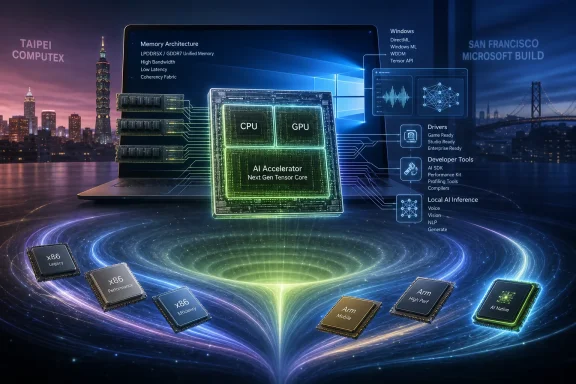
Futuristic image of CPU/GPU AI accelerator with Windows software features over a glowing data-flow ring.Nvidia Is No Longer Content to Sit in the Expansion Slot​

For most of PC history, Nvidia’s power came from being indispensable without being foundational. Intel or AMD supplied the CPU, Microsoft supplied Windows, OEMs built the chassis, and Nvidia supplied the performance part that gamers, creators, engineers, and increasingly AI developers actually cared about. That arrangement made Nvidia enormously profitable, but it also left the company outside the most strategic layer of the PC.
AI changed the center of gravity. The GPU stopped being a peripheral accelerator and became the main engine of modern computing. In the data center, Nvidia already turned that shift into a platform business: chips, networking, software libraries, developer tools, and procurement gravity all reinforcing one another. A Windows PC powered by Nvidia silicon is the same argument scaled down to the desk, the laptop bag, and eventually the enterprise refresh cycle.
That is why this move matters even if the first machines are expensive, limited, or aimed at developers. Nvidia does not need to win the entire PC market on day one. It needs to prove that the Windows ecosystem can support a PC where Nvidia is not merely the graphics brand on the sticker, but the architect of the machine’s performance identity.
Microsoft has its own reason to welcome the intrusion. The first Copilot+ PCs showed that Windows could define an AI hardware baseline, but they did not yet prove that AI PCs were a must-buy category. Nvidia brings a stronger performance halo, a developer story, and a brand that consumers already associate with serious compute. For Microsoft, that is oxygen.

Microsoft’s AI PC Pitch Needed a Second Act​

The original Copilot+ PC launch in 2024 was supposed to be Microsoft’s clean break from the incremental laptop cycle. A neural processing unit capable of at least 40 TOPS became the new entry ticket. Local AI features such as Recall, Cocreator, Live Captions, and enhanced Windows search were meant to make the NPU feel like a new organ in the PC, not a benchmark footnote.
Instead, Recall swallowed the launch. The feature’s promise was simple and unsettling: Windows would remember what you had seen and done so you could search your own past activity. Microsoft later moved to make it opt-in and reworked the security and privacy model, but the damage was already done. The public conversation drifted away from “new AI workflows” and toward “why is my operating system taking snapshots of my life?”
That left Microsoft with a category problem. Copilot+ PCs could be good laptops, especially on battery life, but the signature AI use case became a trust crisis. For many buyers, the NPU was invisible unless Windows put it in their face. And when Windows did put it in their face, the result was often suspicion rather than desire.
Nvidia’s arrival gives Microsoft a more familiar story to tell: performance first, AI second, productivity third. That order matters. PC buyers understand why a faster GPU, better local model performance, and stronger creative workloads might be valuable. They are more skeptical when the operating system leads with ambient surveillance-adjacent features and asks users to believe the privacy architecture is safe this time.

The Arm Question Is Still the Windows Question​

The reported Nvidia Windows chips are widely expected to lean on Arm technology, the same instruction-set family behind Qualcomm’s Snapdragon X chips and Apple Silicon. That puts them in the middle of the oldest unresolved Windows hardware argument of the modern era. Windows on Arm is no longer a science project, but it is not yet boring infrastructure either.
For ordinary users, the issue is application compatibility. Microsoft has made major progress with emulation, native Arm64 apps, and developer tooling, but the Windows ecosystem remains messier than Apple’s. Legacy utilities, drivers, shell extensions, VPN clients, anti-cheat systems, creative plugins, and obscure business apps can still turn an elegant hardware story into a help-desk ticket.
For enterprises, that uncertainty is the tax on every Arm Windows pitch. A laptop that benchmarks beautifully is not a deployment win if one department’s line-of-business software fails, one security agent behaves oddly, or one printer driver becomes a week-long archaeology project. IT departments do not buy architectures; they buy predictable support boundaries.
That is why Nvidia’s brand cuts both ways. It can make Windows on Arm feel more credible to enthusiasts and developers, but it will also raise expectations. If these machines are positioned as premium AI PCs, buyers will not forgive the sort of compatibility caveats they tolerated in earlier experimental Windows on Arm devices. The standard will be MacBook-level polish, not “better than last time.”

Qualcomm Finally Gets the Validation It Didn’t Ask For​

One of the more ironic consequences of Nvidia’s entry is that it may help Qualcomm. Snapdragon X laptops carried much of the first Copilot+ push, and Qualcomm had to absorb the burden of explaining Windows on Arm, NPU metrics, battery claims, and app compatibility all at once. That was too much for one vendor to normalize alone.
If Nvidia joins the party, Arm-based Windows PCs stop looking like a Qualcomm side bet and start looking like a platform shift. Developers have more reason to compile native Arm64 builds. Peripheral vendors have more reason to care about drivers. Microsoft has more incentive to harden the rough edges because the opportunity now includes not just one chip partner, but multiple strategic silicon suppliers.
This is how ecosystems change: not by one heroic launch, but by the accumulation of reasons to stop ignoring the new target. Apple forced developers to move because it controlled the Mac. Microsoft cannot force the Windows ecosystem with the same elegance, but it can create gravity through OEM volume, silicon diversity, and platform incentives.
Still, Qualcomm will not be celebrating without anxiety. Nvidia does not enter markets politely. If Nvidia can combine competitive CPU performance, strong battery life, GeForce-class graphics credibility, and a superior local AI stack, Qualcomm’s first-mover advantage could compress quickly. The best outcome for Microsoft is a three-way fight among Qualcomm, Nvidia, and the x86 incumbents. The worst outcome for any one chipmaker is being the transitional vendor that proved the market for someone else.

Intel and AMD Are Being Attacked From the Future and the Past​

Intel and AMD are not standing still. Both have moved NPUs into mainstream processors, both are chasing Copilot+ eligibility, and both have decades of compatibility advantage behind them. The x86 PC remains the default for gaming, enterprise fleets, workstations, and the vast gray market of Windows software that nobody wants to audit too closely.
But the threat from Nvidia is not simply another CPU competitor. It is a competitor arriving with the strongest AI hardware narrative in the industry and a software ecosystem that developers already use. CUDA, TensorRT, RTX, DLSS, and Nvidia’s broader AI tooling are not just product names. They are habits, workflows, and assumptions.
Intel’s problem is that “good enough x86 plus an NPU” may not be emotionally compelling in a market being sold as the beginning of the AI era. AMD’s problem is similar but sharper: it has strong CPU and GPU engineering, yet it lacks Nvidia’s near-mythic AI brand. Both companies can deliver excellent PCs, but they must now defend the premise that continuity is better than reinvention.
That defense may still work. Enterprises often prefer continuity. Gamers care about compatibility and discrete GPU roadmaps. Many buyers will choose x86 because it runs everything they already own without a second thought. But if AI workloads become local, persistent, and user-visible, Nvidia can argue that the PC’s center of value has moved onto terrain where it is strongest.

The First Machines Will Be Judged Like Developer Kits, Even If They Look Like Laptops​

The first Nvidia-powered Windows PCs may arrive with the polish of retail products, but the market will treat them like proof-of-concept machines. Reviewers will test battery life, fan noise, app compatibility, gaming behavior, local AI performance, thermals, standby reliability, and whether Windows itself feels native or negotiated. That is a brutal checklist.
The most important tests will not be synthetic TOPS numbers. The AI PC market is already drowning in abstract performance claims. What matters is whether a user can run a local model without wrecking battery life, transcribe and summarize meetings without sending everything to the cloud, generate media in useful time, search files intelligently, and switch between legacy Windows apps without thinking about the instruction set.
Nvidia also has to solve the laptop problem, not just the chip problem. Apple Silicon succeeded because the whole machine improved: speed, battery, thermals, sleep, video, and silence. Windows buyers will expect the same leap if Nvidia is selling a new architecture. A hot, loud AI laptop with great demos and mediocre everyday behavior will not reset the market.
OEM execution will matter enormously. Dell, HP, Lenovo, Asus, MSI, and Microsoft Surface all know how to build Windows PCs, but they do not all make the same tradeoffs. A great chip can disappear inside a compromised chassis. A merely decent chip can look better than it is inside a carefully tuned premium machine. Nvidia and Microsoft will need the first wave to feel intentional, not like a spec-sheet scramble.

Local AI Is the Only AI PC Argument That Makes Sense​

The cloud is still where the largest models live, and that will remain true for the foreseeable future. But a PC with serious local AI capability makes a different promise: lower latency, more privacy, offline operation, lower marginal cost, and more personalized workflows. That is the argument Microsoft should have led with more carefully from the beginning.
The challenge is that local AI must be useful without feeling creepy. A machine that can summarize documents, index personal files, enhance video calls, run coding assistants, and process images locally has an obvious appeal. A machine that continuously observes user activity and asks for trust after the fact invites backlash.
Nvidia can help here because its developer ecosystem is already oriented around doing real work with accelerated compute. If the Windows AI PC becomes a place where developers can run compact models, prototype agents, build local inference apps, and ship GPU-accelerated experiences, the category gains substance. It becomes less about Microsoft sprinkling AI into Windows and more about Windows becoming a viable local AI platform.
That distinction is critical. Users may not buy a new PC because Windows has another assistant panel. They might buy one because the apps they already use become faster, smarter, and less dependent on subscriptions or round trips to a server. The AI PC only works if the intelligence shows up inside workflows, not just inside marketing.

Security Will Decide Whether IT Lets the New Platform In​

For sysadmins, the Nvidia-Microsoft pitch will immediately raise governance questions. What data do local models access? How are model files updated? Which features are manageable through policy? Can Recall-like capabilities be disabled, audited, or scoped? How do endpoint detection tools inspect AI-assisted workflows without becoming performance bottlenecks?
These are not edge concerns. Microsoft spent the last few years telling enterprises it was recommitting to security after a series of bruising incidents and public criticism. If Windows is now going to host more local AI agents, more semantic indexes, and more background inference, the security model cannot be a white paper stapled to a launch event.
Nvidia brings additional complexity. GPU drivers already sit in a privileged and performance-sensitive part of the system. AI runtimes, model execution layers, and hardware acceleration paths expand the attack surface. That does not make the platform unsafe by default, but it does make transparency and manageability essential.
The best version of this launch would give administrators clear controls from day one. The worst version would repeat the familiar Windows pattern: consumer-first features, enterprise controls later, and admins left to reverse-engineer what needs to be blocked. If Microsoft wants AI PCs in serious fleets, it has to treat manageability as a launch feature, not a quarterly cleanup item.

Developers Are the Real Launch Audience​

The consumer story will get the glossy demos, but developers are the audience that can make or break this transition. Windows needs native Arm64 software. It needs AI frameworks that behave well across NPUs, GPUs, and CPUs. It needs packaging, deployment, debugging, and performance tools that make the new hardware feel like an opportunity rather than a compatibility chore.
Nvidia knows this playbook. Its data-center dominance was built not only on silicon but on developer lock-in through software. If it can bring a credible version of that stack to Windows PCs, it may create a new tier of machines aimed at AI developers who want local inference, GPU acceleration, and Windows compatibility in one box.
That could be especially interesting for small teams. Not every developer wants to rent cloud GPUs for every experiment. Not every business wants sensitive prompts, documents, or prototypes leaving the device. A powerful local Windows AI machine could become a useful middle ground between ordinary laptops and remote workstations.
But Microsoft must avoid fragmenting the developer target. If Copilot+ features use one path, Nvidia tools another, Qualcomm another, and x86 NPUs yet another, developers will route around the whole mess and keep targeting cloud APIs. The promise of local AI depends on abstraction layers that are performant enough to matter and stable enough to trust.

The PC Market Is Ready for Disruption, but Not for Confusion​

The timing is favorable. Windows 10’s support deadline pushed many organizations and consumers toward hardware decisions. The pandemic PC boom has aged into a replacement cycle. AI has given vendors a new reason to argue that old laptops are not merely slower, but structurally obsolete.
Yet the PC market is also exhausted by branding. “AI PC,” “Copilot+ PC,” “NPU,” “TOPS,” “RTX,” “Arm,” and “local agents” can blur into a fog of stickers. Microsoft and Nvidia need to explain what these machines do better in language that survives contact with a retail shelf and a procurement spreadsheet.
The danger is a repeat of past Windows hardware transitions where the category was technically meaningful but commercially muddy. Windows RT taught users to fear compatibility exceptions. Early Windows on Arm devices taught reviewers to ask what did not work. The first Copilot+ wave taught Microsoft that AI features can become liabilities if trust is not established before the demo.
Nvidia’s best chance is to make the machines obviously good before they are philosophically interesting. Fast browsing, long battery life, quiet thermals, strong creative performance, credible gaming behavior, and useful local AI would do more for the category than any keynote claim. The PC buyer’s first question is not whether the architecture is elegant. It is whether the machine makes yesterday’s laptop feel old.

The Launch That Has to Prove More Than a Chip​

The Nvidia-Microsoft launch is best understood as a platform audition. It is a test of Windows on Arm, a test of local AI, a test of OEM discipline, and a test of whether Microsoft can turn Copilot+ from a label into a reason to upgrade.
  • The first Nvidia-powered Windows PCs are expected to use Nvidia silicon as the main processor, not merely as a discrete graphics option.
  • The launch gives Microsoft a stronger second act for Copilot+ PCs after Recall complicated the original AI PC rollout.
  • Arm compatibility remains the practical barrier that will determine whether enthusiasts praise these systems while enterprises wait.
  • Intel and AMD retain the x86 compatibility advantage, but Nvidia brings the AI performance brand Microsoft has been missing.
  • The most important benchmarks will be everyday behavior: battery life, thermals, app reliability, local AI usefulness, and manageability.
  • IT adoption will depend on clear controls for AI features, model access, data retention, driver behavior, and endpoint security.
If Nvidia and Microsoft get this right, the result will not be an overnight replacement for x86 Windows PCs. It will be something more consequential: a credible alternative center of gravity for the Windows ecosystem. The PC has survived many reinventions by absorbing them slowly, then suddenly; Nvidia’s first real Windows processor moment may be the point where the AI PC stops being a marketing category and starts becoming a platform fight.

References​

  1. Primary source: world.infonasional.com
    Published: 2026-05-31T09:52:06.647667
  2. Related coverage: axios.com
  3. Related coverage: techradar.com
  4. Related coverage: tomsguide.com
  5. Related coverage: investing.com
  6. Related coverage: m.investing.com
  1. Related coverage: ca.investing.com
  2. Related coverage: thestar.com.my
  3. Related coverage: au.investing.com
  4. Related coverage: ktwb.com
  5. Related coverage: marketscreener.com
  6. Related coverage: techxplore.com
  7. Official source: blogs.microsoft.com
  8. Official source: blogs.windows.com
  9. Related coverage: forbes.com
  10. Related coverage: windowslatest.com
  11. Official source: support.microsoft.com
  12. Related coverage: geekwire.com
  13. Related coverage: arstechnica.com
  14. Official source: microsoft.com
  15. Official source: 9to5google.com
  16. Related coverage: windowscentral.com
  17. Related coverage: tomshardware.com
  18. Related coverage: time.com
 

Back
Top