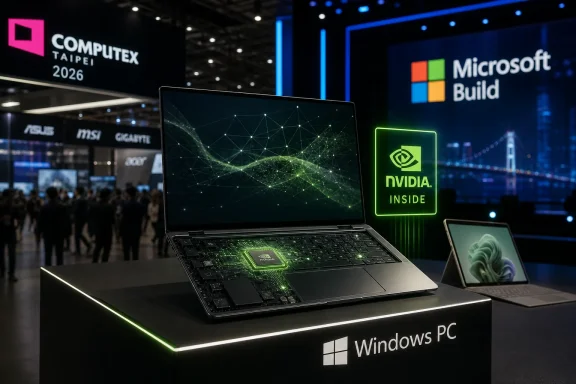
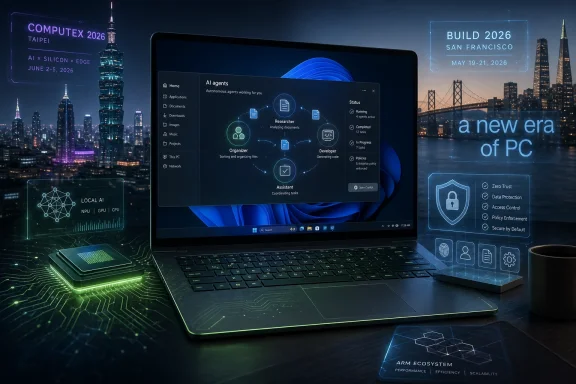
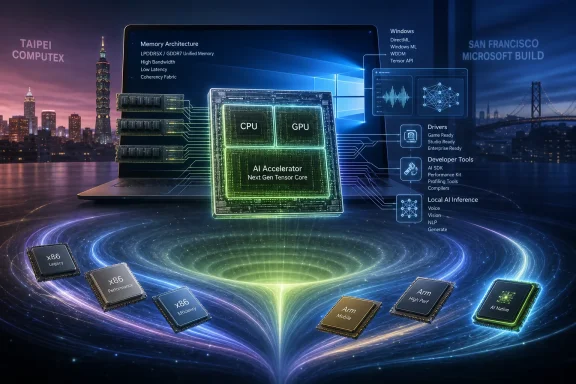
Microsoft and Nvidia are expected to unveil the first Windows PCs powered by Nvidia-designed Arm chips during Computex in Taipei and Microsoft Build in San Francisco in early June 2026, marking Nvidia’s most direct attempt yet to enter the Windows client processor market. The move is not just another AI PC launch. It is a bid to redraw the Windows hardware map around Arm, local AI acceleration, and GPU-class branding that Intel and AMD can no longer treat as background noise.
For Windows users, the interesting part is not that another chip vendor wants a laptop logo. It is that Microsoft appears ready to give Nvidia the kind of platform runway that Qualcomm spent years trying to earn. If the first machines arrive with Surface, Dell, or other top-tier OEM backing, the Windows PC business may be entering its most consequential architectural contest since the original Copilot+ PC rollout.
Nvidia has spent decades as the company that made PCs faster, louder, hotter, and more desirable — but usually as the add-on, not the foundation. Its GPUs defined gaming rigs, creator workstations, CUDA development boxes, and eventually AI servers, but the Windows client CPU socket remained someone else’s kingdom. Intel owned it by default, AMD fought its way back into it, and Qualcomm spent the last several years trying to convince Windows users that Arm could be more than a battery-life curiosity.
That is why the reported Nvidia N1 and N1X moment matters. If these chips debut as expected, Nvidia is not merely selling graphics into a Windows notebook. It is selling the compute identity of the whole machine: CPU, GPU, AI acceleration, media, power management, and the developer story around all of it.
That shift is bigger than a silicon press release because modern laptops are no longer assembled around a simple CPU hierarchy. They are sold as platforms. Apple taught the industry that lesson with M-series Macs, where the chip became the product story, the performance story, and the battery-life story all at once. Microsoft has wanted a Windows equivalent for years, but Windows’ greatest strength — hardware diversity — has also made that message harder to package.
Nvidia gives Microsoft a different kind of weapon. Qualcomm brought credible Arm efficiency and finally made Windows on Arm feel less experimental. Nvidia brings a brand that gamers, developers, AI researchers, and enterprise buyers already associate with high-performance compute. The question is whether that brand can survive the brutal reality of Windows laptop expectations.
Microsoft has already laid the groundwork with Windows 11 version 26H1, a release positioned for new silicon rather than a broad consumer feature wave. That matters because Windows historically bends slowly around new processor architectures. Driver models, emulation layers, security requirements, AI runtimes, firmware standards, and OEM imaging all have to move together. A chip can be impressive in isolation and still fail as a PC if the operating system treats it like an exception.
This is the piece that veteran Windows watchers should focus on. Microsoft does not need another AI PC sticker. It needs a reason for developers and administrators to believe that Windows on Arm is no longer a parallel track with caveats. A high-profile Nvidia entrance could help Microsoft argue that Arm is becoming a mainstream Windows target rather than a Qualcomm-specific island.
The company also needs to keep the Copilot+ PC category from hardening into a marketing promise with uneven practical value. The first Copilot+ wave made the NPU the star of the spec sheet, with 40 TOPS becoming the threshold number that buyers learned whether they wanted to or not. But the market has been waiting for software that makes local AI hardware feel indispensable. Nvidia’s arrival raises the stakes because it brings a much stronger expectation of local acceleration, developer tooling, and GPU-adjacent AI performance.
Microsoft’s challenge is harder because it must support an enormous back catalog of Win32 software, enterprise agents, peripherals, games, anti-cheat systems, VPN clients, security tools, accessibility software, printer drivers, and vendor utilities. The PC is not a curated garden. It is a yard sale with mission-critical dependencies.
That is why Nvidia cannot simply show a beautiful benchmark and declare victory. The first Nvidia Windows PCs will be judged by the dullest possible workflows: Does the corporate VPN install? Does the external dock behave? Does Excel with ancient add-ins run properly? Does the conference-room audio driver stop vanishing after sleep? Does the game launch without an anti-cheat tantrum? Does the battery estimate mean anything after six months?
If Nvidia and Microsoft get those details right, the comparison to Apple becomes less embarrassing and more useful. Windows does not need to become macOS. It needs to prove that an Arm laptop can be a normal Windows laptop first and an AI showcase second.
Nvidia changes the emotional temperature of the market. It has a developer ecosystem around CUDA, a dominant AI brand, and a gaming halo that still carries weight even when the product is not a discrete GPU. A Windows laptop with Nvidia silicon will be judged partly on laptop metrics, but also on the fantasy that it might bring more of Nvidia’s AI and graphics stack into thinner, longer-lasting machines.
That fantasy may outrun the first-generation reality. Arm laptop chips live within thermal and power limits, and Nvidia cannot magically put a desktop RTX experience into a fanless ultraportable. But perception matters in the PC channel. Buyers often make choices based on platform confidence as much as raw performance, and Nvidia is one of the few companies whose logo can change that conversation overnight.
Intel’s risk is strategic. It has spent years recovering from manufacturing delays and competition from AMD, only to find the client market shifting toward AI accelerators and efficiency narratives that weaken the old CPU-first frame. AMD’s risk is different: it has strong CPU and GPU assets but lacks Nvidia’s AI software gravity. Both companies can respond technically. The question is whether they can respond narratively.
Enterprise IT does not adopt platforms because a keynote looked good. It adopts them when lifecycle support, firmware servicing, docking compatibility, Windows Autopilot behavior, endpoint management, security baselines, and repair programs stop looking risky. Nvidia and Microsoft can impress enthusiasts quickly, but administrators will need a slower kind of persuasion.
That persuasion will depend on boring guarantees. Will these machines get predictable driver updates through Windows Update and OEM channels? Will Nvidia’s control software stay out of the way in managed environments? Will Arm-native versions of security and management tools be ready? Will vendors clearly distinguish native, emulated, accelerated, and unsupported workloads?
Microsoft has been here before. Windows RT failed because it asked users to accept Windows branding without Windows compatibility. Early Windows on Arm systems failed because they promised portability but delivered too many edge-case compromises. The Snapdragon X generation improved the story dramatically, but the shadow of those earlier attempts remains. Nvidia’s launch must avoid any sense that Windows users are being asked to beta-test an ecosystem.
Nvidia’s entry could either fix that problem or expose it. If the company can bring compelling local AI workloads to Windows laptops — not just demos, but repeatable daily advantages — it will make the Copilot+ category feel less abstract. Developers might get faster local model testing. Creators might get better generative tools without constant cloud round-trips. Gamers might see AI upscaling and frame-generation technologies tied more deeply into portable systems. Knowledge workers might get assistants that operate across local files with lower latency and better privacy controls.
But none of that is guaranteed. AI features can easily become a showroom layer over a conventional PC, impressive for five minutes and ignored after five days. The difference between capability and habit is where Microsoft has struggled. Windows is full of features users technically have and rarely seek out.
The best version of this launch would show Nvidia and Microsoft focusing less on “TOPS” as a magic number and more on workflows people already understand. Faster video editing. Better battery life under Teams. Local search that works. Development environments that run cleanly. Games that do not punish the new architecture. AI that saves time without demanding trust it has not earned.
The biggest issue is not whether Arm-native apps exist in 2026. Many do, and the situation is far better than it was in the Windows RT or early Windows 10 on Arm era. The issue is the long tail: helper services, browser extensions, kernel drivers, old installers, license managers, audio plug-ins, line-of-business apps, shell extensions, game launchers, and security modules.
Emulation can hide much of that complexity until it cannot. When it fails, it tends to fail in ways that ordinary buyers interpret as “this PC is weird.” That is deadly. The Windows brand is built on the promise that whatever strange thing you need to run will probably run. Arm Windows machines must preserve that expectation or clearly set boundaries before the sale.
Nvidia has one advantage here: developers already pay attention when Nvidia enters a market. If the launch comes with serious tooling, documentation, SDK support, and a visible path for native optimization, software vendors may move faster than they did for prior Windows Arm waves. But the burden is still on Microsoft to make the platform feel coherent.
PC gaming is not just DirectX. It is launchers, overlays, mods, capture tools, input utilities, shader compilation, kernel-level anti-cheat systems, and years of assumptions about x86 Windows. If Nvidia can make a large portion of the library run well, it will have a compelling story. If major games fail because of anti-cheat or translation problems, the Nvidia logo will not save the experience.
Still, gaming gives Nvidia a lever Qualcomm never had at the same scale. Even if the first N1X systems are pitched primarily as AI PCs or premium productivity machines, buyers will ask what they can play. OEMs will ask how to market them. Developers will ask whether this is a new target worth supporting.
The smart expectation is not “RTX gaming laptop replacement.” It is a new category of thin Windows machine with better-than-usual integrated graphics, AI-assisted rendering features, and a compatibility story that will take time to mature. If Nvidia overpromises, it will create backlash. If it underpromises and performs well, it could create momentum.
Nvidia gives Windows on Arm a second anchor tenant with very different strengths. Qualcomm’s story is mobile heritage, modem expertise, and efficiency. Nvidia’s story is accelerated computing, AI software, graphics, and developer gravity. Those stories can coexist, and their coexistence helps Microsoft more than either vendor alone.
For Microsoft, the strategic prize is optionality. If Windows on Arm becomes a multi-vendor category, Microsoft gains leverage over the future of PC hardware without abandoning Intel and AMD. It can push developers toward Arm-native support, pressure x86 vendors to improve efficiency and AI performance, and present Windows as a platform that spans architectures rather than a legacy system dragged into the AI era.
That is the strongest argument for taking this launch seriously even before products ship. The first machines may be expensive. They may be limited. They may have rough edges. But if they prove that another major silicon vendor can enter the Windows Arm market with Microsoft’s backing, the center of gravity moves.
Microsoft is no longer content to let the CPU roadmap define the Windows roadmap. It wants local AI features, secure execution paths, dedicated accelerators, cloud-connected agents, and hardware capabilities that map directly to Windows services. That means Microsoft increasingly cares not just whether a PC can run Windows, but whether it can run the version of Windows Microsoft wants to sell next.
Nvidia fits that ambition because it thinks in platforms, not parts. It sells hardware, software stacks, developer tools, cloud instances, model optimization paths, and ecosystem lock-in. That makes it a natural ally for Microsoft’s AI-era Windows strategy — and a potential source of tension if Nvidia’s own stack becomes too dominant inside the PC.
The irony is that Windows’ openness is both the reason Nvidia can enter and the reason Microsoft must be careful. If the PC becomes a collection of semi-exclusive AI hardware experiences, users may face a new fragmentation problem: some features for Qualcomm, some for Nvidia, some for AMD, some for Intel, and a haze of branding around all of it. Microsoft’s job is to make the differences meaningful without making Windows feel inconsistent.
The more useful test comes later, when the review units leave controlled demos and meet messy daily use. Battery life under mixed workloads will matter more than keynote claims. Sleep reliability will matter more than AI slogans. App compatibility will matter more than theoretical native performance. Thermals, fan noise, pricing, repairability, and driver cadence will decide whether these systems become recommended purchases or interesting footnotes.
Microsoft and Nvidia also need to explain who these PCs are for. If they are premium AI developer machines, say that. If they are MacBook competitors, prove it with battery life and app polish. If they are creator laptops, show the workflows. If they are enterprise devices, bring the management story. Vague “new era” language can open a launch, but it cannot carry a product cycle.
The best possible outcome is a first generation that is honest about its strengths. A Windows Arm machine does not have to beat every Intel, AMD, Qualcomm, and Apple device at once. It has to be excellent for a clear group of buyers and normal enough for everyone else to trust the direction.
For Windows users, the interesting part is not that another chip vendor wants a laptop logo. It is that Microsoft appears ready to give Nvidia the kind of platform runway that Qualcomm spent years trying to earn. If the first machines arrive with Surface, Dell, or other top-tier OEM backing, the Windows PC business may be entering its most consequential architectural contest since the original Copilot+ PC rollout.
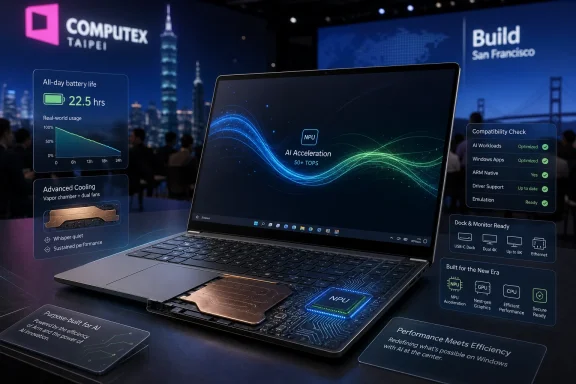 Nvidia Stops Being the Expensive Part Inside Someone Else’s PC
Nvidia has spent decades as the company that made PCs faster, louder, hotter, and more desirable — but usually as the add-on, not the foundation. Its GPUs defined gaming rigs, creator workstations, CUDA development boxes, and eventually AI servers, but the Windows client CPU socket remained someone else’s kingdom. Intel owned it by default, AMD fought its way back into it, and Qualcomm spent the last several years trying to convince Windows users that Arm could be more than a battery-life curiosity.That is why the reported Nvidia N1 and N1X moment matters. If these chips debut as expected, Nvidia is not merely selling graphics into a Windows notebook. It is selling the compute identity of the whole machine: CPU, GPU, AI acceleration, media, power management, and the developer story around all of it.
That shift is bigger than a silicon press release because modern laptops are no longer assembled around a simple CPU hierarchy. They are sold as platforms. Apple taught the industry that lesson with M-series Macs, where the chip became the product story, the performance story, and the battery-life story all at once. Microsoft has wanted a Windows equivalent for years, but Windows’ greatest strength — hardware diversity — has also made that message harder to package.
Nvidia gives Microsoft a different kind of weapon. Qualcomm brought credible Arm efficiency and finally made Windows on Arm feel less experimental. Nvidia brings a brand that gamers, developers, AI researchers, and enterprise buyers already associate with high-performance compute. The question is whether that brand can survive the brutal reality of Windows laptop expectations.
Microsoft’s Timing Says This Is About the Platform, Not Just the PC
The timing around Computex and Build is almost too neat. Computex is where hardware vendors announce the future in aluminum, vapor chambers, and spec sheets. Build is where Microsoft tells developers which future they are supposed to code for. A coordinated Nvidia-Microsoft reveal across those two venues would be a signal that this is not a one-off OEM experiment.Microsoft has already laid the groundwork with Windows 11 version 26H1, a release positioned for new silicon rather than a broad consumer feature wave. That matters because Windows historically bends slowly around new processor architectures. Driver models, emulation layers, security requirements, AI runtimes, firmware standards, and OEM imaging all have to move together. A chip can be impressive in isolation and still fail as a PC if the operating system treats it like an exception.
This is the piece that veteran Windows watchers should focus on. Microsoft does not need another AI PC sticker. It needs a reason for developers and administrators to believe that Windows on Arm is no longer a parallel track with caveats. A high-profile Nvidia entrance could help Microsoft argue that Arm is becoming a mainstream Windows target rather than a Qualcomm-specific island.
The company also needs to keep the Copilot+ PC category from hardening into a marketing promise with uneven practical value. The first Copilot+ wave made the NPU the star of the spec sheet, with 40 TOPS becoming the threshold number that buyers learned whether they wanted to or not. But the market has been waiting for software that makes local AI hardware feel indispensable. Nvidia’s arrival raises the stakes because it brings a much stronger expectation of local acceleration, developer tooling, and GPU-adjacent AI performance.
The Shadow Over This Launch Is Apple Silicon
Every Windows-on-Arm story eventually runs into the same comparison: Apple already did this. It moved the Mac to Arm, controlled the hardware and operating system, translated old apps with surprising competence, and gave users better battery life without making the product feel like a compatibility science project. The Windows ecosystem has never had that luxury.Microsoft’s challenge is harder because it must support an enormous back catalog of Win32 software, enterprise agents, peripherals, games, anti-cheat systems, VPN clients, security tools, accessibility software, printer drivers, and vendor utilities. The PC is not a curated garden. It is a yard sale with mission-critical dependencies.
That is why Nvidia cannot simply show a beautiful benchmark and declare victory. The first Nvidia Windows PCs will be judged by the dullest possible workflows: Does the corporate VPN install? Does the external dock behave? Does Excel with ancient add-ins run properly? Does the conference-room audio driver stop vanishing after sleep? Does the game launch without an anti-cheat tantrum? Does the battery estimate mean anything after six months?
If Nvidia and Microsoft get those details right, the comparison to Apple becomes less embarrassing and more useful. Windows does not need to become macOS. It needs to prove that an Arm laptop can be a normal Windows laptop first and an AI showcase second.
Intel and AMD Now Face a Different Kind of Threat
Intel and AMD have already been fighting the AI PC war on familiar terrain. They are improving NPUs, refreshing laptop platforms, pushing battery-life claims, and packaging CPUs and integrated graphics into ever more capable designs. That competition was intense but legible. Everyone knew the players and the upgrade cadence.Nvidia changes the emotional temperature of the market. It has a developer ecosystem around CUDA, a dominant AI brand, and a gaming halo that still carries weight even when the product is not a discrete GPU. A Windows laptop with Nvidia silicon will be judged partly on laptop metrics, but also on the fantasy that it might bring more of Nvidia’s AI and graphics stack into thinner, longer-lasting machines.
That fantasy may outrun the first-generation reality. Arm laptop chips live within thermal and power limits, and Nvidia cannot magically put a desktop RTX experience into a fanless ultraportable. But perception matters in the PC channel. Buyers often make choices based on platform confidence as much as raw performance, and Nvidia is one of the few companies whose logo can change that conversation overnight.
Intel’s risk is strategic. It has spent years recovering from manufacturing delays and competition from AMD, only to find the client market shifting toward AI accelerators and efficiency narratives that weaken the old CPU-first frame. AMD’s risk is different: it has strong CPU and GPU assets but lacks Nvidia’s AI software gravity. Both companies can respond technically. The question is whether they can respond narratively.
The OEMs Will Decide Whether This Becomes Real
A chip platform becomes a market only when OEMs ship enough machines, at enough prices, with enough configurations, for buyers to stop treating it as exotic. That is where the rumored Dell and possible Surface involvement becomes important. A single showcase laptop is a demo. A Surface device is a statement. A Dell commercial machine is a procurement conversation.Enterprise IT does not adopt platforms because a keynote looked good. It adopts them when lifecycle support, firmware servicing, docking compatibility, Windows Autopilot behavior, endpoint management, security baselines, and repair programs stop looking risky. Nvidia and Microsoft can impress enthusiasts quickly, but administrators will need a slower kind of persuasion.
That persuasion will depend on boring guarantees. Will these machines get predictable driver updates through Windows Update and OEM channels? Will Nvidia’s control software stay out of the way in managed environments? Will Arm-native versions of security and management tools be ready? Will vendors clearly distinguish native, emulated, accelerated, and unsupported workloads?
Microsoft has been here before. Windows RT failed because it asked users to accept Windows branding without Windows compatibility. Early Windows on Arm systems failed because they promised portability but delivered too many edge-case compromises. The Snapdragon X generation improved the story dramatically, but the shadow of those earlier attempts remains. Nvidia’s launch must avoid any sense that Windows users are being asked to beta-test an ecosystem.
The AI PC Still Needs Its Killer Habit
The industry has spent two years trying to make “AI PC” sound like a category rather than a purchasing department acronym. The hardware has improved faster than the everyday use case. Studio effects, local image generation, live captions, recall-style memory features, and background blur are useful, but they have not yet created the same visceral upgrade pressure that SSDs, high-refresh displays, or all-day battery life once did.Nvidia’s entry could either fix that problem or expose it. If the company can bring compelling local AI workloads to Windows laptops — not just demos, but repeatable daily advantages — it will make the Copilot+ category feel less abstract. Developers might get faster local model testing. Creators might get better generative tools without constant cloud round-trips. Gamers might see AI upscaling and frame-generation technologies tied more deeply into portable systems. Knowledge workers might get assistants that operate across local files with lower latency and better privacy controls.
But none of that is guaranteed. AI features can easily become a showroom layer over a conventional PC, impressive for five minutes and ignored after five days. The difference between capability and habit is where Microsoft has struggled. Windows is full of features users technically have and rarely seek out.
The best version of this launch would show Nvidia and Microsoft focusing less on “TOPS” as a magic number and more on workflows people already understand. Faster video editing. Better battery life under Teams. Local search that works. Development environments that run cleanly. Games that do not punish the new architecture. AI that saves time without demanding trust it has not earned.
Compatibility Is the Wall Every Windows Reinvention Hits
For enthusiasts, the first reviews will be a benchmark festival. For IT pros, they will be a compatibility audit. That gap explains why Windows transitions are so hard. A platform can win a synthetic performance chart and still lose the deployment meeting.The biggest issue is not whether Arm-native apps exist in 2026. Many do, and the situation is far better than it was in the Windows RT or early Windows 10 on Arm era. The issue is the long tail: helper services, browser extensions, kernel drivers, old installers, license managers, audio plug-ins, line-of-business apps, shell extensions, game launchers, and security modules.
Emulation can hide much of that complexity until it cannot. When it fails, it tends to fail in ways that ordinary buyers interpret as “this PC is weird.” That is deadly. The Windows brand is built on the promise that whatever strange thing you need to run will probably run. Arm Windows machines must preserve that expectation or clearly set boundaries before the sale.
Nvidia has one advantage here: developers already pay attention when Nvidia enters a market. If the launch comes with serious tooling, documentation, SDK support, and a visible path for native optimization, software vendors may move faster than they did for prior Windows Arm waves. But the burden is still on Microsoft to make the platform feel coherent.
Gamers Will Be Curious, Skeptical, and Mostly Correct
The word Nvidia guarantees gamer attention, but gaming may be the trickiest part of the story. A Windows laptop powered by Nvidia Arm silicon sounds, at first blush, like the dream of a portable machine with great graphics and great battery life. The reality will depend on GPU architecture, driver maturity, game compatibility, anti-cheat support, storefront behavior, and whether developers optimize for the platform.PC gaming is not just DirectX. It is launchers, overlays, mods, capture tools, input utilities, shader compilation, kernel-level anti-cheat systems, and years of assumptions about x86 Windows. If Nvidia can make a large portion of the library run well, it will have a compelling story. If major games fail because of anti-cheat or translation problems, the Nvidia logo will not save the experience.
Still, gaming gives Nvidia a lever Qualcomm never had at the same scale. Even if the first N1X systems are pitched primarily as AI PCs or premium productivity machines, buyers will ask what they can play. OEMs will ask how to market them. Developers will ask whether this is a new target worth supporting.
The smart expectation is not “RTX gaming laptop replacement.” It is a new category of thin Windows machine with better-than-usual integrated graphics, AI-assisted rendering features, and a compatibility story that will take time to mature. If Nvidia overpromises, it will create backlash. If it underpromises and performs well, it could create momentum.
Windows on Arm Finally Gets a Second Anchor Tenant
Until now, modern Windows on Arm has been overwhelmingly associated with Qualcomm. That was both a strength and a limitation. Qualcomm invested heavily, improved performance, and gave Microsoft a serious hardware partner. But a platform tied too closely to one silicon vendor can look less like an ecosystem and more like a special program.Nvidia gives Windows on Arm a second anchor tenant with very different strengths. Qualcomm’s story is mobile heritage, modem expertise, and efficiency. Nvidia’s story is accelerated computing, AI software, graphics, and developer gravity. Those stories can coexist, and their coexistence helps Microsoft more than either vendor alone.
For Microsoft, the strategic prize is optionality. If Windows on Arm becomes a multi-vendor category, Microsoft gains leverage over the future of PC hardware without abandoning Intel and AMD. It can push developers toward Arm-native support, pressure x86 vendors to improve efficiency and AI performance, and present Windows as a platform that spans architectures rather than a legacy system dragged into the AI era.
That is the strongest argument for taking this launch seriously even before products ship. The first machines may be expensive. They may be limited. They may have rough edges. But if they prove that another major silicon vendor can enter the Windows Arm market with Microsoft’s backing, the center of gravity moves.
The Old Wintel Bargain Keeps Fraying
For decades, the PC business ran on an implicit bargain: Microsoft supplied Windows, Intel supplied the dominant CPU platform, OEMs supplied variation, and customers accepted the rhythm. AMD periodically disrupted the performance story, but the architecture stayed familiar. The rise of AI PCs, Arm laptops, and Apple Silicon has made that bargain feel less permanent.Microsoft is no longer content to let the CPU roadmap define the Windows roadmap. It wants local AI features, secure execution paths, dedicated accelerators, cloud-connected agents, and hardware capabilities that map directly to Windows services. That means Microsoft increasingly cares not just whether a PC can run Windows, but whether it can run the version of Windows Microsoft wants to sell next.
Nvidia fits that ambition because it thinks in platforms, not parts. It sells hardware, software stacks, developer tools, cloud instances, model optimization paths, and ecosystem lock-in. That makes it a natural ally for Microsoft’s AI-era Windows strategy — and a potential source of tension if Nvidia’s own stack becomes too dominant inside the PC.
The irony is that Windows’ openness is both the reason Nvidia can enter and the reason Microsoft must be careful. If the PC becomes a collection of semi-exclusive AI hardware experiences, users may face a new fragmentation problem: some features for Qualcomm, some for Nvidia, some for AMD, some for Intel, and a haze of branding around all of it. Microsoft’s job is to make the differences meaningful without making Windows feel inconsistent.
The Real Test Begins After the Keynote
The first wave of reactions will be predictable. Investors will see another AI growth vector. Enthusiasts will argue about benchmarks. OEM watchers will parse model numbers. Windows skeptics will say they have heard this Arm story before. All of them will be partly right.The more useful test comes later, when the review units leave controlled demos and meet messy daily use. Battery life under mixed workloads will matter more than keynote claims. Sleep reliability will matter more than AI slogans. App compatibility will matter more than theoretical native performance. Thermals, fan noise, pricing, repairability, and driver cadence will decide whether these systems become recommended purchases or interesting footnotes.
Microsoft and Nvidia also need to explain who these PCs are for. If they are premium AI developer machines, say that. If they are MacBook competitors, prove it with battery life and app polish. If they are creator laptops, show the workflows. If they are enterprise devices, bring the management story. Vague “new era” language can open a launch, but it cannot carry a product cycle.
The best possible outcome is a first generation that is honest about its strengths. A Windows Arm machine does not have to beat every Intel, AMD, Qualcomm, and Apple device at once. It has to be excellent for a clear group of buyers and normal enough for everyone else to trust the direction.
The Practical Read for WindowsForum Readers
The noise around this launch will be loud because the companies involved are loud. Underneath it, the story is concrete: Nvidia may finally become a primary Windows PC silicon vendor, and Microsoft appears willing to make room for that future at the OS level.- The first Nvidia-powered Windows PCs are expected to be shown around Computex and Microsoft Build in early June 2026.
- The likely chips are Arm-based Nvidia designs commonly discussed as N1 and N1X, with laptops expected to be the first major showcase.
- Windows 11 version 26H1 appears tied to new silicon enablement, making this more than a routine OEM refresh.
- The biggest success factors will be app compatibility, driver maturity, battery life, thermals, and OEM support rather than peak AI benchmark numbers.
- Intel and AMD remain deeply entrenched, but Nvidia’s arrival would give Microsoft a stronger multi-vendor Windows on Arm story.
- Buyers should wait for independent testing before treating these systems as safe replacements for x86 Windows laptops in gaming, enterprise, or specialized professional workflows.
References
- Primary source: intellectia.ai
Published: 2026-05-30T03:40:35.700426
- Related coverage: axios.com
Microsoft, Dell to debut Nvidia-powered laptops
The chips will appear in Microsoft Surface computers and PCs from other manufacturers.www.axios.com
- Related coverage: tomsguide.com
Computex 2026 preview: Intel Arc G3 handhelds and cheap laptops to fight MacBook Neo confirmed, and I'm hoping for Nvidia N1X | Tom's Guide
Computex 2026 is almost here, and Tom's Guide will be in Taipei for the event! Here's what to expect, from Nvidia N1X, to the big Windows fightback against MacBook Neo.www.tomsguide.com - Related coverage: nvidianews.nvidia.com
NVIDIA CEO Jensen Huang and Global Technology Leaders to Showcase Age of AI at GTC 2026 | NVIDIA Newsroom
NVIDIA today announced that GTC, the world’s premier conference on AI and accelerated computing, will take place March 16-19 this year in San Jose, California.nvidianews.nvidia.com - Related coverage: tomshardware.com
Nvidia and Microsoft tease "a new era of PC" ahead of Computex 2026 — coordinated social media posts could indicate that rumored N1X laptops will be Windows on Arm systems | Tom's Hardware
An Nvidia-powered Arm PC running Windows could inspire new local AI experiences beyond Copilot+.www.tomshardware.com - Related coverage: windowslatest.com
Report: Nvidia prepares multiple Arm-based chips for 2026 and 2027, first-gen could debut with Windows 11 26H1
NVIDIA is still planning a Windows on Arm chip, with N1X-based laptops expected as early as Q1 2026. More CPUs are planned. www.windowslatest.com
- Related coverage: windowscentral.com
"A new era of PC": Microsoft and NVIDIA tease major announcement experts predict to be the fabled N1X chip | Windows Central
Microsoft and NVIDIA just hinted at major announcements at Computex and Build 2026.www.windowscentral.com - Related coverage: notebookcheck.net
Nvidia announces new PC era - Notebookcheck News
Nothing less than a new PC era is literally just around the corner, if Nvidia and Microsoft are to be believed. Both companies posted tweets over the weekend before Computex 2026 teasing major upcoming news. Here we clarify what is behind it and why it does not refer to Windows 12. www.notebookcheck.net
- Related coverage: portaltela.com
Microsoft e Nvidia anunciam nova era para PCs em anúncio misterioso
Microsoft e Nvidia sugerem parceria com promessa de “nova era para PCs”, a ser revelada durante a Computex 2026, em Taipei, entre 2 e 5 de junho. A fala de...www.portaltela.com - Related coverage: techradar.com
Microsoft signs up Asus and Dell to join the Cloud PC party - powerful new mini PCs and desktops coming later in 2026 | TechRadar
Asus and Dell are launching Windows 365 Cloud PCswww.techradar.com - Official source: techcommunity.microsoft.com
Microsoft at NVIDIA GTC 2026 | Microsoft Community Hub
Microsoft returns to NVIDIA GTC 2026 in San Jose with a strong presence across conference sessions, in‑booth theater talks, live demos, and executive‑level... techcommunity.microsoft.com
- Related coverage: blogs.nvidia.com
NVIDIA Rubin Platform, Open Models, Autonomous Driving: NVIDIA Presents Blueprint for the Future at CES | NVIDIA Blog
NVIDIA founder and CEO Jensen Huang opened CES in Las Vegas with Rubin — NVIDIA’s first extreme-codesigned AI platform — plus open models for healthcare, robotics and autonomy, and a Mercedes-Benz CLA showcasing AI-defined driving.blogs.nvidia.com - Related coverage: tweaktown.com
NVIDIA and Microsoft tease 'a new era of PC' ahead of Computex, and it's hard not to link this to the fabled N1X chip
N1X sightings have been piling up for months, and with Windows 12 ruled out, the new era of PC is almost certainly NVIDIA chips and new Surface hardware. www.tweaktown.com
- Related coverage: kucoin.com
Nvidia and Microsoft to Launch First Windows PCs Powered by Nvidia Chips in June | KuCoin
Nvidia is about to do something it has never done before: power a Windows PC. Not just the graphics card inside it, but the actual brain running the show.The fiwww.kucoin.com - Related coverage: nvidia.com
Join NVIDIA at Microsoft Build 2026
Learn how NVIDIA and Microsoft are partnering to accelerate the development and deployment of Generative AI across Microsoft Azure, Azure AI services, and more.www.nvidia.com - Related coverage: news.pm-global.co.uk
Nvidia Unveils Next-Generation AI Technologies and Strategic Partnerships at Computex 2025
PMG Newsnews.pm-global.co.uk
- Official source: learn.microsoft.com
Copilot+ PCs developer guide | Microsoft Learn
Developer guide for Windows Copilot+ PCs.learn.microsoft.com - Official source: support.microsoft.com
Learn more about Copilot+ PCs and Windows 11 PCs from Surface | Microsoft Support
Learn more about Copilot + PCs with powerful neural processing units and AI experiences like Recall and Cocreator, as well as Windows 11 PCs from Surface.support.microsoft.com - Official source: microsoft.com
Windows 11 の仕様とシステム要件 | Microsoft Windows
Windows 11 の仕様、システム要件、機能を Microsoft からご確認ください。Windows 11 のデバイス仕様、バージョン、対応言語の詳細をご覧ください。www.microsoft.com - Official source: news.microsoft.com