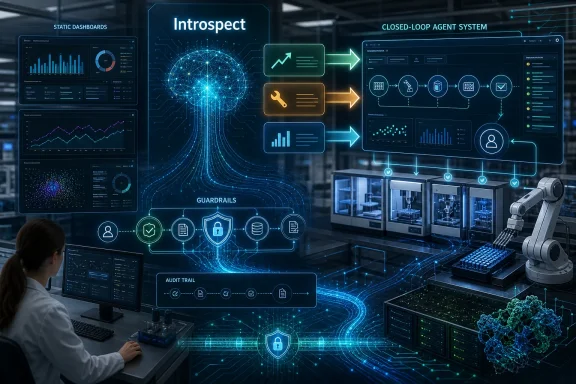
NVIDIA launched BioNeMo Agent Toolkit on June 23, 2026, and Tecan followed on June 24 by integrating its agentic AI capabilities into the Introspect laboratory analytics platform for clinical labs, pharmaceutical companies, and biotechnology environments. The announcement sounds, at first, like another vertical-market AI partnership. It is more important than that. This is NVIDIA’s attempt to move AI agents from chat windows and code editors into regulated, instrument-heavy workplaces where failure is measured in ruined assays, delayed diagnoses, and audit findings.
The past two years of enterprise AI have been dominated by a fairly narrow image of the “agent”: a software assistant that writes a report, files a ticket, queries a database, or chains together cloud APIs while a human watches nervously. BioNeMo Agent Toolkit points at a different destination. NVIDIA is positioning agents as operators inside scientific workflows, where they can call specialized models, interpret experimental data, and recommend changes to physical processes.
That matters because scientific work is already saturated with software, but not always with software that understands the work. A laboratory information system can track samples. A dashboard can report instrument utilization. A workflow engine can enforce a protocol. The gap is between monitoring and reasoning: knowing not just that throughput has fallen, but which reagent lot, instrument drift, scheduling constraint, or upstream protocol variation may be causing the problem.
Tecan’s Introspect integration is a good example of why this market is attractive to NVIDIA. Tecan already sits close to the machinery of automated laboratories. By adding BioNeMo-powered agentic capabilities to Introspect, it is not asking labs to adopt an abstract AI science project; it is embedding AI into a platform that already observes workflows, systems, and operational performance.
That is the play NVIDIA has been rehearsing across industries: do not sell only chips, and do not sell only models. Sell the layer that makes accelerated computing indispensable inside the customer’s workflow. In the lab, that layer is now being branded as scientific agents.
In ordinary IT terms, this sounds like observability growing a brain. A lab platform that previously surfaced dashboards and alerts is being pushed toward a model where agents look across data streams, infer patterns, and suggest interventions. That may include identifying throughput bottlenecks, flagging operational inefficiencies, or spotting conditions that could compromise a run before the lab loses time and materials.
The phrase “agentic AI” carries marketing baggage, but in this context it has a concrete meaning. The agent is not merely generating text about biology. It is being given access to scientific tools, models, and workflows so that it can reason across domain-specific tasks. NVIDIA’s BioNeMo Agent Toolkit is meant to provide those tool connections, while Tecan supplies the laboratory context and operational platform.
This is also why the “guardrails” language in the announcement is not decorative. In a clinical or pharma environment, an autonomous recommendation cannot be treated like a casual chatbot suggestion. Labs need transparency, repeatability, permissions, validation, and records showing why a system recommended what it did. The more useful the agent becomes, the more tightly it must be governed.
That is middleware in the most strategic sense. NVIDIA wants to sit between the scientific application and the compute underneath it. If a biotech company, pharma lab, or clinical automation vendor builds on BioNeMo, NVIDIA becomes more than the supplier of GPUs in the data center. It becomes part of the control plane for AI-assisted scientific work.
The partner list makes that clear. Alongside Tecan, reports around the launch point to integrations from companies such as Simulations Plus, Sigmatic Sciences, and HighRes Biosolutions. These firms operate in different corners of the life-sciences ecosystem, but the pattern is the same: NVIDIA is trying to seed BioNeMo into platforms that scientists and lab operators already use.
That approach is more credible than expecting labs to rip out validated systems and start over. It also mirrors how enterprise software usually absorbs disruptive technology. The winning layer is not the flashiest demo; it is the one that appears inside existing procurement, compliance, identity, storage, and workflow boundaries.
In an office setting, a mistaken AI summary can embarrass a manager or waste an afternoon. In a clinical lab, an automation error can affect quality control, turnaround time, patient-facing diagnostics, or the chain of custody around a specimen. In drug discovery, a bad recommendation can burn expensive reagents and instrument time while sending researchers down a false path.
That does not mean AI agents have no place in the lab. It means the first valuable uses are likely to be bounded, auditable, and advisory. An agent that identifies an emerging bottleneck, recommends maintenance, or compares workflow behavior against historical baselines is easier to defend than one that autonomously changes experimental parameters without human review.
The better analogy for sysadmins is not a self-driving car. It is an increasingly capable runbook automation system attached to observability, ticketing, and configuration management — except the “servers” are liquid handlers, analyzers, incubators, readers, and scientific models. Everyone wants the system to become smarter. Nobody serious wants it to become unaccountable.
That makes the endpoint story more important than the press release suggests. If AI agents begin to sit between lab analytics platforms and physical instrumentation, Windows administrators will inherit a familiar but sharper version of the old problem: local devices feeding sensitive data into increasingly complex back-end systems. Identity, endpoint hardening, certificate management, network segmentation, driver stability, and update control all become part of the AI deployment.
The software stack may be branded as BioNeMo, but the operational blast radius includes mundane Windows concerns. A locked-down instrument PC running a legacy vendor application may be the weak link in a cutting-edge AI workflow. A poorly governed service account may matter more than the model’s benchmark score. A flaky USB-attached instrument controller can still ruin the day.
This is where NVIDIA’s science push collides with the daily work of IT pros. The future of AI in labs will not be decided only by model accuracy or GPU availability. It will be decided by whether organizations can integrate these systems into environments that were never designed for autonomous software acting on live scientific operations.
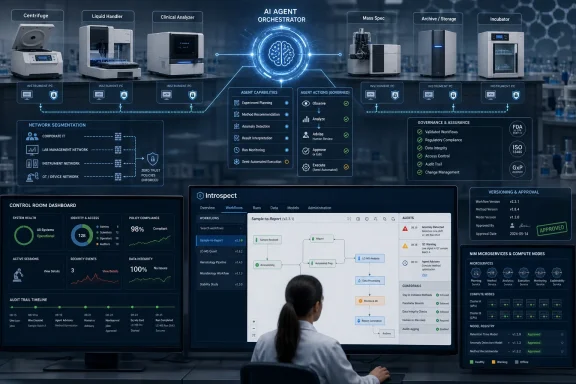
But the selling point that will matter most in regulated environments is not just productivity. It is explainability under pressure. When a lab director, quality manager, auditor, or customer asks why a workflow changed, “the agent recommended it” will not be enough. The system must show its inputs, reasoning path, permissions, version state, and the human approvals that turned a recommendation into an action.
That is why guardrails are not a secondary feature. In life sciences, the guardrail is often the product. A model that is slightly less dazzling but easier to validate may beat a more powerful system that behaves like an oracle. The winning deployment will be the one that improves throughput without making the quality department feel as if it has lost control.
This is also a place where Microsoft’s enterprise footprint will matter indirectly. Many labs already depend on Microsoft identity, Windows endpoints, SQL Server, Azure services, Teams-based collaboration, and Microsoft 365 compliance tooling. NVIDIA and Tecan may provide the AI and laboratory platform, but customers will expect these systems to coexist with the administrative stack they already trust.
If BioNeMo becomes the toolkit that partners use to build scientific agents, NVIDIA gains leverage at a level above hardware refresh cycles. The company would not need every lab manager to understand CUDA, Blackwell, or DGX. It would need lab software vendors to make BioNeMo the default way their platforms connect agents to scientific tools.
That is a familiar platform strategy. Microsoft made Windows indispensable by becoming the common layer for applications and hardware. VMware made itself indispensable by becoming the operational layer for servers. NVIDIA wants its AI software stack to become the layer through which specialized agents consume accelerated computing.
The risk is that vertical workflows are stubborn. Scientists and lab operators do not adopt tools because a platform vendor says the future has arrived. They adopt them when the tool saves time, improves quality, reduces rework, or enables experiments that were previously impractical. BioNeMo’s success will depend less on NVIDIA’s keynote language than on whether partners like Tecan can make agents useful in the ugly middle of real operations.
For customers, the question is not whether lock-in exists. It always does. The question is whether the productivity gains, support model, and technical maturity justify the dependency. In a lab environment, switching costs can be brutal because workflows become validated, staff are trained, integrations accumulate, and data histories become tied to platform assumptions.
This is where open components and interoperability claims need scrutiny. Open-source tools can reduce risk, but they do not automatically eliminate dependence on a vendor’s models, APIs, GPU optimizations, cloud services, or partner ecosystem. A lab can be using open pieces and still find that the practical path of least resistance runs through one supplier.
IT leaders should therefore read BioNeMo announcements in two columns. One column contains the near-term operational upside: better analytics, faster troubleshooting, improved utilization, and smarter workflows. The other contains architectural commitments: where data flows, which compute stack is assumed, how agents are governed, and how easily the organization can move if pricing, strategy, or compliance requirements change.
That means least-privilege access, strong identity controls, logging, approval gates, and isolation between advisory and operational functions. If an agent can read sensitive research data, it must be governed like any other system with access to intellectual property. If it can recommend or initiate workflow changes, those actions need authorization boundaries. If it can call external models or cloud services, data routing must be explicit.
The Windows endpoint angle returns here. Many labs still depend on local PCs attached to instruments that were designed long before modern zero-trust assumptions became fashionable. These machines may be difficult to patch, risky to upgrade, or tied to vendor-certified configurations. Adding AI-driven orchestration above them raises the value of every identity token, API key, network share, and local admin password in the environment.
The right mental model is not “AI feature.” It is “new automation plane.” Once administrators see it that way, the checklist becomes clearer: inventory the systems, classify the data, map the permissions, define the rollback process, and decide which actions require a human sign-off no matter how confident the model sounds.
That is where agentic systems can earn trust. A lab does not need to hand over scientific judgment on day one. It can start by letting the agent observe, correlate, recommend, and document. Over time, if those recommendations prove reliable, the scope can expand from advisory analytics to controlled automation.
This progression mirrors how infrastructure automation entered enterprise IT. Scripts became runbooks. Runbooks became orchestration. Orchestration became policy-driven automation. The organizations that succeeded were not the ones that automated everything first; they were the ones that understood which steps were safe to automate, which needed review, and which should remain human-owned.
Clinical labs and pharma environments will likely follow the same path. The first deployments that matter will not be judged by whether they sound futuristic. They will be judged by whether they survive validation, reduce operational pain, and produce records that quality teams can defend.
It needs access to data that may be scattered across instruments, LIMS platforms, ELNs, storage systems, databases, and vendor-specific file formats. It needs permissions that reflect real organizational roles. It needs a way to understand which data are clean, which are provisional, and which are subject to regulatory controls. It needs to know when a recommendation is scientifically plausible but operationally impossible because the instrument is booked, the reagent is unavailable, or the protocol is locked.
This is why companies like Tecan matter in NVIDIA’s strategy. A general-purpose AI platform cannot simply parachute into a lab and understand the workflow. Domain vendors provide the context, installed base, and customer trust that make the AI layer deployable.
The hard part is that every lab is a snowflake pretending not to be. Standardized platforms help, but local workflows, equipment mixes, validation histories, and institutional habits differ. BioNeMo may provide common agent capabilities, yet the last mile will still require careful integration and change management.
But the revenue path is not guaranteed. Scientific organizations are cautious buyers when tools touch regulated workflows or core intellectual property. Proof-of-concept enthusiasm does not always become production standardization. A demo that impresses at a conference may still face months of security review, validation work, procurement friction, and integration debt.
The more realistic commercial story is incremental but durable. If BioNeMo becomes embedded in multiple partner platforms, NVIDIA can benefit from the cumulative spread of scientific AI workloads. Those workloads may consume GPUs, NIM microservices, cloud resources, enterprise support, and partner software. The company does not need every lab to become autonomous overnight; it needs the default architecture for scientific agents to assume NVIDIA acceleration.
That is why the Tecan announcement is notable despite its modest surface area. It is not a moonshot claim from a startup. It is a laboratory automation company adding NVIDIA’s agentic toolkit to an analytics platform aimed at real lab environments. Platform shifts often arrive this way: not as a revolution, but as a new option in software that customers already recognize.
That means future lab AI deployments will rarely be single-vendor stories. A clinical lab may authenticate through Entra ID, operate Windows instrument PCs, store operational data in Microsoft-backed systems, run analytics in a vendor platform, and call NVIDIA-accelerated models on-premises or in the cloud. The architecture will be hybrid because the real world is hybrid.
This creates both opportunity and risk for administrators. On the opportunity side, existing enterprise controls can help tame AI adoption. Conditional access, device compliance, data loss prevention, privileged access management, and logging pipelines can all be extended into AI-enabled workflows if vendors expose the right hooks. On the risk side, every opaque integration becomes a blind spot.
The practical question for IT is therefore not whether the lab wants AI. It is whether the AI system can be governed like serious enterprise software. If the answer is yes, BioNeMo-like deployments become manageable. If the answer is no, the lab may gain a clever agent while IT inherits an un-auditable automation layer attached to sensitive data and expensive equipment.
For Windows and enterprise IT teams, the announcement suggests several concrete things to watch as scientific agents begin appearing in vendor platforms.
Tecan’s BioNeMo integration will not by itself create the autonomous laboratory, and NVIDIA’s Agent Toolkit will not magically dissolve the hard constraints of regulated science. But it does mark a credible step toward AI systems that act less like chatbots and more like governed participants in real technical workflows. If NVIDIA and its partners can prove that these agents improve lab operations while remaining transparent, controllable, and secure, the next frontier of enterprise AI may look less like a browser tab and more like a Windows-connected instrument room humming through another validated run.
 NVIDIA Wants Agents to Leave the Browser and Enter the Lab
The past two years of enterprise AI have been dominated by a fairly narrow image of the “agent”: a software assistant that writes a report, files a ticket, queries a database, or chains together cloud APIs while a human watches nervously. BioNeMo Agent Toolkit points at a different destination. NVIDIA is positioning agents as operators inside scientific workflows, where they can call specialized models, interpret experimental data, and recommend changes to physical processes.That matters because scientific work is already saturated with software, but not always with software that understands the work. A laboratory information system can track samples. A dashboard can report instrument utilization. A workflow engine can enforce a protocol. The gap is between monitoring and reasoning: knowing not just that throughput has fallen, but which reagent lot, instrument drift, scheduling constraint, or upstream protocol variation may be causing the problem.
Tecan’s Introspect integration is a good example of why this market is attractive to NVIDIA. Tecan already sits close to the machinery of automated laboratories. By adding BioNeMo-powered agentic capabilities to Introspect, it is not asking labs to adopt an abstract AI science project; it is embedding AI into a platform that already observes workflows, systems, and operational performance.
That is the play NVIDIA has been rehearsing across industries: do not sell only chips, and do not sell only models. Sell the layer that makes accelerated computing indispensable inside the customer’s workflow. In the lab, that layer is now being branded as scientific agents.
Tecan’s Introspect Deal Is Really About Closing the Loop
The public framing around the Tecan announcement leans on productivity, proactive operations, and faster discovery. Those are familiar words in laboratory automation, but the architectural shift underneath them is more specific. Tecan is describing a move from retrospective analytics toward a system that can continuously analyze lab data and recommend action before performance, quality, or scientific outcomes are affected.In ordinary IT terms, this sounds like observability growing a brain. A lab platform that previously surfaced dashboards and alerts is being pushed toward a model where agents look across data streams, infer patterns, and suggest interventions. That may include identifying throughput bottlenecks, flagging operational inefficiencies, or spotting conditions that could compromise a run before the lab loses time and materials.
The phrase “agentic AI” carries marketing baggage, but in this context it has a concrete meaning. The agent is not merely generating text about biology. It is being given access to scientific tools, models, and workflows so that it can reason across domain-specific tasks. NVIDIA’s BioNeMo Agent Toolkit is meant to provide those tool connections, while Tecan supplies the laboratory context and operational platform.
This is also why the “guardrails” language in the announcement is not decorative. In a clinical or pharma environment, an autonomous recommendation cannot be treated like a casual chatbot suggestion. Labs need transparency, repeatability, permissions, validation, and records showing why a system recommended what it did. The more useful the agent becomes, the more tightly it must be governed.
BioNeMo Is Becoming NVIDIA’s Science Middleware
BioNeMo began as part of NVIDIA’s effort to make accelerated computing useful for biology, chemistry, and drug discovery. The Agent Toolkit expands that ambition from model access to workflow orchestration. Instead of presenting AI as a single model that predicts a protein structure or analyzes a sequence, NVIDIA is packaging a way for agents to call the right scientific capabilities at the right time.That is middleware in the most strategic sense. NVIDIA wants to sit between the scientific application and the compute underneath it. If a biotech company, pharma lab, or clinical automation vendor builds on BioNeMo, NVIDIA becomes more than the supplier of GPUs in the data center. It becomes part of the control plane for AI-assisted scientific work.
The partner list makes that clear. Alongside Tecan, reports around the launch point to integrations from companies such as Simulations Plus, Sigmatic Sciences, and HighRes Biosolutions. These firms operate in different corners of the life-sciences ecosystem, but the pattern is the same: NVIDIA is trying to seed BioNeMo into platforms that scientists and lab operators already use.
That approach is more credible than expecting labs to rip out validated systems and start over. It also mirrors how enterprise software usually absorbs disruptive technology. The winning layer is not the flashiest demo; it is the one that appears inside existing procurement, compliance, identity, storage, and workflow boundaries.
The Lab Is a Harder Target Than the Office
There is a reason this is not simply “Copilot for pipettes.” Laboratories are hostile environments for casual automation. Instruments differ by vendor, protocol, calibration state, firmware version, and maintenance history. Data quality varies. Human technique still matters. Regulatory obligations can turn a clever shortcut into a compliance problem.In an office setting, a mistaken AI summary can embarrass a manager or waste an afternoon. In a clinical lab, an automation error can affect quality control, turnaround time, patient-facing diagnostics, or the chain of custody around a specimen. In drug discovery, a bad recommendation can burn expensive reagents and instrument time while sending researchers down a false path.
That does not mean AI agents have no place in the lab. It means the first valuable uses are likely to be bounded, auditable, and advisory. An agent that identifies an emerging bottleneck, recommends maintenance, or compares workflow behavior against historical baselines is easier to defend than one that autonomously changes experimental parameters without human review.
The better analogy for sysadmins is not a self-driving car. It is an increasingly capable runbook automation system attached to observability, ticketing, and configuration management — except the “servers” are liquid handlers, analyzers, incubators, readers, and scientific models. Everyone wants the system to become smarter. Nobody serious wants it to become unaccountable.
Windows Desktops Are Still in the Room, Even When the AI Runs Elsewhere
For WindowsForum readers, the obvious temptation is to file this under “NVIDIA data center news” and move on. That would miss the operational reality of many labs. Even when the model training and heavy inference happen on accelerated servers or cloud infrastructure, the lab floor is full of Windows workstations, vendor utilities, instrument-control PCs, local middleware, and browser-based dashboards.That makes the endpoint story more important than the press release suggests. If AI agents begin to sit between lab analytics platforms and physical instrumentation, Windows administrators will inherit a familiar but sharper version of the old problem: local devices feeding sensitive data into increasingly complex back-end systems. Identity, endpoint hardening, certificate management, network segmentation, driver stability, and update control all become part of the AI deployment.
The software stack may be branded as BioNeMo, but the operational blast radius includes mundane Windows concerns. A locked-down instrument PC running a legacy vendor application may be the weak link in a cutting-edge AI workflow. A poorly governed service account may matter more than the model’s benchmark score. A flaky USB-attached instrument controller can still ruin the day.
This is where NVIDIA’s science push collides with the daily work of IT pros. The future of AI in labs will not be decided only by model accuracy or GPU availability. It will be decided by whether organizations can integrate these systems into environments that were never designed for autonomous software acting on live scientific operations.
The Productivity Pitch Is Plausible, but the Audit Trail Is the Product
Tecan’s message is that Introspect can help laboratories move from reactive troubleshooting to proactive operations. That is plausible. Labs generate enormous operational exhaust: run times, error codes, sample queues, maintenance events, environmental readings, utilization patterns, and quality metrics. A system that can correlate those signals across time could find inefficiencies humans miss.But the selling point that will matter most in regulated environments is not just productivity. It is explainability under pressure. When a lab director, quality manager, auditor, or customer asks why a workflow changed, “the agent recommended it” will not be enough. The system must show its inputs, reasoning path, permissions, version state, and the human approvals that turned a recommendation into an action.
That is why guardrails are not a secondary feature. In life sciences, the guardrail is often the product. A model that is slightly less dazzling but easier to validate may beat a more powerful system that behaves like an oracle. The winning deployment will be the one that improves throughput without making the quality department feel as if it has lost control.
This is also a place where Microsoft’s enterprise footprint will matter indirectly. Many labs already depend on Microsoft identity, Windows endpoints, SQL Server, Azure services, Teams-based collaboration, and Microsoft 365 compliance tooling. NVIDIA and Tecan may provide the AI and laboratory platform, but customers will expect these systems to coexist with the administrative stack they already trust.
NVIDIA’s Real Customer Is the Workflow Owner
The Simply Wall St angle on the story is unsurprisingly investor-facing: BioNeMo extends NVIDIA’s reach into biotech, pharma R&D, and computational chemistry. That view is not wrong, but it is incomplete. The more interesting customer is not merely the buyer of GPUs. It is the workflow owner who decides which software becomes embedded in the organization’s daily scientific process.If BioNeMo becomes the toolkit that partners use to build scientific agents, NVIDIA gains leverage at a level above hardware refresh cycles. The company would not need every lab manager to understand CUDA, Blackwell, or DGX. It would need lab software vendors to make BioNeMo the default way their platforms connect agents to scientific tools.
That is a familiar platform strategy. Microsoft made Windows indispensable by becoming the common layer for applications and hardware. VMware made itself indispensable by becoming the operational layer for servers. NVIDIA wants its AI software stack to become the layer through which specialized agents consume accelerated computing.
The risk is that vertical workflows are stubborn. Scientists and lab operators do not adopt tools because a platform vendor says the future has arrived. They adopt them when the tool saves time, improves quality, reduces rework, or enables experiments that were previously impractical. BioNeMo’s success will depend less on NVIDIA’s keynote language than on whether partners like Tecan can make agents useful in the ugly middle of real operations.
Agentic AI Meets the Old Problem of Vendor Lock-In
Every platform story has a lock-in story hiding inside it. NVIDIA’s pitch is that BioNeMo gives life-sciences developers a toolkit for scientific agents, complete with domain capabilities that would be difficult for each vendor to build alone. That is attractive. It is also a way to make the NVIDIA ecosystem the default substrate for a new generation of scientific software.For customers, the question is not whether lock-in exists. It always does. The question is whether the productivity gains, support model, and technical maturity justify the dependency. In a lab environment, switching costs can be brutal because workflows become validated, staff are trained, integrations accumulate, and data histories become tied to platform assumptions.
This is where open components and interoperability claims need scrutiny. Open-source tools can reduce risk, but they do not automatically eliminate dependence on a vendor’s models, APIs, GPU optimizations, cloud services, or partner ecosystem. A lab can be using open pieces and still find that the practical path of least resistance runs through one supplier.
IT leaders should therefore read BioNeMo announcements in two columns. One column contains the near-term operational upside: better analytics, faster troubleshooting, improved utilization, and smarter workflows. The other contains architectural commitments: where data flows, which compute stack is assumed, how agents are governed, and how easily the organization can move if pricing, strategy, or compliance requirements change.
The Security Model Must Treat Agents as Privileged Actors
The security conversation around AI agents often focuses on prompt injection, data leakage, and hallucination. Those risks are real, but in a lab setting they are only the beginning. An agent that can interact with scientific workflows should be treated as a privileged actor, not a clever search box.That means least-privilege access, strong identity controls, logging, approval gates, and isolation between advisory and operational functions. If an agent can read sensitive research data, it must be governed like any other system with access to intellectual property. If it can recommend or initiate workflow changes, those actions need authorization boundaries. If it can call external models or cloud services, data routing must be explicit.
The Windows endpoint angle returns here. Many labs still depend on local PCs attached to instruments that were designed long before modern zero-trust assumptions became fashionable. These machines may be difficult to patch, risky to upgrade, or tied to vendor-certified configurations. Adding AI-driven orchestration above them raises the value of every identity token, API key, network share, and local admin password in the environment.
The right mental model is not “AI feature.” It is “new automation plane.” Once administrators see it that way, the checklist becomes clearer: inventory the systems, classify the data, map the permissions, define the rollback process, and decide which actions require a human sign-off no matter how confident the model sounds.
The First Wins Will Look Boring, Which Is Why They May Work
The most credible near-term use cases for Tecan and NVIDIA are not cinematic visions of autonomous laboratories discovering cures while humans sleep. They are operational improvements that sound boring until you are paying for the lab. Better scheduling. Earlier detection of instrument drift. Faster root-cause analysis. Reduced downtime. Smarter utilization of expensive automation.That is where agentic systems can earn trust. A lab does not need to hand over scientific judgment on day one. It can start by letting the agent observe, correlate, recommend, and document. Over time, if those recommendations prove reliable, the scope can expand from advisory analytics to controlled automation.
This progression mirrors how infrastructure automation entered enterprise IT. Scripts became runbooks. Runbooks became orchestration. Orchestration became policy-driven automation. The organizations that succeeded were not the ones that automated everything first; they were the ones that understood which steps were safe to automate, which needed review, and which should remain human-owned.
Clinical labs and pharma environments will likely follow the same path. The first deployments that matter will not be judged by whether they sound futuristic. They will be judged by whether they survive validation, reduce operational pain, and produce records that quality teams can defend.
The AI Scientist Is Still a Systems Integration Problem
NVIDIA’s technical framing around BioNeMo invites the idea of an “AI scientist,” a system that can reason across biology, chemistry, and experimental design. That phrase is useful as a north star, but misleading as a deployment plan. In practice, the AI scientist is a systems integration problem with a lab coat.It needs access to data that may be scattered across instruments, LIMS platforms, ELNs, storage systems, databases, and vendor-specific file formats. It needs permissions that reflect real organizational roles. It needs a way to understand which data are clean, which are provisional, and which are subject to regulatory controls. It needs to know when a recommendation is scientifically plausible but operationally impossible because the instrument is booked, the reagent is unavailable, or the protocol is locked.
This is why companies like Tecan matter in NVIDIA’s strategy. A general-purpose AI platform cannot simply parachute into a lab and understand the workflow. Domain vendors provide the context, installed base, and customer trust that make the AI layer deployable.
The hard part is that every lab is a snowflake pretending not to be. Standardized platforms help, but local workflows, equipment mixes, validation histories, and institutional habits differ. BioNeMo may provide common agent capabilities, yet the last mile will still require careful integration and change management.
The Money Story Is Bigger Than Drug Discovery Hype
Investor coverage understandably frames BioNeMo as a growth vector for NVIDIA beyond general AI infrastructure. Life sciences is attractive because it has deep pockets, difficult computational problems, expensive delays, and a long history of buying specialized tools. If AI can compress even part of the discovery or lab-operations cycle, the economic argument is obvious.But the revenue path is not guaranteed. Scientific organizations are cautious buyers when tools touch regulated workflows or core intellectual property. Proof-of-concept enthusiasm does not always become production standardization. A demo that impresses at a conference may still face months of security review, validation work, procurement friction, and integration debt.
The more realistic commercial story is incremental but durable. If BioNeMo becomes embedded in multiple partner platforms, NVIDIA can benefit from the cumulative spread of scientific AI workloads. Those workloads may consume GPUs, NIM microservices, cloud resources, enterprise support, and partner software. The company does not need every lab to become autonomous overnight; it needs the default architecture for scientific agents to assume NVIDIA acceleration.
That is why the Tecan announcement is notable despite its modest surface area. It is not a moonshot claim from a startup. It is a laboratory automation company adding NVIDIA’s agentic toolkit to an analytics platform aimed at real lab environments. Platform shifts often arrive this way: not as a revolution, but as a new option in software that customers already recognize.
Microsoft, NVIDIA, and the New Shape of Enterprise AI
WindowsForum readers live at the intersection of platforms, and this announcement sits squarely in that messy overlap. NVIDIA is building the accelerated AI layer. Lab vendors like Tecan are building the domain workflow layer. Microsoft remains deeply embedded in identity, endpoint management, productivity, compliance, and, for many organizations, cloud infrastructure.That means future lab AI deployments will rarely be single-vendor stories. A clinical lab may authenticate through Entra ID, operate Windows instrument PCs, store operational data in Microsoft-backed systems, run analytics in a vendor platform, and call NVIDIA-accelerated models on-premises or in the cloud. The architecture will be hybrid because the real world is hybrid.
This creates both opportunity and risk for administrators. On the opportunity side, existing enterprise controls can help tame AI adoption. Conditional access, device compliance, data loss prevention, privileged access management, and logging pipelines can all be extended into AI-enabled workflows if vendors expose the right hooks. On the risk side, every opaque integration becomes a blind spot.
The practical question for IT is therefore not whether the lab wants AI. It is whether the AI system can be governed like serious enterprise software. If the answer is yes, BioNeMo-like deployments become manageable. If the answer is no, the lab may gain a clever agent while IT inherits an un-auditable automation layer attached to sensitive data and expensive equipment.
The Checklist Hidden Inside Tecan’s AI Lab Pitch
The early BioNeMo integrations are still young, and Tecan’s Introspect update is in early access for clinical laboratory, pharmaceutical, and biotechnology environments. That makes this a moment for disciplined optimism rather than either hype or dismissal. The technology is moving from presentation slides into workflows where operational details will decide its fate.For Windows and enterprise IT teams, the announcement suggests several concrete things to watch as scientific agents begin appearing in vendor platforms.
- Labs should ask whether an AI agent is advisory, semi-automated, or authorized to trigger operational changes without human approval.
- Administrators should map every data source the agent can access, including instrument PCs, analytics platforms, LIMS systems, shared storage, and cloud services.
- Security teams should treat agent credentials, API tokens, and service accounts as high-value assets that require least-privilege design and continuous monitoring.
- Quality and compliance teams should require auditable records showing model versions, input data, recommendations, approvals, and final actions.
- Procurement teams should evaluate BioNeMo integrations not only for productivity claims, but also for portability, support commitments, and long-term platform dependency.
- Windows endpoint owners should expect lab AI projects to expose old weaknesses in patching, driver certification, network segmentation, and local administrator practices.
Tecan’s BioNeMo integration will not by itself create the autonomous laboratory, and NVIDIA’s Agent Toolkit will not magically dissolve the hard constraints of regulated science. But it does mark a credible step toward AI systems that act less like chatbots and more like governed participants in real technical workflows. If NVIDIA and its partners can prove that these agents improve lab operations while remaining transparent, controllable, and secure, the next frontier of enterprise AI may look less like a browser tab and more like a Windows-connected instrument room humming through another validated run.
References
- Primary source: Clinical Lab Products
Published: Thu, 25 Jun 2026 14:34:23 GMT
Tecan and NVIDIA Add AI Capabilities to Introspect Lab Platform
Tecan integrates NVIDIA BioNeMo agentic AI into its Introspect platform, enabling clinical labs to improve operations and productivity.clpmag.com - Independent coverage: simplywall.st
Published: Thu, 25 Jun 2026 13:30:40 GMT
Nvidia (NVDA) Launches BioNeMo As Life Sciences Firms Roll Out Integrations - Simply Wall St News
NVIDIA (NasdaqGS:NVDA) launched its BioNeMo Agent Toolkit this week, a domain-focused AI platform for life sciences research. The toolkit is designed for AI agents and scientific teams to automate, reason, and accelerate experimental discovery. Biotech and lab automation firms including Tecan...simplywall.st - Related coverage: investor.nvidia.com
NVIDIA Corporation - NVIDIA Announces BioNeMo Agent Toolkit — Tools for Agents to Accelerate Scientific Discovery
News Summary: Industry and research leaders including Dassault Systèmes, Databricks, Lilly, OpenAI, Schrödinger, Snowflake, the UW Medicine Institute for Protein Design and dozens others are adopting, and Anthropic and OpenAI are integrating, NVIDIA BioNeMo Agent Toolkit to bring agentic life...investor.nvidia.com - Related coverage: nvidianews.nvidia.com
NVIDIA Announces BioNeMo Agent Toolkit — Tools for Agents to Accelerate Scientific Discovery | NVIDIA Newsroom
NVIDIA today announced NVIDIA BioNeMo Agent Toolkit, which provides domain-specific tools and skills for the agentic life sciences era.nvidianews.nvidia.com - Related coverage: tecan.com
Tecan accelerates Data-Driven Lab journey with Agentic AI developments powered by NVIDIA
Tecan accelerates Data-Driven Lab journey with Agentic AI developments powered by NVIDIAwww.tecan.com
- Related coverage: developer.nvidia.com
Build an AI Scientist for Life Science Discovery with NVIDIA BioNeMo Agent Toolkit | NVIDIA Technical Blog
AI scientists are emerging as a new interface for scientific computing. These agents can read papers, write code, generate hypotheses, call APIs, inspect files…developer.nvidia.com
- Related coverage: edgen.pre.edgen.tech
Nvidia launches BioNeMo Agent Toolkit as 50 companies adopt AI life sciences platform
Nvidia launched the BioNeMo Agent Toolkit on June 23, 2026, enabling AI agents to perform scientific tasks across biology, chemistry and drug discovery with over 50 companies already adopting the platform.edgen.pre.edgen.tech
- Related coverage: tomshardware.com
Nvidia's Nemotron coalition brings eight AI labs together to build open frontier models | Tom's Hardware
Nemotron Coalition's first project is a base model co-developed with Mistral AI and open sourced on release.www.tomshardware.com - Related coverage: itpro.com
Dell unveils Deskside Agentic AI at Dell Technologies World 2026 | IT Pro
Deskside Agentic AI is the latest in the Dell AI Factory with Nvidia stable, with the company saying it further demonstrates its end-to-end enterprise AI capabilitywww.itpro.com - Related coverage: tomsguide.com
Nvidia GTC 2026 LIVE — Jensen Huang reveals DLSS 5, OpenClaw partnership, and an Olaf robot | Tom's Guide
'It all starts here'www.tomsguide.com