

Olares One lands as a striking proof‑of‑concept: a 3.5‑litre mini PC that packs laptop‑class flagship silicon, a top‑tier mobile GPU and workstation‑class memory into a palmable chassis — but it also surfaces uncomfortable questions about software compatibility, long‑term reliability and the real limits of “local AI” promises.
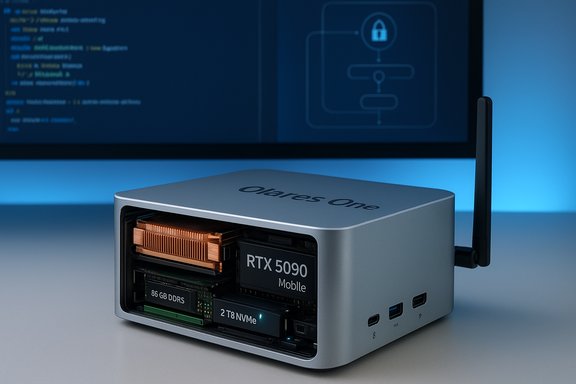
Olares, a startup pitching a privacy‑first local‑AI platform, launched the Olares One as a crowdfunded mini workstation aimed squarely at creators, developers and privacy‑minded professionals who want cloud‑level AI capabilities on their desk. The package stacks an Intel Core Ultra 9 275HX mobile CPU, an NVIDIA GeForce RTX 5090 Mobile GPU with 24 GB of GDDR7 VRAM, 96 GB of DDR5 system memory and a 2 TB PCIe 4.0 NVMe drive into a compact alloy chassis that Olares bills as a “personal AI cloud.” Early coverage and Olares’ own benchmarks emphasize on‑device throughput against a selection of open models and toolchains. The device is being crowdfunded: public trackers and campaign aggregators show several hundred backers and more than one million dollars pledged in the early days of the campaign, a signal of market interest even if crowdfunding itself carries fulfillment and timeline risks.
From a market perspective, the One is not alone; other vendors are shipping or pitching mini PCs optimized for on‑device AI. Olares’ differentiators are a bold hardware spec sheet, a curated OS and marketplace and a clear privacy narrative. That combination is persuasive for certain buyers — but it’s not a universal answer. For enterprises, repairability, managed warranties and fleet services still favor larger vendors. For individuals, the price‑to‑value calculus depends heavily on how much cloud spend is being replaced and how mission‑critical local operation is to a given workflow.
Buyers who will benefit most:
Source: TechRadar Olares One mini PC offers desktop-grade AI performance in a small body
 Background / Overview
Olares, a startup pitching a privacy‑first local‑AI platform, launched the Olares One as a crowdfunded mini workstation aimed squarely at creators, developers and privacy‑minded professionals who want cloud‑level AI capabilities on their desk. The package stacks an Intel Core Ultra 9 275HX mobile CPU, an NVIDIA GeForce RTX 5090 Mobile GPU with 24 GB of GDDR7 VRAM, 96 GB of DDR5 system memory and a 2 TB PCIe 4.0 NVMe drive into a compact alloy chassis that Olares bills as a “personal AI cloud.” Early coverage and Olares’ own benchmarks emphasize on‑device throughput against a selection of open models and toolchains. The device is being crowdfunded: public trackers and campaign aggregators show several hundred backers and more than one million dollars pledged in the early days of the campaign, a signal of market interest even if crowdfunding itself carries fulfillment and timeline risks. What’s inside: hardware and claimed performance
CPU: Intel Core Ultra 9 275HX (mobile, high‑end)
Olares One uses the Intel Core Ultra 9 275HX, a 24‑core mobile flagship in Intel’s Core Ultra family. That silicon is specified with up to 5.4 GHz turbo, support for high‑speed DDR5 memory, and integrated Intel graphics and AI accelerators on the package. Intel’s spec page and independent hardware databases confirm the chip’s core counts, frequencies and memory support: this is a mobile HX‑class part with desktop‑oriented performance characteristics when given adequate power and cooling. Why it matters: the 275HX brings significant single‑thread and sustained multithread capacity into a small chassis, but it remains a mobile‑class package with thermal and power ceilings that matter under sustained, multi‑hour workloads.GPU: NVIDIA GeForce RTX 5090 Mobile (24 GB GDDR7)
Olares pairs the CPU with an NVIDIA GeForce RTX 5090 Mobile GPU carrying 24 GB of GDDR7. The RTX 5090 mobile series has been reviewed and characterized as a generational step in mobile GPU horsepower and efficiency, offering more tensor/RT cores and higher‑bandwidth GDDR7 memory compared with previous laptop parts. Independent GPU databases and early press coverage line up with the 24 GB GDDR7 spec and show the part as a 50‑series mobile flagship intended for high‑performance notebooks. Why it matters: 24 GB of VRAM and modern tensor cores materially broaden the on‑device model envelope — especially for quantized or optimized 12B–30B class models and certain larger, compressed variants — but VRAM alone doesn't guarantee consistent performance at datacenter scale.Memory and storage
Olares advertises 96 GB of DDR5 memory (2×48 GB SO‑DIMMs at DDR5‑5600 in their spec) and a 2 TB PCIe 4.0 NVMe SSD. Those choices intentionally target local LLM workflows: big working sets, large context windows and multiple concurrent models all consume system RAM and fast storage if GPU VRAM becomes the bottleneck. Olares’ publicly posted benchmark methodology shows heavy memory and NVMe use in tests that compare token generation rates across models.Chassis, cooling and I/O
The One’s 3.5‑litre chassis reportedly uses a vapor chamber, copper fin arrays and custom fans for heat dissipation. External I/O includes Wi‑Fi 7, Bluetooth 5.4, Thunderbolt 5, HDMI 2.1, USB‑A sockets and a 2.5 Gbps RJ45 Ethernet port — a modern connectivity suite for both media creators and small local servers. The startup also touts enterprise‑style security features such as sandboxed apps and identity‑based credential controls.Software, ecosystem and the “local AI” pitch
Olares OS and marketplace
Perhaps the most consequential decision Olares made is to ship the One with Olares OS, a privacy‑centric Linux‑based platform designed to host AI apps locally and provide a one‑click marketplace of over 200 preconfigured applications. The company’s documentation and PR material emphasize on‑device inference, sandboxing and a developer/marketplace model that aims to reduce reliance on cloud providers while enabling simple deployment of complex AI stacks. Olares’ own benchmark reports and product pages detail their testing methodology and the preconfigured runtimes they target, including vLLM, Ollama and others. Why this matters: the decision to emphasize a Linux‑first, marketplace‑driven model is consistent with the broader trend in local‑AI tooling: many inference runtimes, quantization pipelines and optimization toolchains are developed on Linux first and can be more performant or reliable there. Community and editorial coverage of mini PCs and local LLM rigs also repeatedly emphasize Linux as the pragmatic operating system for local AI experiments.Windows compatibility — and limitations
Tech coverage repeatedly notes that Olares One does not ship with Windows 11 as standard. Olares claims users can run Windows applications, but compatibility varies and the native, supported experience is Olares OS. For users and organizations tied to Windows‑only workflows, this raises an immediate friction point: many creative, enterprise or hardware‑dependent applications expect Windows environments, and driver or vendor support for exotic mobile GPU power profiles can be fussy outside mainstream Windows laptops.Benchmarks and real‑world throughput: what Olares shows
Olares published a transparent benchmarking suite designed specifically for local inference and LLM throughput. Their tests compare the One against high‑end Mac Studio M3/M4 systems and specialized servers across models such as Qwen3‑30B‑A3B, GPT‑OSS‑20B, Gemma3‑12B and a few heavier compressed models. The public benchmark pages show token‑per‑second generation rates, concurrency scaling and a clear methodology that uses standard inference frameworks (vLLM, Ollama, Llama.cpp where applicable). In those tests, the Olares One often led peer devices on raw token throughput for the selected models and runtimes. Key performance observations from Olares’ reported data:- High single‑session token generation for 12B–30B class models, with observed degradation as concurrency rises (multiple model sessions cause throughput drops).
- The One can run larger open‑models that smaller machines cannot due to VRAM and memory constraints.
- GPU Time Sharing and scheduler features attempt to maximize resource utilization when multiple apps are active.
Strengths: where Olares One genuinely shines
- Compact workstation design — squeezing a 24‑core mobile CPU and a 24 GB RTX 5090 Mobile into a 3.5 L chassis is an engineering feat. The package simplifies a local AI lab to a single, VESA‑mountable box.
- Significant memory headroom — 96 GB of RAM plus 24 GB of VRAM and a fast NVMe drive create a practical environment for many 12B–30B open models and compressed variants, enabling useful local inference without immediate cloud bills.
- Privacy‑centric local AI model — the One is built around keeping data and models on‑device, and the Olares OS marketplace lowers friction for non‑expert users wanting to run image, text or video generation apps locally.
- Modern I/O — Wi‑Fi 7, Thunderbolt 5 and 2.5 Gbps Ethernet make it simple to integrate the One into creative workflows, NAS backends or remote access setups.
- Clear product vision — the combination of curated apps, sandboxing and enterprise security features aims to address use cases that standard mini PCs or gaming laptops don’t prioritize.
Risks, unknowns and practical limits
1) Crowdfunding and fulfillment risk
Olares is launching the One via crowdfunding. While early momentum is strong, crowdfunding carries inherent delivery and quality risks: delays, specification changes, component shortages and warranty gaps are common. Backer counts and pledged totals show robust interest, but they are not a substitute for a proven manufacturing and logistics track record. Crowdfunding can succeed spectacularly or founder on production realities — buyers should treat early pledges as conditional.2) Thermal limits and long‑duration workloads
Mini PCs are thermally constrained spaces. Olares’ vapor chamber, copper fins and custom fans are promising, but sustained multi‑hour AI inference at high GPU TGPs will stress the thermal envelope. Public hands‑on coverage and precedent from similar compact AI‑focused minis suggest fan noise, power throttling or reduced sustained throughput are realistic trade‑offs. Vendors’ lab claims often assume controlled ambient conditions; real‑world sustained use can diverge.3) Software, driver and compatibility edge cases
- The Olares OS marketplace simplifies deployment, but many specialized tools, proprietary drivers or Windows‑only creative apps may not run natively or as well.
- GPU‑accelerated inference stacks and NPUs frequently require specific driver versions, CUDA/CUDNN combinations and runtime changes; the maturity of those stacks for an RTX 50‑series mobile part in a custom desktop chassis may lag mainstream laptop deployments.
- If users need full Windows compatibility for certain workflows, the lack of a guaranteed Windows 11 experience out of the box is a practical limitation.
4) Performance scaling and multi‑user scenarios
Olares’ benchmarks show a drop in per‑session throughput as concurrency increases. For single users or small creative workloads this may be acceptable; for teams wanting a shared local server, the One’s performance will be bounded by GPU memory and scheduling policies. The company’s Time Sharing Mode aims to mitigate this, but it's inherently a trade‑off versus dedicated server hardware.5) Unverifiable claims and the need for independent validation
Olares provides detailed benchmark data and methodology. That transparency is good, but independent long‑duration reviews and reproducible third‑party testing remain essential to validate claims about sustained performance, thermal behavior, driver maturity and the real throughput users will see on their workloads. Any single vendor benchmark should be treated as directional until confirmed by independent testers. Flagged claim: aggregate AI TOPS numbers and cross‑model comparisons are sensitive to quantization, tokenizer differences and model variants; they are useful for comparison but not a substitute for direct, workload‑specific testing.Practical buyer guidance and recommended workflows
If you’re considering the Olares One, match your expectations and procurement strategy to the reality of local AI hardware today:- Identify your primary workloads (image generation, offline LLM chat, video generation, fine‑tuning). Prioritize memory and GPU VRAM headroom for large models, and ensure the vendor/sales SKU maps to the exact components you need.
- Assume you’ll do initial setup and test runs under Linux. Many local‑AI runtimes and optimizations are Linux‑first; Olares OS tries to hide complexity but know how to examine logs, update drivers and manage runtimes.
- Plan for noise and thermal management if you intend sustained inference sessions. If acoustic quiet is essential, budget for an external solution (remote rack, acoustic enclosure or dedicated larger workstation).
- For Windows‑only apps, verify driver and peripheral compatibility early. If a Windows image is critical, ask Olares or the community about tested workflows and driver stability on the SKU you’re buying.
- Treat crowdfunded purchases as higher‑risk than retail buys: confirm refund and shipping policies, and avoid making mission‑critical procurement decisions based solely on pre‑order timelines.
Where Olares One fits in the mini‑PC and local‑AI landscape
The mini‑PC category has matured rapidly: modern mini systems now carry H‑series laptop silicon, integrated NPUs or discrete laptop GPUs, fast NVMe storage and robust I/O in small footprints. Vendors are consciously pushing local AI as a differentiator because many inference toolchains and privacy‑sensitive workflows benefit from localized compute. Community reporting and aggregate reviews point to Linux as a common pragmatic path for local AI experimentation and production proof‑of‑concepts. Those broader trends explain why Olares One matters: it’s a commercial attempt to productize a compact, high‑throughput, privacy‑oriented appliance for creators and small teams.From a market perspective, the One is not alone; other vendors are shipping or pitching mini PCs optimized for on‑device AI. Olares’ differentiators are a bold hardware spec sheet, a curated OS and marketplace and a clear privacy narrative. That combination is persuasive for certain buyers — but it’s not a universal answer. For enterprises, repairability, managed warranties and fleet services still favor larger vendors. For individuals, the price‑to‑value calculus depends heavily on how much cloud spend is being replaced and how mission‑critical local operation is to a given workflow.
Conclusion — who should consider the Olares One (and who should not)
Olares One is an ambitious, technically interesting product that makes the most compelling case yet for a desktop‑sized local AI appliance built around laptop‑class flagship silicon. Its strengths are real: the hardware spec is unusually generous for a compact box, the software stack pushes privacy‑oriented workflows and Olares’ benchmark transparency is welcome.Buyers who will benefit most:
- Privacy‑conscious creators who want to run image, text and video generation workflows locally.
- Developers and researchers needing a compact, VESA‑mountable device to test and iterate on model‑centric pipelines.
- Early adopters and enthusiasts comfortable with Linux and the realities of crowdfunded product timelines.
- Enterprises that need long, guaranteed lifecycles, managed warranties and predictable fleet procurement.
- Users who depend on Windows‑only, GPU‑sensitive software suites that require vendor‑certified drivers and support.
- Anyone who needs proven, sustained server‑class throughput for large multi‑user inference workloads — a rack server or cloud instance remains a safer choice today.
Source: TechRadar Olares One mini PC offers desktop-grade AI performance in a small body
