

Routercall Communications has announced enhanced Global SIP Trunking and a new Microsoft Teams Direct Routing service in Nigeria, pitching the offering to multinational companies, SMEs, and corporate organizations that want cheaper cross-border calling, local-number presence, and Teams-based enterprise voice without abandoning existing Microsoft 365 workflows. The headline is not merely that another telecoms provider has added another cloud voice product. It is that the business phone system is being pulled into the collaboration stack, and African providers are increasingly trying to own the messy middle between Microsoft’s cloud and the public telephone network.
RCC’s announcement lands in a market where “unified communications” has become both a selling point and a warning label. Every vendor says voice, chat, video, contact center, and workflow should live together; every administrator knows the integration layer is where outages, licensing surprises, call-quality disputes, and support handoffs usually appear. By pairing SIP trunks with Teams Direct Routing through certified AudioCodes session border controllers, RCC is making a familiar wager: enterprises want Teams to be the front end, but they still need carrier-grade telephony behind it.
The consumer version of business communications is easy to explain: open Teams, click call, talk to a customer, and move on. The enterprise version is much less glamorous. It involves phone numbers, trunks, routing policies, emergency calling obligations, certificates, firewalls, failover paths, codec negotiation, billing disputes, country coverage, and a long tail of analog or legacy systems that refuse to die.
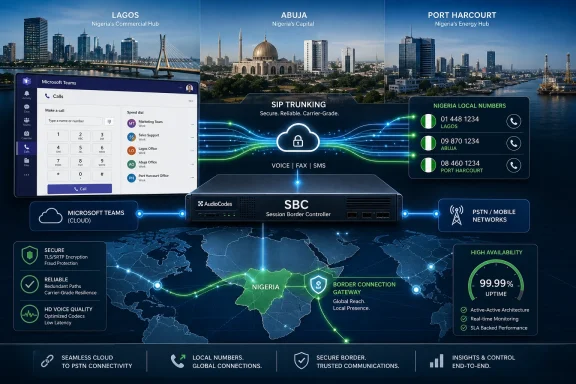
That is where RCC is aiming its announcement. Its enhanced Global SIP Trunking service promises voice connectivity across continents, local presence in Nigerian commercial centers including Lagos, Port Harcourt, and Abuja, and international call-cost reductions it says can reach up to 60 percent. The company is also advertising reliability figures of 98 percent for SIP Trunking and 99 percent for VoIP, Unified Communications, Cloud PBX, and Teams-based calling.
Those numbers will need to be read by buyers as service commitments, not magic. A 98 percent uptime claim sounds strong in marketing copy, but in infrastructure terms it still leaves more theoretical downtime than many regulated or high-volume contact-center environments can tolerate without redundancy. For some SMEs, that may be acceptable if the price is right; for banks, healthcare providers, airlines, and large outsourcing operations, the real procurement question will be what the SLA says, how credits are calculated, and whether RCC’s architecture can fail over cleanly when the network misbehaves.
The more interesting part is not the percentage. It is the implied business model. RCC is not trying to persuade customers to choose between old telephony and cloud collaboration. It is trying to become the carrier-and-integration layer that lets them keep both.
That distinction matters. Teams may be the user interface, but Direct Routing is not a pure Microsoft-only service. It requires a supported SBC, properly configured domains, certificates, DNS records, routing policies, user licensing, and trunk connectivity. Microsoft supports Direct Routing only with certified SBCs, and AudioCodes is one of the long-standing vendors in that ecosystem.
RCC’s decision to call out AudioCodes is therefore more than a brand flourish. It is a signal to IT buyers that the company is building around a known SBC platform rather than an improvised gateway. For administrators who have lived through one-way audio, failed call transfers, broken caller ID, or mysterious SIP errors, the choice of SBC and firmware support can be the difference between a manageable deployment and a career-limiting incident.
Direct Routing also keeps Microsoft from becoming the only carrier relationship in the room. Organizations can use their own PSTN provider, preserve regional numbering arrangements, connect legacy PBXs, and integrate call centers or analog devices that do not fit neatly into a cloud-only calling plan. That flexibility is why Direct Routing has remained important even as Microsoft has pushed alternatives such as Calling Plans and Operator Connect in supported markets.
For countries and regions where Microsoft’s own calling coverage is limited, or where local numbering and regulatory realities complicate cloud-native telephony, Direct Routing is often less a feature than a necessity. RCC appears to understand that its opportunity is not to compete with Teams, but to make Teams usable as a real phone system in places where the telecom layer still needs local expertise.
A company with staff in Lagos, vendors in Dubai, customers in London, and executives in New York does not want every call to behave like an expensive exception. It wants local numbers, centralized policy, predictable billing, and a calling experience that does not force workers to switch tools depending on who they are contacting. SIP trunking is not new, but globalized SIP trunking attached to Teams changes the user experience from “call through the phone system” to “call from the collaboration system you already use all day.”
That is the strategic layer in RCC CEO Adeola Akindele’s statement about borderless communication. The phrase is vendor language, but the underlying customer pain is real. Businesses increasingly organize around distributed teams, hybrid work, offshore support, and cross-border sales, while their phone systems remain fragmented by geography, carrier contracts, and old PBX deployments.
Nigeria is also a market where mobile-first behavior, cost sensitivity, and cloud adoption collide. Many organizations have already standardized on Microsoft 365 for email, identity, file sharing, and collaboration. Turning Teams into the voice front end is a natural next step, but only if the carrier integration is reliable enough and the economics beat a patchwork of mobile lines, desk phones, and regional providers.
The announcement, then, should be read as RCC trying to occupy a higher-value place in the communications stack. Instead of selling minutes alone, it is selling continuity between Microsoft 365, enterprise telephony, local numbering, and managed voice infrastructure.
Savings depend on call patterns, destination countries, existing carrier contracts, local termination rates, concurrent call volume, number rental fees, SBC hosting charges, support costs, and Microsoft licensing. A company that makes heavy international outbound calls may see obvious savings. A company whose communication has largely moved to Teams meetings, WhatsApp, mobile bundles, or customer callbacks may find the economics less dramatic.
There is also a hidden cost in operational complexity. Direct Routing gives administrators control, but control has to be designed, monitored, and maintained. Someone must manage voice routes, dial plans, number normalization, tenant configuration, failover behavior, certificate renewal, and support escalation when a user says “Teams is down” but the actual fault sits somewhere between an ISP, SBC, trunk provider, firewall, Microsoft service, and handset.
That complexity is not a reason to avoid Direct Routing. It is the reason managed providers exist. RCC’s commercial success will depend less on whether customers understand SIP trunking and more on whether they trust RCC to make the complexity disappear without making the architecture opaque.
For SMEs, that trust question is especially sharp. Smaller businesses may want the polish of an enterprise phone system but lack in-house voice engineering expertise. If RCC packages Teams calling, SIP trunks, Cloud PBX, and contact-center capabilities with clear support boundaries and predictable pricing, it could meet a real gap. If the offer becomes a bundle of acronyms and optional charges, it risks sounding like every telecom modernization pitch of the last decade.
But certification is a floor, not a ceiling. A certified SBC can still be badly deployed. Firmware can lag. Dial plans can be sloppy. Media paths can be misconfigured. Firewalls can block required traffic. Certificates can expire on a Friday night. Direct Routing is full of ways to make a technically supported design behave like a haunted switchboard.
This is why RCC’s announcement should be evaluated through implementation maturity rather than only product naming. Does the company provide migration planning from legacy PBX environments? Does it document supported call scenarios? Does it monitor SBC health and SIP options responses? Does it provide tenant-level reporting and call-quality analytics? Does it explain how failures are isolated between Microsoft, AudioCodes, RCC’s network, and downstream carriers?
Enterprise voice buyers have become more skeptical because collaboration platforms have trained users to expect consumer-grade simplicity. The person placing a call does not care whether the problem is SIP signaling, media relay, codec mismatch, or a carrier route. They know only that a customer could not hear them. The provider that wins is the one that can translate that messy reality into quick resolution.
RCC’s technical bet is therefore credible, but the market will judge it on execution. In Direct Routing, the architecture diagram is the easy part. The support model is the product.
RCC’s broader portfolio reflects that transition. The company is not only talking about Teams Direct Routing. It is also positioning Cloud PBX, contact call center services, PRI, VoIP, and omnichannel communications as part of the same modernization path. That is important because few organizations move from legacy telephony to cloud voice in one clean jump.
A branch office may still have analog devices. A call center may need specialized routing and recording. A warehouse may use ruggedized handsets. Executives may insist on mobile forwarding. Finance may want cost-center billing. Compliance teams may demand retention or call logs. The future of voice is not one app; it is an orchestration problem.
Teams Direct Routing can become the bridge because it allows organizations to standardize the user experience without ripping out every underlying dependency at once. But that bridge has to be engineered with care. Poorly planned migrations can strand users between systems, break number portability, or create inconsistent calling behavior across regions.
The strongest case for RCC’s offer is that many customers do not want to become experts in that transition. They want to say: we already use Microsoft 365, we need reliable calling, we need local and international reach, and we want one accountable provider. That is a reasonable demand. It is also difficult to satisfy at scale.
A 99 percent reliability figure for Teams-based calling or Cloud PBX sounds reassuring in a press announcement. In an enterprise procurement process, it should trigger follow-up questions. Is the percentage measured monthly or annually? Does it cover the full call path or only RCC-controlled infrastructure? Are scheduled maintenance windows excluded? What redundancy exists across data centers, carriers, and SBC instances? What happens when Microsoft has a service degradation?
SIP trunking’s 98 percent figure raises similar questions. Some customers may accept it for general business calling, especially if the service is inexpensive and backed by responsive support. Others will require active-active redundancy, multiple trunk routes, geographic diversity, and monitoring that proves uptime rather than merely promises it.
The industry’s move to cloud communications has sometimes blurred responsibility. When calls fail, vendors may point to Microsoft, Microsoft may point to the SBC, SBC vendors may point to the carrier, and carriers may point to customer networks. A provider that wants to sell “unparalleled reliability” must also sell accountability. That means incident reporting, clear escalation paths, measurable SLAs, and architecture choices that are visible enough for customers to trust.
RCC’s announcement uses the language of confidence. The market will want the evidence of discipline.
This is particularly attractive in hybrid work. Employees do not want a desk phone in one place, a mobile app in another, a call-center tool somewhere else, and a separate directory for external dialing. They want presence, chat, meetings, and calls to share context. If the same Teams client can place and receive PSTN calls, the argument for simplification becomes obvious.
But the ROI case depends on licensing and adoption. Teams Phone capabilities are not free just because an organization has Microsoft 365. Users need appropriate licenses, and features such as conferencing, call queues, auto attendants, compliance recording, and contact-center integration may introduce additional costs or third-party dependencies. If finance teams compare only headline trunk rates and ignore licensing, the business case may disappoint.
There is also a human factor. A company can technically move voice into Teams and still have users cling to mobile phones, legacy handsets, or informal channels. Successful migration requires number planning, training, policy decisions, executive sponsorship, and a support desk that understands voice. The return on investment comes when the organization changes behavior, not merely when the SBC registers.
RCC is right to frame Teams Direct Routing as a productivity play. But productivity is earned after deployment, not announced at launch.
The first area is architecture. Customers should know whether RCC hosts the SBCs, whether dedicated or shared SBC models are available, how tenant isolation works, and what redundancy exists. They should also understand how local Nigerian numbering connects to international termination and whether call paths remain compliant with relevant telecom rules.
The second area is support. Direct Routing lives across Microsoft, AudioCodes, RCC, carriers, and the customer network. A provider that cannot explain escalation boundaries before the sale will not magically become clear during an outage. Buyers should ask what logs are available, who owns first-line troubleshooting, and how quickly RCC can engage SBC vendor or Microsoft support when needed.
The third area is migration. Moving voice into Teams is not just a porting exercise. It affects reception workflows, hunt groups, call queues, emergency procedures, after-hours routing, executive assistants, shared lines, contact-center agents, and users who may have spent years with a desk-phone muscle memory. A serious provider should treat discovery and pilot phases as mandatory, not optional.
Finally, customers should examine security. SBCs sit at a sensitive boundary between enterprise collaboration systems and the public telephone network. Misconfiguration can expose organizations to toll fraud, spoofing, denial-of-service risks, or weak encryption. The security posture should include hardened SBC configuration, certificate management, access control, monitoring, and clear policies for administrative changes.
The executive story is straightforward: lower international calling costs, simplify communications, improve hybrid-work productivity, and use Microsoft 365 more fully. The administrator story is stricter: certified SBCs, predictable routing, documented failover, visible call quality, secure configuration, and a provider that answers the phone when calls stop working. Both stories must be true.
This is where regional providers can have an advantage over global giants. They understand local numbering, customer expectations, regulatory friction, and the realities of network quality in their markets. They can also provide the kind of hands-on support that large self-service platforms often struggle to deliver. But the advantage only holds if they combine local knowledge with enterprise-grade process.
RCC has positioned itself as a bridge between Nigerian business communications and the Microsoft-centered workplace. That is a smart position. It is also a demanding one because bridges are judged most harshly when traffic is heavy.
RCC’s announcement lands in a market where “unified communications” has become both a selling point and a warning label. Every vendor says voice, chat, video, contact center, and workflow should live together; every administrator knows the integration layer is where outages, licensing surprises, call-quality disputes, and support handoffs usually appear. By pairing SIP trunks with Teams Direct Routing through certified AudioCodes session border controllers, RCC is making a familiar wager: enterprises want Teams to be the front end, but they still need carrier-grade telephony behind it.
 RCC Is Selling the Boring Part of Cloud Voice, and That Is the Point
The consumer version of business communications is easy to explain: open Teams, click call, talk to a customer, and move on. The enterprise version is much less glamorous. It involves phone numbers, trunks, routing policies, emergency calling obligations, certificates, firewalls, failover paths, codec negotiation, billing disputes, country coverage, and a long tail of analog or legacy systems that refuse to die.That is where RCC is aiming its announcement. Its enhanced Global SIP Trunking service promises voice connectivity across continents, local presence in Nigerian commercial centers including Lagos, Port Harcourt, and Abuja, and international call-cost reductions it says can reach up to 60 percent. The company is also advertising reliability figures of 98 percent for SIP Trunking and 99 percent for VoIP, Unified Communications, Cloud PBX, and Teams-based calling.
Those numbers will need to be read by buyers as service commitments, not magic. A 98 percent uptime claim sounds strong in marketing copy, but in infrastructure terms it still leaves more theoretical downtime than many regulated or high-volume contact-center environments can tolerate without redundancy. For some SMEs, that may be acceptable if the price is right; for banks, healthcare providers, airlines, and large outsourcing operations, the real procurement question will be what the SLA says, how credits are calculated, and whether RCC’s architecture can fail over cleanly when the network misbehaves.
The more interesting part is not the percentage. It is the implied business model. RCC is not trying to persuade customers to choose between old telephony and cloud collaboration. It is trying to become the carrier-and-integration layer that lets them keep both.
Teams Direct Routing Turns Microsoft 365 Into a Phone System, But Not by Itself
Microsoft Teams Direct Routing is often described too casually, as if it simply “adds calling” to Teams. In practice, it connects Microsoft Teams Phone to the public switched telephone network through a supported session border controller, usually supplied, managed, or hosted by a telecoms provider or systems integrator. The SBC is the gatekeeper between Microsoft’s cloud and the carrier world.That distinction matters. Teams may be the user interface, but Direct Routing is not a pure Microsoft-only service. It requires a supported SBC, properly configured domains, certificates, DNS records, routing policies, user licensing, and trunk connectivity. Microsoft supports Direct Routing only with certified SBCs, and AudioCodes is one of the long-standing vendors in that ecosystem.
RCC’s decision to call out AudioCodes is therefore more than a brand flourish. It is a signal to IT buyers that the company is building around a known SBC platform rather than an improvised gateway. For administrators who have lived through one-way audio, failed call transfers, broken caller ID, or mysterious SIP errors, the choice of SBC and firmware support can be the difference between a manageable deployment and a career-limiting incident.
Direct Routing also keeps Microsoft from becoming the only carrier relationship in the room. Organizations can use their own PSTN provider, preserve regional numbering arrangements, connect legacy PBXs, and integrate call centers or analog devices that do not fit neatly into a cloud-only calling plan. That flexibility is why Direct Routing has remained important even as Microsoft has pushed alternatives such as Calling Plans and Operator Connect in supported markets.
For countries and regions where Microsoft’s own calling coverage is limited, or where local numbering and regulatory realities complicate cloud-native telephony, Direct Routing is often less a feature than a necessity. RCC appears to understand that its opportunity is not to compete with Teams, but to make Teams usable as a real phone system in places where the telecom layer still needs local expertise.
The Nigerian Angle Makes the Announcement More Than a Product Refresh
RCC’s pitch is explicitly geographic. It talks about local presence in Nigeria’s major business hubs while also promising cross-border communication for multinational and regional customers. That combination is important because African enterprise communications often live between two pressures: the need to appear local to customers and regulators, and the need to operate internationally with predictable costs.A company with staff in Lagos, vendors in Dubai, customers in London, and executives in New York does not want every call to behave like an expensive exception. It wants local numbers, centralized policy, predictable billing, and a calling experience that does not force workers to switch tools depending on who they are contacting. SIP trunking is not new, but globalized SIP trunking attached to Teams changes the user experience from “call through the phone system” to “call from the collaboration system you already use all day.”
That is the strategic layer in RCC CEO Adeola Akindele’s statement about borderless communication. The phrase is vendor language, but the underlying customer pain is real. Businesses increasingly organize around distributed teams, hybrid work, offshore support, and cross-border sales, while their phone systems remain fragmented by geography, carrier contracts, and old PBX deployments.
Nigeria is also a market where mobile-first behavior, cost sensitivity, and cloud adoption collide. Many organizations have already standardized on Microsoft 365 for email, identity, file sharing, and collaboration. Turning Teams into the voice front end is a natural next step, but only if the carrier integration is reliable enough and the economics beat a patchwork of mobile lines, desk phones, and regional providers.
The announcement, then, should be read as RCC trying to occupy a higher-value place in the communications stack. Instead of selling minutes alone, it is selling continuity between Microsoft 365, enterprise telephony, local numbering, and managed voice infrastructure.
The Cost-Savings Claim Is Plausible, But the Fine Print Will Decide the Winner
RCC says its Global SIP Trunking can reduce international call costs by up to 60 percent. That kind of claim is common in SIP trunking marketing because packet-based voice, centralized routing, and local termination can indeed reduce costs compared with traditional international calling arrangements. But “up to” remains the most important phrase in the sentence.Savings depend on call patterns, destination countries, existing carrier contracts, local termination rates, concurrent call volume, number rental fees, SBC hosting charges, support costs, and Microsoft licensing. A company that makes heavy international outbound calls may see obvious savings. A company whose communication has largely moved to Teams meetings, WhatsApp, mobile bundles, or customer callbacks may find the economics less dramatic.
There is also a hidden cost in operational complexity. Direct Routing gives administrators control, but control has to be designed, monitored, and maintained. Someone must manage voice routes, dial plans, number normalization, tenant configuration, failover behavior, certificate renewal, and support escalation when a user says “Teams is down” but the actual fault sits somewhere between an ISP, SBC, trunk provider, firewall, Microsoft service, and handset.
That complexity is not a reason to avoid Direct Routing. It is the reason managed providers exist. RCC’s commercial success will depend less on whether customers understand SIP trunking and more on whether they trust RCC to make the complexity disappear without making the architecture opaque.
For SMEs, that trust question is especially sharp. Smaller businesses may want the polish of an enterprise phone system but lack in-house voice engineering expertise. If RCC packages Teams calling, SIP trunks, Cloud PBX, and contact-center capabilities with clear support boundaries and predictable pricing, it could meet a real gap. If the offer becomes a bundle of acronyms and optional charges, it risks sounding like every telecom modernization pitch of the last decade.
AudioCodes Gives the Pitch Technical Credibility, Not Automatic Success
AudioCodes is a sensible name to attach to a Teams Direct Routing service. Its SBCs are widely used in enterprise voice environments and are part of Microsoft’s certified Direct Routing ecosystem. Certification matters because Microsoft’s support model for Direct Routing depends heavily on supported SBCs and vendor cooperation.But certification is a floor, not a ceiling. A certified SBC can still be badly deployed. Firmware can lag. Dial plans can be sloppy. Media paths can be misconfigured. Firewalls can block required traffic. Certificates can expire on a Friday night. Direct Routing is full of ways to make a technically supported design behave like a haunted switchboard.
This is why RCC’s announcement should be evaluated through implementation maturity rather than only product naming. Does the company provide migration planning from legacy PBX environments? Does it document supported call scenarios? Does it monitor SBC health and SIP options responses? Does it provide tenant-level reporting and call-quality analytics? Does it explain how failures are isolated between Microsoft, AudioCodes, RCC’s network, and downstream carriers?
Enterprise voice buyers have become more skeptical because collaboration platforms have trained users to expect consumer-grade simplicity. The person placing a call does not care whether the problem is SIP signaling, media relay, codec mismatch, or a carrier route. They know only that a customer could not hear them. The provider that wins is the one that can translate that messy reality into quick resolution.
RCC’s technical bet is therefore credible, but the market will judge it on execution. In Direct Routing, the architecture diagram is the easy part. The support model is the product.
The PBX Is Not Dying; It Is Being Absorbed
For years, vendors have declared the death of the PBX. The reality is more subtle. PBX functions are not disappearing; they are being absorbed into collaboration platforms, cloud services, and managed carrier layers. Users see Teams. Administrators see policies, trunks, SBCs, numbers, compliance obligations, and integration points.RCC’s broader portfolio reflects that transition. The company is not only talking about Teams Direct Routing. It is also positioning Cloud PBX, contact call center services, PRI, VoIP, and omnichannel communications as part of the same modernization path. That is important because few organizations move from legacy telephony to cloud voice in one clean jump.
A branch office may still have analog devices. A call center may need specialized routing and recording. A warehouse may use ruggedized handsets. Executives may insist on mobile forwarding. Finance may want cost-center billing. Compliance teams may demand retention or call logs. The future of voice is not one app; it is an orchestration problem.
Teams Direct Routing can become the bridge because it allows organizations to standardize the user experience without ripping out every underlying dependency at once. But that bridge has to be engineered with care. Poorly planned migrations can strand users between systems, break number portability, or create inconsistent calling behavior across regions.
The strongest case for RCC’s offer is that many customers do not want to become experts in that transition. They want to say: we already use Microsoft 365, we need reliable calling, we need local and international reach, and we want one accountable provider. That is a reasonable demand. It is also difficult to satisfy at scale.
Reliability Claims Need Enterprise-Grade Transparency
RCC’s stated reliability figures are central to the pitch, but they also invite scrutiny. Voice is unforgiving because it is synchronous. Email can arrive late. Chat can reconnect. A failed voice call is immediately visible, emotionally frustrating, and often commercially costly.A 99 percent reliability figure for Teams-based calling or Cloud PBX sounds reassuring in a press announcement. In an enterprise procurement process, it should trigger follow-up questions. Is the percentage measured monthly or annually? Does it cover the full call path or only RCC-controlled infrastructure? Are scheduled maintenance windows excluded? What redundancy exists across data centers, carriers, and SBC instances? What happens when Microsoft has a service degradation?
SIP trunking’s 98 percent figure raises similar questions. Some customers may accept it for general business calling, especially if the service is inexpensive and backed by responsive support. Others will require active-active redundancy, multiple trunk routes, geographic diversity, and monitoring that proves uptime rather than merely promises it.
The industry’s move to cloud communications has sometimes blurred responsibility. When calls fail, vendors may point to Microsoft, Microsoft may point to the SBC, SBC vendors may point to the carrier, and carriers may point to customer networks. A provider that wants to sell “unparalleled reliability” must also sell accountability. That means incident reporting, clear escalation paths, measurable SLAs, and architecture choices that are visible enough for customers to trust.
RCC’s announcement uses the language of confidence. The market will want the evidence of discipline.
The Microsoft 365 ROI Argument Is Strong Because Budgets Are Already There
One of RCC’s smarter angles is the claim that Teams Direct Routing maximizes Microsoft 365 investments. That is not just marketing. Many organizations already pay for Microsoft 365 licenses, train users on Teams, and rely on Entra identity, Exchange calendars, SharePoint files, and Teams meetings. Adding enterprise voice to that environment can feel less like a new platform and more like activating value from an existing one.This is particularly attractive in hybrid work. Employees do not want a desk phone in one place, a mobile app in another, a call-center tool somewhere else, and a separate directory for external dialing. They want presence, chat, meetings, and calls to share context. If the same Teams client can place and receive PSTN calls, the argument for simplification becomes obvious.
But the ROI case depends on licensing and adoption. Teams Phone capabilities are not free just because an organization has Microsoft 365. Users need appropriate licenses, and features such as conferencing, call queues, auto attendants, compliance recording, and contact-center integration may introduce additional costs or third-party dependencies. If finance teams compare only headline trunk rates and ignore licensing, the business case may disappoint.
There is also a human factor. A company can technically move voice into Teams and still have users cling to mobile phones, legacy handsets, or informal channels. Successful migration requires number planning, training, policy decisions, executive sponsorship, and a support desk that understands voice. The return on investment comes when the organization changes behavior, not merely when the SBC registers.
RCC is right to frame Teams Direct Routing as a productivity play. But productivity is earned after deployment, not announced at launch.
Where Admins Should Look Before Signing
The practical test for RCC’s offer is not whether SIP trunking and Teams Direct Routing are useful. They are. The test is whether the provider can make them boring, observable, and supportable. IT pros should press for details before treating the announcement as a turnkey transformation.The first area is architecture. Customers should know whether RCC hosts the SBCs, whether dedicated or shared SBC models are available, how tenant isolation works, and what redundancy exists. They should also understand how local Nigerian numbering connects to international termination and whether call paths remain compliant with relevant telecom rules.
The second area is support. Direct Routing lives across Microsoft, AudioCodes, RCC, carriers, and the customer network. A provider that cannot explain escalation boundaries before the sale will not magically become clear during an outage. Buyers should ask what logs are available, who owns first-line troubleshooting, and how quickly RCC can engage SBC vendor or Microsoft support when needed.
The third area is migration. Moving voice into Teams is not just a porting exercise. It affects reception workflows, hunt groups, call queues, emergency procedures, after-hours routing, executive assistants, shared lines, contact-center agents, and users who may have spent years with a desk-phone muscle memory. A serious provider should treat discovery and pilot phases as mandatory, not optional.
Finally, customers should examine security. SBCs sit at a sensitive boundary between enterprise collaboration systems and the public telephone network. Misconfiguration can expose organizations to toll fraud, spoofing, denial-of-service risks, or weak encryption. The security posture should include hardened SBC configuration, certificate management, access control, monitoring, and clear policies for administrative changes.
RCC’s Real Opportunity Is Managed Modernization, Not Telecom Buzzwords
The telecom industry has never suffered from a shortage of acronyms. SIP, PRI, PBX, SBC, PSTN, UC, CCaaS, and CPaaS can make a modernization pitch sound more like a certification exam than a business decision. RCC’s challenge is to turn that alphabet soup into a product story executives and administrators can both believe.The executive story is straightforward: lower international calling costs, simplify communications, improve hybrid-work productivity, and use Microsoft 365 more fully. The administrator story is stricter: certified SBCs, predictable routing, documented failover, visible call quality, secure configuration, and a provider that answers the phone when calls stop working. Both stories must be true.
This is where regional providers can have an advantage over global giants. They understand local numbering, customer expectations, regulatory friction, and the realities of network quality in their markets. They can also provide the kind of hands-on support that large self-service platforms often struggle to deliver. But the advantage only holds if they combine local knowledge with enterprise-grade process.
RCC has positioned itself as a bridge between Nigerian business communications and the Microsoft-centered workplace. That is a smart position. It is also a demanding one because bridges are judged most harshly when traffic is heavy.
The Teams Phone Moment Gives RCC a Narrow Window to Prove It
The concrete story here is not that RCC added a feature. It is that voice is being folded into the same cloud productivity stack that already absorbed meetings, messaging, and file collaboration. For buyers, the announcement should prompt practical evaluation rather than automatic enthusiasm.- RCC is offering enhanced Global SIP Trunking alongside Microsoft Teams Direct Routing, with the goal of making Teams a full external calling interface for business users.
- The Direct Routing service depends on AudioCodes session border controllers, a technically credible choice because Microsoft requires certified SBCs for supported deployments.
- The advertised cost reductions may be meaningful for international callers, but actual savings will depend on traffic patterns, licensing, numbering, support, and migration costs.
- The reliability claims should be tested against written SLAs, redundancy design, maintenance exclusions, and clear incident-management procedures.
- The strongest fit is likely to be organizations already invested in Microsoft 365 that need local Nigerian presence, international reach, and managed telephony expertise.
- The biggest risk is not the concept of Teams calling, but the operational handoff between Microsoft, RCC, SBC infrastructure, carriers, and the customer’s own network.
References
- Primary source: The Guardian Nigeria News
Published: Sat, 30 May 2026 04:02:00 GMT
RCC Unveils Enhanced Global SIP Trunking, Microsoft Teams Direct Routing
Routercall Communications (RCC), a leading provider of innovative omnichannel communication solutions, has announced significantguardian.ng - Related coverage: audiocodes.com
Microsoft Teams Direct Routing
Microsoft Teams Direct Routing allows enterprises to connect Teams to the PSTN or SIP trunk providers via a certified session border controller. www.audiocodes.com
- Official source: learn.microsoft.com
Session Border Controllers certified for Direct Routing - Microsoft Teams | Microsoft Learn
Learn about which Session Border Controllers (SBCs) are certified for Microsoft Direct Routing.learn.microsoft.com - Related coverage: ipcomms.net
Microsoft Teams Direct Routing Setup Guide 2026 | SIP Trunking for Teams
Complete guide to Microsoft Teams Direct Routing with IPComms SIP trunking. Setup steps, SBC configuration, pricing comparison vs Microsoft Calling Plans, and troubleshooting.www.ipcomms.net
- Related coverage: prnewswire.com

AudioCodes Delivers Direct Routing Connectivity for Microsoft Teams with Twilio Elastic SIP Trunk
/PRNewswire/ -- Highlights AudioCodes has built a solution blueprint that includes Twilio Elastic SIP Trunking service and AudioCodes Mediant SBCs The SBCs'...
www.prnewswire.com
- Official source: techcommunity.microsoft.com

Microsoft Teams Direct Routing - Non Media Bypass Mode | Microsoft Community Hub
Trying to enable SBC working with Microsoft Teams Direct routing in 2 modes of operation "Media Bypass" configured as TRUE / FALSE.When SBC is working...
techcommunity.microsoft.com
- Related coverage: wwt.com
- Related coverage: techtarget.com
Evaluating Direct Routing for Microsoft Teams telephony | TechTarget
Microsoft offers two paths to PSTN connectivity in Teams. For many organizations, the best approach may be through Direct Routing. Learn how to make Direct Routing for Microsoft Teams work for your organization.www.techtarget.com - Related coverage: educronix.com
Mediant SBC with Microsoft Teams Direct Routing Enterprise Model
This document describes AudioCodes Mediant SBC with Microsoft Teams Direct Routing Enterprise Modeleducronix.com
