Gadali has reported that Schedtris, an AI scheduling system built with ECH and Microsoft Elevate and deployed in ECH’s Azure environment, cut ECH’s morning aged-care rescheduling time by 50 percent while recovering 15 hours of scheduling capacity each week in operations. The claim is narrow, operational, and therefore more interesting than another sweeping promise that generative AI will transform work. If the numbers hold beyond the initial case study, this is the kind of AI deployment that matters: not a chatbot sprinkled over office tasks, but software embedded in the frail machinery of real-world service delivery. The story is less about replacing schedulers than about making their judgment survivable at 7 a.m.
The past two years of enterprise AI have been dominated by tools that sit beside knowledge workers: summarize this meeting, draft that email, search those documents. Some of those tools are useful, but they often struggle to prove value because the productivity gain is diffuse, personal, and hard to measure. A worker saves five minutes here, loses two minutes correcting a hallucination there, and the CFO is left squinting at an adoption dashboard.
Schedtris is different because the workflow already had a stopwatch attached. ECH’s schedulers were dealing with short-notice care visit vacancies in the morning rush, and the average time to resolve a vacancy reportedly fell from about eight minutes to under four. The disruption window dropped from two hours to under one hour, which is the kind of metric that carries operational meaning rather than marketing perfume.
That matters for Microsoft’s broader AI strategy. The company has spent heavily to make Azure and Microsoft 365 the default landing zone for enterprise AI, but customers increasingly want proof that those investments can do more than repackage clerical work. A scheduling agent that plugs into an existing Azure and Microsoft 365 estate, reads live operational data, and gives humans better options is a cleaner argument for AI than yet another assistant that writes polite meeting notes.
The important phrase here is decision support. Schedtris is described as recommending qualified replacement workers and surfacing transparent data while leaving the final call to human schedulers. That boundary is not just ethical window dressing in aged care; it is the difference between using automation to clarify judgment and using it to hide accountability.
This is not the same problem as finding an empty slot in Outlook. It is a live optimization problem wrapped in human consequences. A poor reassignment can waste paid time, increase travel, frustrate staff, and send an unfamiliar worker into the home of a client who may rely on routine and trust.
ECH’s own description of the pre-Schedtris process is telling. Sharon Paulson, its Head of Digital Workplace Services, said schedulers at 7 a.m. were previously scrambling under pressure while holding huge amounts of complexity in their heads. That is the kind of work enterprise software has historically under-served: too dynamic for static process maps, too context-heavy for simple rules, and too important to leave entirely to instinct.
The Schedtris case suggests AI’s near-term enterprise value may live in these pressure points. Not where the work is glamorous, but where teams repeatedly make high-volume, time-sensitive decisions with incomplete attention and too many variables. The promise is not that the machine knows more than the worker; it is that the worker no longer has to carry the whole system in memory.
Read-only access matters because it limits the blast radius. If the system is surfacing options rather than directly changing schedules, the organisation can gain speed without immediately surrendering write authority to an AI agent. In a regulated or care-adjacent environment, that is a pragmatic compromise.
The Microsoft 365 and Azure alignment also reflects how enterprise AI is likely to spread in the real world. Most organisations will not build clean-room AI platforms from scratch. They will bolt intelligence onto systems they already trust, govern, audit, and pay for, then argue internally that the incremental risk is manageable because identity, access control, and data boundaries already exist.
That does not make the risk disappear. Live scheduling, workforce, skills, and availability data can be sensitive even when client records are not being dumped wholesale into a model. But the architecture described here at least points in the right direction: keep the agent close to the operational system, limit its permissions, and make the human decision-maker visible.
In aged care scheduling, that would be dangerous. The scheduler’s judgment includes things that may not be fully represented in structured data: a client’s anxiety with unfamiliar faces, a worker’s recent fatigue, local traffic quirks, or the unspoken knowledge that one pairing tends to go badly even if the spreadsheet says it should work. A useful agent must make that judgment faster, not flatten it into a blind ranking.
Schedtris is being presented as preserving the final decision for schedulers while structuring the options. That is a healthier model for AI in frontline operations. It treats human expertise as scarce and valuable, not as an inconvenience to be automated away.
The deeper insight is that consistency and discretion do not have to be enemies. ECH said its previous process depended heavily on individual judgment under pressure. By codifying the process around that judgment, the organisation can reduce variance without pretending that every care decision can be reduced to a formula.
Enterprise AI has suffered from inflated expectations because many projects are sold as transformations before they are tested as tools. Schedtris appears to have taken the opposite route. Pick one painful process, connect trusted operational data, support the human decision-maker, and measure whether the bottleneck improves.
The numbers are also framed in practical terms. A 50 percent reduction in morning rescheduling time sounds impressive, but the more concrete figure is the drop from eight minutes to under four minutes per vacancy. Multiply that across daily disruptions, and the reported 15 hours of recovered scheduling capacity per week begins to sound less like a vanity metric and more like operational breathing room.
For sysadmins and IT managers, this is the difference between a dashboard metric and a service metric. The former tells you whether people are clicking the AI tool. The latter tells you whether the organisation is doing the work faster, with less panic, and potentially with better continuity for clients.
The practical disciplines identified in the case are familiar but often ignored: start with a material business problem, treat data quality as core infrastructure, and pair technical build-out with change management. None of that sounds as exciting as “autonomous agents,” but it is far closer to how durable systems get built. AI does not rescue a broken process simply by being attached to it.
Schedtris also shows why operational AI projects need domain-specific design. A generic scheduling assistant can suggest a replacement. A care-aware scheduling system needs to weigh qualifications, continuity, location, travel, availability, and operational policy in a way that matches how the service actually runs.
That is where many AI pilots fail. They show a plausible demo using clean data and toy scenarios, then collapse when exposed to messy rosters, partial records, local exceptions, and frontline habits. The ECH case is noteworthy because it appears to have been built around the mess rather than around a polished demo path.
For organisations already standardized on Microsoft 365 and Azure, the sales pitch is increasingly straightforward. Keep the data where it already lives, build agents that operate under familiar governance, and make AI another layer of the Microsoft-controlled workplace stack. That is attractive to IT departments because it reduces procurement friction and gives administrators fewer novel surfaces to defend.
But it also raises a strategic question. If the next wave of AI value comes from operational workflow redesign, Microsoft will not win merely by providing a chatbot. It will need partners like Gadali, industry data connectors, vertical expertise, and governance patterns that make AI acceptable in sectors where mistakes have human consequences.
This is where the platform contest becomes less theatrical and more consequential. The winner is not necessarily the company with the most dazzling general-purpose model. It may be the company whose ecosystem can turn messy operational data into reliable decision support without forcing every customer to become an AI lab.
A faster reassignment process can help preserve that continuity because schedulers have more time and better information to find a suitable match rather than simply filling a gap. The system’s value, then, is not only in reducing administrative drag. It is in preventing operational disruption from becoming personal disruption for clients.
This is where AI productivity talk often becomes too narrow. Saving staff time is useful, especially in stretched care environments, but the social value comes when saved time translates into better service reliability. The danger is that organisations pocket the efficiency while ignoring the quality dimension.
ECH and its partners are framing the project as a way to improve decision quality under pressure. That framing should be tested over time. The next wave of evidence should not only ask whether schedulers are faster, but whether clients see fewer unfamiliar substitutions, whether workers experience less chaos, and whether service failures decline during peak disruption windows.
That means transparency matters. Schedulers need to know why a worker is being recommended, what data is being used, and where the system may be missing context. A black-box answer is not good enough when the work involves vulnerable clients and frontline staff.
The read-only integration helps, but governance also needs monitoring. Are recommendations fair across workers? Are some staff repeatedly selected for inconvenient travel? Does the system overweight efficiency at the expense of continuity? Does it handle incomplete availability data gracefully, or does it quietly privilege workers whose records are cleaner?
These questions are not arguments against Schedtris. They are arguments for taking the deployment seriously. If AI is moving from office convenience into operational decision support, then auditability, data quality, and feedback loops become first-order features, not compliance afterthoughts.
But labour-saving technology in care work always deserves careful reading. If the saved time reduces burnout and lets schedulers handle exceptions with more attention, that is a positive result. If it becomes an excuse to run thinner teams or absorb more work without additional support, the technology simply shifts pressure into a new shape.
The best version of this system gives schedulers more confidence and less frantic cognitive load. It reduces the dependence on a few highly experienced individuals who know the roster by instinct. It also helps newer staff follow a more consistent decision path without waiting years to absorb the unwritten rules.
That is a real form of resilience. Organisations often discover too late that their operations depend on tacit knowledge held by a small number of people. Codifying that knowledge into a structured decision process can make a team less brittle, provided management does not mistake codification for full automation.
That should be the template for enterprise AI claims. Identify the ugly recurring moment in the business. Measure how long it takes, how much stress it causes, how often it fails, and what downstream harm it creates. Then build an AI-assisted process that makes that moment less chaotic.
There is a reason the Schedtris story reads better than a generic Copilot success quote. It has a named workflow, a named operational window, a before-and-after timing comparison, and a clear human owner of the final decision. Those are the ingredients missing from many enterprise AI announcements.
The lesson for IT leaders is not to go shopping for “an AI strategy.” It is to find the operational choke point where better information, faster ranking, and structured recommendations would matter. If that choke point has reliable data and accountable human decision-makers, it may be a good candidate. If it does not, AI may only accelerate confusion.
For Windows and Microsoft shops, the architecture is also familiar enough to be replicable in spirit. Azure provides the deployment environment, Microsoft 365 provides the enterprise productivity and identity context, and a line-of-business system supplies the operational data. The AI layer sits between the data and the human decision, not above the organisation like an oracle.
That pattern could show up in many sectors. Field service dispatch, hospital bed management, school relief staffing, home maintenance routing, utilities outage response, and local government service coordination all contain similar moments of high-pressure reassignment. The variables differ, but the underlying structure is recognizable.
The catch is that each workflow needs domain knowledge. A generic agent cannot simply be dropped into every operational process and expected to understand what “best” means. In aged care, “best” might mean continuity over travel efficiency. In another sector, safety certification might override speed. The system has to encode priorities, not merely optimize for motion.
Where does the data come from? What permissions does the agent have? What system records the final decision? What logs exist for review? How are recommendations evaluated after the fact? Who owns the process when the model’s suggestion is poor but the human accepts it?
Schedtris does not answer every one of those questions publicly, but the reported design points in a more governable direction than many AI deployments. Read-only access, existing Azure boundaries, human final approval, and a specific operational workflow all make oversight more realistic. A broad “ask anything” bot attached to sensitive systems is much harder to supervise.
The broader lesson for IT pros is that AI governance becomes easier when the use case is narrower. A targeted scheduling agent can be tested against known scenarios, compared with prior performance, and improved with frontline feedback. A general-purpose assistant wandering across documents and workflows is harder to validate because success and failure are both mushier.
That is why the morning rescheduling window is such a revealing test. It is time-bound, stressful, and operationally unforgiving. If a system helps there, it is doing something more useful than producing a clever answer in a sandbox.
Still, the case should be read as evidence, not a final verdict. The reported gains come from an organisational white paper and project partners, not from a long-term independent study. The next questions are durability and transferability: whether the performance persists over months, whether staff continue trusting the recommendations, and whether the model works as well in organisations with messier data or different workforce rules.
The answer may be uneven. Some providers will have clean enough data and mature enough processes to benefit quickly. Others may discover that AI exposes gaps they have tolerated for years: inconsistent skill records, unreliable availability data, undocumented client preferences, or scheduling rules that live in people’s heads rather than systems.
This is not a technology divide alone. It is a management divide. AI rewards organisations that can define what good work looks like, capture the data needed to support it, and change the process around the tool. It punishes organisations that treat software as a substitute for operational discipline.
That is particularly relevant for sectors like aged care, where frontline work has historically depended on people quietly absorbing complexity. Those people are often the system’s real infrastructure. AI can help preserve their knowledge, distribute it, and make it repeatable, but only if the organisation respects the knowledge enough to model it properly.
The risk is that executives hear “50 percent faster” and skip straight to procurement. The more important message is less glamorous: the project worked because it targeted a specific workflow, used trusted operational data, and kept humans accountable for the final decision. That is not magic. It is hard systems work with an AI interface.
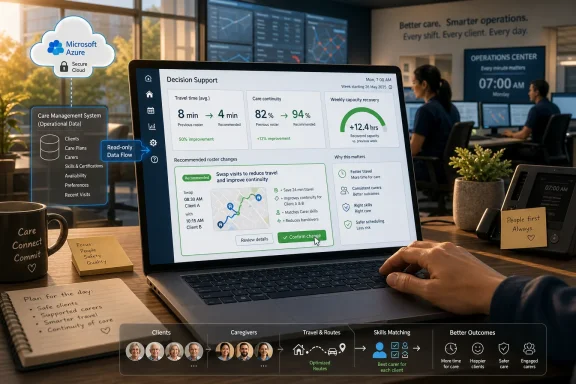 Microsoft’s AI Pitch Gets More Convincing When It Leaves the Demo Stage
The past two years of enterprise AI have been dominated by tools that sit beside knowledge workers: summarize this meeting, draft that email, search those documents. Some of those tools are useful, but they often struggle to prove value because the productivity gain is diffuse, personal, and hard to measure. A worker saves five minutes here, loses two minutes correcting a hallucination there, and the CFO is left squinting at an adoption dashboard.Schedtris is different because the workflow already had a stopwatch attached. ECH’s schedulers were dealing with short-notice care visit vacancies in the morning rush, and the average time to resolve a vacancy reportedly fell from about eight minutes to under four. The disruption window dropped from two hours to under one hour, which is the kind of metric that carries operational meaning rather than marketing perfume.
That matters for Microsoft’s broader AI strategy. The company has spent heavily to make Azure and Microsoft 365 the default landing zone for enterprise AI, but customers increasingly want proof that those investments can do more than repackage clerical work. A scheduling agent that plugs into an existing Azure and Microsoft 365 estate, reads live operational data, and gives humans better options is a cleaner argument for AI than yet another assistant that writes polite meeting notes.
The important phrase here is decision support. Schedtris is described as recommending qualified replacement workers and surfacing transparent data while leaving the final call to human schedulers. That boundary is not just ethical window dressing in aged care; it is the difference between using automation to clarify judgment and using it to hide accountability.
The Morning Rostering Crunch Is a Systems Problem, Not a Calendar Problem
Aged-care scheduling sounds mundane until you unpack what a vacancy actually means. A worker calls in sick, becomes unavailable, or cannot make a visit, and the scheduler has to reassign care without breaking a chain of constraints. The replacement must have the right skills, be geographically sensible, fit within travel time, remain available, and ideally preserve continuity with the client.This is not the same problem as finding an empty slot in Outlook. It is a live optimization problem wrapped in human consequences. A poor reassignment can waste paid time, increase travel, frustrate staff, and send an unfamiliar worker into the home of a client who may rely on routine and trust.
ECH’s own description of the pre-Schedtris process is telling. Sharon Paulson, its Head of Digital Workplace Services, said schedulers at 7 a.m. were previously scrambling under pressure while holding huge amounts of complexity in their heads. That is the kind of work enterprise software has historically under-served: too dynamic for static process maps, too context-heavy for simple rules, and too important to leave entirely to instinct.
The Schedtris case suggests AI’s near-term enterprise value may live in these pressure points. Not where the work is glamorous, but where teams repeatedly make high-volume, time-sensitive decisions with incomplete attention and too many variables. The promise is not that the machine knows more than the worker; it is that the worker no longer has to carry the whole system in memory.
Azure Is the Boring Detail That Makes the Story Plausible
The deployment detail that should catch the eye of WindowsForum readers is that Schedtris was placed inside ECH’s Microsoft Azure environment and connected read-only to operational data from AlayaCare. That is not a throwaway architecture note. It explains why the project could be framed as a controlled operational tool rather than a risky experiment with sensitive care data.Read-only access matters because it limits the blast radius. If the system is surfacing options rather than directly changing schedules, the organisation can gain speed without immediately surrendering write authority to an AI agent. In a regulated or care-adjacent environment, that is a pragmatic compromise.
The Microsoft 365 and Azure alignment also reflects how enterprise AI is likely to spread in the real world. Most organisations will not build clean-room AI platforms from scratch. They will bolt intelligence onto systems they already trust, govern, audit, and pay for, then argue internally that the incremental risk is manageable because identity, access control, and data boundaries already exist.
That does not make the risk disappear. Live scheduling, workforce, skills, and availability data can be sensitive even when client records are not being dumped wholesale into a model. But the architecture described here at least points in the right direction: keep the agent close to the operational system, limit its permissions, and make the human decision-maker visible.
Human-in-the-Loop Is Not a Slogan When the Job Carries Duty of Care
“Human in the loop” has become one of the most abused phrases in AI governance. Vendors use it to reassure customers, customers use it to reassure boards, and everyone quietly hopes nobody asks how meaningful the human review actually is. In some workflows, the human is reduced to rubber-stamping whatever the system suggests.In aged care scheduling, that would be dangerous. The scheduler’s judgment includes things that may not be fully represented in structured data: a client’s anxiety with unfamiliar faces, a worker’s recent fatigue, local traffic quirks, or the unspoken knowledge that one pairing tends to go badly even if the spreadsheet says it should work. A useful agent must make that judgment faster, not flatten it into a blind ranking.
Schedtris is being presented as preserving the final decision for schedulers while structuring the options. That is a healthier model for AI in frontline operations. It treats human expertise as scarce and valuable, not as an inconvenience to be automated away.
The deeper insight is that consistency and discretion do not have to be enemies. ECH said its previous process depended heavily on individual judgment under pressure. By codifying the process around that judgment, the organisation can reduce variance without pretending that every care decision can be reduced to a formula.
The Case Study Is Small Enough to Be Believable and Big Enough to Matter
The reported operating scale is modest but meaningful: about 20 daily disruptions across a client base of roughly 4,500 people. That is not a moonshot deployment across a national bureaucracy. It is a targeted intervention in a recurring workflow, which is precisely why the results are easier to believe.Enterprise AI has suffered from inflated expectations because many projects are sold as transformations before they are tested as tools. Schedtris appears to have taken the opposite route. Pick one painful process, connect trusted operational data, support the human decision-maker, and measure whether the bottleneck improves.
The numbers are also framed in practical terms. A 50 percent reduction in morning rescheduling time sounds impressive, but the more concrete figure is the drop from eight minutes to under four minutes per vacancy. Multiply that across daily disruptions, and the reported 15 hours of recovered scheduling capacity per week begins to sound less like a vanity metric and more like operational breathing room.
For sysadmins and IT managers, this is the difference between a dashboard metric and a service metric. The former tells you whether people are clicking the AI tool. The latter tells you whether the organisation is doing the work faster, with less panic, and potentially with better continuity for clients.
The White Paper’s Real Argument Is About Process, Not Prompts
Gadali’s white paper reportedly argues that the next phase of AI adoption will focus less on individual productivity and more on redesigning operational processes. That is the right argument, and it is one Microsoft’s ecosystem needs to make more often. Prompt engineering was never going to be a durable business strategy for organisations with complex, regulated, or time-critical work.The practical disciplines identified in the case are familiar but often ignored: start with a material business problem, treat data quality as core infrastructure, and pair technical build-out with change management. None of that sounds as exciting as “autonomous agents,” but it is far closer to how durable systems get built. AI does not rescue a broken process simply by being attached to it.
Schedtris also shows why operational AI projects need domain-specific design. A generic scheduling assistant can suggest a replacement. A care-aware scheduling system needs to weigh qualifications, continuity, location, travel, availability, and operational policy in a way that matches how the service actually runs.
That is where many AI pilots fail. They show a plausible demo using clean data and toy scenarios, then collapse when exposed to messy rosters, partial records, local exceptions, and frontline habits. The ECH case is noteworthy because it appears to have been built around the mess rather than around a polished demo path.
The Windows Angle Is Enterprise Gravity, Not Desktop Glamour
There is no obvious Windows consumer hook here, and that is exactly why the story belongs in a WindowsForum discussion. Microsoft’s platform power has always been less about flashy end-user features than about enterprise gravity: identity, Office workflows, admin controls, cloud tenancy, and the quiet assumption that business processes eventually pass through Microsoft infrastructure. AI is being pulled into that same orbit.For organisations already standardized on Microsoft 365 and Azure, the sales pitch is increasingly straightforward. Keep the data where it already lives, build agents that operate under familiar governance, and make AI another layer of the Microsoft-controlled workplace stack. That is attractive to IT departments because it reduces procurement friction and gives administrators fewer novel surfaces to defend.
But it also raises a strategic question. If the next wave of AI value comes from operational workflow redesign, Microsoft will not win merely by providing a chatbot. It will need partners like Gadali, industry data connectors, vertical expertise, and governance patterns that make AI acceptable in sectors where mistakes have human consequences.
This is where the platform contest becomes less theatrical and more consequential. The winner is not necessarily the company with the most dazzling general-purpose model. It may be the company whose ecosystem can turn messy operational data into reliable decision support without forcing every customer to become an AI lab.
Care Continuity Is the Metric That Deserves More Attention
The headline numbers are about scheduler time, but the more human metric is continuity of care. In aged care, familiar workers matter. They know routines, preferences, risks, and the small signals that may not be documented but can affect whether a visit goes smoothly.A faster reassignment process can help preserve that continuity because schedulers have more time and better information to find a suitable match rather than simply filling a gap. The system’s value, then, is not only in reducing administrative drag. It is in preventing operational disruption from becoming personal disruption for clients.
This is where AI productivity talk often becomes too narrow. Saving staff time is useful, especially in stretched care environments, but the social value comes when saved time translates into better service reliability. The danger is that organisations pocket the efficiency while ignoring the quality dimension.
ECH and its partners are framing the project as a way to improve decision quality under pressure. That framing should be tested over time. The next wave of evidence should not only ask whether schedulers are faster, but whether clients see fewer unfamiliar substitutions, whether workers experience less chaos, and whether service failures decline during peak disruption windows.
Governance Is the Difference Between an Agent and a Liability
Any AI system touching workforce coordination in care settings needs governance that is more than a slide in the procurement deck. The system can influence who gets work, who travels where, and which client receives which worker. Even if it does not make the final decision, its recommendations can shape human choices.That means transparency matters. Schedulers need to know why a worker is being recommended, what data is being used, and where the system may be missing context. A black-box answer is not good enough when the work involves vulnerable clients and frontline staff.
The read-only integration helps, but governance also needs monitoring. Are recommendations fair across workers? Are some staff repeatedly selected for inconvenient travel? Does the system overweight efficiency at the expense of continuity? Does it handle incomplete availability data gracefully, or does it quietly privilege workers whose records are cleaner?
These questions are not arguments against Schedtris. They are arguments for taking the deployment seriously. If AI is moving from office convenience into operational decision support, then auditability, data quality, and feedback loops become first-order features, not compliance afterthoughts.
The Labour Story Is More Complicated Than “AI Saves Time”
Aged care providers are under pressure from staffing constraints, rising demand, and operational complexity. A tool that recovers 15 hours of scheduling capacity per week will naturally be sold as a relief valve. It probably is one.But labour-saving technology in care work always deserves careful reading. If the saved time reduces burnout and lets schedulers handle exceptions with more attention, that is a positive result. If it becomes an excuse to run thinner teams or absorb more work without additional support, the technology simply shifts pressure into a new shape.
The best version of this system gives schedulers more confidence and less frantic cognitive load. It reduces the dependence on a few highly experienced individuals who know the roster by instinct. It also helps newer staff follow a more consistent decision path without waiting years to absorb the unwritten rules.
That is a real form of resilience. Organisations often discover too late that their operations depend on tacit knowledge held by a small number of people. Codifying that knowledge into a structured decision process can make a team less brittle, provided management does not mistake codification for full automation.
The Vendor Lesson Is to Stop Selling Magic and Start Selling Fewer Bad Mornings
The AI industry has spent too much energy selling imagination. Every vendor wants to describe a future of autonomous agents, hyper-personalized workflows, and exponential productivity. The ECH case is humbler and more persuasive: fewer bad mornings.That should be the template for enterprise AI claims. Identify the ugly recurring moment in the business. Measure how long it takes, how much stress it causes, how often it fails, and what downstream harm it creates. Then build an AI-assisted process that makes that moment less chaotic.
There is a reason the Schedtris story reads better than a generic Copilot success quote. It has a named workflow, a named operational window, a before-and-after timing comparison, and a clear human owner of the final decision. Those are the ingredients missing from many enterprise AI announcements.
The lesson for IT leaders is not to go shopping for “an AI strategy.” It is to find the operational choke point where better information, faster ranking, and structured recommendations would matter. If that choke point has reliable data and accountable human decision-makers, it may be a good candidate. If it does not, AI may only accelerate confusion.
The Schedtris Numbers Point to a Narrower, Stronger AI Playbook
The most useful part of this case is that it resists the temptation to be universal. Schedtris is not trying to solve aged care. It is trying to solve a specific rostering failure mode inside aged care operations. That focus is why the project has something concrete to say.For Windows and Microsoft shops, the architecture is also familiar enough to be replicable in spirit. Azure provides the deployment environment, Microsoft 365 provides the enterprise productivity and identity context, and a line-of-business system supplies the operational data. The AI layer sits between the data and the human decision, not above the organisation like an oracle.
That pattern could show up in many sectors. Field service dispatch, hospital bed management, school relief staffing, home maintenance routing, utilities outage response, and local government service coordination all contain similar moments of high-pressure reassignment. The variables differ, but the underlying structure is recognizable.
The catch is that each workflow needs domain knowledge. A generic agent cannot simply be dropped into every operational process and expected to understand what “best” means. In aged care, “best” might mean continuity over travel efficiency. In another sector, safety certification might override speed. The system has to encode priorities, not merely optimize for motion.
This Is the Part of AI Adoption That IT Can Actually Govern
The consumer AI boom trained people to think of AI as a conversational interface. Enterprise IT should think of it as a governed service component. That shift changes the questions administrators ask.Where does the data come from? What permissions does the agent have? What system records the final decision? What logs exist for review? How are recommendations evaluated after the fact? Who owns the process when the model’s suggestion is poor but the human accepts it?
Schedtris does not answer every one of those questions publicly, but the reported design points in a more governable direction than many AI deployments. Read-only access, existing Azure boundaries, human final approval, and a specific operational workflow all make oversight more realistic. A broad “ask anything” bot attached to sensitive systems is much harder to supervise.
The broader lesson for IT pros is that AI governance becomes easier when the use case is narrower. A targeted scheduling agent can be tested against known scenarios, compared with prior performance, and improved with frontline feedback. A general-purpose assistant wandering across documents and workflows is harder to validate because success and failure are both mushier.
The Care Sector Will Judge AI by Reliability, Not Novelty
Care providers do not have the luxury of treating AI as a novelty layer. Their constraints are immediate: limited staff, rising demand, client expectations, regulatory scrutiny, and the daily reality that small scheduling failures can cascade quickly. A tool earns trust only if it works when the day starts badly.That is why the morning rescheduling window is such a revealing test. It is time-bound, stressful, and operationally unforgiving. If a system helps there, it is doing something more useful than producing a clever answer in a sandbox.
Still, the case should be read as evidence, not a final verdict. The reported gains come from an organisational white paper and project partners, not from a long-term independent study. The next questions are durability and transferability: whether the performance persists over months, whether staff continue trusting the recommendations, and whether the model works as well in organisations with messier data or different workforce rules.
The answer may be uneven. Some providers will have clean enough data and mature enough processes to benefit quickly. Others may discover that AI exposes gaps they have tolerated for years: inconsistent skill records, unreliable availability data, undocumented client preferences, or scheduling rules that live in people’s heads rather than systems.
The Real AI Divide Will Be Between Process-Rich and Process-Poor Organisations
Schedtris hints at a coming split in AI adoption. Organisations with well-understood workflows and usable data will turn AI into operational leverage. Organisations with vague processes and dirty data will buy tools and wonder why the promised transformation never arrives.This is not a technology divide alone. It is a management divide. AI rewards organisations that can define what good work looks like, capture the data needed to support it, and change the process around the tool. It punishes organisations that treat software as a substitute for operational discipline.
That is particularly relevant for sectors like aged care, where frontline work has historically depended on people quietly absorbing complexity. Those people are often the system’s real infrastructure. AI can help preserve their knowledge, distribute it, and make it repeatable, but only if the organisation respects the knowledge enough to model it properly.
The risk is that executives hear “50 percent faster” and skip straight to procurement. The more important message is less glamorous: the project worked because it targeted a specific workflow, used trusted operational data, and kept humans accountable for the final decision. That is not magic. It is hard systems work with an AI interface.
What ECH’s 7 A.M. Scheduling Crunch Teaches the Rest of Microsoft’s AI Customers
The practical lessons from Schedtris are sharper than the usual AI adoption checklist because they come from a workflow where delay has immediate consequences. One short paragraph can carry the strategic point: AI value becomes measurable when the system is aimed at a recurring operational decision, not when it is scattered across everyone’s inbox.- Schedtris reportedly halved ECH’s morning rescheduling time and reduced the average vacancy-handling time from about eight minutes to under four.
- The system was deployed inside ECH’s Azure environment and connected read-only to AlayaCare operational data, which limited its authority while giving it useful live context.
- Human schedulers still make the final decision, making the system a decision-support layer rather than an autonomous rostering engine.
- The workflow matters because aged-care rescheduling must balance skills, travel, availability, location, and continuity of care under severe time pressure.
- The strongest lesson for other organisations is to start with a painful, measurable process before choosing the AI tool.
- The next proof point should be whether faster scheduling also improves service continuity, worker experience, and client outcomes over time.
References
- Primary source: ecommercenews.com.au
Published: 2026-06-23T05:30:15.970382
AI scheduling tool cuts aged care rostering delays
Aged care staff are spending half as long on morning rostering after an AI system recovered 15 hours a week at ECH. ecommercenews.com.au
- Related coverage: gadali.com
Gadali and Ability First with Microsoft empower disability care through AI-driven workforce efficiency — Gadali Group
Ability First Australia partnered with Gadali, working closely with Microsoft Elevate, to address frontline reporting challenges and workforce efficiency across disability service delivery, with a strong focus on reducing administrative workload and increasing time spent on direct participant suppogadali.com
- Related coverage: nmetric.com
nMetric - GA Scheduling Engine
 www.nmetric.com
- Related coverage: resources.sumtotalsystems.com
SumTotal_logo_Navy_RGB
A group of seniors smiling together while in a retirement homeresources.sumtotalsystems.com