

GCC administrators should purchase Teams Premium now for a tightly defined insight population if they need an external-collaboration baseline when Microsoft Teams Advanced Collaboration Analytics begins rolling out in October 2026. Microsoft states that data is unavailable until 30 days after licenses are purchased, while the practical scope of the analytics depends on which users are assigned those licenses. Organizations without a named governance decision, accountable review owner, or approved response process should wait rather than license broadly.
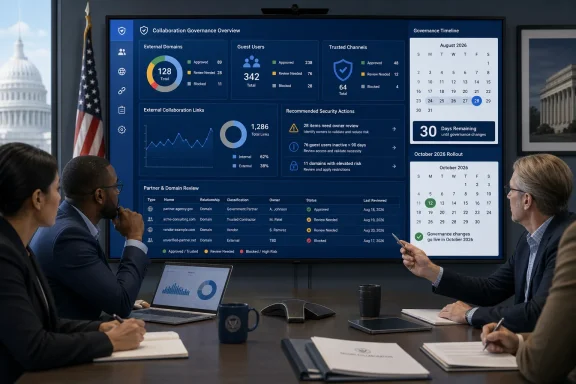
Microsoft 365 Roadmap ID 493742 lists Teams Advanced Collaboration Analytics for GCC as in development, with rollout starting in October 2026; the item was last modified May 29, 2026. Microsoft describes the feature as an administrative view of external collaboration across teams, federated or trusted domains, channels, guests, and internal users, with recommended security actions.
For organizations that want initial data near the start of October, late August is the planning target for purchase and assignment. That date is not a promise of availability: Microsoft’s roadmap dates are estimates and subject to change. Still, the 30-day licensing lead time means waiting for the feature to appear in the tenant can delay the first usable dataset.
WindowsForum readers have seen this pattern in reports on Microsoft’s July 2025 Microsoft 365 updates and continuing Teams collaboration changes: new collaboration capabilities often arrive faster than the administrative process needed to govern them. Advanced Collaboration Analytics should be treated as a targeted governance capability, not as a reason to buy Teams Premium for every user by default.
Teams Premium is a requirement for the users an organization wants represented in Advanced Collaboration Analytics. Microsoft’s verified timing statement is that data is unavailable until 30 days after licenses are purchased. Assignment remains important because agencies need to define which users are in the insight population, but assignment should not be confused with Microsoft’s stated 30-day clock.
The first planning step is to identify whose external-collaboration activity must be measured for a named governance decision. That might be a decision about whether approved partner relationships match actual Teams activity, whether guest access has accountable owners, or whether an external-access policy needs adjustment. The selection criterion should be the decision, not job titles or a broad assumption that every knowledge worker needs monitoring.
A targeted pilot should include users whose external activity is meaningful enough to test the report and whose business owners can review findings. It does not need to cover every employee in the tenant. A pilot that is too broad can create a larger review queue without improving the organization’s ability to determine whether a domain, guest, or collaboration pattern is appropriate.
The worksheet should also identify the policy question the pilot is intended to answer. For example: “Do the external domains and guests associated with this group have a current business owner and an approved collaboration relationship?” That gives reviewers a bounded decision instead of an open-ended request to investigate every unfamiliar signal.
Start with a register of approved external relationships. Record the known federated or trusted domains, the business owner for each relationship, the programs or teams expected to use it, and a review date. If a frequently used external relationship has no identifiable sponsor, that is a governance issue worth resolving regardless of the new report.
Next, establish the organization’s internal review workflow. The following is an agency or contractor process, not a statement that Microsoft products automatically perform these reviews:
Microsoft’s description of the feature emphasizes analytics and recommended security actions. It does not eliminate the need for human judgment. An unfamiliar domain may be a legitimate partner; a long-standing guest may still have a valid role. The value of the report is in identifying relationships that need an accountable owner to confirm, explain, or change them.
WindowsForum’s reporting on Teams as a broad collaboration platform is relevant here. As Teams becomes more central to communication among employees, guests, and external organizations, governance cannot rely solely on an assumption that all activity is internal or that every external relationship is risky. The practical goal is to distinguish expected collaboration from activity that lacks a current business justification.
Broad licensing is more defensible when leadership needs organization-wide evidence and already has a mature process for handling external-collaboration findings. That means the organization can identify who reviews relationships, who makes access decisions, and how business units respond when a domain or guest arrangement needs validation. Broad coverage without a workable review process can simply create more unresolved questions.
Waiting is reasonable when Teams Premium approval is unsettled, external collaboration is limited, or nobody is accountable for responding to the resulting data. Waiting preserves budget flexibility, but it also means the organization accepts a later start for the 30-day data-availability period.
The decision framework is straightforward:
This matters for agencies and contractors that work across GCC, commercial Microsoft 365, GCC High, partner tenants, or customer-managed environments. Before making a broad procurement or compliance decision, request written confirmation from Microsoft or the relevant account team for the specific scenarios that must be visible in the organization’s tenant.
Questions worth confirming include whether the organization’s required external relationships are within the report’s intended coverage and how tenant ownership affects visibility. A collaboration relationship can be operationally important even when it is not represented in the same way as activity in tenant-owned teams and channels.
The report should therefore be treated as an evidence source with boundaries, not as a complete map of every conversation, meeting, file exchange, or cross-environment interaction involving the organization.
Set internal thresholds before the first review. For example, an external domain with no recorded sponsor can trigger ownership validation. A guest relationship connected to a completed engagement can trigger a lifecycle review. Unexpected activity involving a sensitive team can trigger a combined review by the project sponsor, collaboration owner, and compliance stakeholders.
Teams external and guest-access settings, Entra B2B guest accounts, and the organization’s Purview-related governance practices may be relevant to those decisions. The agency or contractor should define how its own teams will use those existing controls and processes; it should not assume that Advanced Collaboration Analytics automatically enforces policy, manages guest reviews, preserves records, or conducts investigations.
WindowsForum’s coverage of collaboration, security, and AI-related Teams updates underscores why that separation matters. New visibility can improve decision-making, but visibility is only useful when an organization has decided who interprets it and what action is proportionate to the evidence.
GCC organizations that benefit most from the October 2026 rollout will not necessarily be those that license most broadly. They will be the ones that purchase early enough for Microsoft’s 30-day data window, assign a purposeful insight population, document expected relationships, and give a named owner responsibility for acting on the first findings.
Microsoft 365 Roadmap ID 493742 lists Teams Advanced Collaboration Analytics for GCC as in development, with rollout starting in October 2026; the item was last modified May 29, 2026. Microsoft describes the feature as an administrative view of external collaboration across teams, federated or trusted domains, channels, guests, and internal users, with recommended security actions.
For organizations that want initial data near the start of October, late August is the planning target for purchase and assignment. That date is not a promise of availability: Microsoft’s roadmap dates are estimates and subject to change. Still, the 30-day licensing lead time means waiting for the feature to appear in the tenant can delay the first usable dataset.
WindowsForum readers have seen this pattern in reports on Microsoft’s July 2025 Microsoft 365 updates and continuing Teams collaboration changes: new collaboration capabilities often arrive faster than the administrative process needed to govern them. Advanced Collaboration Analytics should be treated as a targeted governance capability, not as a reason to buy Teams Premium for every user by default.
 The licensing clock is the real October deadline
Teams Premium is a requirement for the users an organization wants represented in Advanced Collaboration Analytics. Microsoft’s verified timing statement is that data is unavailable until 30 days after licenses are purchased. Assignment remains important because agencies need to define which users are in the insight population, but assignment should not be confused with Microsoft’s stated 30-day clock.The first planning step is to identify whose external-collaboration activity must be measured for a named governance decision. That might be a decision about whether approved partner relationships match actual Teams activity, whether guest access has accountable owners, or whether an external-access policy needs adjustment. The selection criterion should be the decision, not job titles or a broad assumption that every knowledge worker needs monitoring.
A targeted pilot should include users whose external activity is meaningful enough to test the report and whose business owners can review findings. It does not need to cover every employee in the tenant. A pilot that is too broad can create a larger review queue without improving the organization’s ability to determine whether a domain, guest, or collaboration pattern is appropriate.
Procurement worksheet
Before purchasing, complete a short worksheet that turns the recommendation into an executable plan:| Decision input | Record before purchase |
|---|---|
| Named insight population | Users whose external-collaboration activity must be measured for a specific governance decision |
| Licensing requirement | Teams license plus the Teams Premium add-on for each user in the insight population |
| Purchase date | Date Teams Premium licenses are purchased; use this to calculate the 30-day Microsoft data-availability window |
| Assignment roster | Named users who will receive Teams Premium and the business owner for each group |
| Accountable review owner | Person or team responsible for reviewing findings and coordinating follow-up |
| Target first-data date | Desired date for the first review, allowing at least 30 days from license purchase and allowing for roadmap timing changes |
Build the baseline before the report exists
Useful preparation does not require waiting for the new analytics view. Agencies and contractors can document what they already expect external collaboration to look like, then compare the first reporting cycle against that expectation.Start with a register of approved external relationships. Record the known federated or trusted domains, the business owner for each relationship, the programs or teams expected to use it, and a review date. If a frequently used external relationship has no identifiable sponsor, that is a governance issue worth resolving regardless of the new report.
Next, establish the organization’s internal review workflow. The following is an agency or contractor process, not a statement that Microsoft products automatically perform these reviews:
| Finding pattern | Internal first review owner | Internal follow-up question |
|---|---|---|
| An unfamiliar external domain appears repeatedly | Collaboration owner and business sponsor | Is there a current, approved business relationship? |
| Guest participation has no identified program owner | Team owner and identity governance staff | Who sponsors the guest relationship, and is access still needed? |
| A sensitive project team shows unexpected outside activity | Project sponsor and compliance owner | Is the activity consistent with the team’s approved collaboration practices? |
| A relationship remains active after an engagement ends | Business owner and security team | Should the organization review external access or guest lifecycle actions? |
WindowsForum’s reporting on Teams as a broad collaboration platform is relevant here. As Teams becomes more central to communication among employees, guests, and external organizations, governance cannot rely solely on an assumption that all activity is internal or that every external relationship is risky. The practical goal is to distinguish expected collaboration from activity that lacks a current business justification.
Targeted pilot, broad license, or deliberate wait
A targeted pilot is the strongest default for many GCC tenants. It begins the 30-day data-availability period for a group the organization can realistically review, while limiting initial cost and administrative burden. The pilot should have a named population, a documented business purpose, and an owner who can validate findings during the first review cycle.Broad licensing is more defensible when leadership needs organization-wide evidence and already has a mature process for handling external-collaboration findings. That means the organization can identify who reviews relationships, who makes access decisions, and how business units respond when a domain or guest arrangement needs validation. Broad coverage without a workable review process can simply create more unresolved questions.
Waiting is reasonable when Teams Premium approval is unsettled, external collaboration is limited, or nobody is accountable for responding to the resulting data. Waiting preserves budget flexibility, but it also means the organization accepts a later start for the 30-day data-availability period.
The decision framework is straightforward:
- Use a targeted pilot when a defined user group has external activity that must be measured for a named governance decision and an accountable owner can review results.
- License broadly when organization-wide coverage is required and the governance workflow is ready to process the findings.
- Wait when the organization cannot identify the decision, the population, or the owner who will act on the information.
GCC coverage is not the same as universal visibility
The roadmap item concerns GCC availability, but that should not be treated as proof that every cross-tenant or cross-cloud collaboration scenario will appear in the report. The supplied planning information establishes a GCC rollout target and an external-collaboration focus. It does not establish universal visibility across every Microsoft cloud, partner tenant, or externally hosted collaboration space.This matters for agencies and contractors that work across GCC, commercial Microsoft 365, GCC High, partner tenants, or customer-managed environments. Before making a broad procurement or compliance decision, request written confirmation from Microsoft or the relevant account team for the specific scenarios that must be visible in the organization’s tenant.
Questions worth confirming include whether the organization’s required external relationships are within the report’s intended coverage and how tenant ownership affects visibility. A collaboration relationship can be operationally important even when it is not represented in the same way as activity in tenant-owned teams and channels.
The report should therefore be treated as an evidence source with boundaries, not as a complete map of every conversation, meeting, file exchange, or cross-environment interaction involving the organization.
Turn findings into controlled actions, not blanket blocks
The most common governance mistake would be treating every unfamiliar external pattern as a security incident. External collaboration can be legitimate in government work, contracting, interagency coordination, and partner delivery. A useful review process asks whether the relationship is owned, expected, and consistent with policy before deciding whether anything needs to change.Set internal thresholds before the first review. For example, an external domain with no recorded sponsor can trigger ownership validation. A guest relationship connected to a completed engagement can trigger a lifecycle review. Unexpected activity involving a sensitive team can trigger a combined review by the project sponsor, collaboration owner, and compliance stakeholders.
Teams external and guest-access settings, Entra B2B guest accounts, and the organization’s Purview-related governance practices may be relevant to those decisions. The agency or contractor should define how its own teams will use those existing controls and processes; it should not assume that Advanced Collaboration Analytics automatically enforces policy, manages guest reviews, preserves records, or conducts investigations.
WindowsForum’s coverage of collaboration, security, and AI-related Teams updates underscores why that separation matters. New visibility can improve decision-making, but visibility is only useful when an organization has decided who interprets it and what action is proportionate to the evidence.
Frequently Asked Questions
Does every GCC user need a Teams Premium license?
No. Microsoft says each user an organization wants insights about needs a Teams Premium license. A targeted population can support a useful pilot when it is tied to a defined governance decision.When should licenses be purchased for an October 2026 target?
Organizations seeking early October data should aim to purchase licenses by late August 2026 and assign the intended insight population as part of implementation. Microsoft states that data is unavailable until 30 days after licenses are purchased. Roadmap timing remains an estimate and can change.What should be documented before the first review?
Document the licensed population, assignment roster, business purpose, approved external relationships, accountable review owner, and the internal escalation path for findings that need validation.Can the report replace external-access or guest-access governance?
No. The feature provides analytics and recommended security actions. The organization still needs an internal process to determine whether an external relationship is authorized and whether its Teams, Entra, or governance practices need adjustment.GCC organizations that benefit most from the October 2026 rollout will not necessarily be those that license most broadly. They will be the ones that purchase early enough for Microsoft’s 30-day data window, assign a purposeful insight population, document expected relationships, and give a named owner responsibility for acting on the first findings.
References
- Primary source: learn.microsoft.com
Advanced collaboration analytics for Microsoft Teams - Microsoft Teams | Microsoft Learn
Learn about the collaboration activity reports in Microsoft Teams.learn.microsoft.com - Independent coverage: microsoft.com
Microsoft 365 Roadmap | Microsoft 365
The Microsoft 365 Roadmap lists updates that are currently planned for applicable subscribers. Check here for more information on the status of new features and updates.www.microsoft.com
- Primary source: WindowsForum
Microsoft July 2025 Updates: Enhanced Collaboration, Security, and AI Tools | Windows Forum
Microsoft's July 2025 updates to Microsoft 365 introduce a suite of enhancements aimed at improving collaboration, communication, and security across its...windowsforum.com
