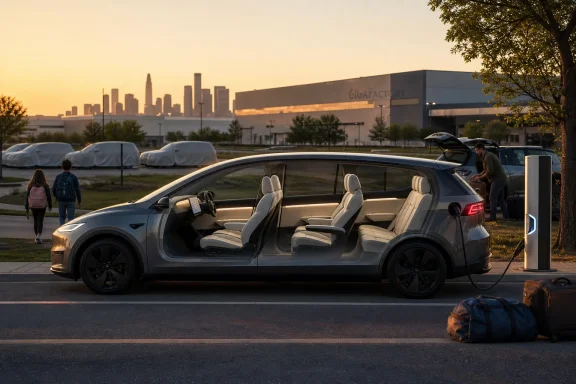
On June 24, 2026, Tesla Oracle reported that Tesla may open North American orders for the long-wheelbase, six-seat Model Y L before July 4, while CarBuzz separately framed the move as Tesla finally bringing a more credible three-row Model Y to America. The operative word is may: this is still rumor territory, not a confirmed Tesla launch. But the rumor matters because it points to a product gap Tesla has allowed to linger for years. If the Model Y L is real for North America, Tesla is not just stretching a crossover; it is trying to make the Model Y do the family-hauling work once reserved for the fading Model X.
The Model Y has already been Tesla’s volume machine, its default answer to almost every mainstream-buyer question. Need an EV crossover? Model Y. Need a relatively efficient commuter? Model Y. Need something that can pass for a family car without the size or price of a Model X? Again, Model Y.
That success has also created a problem. Tesla has leaned so hard on the Model Y that the nameplate now has to cover too many jobs at once. The standard five-seat version works well as a compact-to-midsize crossover, but the old three-row Model Y option in the United States was always more technical compliance than genuine people-moving solution.
A longer-wheelbase Model Y L changes the premise. Instead of squeezing extra seats into the same basic shell and asking physics to be polite, Tesla would be acknowledging that a useful third row needs length, roof height, and packaging attention. That sounds obvious, but it is exactly the kind of obvious product move Tesla has sometimes avoided while chasing higher-drama narratives around robotaxis, AI, and autonomy.
The rumor, then, is less about one trim and more about a shift in discipline. Tesla may be rediscovering the value of making a car that solves a boring household problem better than the car it replaces.
That layout is not accidental. In China, long-wheelbase variants have long been treated as more than luxury indulgences. They are often market-specific answers to rear-seat comfort, family transport, and buyer expectations around space.
For North America, the same geometry would be serving a different but overlapping demand. American buyers may not describe the problem in the same way, but families shopping three-row crossovers understand it immediately. The third row in many vehicles is where good intentions go to die; a little more wheelbase can be the difference between “occasional use” and “usable without apology.”
Still, a Chinese-market product does not automatically become a North American product. Certification, manufacturing, supply-chain localization, crash testing, pricing, and production allocation all matter. Tesla Oracle’s report says Tesla may be preparing Giga Texas for production, and that would be the most plausible path if Tesla wants to avoid importing a China-built family EV into a tariff-sensitive, politically charged U.S. market.
The more important distinction is between ordering and delivery. Tesla could open reservations or configurator orders before Independence Day and still deliver vehicles months later. Tesla Oracle itself suggests that if North American production is only being prepared now, deliveries could plausibly slip toward late 2026.
That distinction matters because Tesla’s public-facing launch rhythm often blurs announcement, ordering, production, and real customer delivery. A button appearing in the configurator is not the same thing as thousands of vehicles rolling off a line. For buyers, especially those trying to plan around family needs, tax eligibility, leases, or expiring vehicles, the delivery clock is the only clock that matters.
It also matters for investors and industry watchers. Tesla does not need another vapor-adjacent product tease; it needs volume, mix, and showroom relevance. A Model Y L that can be ordered in July but arrives at scale in the fourth quarter would still be meaningful, but it would be a late-2026 product story rather than a summer sales rescue.
The distinction is not pedantic. A third row has to clear a basic usability bar: knees, feet, headroom, entry, exit, cargo space, and the ability to carry actual humans for more than a short errand. The old Model Y third row was useful for small children and edge cases, but it was not the same proposition as a purpose-shaped three-row SUV.
The Model Y L’s reported six-seat layout would also move Tesla away from the old “add seats, subtract dignity” approach. Captain’s chairs in the second row create a pass-through and make the third row easier to access. That matters because family vehicles are not evaluated in spec-sheet isolation; they are judged in school pickup lines, airport runs, rainy parking lots, and the chaos of child seats.
Tesla’s advantage is that it can make this move without creating a wholly new vehicle. Its risk is that buyers may expect wholly new-vehicle utility anyway. Stretching the Model Y solves one problem, but it does not magically turn it into a minivan, a Suburban, or even a conventional three-row midsize SUV.
The Model Y L would not need to match the Model X to hurt it. It would only need to be good enough for buyers who want six seats, Tesla software, Supercharger access, and a price meaningfully below the X. That is a large and commercially attractive group.
Tesla Oracle speculates that some potential Model X customers could transition to the Model Y L, and that is probably true. But the cannibalization risk is less damaging than it looks. If a buyer was already hesitating over Model X pricing, service complexity, or age, Tesla may be better off keeping that buyer inside the brand with a stretched Model Y than losing them to Kia, Hyundai, Rivian, Volvo, or a gasoline three-row SUV.
The bigger issue is product hierarchy. Tesla’s lineup has grown oddly top-light: the Model S and Model X no longer define the brand’s momentum, while the Cybertruck occupies its own polarizing universe. A Model Y L would effectively become Tesla’s practical flagship for many households, even if it is not the most expensive vehicle in the showroom.
That would be a very Tesla move. The company has repeatedly used pricing as a live control surface, moving numbers up or down as demand, incentives, and production constraints change. A Model Y L at about $53,000 looks like an accessible upgrade for a family already considering a Premium AWD. A Model Y L at or above $55,000 starts to feel more like a premium lifestyle trim.
The difference matters because three-row buyers are often cross-shopping brutally practical alternatives. They may like the Tesla ecosystem, but they are also comparing monthly payments, cargo space, insurance, service proximity, and the cost of adding teenagers to the household fleet. A stretched Model Y cannot win purely on novelty.
Tesla also has to be careful not to price the Model Y L into a no-man’s-land between value and aspiration. Too cheap, and it crowds the Premium AWD and raises questions about margins. Too expensive, and buyers start asking why they should not wait for a different EV platform, buy a discounted competitor, or step back into a hybrid three-row SUV with fewer charging compromises.
That difference could make the Model Y L harder to sell — or more important. Tesla’s U.S. lineup has been aging around the edges, and its most credible mainstream product is still the Model Y. A stretched variant gives Tesla a way to refresh the showroom without waiting for an all-new platform.
It also gives Tesla dealers — or rather, Tesla stores and online configurators — a cleaner answer to a common objection. For years, the practical family ladder inside Tesla went from Model Y to Model X with a steep price and concept jump in between. The Model Y L would insert a missing rung.
That missing rung becomes more valuable as rival EVs mature. Hyundai and Kia have pushed hard into family EVs. Rivian’s coming smaller vehicles loom over the premium-adventure space. Traditional automakers may be inconsistent on EV strategy, but they know how to build three-row family haulers. Tesla does not need to beat every one of them on every dimension; it needs to stop forfeiting the conversation before it begins.
But the Model Y L rumor is a reminder that software cannot patch everything. No update can add wheelbase. No neural network can create third-row legroom. No interface redesign can make a cramped rear bench feel like a family-friendly space.
That is why this potential launch feels more grounded than many Tesla headlines. It is not primarily about autonomy promises or speculative future revenue. It is about sheet metal, seating, and whether a high-volume EV can become more useful to more households.
The best version of the Model Y L story is therefore not “Tesla adds another variant.” It is “Tesla remembers that platform leverage works best when it solves physical problems.” In the PC world, that is the difference between a spec bump and a form-factor rethink. In cars, the stakes are heavier, costlier, and harder to fix after purchase.
That uncertainty should not be buried. It is the story. Tesla is unusually capable of moving quickly when it chooses, but it is also unusually comfortable letting rumor, executive commentary, and fan-driven expectation fill gaps in the official record.
Elon Musk previously suggested the Model Y L might not come to the U.S., or at least not before late 2026 if production happened. If Tesla is now preparing an earlier North American order window, that would represent either a change in demand assessment, a change in production readiness, or a change in competitive urgency.
All three explanations are plausible. None is confirmed. The disciplined read is that Tesla appears to be testing, preparing, or at least allowing expectations to form around a North American Model Y L — and that the strongest evidence for eventual launch is not a Reddit screenshot but the obviousness of the product gap.
That makes the Model Y L potentially more important than its modest format suggests. It is not a moonshot. It is not a robotaxi. It is not a stainless-steel provocation. It is a practical derivative of a proven vehicle, aimed at a segment where buyers still spend real money.
That may be exactly what Tesla needs. Mature car companies make much of their money not from reinventing transportation every three years, but from carefully slicing platforms into body styles, wheelbases, trims, and use cases. Tesla has often behaved as if that kind of incrementalism was beneath it. The Model Y L would be incrementalism with a business case.
There is a lesson here for every technology company that becomes a hardware company. Eventually, the market stops grading on vision and starts grading on fit. The right hinge, port, keyboard, display size, battery chemistry, or third row can matter more than the keynote.
Range will matter too, especially if the longer body adds weight. A six-seat family EV is more likely to be loaded with people, bags, and highway miles than a commuter crossover. Tesla’s route planning and Supercharger network help, but physics still collects its fee.
Ride quality may become another quiet differentiator. A longer wheelbase can improve highway composure, but added mass and packaging changes can also expose suspension compromises. If Tesla wants the Model Y L to feel like a more premium family product rather than a stretched derivative, refinement will matter.
The cabin experience will be equally important. Families notice storage, cupholders, charging ports, rear screens, climate zones, seat-folding behavior, and how easy the interior is to clean. These are not glamorous details, but they are the details that decide whether a vehicle becomes part of household life or merely survives it.
Those buyers are not anti-technology. They are simply practical. They want the charging network, the app, the efficiency, and the clean EV ownership proposition, but they also need room for grandparents, car seats, backpacks, sports equipment, and Costco runs.
For them, the Model Y L could be the first Tesla that feels like it was designed around their household rather than adapted to it. That is a subtle but important distinction. Tesla’s earlier magic came from making electric cars desirable. Its next challenge is making them fit more normal lives.
That is why this rumor has legs. It aligns with a market need, a known product, a plausible factory path, and a pricing slot in the current lineup. It may still prove premature, but it is not fanciful.
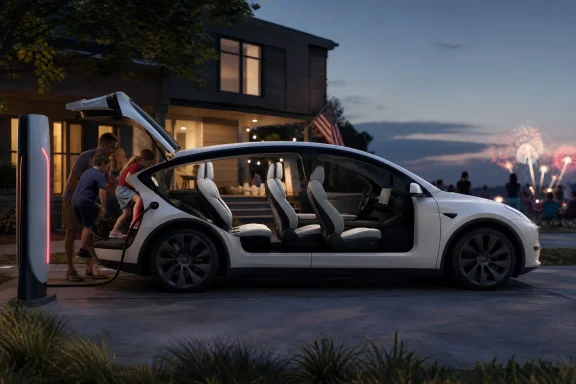 Tesla’s Most Important Car May Be Asked to Carry One More Job
The Model Y has already been Tesla’s volume machine, its default answer to almost every mainstream-buyer question. Need an EV crossover? Model Y. Need a relatively efficient commuter? Model Y. Need something that can pass for a family car without the size or price of a Model X? Again, Model Y.That success has also created a problem. Tesla has leaned so hard on the Model Y that the nameplate now has to cover too many jobs at once. The standard five-seat version works well as a compact-to-midsize crossover, but the old three-row Model Y option in the United States was always more technical compliance than genuine people-moving solution.
A longer-wheelbase Model Y L changes the premise. Instead of squeezing extra seats into the same basic shell and asking physics to be polite, Tesla would be acknowledging that a useful third row needs length, roof height, and packaging attention. That sounds obvious, but it is exactly the kind of obvious product move Tesla has sometimes avoided while chasing higher-drama narratives around robotaxis, AI, and autonomy.
The rumor, then, is less about one trim and more about a shift in discipline. Tesla may be rediscovering the value of making a car that solves a boring household problem better than the car it replaces.
The China Version Provides the Blueprint, Not the Guarantee
The Model Y L already exists in China, where Tesla launched it as a longer, six-seat version of the refreshed Model Y. Reports from that market describe a vehicle roughly seven inches longer overall, with about six inches added to the wheelbase and additional height to improve cabin space. The seating layout is the important part: two seats up front, two captain’s chairs in the second row, and two seats in the third.That layout is not accidental. In China, long-wheelbase variants have long been treated as more than luxury indulgences. They are often market-specific answers to rear-seat comfort, family transport, and buyer expectations around space.
For North America, the same geometry would be serving a different but overlapping demand. American buyers may not describe the problem in the same way, but families shopping three-row crossovers understand it immediately. The third row in many vehicles is where good intentions go to die; a little more wheelbase can be the difference between “occasional use” and “usable without apology.”
Still, a Chinese-market product does not automatically become a North American product. Certification, manufacturing, supply-chain localization, crash testing, pricing, and production allocation all matter. Tesla Oracle’s report says Tesla may be preparing Giga Texas for production, and that would be the most plausible path if Tesla wants to avoid importing a China-built family EV into a tariff-sensitive, politically charged U.S. market.
The July 4 Timing Is Symbolic, but the Production Clock Is Practical
The alleged timing — before the 250th Independence Day — gives the rumor a convenient marketing hook. Tesla has never been shy about symbolism, and launching or opening orders around July 4, 2026, would allow the company to wrap a North American family vehicle in a neat patriotic bow. That does not make the report true, but it does make it believable as a launch-window story.The more important distinction is between ordering and delivery. Tesla could open reservations or configurator orders before Independence Day and still deliver vehicles months later. Tesla Oracle itself suggests that if North American production is only being prepared now, deliveries could plausibly slip toward late 2026.
That distinction matters because Tesla’s public-facing launch rhythm often blurs announcement, ordering, production, and real customer delivery. A button appearing in the configurator is not the same thing as thousands of vehicles rolling off a line. For buyers, especially those trying to plan around family needs, tax eligibility, leases, or expiring vehicles, the delivery clock is the only clock that matters.
It also matters for investors and industry watchers. Tesla does not need another vapor-adjacent product tease; it needs volume, mix, and showroom relevance. A Model Y L that can be ordered in July but arrives at scale in the fourth quarter would still be meaningful, but it would be a late-2026 product story rather than a summer sales rescue.
The Old Three-Row Model Y Was the Compromise Tesla Could No Longer Defend
CarBuzz’s framing — that Tesla is finally bringing the “real” three-row Model Y to America — lands because the previous U.S. seven-seat Model Y always felt compromised. It technically gave Tesla a three-row crossover. It did not convincingly give families a three-row vehicle.The distinction is not pedantic. A third row has to clear a basic usability bar: knees, feet, headroom, entry, exit, cargo space, and the ability to carry actual humans for more than a short errand. The old Model Y third row was useful for small children and edge cases, but it was not the same proposition as a purpose-shaped three-row SUV.
The Model Y L’s reported six-seat layout would also move Tesla away from the old “add seats, subtract dignity” approach. Captain’s chairs in the second row create a pass-through and make the third row easier to access. That matters because family vehicles are not evaluated in spec-sheet isolation; they are judged in school pickup lines, airport runs, rainy parking lots, and the chaos of child seats.
Tesla’s advantage is that it can make this move without creating a wholly new vehicle. Its risk is that buyers may expect wholly new-vehicle utility anyway. Stretching the Model Y solves one problem, but it does not magically turn it into a minivan, a Suburban, or even a conventional three-row midsize SUV.
The Model X Shadow Hangs Over the Whole Story
A North American Model Y L would also say something uncomfortable about the Model X. Tesla’s flagship SUV remains technologically distinctive, but it has become increasingly hard to understand as a mainstream family recommendation. It is expensive, complex, and burdened by design choices that once looked futuristic and now often look like ownership complications.The Model Y L would not need to match the Model X to hurt it. It would only need to be good enough for buyers who want six seats, Tesla software, Supercharger access, and a price meaningfully below the X. That is a large and commercially attractive group.
Tesla Oracle speculates that some potential Model X customers could transition to the Model Y L, and that is probably true. But the cannibalization risk is less damaging than it looks. If a buyer was already hesitating over Model X pricing, service complexity, or age, Tesla may be better off keeping that buyer inside the brand with a stretched Model Y than losing them to Kia, Hyundai, Rivian, Volvo, or a gasoline three-row SUV.
The bigger issue is product hierarchy. Tesla’s lineup has grown oddly top-light: the Model S and Model X no longer define the brand’s momentum, while the Cybertruck occupies its own polarizing universe. A Model Y L would effectively become Tesla’s practical flagship for many households, even if it is not the most expensive vehicle in the showroom.
Pricing Will Decide Whether This Is a Family EV or a Premium Upsell
The rumored U.S. price band is the most delicate part of the story. Tesla Oracle estimates that if Tesla mirrors the Chinese positioning, the Model Y L could land between the current Model Y Premium AWD and Model Y Performance, perhaps in the low-to-mid $50,000 range. It also speculates Tesla could adjust Performance pricing upward to make room.That would be a very Tesla move. The company has repeatedly used pricing as a live control surface, moving numbers up or down as demand, incentives, and production constraints change. A Model Y L at about $53,000 looks like an accessible upgrade for a family already considering a Premium AWD. A Model Y L at or above $55,000 starts to feel more like a premium lifestyle trim.
The difference matters because three-row buyers are often cross-shopping brutally practical alternatives. They may like the Tesla ecosystem, but they are also comparing monthly payments, cargo space, insurance, service proximity, and the cost of adding teenagers to the household fleet. A stretched Model Y cannot win purely on novelty.
Tesla also has to be careful not to price the Model Y L into a no-man’s-land between value and aspiration. Too cheap, and it crowds the Premium AWD and raises questions about margins. Too expensive, and buyers start asking why they should not wait for a different EV platform, buy a discounted competitor, or step back into a hybrid three-row SUV with fewer charging compromises.
North America Is Not China, and That Cuts Both Ways
The Model Y L was born in a market where Tesla faces ferocious domestic EV competition and where extended-wheelbase packaging has obvious cultural and commercial logic. North America is different. EV adoption is more uneven, charging access varies widely by region, and the three-row family vehicle segment remains deeply tied to road trips, sports gear, towing dreams, and cargo flexibility.That difference could make the Model Y L harder to sell — or more important. Tesla’s U.S. lineup has been aging around the edges, and its most credible mainstream product is still the Model Y. A stretched variant gives Tesla a way to refresh the showroom without waiting for an all-new platform.
It also gives Tesla dealers — or rather, Tesla stores and online configurators — a cleaner answer to a common objection. For years, the practical family ladder inside Tesla went from Model Y to Model X with a steep price and concept jump in between. The Model Y L would insert a missing rung.
That missing rung becomes more valuable as rival EVs mature. Hyundai and Kia have pushed hard into family EVs. Rivian’s coming smaller vehicles loom over the premium-adventure space. Traditional automakers may be inconsistent on EV strategy, but they know how to build three-row family haulers. Tesla does not need to beat every one of them on every dimension; it needs to stop forfeiting the conversation before it begins.
The Software Company Still Has to Build the Right Seat
For a WindowsForum audience, the Tesla story always has a familiar undertone: hardware gets announced, but the long-term experience is software, support, and ecosystem control. Tesla’s vehicles are rolling computers in the most literal consumer sense. Their appeal depends on over-the-air updates, driver-assistance features, charging integration, app reliability, route planning, and the company’s ability to keep improving a product after delivery.But the Model Y L rumor is a reminder that software cannot patch everything. No update can add wheelbase. No neural network can create third-row legroom. No interface redesign can make a cramped rear bench feel like a family-friendly space.
That is why this potential launch feels more grounded than many Tesla headlines. It is not primarily about autonomy promises or speculative future revenue. It is about sheet metal, seating, and whether a high-volume EV can become more useful to more households.
The best version of the Model Y L story is therefore not “Tesla adds another variant.” It is “Tesla remembers that platform leverage works best when it solves physical problems.” In the PC world, that is the difference between a spec bump and a form-factor rethink. In cars, the stakes are heavier, costlier, and harder to fix after purchase.
The Rumor Deserves Attention, Not Blind Acceptance
There is a temptation around Tesla coverage to treat every configurator whisper as prophecy. That is a mistake. The current reporting rests on unconfirmed customer communications, third-party claims, and industry inference around factory preparation. Tesla has not publicly announced final North American specs, pricing, order timing, production timing, or delivery dates for the Model Y L.That uncertainty should not be buried. It is the story. Tesla is unusually capable of moving quickly when it chooses, but it is also unusually comfortable letting rumor, executive commentary, and fan-driven expectation fill gaps in the official record.
Elon Musk previously suggested the Model Y L might not come to the U.S., or at least not before late 2026 if production happened. If Tesla is now preparing an earlier North American order window, that would represent either a change in demand assessment, a change in production readiness, or a change in competitive urgency.
All three explanations are plausible. None is confirmed. The disciplined read is that Tesla appears to be testing, preparing, or at least allowing expectations to form around a North American Model Y L — and that the strongest evidence for eventual launch is not a Reddit screenshot but the obviousness of the product gap.
The Stretched Model Y Would Arrive in a Less Forgiving Tesla Era
A few years ago, Tesla could launch almost anything into a market eager to reward the company for moving faster than the legacy auto industry. That era has cooled. EV buyers have more choices, Tesla’s brand has become more politically and culturally complicated, and the company’s product cadence is scrutinized more harshly.That makes the Model Y L potentially more important than its modest format suggests. It is not a moonshot. It is not a robotaxi. It is not a stainless-steel provocation. It is a practical derivative of a proven vehicle, aimed at a segment where buyers still spend real money.
That may be exactly what Tesla needs. Mature car companies make much of their money not from reinventing transportation every three years, but from carefully slicing platforms into body styles, wheelbases, trims, and use cases. Tesla has often behaved as if that kind of incrementalism was beneath it. The Model Y L would be incrementalism with a business case.
There is a lesson here for every technology company that becomes a hardware company. Eventually, the market stops grading on vision and starts grading on fit. The right hinge, port, keyboard, display size, battery chemistry, or third row can matter more than the keynote.
The Real Test Will Be the Third Row, Not the 0–60 Time
Tesla has conditioned buyers to expect performance even from family vehicles. That is useful marketing, but it is not what will make or break the Model Y L. The decisive tests will be mundane: Can adults use the third row in a pinch? Can children climb in without a parental engineering degree? Is there enough cargo room with all seats up? Does the HVAC reach the back? Are child-seat arrangements sane?Range will matter too, especially if the longer body adds weight. A six-seat family EV is more likely to be loaded with people, bags, and highway miles than a commuter crossover. Tesla’s route planning and Supercharger network help, but physics still collects its fee.
Ride quality may become another quiet differentiator. A longer wheelbase can improve highway composure, but added mass and packaging changes can also expose suspension compromises. If Tesla wants the Model Y L to feel like a more premium family product rather than a stretched derivative, refinement will matter.
The cabin experience will be equally important. Families notice storage, cupholders, charging ports, rear screens, climate zones, seat-folding behavior, and how easy the interior is to clean. These are not glamorous details, but they are the details that decide whether a vehicle becomes part of household life or merely survives it.
The Independence Day Bet Is Really a Bet on Ordinary Buyers
If Tesla opens North American Model Y L orders before July 4, the symbolism will be obvious. A U.S.-built, family-oriented Tesla arriving around America’s semiquincentennial is the kind of launch narrative marketers dream about. But the real bet is not patriotic sentiment; it is whether Tesla can re-engage ordinary buyers who care less about spectacle than usefulness.Those buyers are not anti-technology. They are simply practical. They want the charging network, the app, the efficiency, and the clean EV ownership proposition, but they also need room for grandparents, car seats, backpacks, sports equipment, and Costco runs.
For them, the Model Y L could be the first Tesla that feels like it was designed around their household rather than adapted to it. That is a subtle but important distinction. Tesla’s earlier magic came from making electric cars desirable. Its next challenge is making them fit more normal lives.
That is why this rumor has legs. It aligns with a market need, a known product, a plausible factory path, and a pricing slot in the current lineup. It may still prove premature, but it is not fanciful.
A Short Checklist for the Model Y L Watchers
The Model Y L rumor is worth watching because it is concrete enough to matter and uncertain enough to punish overconfidence. The next few weeks should clarify whether this is a near-term launch or another Tesla expectation cycle running ahead of the company.- Tesla has not officially confirmed North American Model Y L pricing, specifications, order timing, or delivery timing.
- The China-market Model Y L is a longer, taller, six-seat Model Y with a 2-2-2 cabin layout.
- A North American version would likely need local production or a carefully justified import strategy to make commercial sense.
- The most plausible U.S. price target sits between the Model Y Premium AWD and Model Y Performance, but Tesla could adjust the lineup to create more room.
- The vehicle’s success will depend less on acceleration and more on third-row usability, cargo space, range under load, and family practicality.
- If orders open before July 4, deliveries may still arrive much later, making production timing more important than launch symbolism.
References
- Primary source: Tesla Oracle
Published: Wed, 24 Jun 2026 19:13:49 GMT
Tesla might launch Model Y L in North America before the 250th Independence Day - Tesla Oracle
Tesla (TSLA) is rumored to be launching the Model Y L (long wheelbase Model Y) in the United States just before the 250th anniversary, more. www.teslaoracle.com
- Independent coverage: CarBuzz
Published: Wed, 24 Jun 2026 14:22:53 GMT
Tesla Is Finally Bringing The Real Three-Row Model Y To America
The Tesla Model Y L is coming to the US by late 2025, built at Gigafactory Texas, with six seats, a longer wheelbase, and an estimated $55,000 price. carbuzz.com
- Related coverage: paultan.org
2025 Tesla Model Y L launched in China – 6 seats, long wheelbase; up to 751 km CLTC EV range; from RM199k - paultan.org
After some brief teasing, Tesla has officially launched the new Model Y L in China. As its name implies, this is the long-wheelbase version of the current Juniper facelift, which you can identify by the …paultan.org
- Related coverage: shop4tesla.com
Tesla Model Y L: Extended 6-seater version officially unveiled – Shop4Tesla
Tesla shows the Model Y L: longer wheelbase, 6 seats, 688 km CLTC. All the facts about the China premiere and why the family SUV would also be exciting for Eur… www.shop4tesla.com
- Related coverage: tparts.com
Tesla Unveils Model Y L: China-Exclusive 6-Seater With Extended Wheelb | Tparts
Tesla has officially revealed its new Model Y L, a 6-seater variant of the world's best-selling electric SUV designed specifically for the Chinese market. With a longer 3,040mm wheelbase, optimized interior space, and premium features, this model bridges the gap between the standard... www.tparts.com
- Related coverage: topelectricsuv.com
Tesla Model Y L 6-Seater gets 18 Key Changes; U.S. Launch Not Ruled Out
Tesla introduced a new version of the Model Y in China, the Tesla Model Y L, with a 6-seat interior. Here's what all is different in new Model Y L.topelectricsuv.com
- Related coverage: autobuzz.my
Tesla Model Y L launched in China with six actually usable seats - AutoBuzz.my
The Tesla Model Y L has finally made its official debut in China, featuring six seats and an extended wheelbase for more space inside. autobuzz.my
- Related coverage: caranddriver.com
2026 Tesla Model Y Performance Launches in U.S. for Under $60,000
The Performance trim has been available to order in Europe since August, but the automaker just began accepting orders in the United States.www.caranddriver.com
- Related coverage: erawish.com
Tesla Model Y L North America: Owner Fitment Guide – Erawish Spigen Store
Tesla Model Y L may reach North America this fall. See rumored timing, six-seat fitment changes, and accessory notes for Model Y owners. www.erawish.com
- Related coverage: teslaacessories.com
Model Y L: Why Tesla New Six-Seat Model Y Matters — Specs Strategy and What U.S. & European Owners Should Expect
On August 1819, 2025 Tesla opened orders in China for a new, longer-wheelbase Model Y variant called the Model Y L (or Model YL), a six-seat version positioned between the standard Model Y and the Model X. The new variant is built at Giga Shanghai and is priced from RMB 339,000 (~US$47,000) in...www.teslaacessories.com - Related coverage: car.news
- Related coverage: techradar.com
Tesla’s sales are plummeting, so it’s adding a cheaper all-wheel-drive Model Y in the US in a bid to drum up interest | TechRadar
Performance comes at the cost of luxurieswww.techradar.com - Related coverage: cincodias.elpais.com
- Related coverage: autoevolution.com
tesla recalls 2025 and 2026 model y crossovers for potentially missing certification label 270575
PDF documentwww.autoevolution.com
- Related coverage: tesla.com
- Related coverage: cars.com
2026 Tesla Model Y Specs, Dimensions & Colors | Cars.com
See detailed specs, features, packages and dimensions by trim level for the 2026 Tesla Model Y.www.cars.com - Related coverage: motortrend.com
2026 Tesla Model Y Review: Expert Insights, Pricing, and Trims
Read our full 2026 Tesla Model Y review for pros, cons, pricing, and expert insights. Our editors test drive over 200 vehicles a year to help car shoppers pick the right vehicle for them.www.motortrend.com - Related coverage: notebookcheck.net
Tesla outs $7,000 cheaper Model Y AWD with the shortest range on a charge - Notebookcheck News
Tesla keeps lowering the price entry points to acquire its electric vehicles by issuing new models, like the $29,000 Model 3 it recently launched in South Korea. It's now time for the US to get a cheaper AWD Model Y. www.notebookcheck.net