

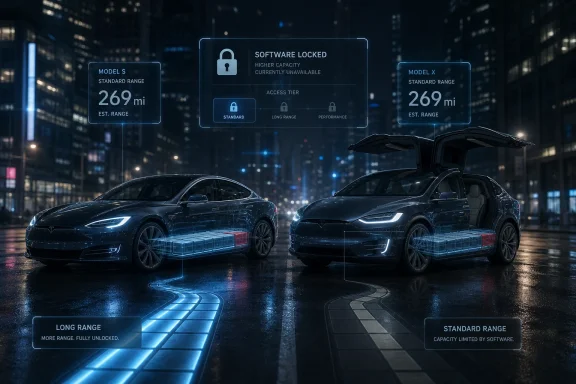
Tesla’s Standard Range Model S and Model X, introduced in August 2023 for U.S. buyers, used the same battery hardware as their Long Range counterparts while limiting usable capacity and performance through software rather than a physically smaller pack. That confirmation turned a simple trim-level story into a much larger argument about what modern car ownership now means. Tesla was not merely selling less range for less money; it was selling access to capability already installed in the vehicle. The result is a revealing case study in how the software-defined car can blur the line between product segmentation, manufacturing efficiency, and post-sale control.
For decades, automakers have sold mechanically similar vehicles at different prices. A base engine might share architecture with a higher-output tune, a luxury trim might include wiring for options not installed, and regional variants might differ more by configuration than by fundamental engineering. The difference with Tesla is that the company made the abstraction visible.
The Standard Range Model S and Model X were not cheap cars. At launch, they sat in the upper reaches of the EV market, with the Model S Standard Range listed at $78,490 and the Model X Standard Range at $88,490 before fees, taxes, incentives, or later price changes. Their advertised ranges, roughly 320 miles for the sedan and 269 miles for the SUV, were lower than the Long Range versions, but the hardware story underneath was the same: the battery pack was reportedly not smaller in the traditional sense.
That matters because battery capacity is the defining cost center and value signal of an EV. Buyers are trained to think of range as the physical output of chemistry, cell count, weight, and pack size. Tesla’s move reframed range as something closer to a license tier.
The company’s defenders can make a rational case. If Tesla can build fewer battery configurations, simplify assembly, reduce parts complexity, and use software to create price steps, the factory gets easier to run. That is not a trivial benefit in an industry where complexity quietly destroys margins.
But the consumer-facing implication is sharper. A driver may be sitting on dormant battery capacity that the car is physically carrying, that the owner paid to move around every mile, and that the software refuses to make available.
From Tesla’s perspective, building one pack and selling it in multiple range tiers can be an elegant solution. The company avoids maintaining a lower-capacity premium pack for what was likely a limited-volume variant. It also preserves flexibility: production can flow without matching every order to a unique battery bill of materials.
That is especially important for Model S and Model X, which were no longer Tesla’s volume engines by 2023. Model 3 and Model Y carried the business, while the older premium models increasingly served as brand flagships, technology showcases, and margin opportunities. In that context, adding an entry price without adding much manufacturing complexity made sense.
The problem is that elegant factory design can look like artificial scarcity from the driveway. A software-locked pack tells owners that the vehicle’s limitations are not entirely physical. The car can do more, but the business model says it should not.
That tension is now central to the software-defined vehicle era. Automakers want the efficiency of common hardware platforms and the revenue flexibility of unlockable features. Customers want lower prices, but they also expect ownership to mean control over the thing they bought. Those expectations are beginning to collide.
This is familiar in computing. The same silicon family may ship with disabled cores, lower clock speeds, or enterprise features fused off or locked behind licensing. In cloud services, customers pay for capacity, throughput, regions, and tiers that often sit on shared infrastructure. Tesla’s move imported that logic into a consumer object with wheels, leather, glass, and a six-figure-adjacent price tag.
WindowsForum readers will recognize the pattern immediately. The PC industry has long accustomed users to the idea that hardware capability and software entitlement are not identical. The difference is emotional as much as technical: a laptop sitting on a desk feels like a computer, while a car in the garage feels like property.
That emotional distinction is becoming harder to defend as cars become rolling compute platforms. Modern EVs are packed with controllers, firmware, subscriptions, driver-assistance logic, network authentication, and over-the-air update paths. The battery may be chemical, but the customer’s access to it can be contractual.
Tesla’s Standard Range strategy made that reality unusually plain. The lower-priced version was not a lesser machine in the old sense. It was a machine with a larger set of capabilities than the customer was allowed to use.
On one hand, owners liked the possibility of upgrading later. A buyer could enter at a lower price and, if finances changed, purchase additional usable range without changing cars. That is a genuine consumer benefit when presented clearly and priced fairly.
On the other hand, it created awkward questions. If the battery was already there, what exactly was being bought later? Was the upgrade a new feature, a deferred purchase, or a ransom payment for capability the vehicle had carried since day one?
Tesla also temporarily unlocked range during emergencies in the past, including natural disasters. Those moves were widely praised because they showed the humanitarian upside of centralized software control. Yet they also reminded everyone that some limitations were policy choices, not physics.
The 2023 Standard Range S and X revived that ambiguity. Reports at launch suggested inconsistent answers from Tesla service personnel about whether owners would be able to pay later to unlock additional capacity. That inconsistency was almost as revealing as the lock itself. It suggested that even inside Tesla’s customer-facing apparatus, the product story was not fully settled.
The 2023 rollout did not provide that clarity. Tesla appeared to be using the lock as a trim separator, not necessarily as a customer-facing upgrade ladder. Some reporting suggested there would be no unlock option, while other accounts left the door open.
That uncertainty changed the tone of the story. If the capacity is locked forever, the customer is paying to haul unused battery mass for the life of the vehicle. If it can be unlocked later, the car becomes a deferred upsell platform. Both models can be defended, but they are not the same proposition.
This is where Tesla’s minimalist communications style becomes a liability. The company often lets configurator pages, service-center replies, owner reports, and executive posts form the public record. That may work for hype cycles, but it is a poor substitute for durable product disclosure.
For a purchase this expensive, the practical questions are not academic. Owners want to know whether range can be unlocked, whether warranty terms differ, whether resale values reflect latent capacity, and whether future software updates could change the economics. Silence leaves room for speculation, and speculation is corrosive when the product is already defined by invisible limits.
But software locks depend on trust. Buyers must believe that the limitation is being used to create a sensible product ladder, not to manipulate artificial scarcity. They must also believe the company will not change the rules after purchase in ways that reduce value.
Tesla has a complicated relationship with that trust. Its over-the-air updates have added meaningful features, improved performance, fixed bugs, and kept older cars feeling current. That is one of the company’s great achievements and a real advantage over legacy automakers that historically treated sold vehicles as frozen products.
At the same time, software-defined control has produced recurring anxieties. Owners worry about feature removals, subscription shifts, repair restrictions, used-car entitlement confusion, and the long-term availability of server-dependent functions. The battery lock sits squarely in that broader debate.
The issue is not that Tesla can control the car through software. Everyone buying a modern connected vehicle is accepting some version of that. The issue is whether the boundaries of that control are clear enough for ownership to remain meaningful.
That is already a challenge with driver-assistance packages, connectivity features, charging histories, and regional differences. Add locked battery capacity, and the used EV inspection checklist becomes even more dependent on screens, account status, and manufacturer records.
The risk is not merely buyer confusion. It is asymmetric information. A seller may describe a vehicle in terms of hardware potential, while the buyer experiences it in terms of software permission. A dealer may not understand the distinction. A listing may use trim names inconsistently. A future Tesla policy change could alter perceived value overnight.
For enthusiasts, this is irritating. For ordinary buyers, it is a trapdoor. The more automakers move value into software states, the more the used market needs reliable ways to verify entitlements.
That is a governance problem the auto industry has not solved. Window stickers were designed for physical options. VIN decoders were designed for build configurations. The software-defined car needs a durable ownership ledger that follows the vehicle without requiring folklore.
If a manufacturer advertises usable range accurately, it can argue that the customer received exactly what was sold. That is a strong defense. The Standard Range buyer was not promised Long Range performance and then denied it.
But regulators tend to become interested when product limitations are difficult for consumers to understand. A hidden capacity lock is not like choosing cloth seats instead of leather. It is a technical constraint placed on a major mechanical asset whose cost, weight, degradation profile, and resale implications are central to the vehicle.
There is also an environmental angle. Carrying unused battery capacity has material and efficiency consequences. If a car includes cells whose capacity is intentionally withheld, critics can argue that scarce battery materials are being deployed inefficiently for pricing strategy rather than mobility benefit.
That argument should not be overstated. A buffer can improve longevity, and common packs may reduce manufacturing waste in other ways. Still, the optics are not simple. In an industry selling itself partly on sustainability, intentionally unused capacity is a difficult story to tell.
Some of those experiments have gone badly because customers saw them as double charging. Heated seats are the canonical example: if the heating elements are installed in the car, many buyers instinctively reject paying a recurring fee to activate them. Automakers can explain platform simplification all day; the customer sees a switch that should work.
Battery capacity is a more sophisticated version of the same dispute. It has a stronger manufacturing rationale than many cabin-feature subscriptions, but it also touches a higher-value component. The stakes are larger because range affects route planning, charging stops, degradation anxiety, and the resale price of the vehicle.
Tesla’s advantage is that its customers are more accustomed to software-mediated cars. Many Tesla owners expect feature changes after purchase. Some even like the idea that the car can become more capable over time.
But enthusiasm has limits. The same community that celebrates over-the-air improvements can turn skeptical when software is used to withhold rather than enhance. The boundary between upgrade and upsell is thin.
Seen that way, the Standard Range variants were not just engineering artifacts. They were pricing instruments. Tesla could advertise a lower entry point for its premium vehicles without fully repositioning the Long Range trims.
That is a familiar retail strategy. Create a lower rung, preserve the premium rung, and let buyers self-select. In conventional cars, that lower rung might mean a smaller engine, fewer speakers, manual seats, or a smaller fuel tank. In Tesla’s case, it meant software-defined access to battery and performance.
The move also protected the status of Long Range buyers. If Tesla had simply cut Long Range prices by $10,000, recent buyers would have been angry and margins would have compressed. A software-limited Standard Range variant gave Tesla a way to lower the headline price while maintaining a distinction.
That distinction, however, depended on buyers accepting that capability can be partitioned after assembly. That is the central bargain of the software-defined car, and it remains unresolved.
Cars invert that intuition. The hardware is the product, or at least that is how buyers have historically understood it. Software controls the hardware, but the engine, battery, brakes, suspension, and seats are supposed to be owned.
Tesla collapses those categories. A Model S is both a vehicle and a software platform. Its value is partly physical, partly computational, and partly dependent on Tesla’s continuing services.
That does not make Tesla wrong. It makes the company early to a fight that the whole industry will have to have. When everything from charging curves to driver assistance to battery availability is software-mediated, the customer needs a new mental model of ownership.
The danger for automakers is assuming that the software industry’s licensing norms can simply be mapped onto cars. Consumers tolerate editioning in software because software is intangible and frequently updated. They are less forgiving when the locked feature is a chunk of battery chemistry bolted under the floor.
There are several possibilities. Tesla could use locked capacity purely for manufacturing simplicity, with no future unlock. It could offer paid unlocks later, turning hardware into deferred revenue. It could temporarily unlock capacity during emergencies, preserving goodwill while maintaining segmentation. It could change policies depending on inventory, demand, region, or regulatory pressure.
Each version creates a different relationship with the owner. A permanent lock is a trim strategy. A paid unlock is a digital option. A temporary emergency unlock is centralized fleet management. A shifting policy is dynamic pricing by another name.
The problem for buyers is that these models can coexist over the life of a vehicle. The car may be sold under one assumption and later governed by another. That is not unique to Tesla, but Tesla’s vertical integration makes the effect more immediate.
This is why disclosure matters more than the lock itself. If automakers want customers to accept software-defined capability, they need to describe it with the precision of a contract and the clarity of a window sticker. Anything less leaves buyers to reverse-engineer the product they just purchased.
By 2023, those vehicles were no longer the company’s future in volume terms. They were aging flagships in a lineup increasingly dominated by Model 3 and Model Y. That made them useful platforms for pricing experiments but also exposed how much the market had changed around them.
The Standard Range software lock belongs to that late-stage flagship era. It shows Tesla trying to extract more market coverage from mature hardware. Instead of redesigning the vehicles around a cheaper pack, it redefined the product in software.
That is efficient, but it is also revealing. The innovation frontier had moved from the pack itself to the permission layer around the pack. In a sense, the Standard Range S and X were less about new cars than about a new commercial grammar.
That grammar will outlive those trims. Whether or not Tesla keeps a particular variant on sale, the idea of common EV hardware segmented by software is now firmly part of the industry playbook.
That is not how most people want to shop for cars. They want range, price, charging speed, warranty coverage, and comfort. Yet the software-defined vehicle forces more technical literacy onto consumers.
Administrators and IT pros will find this familiar. Asset management is easy when capability is physical and visible. It becomes harder when capability depends on licensing, account binding, update channels, and vendor policy.
The car is becoming another managed endpoint. The difference is that this endpoint weighs thousands of pounds, depreciates on a driveway, and carries a family at highway speed.
 Tesla Did Not Invent the Software-Locked Car, but It Made the Idea Legible
For decades, automakers have sold mechanically similar vehicles at different prices. A base engine might share architecture with a higher-output tune, a luxury trim might include wiring for options not installed, and regional variants might differ more by configuration than by fundamental engineering. The difference with Tesla is that the company made the abstraction visible.The Standard Range Model S and Model X were not cheap cars. At launch, they sat in the upper reaches of the EV market, with the Model S Standard Range listed at $78,490 and the Model X Standard Range at $88,490 before fees, taxes, incentives, or later price changes. Their advertised ranges, roughly 320 miles for the sedan and 269 miles for the SUV, were lower than the Long Range versions, but the hardware story underneath was the same: the battery pack was reportedly not smaller in the traditional sense.
That matters because battery capacity is the defining cost center and value signal of an EV. Buyers are trained to think of range as the physical output of chemistry, cell count, weight, and pack size. Tesla’s move reframed range as something closer to a license tier.
The company’s defenders can make a rational case. If Tesla can build fewer battery configurations, simplify assembly, reduce parts complexity, and use software to create price steps, the factory gets easier to run. That is not a trivial benefit in an industry where complexity quietly destroys margins.
But the consumer-facing implication is sharper. A driver may be sitting on dormant battery capacity that the car is physically carrying, that the owner paid to move around every mile, and that the software refuses to make available.
The Factory Logic Is Stronger Than the Consumer Logic
Tesla has always preferred manufacturing simplification over traditional automaker variety. Paint choices shrink, stalks disappear, trim lines collapse, and options migrate from order sheets into software menus. The Standard Range S and X fit that philosophy neatly.From Tesla’s perspective, building one pack and selling it in multiple range tiers can be an elegant solution. The company avoids maintaining a lower-capacity premium pack for what was likely a limited-volume variant. It also preserves flexibility: production can flow without matching every order to a unique battery bill of materials.
That is especially important for Model S and Model X, which were no longer Tesla’s volume engines by 2023. Model 3 and Model Y carried the business, while the older premium models increasingly served as brand flagships, technology showcases, and margin opportunities. In that context, adding an entry price without adding much manufacturing complexity made sense.
The problem is that elegant factory design can look like artificial scarcity from the driveway. A software-locked pack tells owners that the vehicle’s limitations are not entirely physical. The car can do more, but the business model says it should not.
That tension is now central to the software-defined vehicle era. Automakers want the efficiency of common hardware platforms and the revenue flexibility of unlockable features. Customers want lower prices, but they also expect ownership to mean control over the thing they bought. Those expectations are beginning to collide.
Range Became a Product Tier, Not Just an Engineering Result
The software lock on the Standard Range S and X was not just about battery capacity. Reports at the time also noted reduced performance compared with Long Range versions. That made the cars a broader example of software-defined segmentation: same broad platform, different allowed behavior.This is familiar in computing. The same silicon family may ship with disabled cores, lower clock speeds, or enterprise features fused off or locked behind licensing. In cloud services, customers pay for capacity, throughput, regions, and tiers that often sit on shared infrastructure. Tesla’s move imported that logic into a consumer object with wheels, leather, glass, and a six-figure-adjacent price tag.
WindowsForum readers will recognize the pattern immediately. The PC industry has long accustomed users to the idea that hardware capability and software entitlement are not identical. The difference is emotional as much as technical: a laptop sitting on a desk feels like a computer, while a car in the garage feels like property.
That emotional distinction is becoming harder to defend as cars become rolling compute platforms. Modern EVs are packed with controllers, firmware, subscriptions, driver-assistance logic, network authentication, and over-the-air update paths. The battery may be chemical, but the customer’s access to it can be contractual.
Tesla’s Standard Range strategy made that reality unusually plain. The lower-priced version was not a lesser machine in the old sense. It was a machine with a larger set of capabilities than the customer was allowed to use.
The Old Model S 60 Playbook Never Really Went Away
Tesla had precedent here. Years earlier, the company sold software-limited Model S variants such as the 60 and 60D, which could be upgraded to access more capacity from a larger pack. That strategy became part of Tesla lore because it showed both sides of the model.On one hand, owners liked the possibility of upgrading later. A buyer could enter at a lower price and, if finances changed, purchase additional usable range without changing cars. That is a genuine consumer benefit when presented clearly and priced fairly.
On the other hand, it created awkward questions. If the battery was already there, what exactly was being bought later? Was the upgrade a new feature, a deferred purchase, or a ransom payment for capability the vehicle had carried since day one?
Tesla also temporarily unlocked range during emergencies in the past, including natural disasters. Those moves were widely praised because they showed the humanitarian upside of centralized software control. Yet they also reminded everyone that some limitations were policy choices, not physics.
The 2023 Standard Range S and X revived that ambiguity. Reports at launch suggested inconsistent answers from Tesla service personnel about whether owners would be able to pay later to unlock additional capacity. That inconsistency was almost as revealing as the lock itself. It suggested that even inside Tesla’s customer-facing apparatus, the product story was not fully settled.
The Upgrade Path Was the Missing Promise
A software-locked product is easier to accept when the upgrade path is explicit. If a buyer knows that the Standard Range vehicle can later become a Long Range vehicle for a clearly stated fee, the transaction is legible. It becomes a financing and timing choice.The 2023 rollout did not provide that clarity. Tesla appeared to be using the lock as a trim separator, not necessarily as a customer-facing upgrade ladder. Some reporting suggested there would be no unlock option, while other accounts left the door open.
That uncertainty changed the tone of the story. If the capacity is locked forever, the customer is paying to haul unused battery mass for the life of the vehicle. If it can be unlocked later, the car becomes a deferred upsell platform. Both models can be defended, but they are not the same proposition.
This is where Tesla’s minimalist communications style becomes a liability. The company often lets configurator pages, service-center replies, owner reports, and executive posts form the public record. That may work for hype cycles, but it is a poor substitute for durable product disclosure.
For a purchase this expensive, the practical questions are not academic. Owners want to know whether range can be unlocked, whether warranty terms differ, whether resale values reflect latent capacity, and whether future software updates could change the economics. Silence leaves room for speculation, and speculation is corrosive when the product is already defined by invisible limits.
Software Locks Are Efficient Until Trust Becomes the Bottleneck
The strongest case for Tesla’s approach is operational. Common hardware lowers complexity, and lower complexity can lower cost. If some of that saving reaches buyers as a lower entry price, the market may accept the compromise.But software locks depend on trust. Buyers must believe that the limitation is being used to create a sensible product ladder, not to manipulate artificial scarcity. They must also believe the company will not change the rules after purchase in ways that reduce value.
Tesla has a complicated relationship with that trust. Its over-the-air updates have added meaningful features, improved performance, fixed bugs, and kept older cars feeling current. That is one of the company’s great achievements and a real advantage over legacy automakers that historically treated sold vehicles as frozen products.
At the same time, software-defined control has produced recurring anxieties. Owners worry about feature removals, subscription shifts, repair restrictions, used-car entitlement confusion, and the long-term availability of server-dependent functions. The battery lock sits squarely in that broader debate.
The issue is not that Tesla can control the car through software. Everyone buying a modern connected vehicle is accepting some version of that. The issue is whether the boundaries of that control are clear enough for ownership to remain meaningful.
The Resale Market Gets the Weirdest Version of the Story
Software-locked battery capacity also complicates used-car valuation. A buyer shopping a used Model S or Model X wants to know what the vehicle can actually do, not just what hardware it contains. If two cars have physically similar packs but different software entitlements, the used market has to price the invisible.That is already a challenge with driver-assistance packages, connectivity features, charging histories, and regional differences. Add locked battery capacity, and the used EV inspection checklist becomes even more dependent on screens, account status, and manufacturer records.
The risk is not merely buyer confusion. It is asymmetric information. A seller may describe a vehicle in terms of hardware potential, while the buyer experiences it in terms of software permission. A dealer may not understand the distinction. A listing may use trim names inconsistently. A future Tesla policy change could alter perceived value overnight.
For enthusiasts, this is irritating. For ordinary buyers, it is a trapdoor. The more automakers move value into software states, the more the used market needs reliable ways to verify entitlements.
That is a governance problem the auto industry has not solved. Window stickers were designed for physical options. VIN decoders were designed for build configurations. The software-defined car needs a durable ownership ledger that follows the vehicle without requiring folklore.
Regulators Will Eventually Notice the Difference Between Capacity and Access
Software-locked range also invites regulatory scrutiny, even if no rule is obviously violated. EV range estimates, warranty disclosures, battery health reporting, and consumer protection law were not built around the idea that installed capacity and available capacity may intentionally diverge.If a manufacturer advertises usable range accurately, it can argue that the customer received exactly what was sold. That is a strong defense. The Standard Range buyer was not promised Long Range performance and then denied it.
But regulators tend to become interested when product limitations are difficult for consumers to understand. A hidden capacity lock is not like choosing cloth seats instead of leather. It is a technical constraint placed on a major mechanical asset whose cost, weight, degradation profile, and resale implications are central to the vehicle.
There is also an environmental angle. Carrying unused battery capacity has material and efficiency consequences. If a car includes cells whose capacity is intentionally withheld, critics can argue that scarce battery materials are being deployed inefficiently for pricing strategy rather than mobility benefit.
That argument should not be overstated. A buffer can improve longevity, and common packs may reduce manufacturing waste in other ways. Still, the optics are not simple. In an industry selling itself partly on sustainability, intentionally unused capacity is a difficult story to tell.
Legacy Automakers Are Learning the Same Lesson More Slowly
Tesla attracts disproportionate attention because it moves first and communicates bluntly. But the software-locking debate is not confined to Tesla. The entire auto industry is experimenting with heated-seat subscriptions, horsepower upgrades, connected navigation, driver-assistance packages, remote-start fees, and app-mediated ownership.Some of those experiments have gone badly because customers saw them as double charging. Heated seats are the canonical example: if the heating elements are installed in the car, many buyers instinctively reject paying a recurring fee to activate them. Automakers can explain platform simplification all day; the customer sees a switch that should work.
Battery capacity is a more sophisticated version of the same dispute. It has a stronger manufacturing rationale than many cabin-feature subscriptions, but it also touches a higher-value component. The stakes are larger because range affects route planning, charging stops, degradation anxiety, and the resale price of the vehicle.
Tesla’s advantage is that its customers are more accustomed to software-mediated cars. Many Tesla owners expect feature changes after purchase. Some even like the idea that the car can become more capable over time.
But enthusiasm has limits. The same community that celebrates over-the-air improvements can turn skeptical when software is used to withhold rather than enhance. The boundary between upgrade and upsell is thin.
The Standard Range Trim Was Also a Price-Cut Story
The timing matters. The Standard Range S and X arrived in 2023 during a period of aggressive Tesla pricing moves. The company was using price cuts and trim reshuffling to stimulate demand, respond to competition, and keep its lineup moving in a market that was becoming less forgiving.Seen that way, the Standard Range variants were not just engineering artifacts. They were pricing instruments. Tesla could advertise a lower entry point for its premium vehicles without fully repositioning the Long Range trims.
That is a familiar retail strategy. Create a lower rung, preserve the premium rung, and let buyers self-select. In conventional cars, that lower rung might mean a smaller engine, fewer speakers, manual seats, or a smaller fuel tank. In Tesla’s case, it meant software-defined access to battery and performance.
The move also protected the status of Long Range buyers. If Tesla had simply cut Long Range prices by $10,000, recent buyers would have been angry and margins would have compressed. A software-limited Standard Range variant gave Tesla a way to lower the headline price while maintaining a distinction.
That distinction, however, depended on buyers accepting that capability can be partitioned after assembly. That is the central bargain of the software-defined car, and it remains unresolved.
The Windows Analogy Is Uncomfortable but Useful
For a WindowsForum audience, the closest analogy may be editioning. Microsoft has long sold Windows in Home, Pro, Enterprise, Education, and server variants, often with overlapping code but different enabled capabilities. The software is the product, so feature gating feels normal even when users grumble about it.Cars invert that intuition. The hardware is the product, or at least that is how buyers have historically understood it. Software controls the hardware, but the engine, battery, brakes, suspension, and seats are supposed to be owned.
Tesla collapses those categories. A Model S is both a vehicle and a software platform. Its value is partly physical, partly computational, and partly dependent on Tesla’s continuing services.
That does not make Tesla wrong. It makes the company early to a fight that the whole industry will have to have. When everything from charging curves to driver assistance to battery availability is software-mediated, the customer needs a new mental model of ownership.
The danger for automakers is assuming that the software industry’s licensing norms can simply be mapped onto cars. Consumers tolerate editioning in software because software is intangible and frequently updated. They are less forgiving when the locked feature is a chunk of battery chemistry bolted under the floor.
The Real Innovation Is Not the Lock, but the Business Model Around It
The important question is not whether Tesla can lock battery capacity. Clearly it can. The important question is what business model the lock supports.There are several possibilities. Tesla could use locked capacity purely for manufacturing simplicity, with no future unlock. It could offer paid unlocks later, turning hardware into deferred revenue. It could temporarily unlock capacity during emergencies, preserving goodwill while maintaining segmentation. It could change policies depending on inventory, demand, region, or regulatory pressure.
Each version creates a different relationship with the owner. A permanent lock is a trim strategy. A paid unlock is a digital option. A temporary emergency unlock is centralized fleet management. A shifting policy is dynamic pricing by another name.
The problem for buyers is that these models can coexist over the life of a vehicle. The car may be sold under one assumption and later governed by another. That is not unique to Tesla, but Tesla’s vertical integration makes the effect more immediate.
This is why disclosure matters more than the lock itself. If automakers want customers to accept software-defined capability, they need to describe it with the precision of a contract and the clarity of a window sticker. Anything less leaves buyers to reverse-engineer the product they just purchased.
Tesla’s Premium Cars Became a Preview of a Less Certain Ownership Era
The Model S and Model X have always carried symbolic weight for Tesla. The Model S proved that an EV could be desirable, fast, long-range, and technologically ambitious. The Model X proved Tesla could push that formula into a high-end SUV, even if its complexity became part of its reputation.By 2023, those vehicles were no longer the company’s future in volume terms. They were aging flagships in a lineup increasingly dominated by Model 3 and Model Y. That made them useful platforms for pricing experiments but also exposed how much the market had changed around them.
The Standard Range software lock belongs to that late-stage flagship era. It shows Tesla trying to extract more market coverage from mature hardware. Instead of redesigning the vehicles around a cheaper pack, it redefined the product in software.
That is efficient, but it is also revealing. The innovation frontier had moved from the pack itself to the permission layer around the pack. In a sense, the Standard Range S and X were less about new cars than about a new commercial grammar.
That grammar will outlive those trims. Whether or not Tesla keeps a particular variant on sale, the idea of common EV hardware segmented by software is now firmly part of the industry playbook.
The Practical Lesson Is Hiding in the Configurator
For buyers, the immediate lesson is simple: trim names are no longer enough. A modern EV purchase requires understanding not just what hardware is installed, but what software rights come with it, whether those rights transfer, and whether they can change.That is not how most people want to shop for cars. They want range, price, charging speed, warranty coverage, and comfort. Yet the software-defined vehicle forces more technical literacy onto consumers.
Administrators and IT pros will find this familiar. Asset management is easy when capability is physical and visible. It becomes harder when capability depends on licensing, account binding, update channels, and vendor policy.
The car is becoming another managed endpoint. The difference is that this endpoint weighs thousands of pounds, depreciates on a driveway, and carries a family at highway speed.
The Locked-Pack Model Leaves Buyers With a Short Checklist
The Standard Range Model S and Model X episode is useful because it compresses the software-defined car debate into a single decision. Tesla offered a lower price, preserved manufacturing simplicity, and exposed the unease that comes when installed capability is withheld by code. Anyone shopping a modern EV should treat that unease as a signal, not a footnote.- Buyers should confirm the advertised usable range and performance rather than assuming installed battery hardware determines capability.
- Owners should ask whether any locked capacity can be unlocked later, whether the price is fixed, and whether the answer is documented in writing.
- Used-car shoppers should verify software entitlements from the vehicle screen and account records instead of relying only on trim names or seller descriptions.
- Fleet managers should treat software-locked vehicles as licensed assets whose value may depend on vendor policy as much as hardware condition.
- Regulators and consumer advocates should push for clearer disclosure when installed vehicle capability is intentionally unavailable to the owner.
References
- Primary source: Not a Tesla App
Published: 2026-06-27T15:10:11.657240
Tesla Confirms Software-Locking Strategy for Standard Range Model S and Model X
Tesla's Standard Range Model S and Model X have software-locked battery capacity. This strategy enables more affordable pricing, with potential future unlocking www.notateslaapp.com
- Related coverage: cars.com
Tesla Cuts Prices on Model S and Model X, Drops Standard Range Trim | Cars.com
The lower-range cars are gone from Tesla’s website, and what remains are the preexisting Model S and Model X at lower prices.www.cars.com - Related coverage: inverse.com
Tesla’s Model S and Model X EVs Just Got a Lot More Affordable
Tesla is bringing back Standard Range trims for its Model S and Model X which have less range but a more affordable price tag.www.inverse.com - Related coverage: techcrunch.com
Tesla launches cheaper Model X and Model S options with less range | TechCrunch
Tesla has new, lower price options for shoppers who need less range. The automaker revived the "standard range" trim level on its two most expensivetechcrunch.com - Related coverage: electrek.co
Tesla's new Models S and X have the same battery pack but with software-locked capacity | Electrek
Tesla has confirmed that its new “Standard Range” Model S and Model X have the same battery pack as the...electrek.co - Related coverage: electrive.com
USA: Tesla launches 'Standard Range' Model S and X - electrive.com
Tesla launched a new ‘Standard Range’ version of the Model S and Model X in the US. It costs 10,000 dollars less than the previous basic ‘Longwww.electrive.com
- Related coverage: teslarati.com
Tesla confirms new Standard Range Model S and X are limited by software
Tesla has confirmed that its newly-launched Standard Range versions of the Model S and Model X are limited by software and do not equip different battery chemistries, like lithium iron phosphate or LFP. Last night, we reported on Tesla’s launch of the new Standard Range versions of the...www.teslarati.com - Related coverage: notebookcheck.net
Tesla Model S and X with software-locked batteries and US$10k price cuts launch as Standard Range variants - Notebookcheck News
Tesla seems to be applying its heated seat hardware approach to its base Model S and Model X vehicles. While the new Tesla Model S and X Standard Range trims are in the order of US$10,000 cheaper, they also ship with exactly the same battery hardware, with nothing more than a software lock... www.notebookcheck.net
- Related coverage: axios.com
Tesla Model S and Model X to be discontinued, Elon Musk says
Tesla is discontinuing the Model S sedan and Model X crossover — luxury vehicles that put the company on a path to U.S. EV dominance.www.axios.com
- Related coverage: tslablog.com
2024 Tesla Model S Standard Range Specs, 320 mi Range, 670 HP
Full specs for the 2024 Tesla Model S Standard Range: 320 mi EPA range, 670 HP, 3.7s 0-60, 149 mph top speed. Compare wheels, charging, and what changed vs prior generations.tslablog.com - Related coverage: insideevs.com
UPDATE: Tesla Introduces Cheaper Standard Range Variant For Model S And Model X
Tesla is bringing back the Standard Range variant for the Model S and Model X EVs after the trim level has come and gone several times before 2021. insideevs.com
- Related coverage: techradar.com
'We will have an official ceremony to mark the ending of an era. I love those cars' — Elon Musk mourns the officially retired Tesla Model S and Model X | TechRadar
All good things must come to an endwww.techradar.com - Related coverage: tesla.com
- Related coverage: service.tesla.com
