

Rebel Wolves revealed PC system requirements for The Blood of Dawnwalker during its April 28, 2026 Road to Launch showcase, confirming that the Unreal Engine 5 dark-fantasy RPG will launch September 3, 2026, on Windows PC, PlayStation 5, and Xbox Series X/S. The headline is not merely that the game needs an SSD or 16GB of RAM. It is that another prestige RPG is treating native 60fps PC gaming as a premium hardware tier rather than the default. For Windows players, the requirements are a useful early warning: this vampire epic may be narratively old-world, but its PC demands are very much 2026.
System requirements used to be a simple consumer courtesy. They told you whether your machine could boot the game, whether you were headed for low textures and compromise, or whether your GPU could stretch its legs. In 2026, they have become something closer to a marketing document, a performance philosophy, and a warning label rolled into one.
That is why The Blood of Dawnwalker is worth paying attention to before anyone has benchmarked the final code. Rebel Wolves is not just saying that its debut RPG will run on a range of PCs. It is saying, implicitly, that the modern open-world RPG is now built around SSD storage, 16GB memory floors, large VRAM pools, and upscaling as a practical expectation even when native numbers are published.
The most important detail is not the minimum setting by itself. It is the ladder. At the low end, the game targets 1080p at 30fps on low settings. At the higher end, native 4K at 60fps on ultra settings reportedly climbs all the way to an RTX 5090-class GPU. That spread tells us more than any trailer: Rebel Wolves is building for a visual ceiling that most PCs will not reach without compromise.
There is a sensible defense of that. This is an Unreal Engine 5 RPG from a studio founded by veterans of The Witcher 3, and the whole pitch rests on atmosphere, dense environments, choice-heavy systems, and a world that changes under pressure. But it also means PC players should read the requirements less like a checklist and more like a forecast.
That matters for WindowsForum readers because it marks another step in the retirement of the “it’ll run from a hard drive if you’re patient” era. For a modern RPG, storage speed is no longer just about load screens. It affects traversal, texture streaming, stutter, asset pop-in, and the way an open world holds together when the player moves faster than the asset pipeline can comfortably follow.
The CPU floor is also telling. Depending on which published spec tier you are looking at, the game’s minimum-class processors sit well above the ancient quad-core machines that survived the previous console generation through sheer stubbornness. Even if final optimization changes the numbers, the message is clear: Dawnwalker is not being positioned as a game for the long tail of aging office-tower conversions and budget hand-me-down rigs.
That is not inherently unreasonable. The PlayStation 5 and Xbox Series consoles have SSD-first architectures, competent Zen 2-class CPUs, and GPU feature sets that pushed developers away from the Xbox One and PS4 compromise model. A PC version that pretends otherwise risks becoming a stuttery mess. But for players who still think of 1080p as “easy mode,” the modern spec sheet is becoming a rude correction.
If Rebel Wolves is indeed publishing native targets first, that is the right move. It lets players understand the baseline before reconstruction technologies enter the conversation. Upscaling can be excellent, and frame generation can be transformative in the right circumstances, but neither should be used to disguise the cost of the underlying render.
This is especially important for a game like The Blood of Dawnwalker. Dark fantasy worlds live and die on image stability: candlelit interiors, fog, hair, foliage, particle effects, thin geometry, and high-contrast night scenes are all places where reconstruction can either look magical or fall apart. A vampire RPG set across day and night cycles will likely expose every weakness in temporal image processing.
The irony is that upscaling may still become the way most people play it. That is not a scandal; it is the current reality of PC graphics. But there is a difference between “this game supports upscaling to help more PCs run well” and “this game’s recommended performance target only exists because AI reconstruction is doing the heavy lifting.” Rebel Wolves deserves credit if it is trying to keep that distinction visible.
That is where the PC audience fractures. Many players bought 8GB cards in good faith, often not very long ago, after years of being told that 1080p gaming did not require more. Those cards are not suddenly useless. But they increasingly live in a world where texture quality, ray-tracing-adjacent rendering techniques, open-world streaming, and high-resolution assets can punish narrow memory budgets long before raw shader performance runs out.
This is the awkward truth of the current GPU market: model names are less informative than they used to be. An “RTX 4060” or “RTX 5060” label does not tell the whole story unless you also know the VRAM configuration, memory bus, and the target resolution. PC gaming has entered an era where two cards with similar branding can age very differently because one has enough memory headroom and the other is constantly negotiating with the driver.
For The Blood of Dawnwalker, the practical question is whether 8GB cards can still produce a good experience at reduced settings. They probably can, especially at 1080p with sensible texture choices and upscaling. But the spec sheet suggests that players chasing native 60fps at high settings should stop pretending VRAM is a footnote.
The DirectX 12 requirement, by contrast, is unsurprising. Any contemporary Unreal Engine 5 game targeting modern consoles and PC graphics features is going to live in that world. For sysadmins and power users, the compatibility point is less about the API name and more about driver maturity, GPU support, and whether older systems have accumulated enough cruft to turn launch week into troubleshooting week.
This is where PC gaming remains both wonderful and maddening. A console user buys The Blood of Dawnwalker and gets one of a few fixed performance profiles. A Windows user may have the faster machine on paper and still lose an evening to shader compilation, overlays, driver versions, background capture tools, undervolts, RGB utilities, or a motherboard BIOS that has not been touched since 2021.
The official spec sheet can only tell part of that story. The rest will be written in launch-day driver notes, Steam reviews, frame-time graphs, and the inevitable forum threads that begin with “my PC meets recommended, why does it stutter?”
It is a blessing because players understand the ambition immediately. A dark-fantasy RPG with morally tangled quests, a strong narrative spine, and a dangerous open world is exactly the kind of project this team is expected to make. The setting — a fictionalized 14th-century Europe shaped by plague, conflict, and vampiric rule — gives the studio a natural canvas for political horror and personal stakes.
It is a trap because the audience will not judge the game like a modest first effort. They will judge it against The Witcher 3, against Cyberpunk 2077 after years of patching, against Baldur’s Gate 3, against every prestige RPG that has trained players to expect systemic depth and cinematic presentation at once. That is a brutal comparison set for any studio, let alone one launching its first title.
The PC requirements fit that ambition. They suggest Rebel Wolves is not trying to make a lightweight throwback RPG wearing expensive art direction. It is trying to enter the top tier of modern single-player role-playing games, and that tier now comes with serious hardware implications.
A game built around consequence needs persistence. It needs states to change, characters to move or die, quest chains to mutate, and the world to remember what the player chose not to do. That kind of design can be computationally and organizationally expensive even before the renderer enters the picture.
This is where the “open world” label becomes slippery. Some open worlds are large maps filled with repeatable activities. Others are simulation-adjacent narrative machines in which the map is only the container. Rebel Wolves is promising something closer to the latter, or at least wants players to believe it is.
If the studio pulls it off, the hardware requirements will feel easier to justify. Players forgive demanding specs when the world feels alive, reactive, and technically coherent. They are less forgiving when the same specs deliver beautiful screenshots wrapped around traversal stutter and familiar quest design.
For PC builders, this is now table stakes. A SATA SSD is the bare minimum comfort zone, while NVMe storage has become cheap enough that there is little reason for a gaming-focused Windows machine to rely on spinning disks for new releases. The more interesting question is whether the final game benefits materially from faster NVMe drives or merely requires solid-state storage to avoid worst-case streaming issues.
That distinction will matter for handhelds and older desktops. Devices with limited storage, microSD expansion, or lower-power APUs may technically launch the game but struggle to deliver the experience the studio is targeting. Steam Deck-style compatibility will be an especially interesting test, not because the spec sheet invites optimism, but because PC players increasingly expect every major game to be at least negotiable on portable hardware.
The hard drive is not coming back for games like this. The only remaining debate is how gracefully developers handle slower SSDs, limited VRAM, and hardware that sits just below the official line.
That is a reasonable target in 2026, but it is not a cheap one. The psychological problem is that 1080p remains, for many PC players, the resolution of budget practicality. When a game’s 1080p 60fps high target starts naming modern midrange or upper-midrange GPUs, the audience understandably asks whether optimization is the issue or whether the visual bar has simply moved.
The answer may be both. Unreal Engine 5 has enabled striking results, but it has also become associated with shader compilation stutter, CPU overhead, traversal hiccups, and inconsistent PC launches when studios fail to do the unglamorous engineering work. A demanding UE5 spec sheet is not automatically a red flag, but it does raise the burden of proof.
Rebel Wolves has time before September 3. The studio has already said more detail and optimization information will arrive closer to launch. That window matters. A requirement chart in April is a snapshot; launch performance in September is the verdict.
That is why the sensible PC strategy for The Blood of Dawnwalker will probably be conservative. Players should think less about matching a label and more about deciding what matters: texture quality, frame pacing, resolution, latency, shadows, foliage density, global illumination, or effects. A stable 60fps high-ish experience will beat an unstable ultra preset every time.
This is especially true for an RPG where combat, exploration, dialogue, and atmosphere share the stage. Unlike a twitch shooter, Dawnwalker may not live or die by ultra-low latency. But unlike a turn-based RPG, it cannot hide poor frame pacing behind menus. The target should be consistency.
Windows users also need to remember that launch week is not the end state. GPU drivers, game patches, shader precompilation changes, and community-discovered settings often transform the first month of performance. The question is whether Rebel Wolves launches close enough that those improvements feel like polish rather than rescue work.
That expectation can become dangerous for developers. A well-optimized console build does not automatically translate into a smooth PC version across thousands of hardware combinations. But when PC requirements are high, players naturally compare them against a $500 living-room box and ask what their extra money is buying.
The Xbox Series S will be particularly revealing. If Rebel Wolves delivers a coherent Series S version, it will suggest the engine and asset pipeline can scale. If the Series S version is heavily compromised, it will reinforce the idea that The Blood of Dawnwalker is a current-gen-first RPG with little patience for constrained memory and GPU budgets.
For Windows players, the console comparison is not about platform war scorekeeping. It is about calibration. Console performance tells us what the developer considers acceptable; PC performance tells us how much flexibility the studio managed to build above and below that baseline.
That is particularly true here because the game is still months from release. Optimization work can change the practical experience substantially. A setting that destroys performance in a preview build may be tamed by launch. Conversely, a chart that looks manageable may hide traversal stutter or memory spikes that only appear in the final open world.
If your PC already has 16GB of RAM, an SSD, and a reasonably modern GPU, the rational move is to wait. If your system is below the listed floor, the writing is probably on the wall, but even then it is worth seeing whether the final version exposes a hard compatibility wall or merely a comfort problem.
For buyers planning an upgrade anyway, The Blood of Dawnwalker reinforces a broader 2026 rule: prioritize VRAM, SSD capacity, and balanced CPU performance rather than chasing only the flashiest GPU name. A slightly slower card with more memory may age better than a faster-looking model that runs into texture limits.
PC gaming’s great strength is scalability, but scalability is not magic. Every extra hardware tier costs development time, QA coverage, UI consideration, and technical compromise. At some point, a studio decides where the floor sits. Rebel Wolves appears to have placed that floor firmly in the modern era.
The risk is reputational. PC players have been burned often enough by big, beautiful games that launched with stutter, broken shader compilation, VRAM blowouts, or settings menus that seemed designed by people who never had to use them. A demanding spec sheet is acceptable when the final product feels engineered. It is infuriating when it feels like a warning the studio did not heed itself.
That is the bargain now. Developers can ask for more hardware, but they must offer more clarity, better tools, and fewer excuses. Native targets, explicit VRAM numbers, SSD requirements, and clear upscaling support are the beginning of that honesty, not the end.
For Windows users thinking ahead to September, the actionable lessons are already visible:
The Blood of Dawnwalker is arriving at a moment when PC gaming is trying to reconcile cinematic ambition, open-world complexity, and a hardware market that has not become cheaper just because games have become heavier. Rebel Wolves has given players enough information to start planning, but not enough to declare victory or disaster. If the studio can match its demanding requirements with a stable, scalable Windows release, the spec sheet will look like honest preparation; if not, it will be remembered as the first warning sign written in plain sight.
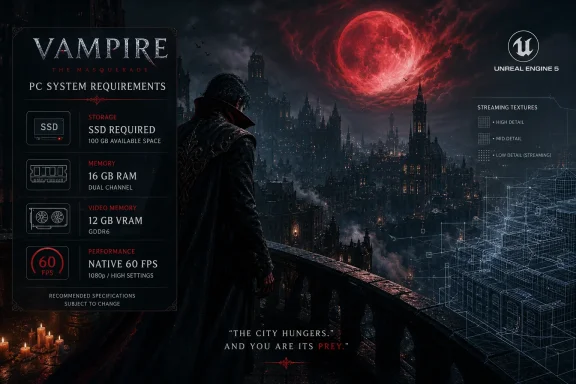 Rebel Wolves Turns the Spec Sheet Into a Confidence Test
System requirements used to be a simple consumer courtesy. They told you whether your machine could boot the game, whether you were headed for low textures and compromise, or whether your GPU could stretch its legs. In 2026, they have become something closer to a marketing document, a performance philosophy, and a warning label rolled into one.That is why The Blood of Dawnwalker is worth paying attention to before anyone has benchmarked the final code. Rebel Wolves is not just saying that its debut RPG will run on a range of PCs. It is saying, implicitly, that the modern open-world RPG is now built around SSD storage, 16GB memory floors, large VRAM pools, and upscaling as a practical expectation even when native numbers are published.
The most important detail is not the minimum setting by itself. It is the ladder. At the low end, the game targets 1080p at 30fps on low settings. At the higher end, native 4K at 60fps on ultra settings reportedly climbs all the way to an RTX 5090-class GPU. That spread tells us more than any trailer: Rebel Wolves is building for a visual ceiling that most PCs will not reach without compromise.
There is a sensible defense of that. This is an Unreal Engine 5 RPG from a studio founded by veterans of The Witcher 3, and the whole pitch rests on atmosphere, dense environments, choice-heavy systems, and a world that changes under pressure. But it also means PC players should read the requirements less like a checklist and more like a forecast.
The Real Minimum Is No Longer the Minimum
The lower-end target is where the PC market’s quiet shift becomes obvious. A 16GB RAM requirement across the board no longer feels aggressive; it feels ordinary. The same goes for the 60GB SSD requirement, which is modest in capacity but firm in storage type.That matters for WindowsForum readers because it marks another step in the retirement of the “it’ll run from a hard drive if you’re patient” era. For a modern RPG, storage speed is no longer just about load screens. It affects traversal, texture streaming, stutter, asset pop-in, and the way an open world holds together when the player moves faster than the asset pipeline can comfortably follow.
The CPU floor is also telling. Depending on which published spec tier you are looking at, the game’s minimum-class processors sit well above the ancient quad-core machines that survived the previous console generation through sheer stubbornness. Even if final optimization changes the numbers, the message is clear: Dawnwalker is not being positioned as a game for the long tail of aging office-tower conversions and budget hand-me-down rigs.
That is not inherently unreasonable. The PlayStation 5 and Xbox Series consoles have SSD-first architectures, competent Zen 2-class CPUs, and GPU feature sets that pushed developers away from the Xbox One and PS4 compromise model. A PC version that pretends otherwise risks becoming a stuttery mess. But for players who still think of 1080p as “easy mode,” the modern spec sheet is becoming a rude correction.
Native Performance Is the New Luxury Setting
The most welcome part of Rebel Wolves’ disclosure is the apparent distinction between native performance and upscaled performance. Too many recent PC requirement charts have blurred that line, presenting frame rates that quietly depend on DLSS, FSR, XeSS, frame generation, or some mixture of all three. The result is a spec sheet that looks cleaner than the lived experience.If Rebel Wolves is indeed publishing native targets first, that is the right move. It lets players understand the baseline before reconstruction technologies enter the conversation. Upscaling can be excellent, and frame generation can be transformative in the right circumstances, but neither should be used to disguise the cost of the underlying render.
This is especially important for a game like The Blood of Dawnwalker. Dark fantasy worlds live and die on image stability: candlelit interiors, fog, hair, foliage, particle effects, thin geometry, and high-contrast night scenes are all places where reconstruction can either look magical or fall apart. A vampire RPG set across day and night cycles will likely expose every weakness in temporal image processing.
The irony is that upscaling may still become the way most people play it. That is not a scandal; it is the current reality of PC graphics. But there is a difference between “this game supports upscaling to help more PCs run well” and “this game’s recommended performance target only exists because AI reconstruction is doing the heavy lifting.” Rebel Wolves deserves credit if it is trying to keep that distinction visible.
The 12GB VRAM Line Is Where the Argument Starts
The spec that will cause the most grumbling is not 16GB of system RAM. It is VRAM. Published higher-end targets place 12GB of video memory into the recommended conversation for 60fps play, with 16GB entering the picture at ultra tiers.That is where the PC audience fractures. Many players bought 8GB cards in good faith, often not very long ago, after years of being told that 1080p gaming did not require more. Those cards are not suddenly useless. But they increasingly live in a world where texture quality, ray-tracing-adjacent rendering techniques, open-world streaming, and high-resolution assets can punish narrow memory budgets long before raw shader performance runs out.
This is the awkward truth of the current GPU market: model names are less informative than they used to be. An “RTX 4060” or “RTX 5060” label does not tell the whole story unless you also know the VRAM configuration, memory bus, and the target resolution. PC gaming has entered an era where two cards with similar branding can age very differently because one has enough memory headroom and the other is constantly negotiating with the driver.
For The Blood of Dawnwalker, the practical question is whether 8GB cards can still produce a good experience at reduced settings. They probably can, especially at 1080p with sensible texture choices and upscaling. But the spec sheet suggests that players chasing native 60fps at high settings should stop pretending VRAM is a footnote.
Windows 10 Survives, DirectX 12 Is Non-Negotiable
One quiet relief in the requirements is Windows 10 support. For a 2026 release, that is increasingly notable. Windows 11 is now the default on new gaming PCs, and Microsoft’s broader ecosystem has been nudging users forward for years, but the installed base of Windows 10 gaming systems remains too large for publishers to ignore casually.The DirectX 12 requirement, by contrast, is unsurprising. Any contemporary Unreal Engine 5 game targeting modern consoles and PC graphics features is going to live in that world. For sysadmins and power users, the compatibility point is less about the API name and more about driver maturity, GPU support, and whether older systems have accumulated enough cruft to turn launch week into troubleshooting week.
This is where PC gaming remains both wonderful and maddening. A console user buys The Blood of Dawnwalker and gets one of a few fixed performance profiles. A Windows user may have the faster machine on paper and still lose an evening to shader compilation, overlays, driver versions, background capture tools, undervolts, RGB utilities, or a motherboard BIOS that has not been touched since 2021.
The official spec sheet can only tell part of that story. The rest will be written in launch-day driver notes, Steam reviews, frame-time graphs, and the inevitable forum threads that begin with “my PC meets recommended, why does it stutter?”
This Is a Debut Studio Behaving Like a Big Studio
Rebel Wolves is new, but it is not inexperienced. The studio’s identity is inseparable from the CD Projekt Red veterans behind it, including Konrad Tomaszkiewicz, whose association with The Witcher 3 gives The Blood of Dawnwalker a level of expectation most debut games never face. That pedigree is both a blessing and a trap.It is a blessing because players understand the ambition immediately. A dark-fantasy RPG with morally tangled quests, a strong narrative spine, and a dangerous open world is exactly the kind of project this team is expected to make. The setting — a fictionalized 14th-century Europe shaped by plague, conflict, and vampiric rule — gives the studio a natural canvas for political horror and personal stakes.
It is a trap because the audience will not judge the game like a modest first effort. They will judge it against The Witcher 3, against Cyberpunk 2077 after years of patching, against Baldur’s Gate 3, against every prestige RPG that has trained players to expect systemic depth and cinematic presentation at once. That is a brutal comparison set for any studio, let alone one launching its first title.
The PC requirements fit that ambition. They suggest Rebel Wolves is not trying to make a lightweight throwback RPG wearing expensive art direction. It is trying to enter the top tier of modern single-player role-playing games, and that tier now comes with serious hardware implications.
The Thirty-Day Clock Raises the Technical Stakes
The most interesting design idea in The Blood of Dawnwalker may be its time structure. The game reportedly gives protagonist Coen 30 days and 30 nights to save his family, with quests advancing time and choices closing off possibilities. That is not just a narrative gimmick; it changes how the world has to function.A game built around consequence needs persistence. It needs states to change, characters to move or die, quest chains to mutate, and the world to remember what the player chose not to do. That kind of design can be computationally and organizationally expensive even before the renderer enters the picture.
This is where the “open world” label becomes slippery. Some open worlds are large maps filled with repeatable activities. Others are simulation-adjacent narrative machines in which the map is only the container. Rebel Wolves is promising something closer to the latter, or at least wants players to believe it is.
If the studio pulls it off, the hardware requirements will feel easier to justify. Players forgive demanding specs when the world feels alive, reactive, and technically coherent. They are less forgiving when the same specs deliver beautiful screenshots wrapped around traversal stutter and familiar quest design.
The SSD Requirement Is the Least Controversial Demand Here
The 60GB SSD requirement may be the easiest part of the chart to accept. In an age of 150GB installations and ballooning live-service clients, 60GB looks almost restrained. The fact that Rebel Wolves specifies an SSD matters more than the number.For PC builders, this is now table stakes. A SATA SSD is the bare minimum comfort zone, while NVMe storage has become cheap enough that there is little reason for a gaming-focused Windows machine to rely on spinning disks for new releases. The more interesting question is whether the final game benefits materially from faster NVMe drives or merely requires solid-state storage to avoid worst-case streaming issues.
That distinction will matter for handhelds and older desktops. Devices with limited storage, microSD expansion, or lower-power APUs may technically launch the game but struggle to deliver the experience the studio is targeting. Steam Deck-style compatibility will be an especially interesting test, not because the spec sheet invites optimism, but because PC players increasingly expect every major game to be at least negotiable on portable hardware.
The hard drive is not coming back for games like this. The only remaining debate is how gracefully developers handle slower SSDs, limited VRAM, and hardware that sits just below the official line.
The Recommended Tier Is Really a Philosophy
The recommended requirements are where publishers reveal what they think a “normal” enthusiast experience should be. For The Blood of Dawnwalker, that appears to mean 1080p or 1440p at 60fps with high settings, a modern multi-core CPU, 16GB of RAM, and a GPU with enough VRAM to avoid constant compromise.That is a reasonable target in 2026, but it is not a cheap one. The psychological problem is that 1080p remains, for many PC players, the resolution of budget practicality. When a game’s 1080p 60fps high target starts naming modern midrange or upper-midrange GPUs, the audience understandably asks whether optimization is the issue or whether the visual bar has simply moved.
The answer may be both. Unreal Engine 5 has enabled striking results, but it has also become associated with shader compilation stutter, CPU overhead, traversal hiccups, and inconsistent PC launches when studios fail to do the unglamorous engineering work. A demanding UE5 spec sheet is not automatically a red flag, but it does raise the burden of proof.
Rebel Wolves has time before September 3. The studio has already said more detail and optimization information will arrive closer to launch. That window matters. A requirement chart in April is a snapshot; launch performance in September is the verdict.
PC Players Should Read Between the Presets
The absence, presence, or naming of presets can mislead players. “Low” does not mean ugly anymore, and “Ultra” often means expensive settings with marginal visual return. The difference between high and ultra can be enormous in performance and subtle in motion, especially once upscaling and dynamic lighting enter the equation.That is why the sensible PC strategy for The Blood of Dawnwalker will probably be conservative. Players should think less about matching a label and more about deciding what matters: texture quality, frame pacing, resolution, latency, shadows, foliage density, global illumination, or effects. A stable 60fps high-ish experience will beat an unstable ultra preset every time.
This is especially true for an RPG where combat, exploration, dialogue, and atmosphere share the stage. Unlike a twitch shooter, Dawnwalker may not live or die by ultra-low latency. But unlike a turn-based RPG, it cannot hide poor frame pacing behind menus. The target should be consistency.
Windows users also need to remember that launch week is not the end state. GPU drivers, game patches, shader precompilation changes, and community-discovered settings often transform the first month of performance. The question is whether Rebel Wolves launches close enough that those improvements feel like polish rather than rescue work.
The Console Versions Will Become the Unspoken Benchmark
Even for a PC-focused audience, the PS5 and Xbox Series X/S versions matter. They set expectations for what the game looks like on fixed hardware. If the console versions deliver a stable 30fps quality mode and a compromised but acceptable 60fps performance mode, PC players with stronger hardware will expect clear advantages.That expectation can become dangerous for developers. A well-optimized console build does not automatically translate into a smooth PC version across thousands of hardware combinations. But when PC requirements are high, players naturally compare them against a $500 living-room box and ask what their extra money is buying.
The Xbox Series S will be particularly revealing. If Rebel Wolves delivers a coherent Series S version, it will suggest the engine and asset pipeline can scale. If the Series S version is heavily compromised, it will reinforce the idea that The Blood of Dawnwalker is a current-gen-first RPG with little patience for constrained memory and GPU budgets.
For Windows players, the console comparison is not about platform war scorekeeping. It is about calibration. Console performance tells us what the developer considers acceptable; PC performance tells us how much flexibility the studio managed to build above and below that baseline.
The Upgrade Decision Should Wait for Benchmarks
The worst time to buy hardware is often the moment a spec sheet scares you. Requirements are useful, but they are not benchmarks. They do not tell you frame-time consistency, CPU scaling, actual VRAM behavior, shader compilation strategy, driver readiness, or whether one vendor’s GPU architecture handles the game unusually well.That is particularly true here because the game is still months from release. Optimization work can change the practical experience substantially. A setting that destroys performance in a preview build may be tamed by launch. Conversely, a chart that looks manageable may hide traversal stutter or memory spikes that only appear in the final open world.
If your PC already has 16GB of RAM, an SSD, and a reasonably modern GPU, the rational move is to wait. If your system is below the listed floor, the writing is probably on the wall, but even then it is worth seeing whether the final version exposes a hard compatibility wall or merely a comfort problem.
For buyers planning an upgrade anyway, The Blood of Dawnwalker reinforces a broader 2026 rule: prioritize VRAM, SSD capacity, and balanced CPU performance rather than chasing only the flashiest GPU name. A slightly slower card with more memory may age better than a faster-looking model that runs into texture limits.
Dawnwalker’s Spec Sheet Says More About PC Gaming Than One RPG
The reaction to these requirements will split along familiar lines. Some players will call them steep and blame optimization before seeing the game. Others will argue that ambitious current-gen RPGs should finally stop dragging ancient hardware behind them. Both reactions contain a piece of the truth.PC gaming’s great strength is scalability, but scalability is not magic. Every extra hardware tier costs development time, QA coverage, UI consideration, and technical compromise. At some point, a studio decides where the floor sits. Rebel Wolves appears to have placed that floor firmly in the modern era.
The risk is reputational. PC players have been burned often enough by big, beautiful games that launched with stutter, broken shader compilation, VRAM blowouts, or settings menus that seemed designed by people who never had to use them. A demanding spec sheet is acceptable when the final product feels engineered. It is infuriating when it feels like a warning the studio did not heed itself.
That is the bargain now. Developers can ask for more hardware, but they must offer more clarity, better tools, and fewer excuses. Native targets, explicit VRAM numbers, SSD requirements, and clear upscaling support are the beginning of that honesty, not the end.
The Vampire RPG Leaves PC Builders With a Practical Map
The cleanest reading of The Blood of Dawnwalker’s PC requirements is that Rebel Wolves is building a visually ambitious, current-gen RPG that will reward modern hardware and expose weak points in older systems. That does not mean every player needs a flagship GPU. It does mean the comfortable middle of PC gaming has moved upward again.For Windows users thinking ahead to September, the actionable lessons are already visible:
- Players below 16GB of system RAM should treat an upgrade as increasingly unavoidable for major 2026 releases, not just this one.
- An SSD should be considered mandatory for The Blood of Dawnwalker, and preferably not a nearly full bargain drive gasping through background Windows tasks.
- Owners of 8GB graphics cards should expect to manage texture settings, resolution, and upscaling carefully rather than assuming high presets will be painless.
- Native 60fps targets are more demanding than upscaled marketing numbers, so the final settings menu will matter as much as the published chart.
- Anyone considering a GPU purchase for this game should wait for independent benchmarks unless the upgrade was already planned.
- Rebel Wolves’ biggest technical test will be frame pacing and streaming consistency, not whether the game can produce impressive screenshots on ultra hardware.
The Blood of Dawnwalker is arriving at a moment when PC gaming is trying to reconcile cinematic ambition, open-world complexity, and a hardware market that has not become cheaper just because games have become heavier. Rebel Wolves has given players enough information to start planning, but not enough to declare victory or disaster. If the studio can match its demanding requirements with a stable, scalable Windows release, the spec sheet will look like honest preparation; if not, it will be remembered as the first warning sign written in plain sight.
References
- Primary source: TwistedVoxel
Published: 2026-06-23T15:20:08.882799
The Blood of Dawnwalker PC System Requirements Revealed
Rebel Wolves has shared the minimum and recommended PC requirements for The Blood of Dawnwalker ahead of its September launch.twistedvoxel.com - Related coverage: store.steampowered.com
Pre-purchase The Blood of Dawnwalker on Steam
The Blood of Dawnwalker is an open-world dark fantasy action RPG set in 14th-century Europe. You play as Coen, human by day and vampire by night, fighting to save your family in a story shaped by your actions and the secrets you uncover.store.steampowered.com
- Related coverage: thegameswiki.com
- Related coverage: techspot.com
Witcher 3 director's Blood of Dawnwalker launches September 3 with steep system requirements | TechSpot
Konrad Tomaszkiewicz, a writer and quest designer on CD Projekt Red's first two Witcher games who went on to direct the award-winning Witcher 3, has spent the...www.techspot.com - Related coverage: gamespot.com
The Blood Of Dawnwalker PC Requirements Revealed - See If Your PC Has Graphical Fangs - GameSpot
Are you going to be a medieval pain in the neck in 1080p or 4K?www.gamespot.com - Related coverage: pcgamer.com
The Blood of Dawnwalker system requirements revealed | PC Gamer
We got a closer look at the upcoming vampiric RPG today, including a release date and details on what you'll need to actually run it.www.pcgamer.com
- Related coverage: gamesradar.com
The Blood of Dawnwalker release date is set for September 2026 | GamesRadar+
The latest game from The Witcher 3 director and other CDPR vets is officially on the road to release this yearwww.gamesradar.com - Related coverage: game8.co
The Blood of Dawnwalker Sets Sept 3 Release Date; Details Duality System and Edition|Game8
2026.04.30 The Blood of Dawnwalker reveals its release date and shares new gameplay footage. Check out how the game’s day-and-night cycle duality system works and what fans can get from each edition of the game.game8.co - Related coverage: abit.ee
The Blood of Dawnwalker demands RTX 5090 for native 4K — full PC requirements revealed
The Blood of Dawnwalker full PC requirements: native 4K/60 fps Ultra requires an RTX 5090. Releases 3 September 2026 on PC, PS5, and Xbox Series.abit.ee
- Related coverage: fanstanza.gg
The Blood of Dawnwalker PC Requirements: Full List of Specs
Blood of Dawnwalker PC requirements revealed: full specs from minimum to ultra, including hardware needed for 1080p, 1440p and 4K gameplay.fanstanza.gg - Related coverage: tweaktown.com
From the director of The Witcher 3, The Blood of Dawnwalker will release on September 3, 2026
New story trailer, release date, and full PC requirements for The Blood of Dawnwalker were revealed in a stream by Rebel Wolves and Bandai Namco. www.tweaktown.com
- Related coverage: readers.id
Spesifikasi PC The Blood of Dawnwalker Rilis 3 September 2026
Rebel Wolves umumkan spesifikasi PC resmi The Blood of Dawnwalker. Game Action RPG ini dijadwalkan meluncur pada 3 September 2026 mendatang.www.readers.id - Related coverage: techradar.com
The Blood of Dawnwalker director says the game's time limit system won't 'punish' players — 'You’ll be able to complete a majority of the game before the time runs out' | TechRadar
Rebel Wolves CEO and The Blood of Dawnwalker director Konrad Tomaszkiewicz has said players don't need to worry about the game's time-limit mechanic and will have plenty of time to explore.www.techradar.com
