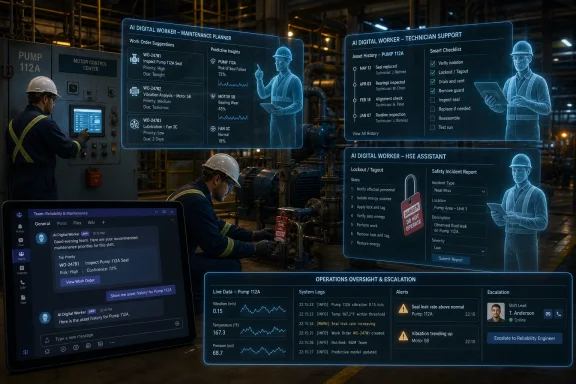
Ultimo announced on May 28, 2026, that it has added three AI “digital workers” for maintenance planning, technician support, and health, safety, and environment workflows to its Intelligent Asset Management platform for industrial maintenance teams. The launch is not just another vendor sprinkling generative AI over an existing dashboard. It is a bet that industrial AI will win or lose in the boring middle of operations: morning briefings, work preparation, incident reporting, asset histories, and the handoff between people who know the plant and systems that know the data. For WindowsForum readers, the most interesting detail may be the least glamorous one: these agents are meant to surface inside Microsoft Teams as much as inside Ultimo itself.
Industrial software vendors have spent the past two years promising AI copilots, assistants, agents, digital workers, and every other available synonym for software that does more than wait for a user to click a button. Ultimo’s announcement fits that wave, but it also lands in a sector where the usual productivity pitch is unusually testable. Maintenance teams either spend less time chasing information, or they do not. Machines either stay available, or they do not. Safety reporting either becomes more consistent, or it remains a form people complete after the real work is done.
That makes Ultimo’s framing notable. The company is not presenting its new digital workers as a standalone analytics layer for executives staring at reliability charts. It is putting them into roles: a maintenance planning worker, a technician worker, and an HSE worker. The names are slightly awkward, as all “digital worker” branding tends to be, but the organizational intent is clear. Ultimo wants AI embedded in the day’s work before a planner allocates jobs, before a technician opens a task, and before a safety manager tries to reconstruct what happened after an incident.
This is the practical edge of agentic AI in industrial systems. In consumer software, an AI agent booking a restaurant table is a novelty. In maintenance, an agent that summarizes open work orders, correlates recurring failures, drafts a shift report, or flags missing safety steps can become part of the operating rhythm. The difference is not intelligence in the abstract. It is whether the AI understands the structure of the work well enough to be trusted near the equipment.
Ultimo says the new tools are built around enterprise asset management data structures, maintenance workflows, and safety protocols. That matters because industrial operations are not blank documents waiting for a chatbot. They are dense systems of assets, spare parts, permits, maintenance histories, regulatory obligations, technicians, planners, shifts, and priorities. The companies that make AI useful in this environment will be the ones that treat domain structure as the product, not as an afterthought.
Ultimo says the digital workers are available through Teams and the Ultimo platform, with some company material also pointing to Slack access. The emphasis is workflow proximity. A maintenance lead should be able to receive a daily briefing, ask for a summary, or pull together operational context where the conversation is already happening. For organizations standardized on Microsoft 365, that makes the feature easier to imagine as a daily habit rather than a digital transformation demo.
That is also why this story belongs on a Windows and Microsoft-centered site, even though Ultimo itself is not a Microsoft product. Teams has become the distribution channel for a huge amount of enterprise AI, from Microsoft’s own Copilot strategy to third-party operational systems. The contest is no longer just which vendor has the smartest model. It is which vendor can meet workers inside the collaboration fabric without making governance, identity, and data access impossible for IT.
There is a risk here, too. Teams can become the place where every system shouts for attention. If AI agents are noisy, vague, or too eager to summarize what nobody asked for, maintenance teams will route around them. The best version of Ultimo’s approach is a low-friction operational assistant. The worst version is another notification machine wearing a hard hat.
Maintenance expertise is often local, tacit, and accumulated through repetition. A veteran technician knows which pump “always” needs a second look, which alarm usually means a sensor problem, which supplier part is technically equivalent but practically unreliable, and which recurring fault is a symptom rather than a cause. Traditional enterprise systems capture some of that knowledge, but much of it remains scattered across work notes, shift logs, chat threads, spreadsheets, and the memories of people who eventually retire.
The promise of AI in this context is not that it replaces the senior technician. It is that it can make the organization less dependent on invisible memory. If an agent can combine asset history, work orders, incident reports, spare-parts data, and technician notes into a useful briefing, it gives newer staff a better starting point. It also gives supervisors a more consistent way to spot patterns that might otherwise hide in the churn of daily tasks.
But this is where the hype line becomes dangerous. “Capturing expertise” sounds tidy until one remembers that maintenance knowledge is often messy because the physical world is messy. Sensors fail. Notes are incomplete. Workarounds become folklore. Asset registers drift from reality. An AI system trained on poor operational data may amplify poor habits with impressive confidence. The companies adopting these tools will need to clean, govern, and challenge their data, not simply connect it to a model and declare the knowledge problem solved.
The number matters because it avoids the usual fog of AI productivity rhetoric. A daily 30-minute saving for one team lead is useful. A daily 60-minute saving across several team leads compounds quickly. In maintenance organizations where experienced staff are scarce, reclaiming preparation time can be more valuable than producing another executive dashboard. The return on investment is easier to defend when the saved time is attached to a recurring ritual, not to a hypothetical transformation.
Berkvens’ second claim is equally important. Jeroen Wijnen, described in Ultimo material as a Maintenance and Installations Leader, said combining data from different sources creates new insights, helps teams set better priorities, identify structural issues, and carry out more targeted maintenance and improvements. That shifts the value proposition from speed to quality. The system is not only supposed to make the morning meeting shorter. It is supposed to make the team choose better work.
Still, early customer quotations should be read with the proper skepticism. They are useful evidence, not independent proof. The reported time savings may depend on Berkvens’ data quality, operational maturity, team structure, and willingness to redesign daily routines around AI output. Other customers may see less dramatic results, particularly if their asset data is fragmented or their existing maintenance processes are poorly standardized. In industrial AI, the demo is rarely the hard part; the hard part is making the demo survive Monday morning.
This is why the announcement deserves attention beyond Ultimo’s customer base. Industrial software is moving from systems of record to systems of action. The EAM or CMMS platform used to be where work was logged, tracked, and analyzed. Vendors now want those platforms to initiate, prepare, summarize, recommend, and in low-risk cases execute. That expands the software’s role, but it also expands the blast radius when the software is wrong.
Ultimo is trying to draw a line around that risk. The company says the digital workers are designed to handle routine, lower-risk actions independently while escalating higher-risk decisions to people. It also emphasizes telemetry so users can see what the system is doing. That is the right language, because accountability will be one of the major adoption barriers for AI in maintenance. A system that silently changes priorities, closes tasks, or recommends actions without traceability will not last long in a safety-conscious environment.
The challenge is that “low-risk” is contextual. A reminder, a summary, or a draft report may be low-risk in one plant and sensitive in another. A maintenance priority that seems routine in a warehouse may affect regulated production in a pharmaceutical facility or patient safety in a hospital. Ultimo’s customers will need controls that reflect their own operating environments rather than a vendor’s generic risk taxonomy.
That does not mean AI has no place. It means the rollout has to be treated like an operational change, not a software switch. Teams will need to know what the agents can do, what they cannot do, when human approval is required, and how mistakes are corrected. They will also need to see that AI is removing drudgery rather than merely creating a faster path to more work.
The word “worker” is doing subtle political work here. Calling the software a digital worker makes it sound like a colleague. That can make the product approachable, but it can also trigger the obvious fear that the colleague is a replacement. In maintenance, where many organizations are facing labor shortages, the more credible story is augmentation. AI can prepare, summarize, compare, and remind; people still diagnose ambiguous failures, work safely around physical equipment, and make judgment calls under constraints.
The vendors that handle this well will be blunt about boundaries. They will show exactly which tasks are automated, which are assisted, and which remain human decisions. They will make audit trails visible. They will give administrators policy controls. They will let frontline teams challenge and improve the system. Industrial AI will not be adopted because a vendor says it is trustworthy. It will be adopted when the people using it can see why it reached a conclusion and can overrule it without ceremony.
An EAM-agnostic AI layer could appeal to organizations that want agentic workflows without ripping out incumbent systems. It also allows Ultimo to sell into environments where it may not yet be the system of record. That is a familiar enterprise software move: start as an intelligence or workflow layer, then expand influence over the underlying operational stack. The open question is how agnostic such a product can remain when the deepest value comes from understanding the data model, permissions, history, and process logic of the systems beneath it.
Integration is where many AI promises go to die. Maintenance data may sit in an EAM system, a CMMS, ERP modules, SCADA-adjacent systems, spreadsheets, inspection apps, Teams channels, email, and document repositories. Some of it is structured. Some of it is tribal knowledge disguised as text. Some of it is wrong. An AI agent that can operate across that landscape needs connectors, permissions, identity mapping, data normalization, and a way to respect the operational meaning of each source.
That also brings IT and security teams into the center of the conversation. If the agents operate through Teams, they will intersect with Microsoft identity, collaboration governance, retention policies, and potentially sensitive operational data. If they connect to multiple maintenance systems, they become another integration surface to secure and monitor. The phrase “digital worker” may sound friendly, but in enterprise architecture terms it is a non-human actor with access, actions, and audit requirements.
Ultimo’s earlier digital worker for HSE incident reporting launched in July 2025, and the new announcement extends that direction. The idea is straightforward: support incident reporting and routine compliance work inside normal workflows rather than forcing safety activity into a separate administrative afterlife. If an AI assistant can prompt better reporting, summarize relevant details, and help ensure that recurring tasks are not missed, it may improve both safety culture and record quality.
But HSE is also where AI overreach would be least tolerated. A system that drafts a report is useful; a system that subtly shapes the narrative of an incident is more complicated. A system that reminds a worker of safety requirements is useful; a system that appears to certify compliance without human review is dangerous. The boundary between assistance and authority must be bright.
Telemetry is therefore not a minor feature. Ultimo’s promise of visibility into what the system is doing speaks directly to this concern. Organizations need to know what the agent accessed, what it produced, what action it took, who approved it, and how the output changed over time. In safety workflows, auditability is not an enterprise checkbox. It is part of the product’s license to operate.
That creates both convenience and complexity for administrators. Teams distribution can accelerate adoption because users already understand the interface, mobile access, notifications, and chat-based interaction. It can also simplify some training and reduce context switching. But it raises questions about tenant governance, data boundaries, conditional access, retention, eDiscovery, and the lifecycle of non-human participants in business processes.
Microsoft itself has been pushing hard into Copilot and agent frameworks, and the broader software market is aligning around the idea that workers will interact with specialized agents from within collaboration tools. Ultimo’s move is a sector-specific example of that trend. The maintenance agent lives close to the conversation, but its value depends on connections far beyond the conversation. That makes it both useful and administratively interesting.
IT departments should resist treating these tools as mere add-ons. An AI agent that summarizes asset failures and suggests priorities may touch commercially sensitive operational data. An HSE assistant may process incident details, personal information, or regulated safety records. A technician support agent may expose asset histories or maintenance procedures. The governance model has to be designed before the pilot becomes a habit.
That is why Berkvens’ 30-to-60-minute daily preparation claim is so effective. It is not abstract transformation. It is the start of the day. It is the point where team leaders gather context, decide priorities, and prepare people for work. If AI can improve that moment, it earns credibility for more ambitious use cases.
The same logic applies to technician support. A useful assistant might surface asset history, likely causes, related work orders, documentation, parts availability, or safety notes. But technicians do not need a verbose explanation of what maintenance is. They need concise, relevant, trustworthy context that helps them do the job correctly. The closer the system gets to the physical task, the less tolerance there will be for generic AI filler.
Maintenance planning is similar. Planners are balancing resources, priorities, downtime windows, parts, skills, and risk. AI can help by summarizing constraints and highlighting patterns. It can also make a mess if it optimizes for one metric while ignoring site reality. The winning systems will be the ones that make planners faster without pretending that scheduling industrial work is a clean mathematical exercise.
This is where administrators and operational leaders need configurable guardrails. A food processing plant, a hospital, a logistics hub, and a utility operation may all use EAM software, but their tolerance for autonomous action differs. Even within one company, a pilot site may be comfortable allowing an agent to prepare daily summaries while another site requires review before any workflow update.
Human-in-the-loop design is not just a product slogan. It needs to be visible in permissions, approvals, logs, and exception handling. The system should make it easy to understand what the agent proposed, what it changed, and why. It should also make it easy to roll back or correct errors. Trust grows when users see that the AI is accountable to the process, not floating above it.
There is also a cultural dimension. If teams believe the AI is being used to measure them rather than help them, adoption will suffer. Maintenance workers already operate under pressure from downtime metrics, safety targets, and production demands. A digital worker that feels like another instrument of surveillance will not be welcomed, even if the underlying technology is competent. Vendors and employers alike will need to present these systems as tools for reducing friction, not as silent supervisors.
That packaging matters because maintenance teams are often overwhelmed by data but under-supported in turning it into decisions. Modern assets produce telemetry. Work orders produce histories. Inspections produce notes. Safety processes produce records. Chat systems produce informal context. The problem is not the absence of data. It is the cost of finding, combining, and trusting the relevant data at the moment of work.
Ultimo’s digital workers sit squarely in that gap. The company is effectively saying that the future of EAM is not simply a better database or a prettier dashboard. It is a set of role-specific agents that understand the maintenance organization well enough to do routine preparation and escalation. That is a plausible direction for the market, even if the vocabulary around “digital workers” still sounds like it was assembled in a strategy workshop.
The competitive implications are clear. EAM and CMMS vendors that cannot embed AI into daily workflows may find themselves relegated to systems of record while another layer owns user attention. Conversely, vendors that move too aggressively risk making reliability and safety professionals skeptical. The winners will be boring in exactly the right way: accurate, auditable, configurable, and useful before they are flashy.
The company says more than 150,000 technicians use its software to manage more than 22 million assets across over 2,500 customers worldwide. Those figures suggest a substantial installed base for AI-enabled workflows. They also imply enormous diversity. The same digital worker that helps a doorsystem manufacturer may need adaptation for healthcare facilities, utilities, logistics operations, or heavy industry.
Scaling will require more than language-model performance. It will require implementation discipline: mapping processes, defining approval rules, training users, cleaning data, connecting systems, and measuring outcomes. It will require IT governance and operational sponsorship. It will require patience with the unglamorous work that makes AI useful.
That is the paradox of agentic AI in maintenance. The most valuable systems may look least magical. They will summarize correctly, escalate appropriately, avoid overclaiming, and make routine work slightly less painful every day. In industrial operations, that is not a small achievement. It is the difference between AI as a press release and AI as infrastructure.
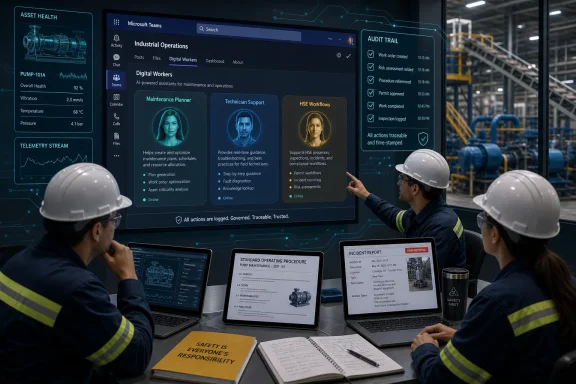 Ultimo Is Selling AI Where Maintenance Actually Happens
Industrial software vendors have spent the past two years promising AI copilots, assistants, agents, digital workers, and every other available synonym for software that does more than wait for a user to click a button. Ultimo’s announcement fits that wave, but it also lands in a sector where the usual productivity pitch is unusually testable. Maintenance teams either spend less time chasing information, or they do not. Machines either stay available, or they do not. Safety reporting either becomes more consistent, or it remains a form people complete after the real work is done.That makes Ultimo’s framing notable. The company is not presenting its new digital workers as a standalone analytics layer for executives staring at reliability charts. It is putting them into roles: a maintenance planning worker, a technician worker, and an HSE worker. The names are slightly awkward, as all “digital worker” branding tends to be, but the organizational intent is clear. Ultimo wants AI embedded in the day’s work before a planner allocates jobs, before a technician opens a task, and before a safety manager tries to reconstruct what happened after an incident.
This is the practical edge of agentic AI in industrial systems. In consumer software, an AI agent booking a restaurant table is a novelty. In maintenance, an agent that summarizes open work orders, correlates recurring failures, drafts a shift report, or flags missing safety steps can become part of the operating rhythm. The difference is not intelligence in the abstract. It is whether the AI understands the structure of the work well enough to be trusted near the equipment.
Ultimo says the new tools are built around enterprise asset management data structures, maintenance workflows, and safety protocols. That matters because industrial operations are not blank documents waiting for a chatbot. They are dense systems of assets, spare parts, permits, maintenance histories, regulatory obligations, technicians, planners, shifts, and priorities. The companies that make AI useful in this environment will be the ones that treat domain structure as the product, not as an afterthought.
Microsoft Teams Becomes the Shop-Floor Front Door
The Microsoft Teams integration is more than a convenience feature. It reflects a broader reality in enterprise software: the collaboration layer has become a kind of unofficial operating system for work. If maintenance leaders, supervisors, and planners already begin the day in Teams, then forcing them into a separate AI console would turn the product into yet another tab to forget.Ultimo says the digital workers are available through Teams and the Ultimo platform, with some company material also pointing to Slack access. The emphasis is workflow proximity. A maintenance lead should be able to receive a daily briefing, ask for a summary, or pull together operational context where the conversation is already happening. For organizations standardized on Microsoft 365, that makes the feature easier to imagine as a daily habit rather than a digital transformation demo.
That is also why this story belongs on a Windows and Microsoft-centered site, even though Ultimo itself is not a Microsoft product. Teams has become the distribution channel for a huge amount of enterprise AI, from Microsoft’s own Copilot strategy to third-party operational systems. The contest is no longer just which vendor has the smartest model. It is which vendor can meet workers inside the collaboration fabric without making governance, identity, and data access impossible for IT.
There is a risk here, too. Teams can become the place where every system shouts for attention. If AI agents are noisy, vague, or too eager to summarize what nobody asked for, maintenance teams will route around them. The best version of Ultimo’s approach is a low-friction operational assistant. The worst version is another notification machine wearing a hard hat.
The Aging Workforce Is the Real Platform Pressure
Ultimo’s announcement leans heavily on a problem that maintenance leaders have been discussing for years: industrial organizations are losing experienced workers faster than they can replace them. The company says its maintenance trend research found that 63 percent of industrial organizations are struggling with an ageing workforce. That statistic is doing a lot of strategic work. It tells customers that the AI pitch is not only about cutting administrative time but also about preserving operational knowledge.Maintenance expertise is often local, tacit, and accumulated through repetition. A veteran technician knows which pump “always” needs a second look, which alarm usually means a sensor problem, which supplier part is technically equivalent but practically unreliable, and which recurring fault is a symptom rather than a cause. Traditional enterprise systems capture some of that knowledge, but much of it remains scattered across work notes, shift logs, chat threads, spreadsheets, and the memories of people who eventually retire.
The promise of AI in this context is not that it replaces the senior technician. It is that it can make the organization less dependent on invisible memory. If an agent can combine asset history, work orders, incident reports, spare-parts data, and technician notes into a useful briefing, it gives newer staff a better starting point. It also gives supervisors a more consistent way to spot patterns that might otherwise hide in the churn of daily tasks.
But this is where the hype line becomes dangerous. “Capturing expertise” sounds tidy until one remembers that maintenance knowledge is often messy because the physical world is messy. Sensors fail. Notes are incomplete. Workarounds become folklore. Asset registers drift from reality. An AI system trained on poor operational data may amplify poor habits with impressive confidence. The companies adopting these tools will need to clean, govern, and challenge their data, not simply connect it to a model and declare the knowledge problem solved.
Berkvens Offers the Kind of Metric Vendors Need
The most concrete customer proof in the launch comes from Berkvens Doorsystems, a Dutch manufacturer that Ultimo says is already using the software. Stefan van Bussel, Teamlead Technical Services at Berkvens, said AI automatically summarizes and combines relevant information, saving each team lead 30 to 60 minutes at the start of the day while matching the company’s own analysis by more than 95 percent. That is the kind of claim enterprise AI vendors should want to make: specific, operational, and tied to a repeated daily workflow.The number matters because it avoids the usual fog of AI productivity rhetoric. A daily 30-minute saving for one team lead is useful. A daily 60-minute saving across several team leads compounds quickly. In maintenance organizations where experienced staff are scarce, reclaiming preparation time can be more valuable than producing another executive dashboard. The return on investment is easier to defend when the saved time is attached to a recurring ritual, not to a hypothetical transformation.
Berkvens’ second claim is equally important. Jeroen Wijnen, described in Ultimo material as a Maintenance and Installations Leader, said combining data from different sources creates new insights, helps teams set better priorities, identify structural issues, and carry out more targeted maintenance and improvements. That shifts the value proposition from speed to quality. The system is not only supposed to make the morning meeting shorter. It is supposed to make the team choose better work.
Still, early customer quotations should be read with the proper skepticism. They are useful evidence, not independent proof. The reported time savings may depend on Berkvens’ data quality, operational maturity, team structure, and willingness to redesign daily routines around AI output. Other customers may see less dramatic results, particularly if their asset data is fragmented or their existing maintenance processes are poorly standardized. In industrial AI, the demo is rarely the hard part; the hard part is making the demo survive Monday morning.
The Vendor Language Has Changed From Insights to Labor
For years, enterprise asset management software sold the promise of better visibility. Dashboards, analytics, and predictive maintenance models would help teams see what was happening across the asset base. Ultimo’s new language is different. It talks about digital labor, autonomous actions, non-disruptive tasks, escalation, and telemetry. That is a shift from “the software informs you” to “the software does some of the work.”This is why the announcement deserves attention beyond Ultimo’s customer base. Industrial software is moving from systems of record to systems of action. The EAM or CMMS platform used to be where work was logged, tracked, and analyzed. Vendors now want those platforms to initiate, prepare, summarize, recommend, and in low-risk cases execute. That expands the software’s role, but it also expands the blast radius when the software is wrong.
Ultimo is trying to draw a line around that risk. The company says the digital workers are designed to handle routine, lower-risk actions independently while escalating higher-risk decisions to people. It also emphasizes telemetry so users can see what the system is doing. That is the right language, because accountability will be one of the major adoption barriers for AI in maintenance. A system that silently changes priorities, closes tasks, or recommends actions without traceability will not last long in a safety-conscious environment.
The challenge is that “low-risk” is contextual. A reminder, a summary, or a draft report may be low-risk in one plant and sensitive in another. A maintenance priority that seems routine in a warehouse may affect regulated production in a pharmaceutical facility or patient safety in a hospital. Ultimo’s customers will need controls that reflect their own operating environments rather than a vendor’s generic risk taxonomy.
Agentic AI Meets the Old Discipline of Change Management
There is a temptation to describe these digital workers as a new category of industrial AI, but the success factors are familiar. The best maintenance organizations already know that tools only work when processes, roles, and incentives line up. If planners do not trust the output, they will ignore it. If technicians think the AI is surveillance disguised as assistance, they will minimize their interaction with it. If managers treat summaries as a replacement for listening to staff, the system will become another management artifact detached from reality.That does not mean AI has no place. It means the rollout has to be treated like an operational change, not a software switch. Teams will need to know what the agents can do, what they cannot do, when human approval is required, and how mistakes are corrected. They will also need to see that AI is removing drudgery rather than merely creating a faster path to more work.
The word “worker” is doing subtle political work here. Calling the software a digital worker makes it sound like a colleague. That can make the product approachable, but it can also trigger the obvious fear that the colleague is a replacement. In maintenance, where many organizations are facing labor shortages, the more credible story is augmentation. AI can prepare, summarize, compare, and remind; people still diagnose ambiguous failures, work safely around physical equipment, and make judgment calls under constraints.
The vendors that handle this well will be blunt about boundaries. They will show exactly which tasks are automated, which are assisted, and which remain human decisions. They will make audit trails visible. They will give administrators policy controls. They will let frontline teams challenge and improve the system. Industrial AI will not be adopted because a vendor says it is trustworthy. It will be adopted when the people using it can see why it reached a conclusion and can overrule it without ceremony.
EAM-Agnostic Claims Are Where the Market Fight Begins
Ultimo says its agent-based offering can work with both enterprise asset management and computerized maintenance management systems, rather than only within its own software stack. If that holds up in practice, it could be strategically important. Industrial companies rarely have perfectly uniform systems. They inherit plants, merge operations, run different systems across regions, and keep legacy tools alive because downtime is more expensive than architectural purity.An EAM-agnostic AI layer could appeal to organizations that want agentic workflows without ripping out incumbent systems. It also allows Ultimo to sell into environments where it may not yet be the system of record. That is a familiar enterprise software move: start as an intelligence or workflow layer, then expand influence over the underlying operational stack. The open question is how agnostic such a product can remain when the deepest value comes from understanding the data model, permissions, history, and process logic of the systems beneath it.
Integration is where many AI promises go to die. Maintenance data may sit in an EAM system, a CMMS, ERP modules, SCADA-adjacent systems, spreadsheets, inspection apps, Teams channels, email, and document repositories. Some of it is structured. Some of it is tribal knowledge disguised as text. Some of it is wrong. An AI agent that can operate across that landscape needs connectors, permissions, identity mapping, data normalization, and a way to respect the operational meaning of each source.
That also brings IT and security teams into the center of the conversation. If the agents operate through Teams, they will intersect with Microsoft identity, collaboration governance, retention policies, and potentially sensitive operational data. If they connect to multiple maintenance systems, they become another integration surface to secure and monitor. The phrase “digital worker” may sound friendly, but in enterprise architecture terms it is a non-human actor with access, actions, and audit requirements.
Safety Workflows Are the Hardest Place to Fake Competence
The inclusion of HSE functionality is both logical and sensitive. Safety and environmental processes are document-heavy, time-sensitive, and often repetitive. They are also governed by consequences that extend beyond productivity. A poorly completed incident report, a missed safety step, or an incorrect compliance action can matter legally, operationally, and morally.Ultimo’s earlier digital worker for HSE incident reporting launched in July 2025, and the new announcement extends that direction. The idea is straightforward: support incident reporting and routine compliance work inside normal workflows rather than forcing safety activity into a separate administrative afterlife. If an AI assistant can prompt better reporting, summarize relevant details, and help ensure that recurring tasks are not missed, it may improve both safety culture and record quality.
But HSE is also where AI overreach would be least tolerated. A system that drafts a report is useful; a system that subtly shapes the narrative of an incident is more complicated. A system that reminds a worker of safety requirements is useful; a system that appears to certify compliance without human review is dangerous. The boundary between assistance and authority must be bright.
Telemetry is therefore not a minor feature. Ultimo’s promise of visibility into what the system is doing speaks directly to this concern. Organizations need to know what the agent accessed, what it produced, what action it took, who approved it, and how the output changed over time. In safety workflows, auditability is not an enterprise checkbox. It is part of the product’s license to operate.
The Windows Angle Is Governance, Not Branding
For WindowsForum’s audience, the easy headline would be that Ultimo’s digital workers are available through Microsoft Teams. The deeper story is that Microsoft’s collaboration and identity ecosystem is becoming the control plane for third-party AI at work. When an industrial AI agent appears in Teams, it is not merely a chatbot in a familiar window. It is a new operational actor entering a Microsoft-managed workflow.That creates both convenience and complexity for administrators. Teams distribution can accelerate adoption because users already understand the interface, mobile access, notifications, and chat-based interaction. It can also simplify some training and reduce context switching. But it raises questions about tenant governance, data boundaries, conditional access, retention, eDiscovery, and the lifecycle of non-human participants in business processes.
Microsoft itself has been pushing hard into Copilot and agent frameworks, and the broader software market is aligning around the idea that workers will interact with specialized agents from within collaboration tools. Ultimo’s move is a sector-specific example of that trend. The maintenance agent lives close to the conversation, but its value depends on connections far beyond the conversation. That makes it both useful and administratively interesting.
IT departments should resist treating these tools as mere add-ons. An AI agent that summarizes asset failures and suggests priorities may touch commercially sensitive operational data. An HSE assistant may process incident details, personal information, or regulated safety records. A technician support agent may expose asset histories or maintenance procedures. The governance model has to be designed before the pilot becomes a habit.
Industrial AI Will Be Judged by the Boring Metrics
The AI industry often prefers grand narratives: autonomous enterprises, self-healing operations, digital labor forces, and systems that reason across the business. Maintenance departments are more likely to judge the product by narrower questions. Did it reduce preparation time? Did it make the work order better? Did it prevent avoidable downtime? Did it improve reporting discipline? Did it create a new administrative burden?That is why Berkvens’ 30-to-60-minute daily preparation claim is so effective. It is not abstract transformation. It is the start of the day. It is the point where team leaders gather context, decide priorities, and prepare people for work. If AI can improve that moment, it earns credibility for more ambitious use cases.
The same logic applies to technician support. A useful assistant might surface asset history, likely causes, related work orders, documentation, parts availability, or safety notes. But technicians do not need a verbose explanation of what maintenance is. They need concise, relevant, trustworthy context that helps them do the job correctly. The closer the system gets to the physical task, the less tolerance there will be for generic AI filler.
Maintenance planning is similar. Planners are balancing resources, priorities, downtime windows, parts, skills, and risk. AI can help by summarizing constraints and highlighting patterns. It can also make a mess if it optimizes for one metric while ignoring site reality. The winning systems will be the ones that make planners faster without pretending that scheduling industrial work is a clean mathematical exercise.
The Automation Boundary Will Decide Trust
Ultimo’s claim that autonomous actions are limited to non-disruptive work is sensible, but customers should press for specifics. What counts as non-disruptive? Can the agent update a work order? Draft a report? Send a briefing? Reprioritize a task? Request missing information? Create an incident notification? Trigger a workflow? Each of these actions carries a different risk profile depending on the site.This is where administrators and operational leaders need configurable guardrails. A food processing plant, a hospital, a logistics hub, and a utility operation may all use EAM software, but their tolerance for autonomous action differs. Even within one company, a pilot site may be comfortable allowing an agent to prepare daily summaries while another site requires review before any workflow update.
Human-in-the-loop design is not just a product slogan. It needs to be visible in permissions, approvals, logs, and exception handling. The system should make it easy to understand what the agent proposed, what it changed, and why. It should also make it easy to roll back or correct errors. Trust grows when users see that the AI is accountable to the process, not floating above it.
There is also a cultural dimension. If teams believe the AI is being used to measure them rather than help them, adoption will suffer. Maintenance workers already operate under pressure from downtime metrics, safety targets, and production demands. A digital worker that feels like another instrument of surveillance will not be welcomed, even if the underlying technology is competent. Vendors and employers alike will need to present these systems as tools for reducing friction, not as silent supervisors.
The Maintenance Stack Is Becoming an AI Stack
Ultimo is not alone in seeing industrial maintenance as fertile ground for AI. Predictive maintenance, digital twins, computer vision inspections, automated asset registration, parts optimization, and shift-log analysis are all part of the same movement. What is changing now is the interface. Instead of asking users to interpret a dashboard, vendors want AI systems to package the next useful action.That packaging matters because maintenance teams are often overwhelmed by data but under-supported in turning it into decisions. Modern assets produce telemetry. Work orders produce histories. Inspections produce notes. Safety processes produce records. Chat systems produce informal context. The problem is not the absence of data. It is the cost of finding, combining, and trusting the relevant data at the moment of work.
Ultimo’s digital workers sit squarely in that gap. The company is effectively saying that the future of EAM is not simply a better database or a prettier dashboard. It is a set of role-specific agents that understand the maintenance organization well enough to do routine preparation and escalation. That is a plausible direction for the market, even if the vocabulary around “digital workers” still sounds like it was assembled in a strategy workshop.
The competitive implications are clear. EAM and CMMS vendors that cannot embed AI into daily workflows may find themselves relegated to systems of record while another layer owns user attention. Conversely, vendors that move too aggressively risk making reliability and safety professionals skeptical. The winners will be boring in exactly the right way: accurate, auditable, configurable, and useful before they are flashy.
The Real Test Will Come After the Pilot
Many industrial AI projects begin with a narrow success. A plant demonstrates a useful briefing. A team reduces reporting time. A model identifies recurring failures. The harder question is whether the system scales across sites with different assets, cultures, data quality, and regulatory expectations. Ultimo’s customer base and IFS ownership give it a serious platform from which to try, but scale remains the test.The company says more than 150,000 technicians use its software to manage more than 22 million assets across over 2,500 customers worldwide. Those figures suggest a substantial installed base for AI-enabled workflows. They also imply enormous diversity. The same digital worker that helps a doorsystem manufacturer may need adaptation for healthcare facilities, utilities, logistics operations, or heavy industry.
Scaling will require more than language-model performance. It will require implementation discipline: mapping processes, defining approval rules, training users, cleaning data, connecting systems, and measuring outcomes. It will require IT governance and operational sponsorship. It will require patience with the unglamorous work that makes AI useful.
That is the paradox of agentic AI in maintenance. The most valuable systems may look least magical. They will summarize correctly, escalate appropriately, avoid overclaiming, and make routine work slightly less painful every day. In industrial operations, that is not a small achievement. It is the difference between AI as a press release and AI as infrastructure.
Ultimo’s AI Bet Comes Down to Five Shop-Floor Realities
The launch is best understood as a pragmatic move into the daily rhythm of maintenance rather than as a moonshot for fully autonomous industrial operations. The claims are ambitious, but the early use cases are grounded enough to be testable.- Ultimo’s three new digital workers target maintenance planning, technician support, and HSE workflows rather than generic enterprise chat.
- The Microsoft Teams connection matters because it places industrial AI inside the collaboration environment many supervisors and planners already use.
- Berkvens Doorsystems’ reported 30-to-60-minute daily saving per team lead is the clearest early metric, but other customers will depend heavily on data quality and process maturity.
- The most important product boundary is between low-risk autonomous action and higher-risk decisions that require human approval.
- IT teams should treat these agents as governed enterprise actors with access, audit, retention, and security implications, not as harmless chatbots.
- The long-term value will come from consistent operational usefulness, not from the branding of “digital workers” itself.
References
- Primary source: IT Brief UK
Published: 2026-06-02T10:42:06.321462
Ultimo adds AI digital workers for maintenance teams
Industrial maintenance teams could save time on routine planning and safety tasks as Ultimo rolls out AI tools through Microsoft Teams. itbrief.co.uk
- Related coverage: ultimo.com
Digital Workers for Industrial Maintenance | Blog | Ultimo EAM
Discover how Ultimo’s digital workers bring AI into maintenance, planning, and safety workflows to save time and improve performance.www.ultimo.com
- Related coverage: finanznachrichten.de
Ultimo präsentiert neue Digital Workers für industrielle Instandhaltungsteams
WESEL, Germany, May 28, 2026 (GLOBE NEWSWIRE) -- Ultimo, ein führender Anbieter von KI-augmentiertem Enterprise Asset Management (EAM), hat drei neue Digital Workers für industrielle Instandhaltungsteamswww.finanznachrichten.de - Related coverage: themanufacturer.com
Ultimo to debut instant maturity assessment and AI 'digital workers' at Maintec 2026 - The Manufacturer
Maintec 2026, part of Smart Manufacturing Week, will host a series of new product previews and industry discussions from Ultimo, as the company sets out its vision for accelerating maintenance maturity through benchmarking and AI-driven automation.www.themanufacturer.com - Related coverage: aveva.com
IFS Ultimo Enterprise: Enterprise Asset Management Platform for large organizations
Innovative, flexible and user-friendly cloud-based tooling for large organizations that want to have the complete platform to leverage maximum benefits.www.aveva.com
- Related coverage: info.ultimo.com