

UNC3753, a financially motivated extortion cluster also known as Luna Moth, Chatty Spider, and Silent Ransom Group, is actively targeting U.S. legal, financial, and professional-services organizations in a campaign disclosed by Google’s Mandiant team and echoed by a recent FBI warning. The story is not that criminals have discovered phone calls, remote desktop tools, or USB drives. The story is that they have stitched those ordinary pieces into a fast, low-malware extortion machine that fits uncomfortably well inside modern Windows-heavy office environments. For law firms in particular, the campaign exposes a hard truth: the weakest link may no longer be the endpoint, but the helpdesk ritual everyone has been trained to trust.
UNC3753’s opening move is deliberately boring. The group reportedly begins with invoice-themed emails from actor-controlled consumer accounts, using language that looks like a stray business follow-up rather than a malicious payload. There is no infected attachment, no weaponized macro, no suspicious link demanding a rushed click. The message exists to make the next contact feel expected.
That next contact is the real payload. Attackers call employees while posing as internal IT, security staff, or helpdesk personnel, often relying on names and phone numbers that organizations have conveniently published on their own websites. The target is not asked to break policy in a dramatic way. They are asked to do what countless employees have done during legitimate support calls: join a screen-sharing session, follow instructions, and install a remote support tool.
This is why the campaign matters to Windows administrators. It abuses the culture around support, not merely a missing patch. A Windows estate can be fully updated and still be vulnerable to a caller who convinces a user that Zoom, Teams, Quick Assist, AnyDesk, Bomgar, Zoho Assist, or SuperOps is part of a routine troubleshooting workflow.
The attackers’ use of Privnote-style self-destructing messages to deliver installation links is especially telling. It reduces evidence on the endpoint and in mailboxes while keeping the interaction feeling casual. The attack chain is designed to vanish in the gaps between email filtering, endpoint telemetry, and human memory.
That creates a detection problem. A random executable beaconing to a known command-and-control server looks malicious. A legitimate support agent installed during a live call may look like business as usual, especially if the organization already uses multiple remote access products across IT, vendors, and contractors. The more fragmented the support stack, the wider the attacker’s camouflage.
The campaign also shows why “living off the land” has expanded beyond Windows binaries and PowerShell. Commercial software is now part of the attacker’s native terrain. If a product is signed, widely used, and permitted by default, it can become a bridge between social engineering and data theft.
For Windows shops, this argues for a stricter view of remote access tooling. The default should not be “allow unless detected as malware.” The default should be “deny unless this exact product, version, signer, tenant, and use case are approved.” That is a cultural change as much as a technical one, because it forces IT to document what it has long improvised.
Many organizations treat VDI as a containment strategy: the unmanaged laptop is merely a window into a controlled environment. But if an attacker can remotely control the user’s session, the distinction between local device and corporate desktop becomes thinner. The attacker does not need to compromise the VDI platform itself if the victim can be talked into opening the door.
Inside the VDI session, the reported targeting is methodical rather than exotic. Attackers enumerate OneDrive folders, mapped drives, and document-management systems, including iManage repositories. They search for the files that make legal and professional-services firms uniquely vulnerable: W-2s, W-9s, 1099s, Social Security numbers, legal agreements, audit material, and client records.
This is extortion economics in its purest form. Encryption is optional when the stolen data is radioactive enough. A law firm’s files can implicate clients, counterparties, employees, financial records, merger activity, litigation strategy, and privileged communications. That makes the threat of disclosure more powerful than downtime alone.
That pace compresses the defender’s decision window. Traditional incident response assumes some opportunity to detect, triage, escalate, and contain. In this model, the attacker may already be uploading data before the helpdesk ticket has been written, before the SOC has correlated the activity, and before a manager realizes the “IT call” was never legitimate.
The exfiltration methods also reflect a practical attacker. Browser uploads to actor-controlled Google Drive accounts can hide in the noise of normal cloud usage. WinSCP and Rclone can move larger volumes over FTP, SFTP, or other channels familiar to administrators. In one reported case, attackers exfiltrated 1.7 GB through Google Drive before taking another 14.4 GB using WinSCP.
That should force a rethink of what counts as suspicious inside a corporate VDI environment. Large outbound transfers from virtual desktops are not always malicious, but they should be unusual enough to deserve scrutiny. A lawyer or accountant suddenly pushing gigabytes through WinSCP from a VDI session is not the same risk profile as a backup server doing scheduled replication.
Physical social engineering is not new. The security industry has told stories for decades about dropped USB drives, fake delivery personnel, and badge-tailgating. What is different here is the convergence of physical presence with an active extortion crew already running scalable vishing operations against law firms.
That convergence changes the defender’s model. The attacker is not merely a voice on the phone or an IP address in a log. The attacker may be someone at reception claiming to be from IT, carrying plausible tools, and relying on the same internal confusion that makes vishing work. If the organization’s badge, visitor, and workstation-access controls are informal, the campaign has a second path in.
For smaller law firms and regional professional-services shops, this is especially uncomfortable. Many have grown into complex digital risk without building mature physical-security processes. They may have cloud file stores, VDI, MFA, and endpoint agents, but still rely on personal familiarity at the front desk and informal trust around “the computer person.”
The group’s alleged extortion cadence is aggressive. Mandiant says UNC3753 has sent extortion emails within roughly 30 minutes of leaving victim environments, giving organizations only days to negotiate before threatening direct outreach to employees and clients or publication on a leak site. The speed is part of the pressure campaign.
For law firms, this is a nightmare scenario because the harm is not limited to the firm’s own data. Clients may have contractual, regulatory, litigation, or market-sensitive exposure. A stolen archive can become a wedge between a firm and the people who trusted it most.
This is also why cyber insurance, outside counsel, and incident-response retainers cannot be treated as paperwork exercises. In a one-business-day attack, the time to decide who is authorized to make containment, notification, and negotiation decisions is before the call comes in. An incident-response plan that requires a committee to assemble after the fact is already behind the attacker’s clock.
Quick Assist, for example, is a legitimate Microsoft support tool that can be invaluable in the right environment and dangerous in the wrong one. Teams and Zoom are not malicious, but screen-sharing during an unsolicited support call can become the attacker’s training room. Windows 365 and Citrix can reduce endpoint data exposure, but they also become high-value portals when the user session is hijacked.
Windows Defender Application Control deserves special attention because it addresses the RMM problem at the execution layer. If unauthorized remote access binaries cannot run, the vishing script loses a key step. But WDAC is not a magic switch; poorly planned application control can break workflows, generate exceptions, and eventually be weakened into irrelevance.
Group Policy and MDM controls around USB storage also need a colder reassessment. Many firms still allow removable media because someone, somewhere, once needed it for court exhibits, discovery exports, or client handoffs. That may be a legitimate business requirement, but it should not be a standing permission for every endpoint in the building.
The better answer is to make helpdesk identity verifiable. Employees should have a known, documented way to confirm that a support interaction is real before they install software, share a screen, or approve remote control. That may mean support sessions must originate from authenticated tickets, internal portals, or preannounced channels rather than ad hoc phone calls.
The same principle applies in reverse. Helpdesk staff should not rely on a caller’s claimed identity when resetting credentials, approving MFA changes, or walking users through remote-access steps. The modern helpdesk is not just a service desk; it is an identity-control point.
This is where policy and tooling must meet. A beautiful policy that employees cannot follow under pressure will fail. A strict technical control that helpdesk staff routinely bypass to get work done will also fail. The goal is to make the secure path the ordinary path.
Law firms are particularly exposed because their value proposition is confidentiality. An attacker does not need to shut down a firm to create leverage. The mere claim of stolen client files can force leadership into crisis mode, especially if the threatened disclosure involves litigation material, tax records, employment data, or regulated client information.
There is also a governance problem. Many firms have sophisticated lawyers and sophisticated IT staff, but security authority can be diffuse. Partners may resist restrictions that slow client work. Practice groups may maintain separate tools. Exceptions can become the operating model.
UNC3753’s playbook punishes that looseness. It does not require a zero-day to exploit a firm whose users can install remote tools, whose VDI sessions can reach sensitive repositories, whose outbound transfers are weakly monitored, and whose front desk may accept a plausible technician with a story.
If no files are encrypted, backups do not solve the immediate crisis. If the attacker’s leverage is publication, the question becomes what data was reachable, what was taken, how quickly the organization can prove scope, and how it communicates with clients and regulators. The incident response muscle must include forensic accounting of data access, not just system restoration.
That makes logging a business necessity. OneDrive, SharePoint, iManage, VDI, VPN, endpoint, DNS, proxy, and identity logs need retention long enough to reconstruct a fast-moving intrusion. If logs roll over in days or are fragmented across vendors, the organization may be left negotiating in the dark.
Data minimization also becomes a security control. Firms that keep years of unnecessary tax forms, stale client archives, and legacy matter files online are increasing the blast radius of the next social-engineered breach. The cheapest stolen file is the one that should not have been accessible in the first place.
Application control should be treated as a core defense, not an advanced luxury. Windows Defender Application Control, AppLocker where appropriate, endpoint management baselines, and allow-listed RMM platforms can make it materially harder for a caller to turn persuasion into persistence. The point is not to ban remote support; it is to make unauthorized remote support impossible.
Network monitoring should treat unexpected file-transfer tooling inside user sessions as a high-signal event. WinSCP, Rclone, unusual SSH traffic, sudden browser uploads to unmanaged cloud accounts, and large transfers from VDI desktops deserve alerting that maps to job role and normal behavior. A finance user and a backup administrator should not have the same outbound data profile.
Physical controls need the same seriousness. Reception staff should have a protocol for unexpected IT visitors. Technicians should be badge-verified, scheduled, and escorted. USB write access should be disabled by default and granted only through documented exceptions.
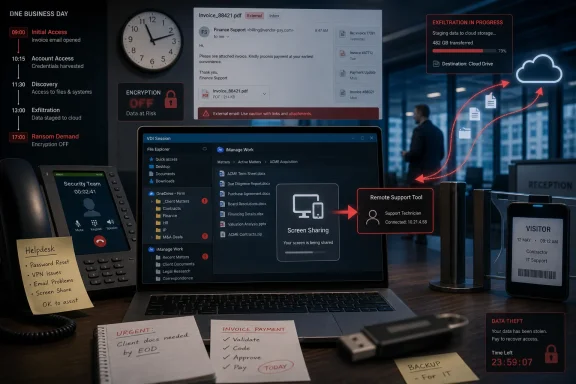 The Breach Now Starts With a Polite Invoice and a Familiar Voice
UNC3753’s opening move is deliberately boring. The group reportedly begins with invoice-themed emails from actor-controlled consumer accounts, using language that looks like a stray business follow-up rather than a malicious payload. There is no infected attachment, no weaponized macro, no suspicious link demanding a rushed click. The message exists to make the next contact feel expected.That next contact is the real payload. Attackers call employees while posing as internal IT, security staff, or helpdesk personnel, often relying on names and phone numbers that organizations have conveniently published on their own websites. The target is not asked to break policy in a dramatic way. They are asked to do what countless employees have done during legitimate support calls: join a screen-sharing session, follow instructions, and install a remote support tool.
This is why the campaign matters to Windows administrators. It abuses the culture around support, not merely a missing patch. A Windows estate can be fully updated and still be vulnerable to a caller who convinces a user that Zoom, Teams, Quick Assist, AnyDesk, Bomgar, Zoho Assist, or SuperOps is part of a routine troubleshooting workflow.
The attackers’ use of Privnote-style self-destructing messages to deliver installation links is especially telling. It reduces evidence on the endpoint and in mailboxes while keeping the interaction feeling casual. The attack chain is designed to vanish in the gaps between email filtering, endpoint telemetry, and human memory.
RMM Abuse Has Become the Perfect Grey Zone
Remote monitoring and management tools occupy one of the most awkward spaces in enterprise defense. They are indispensable to IT teams, managed service providers, and helpdesks, yet they also provide exactly what an intruder wants: interactive control, file movement, persistence, and plausible administrative purpose. UNC3753 is not exploiting RMM tools so much as exploiting the trust those tools inherit.That creates a detection problem. A random executable beaconing to a known command-and-control server looks malicious. A legitimate support agent installed during a live call may look like business as usual, especially if the organization already uses multiple remote access products across IT, vendors, and contractors. The more fragmented the support stack, the wider the attacker’s camouflage.
The campaign also shows why “living off the land” has expanded beyond Windows binaries and PowerShell. Commercial software is now part of the attacker’s native terrain. If a product is signed, widely used, and permitted by default, it can become a bridge between social engineering and data theft.
For Windows shops, this argues for a stricter view of remote access tooling. The default should not be “allow unless detected as malware.” The default should be “deny unless this exact product, version, signer, tenant, and use case are approved.” That is a cultural change as much as a technical one, because it forces IT to document what it has long improvised.
The Windows Desktop Is Only the Front Door
Once UNC3753 gains a foothold, the attacker’s real interest appears to be the corporate data plane behind the user. Mandiant’s reporting describes pivots from bring-your-own-device endpoints into virtual desktop infrastructure using clients such as Windows 365 and Citrix. That is a crucial detail because it reframes BYOD risk.Many organizations treat VDI as a containment strategy: the unmanaged laptop is merely a window into a controlled environment. But if an attacker can remotely control the user’s session, the distinction between local device and corporate desktop becomes thinner. The attacker does not need to compromise the VDI platform itself if the victim can be talked into opening the door.
Inside the VDI session, the reported targeting is methodical rather than exotic. Attackers enumerate OneDrive folders, mapped drives, and document-management systems, including iManage repositories. They search for the files that make legal and professional-services firms uniquely vulnerable: W-2s, W-9s, 1099s, Social Security numbers, legal agreements, audit material, and client records.
This is extortion economics in its purest form. Encryption is optional when the stolen data is radioactive enough. A law firm’s files can implicate clients, counterparties, employees, financial records, merger activity, litigation strategy, and privileged communications. That makes the threat of disclosure more powerful than downtime alone.
Speed Is the Campaign’s Most Important Feature
The most alarming aspect of the UNC3753 campaign is not technical sophistication. It is tempo. Mandiant reportedly observed cases where the entire chain from initial contact to theft and extortion unfolded within a single business day, with data staging and exfiltration beginning in less than an hour in some incidents.That pace compresses the defender’s decision window. Traditional incident response assumes some opportunity to detect, triage, escalate, and contain. In this model, the attacker may already be uploading data before the helpdesk ticket has been written, before the SOC has correlated the activity, and before a manager realizes the “IT call” was never legitimate.
The exfiltration methods also reflect a practical attacker. Browser uploads to actor-controlled Google Drive accounts can hide in the noise of normal cloud usage. WinSCP and Rclone can move larger volumes over FTP, SFTP, or other channels familiar to administrators. In one reported case, attackers exfiltrated 1.7 GB through Google Drive before taking another 14.4 GB using WinSCP.
That should force a rethink of what counts as suspicious inside a corporate VDI environment. Large outbound transfers from virtual desktops are not always malicious, but they should be unusual enough to deserve scrutiny. A lawyer or accountant suddenly pushing gigabytes through WinSCP from a VDI session is not the same risk profile as a backup server doing scheduled replication.
The Office Lobby Has Rejoined the Attack Surface
The reported physical intrusion angle is the part that will grab headlines, and for once the headline instinct is justified. According to public reporting around the FBI warning, individuals posing as IT personnel have attempted to enter offices and use USB storage or direct access to exfiltrate data. Mandiant assesses that at least some of these incidents are likely linked to UNC3753 based on targeting and tactical overlap.Physical social engineering is not new. The security industry has told stories for decades about dropped USB drives, fake delivery personnel, and badge-tailgating. What is different here is the convergence of physical presence with an active extortion crew already running scalable vishing operations against law firms.
That convergence changes the defender’s model. The attacker is not merely a voice on the phone or an IP address in a log. The attacker may be someone at reception claiming to be from IT, carrying plausible tools, and relying on the same internal confusion that makes vishing work. If the organization’s badge, visitor, and workstation-access controls are informal, the campaign has a second path in.
For smaller law firms and regional professional-services shops, this is especially uncomfortable. Many have grown into complex digital risk without building mature physical-security processes. They may have cloud file stores, VDI, MFA, and endpoint agents, but still rely on personal familiarity at the front desk and informal trust around “the computer person.”
Extortion Without Encryption Fits the Legal Sector Too Well
UNC3753’s reported pivot away from traditional ransomware encryption toward data-theft extortion is not surprising. Encrypting systems creates operational disruption, but it also creates technical friction. Data theft, by contrast, can be faster, quieter, and more tightly aimed at reputational leverage.The group’s alleged extortion cadence is aggressive. Mandiant says UNC3753 has sent extortion emails within roughly 30 minutes of leaving victim environments, giving organizations only days to negotiate before threatening direct outreach to employees and clients or publication on a leak site. The speed is part of the pressure campaign.
For law firms, this is a nightmare scenario because the harm is not limited to the firm’s own data. Clients may have contractual, regulatory, litigation, or market-sensitive exposure. A stolen archive can become a wedge between a firm and the people who trusted it most.
This is also why cyber insurance, outside counsel, and incident-response retainers cannot be treated as paperwork exercises. In a one-business-day attack, the time to decide who is authorized to make containment, notification, and negotiation decisions is before the call comes in. An incident-response plan that requires a committee to assemble after the fact is already behind the attacker’s clock.
Microsoft’s Built-In Tools Are Both Shield and Bait
Windows environments sit at the center of this campaign in two ways. They provide the productivity surface attackers want to reach, and they provide some of the controls defenders need to blunt the attack. That dual role is why the response cannot be reduced to “block AnyDesk” and move on.Quick Assist, for example, is a legitimate Microsoft support tool that can be invaluable in the right environment and dangerous in the wrong one. Teams and Zoom are not malicious, but screen-sharing during an unsolicited support call can become the attacker’s training room. Windows 365 and Citrix can reduce endpoint data exposure, but they also become high-value portals when the user session is hijacked.
Windows Defender Application Control deserves special attention because it addresses the RMM problem at the execution layer. If unauthorized remote access binaries cannot run, the vishing script loses a key step. But WDAC is not a magic switch; poorly planned application control can break workflows, generate exceptions, and eventually be weakened into irrelevance.
Group Policy and MDM controls around USB storage also need a colder reassessment. Many firms still allow removable media because someone, somewhere, once needed it for court exhibits, discovery exports, or client handoffs. That may be a legitimate business requirement, but it should not be a standing permission for every endpoint in the building.
The Helpdesk Needs a Stronger Identity System Than Caller ID
The obvious answer to vishing is user training, and user training is necessary. But if the lesson is merely “be careful when someone calls,” the organization has not solved the problem. UNC3753 succeeds because the attacker can imitate a workflow that employees have been conditioned to accept.The better answer is to make helpdesk identity verifiable. Employees should have a known, documented way to confirm that a support interaction is real before they install software, share a screen, or approve remote control. That may mean support sessions must originate from authenticated tickets, internal portals, or preannounced channels rather than ad hoc phone calls.
The same principle applies in reverse. Helpdesk staff should not rely on a caller’s claimed identity when resetting credentials, approving MFA changes, or walking users through remote-access steps. The modern helpdesk is not just a service desk; it is an identity-control point.
This is where policy and tooling must meet. A beautiful policy that employees cannot follow under pressure will fail. A strict technical control that helpdesk staff routinely bypass to get work done will also fail. The goal is to make the secure path the ordinary path.
Professional Services Became a Data Lake With Reception Desks
The campaign’s focus on legal, financial, and professional services is strategic. These organizations hold concentrated stores of sensitive data while often operating with decentralized business units, high-trust client relationships, and intense time pressure. They also tend to have many external contacts, urgent document workflows, and public-facing staff directories that make social engineering easier.Law firms are particularly exposed because their value proposition is confidentiality. An attacker does not need to shut down a firm to create leverage. The mere claim of stolen client files can force leadership into crisis mode, especially if the threatened disclosure involves litigation material, tax records, employment data, or regulated client information.
There is also a governance problem. Many firms have sophisticated lawyers and sophisticated IT staff, but security authority can be diffuse. Partners may resist restrictions that slow client work. Practice groups may maintain separate tools. Exceptions can become the operating model.
UNC3753’s playbook punishes that looseness. It does not require a zero-day to exploit a firm whose users can install remote tools, whose VDI sessions can reach sensitive repositories, whose outbound transfers are weakly monitored, and whose front desk may accept a plausible technician with a story.
The Old Anti-Ransomware Playbook Is No Longer Enough
For years, ransomware readiness focused heavily on backups, restore testing, segmentation, and endpoint protection. Those still matter. But an extortion-only campaign changes the center of gravity from recovery to exposure.If no files are encrypted, backups do not solve the immediate crisis. If the attacker’s leverage is publication, the question becomes what data was reachable, what was taken, how quickly the organization can prove scope, and how it communicates with clients and regulators. The incident response muscle must include forensic accounting of data access, not just system restoration.
That makes logging a business necessity. OneDrive, SharePoint, iManage, VDI, VPN, endpoint, DNS, proxy, and identity logs need retention long enough to reconstruct a fast-moving intrusion. If logs roll over in days or are fragmented across vendors, the organization may be left negotiating in the dark.
Data minimization also becomes a security control. Firms that keep years of unnecessary tax forms, stale client archives, and legacy matter files online are increasing the blast radius of the next social-engineered breach. The cheapest stolen file is the one that should not have been accessible in the first place.
The Defenses Are Boring, Which Is Why They Matter
There is no glamour in blocking unauthorized remote tools, restricting USB storage, tightening VDI monitoring, and teaching employees how to verify a support call. But UNC3753 is betting that organizations will overlook exactly those controls because they feel mundane. The campaign is a reminder that boring controls often fail publicly.Application control should be treated as a core defense, not an advanced luxury. Windows Defender Application Control, AppLocker where appropriate, endpoint management baselines, and allow-listed RMM platforms can make it materially harder for a caller to turn persuasion into persistence. The point is not to ban remote support; it is to make unauthorized remote support impossible.
Network monitoring should treat unexpected file-transfer tooling inside user sessions as a high-signal event. WinSCP, Rclone, unusual SSH traffic, sudden browser uploads to unmanaged cloud accounts, and large transfers from VDI desktops deserve alerting that maps to job role and normal behavior. A finance user and a backup administrator should not have the same outbound data profile.
Physical controls need the same seriousness. Reception staff should have a protocol for unexpected IT visitors. Technicians should be badge-verified, scheduled, and escorted. USB write access should be disabled by default and granted only through documented exceptions.
The Signal Buried in UNC3753’s Noise
The practical lesson from this campaign is that extortion crews are optimizing for the shortest path between trust and data. They are not trying to win a malware beauty contest. They are trying to make a human being open the door quickly enough that detection arrives too late.- Organizations should treat unsolicited IT support calls as security events until they are verified through an internal, authenticated channel.
- Windows environments should restrict remote support tools to approved products and block unapproved RMM binaries through application control.
- VDI and Windows 365 sessions should be monitored for abnormal access to document repositories, mapped drives, and large outbound transfers.
- USB storage should be disabled by default on corporate and BYOD endpoints that can touch sensitive client data.
- Law firms should rehearse one-business-day data-theft scenarios, including client notification, legal privilege review, and executive decision authority.
- Public staff directories should be reviewed with social engineering in mind, because attackers are using ordinary contact information as targeting infrastructure.
References
- Primary source: cyberpress.org
Published: 2026-06-06T09:42:07.807787
UNC3753 Targets US Law Firms with Vishing and RMM Tools
Mandiant's Google Threat Intelligence Group (GTIG) has disclosed an active financially motivated campaign by threat cluster UNC3753, also tracked as "Luna Moth," "Chatty Spider," and "Silent Ransom Group," targeting dozens of US-based professional, legal, and financial services organizations. cyberpress.org
- Related coverage: howdengroup.com
Cyber Bulletin - Law Firms & FBI Advisory
www.howdengroup.com
- Related coverage: thecybersignal.com
FBI FLASH: Silent Ransom Group Hits Law Firms In Person
The FBI's May 26 FLASH alert warns Silent Ransom Group (Luna Moth) is now sending operatives into US law firms in person, posing as IT and using USB drives. www.thecybersignal.com
- Related coverage: breached.company
FBI Warns: Silent Ransom Group Now Sending Operatives In Person to Law Firms Posing as IT Staff | Breached.Company
FBI FLASH alert: Silent Ransom Group is physically sending operatives into law firm offices posing as IT staff. 38+ firms breached, 100+ total attacks in an escalating extortion campaign. breached.company
