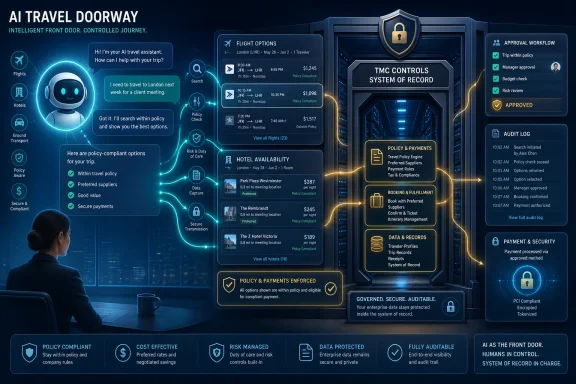
Vibe has launched an MCP-based AI integration for travel management companies, announced July 2026 and already live in testing with ITG Business Travel, that lets corporate travellers search, book, pay for, amend and manage trips through assistants such as ChatGPT, Claude and Microsoft Copilot while keeping the TMC’s platform, policy controls and supplier content in the transaction path. The pitch is not that artificial intelligence will replace the corporate booking tool overnight. It is that the booking tool may stop being the place where the traveller starts. For TMCs, that distinction is existential.
As reported by Travolution and also covered by Business Travel News, Vibe’s launch is built around a Vibe MCP server — MCP meaning Model Context Protocol — that connects Vibe-powered travel platforms to mainstream AI assistant environments. The company says this lets travellers use natural language to interact with approved corporate travel content rather than stepping outside the managed programme and into a consumer AI workflow. That is the real story here: not a chatbot bolted onto travel, but a bid to make the TMC’s rules and commercial plumbing available inside the next generation of AI front doors.
Corporate travel has always had an uneasy relationship with user behaviour. Companies spend heavily on managed travel programmes, preferred suppliers, duty-of-care processes and approval rules, only to watch travellers try to route around anything that feels slower than the consumer web. The traditional online booking tool survived because it owned the practical start of the journey: search.
Generative AI threatens that position because it does not begin with a form. A traveller can ask, “Get me to Frankfurt for Tuesday morning, near the client office, inside policy, and avoid a 5 a.m. departure,” and reasonably expect the assistant to interpret constraints, compare options and continue the conversation. That is a very different interaction model from selecting origin, destination, date, time, fare type and hotel radius across multiple screens.
Vibe’s move acknowledges a basic shift: the interface for booking may become less important than the controlled access layer behind it. If the assistant is where the traveller expresses intent, the TMC must make sure the assistant is calling the managed platform rather than improvising with unmanaged inventory. Otherwise, the company gets the appearance of convenience at the cost of leakage, weak reporting and policy drift.
That is why Matthew Chapman, Vibe’s co-founder and chief technical officer, framed the launch around the risk of travellers using AI outside managed programmes. His argument is not hard to understand. If AI becomes “the front door to digital commerce,” as he put it in the company’s announcement, then being absent from that front door means surrendering the traveller before the booking process has even begun.
That distinction is crucial in corporate travel. A generic AI assistant can describe flights, summarize hotel options or draft an itinerary. But a managed travel programme needs more than plausible text. It needs approved inventory, negotiated rates, traveller profiles, payment controls, approval workflows, policy checks, servicing rules, auditability and duty-of-care data.
Vibe’s claim is that its MCP server exposes those capabilities to AI assistants without forcing each TMC to build its own agent infrastructure. In practical terms, the AI assistant becomes the conversational interface, while the Vibe-powered TMC platform remains the system of record and the transaction engine. The assistant may ask the question and present the answer, but the managed platform is still supposed to decide what inventory is available, what is compliant and how the booking is completed.
That architecture is more interesting than another “AI travel planner” because it tries to solve the boring problem that enterprise buyers actually care about. Travel managers are not short of demos that can produce a cheerful itinerary. They are short of AI systems that respect policy, preserve commercial relationships and leave an auditable trail when a traveller changes a hotel at midnight.
For a TMC, control is not a vanity metric. It is the business model. TMCs make their case to corporate clients by aggregating content, enforcing policy, managing disruption, supporting travellers and providing data back to the organization. If the traveller defects to a general-purpose AI assistant that books through unmanaged channels, the TMC may still exist contractually, but it loses practical influence.
Vibe is trying to invert that threat. Instead of treating ChatGPT, Claude or Copilot as rivals to the booking platform, it treats them as surfaces that can be connected back to the managed stack. That is a sensible strategy, because workers are already bringing AI assistants into daily workflows whether procurement departments are ready or not.
The Windows angle is especially obvious with Microsoft Copilot. Microsoft has been pushing Copilot across Windows, Microsoft 365 and enterprise tooling, while Copilot Studio added support for connecting agents to existing MCP servers. For organizations already standardizing around Microsoft’s productivity stack, the idea of travel management showing up inside a Copilot-driven workflow is not far-fetched. The question is whether the governance around that workflow is mature enough for bookings, payments and personal travel data.
Mat Cook, ITG Business Travel’s managing director, said the MCP server lets the company compete in the AI landscape without the investment and technical resource normally required to build such capability in-house. That is the other half of the market Vibe is targeting. Large platforms may be able to staff their own AI infrastructure teams; many TMCs cannot.
If ITG’s testing shows that travellers actually use AI booking flows without breaking programme controls, Vibe will have a credible sales story. If the tests reveal that travellers enjoy search but still need human or traditional-tool intervention for amendments, exceptions and payment edge cases, that will be useful too. The first generation of these systems should be judged less by whether they replace the booking tool than by whether they capture intent before unmanaged alternatives do.
There is also a subtler benefit for ITG and similar agencies: behavioural data. Watching how travellers phrase requests to an AI assistant can reveal what traditional booking tools have obscured. Users do not think in fare classes and policy codes. They think in arrival times, fatigue, proximity, loyalty preferences and risk. A conversational interface can expose those priorities in a way that dropdown menus rarely do.
That is plausible. Most TMCs are not AI infrastructure companies. Their defensible value lies in travel operations, client service, supplier relationships and managed programme expertise. If every TMC has to reinvent the AI connector layer alone, the market will tilt even more heavily toward the largest players with the deepest engineering budgets.
A shared MCP layer can therefore function as a kind of equalizer, at least in theory. It lets the TMC present modern AI interaction without abandoning its existing platform investment. It also lets the corporate client experiment with AI-enabled booking without ripping out the managed travel programme.
But platform dependency cuts both ways. If Vibe becomes the AI gateway for its TMC clients, then Vibe’s implementation choices around permissions, logging, identity, data minimization and assistant compatibility become strategically important. The TMC remains “in control” only if the platform’s control plane is strong enough to satisfy enterprise governance teams.
MCP is useful because it standardizes how tools are exposed to assistants, but a protocol is not a security guarantee by itself. The wider MCP ecosystem has already drawn scrutiny from security researchers and enterprise architects because connecting AI agents to tools creates new paths for prompt injection, overbroad permissions and unintended actions. In travel, a bad action is not just an incorrect answer; it could be a non-refundable booking, a missed duty-of-care signal or exposure of traveller data.
That does not mean Vibe’s approach is reckless. In fact, routing assistant activity through the managed TMC platform is probably safer than letting employees paste travel requirements into arbitrary AI tools and then book outside policy. But it does mean enterprise buyers should ask sharper questions than “Does it work with Copilot?” They should ask what the assistant can see, what it can do, how actions are confirmed, how logs are retained and how the system handles conflicting instructions.
The most serious risk is not that AI suggests a silly hotel. It is that the system gradually normalizes high-authority actions through a conversational interface that feels informal. Booking, payment and amendment flows need clear confirmation boundaries. The assistant should reduce friction, not blur accountability.
That changes who needs to be in the room. Travel managers will care about supplier content, policy compliance and traveller experience. Security teams will care about identity, access control and data leakage. IT admins will care about tenant configuration, connector approval, endpoint governance and whether users can invoke travel actions from unmanaged contexts. Finance will care about payments, approvals and reconciliation.
MCP’s appeal is that it promises a cleaner integration pattern across these concerns. Microsoft’s own Copilot Studio documentation describes connecting agents to existing MCP servers, showing how the protocol is being pulled into mainstream enterprise tooling. But the enterprise governance story is still young. Many organizations are still deciding which agents may access which systems, under which identities, and with what human confirmation requirements.
That is why Vibe’s launch should not be read as a narrow travel-industry feature. It is one example of a much larger change in enterprise software: specialist systems are preparing to be operated by general-purpose AI assistants. The winners will be the platforms that expose useful actions without turning the enterprise into a permissionless experiment.
There will still be users who prefer a conventional booking screen, especially for complex itineraries or when they need to compare options visually. There will still be support agents, approval dashboards, reporting tools and servicing workflows that look nothing like a chat transcript. Travel is too operationally dense to collapse entirely into a prompt box.
But the first interaction may change. Instead of logging into an OBT to begin a search, a traveller may start in the assistant they already use for email, calendar, documents and internal knowledge. The assistant may know the meeting time, the location, the traveller’s preferences and the company’s rules. If the managed travel platform is connected at that point, the TMC keeps the booking inside the programme. If it is not, the TMC is reduced to cleaning up after decisions made elsewhere.
That is the strategic importance of Vibe’s launch. It is not claiming that every traveller will immediately book through AI. It is asserting that TMCs need to be present wherever travel intent is formed. In an AI-first workflow, that place may not be the booking tool’s homepage.
The meaningful distinction is not who used the acronym first. It is which model wins: AI as a consumer bypass around managed travel, or AI as a controlled interface into managed travel. Vibe is betting on the second model, and that is the one corporate buyers are more likely to accept.
There is a commercial reason for that. TMCs cannot tell clients to ignore AI, because travellers will not. They also cannot embrace unmanaged AI, because that undermines the programme they are paid to manage. An MCP layer offers a compromise: let travellers use the assistant interface they want, while the TMC retains the policy, content and servicing backbone.
The danger is that “AI integration” becomes another checkbox in travel RFPs before the operational details are proven. A genuine managed AI booking flow needs more than impressive natural-language search. It needs resilience when flights change, clarity when policy exceptions arise, and clean handoff when a human consultant must intervene.
That is the unmanaged shortcut Vibe is trying to intercept. The problem is not simply that travellers may book outside policy. It is that the moment of decision may happen before the traveller even thinks of the TMC. Once an assistant has helped plan the trip, recommended options and built confidence, the managed channel becomes an administrative obstacle.
The TMC’s defense cannot be “please use the approved tool.” It has to be presence, convenience and trust. The approved path must show up inside the workflow where the traveller already is. It must answer naturally, transact reliably and explain policy without sounding like a compliance manual.
This is where Vibe’s approach has a credible strategic logic. By connecting AI assistants to approved content and booking functions, the TMC can compete at the level of user experience without giving up the managed substrate. That does not guarantee adoption, but it addresses the right failure mode.
These questions are not theoretical. Vibe’s announcement says travellers can search and book flights, rail and hotels, view existing bookings, manage arrangements, make payments, amend itineraries and access relevant corporate travel policy information. That is a broad action surface. It is also exactly why TMC control matters.
A read-only AI assistant is relatively easy to tolerate. A transaction-capable assistant is a governance project. Once payments and itinerary amendments enter the chat, the organization needs strong identity binding, role-based access, confirmation steps and audit trails. It also needs a plan for error handling when the assistant’s interpretation of a traveller’s request differs from the traveller’s intent.
The best implementations will likely feel conservative at first. They will require confirmation before purchases, clearly separate policy guidance from booking execution, and keep humans in the loop for ambiguous or high-risk changes. That may make the experience less magical, but enterprise systems are not supposed to be magic. They are supposed to be accountable.
The servicing side may prove more valuable than initial booking. Business travel is full of small disruptions: changed meetings, delayed flights, hotel switches, receipts, cancellations and policy clarifications. A conversational assistant connected to the managed travel platform could reduce support load by handling routine changes while escalating the complicated ones.
There is also room for better pre-trip guidance. A traveller asking about options can receive policy-aware answers before making a noncompliant choice. Instead of policy enforcement arriving as a rejection screen late in the process, it can become part of the conversation. That could make managed travel feel less adversarial.
But the experience must be honest about uncertainty. If fare availability changes, if a hotel rate is conditional, or if an approval is required, the assistant should say so plainly. The fastest way to destroy trust in AI booking is to let the assistant sound certain when the underlying system is not.
As reported by Travolution and also covered by Business Travel News, Vibe’s launch is built around a Vibe MCP server — MCP meaning Model Context Protocol — that connects Vibe-powered travel platforms to mainstream AI assistant environments. The company says this lets travellers use natural language to interact with approved corporate travel content rather than stepping outside the managed programme and into a consumer AI workflow. That is the real story here: not a chatbot bolted onto travel, but a bid to make the TMC’s rules and commercial plumbing available inside the next generation of AI front doors.
 The Booking Tool Is Losing Its Monopoly on Intent
Corporate travel has always had an uneasy relationship with user behaviour. Companies spend heavily on managed travel programmes, preferred suppliers, duty-of-care processes and approval rules, only to watch travellers try to route around anything that feels slower than the consumer web. The traditional online booking tool survived because it owned the practical start of the journey: search.Generative AI threatens that position because it does not begin with a form. A traveller can ask, “Get me to Frankfurt for Tuesday morning, near the client office, inside policy, and avoid a 5 a.m. departure,” and reasonably expect the assistant to interpret constraints, compare options and continue the conversation. That is a very different interaction model from selecting origin, destination, date, time, fare type and hotel radius across multiple screens.
Vibe’s move acknowledges a basic shift: the interface for booking may become less important than the controlled access layer behind it. If the assistant is where the traveller expresses intent, the TMC must make sure the assistant is calling the managed platform rather than improvising with unmanaged inventory. Otherwise, the company gets the appearance of convenience at the cost of leakage, weak reporting and policy drift.
That is why Matthew Chapman, Vibe’s co-founder and chief technical officer, framed the launch around the risk of travellers using AI outside managed programmes. His argument is not hard to understand. If AI becomes “the front door to digital commerce,” as he put it in the company’s announcement, then being absent from that front door means surrendering the traveller before the booking process has even begun.
MCP Turns AI From a Chat Window Into a Transaction Layer
The Model Context Protocol matters because it gives AI assistants a standardized way to connect to external tools, services and data sources. Anthropic introduced MCP in late 2024 as an open standard for connecting AI applications to the systems where data lives. Since then, the protocol has become one of the industry’s preferred answers to a problem every agentic AI demo eventually hits: language models can talk fluently, but businesses need them to act through governed systems.That distinction is crucial in corporate travel. A generic AI assistant can describe flights, summarize hotel options or draft an itinerary. But a managed travel programme needs more than plausible text. It needs approved inventory, negotiated rates, traveller profiles, payment controls, approval workflows, policy checks, servicing rules, auditability and duty-of-care data.
Vibe’s claim is that its MCP server exposes those capabilities to AI assistants without forcing each TMC to build its own agent infrastructure. In practical terms, the AI assistant becomes the conversational interface, while the Vibe-powered TMC platform remains the system of record and the transaction engine. The assistant may ask the question and present the answer, but the managed platform is still supposed to decide what inventory is available, what is compliant and how the booking is completed.
That architecture is more interesting than another “AI travel planner” because it tries to solve the boring problem that enterprise buyers actually care about. Travel managers are not short of demos that can produce a cheerful itinerary. They are short of AI systems that respect policy, preserve commercial relationships and leave an auditable trail when a traveller changes a hotel at midnight.
Vibe’s Bet Is That Control Beats Novelty
The most important phrase in Vibe’s announcement is not “AI-powered booking.” It is “fully in control of the booking process.” That is the line aimed at TMCs, and it is the line that separates this launch from the consumer-AI travel experiments that have been appearing across the industry.For a TMC, control is not a vanity metric. It is the business model. TMCs make their case to corporate clients by aggregating content, enforcing policy, managing disruption, supporting travellers and providing data back to the organization. If the traveller defects to a general-purpose AI assistant that books through unmanaged channels, the TMC may still exist contractually, but it loses practical influence.
Vibe is trying to invert that threat. Instead of treating ChatGPT, Claude or Copilot as rivals to the booking platform, it treats them as surfaces that can be connected back to the managed stack. That is a sensible strategy, because workers are already bringing AI assistants into daily workflows whether procurement departments are ready or not.
The Windows angle is especially obvious with Microsoft Copilot. Microsoft has been pushing Copilot across Windows, Microsoft 365 and enterprise tooling, while Copilot Studio added support for connecting agents to existing MCP servers. For organizations already standardizing around Microsoft’s productivity stack, the idea of travel management showing up inside a Copilot-driven workflow is not far-fetched. The question is whether the governance around that workflow is mature enough for bookings, payments and personal travel data.
ITG Becomes the Necessary Reality Check
ITG Business Travel is the first Vibe client live with the integration, according to the announcement, and is testing it with corporate clients in real-world booking environments. That matters because AI travel tooling often looks better in a controlled demo than in the messy life of a corporate traveller. A genuine test has to include the awkward cases: split itineraries, late amendments, fare restrictions, policy exceptions, rail plus air combinations, and the inevitable moment when the assistant misunderstands a constraint.Mat Cook, ITG Business Travel’s managing director, said the MCP server lets the company compete in the AI landscape without the investment and technical resource normally required to build such capability in-house. That is the other half of the market Vibe is targeting. Large platforms may be able to staff their own AI infrastructure teams; many TMCs cannot.
If ITG’s testing shows that travellers actually use AI booking flows without breaking programme controls, Vibe will have a credible sales story. If the tests reveal that travellers enjoy search but still need human or traditional-tool intervention for amendments, exceptions and payment edge cases, that will be useful too. The first generation of these systems should be judged less by whether they replace the booking tool than by whether they capture intent before unmanaged alternatives do.
There is also a subtler benefit for ITG and similar agencies: behavioural data. Watching how travellers phrase requests to an AI assistant can reveal what traditional booking tools have obscured. Users do not think in fare classes and policy codes. They think in arrival times, fatigue, proximity, loyalty preferences and risk. A conversational interface can expose those priorities in a way that dropdown menus rarely do.
The TMC No Longer Has to Build the Whole AI Stack
For smaller and mid-market TMCs, the launch points to a broader software-platform shift. AI capability is becoming less a standalone product and more an integration layer that established providers are expected to supply. Vibe’s argument is that TMCs should not have to construct model integrations, authentication, tooling schemas and assistant-facing transaction flows from scratch.That is plausible. Most TMCs are not AI infrastructure companies. Their defensible value lies in travel operations, client service, supplier relationships and managed programme expertise. If every TMC has to reinvent the AI connector layer alone, the market will tilt even more heavily toward the largest players with the deepest engineering budgets.
A shared MCP layer can therefore function as a kind of equalizer, at least in theory. It lets the TMC present modern AI interaction without abandoning its existing platform investment. It also lets the corporate client experiment with AI-enabled booking without ripping out the managed travel programme.
But platform dependency cuts both ways. If Vibe becomes the AI gateway for its TMC clients, then Vibe’s implementation choices around permissions, logging, identity, data minimization and assistant compatibility become strategically important. The TMC remains “in control” only if the platform’s control plane is strong enough to satisfy enterprise governance teams.
The Assistant Is Friendly; the Data Flow Is Not
The hard part of AI in corporate travel is not natural language. It is trust. A corporate travel booking contains personal data, payment information, location signals, company policy, commercial rates and sometimes sensitive business context. Putting an AI assistant in front of that workflow increases the number of systems that must be understood, secured and audited.MCP is useful because it standardizes how tools are exposed to assistants, but a protocol is not a security guarantee by itself. The wider MCP ecosystem has already drawn scrutiny from security researchers and enterprise architects because connecting AI agents to tools creates new paths for prompt injection, overbroad permissions and unintended actions. In travel, a bad action is not just an incorrect answer; it could be a non-refundable booking, a missed duty-of-care signal or exposure of traveller data.
That does not mean Vibe’s approach is reckless. In fact, routing assistant activity through the managed TMC platform is probably safer than letting employees paste travel requirements into arbitrary AI tools and then book outside policy. But it does mean enterprise buyers should ask sharper questions than “Does it work with Copilot?” They should ask what the assistant can see, what it can do, how actions are confirmed, how logs are retained and how the system handles conflicting instructions.
The most serious risk is not that AI suggests a silly hotel. It is that the system gradually normalizes high-authority actions through a conversational interface that feels informal. Booking, payment and amendment flows need clear confirmation boundaries. The assistant should reduce friction, not blur accountability.
Microsoft Copilot Makes This an IT Story, Not Just a Travel Story
For WindowsForum readers, the mention of Microsoft Copilot is not incidental. Copilot has become Microsoft’s preferred surface for AI across consumer Windows, Microsoft 365 and enterprise automation. If travel booking can move into Copilot-connected workflows, then IT departments inherit another category of business process that may run through AI agents.That changes who needs to be in the room. Travel managers will care about supplier content, policy compliance and traveller experience. Security teams will care about identity, access control and data leakage. IT admins will care about tenant configuration, connector approval, endpoint governance and whether users can invoke travel actions from unmanaged contexts. Finance will care about payments, approvals and reconciliation.
MCP’s appeal is that it promises a cleaner integration pattern across these concerns. Microsoft’s own Copilot Studio documentation describes connecting agents to existing MCP servers, showing how the protocol is being pulled into mainstream enterprise tooling. But the enterprise governance story is still young. Many organizations are still deciding which agents may access which systems, under which identities, and with what human confirmation requirements.
That is why Vibe’s launch should not be read as a narrow travel-industry feature. It is one example of a much larger change in enterprise software: specialist systems are preparing to be operated by general-purpose AI assistants. The winners will be the platforms that expose useful actions without turning the enterprise into a permissionless experiment.
The Old Booking Interface Will Not Vanish, but Its Job Will Change
It is tempting to frame this as the end of the corporate booking tool. Chapman himself asked whether this is the beginning of the end of traditional booking behaviour. The better answer is that the old interface will become less central, not irrelevant.There will still be users who prefer a conventional booking screen, especially for complex itineraries or when they need to compare options visually. There will still be support agents, approval dashboards, reporting tools and servicing workflows that look nothing like a chat transcript. Travel is too operationally dense to collapse entirely into a prompt box.
But the first interaction may change. Instead of logging into an OBT to begin a search, a traveller may start in the assistant they already use for email, calendar, documents and internal knowledge. The assistant may know the meeting time, the location, the traveller’s preferences and the company’s rules. If the managed travel platform is connected at that point, the TMC keeps the booking inside the programme. If it is not, the TMC is reduced to cleaning up after decisions made elsewhere.
That is the strategic importance of Vibe’s launch. It is not claiming that every traveller will immediately book through AI. It is asserting that TMCs need to be present wherever travel intent is formed. In an AI-first workflow, that place may not be the booking tool’s homepage.
The Claim of Being First Is Less Important Than the Direction of Travel
Vibe says it is not aware of anything else like this that keeps the TMC fully in control of the booking process. Such first-to-market claims deserve the usual caution, especially in an industry where multiple vendors are experimenting with agentic booking and AI servicing. Business Travel News reported that Navan has also launched MCP server capabilities, underscoring that Vibe is not alone in seeing MCP as a new integration battleground.The meaningful distinction is not who used the acronym first. It is which model wins: AI as a consumer bypass around managed travel, or AI as a controlled interface into managed travel. Vibe is betting on the second model, and that is the one corporate buyers are more likely to accept.
There is a commercial reason for that. TMCs cannot tell clients to ignore AI, because travellers will not. They also cannot embrace unmanaged AI, because that undermines the programme they are paid to manage. An MCP layer offers a compromise: let travellers use the assistant interface they want, while the TMC retains the policy, content and servicing backbone.
The danger is that “AI integration” becomes another checkbox in travel RFPs before the operational details are proven. A genuine managed AI booking flow needs more than impressive natural-language search. It needs resilience when flights change, clarity when policy exceptions arise, and clean handoff when a human consultant must intervene.
The Real Competition Is the Unmanaged Shortcut
Corporate travel technology has spent years trying to make managed channels feel more like consumer channels. AI raises the bar again. If a traveller can ask a consumer assistant for “the easiest way to get to Munich tomorrow” and get a polished answer in seconds, a clunky corporate booking flow looks even more punitive than before.That is the unmanaged shortcut Vibe is trying to intercept. The problem is not simply that travellers may book outside policy. It is that the moment of decision may happen before the traveller even thinks of the TMC. Once an assistant has helped plan the trip, recommended options and built confidence, the managed channel becomes an administrative obstacle.
The TMC’s defense cannot be “please use the approved tool.” It has to be presence, convenience and trust. The approved path must show up inside the workflow where the traveller already is. It must answer naturally, transact reliably and explain policy without sounding like a compliance manual.
This is where Vibe’s approach has a credible strategic logic. By connecting AI assistants to approved content and booking functions, the TMC can compete at the level of user experience without giving up the managed substrate. That does not guarantee adoption, but it addresses the right failure mode.
The Next Procurement Fight Will Be Over Agent Rights
If AI assistants become a front end for travel, procurement and IT teams will need a new vocabulary for evaluating suppliers. The old questions about inventory coverage, usability and reporting will remain, but they will be joined by questions about agent permissions. What can the assistant do autonomously? When must it ask for confirmation? Can it amend a booking? Can it process payment? Can it access traveller profiles? Can it explain why an option is out of policy?These questions are not theoretical. Vibe’s announcement says travellers can search and book flights, rail and hotels, view existing bookings, manage arrangements, make payments, amend itineraries and access relevant corporate travel policy information. That is a broad action surface. It is also exactly why TMC control matters.
A read-only AI assistant is relatively easy to tolerate. A transaction-capable assistant is a governance project. Once payments and itinerary amendments enter the chat, the organization needs strong identity binding, role-based access, confirmation steps and audit trails. It also needs a plan for error handling when the assistant’s interpretation of a traveller’s request differs from the traveller’s intent.
The best implementations will likely feel conservative at first. They will require confirmation before purchases, clearly separate policy guidance from booking execution, and keep humans in the loop for ambiguous or high-risk changes. That may make the experience less magical, but enterprise systems are not supposed to be magic. They are supposed to be accountable.
The First Useful Test Is Whether Travellers Stay Inside the Fence
The launch should be judged by practical outcomes rather than AI spectacle. If Vibe and ITG can show that travellers complete more bookings inside policy, reduce leakage and still report a better experience, the MCP layer will look like a serious product direction. If users treat the assistant as a novelty and return to conventional tools for real transactions, the integration may still be useful but less transformative.The servicing side may prove more valuable than initial booking. Business travel is full of small disruptions: changed meetings, delayed flights, hotel switches, receipts, cancellations and policy clarifications. A conversational assistant connected to the managed travel platform could reduce support load by handling routine changes while escalating the complicated ones.
There is also room for better pre-trip guidance. A traveller asking about options can receive policy-aware answers before making a noncompliant choice. Instead of policy enforcement arriving as a rejection screen late in the process, it can become part of the conversation. That could make managed travel feel less adversarial.
But the experience must be honest about uncertainty. If fare availability changes, if a hotel rate is conditional, or if an approval is required, the assistant should say so plainly. The fastest way to destroy trust in AI booking is to let the assistant sound certain when the underlying system is not.
Vibe’s MCP Play Compresses the AI Travel Debate Into One Integration
Vibe’s launch is a small announcement with a large implication: corporate travel does not get to opt out of the agent era, but it can still decide where the agent connects. The most concrete lessons are already visible.- Vibe has launched an MCP server that connects Vibe-powered TMC platforms with AI assistants including ChatGPT, Claude and Microsoft Copilot.
- ITG Business Travel is the first named Vibe client live with the integration and is testing it with corporate clients in real booking environments.
- The integration is designed to let travellers search, book, pay for, amend and manage travel while staying inside approved TMC content and corporate policy.
- The strategic target is unmanaged AI usage, where travellers might otherwise plan or book outside the corporate travel programme.
- The enterprise risk shifts from interface usability to agent governance, including permissions, identity, confirmation, logging and data protection.
- The success metric is not whether chat replaces every booking screen, but whether managed travel remains present when travellers begin expressing intent through AI.
References
- Primary source: Travolution
Published: 2026-07-07T09:58:08.332839
Vibe launches AI integration with MCP layer... | Travolution
ITG Business Travel is the first client, it's already live and testingwww.travolution.com - Official source: microsoft.com
Extend agents with Model Context Protocol (MCP) in Copilot Studio | Microsoft Copilot Blog
Discover how Model Context Protocol (MCP) extends Microsoft Copilot Studio, connecting agents to data, APIs, and external systems.www.microsoft.com - Related coverage: businesstravelnews.com
Vibe, Navan Launch MCP Servers
Navan and Vibe have launched Model Context Protocol servers to integrate AI in travel management, allowing enhanced data queries and booking functions.www.businesstravelnews.com