

Microsoft plans to add Cloud-Initiated Driver Recovery to Windows Update, with partner testing running from May through August 2026 and broader automated support targeted for September 2026, allowing Windows 11 systems to roll back faulty drivers without user or hardware-vendor intervention. That is a small sentence for a large admission: driver updates remain one of Windows’ most stubborn weak points. CIDR is Microsoft’s attempt to turn rollback from a support ritual into infrastructure. If it works, Windows Update gets something it has long needed — a credible undo button.
For years, Windows users have treated driver updates with a mixture of resignation and superstition. A graphics driver lands and breaks sleep. A network adapter update arrives and Wi-Fi vanishes. A storage or chipset driver slips through and suddenly the problem is not merely annoying but existential: the machine may no longer boot cleanly enough for an ordinary user to repair it.
Cloud-Initiated Driver Recovery is meant to change the choreography. Instead of waiting for a hardware maker to submit a replacement package, or expecting users to find Device Manager, identify the bad component, and manually roll back the driver, Microsoft can trigger recovery through its own Windows Update pipeline. The affected device should receive a previously known-good driver or the most appropriate replacement available through Windows Update.
That is not glamorous engineering. It is plumbing. But Windows lives and dies by plumbing, and driver delivery is among the places where Microsoft’s consumer operating system still reveals its age, scale, and ecosystem complexity.
The feature also arrives with a telling name. This is not merely “automatic rollback.” It is cloud-initiated rollback, meaning Microsoft is centralizing the decision to unwind a bad driver after it has already passed through the formal distribution system. The phrase sounds like modern platform management, but the implication is old-fashioned: Microsoft knows the current process still lets bad drivers reach real machines.
That distinction matters. Pre-release validation is never enough in an ecosystem as wide as Windows. The operating system runs on boutique gaming rigs, five-year-old laptops, business desktops with firmware images frozen by procurement, industrial PCs connected to obscure USB devices, and enterprise fleets where every driver has to coexist with VPNs, endpoint security tools, encryption layers, and management agents. No lab matrix can fully model that.
CIDR acknowledges the mismatch between certification and reality. A driver may look acceptable in testing and still misbehave at scale. It may fail only on a specific hardware revision, only after a firmware update, only with a certain Windows build, or only when paired with another vendor’s component. By scoping rollback to the relevant hardware targets and shipping labels, Microsoft is trying to fix the blast radius problem without turning driver recovery into a system-wide panic button.
That scoping is essential. A broad rollback mechanism would be dangerous in its own right; Windows cannot simply yank drivers across millions of machines because one configuration fails. Microsoft’s pitch is that CIDR targets the specific hardware and components tied to the faulty driver, leaving unrelated device drivers and system functions alone.
In theory, this makes the Driver Shiproom more like an air-traffic control tower than a customs checkpoint. It does not merely stamp cargo as approved. It watches for trouble after takeoff and can order a return before passengers are left stranded.
Consumer advice usually begins with Device Manager, “Roll Back Driver,” Safe Mode, System Restore, or vendor cleanup utilities. That may be tolerable for enthusiasts, though even enthusiasts have better things to do. It is absurd for ordinary users, who reasonably assume that if Windows Update installed the software, Windows Update should also be able to remove it.
In enterprises, the pain has a different shape. A bad driver can turn into help-desk tickets, emergency rings, blocked deployments, and awkward conversations between IT, procurement, and vendors. The support burden compounds because drivers sit close to the hardware. When they fail, the symptoms are often messy: blue screens, disappearing peripherals, broken docking stations, battery drain, audio failures, or degraded performance that is hard to attribute.
Microsoft’s proposed fix does not eliminate the need for vendor accountability. Hardware makers still have to submit corrected drivers through the normal Hardware Dev Center publishing process. But CIDR gives Microsoft a mitigation layer while that slower process unfolds.
That matters because “wait for the vendor” is not a recovery strategy. It is a holding pattern. CIDR is Microsoft saying that the platform owner needs the authority to reduce damage before the ecosystem’s normal paperwork catches up.
Automatic rollback is powerful because it removes friction. It is also dangerous because rollback itself is a change, and changes to drivers can be just as disruptive as updates. A previously known-good version may be known-good for most devices but not for a newly revised hardware batch. A rollback might restore stability for one symptom while reintroducing another issue that the newer driver fixed. In enterprise environments, automatic remediation can collide with change windows, validation procedures, and compliance documentation.
Microsoft appears to be trying to reduce that risk by keeping CIDR inside existing Windows Update infrastructure and partner workflows. Hardware manufacturers do not need new APIs, portal fields, or side-channel tooling. Partners are notified through established shiproom communications, and fixed drivers continue through the standard ingestion pipeline.
That is the right design instinct. If CIDR required every OEM and component maker to build new processes before it became useful, it would fail slowly. By placing the recovery action inside infrastructure Microsoft already controls, the company can make rollback an operational capability rather than a new ecosystem negotiation.
Still, the hard problem is not the button. It is the decision to press it. Microsoft will need sufficiently fast telemetry, confidence in root cause, and restraint. If CIDR becomes trigger-happy, administrators will distrust it. If it is too cautious, users will not notice it exists until after they have already suffered the outage.
Driver rollback is not as marketable as a redesigned Start menu or a Copilot feature. It will not sell new laptops. It will not anchor a keynote. But it addresses one of the most corrosive forms of platform mistrust: the fear that Windows Update can make a working PC worse.
That fear is not irrational. Windows Update is both a security lifeline and a source of operational anxiety. Users are told, correctly, to stay patched. They are also conditioned, through experience, to wonder whether the next update will break audio, networking, printing, or graphics. Microsoft has improved the servicing model over the years, but the emotional memory of bad updates is long.
CIDR is therefore more than a driver feature. It is a trust feature. It tells users and administrators that Microsoft understands the obligation created when it uses Windows Update as the central delivery channel for hardware software.
The company’s challenge is to prove that this is not merely another layer of opacity. A silent rollback that fixes a problem is welcome. A silent rollback that changes a driver without clear reporting will be less welcome in managed environments. The more automatic Windows becomes, the more important its explanations become.
Microsoft says the recovery mechanism does not require new partner-side tooling, but administrators will still care how CIDR interacts with update rings, driver policies, deployment controls, and reporting. Driver management in business environments is already a balancing act. Some organizations rely on Windows Update for Business and Intune policies. Others tightly curate drivers through OEM tools or internal validation. Many sit somewhere in between, allowing Microsoft’s pipeline for certain classes of devices while blocking others.
An automatic cloud rollback could be a gift to IT teams if it reduces incidents without bypassing governance. It could be a headache if it introduces a new class of Microsoft-initiated change that administrators cannot easily audit or stage.
The likely dividing line will be visibility. If CIDR events appear clearly in management consoles, logs, and update reporting, enterprises may treat it as another safety layer. If they surface as vague driver churn after the fact, CIDR will earn suspicion even when it prevents outages.
Microsoft’s stated plan to notify partners through existing ecosystem channels is only one half of the story. The other half is what customers see. A platform that can heal itself should also be able to explain itself.
Windows also has more than one kind of driver problem. Some failures come from newly shipped driver packages. Others come from mismatched firmware, vendor utilities, BIOS settings, security software, device-specific control panels, or Windows feature updates that change assumptions underneath an existing driver. CIDR may help with a bad Windows Update driver, but it will not magically resolve every device failure that looks like a driver problem.
The phrase “previously known-good” also deserves scrutiny. Known-good is contextual. A driver that was stable last month may not be ideal after a Windows cumulative update, a firmware change, or a new peripheral configuration. Microsoft can improve outcomes statistically, but it cannot make rollback risk-free.
That does not weaken the case for CIDR. It clarifies it. The goal is not perfection. The goal is to reduce the number of cases where a bad driver remains installed simply because the system has no timely, centralized way to reverse course.
For Windows, that would still be meaningful progress. The platform does not need every recovery mechanism to be flawless. It needs fewer failures that turn into user archaeology.
The normal submission pipeline remains intact. After recovery, vendors can submit a fixed driver through the standard Hardware Dev Center process, and once that driver passes evaluation it can publish through Windows Update as usual. The difference is that customers need not remain stuck on the bad package while that happens.
This is particularly important because users rarely distinguish between Microsoft’s responsibility and the hardware maker’s responsibility. If Windows Update installs a broken driver, most people blame Windows. Microsoft may privately know the root cause sits with a vendor submission, but that distinction does little for a user staring at a black screen or a missing Wi-Fi adapter.
CIDR lets Microsoft protect the Windows brand even when the bug originates elsewhere. It also gives Microsoft more leverage over partners, because rollback becomes an operational consequence of quality failure. A vendor whose driver is recovered may face reputational pressure inside the ecosystem even if end users never learn the details.
That is healthy, up to a point. Driver quality has always depended on incentives. If CIDR makes poor submissions less sticky and more visible to Microsoft’s pipeline, vendors have another reason to improve testing before release.
This is the natural direction for a modern operating system at Windows scale. Shipping an update to hundreds of millions of devices is not a single event. It is an ongoing negotiation with telemetry, hardware diversity, user behavior, and enterprise policy. The old notion of an update as a package that simply installs and stays installed unless the user intervenes is too brittle.
CIDR fits that evolution. It treats a driver not as a static artifact but as a managed state. If the state proves harmful, Microsoft can move affected machines to a better state through the same service that delivered the driver.
The tension is that every improvement in cloud-managed remediation makes Windows more dependent on Microsoft’s central judgment. Enthusiasts who prefer local control will see that trade-off immediately. Administrators will evaluate it through policy and auditability. Ordinary users will mostly judge it by whether their PCs break less often.
That is the correct test. Platform architecture is invisible until it fails. CIDR will earn trust only if it quietly reduces the number of failures that reach people.
The boring parts are where this feature will succeed or fail. Can Microsoft reliably identify affected hardware targets? Can the rollback package land without creating installation loops? Can Windows distinguish between a driver that should be recovered and a driver that is merely associated with noisy telemetry? Can administrators see what happened? Can users who need a newer vendor driver avoid being forced back repeatedly?
These are not edge concerns. They are the product. Automatic recovery is only impressive if it does not become another update mystery.
There is also a communications challenge. Microsoft should resist overselling CIDR as the end of driver problems. It is more believable, and more useful, as a targeted mitigation for a specific class of Windows Update failures. The company will get more credit by being precise than by pretending it has solved the entire driver ecosystem.
The Windows community has a long memory for promises that sounded cleaner than the reality. CIDR deserves optimism, but not credulity.
That shifts the reliability conversation from prevention alone to resilience. Prevention remains essential, but resilience is what users experience when prevention fails. A platform that can recover quickly from mistakes is more trustworthy than one that insists mistakes should not happen and leaves users to clean up when they do.
The same idea has shaped cloud services for years. Deployment systems assume that some releases will fail, so they emphasize monitoring, rollback, staged rollout, and blast-radius control. Windows, despite being a local operating system, increasingly needs the same discipline because its update model is service-like.
The tricky part is that PCs are not cloud instances. They contain personal data, local peripherals, business workflows, and hardware combinations that Microsoft does not own. A rollback on a server fleet is an operations event. A rollback on a personal computer can feel intimate, especially if the user does not understand why it happened.
That is why CIDR’s success will depend as much on transparency as automation. Silent repair is wonderful until it becomes inexplicable repair.
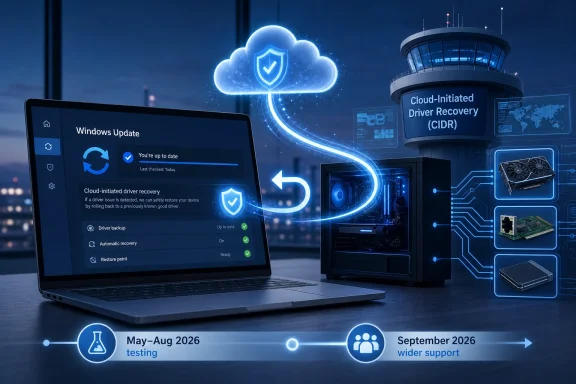 Microsoft Finally Builds the Escape Hatch Windows Update Always Needed
For years, Windows users have treated driver updates with a mixture of resignation and superstition. A graphics driver lands and breaks sleep. A network adapter update arrives and Wi-Fi vanishes. A storage or chipset driver slips through and suddenly the problem is not merely annoying but existential: the machine may no longer boot cleanly enough for an ordinary user to repair it.Cloud-Initiated Driver Recovery is meant to change the choreography. Instead of waiting for a hardware maker to submit a replacement package, or expecting users to find Device Manager, identify the bad component, and manually roll back the driver, Microsoft can trigger recovery through its own Windows Update pipeline. The affected device should receive a previously known-good driver or the most appropriate replacement available through Windows Update.
That is not glamorous engineering. It is plumbing. But Windows lives and dies by plumbing, and driver delivery is among the places where Microsoft’s consumer operating system still reveals its age, scale, and ecosystem complexity.
The feature also arrives with a telling name. This is not merely “automatic rollback.” It is cloud-initiated rollback, meaning Microsoft is centralizing the decision to unwind a bad driver after it has already passed through the formal distribution system. The phrase sounds like modern platform management, but the implication is old-fashioned: Microsoft knows the current process still lets bad drivers reach real machines.
The Driver Shiproom Becomes a Control Tower
Microsoft’s Driver Shiproom has long been part of the machinery that evaluates driver submissions before they reach Windows Update. CIDR gives that machinery a second responsibility: not just deciding what should ship, but deciding what should be pulled back after shipping.That distinction matters. Pre-release validation is never enough in an ecosystem as wide as Windows. The operating system runs on boutique gaming rigs, five-year-old laptops, business desktops with firmware images frozen by procurement, industrial PCs connected to obscure USB devices, and enterprise fleets where every driver has to coexist with VPNs, endpoint security tools, encryption layers, and management agents. No lab matrix can fully model that.
CIDR acknowledges the mismatch between certification and reality. A driver may look acceptable in testing and still misbehave at scale. It may fail only on a specific hardware revision, only after a firmware update, only with a certain Windows build, or only when paired with another vendor’s component. By scoping rollback to the relevant hardware targets and shipping labels, Microsoft is trying to fix the blast radius problem without turning driver recovery into a system-wide panic button.
That scoping is essential. A broad rollback mechanism would be dangerous in its own right; Windows cannot simply yank drivers across millions of machines because one configuration fails. Microsoft’s pitch is that CIDR targets the specific hardware and components tied to the faulty driver, leaving unrelated device drivers and system functions alone.
In theory, this makes the Driver Shiproom more like an air-traffic control tower than a customs checkpoint. It does not merely stamp cargo as approved. It watches for trouble after takeoff and can order a return before passengers are left stranded.
The Old Model Pushed Too Much Work Onto the Victim
The existing failure path has always been strangely backwards. A driver is delivered through Windows Update, a trusted channel operated by Microsoft, but when that driver fails, the burden often shifts to the user, the administrator, or the hardware vendor. The person whose machine just broke becomes the first responder.Consumer advice usually begins with Device Manager, “Roll Back Driver,” Safe Mode, System Restore, or vendor cleanup utilities. That may be tolerable for enthusiasts, though even enthusiasts have better things to do. It is absurd for ordinary users, who reasonably assume that if Windows Update installed the software, Windows Update should also be able to remove it.
In enterprises, the pain has a different shape. A bad driver can turn into help-desk tickets, emergency rings, blocked deployments, and awkward conversations between IT, procurement, and vendors. The support burden compounds because drivers sit close to the hardware. When they fail, the symptoms are often messy: blue screens, disappearing peripherals, broken docking stations, battery drain, audio failures, or degraded performance that is hard to attribute.
Microsoft’s proposed fix does not eliminate the need for vendor accountability. Hardware makers still have to submit corrected drivers through the normal Hardware Dev Center publishing process. But CIDR gives Microsoft a mitigation layer while that slower process unfolds.
That matters because “wait for the vendor” is not a recovery strategy. It is a holding pattern. CIDR is Microsoft saying that the platform owner needs the authority to reduce damage before the ecosystem’s normal paperwork catches up.
Automation Is Useful Only If Microsoft Gets the Judgment Right
The obvious appeal of CIDR is that users do not need to do anything. The obvious risk is the same sentence.Automatic rollback is powerful because it removes friction. It is also dangerous because rollback itself is a change, and changes to drivers can be just as disruptive as updates. A previously known-good version may be known-good for most devices but not for a newly revised hardware batch. A rollback might restore stability for one symptom while reintroducing another issue that the newer driver fixed. In enterprise environments, automatic remediation can collide with change windows, validation procedures, and compliance documentation.
Microsoft appears to be trying to reduce that risk by keeping CIDR inside existing Windows Update infrastructure and partner workflows. Hardware manufacturers do not need new APIs, portal fields, or side-channel tooling. Partners are notified through established shiproom communications, and fixed drivers continue through the standard ingestion pipeline.
That is the right design instinct. If CIDR required every OEM and component maker to build new processes before it became useful, it would fail slowly. By placing the recovery action inside infrastructure Microsoft already controls, the company can make rollback an operational capability rather than a new ecosystem negotiation.
Still, the hard problem is not the button. It is the decision to press it. Microsoft will need sufficiently fast telemetry, confidence in root cause, and restraint. If CIDR becomes trigger-happy, administrators will distrust it. If it is too cautious, users will not notice it exists until after they have already suffered the outage.
This Is Also a Reputation Repair Project
Microsoft’s public framing is about reliability, security, performance, compatibility, and quality. That language is familiar, but the timing gives it more weight. Windows 11 has spent much of its life fighting perception problems: hardware requirements that made sense to Microsoft but annoyed users, interface changes that felt unfinished, update incidents that reinforced old jokes, and AI branding that often arrived faster than obvious quality-of-life fixes.Driver rollback is not as marketable as a redesigned Start menu or a Copilot feature. It will not sell new laptops. It will not anchor a keynote. But it addresses one of the most corrosive forms of platform mistrust: the fear that Windows Update can make a working PC worse.
That fear is not irrational. Windows Update is both a security lifeline and a source of operational anxiety. Users are told, correctly, to stay patched. They are also conditioned, through experience, to wonder whether the next update will break audio, networking, printing, or graphics. Microsoft has improved the servicing model over the years, but the emotional memory of bad updates is long.
CIDR is therefore more than a driver feature. It is a trust feature. It tells users and administrators that Microsoft understands the obligation created when it uses Windows Update as the central delivery channel for hardware software.
The company’s challenge is to prove that this is not merely another layer of opacity. A silent rollback that fixes a problem is welcome. A silent rollback that changes a driver without clear reporting will be less welcome in managed environments. The more automatic Windows becomes, the more important its explanations become.
Enterprises Will Ask Who Controls the Recovery
For home users, CIDR’s best-case scenario is simple: a bad driver arrives, Microsoft detects the issue, and Windows quietly restores a stable version before the user spends a Saturday reading forum threads. For managed fleets, the question is more complicated. IT departments do not merely want systems fixed; they want to know what changed, when it changed, why it changed, and whether they can control the timing.Microsoft says the recovery mechanism does not require new partner-side tooling, but administrators will still care how CIDR interacts with update rings, driver policies, deployment controls, and reporting. Driver management in business environments is already a balancing act. Some organizations rely on Windows Update for Business and Intune policies. Others tightly curate drivers through OEM tools or internal validation. Many sit somewhere in between, allowing Microsoft’s pipeline for certain classes of devices while blocking others.
An automatic cloud rollback could be a gift to IT teams if it reduces incidents without bypassing governance. It could be a headache if it introduces a new class of Microsoft-initiated change that administrators cannot easily audit or stage.
The likely dividing line will be visibility. If CIDR events appear clearly in management consoles, logs, and update reporting, enterprises may treat it as another safety layer. If they surface as vague driver churn after the fact, CIDR will earn suspicion even when it prevents outages.
Microsoft’s stated plan to notify partners through existing ecosystem channels is only one half of the story. The other half is what customers see. A platform that can heal itself should also be able to explain itself.
The Limits Are as Important as the Promise
CIDR is not a universal undo system for Windows. It applies to drivers distributed through Windows Update, and its recovery scope is tied to the shipping labels and hardware targets Microsoft can identify within that ecosystem. That distinction will matter to users who install drivers directly from Nvidia, AMD, Intel, Realtek, Dell, Lenovo, HP, or boutique hardware vendors.Windows also has more than one kind of driver problem. Some failures come from newly shipped driver packages. Others come from mismatched firmware, vendor utilities, BIOS settings, security software, device-specific control panels, or Windows feature updates that change assumptions underneath an existing driver. CIDR may help with a bad Windows Update driver, but it will not magically resolve every device failure that looks like a driver problem.
The phrase “previously known-good” also deserves scrutiny. Known-good is contextual. A driver that was stable last month may not be ideal after a Windows cumulative update, a firmware change, or a new peripheral configuration. Microsoft can improve outcomes statistically, but it cannot make rollback risk-free.
That does not weaken the case for CIDR. It clarifies it. The goal is not perfection. The goal is to reduce the number of cases where a bad driver remains installed simply because the system has no timely, centralized way to reverse course.
For Windows, that would still be meaningful progress. The platform does not need every recovery mechanism to be flawless. It needs fewer failures that turn into user archaeology.
Hardware Vendors Keep Their Workflow, But Lose Some Excuses
Microsoft says hardware partners do not need to change their APIs, portal workflows, or development lifecycle for CIDR. That is a pragmatic move, but it also changes the accountability model. If Microsoft can roll back a bad driver independently, vendors have less room to hide behind process latency when a faulty package harms customers.The normal submission pipeline remains intact. After recovery, vendors can submit a fixed driver through the standard Hardware Dev Center process, and once that driver passes evaluation it can publish through Windows Update as usual. The difference is that customers need not remain stuck on the bad package while that happens.
This is particularly important because users rarely distinguish between Microsoft’s responsibility and the hardware maker’s responsibility. If Windows Update installs a broken driver, most people blame Windows. Microsoft may privately know the root cause sits with a vendor submission, but that distinction does little for a user staring at a black screen or a missing Wi-Fi adapter.
CIDR lets Microsoft protect the Windows brand even when the bug originates elsewhere. It also gives Microsoft more leverage over partners, because rollback becomes an operational consequence of quality failure. A vendor whose driver is recovered may face reputational pressure inside the ecosystem even if end users never learn the details.
That is healthy, up to a point. Driver quality has always depended on incentives. If CIDR makes poor submissions less sticky and more visible to Microsoft’s pipeline, vendors have another reason to improve testing before release.
Windows Update Is Becoming a Remediation System, Not Just a Delivery System
The broader shift is that Windows Update is no longer merely a mechanism for delivering code. It is becoming a system for managing the lifecycle of code after delivery. That includes staged rollouts, safeguard holds, known issue rollback for certain Windows changes, and now cloud-initiated driver recovery.This is the natural direction for a modern operating system at Windows scale. Shipping an update to hundreds of millions of devices is not a single event. It is an ongoing negotiation with telemetry, hardware diversity, user behavior, and enterprise policy. The old notion of an update as a package that simply installs and stays installed unless the user intervenes is too brittle.
CIDR fits that evolution. It treats a driver not as a static artifact but as a managed state. If the state proves harmful, Microsoft can move affected machines to a better state through the same service that delivered the driver.
The tension is that every improvement in cloud-managed remediation makes Windows more dependent on Microsoft’s central judgment. Enthusiasts who prefer local control will see that trade-off immediately. Administrators will evaluate it through policy and auditability. Ordinary users will mostly judge it by whether their PCs break less often.
That is the correct test. Platform architecture is invisible until it fails. CIDR will earn trust only if it quietly reduces the number of failures that reach people.
The September Target Gives Microsoft Time to Prove the Boring Parts
Microsoft’s schedule is cautious by the standards of feature hype. Initial testing with selected shipping labels runs from May through August 2026, with broader automated support targeted for September. That gives the company several months to validate the mechanism before it becomes part of the normal Hardware Dev Center publishing process.The boring parts are where this feature will succeed or fail. Can Microsoft reliably identify affected hardware targets? Can the rollback package land without creating installation loops? Can Windows distinguish between a driver that should be recovered and a driver that is merely associated with noisy telemetry? Can administrators see what happened? Can users who need a newer vendor driver avoid being forced back repeatedly?
These are not edge concerns. They are the product. Automatic recovery is only impressive if it does not become another update mystery.
There is also a communications challenge. Microsoft should resist overselling CIDR as the end of driver problems. It is more believable, and more useful, as a targeted mitigation for a specific class of Windows Update failures. The company will get more credit by being precise than by pretending it has solved the entire driver ecosystem.
The Windows community has a long memory for promises that sounded cleaner than the reality. CIDR deserves optimism, but not credulity.
The Real Win Is Less Drama After Bad Code Ships
The most important thing about CIDR is not that bad drivers will stop shipping. They will not. The Windows ecosystem is too large, too varied, and too dependent on third-party hardware for that fantasy. The win is that a bad driver should be easier to unwind once Microsoft knows it is bad.That shifts the reliability conversation from prevention alone to resilience. Prevention remains essential, but resilience is what users experience when prevention fails. A platform that can recover quickly from mistakes is more trustworthy than one that insists mistakes should not happen and leaves users to clean up when they do.
The same idea has shaped cloud services for years. Deployment systems assume that some releases will fail, so they emphasize monitoring, rollback, staged rollout, and blast-radius control. Windows, despite being a local operating system, increasingly needs the same discipline because its update model is service-like.
The tricky part is that PCs are not cloud instances. They contain personal data, local peripherals, business workflows, and hardware combinations that Microsoft does not own. A rollback on a server fleet is an operations event. A rollback on a personal computer can feel intimate, especially if the user does not understand why it happened.
That is why CIDR’s success will depend as much on transparency as automation. Silent repair is wonderful until it becomes inexplicable repair.
The September Rollback Test Windows Users Should Actually Watch
CIDR’s arrival should be judged less by announcement language and more by the first messy incidents it handles in the wild. The promise is concrete enough to evaluate: a driver shipped through Windows Update causes trouble, Microsoft identifies the scope, and affected devices are moved back to a stable driver without the user or OEM doing manual repair.- Microsoft is building CIDR into the existing Windows Update and Hardware Dev Center pipeline rather than asking hardware partners to adopt a new workflow.
- The recovery action is designed to target the specific devices and hardware labels associated with a problematic driver, not every driver on a machine.
- Users should benefit most when a Windows Update-delivered driver breaks hardware behavior and a known-good replacement is available.
- Enterprises will need clear reporting and policy visibility before they treat automatic rollback as a dependable operational safeguard.
- CIDR will not fix every driver-related problem, especially issues caused by vendor-installed packages, firmware interactions, or drivers obtained outside Windows Update.
- The September 2026 target is the point at which Microsoft’s rollback promise should start being tested against real-world complexity.
References
- Primary source: Bangkok Post
Published: Sun, 31 May 2026 03:09:00 GMT
Bangkok Post - Microsoft to add automatic driver rollback to Windows 11
Microsoft is set to introduce a new Windows 11 feature called Cloud-Initiated Driver Recovery (CIDR) that will automatically roll back problematic driver updates to a stable version via Windows Update, eliminating the need for users to manually uninstall faulty software or wait for hardware...www.bangkokpost.com - Official source: techcommunity.microsoft.com

Introducing Cloud-Initiated Driver Recovery for Windows Update | Microsoft Community Hub
As part of Microsoft's ongoing commitment to improving Windows quality and reliability, we are introducing Cloud-Initiated Driver Recovery — a new capability...
techcommunity.microsoft.com
- Related coverage: techspot.com
Windows is getting a cloud feature that fixes bad drivers before they wreck your PC | TechSpot
According to an official Microsoft blog post, the cloud-based recovery process will be initiated if a driver is identified as problematic during evaluation. In such cases, the...www.techspot.com - Related coverage: windows.gadgethacks.com
Windows 11 automatic driver rollback explained: what it does and its limits << Windows Tips :: Gadget Hacks
Windows 11 automatic driver rollback explained: what it does and its limits Microsoft is adding a Windows 11 automatic driver rollback feature that can... windows.gadgethacks.com
- Related coverage: pcworld.com
Windows Update is getting automatic rollbacks for faulty drivers | PCWorld
A new feature called Cloud-Initiated Driver Recovery will remotely revert problematic drivers without any manual intervention required.www.pcworld.com - Related coverage: windowscentral.com
Microsoft will soon let you pause Windows 11 updates indefinitely and automatically roll back faulty drivers — solving half of my problems with the OS | Windows Central
Windows Update’s new rollback feature rescues systems from crashes and instability.www.windowscentral.com
- Related coverage: techbriefly.com
Microsoft adds automatic rollback system for faulty Windows drivers - TechBriefly
Microsoft is adding Cloud-Initiated Driver Recovery to Windows Update, automatically reverting faulty drivers to keep Windows 11 systems stable.techbriefly.com - Related coverage: tomshardware.com
Microsoft launches Cloud‑Initiated Driver Recovery for remote rollback of faulty updates — no user action or OEM intervention will be needed to handle broken drivers delivered via Windows Update | Tom's Hardware
CIDR is rolling out now for validation and testing.www.tomshardware.com - Related coverage: theregister.com
Microsoft gives Windows Update a Ctrl-Z for bad drivers
Cloud-powered undo will roll back dodgy code without users or hardware partners lifting a fingerwww.theregister.com - Related coverage: mwm.ai
Windows 11 Gains Automatic Driver Rollback Feature via the Cloud | MWM
Microsoft is launching a new Windows 11 feature called “Cloud-Initiated Driver Recovery” to automatically replace faulty drivers, aiming to improve system stability.mwm.ai - Related coverage: dataconomy.com
Microsoft adds automatic driver rollback system to Windows
Microsoft has introduced "Cloud-Initiated Driver Recovery" (CIDR) for Windows Update, a system designed to automatically roll back faulty drivers withoutdataconomy.com - Related coverage: windowsnews.ai
Microsoft Cloud Driver Recovery Auto-Rolls Back Bad Windows Updates - Windows News
Microsoft announced Cloud-Initiated Driver Recovery on May 12, 2026, a new mechanism that automatically rolls back bad drivers from the cloud to keep...windowsnews.ai - Related coverage: pcwelt.de
Microsoft testet automatische Treiber-Reparatur für Windows - PC-WELT
Microsoft führt den automatischen Austausch fehlerhafter Treiber ein. Für ein stabileres Windows, ohne dass Windows-Anwender oder Hardware-Hersteller die Treiber manuell ersetzen müssen.www.pcwelt.de - Related coverage: heise.de
More stable Windows: Cloud-assisted driver recovery for Windows Update | heise online
Microsoft continues to work on Windows stability. Windows Update is intended to roll back unstable drivers. www.heise.de
- Related coverage: tomsguide.com
Microsoft will soon automatically uninstall bad Windows drivers and this new tool could be a game changer for your PC | Tom's Guide
Microsoft has released a new Windows 11 tool that lets it remove faulty drivers after updates.www.tomsguide.com - Related coverage: download.bleepingcomputer.com
- Official source: learn.microsoft.com
- Related coverage: downloads.dell.com
Dell Hybrid Cloud System for Microsoft Cloud Platform System (CPS) Standard Version 1.4 Support Matrix, based on release 1703b
Concept Guide4downloads.dell.com
