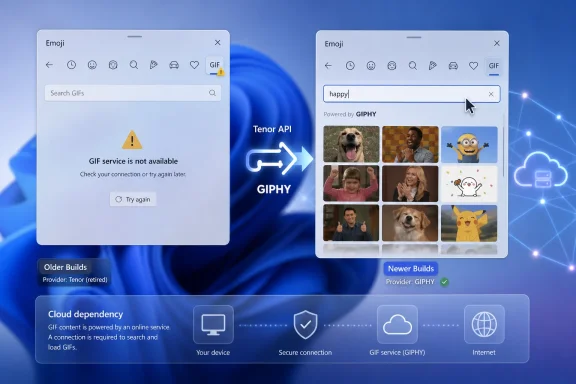
Microsoft confirmed that GIF search in the Windows 11 emoji panel broke because Google deprecated the Tenor API on June 30, 2026, and Microsoft’s June 23 KB5095093 preview update switches Windows 11 version 24H2 and 25H2 systems to GIPHY instead. The fix is mundane, but the lesson is not. A tiny feature buried behind Win + period has exposed a modern Windows truth: even the operating system’s smallest conveniences now depend on live cloud services, third-party APIs, and update timing that users rarely see until something fails.
That distinction matters because users experienced the outage as a Windows problem. Press Win + period, click GIFs, and the panel returns “GIF service is not available.” From the user’s chair, that is Windows failing to do Windows things.
Microsoft’s explanation reframes the breakage as dependency failure. Tenor’s API retirement cut off the backend Windows had been using, so the panel could no longer retrieve content. Microsoft’s fix was not to repair Tenor access but to replace the provider, moving the feature to GIPHY through KB5095093.
This is a small incident, but it is a useful one because it strips away the abstraction. Windows 11 is not merely an operating system with online features bolted on. It is increasingly a shell that routes everyday interactions through service contracts, cloud endpoints, identity layers, and content providers.
That pipeline is both Microsoft’s strength and its bottleneck. Once Redmond decided to move from Tenor to GIPHY, it could distribute the change broadly through a cumulative update. But the dependency break still landed on machines that had not yet received or installed the update.
The practical effect is that even frivolous features now have servicing implications. A GIF search outage is not a security incident, but it trains administrators to ask familiar questions: Which builds are affected? Is the fix optional or mandatory? Does the preview update introduce other regressions? Can users wait until Patch Tuesday?
KB5095093 applies to Windows 11 version 24H2 and 25H2, with OS builds 26100.8737 and 26200.8737. Neowin also reports that 26H1 systems are affected in the broader transition, which tracks with Microsoft’s recent Insider messaging around the same GIPHY change. The immediate production support article, however, names 24H2 and 25H2 as the supported release targets for the KB.
There may be good engineering reasons for that. The emoji panel integration may include client-side assumptions about API shape, authentication, query parameters, result formatting, content handling, or policy behavior. A provider swap can look simple in a support note while requiring client code changes under the hood.
Still, this reinforces the uneasy bargain of Windows 11’s continuous update model. Microsoft has spent years trying to make Windows feel more modular, more serviceable, and less dependent on monolithic OS releases. Yet here is a content-provider change for GIFs arriving in a cumulative update alongside File Explorer fixes, Bluetooth improvements, accessibility additions, networking changes, and recovery features.
That bundling is efficient from Microsoft’s perspective. It is also why administrators hesitate over optional preview releases. The same package that restores reaction GIFs may also touch shell reliability, printer defaults, VPN behavior, audio paths, and known Office automation interactions.
That creates a familiar Windows servicing tension. If users want GIFs back immediately, they need the preview update. If administrators prefer to avoid preview updates, they can wait for the changes to roll into a later security release, assuming business impact is low.
For a GIF panel, waiting is probably fine. But the same package also fixes a disk-space issue involving CapabilityAccessManager.db-wal, addresses a Recycle Bin naming problem, improves notification badges, and includes a long list of shell, Bluetooth, networking, accessibility, File Explorer, WSL, and performance changes. The update is not merely cosmetic.
The preview label therefore understates how these releases function in practice. They are increasingly Microsoft’s first broad landing zone for user-visible fixes, with security Patch Tuesday acting as the later consolidation point. That rhythm works if organizations have rings, telemetry, rollback plans, and test devices. It works less well for users who only know that part of Windows stopped working and the fix is hiding behind “optional.”
That makes this less a surprise outage than a coordination story. Microsoft had a replacement ready before the cutoff, shipping KB5095093 on June 23, one week before the June 30 break. But Windows’ installed base is not a single machine; it is hundreds of millions of systems with different update policies, maintenance windows, metered connections, paused updates, corporate controls, and user habits.
The result is a patch that beats the deadline on paper while many machines still encounter the failure in reality. That is the gap between software release and software arrival. Windows Update can distribute a fix, but it cannot guarantee that every eligible device has crossed the bridge before the old dependency burns.
This is where Microsoft’s cloud-era Windows sometimes collides with the PC’s offline heritage. Users expect the OS to keep working until they choose to change it. Cloud services expect clients to keep up with evolving APIs, certificates, tokens, terms, and endpoints.
But provider choice has consequences. GIF search is not a neutral database lookup. Tenor and GIPHY have different libraries, ranking systems, moderation policies, regional availability, content partnerships, and cultural gravity. Users who rely on one service’s results may find that another service feels subtly wrong.
That matters less for Windows than it does for messaging platforms, but the emoji panel is part of the operating system’s input surface. It appears wherever text input exists. It is not “just an app” in the way a standalone GIF keyboard is an app.
There is also a governance angle. When Windows integrates outside content services, Microsoft inherits some responsibility for the user experience while lacking full control over the underlying catalog. If GIPHY changes its API, business model, moderation rules, or availability, Microsoft may again need to adjust the Windows client.
The headline feature for many administrators will be point-in-time restore, a recovery mechanism intended to roll a PC back to a recent automatic restore point including apps, settings, and personal files. That is Microsoft trying to make Windows recovery less catastrophic and more routine, especially as PCs become more complex and update cadence remains relentless.
The update also adds a more flexible Windows Update pause interface, letting users choose an end date up to 35 days out. That is a small but overdue concession to the reality that update control is often about calendars, not abstract pause buttons. People want to avoid installing changes before a trip, a deadline, a payroll run, or a deployment freeze.
There are also quieter changes with long-term implications. New printer installations can default to Internet Printing Protocol when supported, part of Microsoft’s broader move away from legacy third-party printer drivers. Accessibility gains include screen tint and Magnifier refinements. Bluetooth changes address mute-state synchronization, reconnection behavior, and audio reliability.
The GIF fix is the most amusing line item. It is not the most important one.
A normal user does not think in terms of C releases, B releases, gradual rollout, normal rollout, or cumulative package composition. They see an error message. They open Settings. They may or may not install an optional preview update depending on whether Windows makes it visible, whether they trust it, and whether their machine is managed.
Administrators, meanwhile, see optional previews as early access to next month’s payload. That can be useful, but it also means accepting known issues earlier. KB5095093 carries a known issue involving some third-party applications that use OLE automation to launch Office apps or open documents after Windows updates released on or after June 9, 2026.
That known issue is not theoretical for accounting firms, dental practices, research workflows, document-management shops, and other environments where line-of-business software launches Office behind the scenes. Microsoft lists affected categories and says a resolution is in progress, with workarounds involving opening files directly or contacting Microsoft Support for business for organizational mitigation.
So the admin calculus is not “GIFs versus no GIFs.” It is “Do we want the cumulative payload now, knowing what else it touches, or do we wait for broader validation?”
A better failure mode would tell users that GIF search requires a Windows update because the underlying GIF provider changed. That is a delicate UX problem; Microsoft does not want to turn every small panel into a servicing bulletin. But the present message funnels users toward confusion, search engines, and forum threads.
This is not unique to Windows. Modern software often hides dependencies until they break. Authentication errors, expired certificates, retired APIs, regional outages, and throttled services all surface as vague application failures. The client says something is unavailable because the client often cannot explain the business or infrastructure reason behind it.
Still, Windows carries a heavier burden because it is the platform underneath everything else. When a shell feature fails, users do not mentally assign blame to Google’s Tenor API lifecycle. They assign it to Microsoft, because Microsoft put the button there.
That may be unfair, but it is also the price of integration. If Windows ships the front end, Windows owns the user’s trust.
But low-stakes failures are often the clearest demonstrations of high-stakes architecture. This incident shows how a Windows shell feature can depend on an external API, how a vendor deadline can create a visible break, how the fix can arrive through an optional cumulative update, and how users stuck behind update delay encounter the outage anyway.
That is the same pattern administrators worry about in more serious contexts. Cloud-dependent features are only as resilient as their contracts, fallbacks, telemetry, and update channels. When dependencies move, the endpoint has to move with them.
The right lesson is not that Microsoft should avoid third-party services entirely. That is unrealistic. The lesson is that Windows needs clearer dependency management, better degradation, and more transparent communication when cloud-backed shell features stop behaving like local OS components.
The new detail is that Windows 11 26H1 is covered by a separate June 23 preview update, KB5095091, while 24H2 and 25H2 use KB5095093. Systems that installed the relevant preview update before June 30 should have moved to GIPHY without seeing the break.
Ghacks also reports that the fix is expected to roll into the July 2026 Patch Tuesday cumulative update, giving cautious users and managed environments a standard servicing path if they skipped the optional preview release. For admins, that means the immediate workaround remains installing the June preview update, but broader deployment can wait for the regular July cumulative update if GIF search is not business-critical.
The Emoji Panel Was a Cloud Client All Along
The Windows emoji panel looks like local furniture. It appears instantly, lives beside symbols and clipboard history, and feels like the sort of thing an operating system should own outright. But the GIF tab was never just a bundle of animations sitting somewhere in System32; it was a front end to Tenor, Google’s GIF service.That distinction matters because users experienced the outage as a Windows problem. Press Win + period, click GIFs, and the panel returns “GIF service is not available.” From the user’s chair, that is Windows failing to do Windows things.
Microsoft’s explanation reframes the breakage as dependency failure. Tenor’s API retirement cut off the backend Windows had been using, so the panel could no longer retrieve content. Microsoft’s fix was not to repair Tenor access but to replace the provider, moving the feature to GIPHY through KB5095093.
This is a small incident, but it is a useful one because it strips away the abstraction. Windows 11 is not merely an operating system with online features bolted on. It is increasingly a shell that routes everyday interactions through service contracts, cloud endpoints, identity layers, and content providers.
A Small Failure With an Enterprise-Shaped Shadow
For home users, the fix is easy enough: install the latest Windows update and GIFs return. For IT pros, the incident reads differently. A consumer-facing feature broke on a deadline set outside Microsoft, and the repair arrived through the Windows servicing pipeline.That pipeline is both Microsoft’s strength and its bottleneck. Once Redmond decided to move from Tenor to GIPHY, it could distribute the change broadly through a cumulative update. But the dependency break still landed on machines that had not yet received or installed the update.
The practical effect is that even frivolous features now have servicing implications. A GIF search outage is not a security incident, but it trains administrators to ask familiar questions: Which builds are affected? Is the fix optional or mandatory? Does the preview update introduce other regressions? Can users wait until Patch Tuesday?
KB5095093 applies to Windows 11 version 24H2 and 25H2, with OS builds 26100.8737 and 26200.8737. Neowin also reports that 26H1 systems are affected in the broader transition, which tracks with Microsoft’s recent Insider messaging around the same GIPHY change. The immediate production support article, however, names 24H2 and 25H2 as the supported release targets for the KB.
Microsoft Picked the Servicing Train, Not a Silent Switch
The interesting choice is not GIPHY itself. It is Microsoft’s decision to ship the provider change as a Windows update rather than quietly flipping a server-side configuration.There may be good engineering reasons for that. The emoji panel integration may include client-side assumptions about API shape, authentication, query parameters, result formatting, content handling, or policy behavior. A provider swap can look simple in a support note while requiring client code changes under the hood.
Still, this reinforces the uneasy bargain of Windows 11’s continuous update model. Microsoft has spent years trying to make Windows feel more modular, more serviceable, and less dependent on monolithic OS releases. Yet here is a content-provider change for GIFs arriving in a cumulative update alongside File Explorer fixes, Bluetooth improvements, accessibility additions, networking changes, and recovery features.
That bundling is efficient from Microsoft’s perspective. It is also why administrators hesitate over optional preview releases. The same package that restores reaction GIFs may also touch shell reliability, printer defaults, VPN behavior, audio paths, and known Office automation interactions.
The Optional Preview Update Is Doing Mandatory Work
KB5095093 is a preview update, which means it is not the monthly security release most conservative environments automatically approve. Microsoft’s own documentation positions it as a non-security update with production-quality improvements, distributed through optional update channels and available through the Microsoft Update Catalog and WSUS import.That creates a familiar Windows servicing tension. If users want GIFs back immediately, they need the preview update. If administrators prefer to avoid preview updates, they can wait for the changes to roll into a later security release, assuming business impact is low.
For a GIF panel, waiting is probably fine. But the same package also fixes a disk-space issue involving CapabilityAccessManager.db-wal, addresses a Recycle Bin naming problem, improves notification badges, and includes a long list of shell, Bluetooth, networking, accessibility, File Explorer, WSL, and performance changes. The update is not merely cosmetic.
The preview label therefore understates how these releases function in practice. They are increasingly Microsoft’s first broad landing zone for user-visible fixes, with security Patch Tuesday acting as the later consolidation point. That rhythm works if organizations have rings, telemetry, rollback plans, and test devices. It works less well for users who only know that part of Windows stopped working and the fix is hiding behind “optional.”
Tenor’s Disappearance Was Predictable, But Still Revealing
The Tenor API deprecation was not a lightning strike. Google’s GIF service had been moving away from older API access, and developers had time to transition. Microsoft’s update even states that starting June 30, users need the latest Windows update to keep using GIFs in the emoji panel.That makes this less a surprise outage than a coordination story. Microsoft had a replacement ready before the cutoff, shipping KB5095093 on June 23, one week before the June 30 break. But Windows’ installed base is not a single machine; it is hundreds of millions of systems with different update policies, maintenance windows, metered connections, paused updates, corporate controls, and user habits.
The result is a patch that beats the deadline on paper while many machines still encounter the failure in reality. That is the gap between software release and software arrival. Windows Update can distribute a fix, but it cannot guarantee that every eligible device has crossed the bridge before the old dependency burns.
This is where Microsoft’s cloud-era Windows sometimes collides with the PC’s offline heritage. Users expect the OS to keep working until they choose to change it. Cloud services expect clients to keep up with evolving APIs, certificates, tokens, terms, and endpoints.
GIPHY Solves the Outage, Not the Dependency Problem
Switching to GIPHY restores the feature, but it does not make the feature independent. It simply replaces one dependency with another. That is not necessarily bad; outsourcing GIF search to a specialist service is more realistic than expecting Microsoft to curate and host a global GIF index itself.But provider choice has consequences. GIF search is not a neutral database lookup. Tenor and GIPHY have different libraries, ranking systems, moderation policies, regional availability, content partnerships, and cultural gravity. Users who rely on one service’s results may find that another service feels subtly wrong.
That matters less for Windows than it does for messaging platforms, but the emoji panel is part of the operating system’s input surface. It appears wherever text input exists. It is not “just an app” in the way a standalone GIF keyboard is an app.
There is also a governance angle. When Windows integrates outside content services, Microsoft inherits some responsibility for the user experience while lacking full control over the underlying catalog. If GIPHY changes its API, business model, moderation rules, or availability, Microsoft may again need to adjust the Windows client.
The Fix Lives in the Same Package as Bigger Windows Bets
KB5095093 is not a narrow GIF hotfix. It is a sprawling preview release that says a great deal about where Windows 11 is heading.The headline feature for many administrators will be point-in-time restore, a recovery mechanism intended to roll a PC back to a recent automatic restore point including apps, settings, and personal files. That is Microsoft trying to make Windows recovery less catastrophic and more routine, especially as PCs become more complex and update cadence remains relentless.
The update also adds a more flexible Windows Update pause interface, letting users choose an end date up to 35 days out. That is a small but overdue concession to the reality that update control is often about calendars, not abstract pause buttons. People want to avoid installing changes before a trip, a deadline, a payroll run, or a deployment freeze.
There are also quieter changes with long-term implications. New printer installations can default to Internet Printing Protocol when supported, part of Microsoft’s broader move away from legacy third-party printer drivers. Accessibility gains include screen tint and Magnifier refinements. Bluetooth changes address mute-state synchronization, reconnection behavior, and audio reliability.
The GIF fix is the most amusing line item. It is not the most important one.
Preview Updates Are Becoming the Real Changelog
Microsoft’s monthly servicing model now asks users to understand a subtle distinction: security updates are mandatory for protection, but preview updates increasingly contain the fixes and feature work people actually notice. That is a difficult message to communicate outside IT circles.A normal user does not think in terms of C releases, B releases, gradual rollout, normal rollout, or cumulative package composition. They see an error message. They open Settings. They may or may not install an optional preview update depending on whether Windows makes it visible, whether they trust it, and whether their machine is managed.
Administrators, meanwhile, see optional previews as early access to next month’s payload. That can be useful, but it also means accepting known issues earlier. KB5095093 carries a known issue involving some third-party applications that use OLE automation to launch Office apps or open documents after Windows updates released on or after June 9, 2026.
That known issue is not theoretical for accounting firms, dental practices, research workflows, document-management shops, and other environments where line-of-business software launches Office behind the scenes. Microsoft lists affected categories and says a resolution is in progress, with workarounds involving opening files directly or contacting Microsoft Support for business for organizational mitigation.
So the admin calculus is not “GIFs versus no GIFs.” It is “Do we want the cumulative payload now, knowing what else it touches, or do we wait for broader validation?”
The Error Message Told the Truth, But Not Enough of It
“GIF service is not available” is accurate. It is also the kind of message that leaves users with no useful next step.A better failure mode would tell users that GIF search requires a Windows update because the underlying GIF provider changed. That is a delicate UX problem; Microsoft does not want to turn every small panel into a servicing bulletin. But the present message funnels users toward confusion, search engines, and forum threads.
This is not unique to Windows. Modern software often hides dependencies until they break. Authentication errors, expired certificates, retired APIs, regional outages, and throttled services all surface as vague application failures. The client says something is unavailable because the client often cannot explain the business or infrastructure reason behind it.
Still, Windows carries a heavier burden because it is the platform underneath everything else. When a shell feature fails, users do not mentally assign blame to Google’s Tenor API lifecycle. They assign it to Microsoft, because Microsoft put the button there.
That may be unfair, but it is also the price of integration. If Windows ships the front end, Windows owns the user’s trust.
The Consumer Feature That Teaches an Admin Lesson
There is a temptation to dismiss this entire episode as fluff. GIFs in an emoji panel are not BitLocker, Defender, SMB, Hyper-V, or Entra ID. Nobody’s compliance posture should depend on a perfect reaction image.But low-stakes failures are often the clearest demonstrations of high-stakes architecture. This incident shows how a Windows shell feature can depend on an external API, how a vendor deadline can create a visible break, how the fix can arrive through an optional cumulative update, and how users stuck behind update delay encounter the outage anyway.
That is the same pattern administrators worry about in more serious contexts. Cloud-dependent features are only as resilient as their contracts, fallbacks, telemetry, and update channels. When dependencies move, the endpoint has to move with them.
The right lesson is not that Microsoft should avoid third-party services entirely. That is unrealistic. The lesson is that Windows needs clearer dependency management, better degradation, and more transparent communication when cloud-backed shell features stop behaving like local OS components.
The June 23 Patch Is Bigger Than Its Funniest Bug
For users and administrators deciding what to do with KB5095093, the GIF fix is the hook, not the whole story. The package is a preview update, but it carries enough substantive change that it deserves the same staged evaluation as any other cumulative Windows release.- Installing KB5095093 restores GIF search in the Windows 11 emoji panel by moving the provider from Tenor to GIPHY.
- Machines that do not receive the update can show a “GIF service is not available” message after the June 30, 2026 Tenor API cutoff.
- The documented production targets for the update are Windows 11 version 24H2 and 25H2, with OS builds 26100.8737 and 26200.8737.
- The update also includes point-in-time restore, Windows Update pause changes, accessibility improvements, File Explorer fixes, Bluetooth work, networking updates, and storage-related fixes.
- Organizations should weigh the preview update’s benefits against its known Office automation issue before broad deployment.
- The incident is a reminder that even small Windows experiences can depend on external services that change on someone else’s calendar.
Update: Microsoft release health notice adds 26H1 and July Patch Tuesday rollout (July 4, 2026)
Microsoft’s Windows release health dashboard now confirms the GIF outage applies to Windows 11 versions 24H2, 25H2, and 26H1, expanding the official scope beyond the KB5095093 support article’s 24H2 and 25H2 wording. The notice says devices that do not update after the June 30 Tenor API retirement will continue to see “GIF service is not available” in the emoji panel.The new detail is that Windows 11 26H1 is covered by a separate June 23 preview update, KB5095091, while 24H2 and 25H2 use KB5095093. Systems that installed the relevant preview update before June 30 should have moved to GIPHY without seeing the break.
Ghacks also reports that the fix is expected to roll into the July 2026 Patch Tuesday cumulative update, giving cautious users and managed environments a standard servicing path if they skipped the optional preview release. For admins, that means the immediate workaround remains installing the June preview update, but broader deployment can wait for the regular July cumulative update if GIF search is not business-critical.
References
- Primary source: Neowin
Published: Wed, 01 Jul 2026 09:46:00 GMT
Microsoft explains why GIFs stopped working in Windows 11 emoji panel, and how to fix it - Neowin
Have you noticed that GIFs recently stopped working in Windows 11? Microsoft explains why that happened and how to fix it. www.neowin.net
- Official source: support.microsoft.com
- Related coverage: ntcompatible.com
Windows 11 June 2026 Update KB5095093 Preview: Point-in-Time Restore, Widget Tweaks, and GIF Fix
Microsoft’s June 2026 cumulative update for Windows 11, KB5095093, delivers production-quality fixes alongside a flexible point-in-time system restore feature.www.ntcompatible.com - Related coverage: seniorplanet.org

Last edited: