

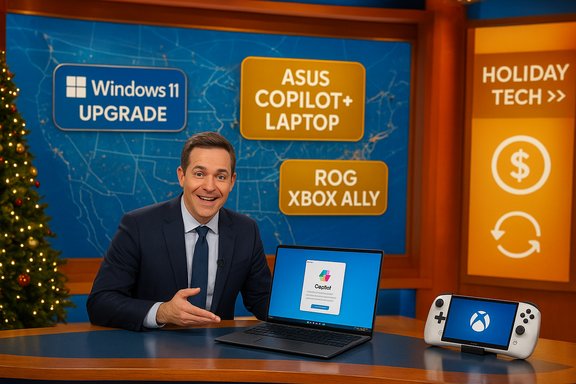
Marc Saltzman’s “Tech It Out” holiday push with News Media Group and ASUS deploys a classic broadcast playbook — a nationwide Satellite Media Tour (SMT) of short, local TV segments — to promote Windows 11 upgrades, ASUS Copilot+ laptops, and the new ROG Xbox Ally handhelds as top holiday tech gifts for 2025, a timely message anchored to Microsoft’s formal end‑of‑support deadline for Windows 10.
Marc Saltzman has long run Tech It Out as a syndicated consumer tech segment on radio and local TV, and for the 2025 holiday season he partnered with News Media Group, Inc. and ASUS to place short, sponsor‑backed gift‑guide segments on dozens of local morning and lifestyle shows across the U.S. The segments distill complex product claims into broadcast‑friendly demos and runbooks designed to convert viewership into holiday purchases.
The SMT’s creative framing is built on three concrete pillars: (1) a security and lifecycle urgency — upgrade Windows 10 systems to Windows 11 now that official support has ended; (2) buy AI‑capable, Copilot+‑ready PCs that include on‑device NPUs and Copilot integrations; and (3) consider new form factors — notably the ROG Xbox Ally handheld family for gamers and docked entertainment. Those three bullets are the explicit narrative Saltzman carries into local morning segments and syndicated radio inserts.
This campaign leverages a national vendor message through a local distribution model: stations receive short turnkey segments (2–4 minutes) that are labeled as paid content but are still consumed alongside editorial programming by millions of viewers. Local affiliates such as KTNV and WCPO have already run Saltzman’s sponsored Tech It Out spots, highlighting specific ASUS SKUs and general buying guidance.
Source: StreetInsider Tech Expert Marc Saltzman and News Media Group, Inc. Partnered with ASUS for a “Tech it Out” Holiday Gifts 2025 Nationwide Satellite Media Tour (SMT)
 Background / Overview
Marc Saltzman has long run Tech It Out as a syndicated consumer tech segment on radio and local TV, and for the 2025 holiday season he partnered with News Media Group, Inc. and ASUS to place short, sponsor‑backed gift‑guide segments on dozens of local morning and lifestyle shows across the U.S. The segments distill complex product claims into broadcast‑friendly demos and runbooks designed to convert viewership into holiday purchases.The SMT’s creative framing is built on three concrete pillars: (1) a security and lifecycle urgency — upgrade Windows 10 systems to Windows 11 now that official support has ended; (2) buy AI‑capable, Copilot+‑ready PCs that include on‑device NPUs and Copilot integrations; and (3) consider new form factors — notably the ROG Xbox Ally handheld family for gamers and docked entertainment. Those three bullets are the explicit narrative Saltzman carries into local morning segments and syndicated radio inserts.
This campaign leverages a national vendor message through a local distribution model: stations receive short turnkey segments (2–4 minutes) that are labeled as paid content but are still consumed alongside editorial programming by millions of viewers. Local affiliates such as KTNV and WCPO have already run Saltzman’s sponsored Tech It Out spots, highlighting specific ASUS SKUs and general buying guidance.
Why this matters now: the platform deadline and the AI moment
Microsoft formally ended mainstream support for Windows 10 on October 14, 2025. After that date Microsoft stopped issuing routine security updates and feature support for Windows 10, and the company recommends moving eligible machines to Windows 11 or signing up for a short Extended Security Updates (ESU) bridge where available. That platform deadline gives the SMT a defensible, time‑sensitive hook: there is a real security and feature‑access rationale for many users to consider a new PC or a verified upgrade. At the same time, OEMs are positioning 2025 models as “Copilot+” PCs — systems certified or marketed to deliver on‑device AI acceleration, often via integrated or discrete NPUs, Intel/AMD AI silicon, or Snapdragon X‑class processors. ASUS’s 2025 product messaging explicitly emphasizes Copilot+ readiness across Zenbook, Vivobook, and select ROG devices and quotes concrete NPU figures (TOPS) for marketing separation between tiers. The SMT stitches platform lifecycle messaging to these hardware claims to create a short, actionable shopping list for mainstream holiday buyers.What the SMT promotes — product and message breakdown
1) Windows 11 as the secure baseline
Saltzman’s on‑air advice stresses that running an unsupported OS increases exposure to unpatched vulnerabilities and chip‑level mitigations present in Windows 11 (TPM 2.0, Secure Boot, VBS options). For viewers on older machines, the segment recommends using Microsoft’s PC Health Check to confirm upgrade eligibility or planning a purchase of a Windows 11‑capable device. The “upgrade or replace” advice is practical and maps to Microsoft’s public guidance.2) Copilot+ and NPU‑forward laptops
ASUS has expanded its Copilot+ portfolio — Zenbook, Vivobook, and some Expert/Business lines — across multiple silicon families (Intel Core Ultra Series 2, AMD Ryzen AI series, Snapdragon X Elite/X processors). The vendor explicitly calls out NPU figures (dozens of TOPS on select SKUs), Copilot shortcut keys, and AI‑enhanced features (on‑device transcription, AutoSR upscaling, live captions, and camera enhancements) in product press materials. Saltzman’s segments highlight the UX benefits consumers can expect today and tomorrow while noting that some Copilot+ experiences will improve as OS and app updates roll out.3) New form factors: ROG Xbox Ally handhelds
ASUS and Microsoft have repositioned handheld Windows gaming machines as a mainstream holiday play. The ROG Xbox Ally family (standard Ally and Ally X) is promoted in SMT segments as a holiday‑friendly gift for gamers wanting a portable Xbox/Game Pass experience with Windows 11, higher refresh rates, and AI‑assisted features such as AutoSR and highlight capture. Reviews and tech press confirm the announced specs and staggered launch dates for these handhelds.Technical verification — what’s provable and what to watch for
The most important assertions the SMT makes are testable: the Windows 10 EoS date, the presence of NPUs and Copilot+ badges on ASUS SKUs, and the ROG Ally technical specs (CPU family, RAM, battery, display). Each is verifiable on vendor pages, platform support notices, or independent hands‑on reviews.- Windows 10 end of support on October 14, 2025 is Microsoft’s official position and appears in multiple Microsoft support notices and KB articles. That date is the canonical reason for urgency in Saltzman’s segments.
- ASUS’s Copilot+ expansion (Zenbook, Vivobook, and Snapdragon X models) and NPU TOPS claims appear in the company’s CES 2025 and product press materials. ASUS lists TOPS numbers (for example up to ~48 TOPS on selected Zenbook SKUs) and markets specific Copilot+ features across product pages. Those marketing specs are supported by OEM documentation, but real‑world AI usefulness depends on software implementation and timing of Microsoft/third‑party updates.
- ROG Xbox Ally hardware claims (AMD Z2 family processors, 16–24GB LPDDR memory, 7‑inch 120Hz FHD displays, 60–80Wh battery options) are published in ASUS/Xbox press materials and corroborated by trade press previews and reviews. Early hands‑on articles flag ergonomy, heat, and battery life as variables that depend on title and configuration.
Independent testing and early reviews — practical performance signals
Independent reviews of ASUS Copilot+ SKUs (example: Vivobook 14 Flip) validate several vendor claims while adding nuance. Reviewers confirm on‑device NPUs and quoted TOPS figures in real hardware, praise display and battery characteristics on specific SKUs, but also note that many Copilot+ features are still rolling out via Windows updates and OEM software. Battery life, thermal management, and the practical availability of AI features vary by SKU and region. These reviews are critical to closing the gap between marketed capability and measured behavior. Early hands‑on coverage of the ROG Xbox Ally family confirms AMD Z2‑class silicon, LPDDR5X memory tiers, and the docking/docked performance story ASUS sells — but reviewers consistently call out measured battery life and temperature under sustained gaming as items to test in real use for your titles. That’s particularly true for handhelds where ergonomics and battery runtime directly affect the gift experience.Strengths of the SMT strategy (what works for mainstream shoppers)
- Local reach, national message: SMTs put a concise, branded message in front of viewers while they’re already engaged with trusted local shows. That drives awareness among older and mainstream holiday buyers who still rely on morning TV and syndicated radio for purchase ideas.
- A defensible narrative: Linking recommendations to a concrete platform deadline (Windows 10 EoS) is a stronger consumer argument than generic “gifts” lists. It gives buyers an actionable reason to prioritize certain purchases now.
- Clear product tiers: The SMT pairs premium Copilot+ Zenbook models with more affordable Vivobook Copilot+ entries and a distinct gaming story (ROG Ally), giving viewers options across budgets and use cases. That helps the segment convert different holiday personas: gamers, students, creators, and mainstream users.
- Practical on‑air guidance: Saltzman’s segments reportedly include simple, usable steps — run PC Health Check, record exact SKU, back up data, and verify retailer return windows — which increases buyer confidence and reduces post‑purchase friction.
Risks and limitations — what the SMT may understate
- Sponsor bias and disclosure: SMT content is typically paid‑for and produced to favor a partner’s SKUs. Local stations often label segments as sponsored content, but viewers who watch clips or social versions may miss that caveat. Treat SMT picks as marketing plus expert commentary, not an independent buyer’s guide.
- SKU drift and configuration variance: Model family names (Zenbook S16, Vivobook 14 Flip, ROG Ally) hide many SKUs with different CPUs, NPUs, displays, RAM, and storage. The configuration shown in a demo may not match the SKU on sale or the one you receive as a gift. Always record the SKU string shown in the segment and verify the exact spec sheet before purchase.
- TOPS and marketing vs. real features: TOPS numbers are directional. They separate product tiers in marketing copy but won’t guarantee that your preferred Copilot+ feature (e.g., real‑time transcription, AutoSR upscaling) is fully supported or polished on day one. Confirm that the feature is implemented in the shipping software and that reviewers have tested it.
- Availability and regional pricing: SMT placements can imply broad availability, but stock and pricing often vary by retailer and region — particularly for new or premium SKUs like the Ally X. Check retailer pages and pre‑order windows before promising a gift or counting on holiday‑season stock.
- Long‑term update behavior: OEMs promise Copilot+ support and periodic driver/firmware updates, but long‑term follow‑through (driver cadence, OS tweaks, and feature enablement) will determine whether advertised AI capabilities remain available and improve over time. That’s a legitimate risk for buyers who expect quick gains from AI silicon alone. Treat Copilot+ as a two‑part play: hardware + evolving software.
A practical shopper’s checklist — use SMT segments as the starting point, not the finish line
Follow this numbered routine before you click buy or write that gift receipt:- Run Microsoft’s PC Health Check on an existing machine to confirm Windows 11 upgrade eligibility; if the current PC is ineligible, treat ESU as a short bridge, not a permanent fix.
- Record the exact SKU shown in the segment (example format: Zenbook S16 UM5606KA or ROG Xbox Ally RC73XA) and open the manufacturer’s official spec page to confirm CPU/APU, NPU TOPS, memory, panel type, SSD type, and battery capacity.
- Read one or two independent, hands‑on reviews for that exact SKU (not just the product family) to check measured battery life, thermal behavior, display quality, and feature availability for Copilot+ functions you care about.
- Validate retailer return windows, holiday price‑match protections, and extended warranty/accidental damage options (holiday returns spike and good protections reduce buyer’s remorse).
- For gamers: test or read docked performance and battery runtime for the titles your recipient plays; ergonomics and controller feel matter on handhelds more than on laptops.
- Backup everything before you upgrade an OS or hand a new device to someone; perform the Windows 11 upgrade only after confirming app compatibility and restoring a tested backup.
Retail timing and pricing — expectation management
SMTs create impressions of immediate availability; reality often lags. The ROG Ally family had staggered availability windows and regionally variant SKUs. Copilot+ laptops from ASUS span price points (entry Vivobooks around $699–$899, Zenbook A14 and premium S16 models at higher tiers), but exact pricing, regional SKUs, and accessory bundles vary by market and holiday promotions. Confirm price pages and pre‑order terms rather than assuming the segment’s sample unit equals what’s in the cart.Final analysis and recommendation
The Saltzman / News Media Group SMT with ASUS is an effective, well‑timed campaign that turns a credible platform milestone — Microsoft’s October 14, 2025 end of support for Windows 10 — into clear buying guidance for holiday shoppers. The combination of Windows lifecycle urgency, ASUS Copilot+ hardware claims, and the visible ROG handheld play gives mainstream audiences an actionable holiday shopping script: upgrade where necessary, favor Copilot+ SKUs when on‑device AI is a requirement, and evaluate handheld ergonomics for gaming gifts. However, the ultimate obligation rests with the buyer: SMT segments are promotional by design. Consumers should treat broadcast advice as inspiration, not a substitute for SKU‑level verification. Prioritize the simple, practical checks above — PC Health Check, SKU verification, independent hands‑on reviews, and clear retailer protections — and match the device to the recipient’s real workflows rather than to headline AI numbers alone. In short: use the SMT to narrow choices, then do the due diligence that turns a shiny holiday idea into a reliable, useful gift.Quick takeaways — smart holiday tech shopping (SEO‑friendly summary)
- Windows 10 support ended on October 14, 2025; plan an upgrade to Windows 11 or enroll in ESU as a bridge.
- ASUS’s 2025 Copilot+ lineup (Zenbook, Vivobook, Zenbook DUO) advertises NPUs and TOPS figures; treat TOPS as a directional performance metric and verify feature availability in hands‑on reviews.
- ROG Xbox Ally handhelds target gamers with portable Windows 11 experiences; check measured battery life and ergonomics for your favorite games before committing.
- Use SMT segments as a fast holiday tech gifts checklist, then confirm SKU numbers, warranty/return terms, and independent test results.
Source: StreetInsider Tech Expert Marc Saltzman and News Media Group, Inc. Partnered with ASUS for a “Tech it Out” Holiday Gifts 2025 Nationwide Satellite Media Tour (SMT)
