

A federal judge in San Francisco heard arguments on June 15, 2026, over whether California’s employment discrimination law can reach Workday’s AI-powered hiring tools when those tools are used by employers across the United States. The fight is not merely about one software vendor or one state statute. It is a test of whether algorithmic hiring systems can be treated as national infrastructure while still being judged by the civil-rights laws of the places where they are built, sold, configured, and allegedly used to screen people out. Workday wants the court to draw a jurisdictional line; the job seekers suing it want the court to recognize that AI hiring does not become legally weightless just because it runs through a cloud platform.
The Workday dispute has reached the point where the technical architecture and the legal geography are inseparable. Workday is not accused of being a single employer that rejected a single applicant from a single job. It is accused of supplying algorithmic screening and recommendation tools that customers allegedly used in hiring pipelines, with plaintiffs arguing those tools disadvantaged applicants on protected grounds including age, race, disability, and gender.
That distinction matters because the modern hiring stack is rarely owned end to end by the company whose logo appears on the job posting. Applicant tracking, ranking, skills matching, automated screening, sourcing, and recruiter dashboards are often stitched together from vendor products. The employer may make the final decision, but the software can shape who is seen, who is ranked, who is delayed, and who quietly disappears.
Workday’s argument, as described in reporting from the hearing, is that California’s Fair Employment and Housing Act should not become a nationwide regulator of AI hiring merely because Workday is a California-linked technology company or because some conduct is alleged to have touched California. Plaintiffs answered that they are not asking California to police the entire country in the abstract. They say they are trying to hold Workday responsible for what it did within California.
That is the jurisdictional hinge. If a vendor designs, sells, supports, or operates a hiring tool from California, and that tool allegedly produces discriminatory effects in hiring processes elsewhere, does California law stop at the state border? Or does the state have an interest in regulating the conduct of a company operating from within its own legal and commercial ecosystem?
For years, enterprise software companies have sold AI-adjacent hiring features under a careful rhetorical compromise. The vendor provides tools, insights, recommendations, automation, ranking, or workflow assistance. The customer remains the decision-maker. The product improves efficiency, but the employer owns the employment decision.
That distinction is commercially useful, but the Workday litigation has exposed how thin it can become. If a software system materially influences which applicants are surfaced or recommended, it is hard to maintain that the vendor is only selling a neutral filing cabinet. The more persuasive the sales pitch about AI-driven hiring efficiency, the harder it becomes to say the software has no real effect.
This is why the case has become bigger than Workday. A ruling that lets claims proceed against a vendor under an agency theory, or under a state-law theory with national implications, tells every AI hiring provider that contractual disclaimers will not necessarily keep civil-rights law outside the product boundary. The law may care less about who signs the rejection email than about who built and controlled the mechanism that made rejection more likely.
The AI hiring stack complicates that map. A candidate may apply through a branded employer portal powered by Workday or another vendor. Their resume may be parsed, normalized, scored, compared, ranked, or filtered before a human recruiter has meaningfully engaged with it. The applicant experiences the process as one opaque system, while the legal responsibilities may be split among employer, platform provider, data processor, integration partner, and model vendor.
That fragmentation is convenient for everyone except the applicant. The employer can point to vendor software. The vendor can point to customer configuration. The recruiter can point to workflow defaults. The model provider can point to training data and implementation choices. By the time responsibility is distributed across the stack, accountability risks dissolving into architecture.
The Workday case matters because it challenges that diffusion. Plaintiffs are effectively saying that a vendor cannot occupy the powerful middle of the hiring process and then retreat into the posture of a passive toolmaker when discrimination claims arrive. If the software is consequential enough to sell as decision support, it may be consequential enough to scrutinize as part of the decision.
That earlier decision was a warning shot to the broader industry. If an AI hiring platform participates in screening, ranking, or recommendation in a way that meaningfully affects access to employment opportunities, a court may look past the label on the contract. The question becomes functional: what did the tool do, who controlled it, and how did it affect protected groups?
Workday has denied that the lawsuit has merit, and the allegations have not been proven. That point is important, because high-profile AI cases can easily become morality plays before the evidence is tested. Still, the procedural posture itself is consequential. Surviving dismissal means plaintiffs get discovery, and discovery is where AI systems become less abstract.
That is the stage vendors fear most. Marketing materials, configuration documents, internal validation studies, customer communications, model limitations, bias testing, and audit trails can all become part of the factual record. The case is no longer about whether “AI hiring bias” sounds plausible. It is about what the vendor knew, what it measured, what it promised, and what happened to applicants.
That scale is precisely the problem. A cloud HR platform is not a local filing cabinet. It is a standardized system with configurable components, shared design choices, common user interfaces, centralized documentation, and product-wide analytics. The more uniform the platform, the stronger the business case for selling it nationally — and the more plausible it becomes that a legal defect could also scale nationally.
Workday’s position reflects a familiar fear among technology companies: if California can regulate conduct with national consequences, then the most aggressive state law may become the de facto national rule. That argument has force in many technology-policy fights, from privacy to content moderation to consumer protection. A patchwork of state rules can be costly, confusing, and sometimes contradictory.
But employment discrimination is not a normal product-compliance problem. A hiring tool does not merely affect business efficiency or user preference. It affects access to income, health insurance, career progression, visa sponsorship, and social mobility. When a system operates at national scale, a legal rule that follows the system’s operation may look less like overreach and more like the minimum price of automation.
Workday’s fear is understandable. If California’s FEHA can govern alleged discriminatory conduct tied to a vendor’s AI hiring tools across the country, other states may attempt similar moves. New York, Illinois, Colorado, and other jurisdictions have already shown interest in automated employment decision tools, bias audits, notice obligations, or AI governance. The result could be a legal environment where AI hiring vendors must design for the strictest plausible jurisdiction from the outset.
For HR technology companies, this is not just a litigation risk. It is a product management problem. The old compliance model treated the law as a customer-side obligation: the employer would decide how to use the software lawfully. The emerging model pushes compliance into the platform itself, requiring auditability, explainability, configuration controls, adverse-impact testing, and documentation that can survive discovery.
That shift will not be cheap. It may slow feature releases, complicate model updates, and force vendors to expose more about systems they would rather describe in glossy but nonspecific terms. But it is also the predictable outcome of selling software that participates in legally regulated decisions.
That perception matters because legitimacy is part of compliance. A hiring system can be technically lawful and still destroy trust if applicants believe they are being sorted by inscrutable machinery before a human being ever reads their qualifications. For older workers, disabled applicants, career switchers, people with nontraditional resumes, and candidates from underrepresented groups, that distrust is not paranoia. It is a rational response to systems that have historically encoded patterns of exclusion even when nobody intended to discriminate.
AI hiring tools intensify that concern because they can turn historical patterns into operational recommendations. If past hiring favored certain schools, titles, career paths, gaps, keywords, or work histories, a model trained or configured around those signals may reproduce those preferences under the cleaner language of matching and prediction. The result may not look like old-fashioned discrimination. It may look like “fit.”
This is why the Workday case has resonated beyond the legal press. It speaks to a suspicion many applicants already have: that the hiring process has become less human at precisely the moment when candidates are asked to reveal more data about themselves. The courts are now being asked whether that suspicion corresponds to legally actionable harm.
The employer still owns the employment relationship. It chooses the tool, configures workflows, sets job criteria, trains recruiters, reviews candidates, and decides how heavily to rely on recommendations. If the system disadvantages protected groups, the employer may face claims regardless of whether the vendor is also in the case.
That reality should change procurement. AI hiring features can no longer be evaluated only on recruiter productivity, time-to-fill, integration, and user experience. Buyers need to ask whether the vendor can produce credible evidence of validation, adverse-impact analysis, accessibility review, data governance, and change management. They also need to understand which features are actually enabled, which are optional, and which are merely branded as AI without making consequential decisions.
The hardest part is operational discipline. A vendor may provide controls, but customers still have to use them. A bias audit performed once before deployment is not enough if the model changes, the applicant pool shifts, the labor market moves, or recruiters configure new filters. Compliance has to become continuous because the system itself is continuous.
Sysadmins and IT security teams may not decide who gets hired, but they often control permissions, integrations, retention policies, logging, vendor access, SSO, API connections, and data exports. Those choices affect whether an organization can later explain what happened in a hiring process. If a plaintiff asks how a candidate was scored, who saw the recommendation, which fields were used, or when a configuration changed, the answer may depend on system logs and administrative hygiene.
This is where AI governance becomes painfully practical. It is not enough for an organization to announce that humans remain “in the loop.” The system should be able to show what the loop was. Who reviewed the candidate? What recommendation was displayed? Was the recommendation required, optional, hidden, overridden, or ignored? Were accessibility accommodations routed differently? Were rejection reasons captured in a way that can be audited?
Those are IT questions as much as HR questions. If the data is unavailable, overwritten, inconsistently logged, or locked inside a vendor black box, the organization may have a compliance problem even before anyone proves discrimination. In litigation, missing context can be nearly as damaging as bad context.
Courts are likely to care more about function than branding. A deterministic rules engine can discriminate. A statistical model can discriminate. A recruiter using a badly designed dashboard can discriminate. A keyword filter can discriminate if it screens out people based on proxies for protected characteristics. The question is not whether the system is impressive enough to satisfy a computer scientist’s definition of AI.
That is why Workday’s case is a warning for the entire HR technology category, not just vendors selling generative AI features. The legal risk attaches to automated influence over employment opportunity. If software materially shapes access to jobs, it belongs inside the compliance perimeter.
This also means employers should not take comfort in disabling the flashiest AI features while leaving older automation untouched. Resume parsing, knockout questions, ranking scores, skills-matching tools, and workflow defaults can all have discriminatory effects. The lawsuit’s broader lesson is that the humble parts of the hiring stack may be just as important as the parts marketed as intelligent.
The serious question is evidentiary. What data was used? What outcome was measured? Which groups were affected? What alternatives were considered? Were the tools validated for the actual jobs and applicant pools where they were deployed? Did the vendor or employer test for adverse impact, and did they act on the results?
That is where many AI governance programs remain weak. Companies adopt policy language faster than they build measurement infrastructure. They say they use responsible AI, but they cannot always produce the audit trail that would make the claim meaningful. They say a human makes the final decision, but they cannot show whether humans routinely defer to the score.
The Workday litigation is valuable because it moves the conversation from ethics decks to litigation-grade facts. Courts do not care whether a company’s AI principles sound modern. They care whether the pleaded facts support liability, whether discovery reveals relevant evidence, and whether the law recognizes a path from the tool’s operation to the alleged harm.
The most immediate consequence would be leverage. Plaintiffs would have a stronger argument that state anti-discrimination law can reach platform conduct with nationwide effects. Vendors would face greater pressure to settle, disclose, or redesign. Employers would face more uncomfortable questions about whether their AI hiring vendors are exposing them to state-law claims they did not anticipate.
Longer term, the case could accelerate a split between vendors that treat compliance as a contractual appendix and vendors that treat it as a core product feature. The winners in enterprise HR software may not be the companies with the most aggressive AI branding. They may be the companies that can prove, in a deposition and not just a demo, how their systems behave.
That proof will require more than dashboards. It will require documented model governance, customer-specific configuration records, validated job-related criteria, bias testing that is actually tied to deployment, and transparent explanations of what the system does and does not decide. In other words, HR AI may become less magical and more bureaucratic. That would be an improvement.
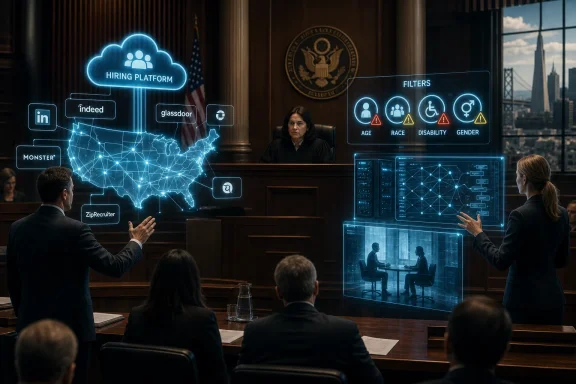 California Wants to Regulate the Machine Room, Not Just the Interview Room
The Workday dispute has reached the point where the technical architecture and the legal geography are inseparable. Workday is not accused of being a single employer that rejected a single applicant from a single job. It is accused of supplying algorithmic screening and recommendation tools that customers allegedly used in hiring pipelines, with plaintiffs arguing those tools disadvantaged applicants on protected grounds including age, race, disability, and gender.That distinction matters because the modern hiring stack is rarely owned end to end by the company whose logo appears on the job posting. Applicant tracking, ranking, skills matching, automated screening, sourcing, and recruiter dashboards are often stitched together from vendor products. The employer may make the final decision, but the software can shape who is seen, who is ranked, who is delayed, and who quietly disappears.
Workday’s argument, as described in reporting from the hearing, is that California’s Fair Employment and Housing Act should not become a nationwide regulator of AI hiring merely because Workday is a California-linked technology company or because some conduct is alleged to have touched California. Plaintiffs answered that they are not asking California to police the entire country in the abstract. They say they are trying to hold Workday responsible for what it did within California.
That is the jurisdictional hinge. If a vendor designs, sells, supports, or operates a hiring tool from California, and that tool allegedly produces discriminatory effects in hiring processes elsewhere, does California law stop at the state border? Or does the state have an interest in regulating the conduct of a company operating from within its own legal and commercial ecosystem?
Workday Is Fighting the Precedent as Much as the Plaintiffs
The immediate hearing followed a tentative ruling by US District Judge Rita Lin indicating that California’s anti-discrimination law may apply to the challenged conduct nationally. Tentative rulings are not final judgments, and Workday is entitled to argue the point before the court lands on a formal order. But even a tentative view of this kind is enough to alarm the HR software industry because it reframes the vendor’s role.For years, enterprise software companies have sold AI-adjacent hiring features under a careful rhetorical compromise. The vendor provides tools, insights, recommendations, automation, ranking, or workflow assistance. The customer remains the decision-maker. The product improves efficiency, but the employer owns the employment decision.
That distinction is commercially useful, but the Workday litigation has exposed how thin it can become. If a software system materially influences which applicants are surfaced or recommended, it is hard to maintain that the vendor is only selling a neutral filing cabinet. The more persuasive the sales pitch about AI-driven hiring efficiency, the harder it becomes to say the software has no real effect.
This is why the case has become bigger than Workday. A ruling that lets claims proceed against a vendor under an agency theory, or under a state-law theory with national implications, tells every AI hiring provider that contractual disclaimers will not necessarily keep civil-rights law outside the product boundary. The law may care less about who signs the rejection email than about who built and controlled the mechanism that made rejection more likely.
The AI Hiring Stack Has Outgrown the Old Liability Map
Traditional employment law was built around a simpler model. An employer posted a job, reviewed applications, interviewed candidates, and made a decision. Liability flowed naturally to the employer because the employer controlled the process and the workplace.The AI hiring stack complicates that map. A candidate may apply through a branded employer portal powered by Workday or another vendor. Their resume may be parsed, normalized, scored, compared, ranked, or filtered before a human recruiter has meaningfully engaged with it. The applicant experiences the process as one opaque system, while the legal responsibilities may be split among employer, platform provider, data processor, integration partner, and model vendor.
That fragmentation is convenient for everyone except the applicant. The employer can point to vendor software. The vendor can point to customer configuration. The recruiter can point to workflow defaults. The model provider can point to training data and implementation choices. By the time responsibility is distributed across the stack, accountability risks dissolving into architecture.
The Workday case matters because it challenges that diffusion. Plaintiffs are effectively saying that a vendor cannot occupy the powerful middle of the hiring process and then retreat into the posture of a passive toolmaker when discrimination claims arrive. If the software is consequential enough to sell as decision support, it may be consequential enough to scrutinize as part of the decision.
The Court Has Already Signaled That “Just Software” Is Not a Shield
The case did not begin with the June 2026 FEHA dispute. In July 2024, Judge Lin allowed key discrimination claims against Workday to move forward, finding that the plaintiffs had plausibly alleged that Workday could be treated as an agent of employers under federal anti-discrimination law. The court did not accept every theory against Workday, and the merits remain contested, but the ruling punctured the clean vendor-customer separation that software companies often rely on.That earlier decision was a warning shot to the broader industry. If an AI hiring platform participates in screening, ranking, or recommendation in a way that meaningfully affects access to employment opportunities, a court may look past the label on the contract. The question becomes functional: what did the tool do, who controlled it, and how did it affect protected groups?
Workday has denied that the lawsuit has merit, and the allegations have not been proven. That point is important, because high-profile AI cases can easily become morality plays before the evidence is tested. Still, the procedural posture itself is consequential. Surviving dismissal means plaintiffs get discovery, and discovery is where AI systems become less abstract.
That is the stage vendors fear most. Marketing materials, configuration documents, internal validation studies, customer communications, model limitations, bias testing, and audit trails can all become part of the factual record. The case is no longer about whether “AI hiring bias” sounds plausible. It is about what the vendor knew, what it measured, what it promised, and what happened to applicants.
A Nationwide Class Theory Turns Compliance Into Product Design
The June 2026 fight over California law raises a practical question that enterprise software vendors have tried to avoid: can a national SaaS product comply with civil-rights obligations state by state, customer by customer, and feature by feature? In theory, yes. In practice, AI hiring tools are often built for scale.That scale is precisely the problem. A cloud HR platform is not a local filing cabinet. It is a standardized system with configurable components, shared design choices, common user interfaces, centralized documentation, and product-wide analytics. The more uniform the platform, the stronger the business case for selling it nationally — and the more plausible it becomes that a legal defect could also scale nationally.
Workday’s position reflects a familiar fear among technology companies: if California can regulate conduct with national consequences, then the most aggressive state law may become the de facto national rule. That argument has force in many technology-policy fights, from privacy to content moderation to consumer protection. A patchwork of state rules can be costly, confusing, and sometimes contradictory.
But employment discrimination is not a normal product-compliance problem. A hiring tool does not merely affect business efficiency or user preference. It affects access to income, health insurance, career progression, visa sponsorship, and social mobility. When a system operates at national scale, a legal rule that follows the system’s operation may look less like overreach and more like the minimum price of automation.
The Vendor’s California Problem Is Also the Industry’s California Problem
California is not just another jurisdiction in this story. It is both a massive labor market and a technology production center. A large share of the software infrastructure used across the United States is designed, managed, funded, or governed through California-linked companies. That makes the state a natural battleground for rules that reach beyond physical workplaces.Workday’s fear is understandable. If California’s FEHA can govern alleged discriminatory conduct tied to a vendor’s AI hiring tools across the country, other states may attempt similar moves. New York, Illinois, Colorado, and other jurisdictions have already shown interest in automated employment decision tools, bias audits, notice obligations, or AI governance. The result could be a legal environment where AI hiring vendors must design for the strictest plausible jurisdiction from the outset.
For HR technology companies, this is not just a litigation risk. It is a product management problem. The old compliance model treated the law as a customer-side obligation: the employer would decide how to use the software lawfully. The emerging model pushes compliance into the platform itself, requiring auditability, explainability, configuration controls, adverse-impact testing, and documentation that can survive discovery.
That shift will not be cheap. It may slow feature releases, complicate model updates, and force vendors to expose more about systems they would rather describe in glossy but nonspecific terms. But it is also the predictable outcome of selling software that participates in legally regulated decisions.
Job Applicants Have Become Test Data With Rent Due
The public frustration around Workday and other applicant tracking systems is not hard to understand. Many job seekers experience modern hiring as a maze of duplicated accounts, resume uploads followed by manual re-entry, automated status emails, instant rejections, and silence. Whether or not AI is actually responsible in a particular case, the process often feels mechanical and unaccountable.That perception matters because legitimacy is part of compliance. A hiring system can be technically lawful and still destroy trust if applicants believe they are being sorted by inscrutable machinery before a human being ever reads their qualifications. For older workers, disabled applicants, career switchers, people with nontraditional resumes, and candidates from underrepresented groups, that distrust is not paranoia. It is a rational response to systems that have historically encoded patterns of exclusion even when nobody intended to discriminate.
AI hiring tools intensify that concern because they can turn historical patterns into operational recommendations. If past hiring favored certain schools, titles, career paths, gaps, keywords, or work histories, a model trained or configured around those signals may reproduce those preferences under the cleaner language of matching and prediction. The result may not look like old-fashioned discrimination. It may look like “fit.”
This is why the Workday case has resonated beyond the legal press. It speaks to a suspicion many applicants already have: that the hiring process has become less human at precisely the moment when candidates are asked to reveal more data about themselves. The courts are now being asked whether that suspicion corresponds to legally actionable harm.
Enterprise Buyers Can No Longer Outsource the Moral Math
For employers using AI hiring tools, the Workday litigation is not a spectator sport. Even if Workday ultimately narrows or defeats some claims, the direction of travel is clear. Employers cannot assume that buying from a major vendor solves the legal problem of automated screening.The employer still owns the employment relationship. It chooses the tool, configures workflows, sets job criteria, trains recruiters, reviews candidates, and decides how heavily to rely on recommendations. If the system disadvantages protected groups, the employer may face claims regardless of whether the vendor is also in the case.
That reality should change procurement. AI hiring features can no longer be evaluated only on recruiter productivity, time-to-fill, integration, and user experience. Buyers need to ask whether the vendor can produce credible evidence of validation, adverse-impact analysis, accessibility review, data governance, and change management. They also need to understand which features are actually enabled, which are optional, and which are merely branded as AI without making consequential decisions.
The hardest part is operational discipline. A vendor may provide controls, but customers still have to use them. A bias audit performed once before deployment is not enough if the model changes, the applicant pool shifts, the labor market moves, or recruiters configure new filters. Compliance has to become continuous because the system itself is continuous.
Sysadmins and Security Teams Are Now Part of the Hiring Risk Surface
For WindowsForum readers, the Workday case may seem at first like an HR-law story rather than an IT story. That would be a mistake. Modern HR platforms are identity systems, data stores, workflow engines, analytics products, integration hubs, and compliance repositories. The people who administer them are part of the control environment.Sysadmins and IT security teams may not decide who gets hired, but they often control permissions, integrations, retention policies, logging, vendor access, SSO, API connections, and data exports. Those choices affect whether an organization can later explain what happened in a hiring process. If a plaintiff asks how a candidate was scored, who saw the recommendation, which fields were used, or when a configuration changed, the answer may depend on system logs and administrative hygiene.
This is where AI governance becomes painfully practical. It is not enough for an organization to announce that humans remain “in the loop.” The system should be able to show what the loop was. Who reviewed the candidate? What recommendation was displayed? Was the recommendation required, optional, hidden, overridden, or ignored? Were accessibility accommodations routed differently? Were rejection reasons captured in a way that can be audited?
Those are IT questions as much as HR questions. If the data is unavailable, overwritten, inconsistently logged, or locked inside a vendor black box, the organization may have a compliance problem even before anyone proves discrimination. In litigation, missing context can be nearly as damaging as bad context.
The AI Label Is Less Important Than the Decision Function
One of the recurring problems in AI regulation is that everyone argues about the label. Is the system truly artificial intelligence? Is it machine learning? Is it rules-based automation? Is it a recommendation engine? Is it merely search, ranking, or matching?Courts are likely to care more about function than branding. A deterministic rules engine can discriminate. A statistical model can discriminate. A recruiter using a badly designed dashboard can discriminate. A keyword filter can discriminate if it screens out people based on proxies for protected characteristics. The question is not whether the system is impressive enough to satisfy a computer scientist’s definition of AI.
That is why Workday’s case is a warning for the entire HR technology category, not just vendors selling generative AI features. The legal risk attaches to automated influence over employment opportunity. If software materially shapes access to jobs, it belongs inside the compliance perimeter.
This also means employers should not take comfort in disabling the flashiest AI features while leaving older automation untouched. Resume parsing, knockout questions, ranking scores, skills-matching tools, and workflow defaults can all have discriminatory effects. The lawsuit’s broader lesson is that the humble parts of the hiring stack may be just as important as the parts marketed as intelligent.
The Coming Fight Is Over Evidence, Not Slogans
The public debate over AI hiring often gets stuck between two slogans. Vendors say automation reduces human bias and improves efficiency. Critics say AI encodes bias and makes discrimination harder to detect. Both claims can be true in different systems, and neither is enough to decide a lawsuit.The serious question is evidentiary. What data was used? What outcome was measured? Which groups were affected? What alternatives were considered? Were the tools validated for the actual jobs and applicant pools where they were deployed? Did the vendor or employer test for adverse impact, and did they act on the results?
That is where many AI governance programs remain weak. Companies adopt policy language faster than they build measurement infrastructure. They say they use responsible AI, but they cannot always produce the audit trail that would make the claim meaningful. They say a human makes the final decision, but they cannot show whether humans routinely defer to the score.
The Workday litigation is valuable because it moves the conversation from ethics decks to litigation-grade facts. Courts do not care whether a company’s AI principles sound modern. They care whether the pleaded facts support liability, whether discovery reveals relevant evidence, and whether the law recognizes a path from the tool’s operation to the alleged harm.
A Single California Ruling Could Redraw the SaaS Compliance Map
If Judge Lin ultimately embraces the tentative view that FEHA can apply to Workday’s challenged conduct beyond California job postings or California applicants, the ruling will not instantly settle the national question. Workday could seek further review, and other courts may disagree. But it would still become a major reference point for plaintiffs, regulators, vendors, and enterprise buyers.The most immediate consequence would be leverage. Plaintiffs would have a stronger argument that state anti-discrimination law can reach platform conduct with nationwide effects. Vendors would face greater pressure to settle, disclose, or redesign. Employers would face more uncomfortable questions about whether their AI hiring vendors are exposing them to state-law claims they did not anticipate.
Longer term, the case could accelerate a split between vendors that treat compliance as a contractual appendix and vendors that treat it as a core product feature. The winners in enterprise HR software may not be the companies with the most aggressive AI branding. They may be the companies that can prove, in a deposition and not just a demo, how their systems behave.
That proof will require more than dashboards. It will require documented model governance, customer-specific configuration records, validated job-related criteria, bias testing that is actually tied to deployment, and transparent explanations of what the system does and does not decide. In other words, HR AI may become less magical and more bureaucratic. That would be an improvement.
The Hiring Algorithm Now Has a Court Date
The concrete lessons from the Workday fight are already visible, even before the court’s next formal ruling. This is not a final merits decision, and it does not prove that Workday’s tools discriminated against anyone. But it shows how quickly AI hiring has moved from vendor promise to courtroom architecture.- California’s FEHA dispute is about whether a state civil-rights law can reach allegedly discriminatory AI hiring conduct tied to a major software vendor beyond California-specific jobs or applicants.
- Workday’s central defense is not only about whether discrimination occurred, but about whether California can regulate the nationwide use of its HR tools through this case.
- Plaintiffs are trying to keep the focus on Workday’s own alleged conduct, arguing that the company should answer for what it did from within California rather than hide behind the national footprint of its customers.
- Employers using AI hiring products should assume that vendor selection, configuration, logging, validation, and audit practices may all become discoverable facts.
- IT and security teams should treat HR AI systems as regulated decision infrastructure, not merely as SaaS applications with sensitive personal data.
- The next phase of AI hiring compliance will reward systems that can explain and document their influence over candidates, not systems that simply promise faster screening.
References
- Primary source: MLex
Published: Tue, 16 Jun 2026 00:23:00 GMT
Workday argues Calif. law can't regulate AI hiring tools nationwide | MLex | Specialist news and analysis on legal risk and regulation
Workday pushed back on a US judge's tentative ruling that a California employment and housing discrimination law governs use of the company's artificial intelligence-powered human resource tools across the US. Attorneys for job seekers countered during oral arguments that they were...www.mlex.com - Related coverage: hrdive.com
Lawsuit alleging Workday’s AI tools are discriminatory can move forward, court says | HR Dive
“Workday’s tools are engaged in conduct that is at the heart of equal access to employment opportunities,” Judge Rita Lin wrote in the decision.www.hrdive.com
- Related coverage: akingump.com
Court Allows Discrimination Claims Against AI Hiring Tool to Proceed | Mobley v. Workday, Inc. | Akin
Plaintiff filed a class action lawsuit alleging that Workday’s AI applicant screening process discriminated on the basis of race, age, and disability in violation of federal and state anti-discrimination laws. The court denied the plaintiffs’ argument that Workday was an “employment agency”...www.akingump.com - Related coverage: classactiondiscovery.com
Workday AI Hiring Bias Lawsuit | Current Status & Allegations | ClassActionDiscovery
A class action alleges Workday's AI hiring processes are discriminatory. Learn about the current status, allegations, and who may qualify.classactiondiscovery.com - Related coverage: responsibleailabs.ai
Mobley v. Workday AI Hiring Class Action | AI Incident Watch | Responsible AI Labs
Derek Mobley, a Black man over 40 with disabilities, applied to 100+ jobs via Workday's AI screening system and was rejected from every one, often in…responsibleailabs.ai - Related coverage: dwt.com
AI Screening Tools Under Scrutiny: Federal Court Preliminarily Certifies ADEA Collective Action | Davis Wright Tremaine
Preliminary certification in case alleging AI-assisted age discrimination in hiring decisions allows for court-approved notice to similarly situated iwww.dwt.com
- Related coverage: globallawtoday.com
AI in the Crosshairs: Workday Faces Landmark Hiring Discrimination Lawsuit - GLOBAL LAW TODAY
- In a case with potentially wide-reaching implications for artificial intelligence in employment practices, HR software giant Workday Inc. is facing a class-action lawsuit alleging its AI-powered hiring tools discriminated against job applicants based on race, age, and disability. Filed by...www.globallawtoday.com - Related coverage: bamlawca.com
Court Grants Conditional Certification in AI Bias Lawsuit Against Workday — Free Legal Advice | California Labor Laws | Employment Lawyers
A landmark AI discrimination lawsuit against Workday, Inc. is moving forward, with the court granting conditional certification for Age Discrimination in Employment Act (ADEA) claims on behalf of what could be one of the largest collectives ever certified. The case raises major questions about thewww.bamlawca.com
- Related coverage: blogs.duanemorris.com
California Federal Court Clarifies Limits On AI Bias Testing And Applicant Data Disclosure In Mobley v. Workday – Class Action Defense
By Gerald L. Maatman, Jr., Adam D. Brown, and Elizabeth G. Underwood Duane Morris Takeaways: In Mobley, et al. v. Workday, Inc., Case No. 23-CV-00770, 2026 WL 1510537 (N.D. Cal. May 29, 2026) (ECF No. 340), Magistrate Judge Laurel Beeler of the U.S. District Court for the Northern District of...blogs.duanemorris.com - Related coverage: maynardnexsen.com
Emerging Liability for AI-Driven Hiring Tools: Key Developments in Mobley v. Workday, Inc.
Employers using artificial intelligence (AI) in hiring and talent acquisition should be aware of Derek L. Mobley v. Workday, Inc., Case No. 3:23-cv-00770-RFL, a case currently pending in the Northern District of California.www.maynardnexsen.com - Related coverage: theaicounsel.net
AI Screening Tools Under Scrutiny Federal Court Preliminarily Certifies ADEA Collective Action Davis Wright Tremaine
PDF documenttheaicounsel.net
- Related coverage: case-law.vlex.com
Mobley v. Workday, Inc.
Mobley v. Workday, Inc (Mobley v. Workday, Inc., 740 F.Supp.3d 796 (N.D. Cal. 2024)), filed at U.S. District Court — Northern District of California case-law.vlex.com
- Related coverage: cand.uscourts.gov
Mobley v. Workday, Inc.
cand.uscourts.gov
- Related coverage: seyfarth.com
Mobley v. Workday: Court Holds AI Service Providers Could Be Directly Liable for Employment Discrimination Under “Agent” Theory | Seyfarth Shaw LLP
Seyfarth Synopsis: On July 12, 2024, the court issued a mixed ruling in the closely watched Mobley v. Workday putative class action, which claims that Workday, a Human Capital Management platform, is directly liable for alleged unlawful employment discrimination caused by an employer’s use of...www.seyfarth.com
