

Microsoft added CVE-2026-13862 to its Security Update Guide because the vulnerability affects Chromium Open Source Software consumed by Chromium-based Edge. The company’s stated product condition is that the latest Edge is no longer vulnerable.Answer: Microsoft says the latest Chromium-based Edge is no longer vulnerable. Check Edge at Help and feedback > About Microsoft Edge; for managed fleets, verify installed Edge versions and update-policy compliance.
Microsoft did not provide a fixed version, severity, exploitability status, build, or release date in the supplied material.
That is useful but incomplete for enterprise remediation. “Latest Edge” does not establish a measurable compliance threshold unless administrators know which release and update channel Microsoft means for their environment. Because the supplied material does not identify a corrected version, administrators cannot use this advisory alone to define an affected-version range, write a version-based compliance rule, or close scanner findings.
Before declaring a fleet remediated, organizations must identify the current approved Edge release from Microsoft’s current Edge release information or from the documentation governing their approved update channel. They must then compare that release with the Edge version installed on each relevant device.
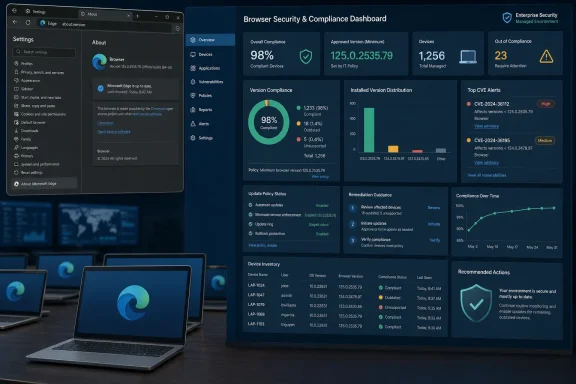 The Microsoft Listing Is a Product-Status Notice, Not a New Windows Alarm
Security Update Guide entries are often read as announcements that customers must install a newly released Microsoft patch. CVE-2026-13862 requires a narrower interpretation.Microsoft says the vulnerability is in Chromium Open Source Software and that Chromium-based Edge consumes the affected software. Microsoft also says the latest Edge is no longer vulnerable. The supplied material does not establish that CVE-2026-13862 is a Microsoft-authored defect, an Edge-only vulnerability, or a flaw requiring a separate Windows update.
The listing answers a product-specific question: whether the vulnerability applies to Microsoft Edge. Microsoft’s answer is that its latest Chromium-based Edge has moved beyond the vulnerable condition.
That statement should not be expanded into claims that the vulnerability was disclosed upstream, that an upstream correction existed, or that Microsoft performed a particular sequence of evaluation, integration, testing, packaging, signing, and deployment for this CVE. Those details were not provided. The supported chain is simpler:
- Chromium Open Source Software is affected.
- Chromium-based Edge consumes that software.
- Microsoft says the latest Edge is no longer vulnerable.
“Latest Edge” Is Not a Version-Based Compliance Rule
Microsoft’s wording describes the state of its current browser release. It does not prove the state of every device on which Edge is installed.Administrators should avoid converting the sentence “the latest version is no longer vulnerable” directly into a fleet-wide “not vulnerable” result. Without a fixed version, build, channel, or release date in the supplied material, the advisory does not identify the boundary between affected and corrected installations.
That limitation has direct consequences:
| Question | What the supplied material establishes | What administrators must determine |
|---|---|---|
| Is Chromium OSS affected? | Yes | No additional interpretation is needed for this statement |
| Does Chromium-based Edge consume the affected software? | Yes | Confirm that the finding concerns Microsoft Edge rather than another Chromium consumer |
| Is the latest Edge vulnerable? | Microsoft says it is no longer vulnerable | Identify the applicable current release for the organization’s approved channel |
| What Edge version corrected the issue? | Not stated | Consult Microsoft’s current Edge release information or approved channel documentation |
| What severity applies? | Not stated | Do not infer or invent a rating from the supplied material |
| Is exploitation known or likely? | Not stated | Do not assign an exploitability status without separate evidence |
| When was the corrected release issued? | Not stated | Use an authoritative release record before recording a remediation date |
| Can a finding be closed solely because Microsoft published this entry? | No | Validate the installed version and the scanner’s supporting evidence |
Organizations should therefore resist inventing a threshold from nearby releases, another Chromium-based product, or assumptions about when Microsoft changed the relevant code. The defensible threshold must come from Microsoft’s current Edge release information or from the organization’s approved update-channel documentation.
If that information still does not map CVE-2026-13862 to a specific Edge version, the finding should remain qualified rather than being closed through guesswork. Administrators can document that Microsoft considers the latest Edge no longer vulnerable, record the installed browser version, and note the unresolved absence of an advisory-defined fixed build.
The Advisory’s Silence Is a Boundary, Not an Invitation to Guess
The supplied Microsoft material is narrow. It identifies the affected open-source project, connects that project to Chromium-based Edge, and states that the latest Edge is no longer vulnerable.It does not provide:
- A fixed Edge version or build
- An affected Edge version range
- A release date
- A severity rating
- An exploitability assessment
- An exploitation status
- A workaround
- A technical description of the flaw
- A product-specific attack path
- A channel-specific remediation threshold
A CVE identifier in Microsoft’s Security Update Guide does not, by itself, establish active exploitation, widespread compromise, or a need to remove Edge. It also does not establish that every Edge installation is current. Both alarmist and complacent interpretations go beyond the supplied facts.
Risk teams should be especially careful when consolidating records from several vulnerability feeds. Information associated with Chromium OSS or another Chromium-based product may help researchers investigate the issue, but it should not automatically be represented as Microsoft’s Edge-specific assessment.
Shared code establishes potential relevance; it does not establish identical product behavior, exposure, severity, or corrected-version boundaries across every downstream browser. Microsoft has stated the condition of the latest Edge, but the supplied material does not support broader conclusions about other Chromium consumers or older Edge releases.
The same restraint applies to dates and version numbers. Administrators should not infer that the closest Edge release to a third-party disclosure is necessarily the first corrected Microsoft release. A defensible compliance record needs an authoritative connection between the CVE and the version used as the closure threshold.
Turn Microsoft’s Statement Into an Environment-Specific Decision
The immediate decision is not whether to trust Microsoft’s statement. It is how to translate that statement into evidence appropriate for the organization’s Edge environment.A practical sequence is:
- Identify the affected product record. Confirm that the issue being investigated is CVE-2026-13862 and that the asset finding concerns Chromium-based Microsoft Edge.
- Record Microsoft’s stated condition. The latest Chromium-based Edge is no longer vulnerable.
- Identify the organization’s approved Edge channel. Do not assume that “latest” names the same release across every managed environment.
- Find the current approved release. Use Microsoft’s current Edge release information or the authoritative documentation for the approved channel.
- Collect installed-version evidence. Determine which Edge version is installed on each device included in the finding.
- Compare the evidence. Evaluate the installed version against the approved release identified in the previous step.
- Review update-policy compliance. Confirm that the device complies with the organization’s own browser-update requirements.
- Examine scanner evidence. Ensure the scanner identified Microsoft Edge and recorded an installed version that supports the finding.
- Remediate or qualify. Update devices that are behind. If a corrected version still cannot be established, document the limitation rather than creating an unsupported threshold.
- Retest before closure. Refresh inventory or rerun the relevant assessment so the closure record reflects the device’s current state.
The distinction matters because an organization may intentionally approve a release other than the newest generally available release. Whether that choice satisfies the organization’s security requirements cannot be determined from the supplied advisory alone. The organization must reconcile its approved channel with Microsoft’s current release information and its own risk-acceptance process.
Validate Scanner Findings Against Installed Edge
Scanner output should be treated as a finding that needs evidence, not as a substitute for product and version verification.For CVE-2026-13862, administrators should ask the scanner or vulnerability platform to identify at least:
- The affected product it detected
- The device on which it detected the product
- The installed Edge version used for the match
- The version or condition the scanner considers corrected
- The evidence supporting that version comparison
- The time at which the evidence was collected
If a scanner reports CVE-2026-13862 but does not show the Edge version that triggered the finding, the result is not sufficiently transparent for version-based closure. The security team should request the missing evidence or perform an independent inventory check.
If the installed version is behind the organization’s identified current release, the appropriate response is to bring the browser into compliance and reassess the device. If the installed version matches the approved current release but the scanner continues to report the CVE, the finding should be investigated using the scanner’s own detection criteria.
Administrators should not close a report merely because a device displays a generic “up to date” message. Nor should they leave a report open indefinitely when the scanner’s version logic conflicts with authoritative Microsoft release information. Closure should be based on recorded, reproducible evidence.
Because Microsoft did not provide a fixed version in the supplied advisory, the closure record should state where the organization obtained its threshold. That source may be Microsoft’s current Edge release information or the authoritative documentation for the organization’s approved channel. The record should not imply that the version came from the CVE entry itself.
Managed Fleets Need a Defined Closure Standard
A useful fleet closure standard for CVE-2026-13862 should contain four elements:1. Product identity
The asset must be confirmed as running Chromium-based Microsoft Edge. A generic association with Chromium is not enough for a Microsoft Edge compliance decision.2. Approved release identity
The organization must identify the current Edge release applicable to its approved channel. That release becomes the operational comparison point only after it has been verified through authoritative release or channel information.3. Installed-version evidence
The organization must collect the Edge version installed on the device. For an individual system, the user or administrator can check Help and feedback > About Microsoft Edge. At fleet scale, administrators should use their organization’s established software-inventory method.4. Policy-compliance evidence
The device must satisfy the organization’s browser-update policy. This is general operational guidance, not a claim about a specific Microsoft policy recommendation or about the mechanics of CVE-2026-13862 remediation.A concise closure statement could read:
That wording preserves the limits of the source while showing how the organization reached its decision.Microsoft states that the latest Chromium-based Edge is no longer vulnerable to CVE-2026-13862. The advisory does not identify a fixed version. The organization therefore verified the current approved Edge release for its managed channel, compared that release with the version installed on the affected device, confirmed compliance with its browser-update policy, and refreshed the vulnerability assessment.
By contrast, a closure note stating only that “Microsoft fixed the CVE” is too broad. The supplied material does not identify the correction, the corrected build, or the date on which it became available. Likewise, stating that “all Edge systems are safe” would confuse Microsoft’s description of its latest product release with evidence about the organization’s assets.
Application Compatibility Does Not Remove the Need for a Decision
Some organizations approve browser releases only after internal compatibility review. That may produce a gap between Microsoft’s latest Edge release and the version approved for a particular environment.CVE-2026-13862 does not provide enough detail to determine the risk created by such a gap. It contains no supplied severity or exploitability information, and those values should not be invented. The absence of those details, however, does not make the version difference irrelevant.
Administrators should document:
- The Edge channel used by the environment
- The release currently approved for deployment
- The current release identified through authoritative information
- The reason for any difference between the two
- The owner responsible for approving or rejecting an update
- The date on which the decision will be reviewed
- The evidence used to assess CVE-2026-13862
The same rule applies when a scanner provides an affected range that Microsoft’s supplied advisory does not. The scanner may have additional evidence, but administrators should review that evidence before adopting it as the organization’s compliance threshold. The threshold must be attributable to a real source, not merely inferred from the presence of a CVE identifier.
Action Checklist for Administrators
- Confirm that the finding concerns CVE-2026-13862 and Chromium-based Microsoft Edge.
- Record Microsoft’s statement that the latest Chromium-based Edge is no longer vulnerable.
- Record that the supplied advisory does not provide a fixed version, affected range, severity, exploitability status, build, or release date.
- Identify the Edge update channel approved for the affected environment.
- Consult Microsoft’s current Edge release information or the authoritative documentation for that approved channel.
- Establish the current approved Edge release before defining a compliance threshold.
- Check an individual device at Help and feedback > About Microsoft Edge when direct validation is appropriate.
- Inventory installed Edge versions across managed devices using the organization’s established management process.
- Compare installed versions with the current approved release applicable to each environment.
- Verify compliance with the organization’s browser-update policy.
- Review exceptions for devices that have not reached the approved release.
- Require scanners to show the detected product, installed version, collection time, and matching evidence.
- Validate each disputed finding against the device’s installed Edge version and the scanner’s evidence.
- Refresh inventory or rescan affected devices after remediation.
- Do not close findings using a fixed version supposedly supplied by the advisory, because the supplied material contains no such version.
- Document the authoritative release or channel information used to support closure.
- If no reliable corrected-version boundary can be established, qualify the finding and escalate the missing information rather than guessing.
The Decision Is Simple, but the Evidence Must Be Specific
CVE-2026-13862 is not a basis for declaring a new Windows-wide emergency. Microsoft identifies it as a vulnerability in Chromium Open Source Software consumed by Chromium-based Edge, and Microsoft says the latest Edge is no longer vulnerable.That is the answer for the product. It is not automatically the answer for every device.
For individual users, the immediate action is to check Edge at Help and feedback > About Microsoft Edge. For managed fleets, administrators must identify the current approved Edge release for their environment, verify installed versions, confirm update-policy compliance, and examine the evidence behind scanner findings.
The missing fixed version is not a minor editorial omission. It prevents administrators from deriving a version-based compliance threshold from this advisory alone. Any threshold used to close CVE-2026-13862 must come from Microsoft’s current Edge release information, authoritative approved-channel documentation, or another separately evaluated source.
Microsoft’s statement defines the desired product condition: the latest Edge is no longer vulnerable. A defensible enterprise closure requires the additional evidence that each affected device has reached the release the organization has authoritatively identified as current and applicable.
References
- Primary source: MSRC
Published: 2026-07-11T15:40:13-07:00
Security Update Guide - Microsoft Security Response Center
 msrc.microsoft.com
- Related coverage: sentinelone.com
CVE-2026-13862: Chrome iOS Information Disclosure Bug
CVE-2026-13862 is an information disclosure vulnerability in Google Chrome for iOS. Learn about its impact, affected versions, and mitigation methods.www.sentinelone.com
- Official source: learn.microsoft.com
Microsoft Edge Update Policy Documentation | Microsoft Learn
Documentation for all policies supported by the Microsoft Edge Updaterlearn.microsoft.com - Official source: support.microsoft.com
Securely browse the web in Microsoft Edge | Microsoft Support
Securely browse the web in Microsoft Edgesupport.microsoft.com - Official source: download.microsoft.com
- Official source: cdn-dynmedia-1.microsoft.com
- Related coverage: www2.gov.bc.ca
- Related coverage: windowscentral.com
Microsoft Edge removes several features in latest update | Windows Central
Microsoft is getting rid of Collections and forcing new password rules but also finally fixed a major annoyance with clearing your history.www.windowscentral.com
