

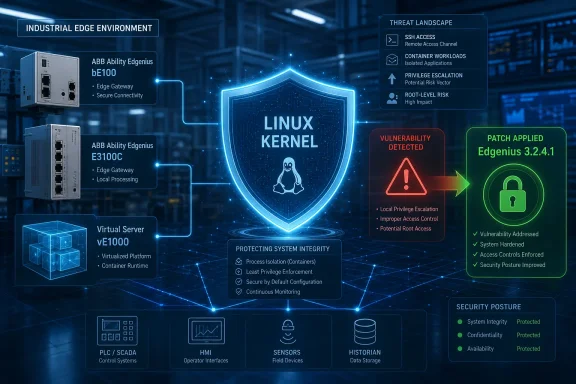
ABB has fixed CVE-2026-31431, the high-severity “Copy Fail” Linux kernel vulnerability, in Ability Edgenius 3.2.4.1 after warning that locally authenticated users or compromised container workloads could gain root privileges on affected bE100, E3100C, and vE1000 systems. CISA also published the issue as ICSA-26-195-02, increasing its visibility across the critical-manufacturing sector. The practical message is straightforward: any listed Edgenius installation from version 3.2.0.0 up to, but not including, 3.2.4.1 should be treated as affected and updated through an ABB-approved procedure.
The vulnerability cannot be exploited remotely by itself. That qualification matters, but it should not be mistaken for safety. An attacker first needs physical access, valid SSH credentials, another locally authenticated foothold, or the ability to execute code through a compromised container workload. CVE-2026-31431 could then be used for privilege escalation and complete control of the Edgenius system.
ABB says it had received no information indicating exploitation against Edgenius when its advisory was issued. The vulnerability had already been publicly disclosed, however, so organizations should address both the vulnerable software and the possibility that an existing local foothold could have been used before remediation.
ABB Ability Edgenius is the affected product family identified in the vendor advisory, with the vulnerable software deployed on the bE100 and E3100C gateways and the vE1000 server platform. The issue is not described as a defect in ABB’s application logic. According to ABB, CVE-2026-31431 is located in the Linux kernel’s cryptographic subsystem and involves the
The available advisory information identifies the affected kernel component but does not establish a detailed exploitation mechanism for Edgenius. Administrators therefore should avoid treating speculative descriptions of memory mappings, cryptographic data corruption, or a particular container-escape technique as confirmed facts about this product advisory.
What ABB does establish is the security outcome that matters operationally: a locally authenticated user or compromised container workload may be able to exploit the vulnerability to elevate privileges to root. ABB characterizes that result as effectively giving the attacker complete control of the system.
That distinction is central to the story. The vulnerability is not presented as a remotely reachable Edgenius management flaw, and it does not independently provide an outside attacker with an initial connection to the node. It becomes dangerous after another weakness, credential compromise, physical-access event, malicious insider action, or workload compromise has already supplied the ability to execute code locally.
The kernel’s role makes that escalation consequential. Applications, management services, user accounts, and container workloads ultimately depend on the operating-system kernel to enforce their restrictions. If an attacker can move from a limited local context to root, controls that were intended to contain that context may no longer provide meaningful protection on the affected node.
ABB explicitly says CVE-2026-31431 cannot be exploited remotely. Operators should preserve the distinction between two very different scenarios:
At the same time, the impact should not be overstated. ABB’s advisory supports root access and effective complete system control. The supplied information does not establish that CVE-2026-31431 by itself permits remote exploitation, directly manipulates an industrial process, crosses an industrial-protocol boundary, compromises connected equipment, or produces any particular operational failure.
The defensible conclusion is narrower but still serious: if an attacker can satisfy the local-access prerequisite on a vulnerable Edgenius node, the attacker may be able to turn that foothold into root-level control of the node.
The uniform boundary simplifies the first inventory decision. If one of the three listed platforms runs Edgenius 3.2.0.0 or later but remains below 3.2.4.1, it falls within ABB’s affected range. Operators should not assume that a gateway and server require different vulnerability thresholds merely because their hardware roles differ.
ABB confirms that Edgenius 3.2.4.1 incorporates the relevant Linux kernel security update and recommends applying the update at the earliest convenience. That confirms the target version, but it does not amount to a complete installation procedure.
The advisory does not provide a click path, package-management command, download location, backup requirement, validation sequence, rollback process, or reboot procedure. WindowsForum therefore cannot responsibly present the version number alone as a complete update how-to. Operators should obtain the vendor-approved upgrade procedure, installation media, prerequisites, and platform-specific change guidance through ABB support or the applicable ABB documentation before deployment.
This distinction matters in operational environments. A correct target version does not answer whether an installation requires an intermediate release, whether workloads or configuration must be preserved separately, how long the node may be unavailable, or how operators should validate normal service after the update. Those details should come from ABB rather than from assumptions based on ordinary Linux or Windows patching practices.
The advisory does not establish that every container can reach the vulnerable interface, that exploitation automatically escapes every container configuration, or that shared and multi-tenant deployments are inherently more vulnerable. Those conclusions depend on implementation and configuration details not provided in the available material.
The supported concern is more precise: if a container workload is already compromised and can satisfy the conditions needed to exploit CVE-2026-31431, the vulnerability may allow escalation to root on the affected Edgenius system. That makes workload compromise part of the threat model even though Copy Fail does not itself provide the initial route into the workload.
The default absence of additional lower-privilege users on Edgenius installations is a mitigating factor identified in the advisory material. Fewer ordinary local accounts can reduce the number of obvious starting points for a low-privileged attack. It does not correct the kernel vulnerability, invalidate stolen credentials, prevent physical access, or rule out execution through a compromised workload.
Administrators should therefore avoid using account count as a substitute for patch status. A system with no routinely used lower-privilege interactive accounts can still be affected according to its installed Edgenius version, and ABB’s corrected release remains the primary remediation.
The technical conclusions relevant to remediation remain those attributed to ABB: which Edgenius platforms are affected, which version range is vulnerable, what access conditions are required, what privilege level may be obtained, and which release contains the correction.
CISA’s publication should not be treated as evidence for claims that do not appear in the available advisory facts. In particular, there is no need to characterize the CISA notice as a verbatim conversion, assign it a separate technical-validation role, or infer product-specific network architecture requirements beyond what ABB establishes.
For operators, the value of the CISA publication is increased awareness and coordination. It places the issue into the industrial cybersecurity reporting stream and gives organizations another recognizable advisory identifier to use when communicating with security teams, managed service providers, auditors, and incident responders.
The two identifiers should be recorded together where practical:
Recording both can help avoid duplicate investigation tickets or confusion when different teams receive the same underlying issue through separate alerting channels.
Patching prevents future exploitation of the corrected defect, but it cannot prove that an already vulnerable node was never compromised. Where there are credible signs of prior unauthorized local execution, teams should follow their established incident-response process, preserve relevant evidence, determine the period of exposure, and obtain ABB assistance where product-specific analysis is required.
That overlap is a coordination issue rather than evidence of a product-specific Windows attack path. The practical goal is to ensure that responsibility does not fall between teams simply because the vulnerable component is a Linux kernel inside an industrial edge product.
The update does not automatically answer whether an attacker previously obtained valid credentials, whether a workload was compromised, whether physical access occurred, or whether root privileges were obtained before remediation. Those are separate security and incident-response questions.
Similarly, restricting SSH and Cockpit is an important exposure-reduction measure but not a replacement for the corrected release. Access controls can reduce the probability that an attacker reaches the local prerequisite. They do not remove the vulnerable kernel component from an affected version.
Operators should therefore avoid choosing between patching and access review as if they were competing remedies. The concise response sequence is:
Edgenius 3.2.4.1 closes the documented escalation path. Restricting SSH and Cockpit makes the required foothold harder to obtain, while investigation of suspicious prior access addresses the possibility that exploitation occurred before the update. That combination—accurate inventory, vendor-approved patching, constrained management access, and evidence-driven incident response—is the durable lesson for the next kernel flaw that reaches an industrial edge system.
The vulnerability cannot be exploited remotely by itself. That qualification matters, but it should not be mistaken for safety. An attacker first needs physical access, valid SSH credentials, another locally authenticated foothold, or the ability to execute code through a compromised container workload. CVE-2026-31431 could then be used for privilege escalation and complete control of the Edgenius system.
ABB says it had received no information indicating exploitation against Edgenius when its advisory was issued. The vulnerability had already been publicly disclosed, however, so organizations should address both the vulnerable software and the possibility that an existing local foothold could have been used before remediation.
 A Linux Kernel Flaw Reaches the Industrial Edge
ABB Ability Edgenius is the affected product family identified in the vendor advisory, with the vulnerable software deployed on the bE100 and E3100C gateways and the vE1000 server platform. The issue is not described as a defect in ABB’s application logic. According to ABB, CVE-2026-31431 is located in the Linux kernel’s cryptographic subsystem and involves the algif_aead cryptographic algorithm interface.The available advisory information identifies the affected kernel component but does not establish a detailed exploitation mechanism for Edgenius. Administrators therefore should avoid treating speculative descriptions of memory mappings, cryptographic data corruption, or a particular container-escape technique as confirmed facts about this product advisory.
What ABB does establish is the security outcome that matters operationally: a locally authenticated user or compromised container workload may be able to exploit the vulnerability to elevate privileges to root. ABB characterizes that result as effectively giving the attacker complete control of the system.
That distinction is central to the story. The vulnerability is not presented as a remotely reachable Edgenius management flaw, and it does not independently provide an outside attacker with an initial connection to the node. It becomes dangerous after another weakness, credential compromise, physical-access event, malicious insider action, or workload compromise has already supplied the ability to execute code locally.
The kernel’s role makes that escalation consequential. Applications, management services, user accounts, and container workloads ultimately depend on the operating-system kernel to enforce their restrictions. If an attacker can move from a limited local context to root, controls that were intended to contain that context may no longer provide meaningful protection on the affected node.
The Threat Model: A Second-Stage Escalation, Not Standalone Remote Exploitation
The CVSS 3.1 assessment gives Copy Fail a base score of 7.8 and a severity rating of HIGH. Its vector isCVSS:3.1/AV:L/AC:L/PR:L/UI:N/S:U/C:H/I:H/A:H. In practical terms, the assessment describes a local attack that requires low privileges, has low attack complexity, needs no user interaction, and may have a high effect on confidentiality, integrity, and availability.ABB explicitly says CVE-2026-31431 cannot be exploited remotely. Operators should preserve the distinction between two very different scenarios:
- Standalone remote exploitation: The advisory does not support a scenario in which an unauthenticated internet attacker directly sends a request to Edgenius and immediately obtains root through CVE-2026-31431.
- Post-compromise privilege escalation: The advisory does support a scenario in which an attacker who already has local access or code execution—through valid SSH credentials, physical access, a locally authenticated account, or a compromised container workload—uses the vulnerability to gain root privileges and complete control of the system.
At the same time, the impact should not be overstated. ABB’s advisory supports root access and effective complete system control. The supplied information does not establish that CVE-2026-31431 by itself permits remote exploitation, directly manipulates an industrial process, crosses an industrial-protocol boundary, compromises connected equipment, or produces any particular operational failure.
The defensible conclusion is narrower but still serious: if an attacker can satisfy the local-access prerequisite on a vulnerable Edgenius node, the attacker may be able to turn that foothold into root-level control of the node.
Three Edgenius Platforms Share the Same Patch Boundary
ABB identifies the same affected version interval across two gateway models and one server platform. Version 3.2.4.1 is the first corrected Edgenius release for all three.| Edgenius deployment | Hardware | Affected versions | Fixed version | Status |
|---|---|---|---|---|
| ABB Ability Edgenius | Gateway bE100 | 3.2.0.0 or later, before 3.2.4.1 | 3.2.4.1 | Known affected |
| ABB Ability Edgenius | Gateway E3100C | 3.2.0.0 or later, before 3.2.4.1 | 3.2.4.1 | Known affected |
| ABB Ability Edgenius | Server vE1000 | 3.2.0.0 or later, before 3.2.4.1 | 3.2.4.1 | Known affected |
ABB confirms that Edgenius 3.2.4.1 incorporates the relevant Linux kernel security update and recommends applying the update at the earliest convenience. That confirms the target version, but it does not amount to a complete installation procedure.
The advisory does not provide a click path, package-management command, download location, backup requirement, validation sequence, rollback process, or reboot procedure. WindowsForum therefore cannot responsibly present the version number alone as a complete update how-to. Operators should obtain the vendor-approved upgrade procedure, installation media, prerequisites, and platform-specific change guidance through ABB support or the applicable ABB documentation before deployment.
This distinction matters in operational environments. A correct target version does not answer whether an installation requires an intermediate release, whether workloads or configuration must be preserved separately, how long the node may be unavailable, or how operators should validate normal service after the update. Those details should come from ABB rather than from assumptions based on ordinary Linux or Windows patching practices.
Container Workloads Are One Supported Route to the Local Foothold
ABB identifies a compromised container workload as one condition from which the vulnerability may be exploited. That is important because it expands the relevant inventory beyond named interactive users. Administrators need to consider both people who can access the node and software workloads that can execute on it.The advisory does not establish that every container can reach the vulnerable interface, that exploitation automatically escapes every container configuration, or that shared and multi-tenant deployments are inherently more vulnerable. Those conclusions depend on implementation and configuration details not provided in the available material.
The supported concern is more precise: if a container workload is already compromised and can satisfy the conditions needed to exploit CVE-2026-31431, the vulnerability may allow escalation to root on the affected Edgenius system. That makes workload compromise part of the threat model even though Copy Fail does not itself provide the initial route into the workload.
The default absence of additional lower-privilege users on Edgenius installations is a mitigating factor identified in the advisory material. Fewer ordinary local accounts can reduce the number of obvious starting points for a low-privileged attack. It does not correct the kernel vulnerability, invalidate stolen credentials, prevent physical access, or rule out execution through a compromised workload.
Administrators should therefore avoid using account count as a substitute for patch status. A system with no routinely used lower-privilege interactive accounts can still be affected according to its installed Edgenius version, and ABB’s corrected release remains the primary remediation.
CISA Broadens Visibility of the ABB Advisory
ABB PSIRT issued advisory 7PAA024620 and reported the vulnerability to CISA. CISA subsequently published ICSA-26-195-02, bringing the issue to the attention of a broader industrial-security audience and identifying the affected products as used in the critical-manufacturing sector.The technical conclusions relevant to remediation remain those attributed to ABB: which Edgenius platforms are affected, which version range is vulnerable, what access conditions are required, what privilege level may be obtained, and which release contains the correction.
CISA’s publication should not be treated as evidence for claims that do not appear in the available advisory facts. In particular, there is no need to characterize the CISA notice as a verbatim conversion, assign it a separate technical-validation role, or infer product-specific network architecture requirements beyond what ABB establishes.
For operators, the value of the CISA publication is increased awareness and coordination. It places the issue into the industrial cybersecurity reporting stream and gives organizations another recognizable advisory identifier to use when communicating with security teams, managed service providers, auditors, and incident responders.
The two identifiers should be recorded together where practical:
| Publisher | Advisory identifier | Operational use |
|---|---|---|
| ABB PSIRT | 7PAA024620 | Vendor advisory for affected products, impact, and corrected release |
| CISA | ICSA-26-195-02 | Industrial cybersecurity notice that increases visibility of the issue |
Prioritized Action Box for Administrators
The highest-value response is a combination of inventory, vendor-approved deployment of Edgenius 3.2.4.1, restriction of the supported local-access routes, and investigation where prior unauthorized execution is suspected.The first two steps establish exposure. The third and fourth correct it without pretending that a version number is an installation guide. The fifth reduces opportunities to obtain the prerequisite foothold. The final step addresses the difference between vulnerability remediation and incident recovery.Priority actions
- Inventory the three affected platforms. Find all bE100, E3100C, and vE1000 systems running ABB Ability Edgenius, including nodes managed outside the central IT patching platform.
- Identify vulnerable versions. Treat Edgenius 3.2.0.0 or later but earlier than 3.2.4.1 as affected on the listed systems.
- Obtain ABB’s approved update procedure. The advisory confirms 3.2.4.1 as the corrected release but does not provide the complete download, backup, installation, reboot, rollback, or validation process.
- Deploy Edgenius 3.2.4.1. Schedule the update using ABB support or documentation and the organization’s normal operational change controls.
- Restrict SSH and Cockpit. ABB explicitly recommends limiting access to these services. Permit only required management identities and approved management paths.
- Investigate suspected prior local execution. If there is evidence of unauthorized SSH use, physical access, account misuse, or a compromised container workload, do not assume that installing the update removes the consequences of an earlier root compromise.
Patching prevents future exploitation of the corrected defect, but it cannot prove that an already vulnerable node was never compromised. Where there are credible signs of prior unauthorized local execution, teams should follow their established incident-response process, preserve relevant evidence, determine the period of exposure, and obtain ABB assistance where product-specific analysis is required.
WindowsForum operational advice
The following measures are WindowsForum recommendations for applying ABB’s advisory in a mixed enterprise and operational-technology environment. They are not presented as additional requirements from ABB or CISA:- Reconcile Edgenius inventory records across asset management, operational ownership, and security-monitoring systems so that appliances outside the Windows patch estate are not missed.
- Confirm the installed version directly through the approved Edgenius management method rather than inferring it from purchase dates, hardware model, or an old inventory record.
- Identify the owners responsible for approving downtime, obtaining ABB materials, performing the update, and validating service afterward.
- Check whether SSH or Cockpit is enabled and whether access is limited to the minimum set of authorized administrators and management networks.
- Review available authentication and security telemetry if there is a specific reason to suspect credential misuse, unauthorized local access, or workload compromise.
- Treat confirmed or suspected prior root access as an incident requiring investigation, not merely as a patch-compliance exception.
- Document the updated version and validation result after deployment so vulnerability-management teams can close the finding with evidence.
That overlap is a coordination issue rather than evidence of a product-specific Windows attack path. The practical goal is to ensure that responsibility does not fall between teams simply because the vulnerable component is a Linux kernel inside an industrial edge product.
What the Update Does—and Does Not Resolve
Moving an affected node to Edgenius 3.2.4.1 addresses the vulnerability described by ABB. It closes the documented privilege-escalation path associated with CVE-2026-31431 on the listed platforms.The update does not automatically answer whether an attacker previously obtained valid credentials, whether a workload was compromised, whether physical access occurred, or whether root privileges were obtained before remediation. Those are separate security and incident-response questions.
Similarly, restricting SSH and Cockpit is an important exposure-reduction measure but not a replacement for the corrected release. Access controls can reduce the probability that an attacker reaches the local prerequisite. They do not remove the vulnerable kernel component from an affected version.
Operators should therefore avoid choosing between patching and access review as if they were competing remedies. The concise response sequence is:
- Establish whether the node and version are affected.
- Obtain and follow ABB’s approved procedure for deploying 3.2.4.1.
- Limit SSH and Cockpit to authorized access.
- Investigate if there is evidence that an attacker may previously have achieved local execution.
- Record and validate the resulting software state.
What Edgenius Operators Should Carry Forward
The immediate remediation is clear, even though the installation details must come from ABB:- CVE-2026-31431 is a high-severity Linux kernel privilege-escalation vulnerability involving
algif_aead. - ABB Ability Edgenius versions from 3.2.0.0 up to, but not including, 3.2.4.1 are affected on the bE100, E3100C, and vE1000 platforms.
- Edgenius 3.2.4.1 incorporates the corrective Linux kernel security update.
- The vulnerability cannot be exploited remotely by itself.
- Physical access, valid SSH credentials, another locally authenticated foothold, or a compromised container workload can provide the prerequisite for exploitation.
- Successful exploitation may provide root privileges and effective complete control of the system.
- ABB had received no information indicating exploitation against Edgenius when its advisory was issued.
- The advisory confirms the fixed version but does not provide a complete package-acquisition, backup, installation, reboot, rollback, or validation procedure.
- Operators should obtain the approved update instructions from ABB support or documentation and investigate systems where prior unauthorized local execution is suspected.
Edgenius 3.2.4.1 closes the documented escalation path. Restricting SSH and Cockpit makes the required foothold harder to obtain, while investigation of suspicious prior access addresses the possibility that exploitation occurred before the update. That combination—accurate inventory, vendor-approved patching, constrained management access, and evidence-driven incident response—is the durable lesson for the next kernel flaw that reaches an industrial edge system.
References
- Primary source: CISA
Published: 2026-07-14T12:00:00+00:00

ABB Ability Edgenius | CISA
www.cisa.gov
