

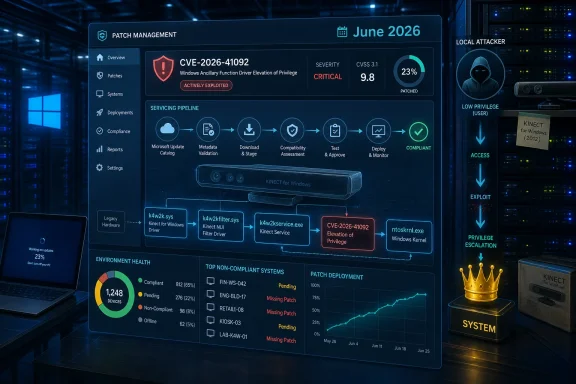
Microsoft published CVE-2026-41092 on June 9, 2026, as an Important-rated Microsoft Kinect elevation-of-privilege vulnerability caused by improper access control, with security updates available for supported Windows client and server releases where the vulnerable component is present. The oddity is not that Kinect still has a security footprint; it is that the footprint now runs through the ordinary machinery of Windows servicing. A device line most consumers remember as an Xbox accessory has become a reminder that retired products rarely retire cleanly from enterprise estates. For administrators, the practical story is simple: this is a local privilege-escalation bug with SYSTEM as the prize, and “old peripheral” is not a synonym for “irrelevant risk.”
Kinect’s cultural moment was a decade ago, when Microsoft tried to make depth cameras, voice control, and gesture recognition feel like the future of gaming. The consumer market moved on. Enterprises, labs, industrial developers, robotics researchers, accessibility projects, and odd line-of-business deployments did not always move with it.
That is why a Microsoft Kinect vulnerability in 2026 lands with a strange double effect. On one hand, many readers will reasonably ask why Kinect appears in the Security Update Guide at all. On the other, anyone who has audited a manufacturing floor, university lab, hospital simulation rig, kiosk fleet, or inherited Windows workstation knows exactly why it does.
The vulnerability is not described as a remote wormable flaw. Microsoft’s scoring says the attacker needs local access and low privileges, with no user interaction required. That places CVE-2026-41092 in the familiar Windows escalation bucket: not usually the first door into an environment, but potentially a very useful stairwell once someone is already inside.
That distinction matters. Security teams sometimes triage local elevation-of-privilege vulnerabilities below internet-facing remote-code-execution bugs, and often they should. But attackers do not rank vulnerabilities as isolated press releases; they chain them. A phishing foothold, a stolen low-privilege account, or a compromised developer workstation becomes far more dangerous if a local bug can turn that access into SYSTEM.
That combination is easy to misread. “Important” sounds manageable, perhaps even routine, in a month that may also contain Critical Windows, Exchange, browser, or cloud-service fixes. But the FAQ attached to this CVE states the privilege outcome plainly: a successful attacker could gain SYSTEM privileges.
SYSTEM is the line that changes the conversation. It is the difference between “a user did something bad in their profile” and “the operating system can now be made to do something bad on the attacker’s behalf.” With SYSTEM-level control, defenders have to assume credential theft, persistence, tampering, lateral movement preparation, and security-tool interference are all on the table.
Microsoft also lists the exploit code maturity as unproven and says the issue was not publicly disclosed or exploited at the time of publication. That lowers the immediate panic level. It does not erase the risk, because confirmed vulnerabilities with official fixes tend to become study material after Patch Tuesday, especially when the affected surface is present across many supported Windows builds.
That confidence should shape triage. When a vendor confirms a vulnerability, defenders no longer have to debate whether the bug is real. The open questions become narrower and more operational: where is the vulnerable component installed, which systems are exposed to local users or low-privilege accounts, and how quickly can the fixed build be deployed?
There is a second edge to confirmed confidence. It signals to attackers that the trail is worth following. Even without public exploit code, a confirmed local privilege-escalation vulnerability with a patch available can invite reverse engineering, especially if the update touches components that can be compared before and after the fix.
This is one of the uncomfortable truths of coordinated disclosure. Publishing a fix protects customers, but it also starts the clock. The security value is in getting patched before exploit developers turn Microsoft’s sparse advisory into working technique.
That breadth creates a familiar administrative trap. Teams may search their hardware inventory for “Kinect,” find little or nothing, and mentally close the ticket. But Windows components, drivers, SDK remnants, optional packages, development tools, and legacy application dependencies do not always map neatly to visible peripherals.
The safer posture is to treat the CVE as part of the June 2026 Windows security baseline rather than as a niche accessory update. If the system is in scope for the cumulative or security update Microsoft lists, apply the update through the normal Windows Update, WSUS, Configuration Manager, Intune, or catalog-driven process. The existence of Kinect hardware may influence urgency, but it should not become the only decision gate.
This is especially true for older platforms still receiving security updates through extended support arrangements. Windows Server 2012 and 2012 R2 remain fixtures in too many environments, often because the application they host is harder to replace than the server operating system. A Kinect-named CVE landing on those platforms is another small reminder that legacy does not stop accumulating modern risk.
But local does not mean harmless. In modern enterprise incidents, attackers frequently begin with ordinary user context. They land through stolen credentials, malicious documents, drive-by payloads, over-permissive remote access, developer tooling, or compromised third-party software. Once inside, privilege escalation is how “some access” becomes “durable control.”
The no-user-interaction metric matters here. Microsoft’s scoring indicates that exploitation does not require a second victim to click, open, approve, or otherwise participate after the attacker has the required local privileges. That tends to make a vulnerability more attractive in post-compromise automation, because the attacker’s workflow can be more deterministic.
Low attack complexity pushes in the same direction. Microsoft’s CVSS assessment says specialized conditions are not required. That does not mean an exploit is available or trivial today, but it does suggest that if an exploit is developed, defenders should not count on fragile environmental assumptions to save them.
DB Systel is the digital and IT arm associated with Deutsche Bahn, and a report emerging from that orbit fits a pattern security teams will recognize. Depth cameras and sensor stacks are not just game accessories; they can be part of prototyping, logistics, training, safety systems, analytics, robotics, and research platforms. The business value may persist long after the original consumer brand fades from public view.
That does not mean this CVE is specific to rail operations, nor should readers infer details Microsoft has not published. It does, however, argue against dismissing the vulnerability as a museum piece. The most interesting security bugs often appear where consumer hardware, industrial adaptation, and long-lived Windows deployments intersect.
There is also a governance lesson here. Coordinated vulnerability disclosure works when organizations running specialized systems have the engineering maturity to investigate, report, and wait for a fix. The public advisory is terse, but behind it sits the ordinary, unglamorous work of finding a real defect before attackers do.
That sparseness is normal for MSRC advisories, but it creates a tension. Defenders want enough technical detail to hunt for misuse, validate exposure, and understand compensating controls. Vendors often withhold detail to reduce exploit acceleration, especially early in the patch cycle.
In this case, the vulnerability type is mapped to CWE-284, improper access control. That is a broad category, covering failures where a component does not properly restrict who can reach or manipulate a resource. In Windows privilege escalation, that can mean overly permissive objects, unsafe broker behavior, privileged services trusting unprivileged input, device interfaces exposed too widely, or update and driver paths that fail to enforce intended boundaries.
Without additional technical detail, administrators should resist inventing a root cause. The useful response is not speculation; it is patch coverage, asset correlation, and post-patch verification. If later research reveals the exact mechanism, that can inform detection engineering, but it should not be a prerequisite for remediation.
Those build numbers are not trivia. They are how operations teams prove that the advisory became reality on endpoints. In a well-run environment, the CVE is only the opening ticket; the closing evidence is update compliance across affected rings, including laptops, lab machines, servers, disconnected systems, and special-purpose workstations.
The practical rollout path should be familiar. Pilot the June 2026 security updates, watch for regressions on systems using depth-camera hardware or legacy Kinect-dependent software, then expand deployment according to risk. Environments with shared workstations, labs, kiosk-like systems, developer desktops, or exposed low-privilege user populations should avoid letting the “Kinect” label push this fix into a novelty queue.
For home users, the advice is simpler. Install the June 2026 Windows security update for your supported release. If you still run Kinect-related software, the update matters more, not less. If you do not, Windows Update remains the right answer because the vulnerable component may not be obvious from the device sitting on your desk.
Kinect is a particularly good symbol because it straddled consumer excitement and developer experimentation. It was a camera, microphone array, depth sensor, natural user interface, robotics input device, accessibility tool, and research platform, depending on who plugged it in. That flexibility made it useful, and usefulness is how hardware survives.
The security problem is that organizations often inventory devices less carefully than they inventory software. A server application may have an owner, a CMDB entry, a support contract, and a migration roadmap. A USB sensor attached to a workstation in a lab may have none of those things, even if the driver stack it depends on still receives security fixes.
CVE-2026-41092 should therefore be read as a small case study in hidden dependencies. If a forgotten component can create SYSTEM-level risk, then “we don’t use that product anymore” needs evidence. In Windows administration, absence of memory is not absence of exposure.
Security teams should ask which systems received the vulnerable component, which update supersedes it, and which machines remain unpatched after the normal deployment window. They should pay special attention to devices where local users are numerous or not fully trusted, because local privilege escalation is most useful where attacker-controlled low-privilege sessions are plausible.
There is also a detection implication, although Microsoft’s limited technical detail constrains specifics. Until more is known, defenders can focus on generic post-exploitation signals: unexpected privilege changes, suspicious service creation, tampering with security tools, unusual child processes from device-related services, and anomalous SYSTEM-level execution following low-privilege user activity. These signals will not identify CVE-2026-41092 uniquely, but they cover the behaviors attackers typically want after a local escalation succeeds.
The healthiest response is boring: patch, verify, and review inventory. The unhealthy response is equally common: laugh at the Kinect label, assume irrelevance, and move on. Attackers tend to prefer the second option.
 Kinect Is Gone From the Living Room, But Not From the Patch Graph
Kinect’s cultural moment was a decade ago, when Microsoft tried to make depth cameras, voice control, and gesture recognition feel like the future of gaming. The consumer market moved on. Enterprises, labs, industrial developers, robotics researchers, accessibility projects, and odd line-of-business deployments did not always move with it.That is why a Microsoft Kinect vulnerability in 2026 lands with a strange double effect. On one hand, many readers will reasonably ask why Kinect appears in the Security Update Guide at all. On the other, anyone who has audited a manufacturing floor, university lab, hospital simulation rig, kiosk fleet, or inherited Windows workstation knows exactly why it does.
The vulnerability is not described as a remote wormable flaw. Microsoft’s scoring says the attacker needs local access and low privileges, with no user interaction required. That places CVE-2026-41092 in the familiar Windows escalation bucket: not usually the first door into an environment, but potentially a very useful stairwell once someone is already inside.
That distinction matters. Security teams sometimes triage local elevation-of-privilege vulnerabilities below internet-facing remote-code-execution bugs, and often they should. But attackers do not rank vulnerabilities as isolated press releases; they chain them. A phishing foothold, a stolen low-privilege account, or a compromised developer workstation becomes far more dangerous if a local bug can turn that access into SYSTEM.
The Score Says “Important,” But the Impact Says “SYSTEM”
Microsoft rates CVE-2026-41092 as Important, with a CVSS base score of 7.8 and a temporal score of 6.8. The vector is the classic high-impact local escalation pattern: local attack vector, low complexity, low privileges required, no user interaction, unchanged scope, and high impact across confidentiality, integrity, and availability.That combination is easy to misread. “Important” sounds manageable, perhaps even routine, in a month that may also contain Critical Windows, Exchange, browser, or cloud-service fixes. But the FAQ attached to this CVE states the privilege outcome plainly: a successful attacker could gain SYSTEM privileges.
SYSTEM is the line that changes the conversation. It is the difference between “a user did something bad in their profile” and “the operating system can now be made to do something bad on the attacker’s behalf.” With SYSTEM-level control, defenders have to assume credential theft, persistence, tampering, lateral movement preparation, and security-tool interference are all on the table.
Microsoft also lists the exploit code maturity as unproven and says the issue was not publicly disclosed or exploited at the time of publication. That lowers the immediate panic level. It does not erase the risk, because confirmed vulnerabilities with official fixes tend to become study material after Patch Tuesday, especially when the affected surface is present across many supported Windows builds.
The Most Interesting Word Is “Confirmed”
The user-supplied text points to the CVSS Report Confidence metric, and in this case that metric is doing real work. Microsoft marks the report confidence as Confirmed. In plain English, this means the vulnerability is not merely rumored, inferred from symptoms, or described in vague third-party terms; Microsoft is acknowledging that the issue exists.That confidence should shape triage. When a vendor confirms a vulnerability, defenders no longer have to debate whether the bug is real. The open questions become narrower and more operational: where is the vulnerable component installed, which systems are exposed to local users or low-privilege accounts, and how quickly can the fixed build be deployed?
There is a second edge to confirmed confidence. It signals to attackers that the trail is worth following. Even without public exploit code, a confirmed local privilege-escalation vulnerability with a patch available can invite reverse engineering, especially if the update touches components that can be compared before and after the fix.
This is one of the uncomfortable truths of coordinated disclosure. Publishing a fix protects customers, but it also starts the clock. The security value is in getting patched before exploit developers turn Microsoft’s sparse advisory into working technique.
A Kinect Bug Becomes a Windows Estate Problem
The affected-product list is broad because the servicing vehicle is Windows, not because every desktop still has a Kinect camera sitting on top of the monitor. Microsoft lists updates across Windows Server 2012, Windows Server 2012 R2, Windows Server 2016, Windows Server 2019, Windows Server 2022, Windows Server 2025, Windows 10 versions including 1607, 1809, 21H2, and 22H2, and Windows 11 versions including 23H2, 24H2, 25H2, and 26H1.That breadth creates a familiar administrative trap. Teams may search their hardware inventory for “Kinect,” find little or nothing, and mentally close the ticket. But Windows components, drivers, SDK remnants, optional packages, development tools, and legacy application dependencies do not always map neatly to visible peripherals.
The safer posture is to treat the CVE as part of the June 2026 Windows security baseline rather than as a niche accessory update. If the system is in scope for the cumulative or security update Microsoft lists, apply the update through the normal Windows Update, WSUS, Configuration Manager, Intune, or catalog-driven process. The existence of Kinect hardware may influence urgency, but it should not become the only decision gate.
This is especially true for older platforms still receiving security updates through extended support arrangements. Windows Server 2012 and 2012 R2 remain fixtures in too many environments, often because the application they host is harder to replace than the server operating system. A Kinect-named CVE landing on those platforms is another small reminder that legacy does not stop accumulating modern risk.
The Local-Attacker Requirement Is a Boundary, Not a Comfort Blanket
CVE-2026-41092 requires local exploitation, which is a meaningful boundary. It means the bug is not advertised as reachable directly over the network. A firewall will not be bypassed simply because this CVE exists, and internet-wide scanning is unlikely to find exposed Kinect privilege-escalation endpoints in the way it might find vulnerable web servers.But local does not mean harmless. In modern enterprise incidents, attackers frequently begin with ordinary user context. They land through stolen credentials, malicious documents, drive-by payloads, over-permissive remote access, developer tooling, or compromised third-party software. Once inside, privilege escalation is how “some access” becomes “durable control.”
The no-user-interaction metric matters here. Microsoft’s scoring indicates that exploitation does not require a second victim to click, open, approve, or otherwise participate after the attacker has the required local privileges. That tends to make a vulnerability more attractive in post-compromise automation, because the attacker’s workflow can be more deterministic.
Low attack complexity pushes in the same direction. Microsoft’s CVSS assessment says specialized conditions are not required. That does not mean an exploit is available or trivial today, but it does suggest that if an exploit is developed, defenders should not count on fragile environmental assumptions to save them.
The Acknowledgements Hint at Where Kinect Still Lives
Microsoft credits Tim Kornhuber and Oliver Matula of DB Systel GmbH, along with Maximilian Letzner of Deutsche Bahn AG, for reporting the issue. That acknowledgement is more than a courtesy line. It subtly reinforces the enterprise-industrial afterlife of technologies like Kinect.DB Systel is the digital and IT arm associated with Deutsche Bahn, and a report emerging from that orbit fits a pattern security teams will recognize. Depth cameras and sensor stacks are not just game accessories; they can be part of prototyping, logistics, training, safety systems, analytics, robotics, and research platforms. The business value may persist long after the original consumer brand fades from public view.
That does not mean this CVE is specific to rail operations, nor should readers infer details Microsoft has not published. It does, however, argue against dismissing the vulnerability as a museum piece. The most interesting security bugs often appear where consumer hardware, industrial adaptation, and long-lived Windows deployments intersect.
There is also a governance lesson here. Coordinated vulnerability disclosure works when organizations running specialized systems have the engineering maturity to investigate, report, and wait for a fix. The public advisory is terse, but behind it sits the ordinary, unglamorous work of finding a real defect before attackers do.
Microsoft Gives Defenders Just Enough, Not Enough to Be Comfortable
The advisory’s executive summary is short: improper access control in Microsoft Kinect allows an authorized attacker to elevate privileges locally. That sentence tells administrators the class of bug, the affected technology, and the exploitation boundary. It does not tell them which binary, driver, service, registry object, device interface, named pipe, ACL, or file-system path caused the problem.That sparseness is normal for MSRC advisories, but it creates a tension. Defenders want enough technical detail to hunt for misuse, validate exposure, and understand compensating controls. Vendors often withhold detail to reduce exploit acceleration, especially early in the patch cycle.
In this case, the vulnerability type is mapped to CWE-284, improper access control. That is a broad category, covering failures where a component does not properly restrict who can reach or manipulate a resource. In Windows privilege escalation, that can mean overly permissive objects, unsafe broker behavior, privileged services trusting unprivileged input, device interfaces exposed too widely, or update and driver paths that fail to enforce intended boundaries.
Without additional technical detail, administrators should resist inventing a root cause. The useful response is not speculation; it is patch coverage, asset correlation, and post-patch verification. If later research reveals the exact mechanism, that can inform detection engineering, but it should not be a prerequisite for remediation.
Patch Tuesday Turns Niche Risk Into Fleet Hygiene
The fix for CVE-2026-41092 is delivered through security updates tied to the affected Windows releases. Build numbers listed by Microsoft include, among others, Windows 11 24H2 moving to 10.0.26100.8655, Windows 11 25H2 moving to 10.0.26200.8655, Windows 10 22H2 moving to 10.0.19045.7417, Windows Server 2022 moving to 10.0.20348.5256, and Windows Server 2025 moving to 10.0.26100.32995. Older lines have their own corresponding KBs and build targets.Those build numbers are not trivia. They are how operations teams prove that the advisory became reality on endpoints. In a well-run environment, the CVE is only the opening ticket; the closing evidence is update compliance across affected rings, including laptops, lab machines, servers, disconnected systems, and special-purpose workstations.
The practical rollout path should be familiar. Pilot the June 2026 security updates, watch for regressions on systems using depth-camera hardware or legacy Kinect-dependent software, then expand deployment according to risk. Environments with shared workstations, labs, kiosk-like systems, developer desktops, or exposed low-privilege user populations should avoid letting the “Kinect” label push this fix into a novelty queue.
For home users, the advice is simpler. Install the June 2026 Windows security update for your supported release. If you still run Kinect-related software, the update matters more, not less. If you do not, Windows Update remains the right answer because the vulnerable component may not be obvious from the device sitting on your desk.
Legacy Peripherals Are Now Part of the Attack Surface Memory Hole
The Windows ecosystem has a long memory. Drivers, compatibility shims, optional components, SDKs, device frameworks, and old integration layers can remain relevant long after the marketing campaign ends. That is good for compatibility and bad for security simplicity.Kinect is a particularly good symbol because it straddled consumer excitement and developer experimentation. It was a camera, microphone array, depth sensor, natural user interface, robotics input device, accessibility tool, and research platform, depending on who plugged it in. That flexibility made it useful, and usefulness is how hardware survives.
The security problem is that organizations often inventory devices less carefully than they inventory software. A server application may have an owner, a CMDB entry, a support contract, and a migration roadmap. A USB sensor attached to a workstation in a lab may have none of those things, even if the driver stack it depends on still receives security fixes.
CVE-2026-41092 should therefore be read as a small case study in hidden dependencies. If a forgotten component can create SYSTEM-level risk, then “we don’t use that product anymore” needs evidence. In Windows administration, absence of memory is not absence of exposure.
The June 2026 Lesson Is Bigger Than Kinect
For defenders, this CVE’s value is not just in the patch. It is in the way it exposes assumptions about asset management. A vulnerability named after Kinect tempts organizations to triage based on recognition rather than impact. That is backwards.Security teams should ask which systems received the vulnerable component, which update supersedes it, and which machines remain unpatched after the normal deployment window. They should pay special attention to devices where local users are numerous or not fully trusted, because local privilege escalation is most useful where attacker-controlled low-privilege sessions are plausible.
There is also a detection implication, although Microsoft’s limited technical detail constrains specifics. Until more is known, defenders can focus on generic post-exploitation signals: unexpected privilege changes, suspicious service creation, tampering with security tools, unusual child processes from device-related services, and anomalous SYSTEM-level execution following low-privilege user activity. These signals will not identify CVE-2026-41092 uniquely, but they cover the behaviors attackers typically want after a local escalation succeeds.
The healthiest response is boring: patch, verify, and review inventory. The unhealthy response is equally common: laugh at the Kinect label, assume irrelevance, and move on. Attackers tend to prefer the second option.
The Patch Notes Say Kinect; the Risk Register Says Privilege
Here is the compressed version administrators should carry into change control and endpoint review:- Microsoft released CVE-2026-41092 on June 9, 2026, as an Important-rated Microsoft Kinect elevation-of-privilege vulnerability caused by improper access control.
- The vulnerability requires local access and low privileges, but Microsoft says no user interaction is needed and successful exploitation could grant SYSTEM privileges.
- Microsoft reported no public disclosure and no active exploitation at publication time, with exploitation assessed as less likely and exploit maturity listed as unproven.
- The report confidence is confirmed, which means defenders should treat the vulnerability as real rather than speculative.
- Security updates are available across a wide set of supported Windows client and server releases, so remediation should follow Windows patch compliance rather than visible Kinect hardware alone.
- Organizations with labs, kiosks, industrial workstations, research systems, legacy peripherals, or shared endpoints should give this bug more attention than the product name might suggest.
References
- Primary source: MSRC
Published: 2026-06-09T07:00:00-07:00
Security Update Guide - Microsoft Security Response Center
 msrc.microsoft.com
