

Microsoft disclosed CVE-2026-45636 on June 9, 2026, as an Important-severity Windows NTFS remote code execution vulnerability caused by heap-based buffer overflow and improper input validation, affecting supported Windows client and server releases and patched through the June 2026 security updates. The headline says “remote,” but the mechanics are more subtle and more Windows-like: exploitation is local in CVSS terms, requires user interaction, and depends on a victim mounting a malicious VHD file. That distinction matters because this is not a wormable network bug, but it is still a serious parsing flaw in one of Windows’ most trusted storage components. The practical story is not panic; it is patching discipline, removable-media skepticism, and a reminder that file-system code remains a high-value attack surface.
The phrase “Windows NTFS Remote Code Execution Vulnerability” sounds like the kind of bulletin that makes administrators reach for emergency change windows. NTFS sits near the center of the Windows trust model, and remote code execution remains the most attention-grabbing impact category in Microsoft’s taxonomy. But CVE-2026-45636 is a useful case study in why the title of a CVE is only the beginning of the risk conversation.
Microsoft’s own scoring places the attack vector at local, with low attack complexity, no privileges required, and user interaction required. In plain English, the attacker does not need an account on the target system, but the target user has to do something that causes Windows to process the crafted content. Microsoft’s FAQ narrows that action further: the user would need to mount a
That is a much different operational picture from a remote service listening on a port. There is no indication from Microsoft that this vulnerability is publicly disclosed or actively exploited as of its original June 9 publication. Microsoft’s exploitability assessment is “Exploitation Less Likely,” and the exploit code maturity metric is “Unproven.”
Still, the base CVSS score of 7.8 is not decorative. The confidentiality, integrity, and availability impact ratings are all high. If an attacker gets the victim to mount the malicious virtual hard disk and exploitation succeeds, the theoretical consequence is arbitrary code execution on the local machine.
That distinction will frustrate some readers, but it is not meaningless hairsplitting. A remotely located attacker can send a malicious file, host it on a share, attach it to a message, or place it somewhere a user is likely to retrieve it. But Windows still needs a local action to trigger the vulnerable code path.
The attack vector being local also tells defenders something useful. Network segmentation alone is not the control that saves you here. Email filtering, attachment handling, web download controls, endpoint protection, user training, and file association policy are much closer to the blast radius.
The
A file-system driver must interpret complicated on-disk structures while maintaining performance, backward compatibility, metadata integrity, and compatibility with decades of Windows behavior. When virtual disk formats enter the picture, Windows is not merely opening a file as data; it is treating that file as a mountable storage object with its own file-system structures. That raises the stakes.
CVE-2026-45636 is described as a heap-based buffer overflow and improper input validation issue. Those two phrases are familiar because they describe a classic failure mode: software accepts structured input, fails to constrain or validate it properly, and ends up writing or reading memory in unsafe ways. In a user-facing application, that is bad. In storage and file-system plumbing, it can be worse, because the component is close to the operating system’s core assumptions about what is trustworthy.
This is also why file-based RCEs retain strategic value for attackers. They fit into phishing, help-desk impersonation, supply-chain staging, and “please mount this image” workflows. They do not need to be wormable to matter.
But the CVSS vector shows why Important does not mean optional. Attack complexity is low. Privileges required are none. The three impact categories — confidentiality, integrity, and availability — are high. The vulnerability is also marked with confirmed report confidence, meaning Microsoft is not merely relaying a vague outside claim.
The temporal score is lower than the base score because Microsoft has issued an official fix and because exploit code maturity is unproven. That is the system working as designed. Once a patch exists, urgency should shift from “we do not know what to do” to “how quickly can we deploy without breaking the business.”
For administrators, this is the kind of bug that deserves normal Patch Tuesday prioritization with a bias toward endpoints and systems where users handle untrusted files. It is not the only June 2026 vulnerability worth attention, but it should not be lost in the large Patch Tuesday pile.
Large Patch Tuesday releases create triage fatigue. Security teams look for exploited-in-the-wild tags, Critical severity, internet-facing services, domain controller exposure, and known public proof-of-concept code. By those filters, CVE-2026-45636 may not be the first item on the whiteboard.
But Patch Tuesday triage should not be a severity-only exercise. User-assisted code execution bugs often become useful after the first wave of more obvious vulnerabilities gets patched. Attackers do not need the “best” vulnerability; they need one that works in a target’s environment and fits their delivery chain.
That is the real position of CVE-2026-45636. It is not the emergency siren of the month. It is a credible foothold candidate if organizations allow users to mount untrusted virtual disk files and lag behind cumulative updates.
A VHD can be presented as a disk image, a lab environment, a backup export, a forensic package, or a software bundle. In technical communities, those are not inherently suspicious objects. In enterprise environments, they may even bypass some of the reflexive suspicion attached to
The control question is whether ordinary users need to mount virtual disks at all. On many managed endpoints, the answer is no. On developer workstations, incident response machines, virtualization hosts, and engineering systems, the answer may be yes — but that is precisely where policy should be more deliberate.
This is where Windows security posture often breaks down. Organizations restrict script execution, harden Office macros, and scrutinize executables, then leave less common file handlers available because they are part of the OS and rarely cause trouble. A VHD-handling vulnerability is a reminder that every file type with privileged parsing behavior deserves policy attention.
That matters because defenders often confuse limited public detail with uncertainty. Microsoft has not published exploit steps, proof-of-concept code, or a deep root-cause post. But the vulnerability is not speculative. Microsoft is the assigning CNA, the affected component is identified, the weakness categories are listed, and the patch is available.
Confirmed report confidence also cuts both ways. It gives defenders assurance that this is worth addressing. It also tells would-be attackers that the bug exists and that the general terrain — NTFS processing of a mounted VHD, heap overflow, input validation failure — is real enough to investigate.
This is one of the awkward truths of modern vulnerability disclosure. The same metadata that helps defenders prioritize can help offensive researchers aim their fuzzers. That is not an argument for opacity; it is an argument for treating Patch Tuesday metadata as operational intelligence, not mere compliance paperwork.
That breadth is unsurprising for NTFS. File-system code is shared across Windows generations, and security fixes often have to move through multiple servicing channels. For sysadmins, the lesson is old but still uncomfortable: if an organization maintains long tails of Windows versions, even a single component bug turns into a patch-management matrix.
The Windows 10 entries are especially notable because Windows 10 is deep into its late lifecycle period in 2026. Extended servicing, special support channels, and legacy application dependencies can keep older builds alive long after security teams would prefer to retire them. Those machines still parse files, mount media, and interact with users.
The presence of Server Core should also prevent a common mistake. A reduced GUI footprint does not eliminate file-system exposure. Servers may be less likely to receive random VHDs through email, but they may process disk images in backup, deployment, virtualization, or administrative workflows.
That said, patching is not the only useful defensive move. Organizations should treat this advisory as a prompt to review who can mount virtual disk files, where VHDs are accepted from, and whether endpoint controls inspect or quarantine disk-image formats. This is particularly relevant for help desks, developers, virtualization admins, and users who routinely exchange lab images.
Smart App Control, Defender, attack surface reduction rules, and third-party endpoint tools are not magic shields against a file-system parsing bug. But layered controls can reduce the odds that a malicious VHD reaches a user, is trusted by the user, and is mounted on a vulnerable machine before patching completes. The chain has several links; defenders should stress all of them.
Enterprises should also remember that the mounting action itself is a telemetry opportunity. If ordinary office users rarely mount VHDs, then VHD mount events deserve attention. The same event that looks normal on a virtualization engineer’s workstation may be suspicious on a finance laptop.
For home users, the advice is straightforward: install the June 2026 updates and do not mount disk images from people or sites you do not trust. Windows enthusiasts who test ISOs, VHDs, and preview builds should be especially careful because the workflows that make them power users also put them near this bug class.
For IT teams, the question is not whether users are smart enough to avoid malicious files. The question is whether the organization has made dangerous file handling unnecessarily easy. If mounting virtual disks is not part of someone’s job, it should not be a casual default behavior.
This is where security maturity shows. The same organization that blocks unknown scripts but allows unreviewed virtual disk mounting has not really solved the file-delivery problem. It has merely moved the risky parser from one extension to another.
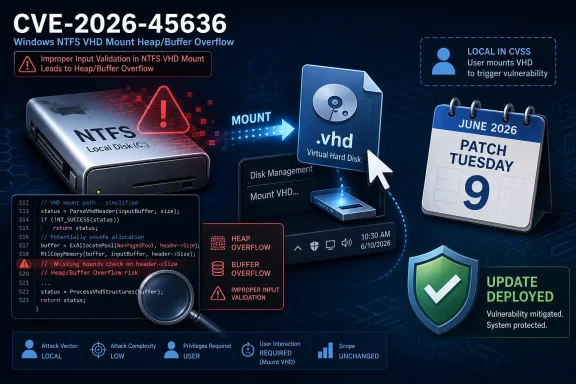 Microsoft’s NTFS Bug Is Less Explosive Than Its Name, and More Interesting Than Its Score
The phrase “Windows NTFS Remote Code Execution Vulnerability” sounds like the kind of bulletin that makes administrators reach for emergency change windows. NTFS sits near the center of the Windows trust model, and remote code execution remains the most attention-grabbing impact category in Microsoft’s taxonomy. But CVE-2026-45636 is a useful case study in why the title of a CVE is only the beginning of the risk conversation.Microsoft’s own scoring places the attack vector at local, with low attack complexity, no privileges required, and user interaction required. In plain English, the attacker does not need an account on the target system, but the target user has to do something that causes Windows to process the crafted content. Microsoft’s FAQ narrows that action further: the user would need to mount a
.vhd file.That is a much different operational picture from a remote service listening on a port. There is no indication from Microsoft that this vulnerability is publicly disclosed or actively exploited as of its original June 9 publication. Microsoft’s exploitability assessment is “Exploitation Less Likely,” and the exploit code maturity metric is “Unproven.”
Still, the base CVSS score of 7.8 is not decorative. The confidentiality, integrity, and availability impact ratings are all high. If an attacker gets the victim to mount the malicious virtual hard disk and exploitation succeeds, the theoretical consequence is arbitrary code execution on the local machine.
The “Remote” in Remote Code Execution Does Not Mean What Many Readers Think
Microsoft’s terminology often collides with how defenders talk about attacks in the field. In this case, the word “remote” refers to the location of the attacker, not the network path into the vulnerable component. Microsoft explicitly notes that this class of issue may also be described as arbitrary code execution, because the actual exploit path is carried out locally.That distinction will frustrate some readers, but it is not meaningless hairsplitting. A remotely located attacker can send a malicious file, host it on a share, attach it to a message, or place it somewhere a user is likely to retrieve it. But Windows still needs a local action to trigger the vulnerable code path.
The attack vector being local also tells defenders something useful. Network segmentation alone is not the control that saves you here. Email filtering, attachment handling, web download controls, endpoint protection, user training, and file association policy are much closer to the blast radius.
The
.vhd detail is especially important. Virtual hard disks are not exotic in IT environments. Developers use them, admins use them, backup and lab workflows use them, and power users often treat them as portable containers. That familiarity is exactly why a malicious VHD can be socially engineered more plausibly than a random executable.NTFS Remains a Prime Target Because Windows Keeps Trusting Storage
NTFS is old, heavily tested, and deeply integrated into Windows. That does not make it boring. File systems are parsers, and parsers are where attackers love to live.A file-system driver must interpret complicated on-disk structures while maintaining performance, backward compatibility, metadata integrity, and compatibility with decades of Windows behavior. When virtual disk formats enter the picture, Windows is not merely opening a file as data; it is treating that file as a mountable storage object with its own file-system structures. That raises the stakes.
CVE-2026-45636 is described as a heap-based buffer overflow and improper input validation issue. Those two phrases are familiar because they describe a classic failure mode: software accepts structured input, fails to constrain or validate it properly, and ends up writing or reading memory in unsafe ways. In a user-facing application, that is bad. In storage and file-system plumbing, it can be worse, because the component is close to the operating system’s core assumptions about what is trustworthy.
This is also why file-based RCEs retain strategic value for attackers. They fit into phishing, help-desk impersonation, supply-chain staging, and “please mount this image” workflows. They do not need to be wormable to matter.
The Score Says “Important,” but the Impact Fields Say “Do Not Ignore”
Microsoft rates CVE-2026-45636 as Important, not Critical. That is consistent with the need for user interaction and the local attack vector. Critical ratings are typically reserved for bugs that are easier to exploit at scale, especially those reachable over a network without user action.But the CVSS vector shows why Important does not mean optional. Attack complexity is low. Privileges required are none. The three impact categories — confidentiality, integrity, and availability — are high. The vulnerability is also marked with confirmed report confidence, meaning Microsoft is not merely relaying a vague outside claim.
The temporal score is lower than the base score because Microsoft has issued an official fix and because exploit code maturity is unproven. That is the system working as designed. Once a patch exists, urgency should shift from “we do not know what to do” to “how quickly can we deploy without breaking the business.”
For administrators, this is the kind of bug that deserves normal Patch Tuesday prioritization with a bias toward endpoints and systems where users handle untrusted files. It is not the only June 2026 vulnerability worth attention, but it should not be lost in the large Patch Tuesday pile.
June’s Patch Tuesday Was Too Large for One CVE to Carry the News Cycle
CVE-2026-45636 landed in a sprawling June 2026 Microsoft security release. Reporting on the release counted roughly 200 flaws addressed by Microsoft, including dozens of remote code execution vulnerabilities and three publicly disclosed zero-days. That context matters because defenders will not patch this NTFS issue in isolation.Large Patch Tuesday releases create triage fatigue. Security teams look for exploited-in-the-wild tags, Critical severity, internet-facing services, domain controller exposure, and known public proof-of-concept code. By those filters, CVE-2026-45636 may not be the first item on the whiteboard.
But Patch Tuesday triage should not be a severity-only exercise. User-assisted code execution bugs often become useful after the first wave of more obvious vulnerabilities gets patched. Attackers do not need the “best” vulnerability; they need one that works in a target’s environment and fits their delivery chain.
That is the real position of CVE-2026-45636. It is not the emergency siren of the month. It is a credible foothold candidate if organizations allow users to mount untrusted virtual disk files and lag behind cumulative updates.
The VHD Requirement Is a Constraint, Not a Comfort Blanket
The most concrete exploitation requirement Microsoft gives is also the most operationally useful: the victim must mount a.vhd file. That requirement lowers mass-exploitation risk, but it does not make the bug irrelevant. Attackers have spent decades proving that “requires user interaction” is not much of a barrier when the lure is convincing.A VHD can be presented as a disk image, a lab environment, a backup export, a forensic package, or a software bundle. In technical communities, those are not inherently suspicious objects. In enterprise environments, they may even bypass some of the reflexive suspicion attached to
.exe, .js, or macro-enabled Office files.The control question is whether ordinary users need to mount virtual disks at all. On many managed endpoints, the answer is no. On developer workstations, incident response machines, virtualization hosts, and engineering systems, the answer may be yes — but that is precisely where policy should be more deliberate.
This is where Windows security posture often breaks down. Organizations restrict script execution, harden Office macros, and scrutinize executables, then leave less common file handlers available because they are part of the OS and rarely cause trouble. A VHD-handling vulnerability is a reminder that every file type with privileged parsing behavior deserves policy attention.
Report Confidence Is the Quiet Metric That Should Shape Defender Behavior
The user-supplied excerpt from Microsoft’s page describes the CVSS report confidence metric, and it is more than boilerplate. Report confidence measures how certain the vulnerability is and how credible the technical details are. For CVE-2026-45636, Microsoft marks the value as Confirmed.That matters because defenders often confuse limited public detail with uncertainty. Microsoft has not published exploit steps, proof-of-concept code, or a deep root-cause post. But the vulnerability is not speculative. Microsoft is the assigning CNA, the affected component is identified, the weakness categories are listed, and the patch is available.
Confirmed report confidence also cuts both ways. It gives defenders assurance that this is worth addressing. It also tells would-be attackers that the bug exists and that the general terrain — NTFS processing of a mounted VHD, heap overflow, input validation failure — is real enough to investigate.
This is one of the awkward truths of modern vulnerability disclosure. The same metadata that helps defenders prioritize can help offensive researchers aim their fuzzers. That is not an argument for opacity; it is an argument for treating Patch Tuesday metadata as operational intelligence, not mere compliance paperwork.
The Affected Platform List Shows Why Cumulative Patching Still Wins
Microsoft’s security update table covers a broad sweep of Windows client and server versions, including Windows 10, Windows 11, Windows Server 2012 and 2012 R2, Windows Server 2016, Windows Server 2019, Windows Server 2022, and Windows Server 2025, with Server Core variants included where applicable. The fixes arrive through the relevant June cumulative or security updates, including separate KB packages for different supported branches.That breadth is unsurprising for NTFS. File-system code is shared across Windows generations, and security fixes often have to move through multiple servicing channels. For sysadmins, the lesson is old but still uncomfortable: if an organization maintains long tails of Windows versions, even a single component bug turns into a patch-management matrix.
The Windows 10 entries are especially notable because Windows 10 is deep into its late lifecycle period in 2026. Extended servicing, special support channels, and legacy application dependencies can keep older builds alive long after security teams would prefer to retire them. Those machines still parse files, mount media, and interact with users.
The presence of Server Core should also prevent a common mistake. A reduced GUI footprint does not eliminate file-system exposure. Servers may be less likely to receive random VHDs through email, but they may process disk images in backup, deployment, virtualization, or administrative workflows.
The Right Mitigation Is Boring, Which Is Why It Works
Microsoft’s official remediation is the patch. There is no grand architectural workaround in the advisory, and there does not need to be one. The vendor fix is available, the remediation level is official, and the vulnerability is part of the normal June servicing stream.That said, patching is not the only useful defensive move. Organizations should treat this advisory as a prompt to review who can mount virtual disk files, where VHDs are accepted from, and whether endpoint controls inspect or quarantine disk-image formats. This is particularly relevant for help desks, developers, virtualization admins, and users who routinely exchange lab images.
Smart App Control, Defender, attack surface reduction rules, and third-party endpoint tools are not magic shields against a file-system parsing bug. But layered controls can reduce the odds that a malicious VHD reaches a user, is trusted by the user, and is mounted on a vulnerable machine before patching completes. The chain has several links; defenders should stress all of them.
Enterprises should also remember that the mounting action itself is a telemetry opportunity. If ordinary office users rarely mount VHDs, then VHD mount events deserve attention. The same event that looks normal on a virtualization engineer’s workstation may be suspicious on a finance laptop.
The Patch Is the Fix, but the File-Handling Habit Is the Lesson
This vulnerability’s most useful lesson is not that NTFS had another memory safety bug. It is that Windows organizations often underestimate “passive” file handling as an execution path. A virtual disk image is not passive when the operating system mounts it and parses its file-system structures.For home users, the advice is straightforward: install the June 2026 updates and do not mount disk images from people or sites you do not trust. Windows enthusiasts who test ISOs, VHDs, and preview builds should be especially careful because the workflows that make them power users also put them near this bug class.
For IT teams, the question is not whether users are smart enough to avoid malicious files. The question is whether the organization has made dangerous file handling unnecessarily easy. If mounting virtual disks is not part of someone’s job, it should not be a casual default behavior.
This is where security maturity shows. The same organization that blocks unknown scripts but allows unreviewed virtual disk mounting has not really solved the file-delivery problem. It has merely moved the risky parser from one extension to another.
The Concrete Readout for Windows Admins
CVE-2026-45636 should be handled as a serious, patchable, user-assisted code execution bug rather than a network emergency. Its value for defenders is in the details: VHD mounting, NTFS parsing, broad Windows impact, and confirmed vendor acknowledgement.- CVE-2026-45636 was released on June 9, 2026, as part of Microsoft’s June security updates for supported Windows client and server versions.
- The vulnerability affects Windows NTFS and is tied to heap-based buffer overflow and improper input validation weaknesses.
- Microsoft rates the issue Important with a CVSS 3.1 base score of 7.8 and a temporal score of 6.8.
- Exploitation requires user interaction, specifically mounting a malicious
.vhdfile, and Microsoft says the attack vector is local despite the RCE title. - Microsoft lists the vulnerability as not publicly disclosed, not exploited, and less likely to be exploited at the time of publication.
- The practical response is to deploy the June updates and review whether users who do not need VHD mounting capability can trigger that workflow.
References
- Primary source: MSRC
Published: 2026-06-09T07:00:00-07:00
Security Update Guide - Microsoft Security Response Center
 msrc.microsoft.com
