

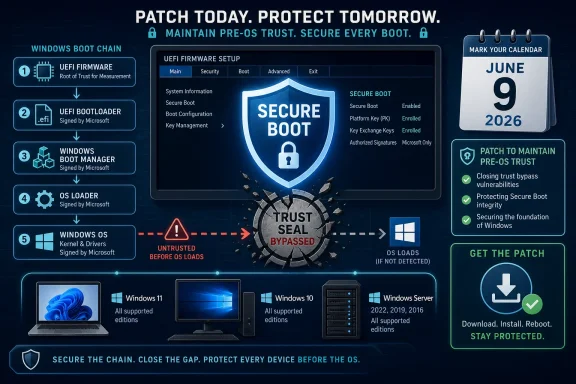
Microsoft disclosed CVE-2026-45656 on June 9, 2026, as an Important-rated Windows UEFI Secure Boot security feature bypass that allows an authorized local attacker to weaken Secure Boot protections across supported Windows client and server releases. The uncomfortable part is not that Microsoft has another Secure Boot bug; it is that the boot chain has become one of Windows’ most politically and operationally sensitive patch surfaces. A browser bug can be fixed and forgotten. A Secure Boot bug asks every administrator to think about trust before the operating system even exists.
This vulnerability lands in a year when Secure Boot is already under pressure from certificate rotation, old bootloaders, expired trust anchors, and a long tail of devices that were never designed for graceful cryptographic renewal. Microsoft says exploitation is less likely, that the issue was not publicly disclosed before release, and that it has not been observed in the wild. That should keep panic out of the room, but it should not keep patching off the calendar.
Secure Boot was sold to Windows users as a relatively simple assurance: before the operating system loads, the firmware checks whether the next component in the boot path is trusted. If it is not, the machine should refuse to continue. That story is still basically true, but the ecosystem around it has become anything but simple.
A modern Windows boot path is a negotiation among firmware, Microsoft-signed components, OEM implementation choices, recovery media, disk encryption, update policy, and sometimes third-party bootloaders. The trust model is only as strong as the weakest component that remains accepted by the platform. That is why Secure Boot bypasses feel different from ordinary privilege escalation bugs: they do not merely ask whether an attacker can do something bad inside Windows, but whether Windows can trust the pre-OS state it inherits.
CVE-2026-45656 is described by Microsoft as a protection mechanism failure in Windows UEFI. The phrase is bland, almost bureaucratic, but the consequences are not. Microsoft says successful exploitation could weaken Secure Boot protections that help ensure only trusted boot components are loaded during startup, potentially allowing the system to start in a less protected state.
The advisory’s details are intentionally limited, which is normal for boot-chain vulnerabilities. Microsoft does not publish a recipe for bypassing one of Windows’ foundational defenses on Patch Tuesday. But the CVSS vector tells us a great deal: local attack vector, low attack complexity, low privileges required, no user interaction, and high impact to confidentiality, integrity, and availability.
That combination is the story. This is not a remote worm. It is also not a harmless edge case. It is a local path to weakening the machinery that is supposed to make post-compromise persistence harder.
The score is held below Critical largely because the attack is local and requires some level of authorized access. That matters. An attacker cannot simply spray packets across the internet and trigger this bug on unpatched machines. They first need a foothold, a compromised account, physical or local access, or another chained weakness that gives them the necessary position.
But local-only vulnerabilities are often exactly what serious intrusions use after the first door has opened. Once an attacker is on a machine, the next question is not whether they can run malware for five minutes. It is whether they can survive cleanup, credential resets, endpoint detection, and OS reinstall attempts. Secure Boot is one of the technologies meant to raise that persistence bar.
This is why the “security feature bypass” category is so often misunderstood. It is not always about immediate code execution. Sometimes it is about making another defensive guarantee less true. A bypass of Secure Boot can matter because it changes the assumptions under which BitLocker, kernel trust, recovery workflows, and endpoint security tools operate.
Microsoft’s exploitability assessment says exploitation is less likely, and the exploit code maturity metric is listed as unproven. That is a meaningful brake on urgency. Yet the report confidence is confirmed, and an official fix is available. In plain English: Microsoft believes the bug is real, says it knows enough to patch it, and is not currently saying attackers are using it.
For administrators, that is not a red-alert siren. It is a strong instruction to fold the update into the normal security deployment process without treating it as optional hygiene.
The affected client list includes Windows 11 versions 23H2, 24H2, 25H2, and 26H1, across x64 and ARM64 where applicable. It also includes Windows 10 versions 21H2 and 22H2, along with older long-servicing branches such as Windows 10 version 1607 and 1809 in contexts where they remain supported. On the server side, Microsoft lists Windows Server 2012, 2012 R2, 2016, 2019, 2022, and 2025, including Server Core variants.
That breadth matters because Secure Boot vulnerabilities do not map neatly onto the devices most people think about first. Consumer laptops are only part of the story. The more consequential exposure may sit in branch-office servers, industrial workstations, virtualized Windows Server images, old management appliances, and carefully frozen enterprise builds.
The update matrix also shows why Windows security is never just about the latest release. The newest Windows 11 build gets the patch, but so do server platforms that many organizations still depend on because replacing them is harder than securing them. That is the Windows reality Microsoft has to support: modern security promises layered onto old operational commitments.
Build numbers also matter here, especially for fleet validation. Windows 11 version 24H2 moves to build 26100.8655. Windows 11 version 25H2 moves to build 26200.8655. Windows 10 version 22H2 moves to build 19045.7417. Server 2022 moves to build 20348.5256, and Server 2025 moves to build 26100.32995. These are not trivia; they are the audit trail that tells a security team whether the estate has actually crossed the line from vulnerable to remediated.
In practice, the patch should be handled like a boot-sensitive update. That means testing on representative hardware, checking recovery workflows, confirming BitLocker recovery key availability where applicable, and validating systems that depend on nonstandard boot paths. The worst way to respond to a Secure Boot bug is to wave it through without testing and then discover that a niche server, dual-boot workstation, or recovery environment no longer behaves as expected.
A phishing attachment, stolen VPN credential, exposed remote management interface, malicious insider, or supply-chain foothold can all put an attacker in a position where local vulnerabilities become useful. Once there, Secure Boot matters because it is part of the line between malware that lives inside the operating system and malware that can influence what the operating system trusts at startup.
That distinction is especially important for defenders who rely on endpoint detection and response. EDR agents run after firmware and early boot components have already done their work. If the boot path is weakened, the system may enter Windows in a state that is harder for those tools to reason about. The machine may look normal while inheriting a trust problem from below.
This does not mean CVE-2026-45656 is automatically a bootkit installation button. Microsoft has not said that, and the public advisory does not provide enough detail to claim it. But Secure Boot bypasses belong to the same family of weaknesses that sophisticated attackers value because they erode the foundation on which later controls stand.
There is also a difference between practical exploitation and strategic value. A bug can be hard to use at scale and still be attractive to targeted attackers. If the target is a high-value workstation, a domain admin’s laptop, a build server, or a server involved in credential flows, local exploitation may be an acceptable hurdle.
This is why “exploitation less likely” should be read as a probability estimate, not a permission slip. It tells administrators not to emergency-reboot the entire company at noon without testing. It does not say the vulnerability is harmless.
That sparseness is frustrating for readers who want root cause details, but it is not surprising. Boot-chain vulnerabilities sit in a disclosure zone where too much information can collapse the time between patch release and exploit reproduction. Microsoft has spent years learning that signed boot components, revocation lists, and firmware trust decisions can have ecosystem-wide consequences.
The CVSS vector is therefore the more revealing part of the advisory. Attack complexity is low, meaning Microsoft does not see exploitation as requiring unusual environmental conditions once the attacker is in the right position. User interaction is none, meaning the attacker does not need to trick another user into participating. Privileges required are low, which keeps the bug relevant to post-compromise scenarios where the attacker does not yet have administrative control.
The temporal metrics pull in the other direction. Exploit code maturity is unproven, remediation is official, and report confidence is confirmed. This is Microsoft telling customers that the issue is real and fixed, but not known to be weaponized. That is the sweet spot where disciplined patch management still works.
The weakness classification, CWE-693, is also telling. Protection mechanism failure is the category you use when the problem is not simply a crash or memory corruption bug in the normal application sense, but a failure of a security control to enforce what it is supposed to enforce. In a Secure Boot context, that is the whole game.
A protection failure in the boot chain does not need to be flashy to matter. Its significance comes from the security promises it can invalidate.
The Secure Boot trust store is not a static monument. It is a living set of certificates, allow lists, revocation lists, boot managers, firmware expectations, and recovery assumptions. When certificates age out or vulnerable boot components need revocation, the update process becomes more delicate than simply copying a new DLL into Windows.
That is the hidden cost of Secure Boot’s success. It has been widely deployed enough that changing it safely is difficult. A bad update can strand machines, break recovery media, disrupt dual-boot configurations, or trigger BitLocker recovery prompts at scale. A delayed update can leave old trust decisions in place long after researchers have shown they are unsafe.
Microsoft has already had to take a phased approach with previous Secure Boot bypass issues, including mitigations tied to BlackLotus-era bootloader revocations. The lesson from that episode was blunt: fixing the boot chain is not only a security engineering problem. It is a logistics problem involving every device that must still be able to boot after trust is tightened.
CVE-2026-45656 does not appear, from the advisory, to require the same kind of dramatic revocation choreography. Microsoft presents the remedy as security updates across Windows releases. But administrators should still view it through the lens of boot-chain fragility. Any patch that touches this layer deserves more respect than an ordinary monthly cumulative update.
The calendar pressure will only increase. As 2026 progresses, certificate expiration and Secure Boot CA updates will keep forcing organizations to prove they understand their boot estate. The companies that already know which systems use Secure Boot, which rely on custom boot media, which have BitLocker recovery keys escrowed, and which devices are firmware-orphaned will move faster. Everyone else will discover their inventory gaps at the worst possible moment.
Still, home users should avoid the common mistake of treating Secure Boot as irrelevant unless they personally changed a BIOS setting. Most modern Windows 11 systems depend on Secure Boot as part of the baseline security model. Even if you never see it, it helps define what your PC is allowed to trust before Windows loads.
The practical risk for consumers is highest on machines that are already compromised, shared with untrusted users, physically exposed, or running unusual boot configurations. A gaming desktop that dual-boots, a developer laptop with alternate boot media, or an older PC with firmware quirks may deserve a little extra care. That care mostly means making sure recovery keys and backups exist before applying updates, not avoiding the update.
Users who have disabled Secure Boot to run unsupported hardware or alternative operating systems should understand that they are outside part of the protection model this patch is meant to preserve. That may be an informed choice. It should not be an accidental one.
For most people, the right answer is boring and good: take the update, reboot, and verify Windows reports that Secure Boot is still enabled if the machine supports it. Security is allowed to be uneventful.
The first task is coverage. Security teams should map the affected Windows versions in their environment, including Server Core installations and older supported servers. The affected list is broad enough that assumptions will fail. A fleet that thinks of itself as “mostly Windows 11” may still have Windows 10 22H2 kiosks, Server 2019 application hosts, and Server 2012 R2 systems under extended support arrangements.
The second task is validation. Because this is a Secure Boot-related issue, testing should include devices with BitLocker, systems using virtualization-based security, hardware with older firmware, and machines that depend on recovery media. The goal is not to invent fear, but to avoid turning a security rollout into a help desk storm.
The third task is detection posture. Microsoft says exploitation has not been observed, but organizations should still treat unexplained Secure Boot state changes, suspicious boot configuration edits, unexpected BitLocker recovery events, and firmware configuration drift as signals worth investigating. The value of Secure Boot is not just that it blocks bad states; it gives defenders something to measure.
The fourth task is incident response realism. If a high-value system is suspected of boot-chain compromise, reinstalling Windows may not be enough. Firmware settings, boot entries, Secure Boot databases, recovery partitions, and hardware provenance may all matter. CVE-2026-45656 does not prove such compromise occurred, but it belongs to the class of issues that should make IR teams think below the OS.
Microsoft has made the fix available. Enterprises now have to do the less glamorous work: deploy it without breaking boot, prove it landed, and fold the lesson into future Secure Boot maintenance.
This vulnerability lands in a year when Secure Boot is already under pressure from certificate rotation, old bootloaders, expired trust anchors, and a long tail of devices that were never designed for graceful cryptographic renewal. Microsoft says exploitation is less likely, that the issue was not publicly disclosed before release, and that it has not been observed in the wild. That should keep panic out of the room, but it should not keep patching off the calendar.
 Secure Boot’s Promise Is Becoming Harder to Keep
Secure Boot was sold to Windows users as a relatively simple assurance: before the operating system loads, the firmware checks whether the next component in the boot path is trusted. If it is not, the machine should refuse to continue. That story is still basically true, but the ecosystem around it has become anything but simple.A modern Windows boot path is a negotiation among firmware, Microsoft-signed components, OEM implementation choices, recovery media, disk encryption, update policy, and sometimes third-party bootloaders. The trust model is only as strong as the weakest component that remains accepted by the platform. That is why Secure Boot bypasses feel different from ordinary privilege escalation bugs: they do not merely ask whether an attacker can do something bad inside Windows, but whether Windows can trust the pre-OS state it inherits.
CVE-2026-45656 is described by Microsoft as a protection mechanism failure in Windows UEFI. The phrase is bland, almost bureaucratic, but the consequences are not. Microsoft says successful exploitation could weaken Secure Boot protections that help ensure only trusted boot components are loaded during startup, potentially allowing the system to start in a less protected state.
The advisory’s details are intentionally limited, which is normal for boot-chain vulnerabilities. Microsoft does not publish a recipe for bypassing one of Windows’ foundational defenses on Patch Tuesday. But the CVSS vector tells us a great deal: local attack vector, low attack complexity, low privileges required, no user interaction, and high impact to confidentiality, integrity, and availability.
That combination is the story. This is not a remote worm. It is also not a harmless edge case. It is a local path to weakening the machinery that is supposed to make post-compromise persistence harder.
“Important” Does Not Mean “Routine” This Time
Microsoft rates CVE-2026-45656 as Important, with a CVSS 3.1 base score of 7.8 and a temporal score of 6.8. In a Patch Tuesday world crowded with Critical remote code execution flaws, Important can sound like the software equivalent of “eventually.” That instinct is dangerous when the affected layer is UEFI Secure Boot.The score is held below Critical largely because the attack is local and requires some level of authorized access. That matters. An attacker cannot simply spray packets across the internet and trigger this bug on unpatched machines. They first need a foothold, a compromised account, physical or local access, or another chained weakness that gives them the necessary position.
But local-only vulnerabilities are often exactly what serious intrusions use after the first door has opened. Once an attacker is on a machine, the next question is not whether they can run malware for five minutes. It is whether they can survive cleanup, credential resets, endpoint detection, and OS reinstall attempts. Secure Boot is one of the technologies meant to raise that persistence bar.
This is why the “security feature bypass” category is so often misunderstood. It is not always about immediate code execution. Sometimes it is about making another defensive guarantee less true. A bypass of Secure Boot can matter because it changes the assumptions under which BitLocker, kernel trust, recovery workflows, and endpoint security tools operate.
Microsoft’s exploitability assessment says exploitation is less likely, and the exploit code maturity metric is listed as unproven. That is a meaningful brake on urgency. Yet the report confidence is confirmed, and an official fix is available. In plain English: Microsoft believes the bug is real, says it knows enough to patch it, and is not currently saying attackers are using it.
For administrators, that is not a red-alert siren. It is a strong instruction to fold the update into the normal security deployment process without treating it as optional hygiene.
The Patch Surface Spans the Windows Estate, Not Just New PCs
One striking feature of CVE-2026-45656 is the breadth of affected Windows versions. Microsoft lists updates for current Windows 11 releases, Windows 10 versions still receiving updates, and a wide range of Windows Server editions, including Server 2012 and Server 2012 R2 under applicable support arrangements.The affected client list includes Windows 11 versions 23H2, 24H2, 25H2, and 26H1, across x64 and ARM64 where applicable. It also includes Windows 10 versions 21H2 and 22H2, along with older long-servicing branches such as Windows 10 version 1607 and 1809 in contexts where they remain supported. On the server side, Microsoft lists Windows Server 2012, 2012 R2, 2016, 2019, 2022, and 2025, including Server Core variants.
That breadth matters because Secure Boot vulnerabilities do not map neatly onto the devices most people think about first. Consumer laptops are only part of the story. The more consequential exposure may sit in branch-office servers, industrial workstations, virtualized Windows Server images, old management appliances, and carefully frozen enterprise builds.
The update matrix also shows why Windows security is never just about the latest release. The newest Windows 11 build gets the patch, but so do server platforms that many organizations still depend on because replacing them is harder than securing them. That is the Windows reality Microsoft has to support: modern security promises layered onto old operational commitments.
Build numbers also matter here, especially for fleet validation. Windows 11 version 24H2 moves to build 26100.8655. Windows 11 version 25H2 moves to build 26200.8655. Windows 10 version 22H2 moves to build 19045.7417. Server 2022 moves to build 20348.5256, and Server 2025 moves to build 26100.32995. These are not trivia; they are the audit trail that tells a security team whether the estate has actually crossed the line from vulnerable to remediated.
In practice, the patch should be handled like a boot-sensitive update. That means testing on representative hardware, checking recovery workflows, confirming BitLocker recovery key availability where applicable, and validating systems that depend on nonstandard boot paths. The worst way to respond to a Secure Boot bug is to wave it through without testing and then discover that a niche server, dual-boot workstation, or recovery environment no longer behaves as expected.
The Real Risk Lives After Initial Compromise
Microsoft’s advisory describes the attacker as authorized and local. That narrows the threat model, but it does not trivialize it. In enterprise incidents, “local attacker” often means “the second stage of a compromise that began somewhere else.”A phishing attachment, stolen VPN credential, exposed remote management interface, malicious insider, or supply-chain foothold can all put an attacker in a position where local vulnerabilities become useful. Once there, Secure Boot matters because it is part of the line between malware that lives inside the operating system and malware that can influence what the operating system trusts at startup.
That distinction is especially important for defenders who rely on endpoint detection and response. EDR agents run after firmware and early boot components have already done their work. If the boot path is weakened, the system may enter Windows in a state that is harder for those tools to reason about. The machine may look normal while inheriting a trust problem from below.
This does not mean CVE-2026-45656 is automatically a bootkit installation button. Microsoft has not said that, and the public advisory does not provide enough detail to claim it. But Secure Boot bypasses belong to the same family of weaknesses that sophisticated attackers value because they erode the foundation on which later controls stand.
There is also a difference between practical exploitation and strategic value. A bug can be hard to use at scale and still be attractive to targeted attackers. If the target is a high-value workstation, a domain admin’s laptop, a build server, or a server involved in credential flows, local exploitation may be an acceptable hurdle.
This is why “exploitation less likely” should be read as a probability estimate, not a permission slip. It tells administrators not to emergency-reboot the entire company at noon without testing. It does not say the vulnerability is harmless.
Microsoft’s Sparse Advisory Says More Than It Seems
The MSRC entry for CVE-2026-45656 is concise, even by Microsoft standards. The executive summary is one sentence. The FAQ gives a general description of weakened Secure Boot protections. The acknowledgement names security researcher Alon Leviev with Microsoft’s STORM team.That sparseness is frustrating for readers who want root cause details, but it is not surprising. Boot-chain vulnerabilities sit in a disclosure zone where too much information can collapse the time between patch release and exploit reproduction. Microsoft has spent years learning that signed boot components, revocation lists, and firmware trust decisions can have ecosystem-wide consequences.
The CVSS vector is therefore the more revealing part of the advisory. Attack complexity is low, meaning Microsoft does not see exploitation as requiring unusual environmental conditions once the attacker is in the right position. User interaction is none, meaning the attacker does not need to trick another user into participating. Privileges required are low, which keeps the bug relevant to post-compromise scenarios where the attacker does not yet have administrative control.
The temporal metrics pull in the other direction. Exploit code maturity is unproven, remediation is official, and report confidence is confirmed. This is Microsoft telling customers that the issue is real and fixed, but not known to be weaponized. That is the sweet spot where disciplined patch management still works.
The weakness classification, CWE-693, is also telling. Protection mechanism failure is the category you use when the problem is not simply a crash or memory corruption bug in the normal application sense, but a failure of a security control to enforce what it is supposed to enforce. In a Secure Boot context, that is the whole game.
A protection failure in the boot chain does not need to be flashy to matter. Its significance comes from the security promises it can invalidate.
Secure Boot Is Also Fighting the Calendar
CVE-2026-45656 arrives against a broader Secure Boot transition that administrators already had to track. Microsoft has been moving the Windows ecosystem away from older Secure Boot certificates toward newer certificate authorities, because older Secure Boot certificates begin expiring in 2026. That certificate migration is not this CVE, but the timing makes the vulnerability feel like part of the same larger story.The Secure Boot trust store is not a static monument. It is a living set of certificates, allow lists, revocation lists, boot managers, firmware expectations, and recovery assumptions. When certificates age out or vulnerable boot components need revocation, the update process becomes more delicate than simply copying a new DLL into Windows.
That is the hidden cost of Secure Boot’s success. It has been widely deployed enough that changing it safely is difficult. A bad update can strand machines, break recovery media, disrupt dual-boot configurations, or trigger BitLocker recovery prompts at scale. A delayed update can leave old trust decisions in place long after researchers have shown they are unsafe.
Microsoft has already had to take a phased approach with previous Secure Boot bypass issues, including mitigations tied to BlackLotus-era bootloader revocations. The lesson from that episode was blunt: fixing the boot chain is not only a security engineering problem. It is a logistics problem involving every device that must still be able to boot after trust is tightened.
CVE-2026-45656 does not appear, from the advisory, to require the same kind of dramatic revocation choreography. Microsoft presents the remedy as security updates across Windows releases. But administrators should still view it through the lens of boot-chain fragility. Any patch that touches this layer deserves more respect than an ordinary monthly cumulative update.
The calendar pressure will only increase. As 2026 progresses, certificate expiration and Secure Boot CA updates will keep forcing organizations to prove they understand their boot estate. The companies that already know which systems use Secure Boot, which rely on custom boot media, which have BitLocker recovery keys escrowed, and which devices are firmware-orphaned will move faster. Everyone else will discover their inventory gaps at the worst possible moment.
Home Users Should Patch, But Not Panic
For typical Windows users, the advice is simple: install the June 2026 security updates when offered through Windows Update. Microsoft says the vulnerability is not publicly disclosed and not exploited, and the attack requires local authorized access. That makes drive-by internet panic inappropriate.Still, home users should avoid the common mistake of treating Secure Boot as irrelevant unless they personally changed a BIOS setting. Most modern Windows 11 systems depend on Secure Boot as part of the baseline security model. Even if you never see it, it helps define what your PC is allowed to trust before Windows loads.
The practical risk for consumers is highest on machines that are already compromised, shared with untrusted users, physically exposed, or running unusual boot configurations. A gaming desktop that dual-boots, a developer laptop with alternate boot media, or an older PC with firmware quirks may deserve a little extra care. That care mostly means making sure recovery keys and backups exist before applying updates, not avoiding the update.
Users who have disabled Secure Boot to run unsupported hardware or alternative operating systems should understand that they are outside part of the protection model this patch is meant to preserve. That may be an informed choice. It should not be an accidental one.
For most people, the right answer is boring and good: take the update, reboot, and verify Windows reports that Secure Boot is still enabled if the machine supports it. Security is allowed to be uneventful.
Enterprise IT Has to Treat Boot Trust as Inventory
For enterprise administrators, CVE-2026-45656 is another reminder that the boot chain is now an asset class. It belongs in inventory, compliance, and incident response planning, not in a dusty BIOS appendix.The first task is coverage. Security teams should map the affected Windows versions in their environment, including Server Core installations and older supported servers. The affected list is broad enough that assumptions will fail. A fleet that thinks of itself as “mostly Windows 11” may still have Windows 10 22H2 kiosks, Server 2019 application hosts, and Server 2012 R2 systems under extended support arrangements.
The second task is validation. Because this is a Secure Boot-related issue, testing should include devices with BitLocker, systems using virtualization-based security, hardware with older firmware, and machines that depend on recovery media. The goal is not to invent fear, but to avoid turning a security rollout into a help desk storm.
The third task is detection posture. Microsoft says exploitation has not been observed, but organizations should still treat unexplained Secure Boot state changes, suspicious boot configuration edits, unexpected BitLocker recovery events, and firmware configuration drift as signals worth investigating. The value of Secure Boot is not just that it blocks bad states; it gives defenders something to measure.
The fourth task is incident response realism. If a high-value system is suspected of boot-chain compromise, reinstalling Windows may not be enough. Firmware settings, boot entries, Secure Boot databases, recovery partitions, and hardware provenance may all matter. CVE-2026-45656 does not prove such compromise occurred, but it belongs to the class of issues that should make IR teams think below the OS.
Microsoft has made the fix available. Enterprises now have to do the less glamorous work: deploy it without breaking boot, prove it landed, and fold the lesson into future Secure Boot maintenance.
The One-Sentence Advisory Carries a Long Operational Tail
The most concrete lesson from CVE-2026-45656 is that Secure Boot vulnerabilities should be judged by where they sit in the trust stack, not merely by whether Microsoft labels them Critical. This one is patched, not known to be exploited, and not remotely reachable by itself, but it touches a defense that Windows relies on before Windows can defend itself.- Microsoft released fixes for CVE-2026-45656 on June 9, 2026, across supported Windows client and server releases.
- The vulnerability is an Important-rated UEFI Secure Boot security feature bypass with a CVSS 3.1 base score of 7.8.
- Microsoft says exploitation is less likely, the issue was not publicly disclosed before release, and exploitation has not been detected.
- The attack requires local authorized access, low privileges, and no user interaction, making it most relevant as a post-compromise or targeted-access risk.
- Administrators should prioritize representative testing on BitLocker-enabled systems, older firmware, Server Core deployments, and machines with unusual boot or recovery configurations.
- Successful patching should be verified by build number and by confirming Secure Boot posture remains consistent after reboot.
References
- Primary source: MSRC
Published: 2026-06-09T07:00:00-07:00
Security Update Guide - Microsoft Security Response Center
 msrc.microsoft.com
