

Linux kernel maintainers disclosed CVE-2026-45839 on May 27, 2026, after fixing a BPF CO-RE parsing bug that lets a privileged user with CAP_BPF crash kernels built with vmlinux BTF support. The flaw is not a Windows vulnerability, but it matters to WindowsForum readers because Linux is now a routine part of Windows estates through WSL, containers, developer workstations, CI runners, and cloud hosts. Its lesson is blunt: the modern kernel attack surface is no longer limited to classic drivers and syscalls. It increasingly lives in developer convenience features that were designed to make observability and portability easier.
CVE-2026-45839 is the kind of bug that looks almost embarrassingly small once reduced to its essence. BPF CO-RE accessor strings are supposed to be non-negative paths through kernel type metadata: “go to member zero, then member one, then member two.” The parser accepted signed integers, and the later bounds check only rejected values that were too large, not values that were below zero.
That is the whole story at the code level, and it is also why the bug is interesting. The kernel did not need a sprawling race condition, a spectacular heap grooming trick, or an exotic hardware side channel to fall over. It needed a negative index to slip through a path that assumed all indexes were naturally non-negative.
The vulnerable function,
That is a familiar C failure mode wearing modern kernel clothing. Signedness bugs are not new. What is new is the particular neighborhood in which this one lives: BPF, CO-RE relocations, and BTF metadata, a stack of technologies increasingly central to Linux observability, security tooling, and high-performance infrastructure.
CO-RE, short for Compile Once – Run Everywhere, is part of what made that ecosystem practical. Instead of compiling a BPF program separately for every target kernel layout, CO-RE uses BTF type information to relocate accesses at load time. The promise is elegant: ship one BPF object and let the target machine’s type metadata tell it where the relevant kernel fields actually live.
That elegance creates a new trust boundary. The loader and verifier are no longer just checking bytecode behavior in the abstract. They are interpreting structured metadata, parsing accessor strings, walking kernel type graphs, and translating symbolic intent into concrete offsets.
CVE-2026-45839 sits precisely in that translation layer. The malicious input is not a packet from the network or a malformed filesystem image. It is a crafted BPF program whose CO-RE relocation data asks the kernel to walk type metadata with an index that should never have existed.
This bug is a reminder that the verifier is only as good as the assumptions feeding it. Before a BPF program can be accepted, CO-RE relocation handling has to parse the metadata that describes how the program’s field accesses map onto the running kernel. If that pre-verification plumbing mishandles an accessor, the kernel may crash before the usual safety story gets a chance to finish.
The call trace in the CVE description is telling. The failure path runs through CO-RE relocation calculation, BTF application, verifier relocation checking,
The fix is equally telling: reject negative CO-RE accessor indices immediately after parsing. In other words, the kernel did not need a new mitigation class. It needed the parser to enforce the grammar it already believed it was receiving.
That does not make it irrelevant. In many production environments, CAP_BPF is delegated to observability agents, networking components, sandboxed services, or container-adjacent tooling. The whole point of fine-grained capabilities is to avoid handing everything to root. But a kernel crash reachable by a narrower capability still represents a real blast radius when that capability has been granted broadly or automatically.
The distinction is especially important for Windows administrators who encounter Linux mostly through WSL, Kubernetes nodes, cloud appliances, or vendor-managed agents. This is not a vulnerability where a random website can crash your Windows desktop. It is a vulnerability where a machine that allows BPF program loading under the wrong trust assumptions can be brought down by a crafted local workload.
Security teams should resist two opposite overreactions. The first is dismissing the bug because it is “only” a crash and “only” CAP_BPF. The second is treating it as if every Linux system is immediately exploitable from the network. The useful answer is narrower: find where BPF loading is permitted, find which kernels carry the fix, and prioritize systems where untrusted or semi-trusted users can reach that capability.
But once metadata becomes part of a runtime decision, it stops being passive documentation. It becomes input. And if it becomes input, it needs the same defensive parsing discipline as any other data structure crossing a trust boundary.
That is the deeper architectural point. Modern operating systems are full of machine-readable descriptions of themselves: type databases, symbol maps, policy manifests, attestation records, telemetry schemas, hardware topology tables, and bytecode metadata. These structures are designed to make systems more adaptable. They also create new parser surfaces in privileged code.
In CVE-2026-45839, the string
A vulnerability can be operationally important before a database assigns it a number. Here, the available description already tells administrators several concrete things: the bug is in the Linux kernel, the affected path involves BPF CO-RE relocation parsing, the crash is deterministic, the required capability is CAP_BPF, and the fix has landed in stable kernel commits.
That is enough to begin triage. The absence of a CVSS vector should slow down automated severity labeling, not human judgment. If your environment grants BPF loading to agents or users, a deterministic kernel crash is not theoretical. It is a reliability and availability problem sitting in privileged local attack surface.
This is where mature vulnerability management differs from dashboard watching. CVSS is a useful normalization tool, but it is not a substitute for understanding exposure. A high-score flaw in unreachable code may matter less than a lower-score flaw on every production node with delegated BPF privileges.
WSL itself is not automatically equivalent to a bare-metal Linux distribution with every BPF capability exposed. Microsoft’s integration choices, kernel configuration, enterprise policy, and user privileges all affect practical exposure. But the broader point remains: Windows estates increasingly contain Linux kernels, whether administrators think of them that way or not.
This is especially true in developer-heavy organizations. The same engineer who lacks administrative rights on a corporate Windows laptop may have significant control inside a WSL distribution, a local container runtime, or a cloud development environment. If those environments enable BPF features for tracing or profiling, Linux kernel patch cadence becomes part of endpoint risk management.
The uncomfortable truth is that many Windows shops still inventory “servers” and “endpoints” more carefully than they inventory developer substrates. WSL distributions, local Kubernetes clusters, ephemeral CI runners, and vendor observability appliances often sit in the gray zone between platform engineering and security operations. Bugs like this thrive in that gray zone.
But simple upstream patches do not instantly become simple enterprise outcomes. Linux distributions backport fixes into vendor kernels. Cloud images may lag behind upstream stable. Appliance vendors may ship custom kernels. Container hosts may be patched while developer workstations are not, or the reverse.
The presence of several stable commit references in the CVE record indicates that the fix is being carried across maintained kernel lines. Administrators should still verify through their distribution’s advisory channel rather than assuming that a version string alone tells the full story. Enterprise kernels routinely include selected patches without changing to the newest upstream version.
For Windows administrators responsible for mixed estates, this is the moment to check whether Linux patch reporting is integrated into the same workflow as Windows Update compliance. If Linux kernel status lives in a separate spreadsheet, a vendor portal, or an engineer’s memory, the operational risk is not this single CVE. The risk is that kernel bugs become visible only after an incident.
That distinction matters for BPF. Many observability and networking tools that operate in container environments need elevated privileges, host mounts, or specific kernel capabilities to do their jobs. The very tools that give administrators insight into clusters can require deeper kernel integration than ordinary application containers.
If CAP_BPF or related privileges are available inside a container boundary, the exposure analysis changes. A supposedly isolated workload may be able to reach kernel functionality that affects the entire host. Even where container runtimes restrict BPF by default, exceptions made for monitoring agents and service mesh components deserve review.
The right response is not to rip out observability. It is to treat privileged observability components as privileged software, with patch requirements, threat models, and least-privilege review. BPF is powerful because it lets small programs run close to the kernel. That power should never be confused with harmlessness.
The relevant accessor indices are inherently non-negative. Struct members do not have negative positions. Array element paths do not become meaningful when prefixed with a minus sign. Enumerator indices are not improved by being allowed to underflow into enormous unsigned values.
This is the kind of invariant that should be encoded where the data enters the subsystem, not merely assumed later. Once a bad value moves through multiple layers, every later function has to defend itself against a state it was never designed to see. The eventual crash in
Kernel developers know this. The reason the bug is still notable is not that it teaches a new principle. It shows how even mature, heavily reviewed subsystems can miss a small mismatch between a textual grammar and a C type.
Every operating system vendor wants to expose programmable hooks without letting those hooks become arbitrary kernel entry points. Linux has BPF. Windows has a long history of kernel-mode drivers and increasingly sophisticated telemetry and isolation features. The engineering cultures differ, but the trade-off is similar: administrators want visibility and control, attackers want the same pathways for leverage.
For IT pros, the practical takeaway is to ask where programmability has been enabled and who is allowed to use it. A system that lets privileged agents load code or metadata into kernel-adjacent paths needs tighter governance than an ordinary application server. The permission may not be called “administrator” or “root,” but the consequence of abuse can still be system-wide.
CVE-2026-45839 is therefore a useful case study for Windows-first teams. It demonstrates why least privilege must be specific, why local denial-of-service bugs still matter, and why developer tooling should not escape security inventory simply because it lives outside the traditional production server fleet.
A deterministic crash during BPF program load is an availability failure with obvious operational consequences. On a developer workstation, it can interrupt work and corrupt state. On a CI runner, it can break pipelines. On a Kubernetes node, it can evict workloads and trigger cascading rescheduling. On a multi-tenant host, it can become a denial-of-service primitive if the capability boundary is too loose.
That is why the CAP_BPF requirement should be read carefully. It narrows the attacker pool, but it does not erase the consequence. Many production outages begin with a component that was trusted more broadly than anyone realized.
Availability bugs also have a way of becoming security bugs in practice. If crashing a host forces failover into a weaker configuration, disables monitoring, corrupts logs, or creates noisy incident response conditions, the blast radius can exceed the immediate kernel panic. Attackers do not need every bug to be a clean privilege escalation if it can reliably destabilize the environment.
Developer systems deserve special attention. They are more likely to run tracing tools, experimental kernels, local containers, and WSL distributions. They are also less likely to be covered by the same kernel compliance reports that track production Linux servers.
Cloud and container hosts deserve the second pass. If observability agents, network plugins, or security tools rely on BPF, verify that the underlying host kernels are patched through the distribution or cloud vendor channel. Do not assume an updated container image repairs a vulnerable host.
Finally, security teams should review capability delegation. CAP_BPF exists for a reason, but granting it should still be a deliberate act. If a service no longer needs it, remove it. If a tool requires it, document why and ensure the host patch level matches the trust being placed in that tool.
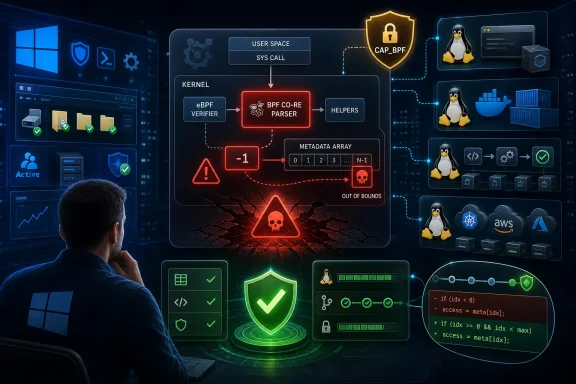 A One-Character Assumption Turned Into a Kernel Crash
CVE-2026-45839 is the kind of bug that looks almost embarrassingly small once reduced to its essence. BPF CO-RE accessor strings are supposed to be non-negative paths through kernel type metadata: “go to member zero, then member one, then member two.” The parser accepted signed integers, and the later bounds check only rejected values that were too large, not values that were below zero.That is the whole story at the code level, and it is also why the bug is interesting. The kernel did not need a sprawling race condition, a spectacular heap grooming trick, or an exotic hardware side channel to fall over. It needed a negative index to slip through a path that assumed all indexes were naturally non-negative.
The vulnerable function,
bpf_core_parse_spec(), parsed each colon-separated component with a signed %d conversion. A string such as -1 could therefore survive parsing. When the value later flowed into code expecting an unsigned member index, it could become 0xffffffff, pushing an out-of-bounds read far beyond the BTF members array.That is a familiar C failure mode wearing modern kernel clothing. Signedness bugs are not new. What is new is the particular neighborhood in which this one lives: BPF, CO-RE relocations, and BTF metadata, a stack of technologies increasingly central to Linux observability, security tooling, and high-performance infrastructure.
BPF Has Become Infrastructure, Not a Niche Kernel Toy
For years, eBPF was easy to describe as a clever kernel subsystem for specialists. That description is now badly out of date. BPF programs power performance profilers, network filters, container observability agents, intrusion detection tools, service meshes, and cloud telemetry platforms.CO-RE, short for Compile Once – Run Everywhere, is part of what made that ecosystem practical. Instead of compiling a BPF program separately for every target kernel layout, CO-RE uses BTF type information to relocate accesses at load time. The promise is elegant: ship one BPF object and let the target machine’s type metadata tell it where the relevant kernel fields actually live.
That elegance creates a new trust boundary. The loader and verifier are no longer just checking bytecode behavior in the abstract. They are interpreting structured metadata, parsing accessor strings, walking kernel type graphs, and translating symbolic intent into concrete offsets.
CVE-2026-45839 sits precisely in that translation layer. The malicious input is not a packet from the network or a malformed filesystem image. It is a crafted BPF program whose CO-RE relocation data asks the kernel to walk type metadata with an index that should never have existed.
The Verifier Cannot Save Code That Lies Before It Arrives
The Linux BPF verifier has a reputation for being both powerful and punishing. It rejects unsafe pointer arithmetic, tracks register states, models control flow, and has become one of the most scrutinized parts of the kernel. That scrutiny is deserved, but it can also create a misleading impression that “BPF safety” begins and ends with verifier logic.This bug is a reminder that the verifier is only as good as the assumptions feeding it. Before a BPF program can be accepted, CO-RE relocation handling has to parse the metadata that describes how the program’s field accesses map onto the running kernel. If that pre-verification plumbing mishandles an accessor, the kernel may crash before the usual safety story gets a chance to finish.
The call trace in the CVE description is telling. The failure path runs through CO-RE relocation calculation, BTF application, verifier relocation checking,
bpf_check(), and then the BPF program load syscall. This is not an accidental side alley. It is on the normal road a BPF program travels when loaded.The fix is equally telling: reject negative CO-RE accessor indices immediately after parsing. In other words, the kernel did not need a new mitigation class. It needed the parser to enforce the grammar it already believed it was receiving.
CAP_BPF Makes This a Privileged DoS, Not an Internet Worm
The practical severity of CVE-2026-45839 depends heavily on who can load BPF programs on a target system. The CVE description says the crash is reachable with CAP_BPF, the Linux capability introduced to separate BPF administration from all-powerful root. That detail matters because it places the bug in the category of privileged local denial of service, not unauthenticated remote compromise.That does not make it irrelevant. In many production environments, CAP_BPF is delegated to observability agents, networking components, sandboxed services, or container-adjacent tooling. The whole point of fine-grained capabilities is to avoid handing everything to root. But a kernel crash reachable by a narrower capability still represents a real blast radius when that capability has been granted broadly or automatically.
The distinction is especially important for Windows administrators who encounter Linux mostly through WSL, Kubernetes nodes, cloud appliances, or vendor-managed agents. This is not a vulnerability where a random website can crash your Windows desktop. It is a vulnerability where a machine that allows BPF program loading under the wrong trust assumptions can be brought down by a crafted local workload.
Security teams should resist two opposite overreactions. The first is dismissing the bug because it is “only” a crash and “only” CAP_BPF. The second is treating it as if every Linux system is immediately exploitable from the network. The useful answer is narrower: find where BPF loading is permitted, find which kernels carry the fix, and prioritize systems where untrusted or semi-trusted users can reach that capability.
BTF Turned Debug Metadata Into Runtime Attack Surface
The CVE description calls out systems withCONFIG_DEBUG_INFO_BTF=y, which is enabled by default on major distributions according to the report. That is another reason this bug deserves attention. BTF began as metadata: a compact representation of kernel types, useful for introspection and essential for CO-RE portability.But once metadata becomes part of a runtime decision, it stops being passive documentation. It becomes input. And if it becomes input, it needs the same defensive parsing discipline as any other data structure crossing a trust boundary.
That is the deeper architectural point. Modern operating systems are full of machine-readable descriptions of themselves: type databases, symbol maps, policy manifests, attestation records, telemetry schemas, hardware topology tables, and bytecode metadata. These structures are designed to make systems more adaptable. They also create new parser surfaces in privileged code.
In CVE-2026-45839, the string
"0:1:2" is harmless and expected, while "-1" is nonsense. The bug was not that the kernel lacked knowledge of what a CO-RE accessor is. The bug was that this knowledge was not enforced at the first moment where text became an integer.The NVD Placeholder Is Not the Risk Assessment
At disclosure, the NVD entry for CVE-2026-45839 was still awaiting enrichment and did not yet carry NVD CVSS scores. That is increasingly common in the period immediately after kernel.org CVE publication. It is also a trap for patch prioritization systems that treat missing CVSS data as missing risk.A vulnerability can be operationally important before a database assigns it a number. Here, the available description already tells administrators several concrete things: the bug is in the Linux kernel, the affected path involves BPF CO-RE relocation parsing, the crash is deterministic, the required capability is CAP_BPF, and the fix has landed in stable kernel commits.
That is enough to begin triage. The absence of a CVSS vector should slow down automated severity labeling, not human judgment. If your environment grants BPF loading to agents or users, a deterministic kernel crash is not theoretical. It is a reliability and availability problem sitting in privileged local attack surface.
This is where mature vulnerability management differs from dashboard watching. CVSS is a useful normalization tool, but it is not a substitute for understanding exposure. A high-score flaw in unreachable code may matter less than a lower-score flaw on every production node with delegated BPF privileges.
Linux Bugs Now Belong in Windows Estate Planning
WindowsForum readers may reasonably ask why a Linux kernel CVE belongs on their radar. The answer is that the boundary between Windows and Linux administration has thinned. Windows developers run WSL. Enterprises run Linux containers on Windows-managed endpoints and hybrid cloud platforms. Security teams deploy cross-platform agents. Build systems compile Linux artifacts from Windows laptops and CI workers.WSL itself is not automatically equivalent to a bare-metal Linux distribution with every BPF capability exposed. Microsoft’s integration choices, kernel configuration, enterprise policy, and user privileges all affect practical exposure. But the broader point remains: Windows estates increasingly contain Linux kernels, whether administrators think of them that way or not.
This is especially true in developer-heavy organizations. The same engineer who lacks administrative rights on a corporate Windows laptop may have significant control inside a WSL distribution, a local container runtime, or a cloud development environment. If those environments enable BPF features for tracing or profiling, Linux kernel patch cadence becomes part of endpoint risk management.
The uncomfortable truth is that many Windows shops still inventory “servers” and “endpoints” more carefully than they inventory developer substrates. WSL distributions, local Kubernetes clusters, ephemeral CI runners, and vendor observability appliances often sit in the gray zone between platform engineering and security operations. Bugs like this thrive in that gray zone.
The Patch Is Simple; Proving Coverage Is Not
The upstream fix rejects negative accessor indices after parsing, aligning the implementation with the CO-RE model. That is reassuring. Simple fixes are easier to review, easier to backport, and less likely to introduce secondary regressions than sweeping redesigns.But simple upstream patches do not instantly become simple enterprise outcomes. Linux distributions backport fixes into vendor kernels. Cloud images may lag behind upstream stable. Appliance vendors may ship custom kernels. Container hosts may be patched while developer workstations are not, or the reverse.
The presence of several stable commit references in the CVE record indicates that the fix is being carried across maintained kernel lines. Administrators should still verify through their distribution’s advisory channel rather than assuming that a version string alone tells the full story. Enterprise kernels routinely include selected patches without changing to the newest upstream version.
For Windows administrators responsible for mixed estates, this is the moment to check whether Linux patch reporting is integrated into the same workflow as Windows Update compliance. If Linux kernel status lives in a separate spreadsheet, a vendor portal, or an engineer’s memory, the operational risk is not this single CVE. The risk is that kernel bugs become visible only after an incident.
Containers Do Not Make Kernel Bugs Disappear
Containerization often muddies the conversation around kernel vulnerabilities. A container image can be rebuilt every hour and still run on a vulnerable host kernel. Conversely, patching an application container does nothing to repair the kernel underneath it.That distinction matters for BPF. Many observability and networking tools that operate in container environments need elevated privileges, host mounts, or specific kernel capabilities to do their jobs. The very tools that give administrators insight into clusters can require deeper kernel integration than ordinary application containers.
If CAP_BPF or related privileges are available inside a container boundary, the exposure analysis changes. A supposedly isolated workload may be able to reach kernel functionality that affects the entire host. Even where container runtimes restrict BPF by default, exceptions made for monitoring agents and service mesh components deserve review.
The right response is not to rip out observability. It is to treat privileged observability components as privileged software, with patch requirements, threat models, and least-privilege review. BPF is powerful because it lets small programs run close to the kernel. That power should never be confused with harmlessness.
The Bug Also Shows Why “Safe Subsystems” Still Need Boring Checks
There is a tendency in security discourse to focus on grand mechanisms: memory-safe languages, sandboxing, formal verification, capability separation, and control-flow integrity. Those mechanisms matter. But CVE-2026-45839 is an argument for something more mundane: validate signedness at the parser boundary.The relevant accessor indices are inherently non-negative. Struct members do not have negative positions. Array element paths do not become meaningful when prefixed with a minus sign. Enumerator indices are not improved by being allowed to underflow into enormous unsigned values.
This is the kind of invariant that should be encoded where the data enters the subsystem, not merely assumed later. Once a bad value moves through multiple layers, every later function has to defend itself against a state it was never designed to see. The eventual crash in
btf_member_bit_offset() is downstream of the original mistake.Kernel developers know this. The reason the bug is still notable is not that it teaches a new principle. It shows how even mature, heavily reviewed subsystems can miss a small mismatch between a textual grammar and a C type.
Windows Lessons From a Linux-Only CVE
The cross-platform lesson here is not “Linux is unsafe” any more than a Windows kernel CVE proves Windows is unsafe. The lesson is that extensibility surfaces become security surfaces. Windows has its own equivalents: drivers, filter platforms, tracing infrastructure, hypervisor interfaces, endpoint agents, and policy engines.Every operating system vendor wants to expose programmable hooks without letting those hooks become arbitrary kernel entry points. Linux has BPF. Windows has a long history of kernel-mode drivers and increasingly sophisticated telemetry and isolation features. The engineering cultures differ, but the trade-off is similar: administrators want visibility and control, attackers want the same pathways for leverage.
For IT pros, the practical takeaway is to ask where programmability has been enabled and who is allowed to use it. A system that lets privileged agents load code or metadata into kernel-adjacent paths needs tighter governance than an ordinary application server. The permission may not be called “administrator” or “root,” but the consequence of abuse can still be system-wide.
CVE-2026-45839 is therefore a useful case study for Windows-first teams. It demonstrates why least privilege must be specific, why local denial-of-service bugs still matter, and why developer tooling should not escape security inventory simply because it lives outside the traditional production server fleet.
The Security Story Is Really an Availability Story
Not every kernel vulnerability is about stealing secrets or becoming root. Some are about making the machine stop. In cloud and enterprise environments, that can be enough.A deterministic crash during BPF program load is an availability failure with obvious operational consequences. On a developer workstation, it can interrupt work and corrupt state. On a CI runner, it can break pipelines. On a Kubernetes node, it can evict workloads and trigger cascading rescheduling. On a multi-tenant host, it can become a denial-of-service primitive if the capability boundary is too loose.
That is why the CAP_BPF requirement should be read carefully. It narrows the attacker pool, but it does not erase the consequence. Many production outages begin with a component that was trusted more broadly than anyone realized.
Availability bugs also have a way of becoming security bugs in practice. If crashing a host forces failover into a weaker configuration, disables monitoring, corrupts logs, or creates noisy incident response conditions, the blast radius can exceed the immediate kernel panic. Attackers do not need every bug to be a clean privilege escalation if it can reliably destabilize the environment.
The Immediate Job Is Inventory, Not Panic
The most useful response to CVE-2026-45839 is neither alarmism nor complacency. Administrators should determine whether their Linux kernels include the fix, whether BPF loading is available, and whether any untrusted users or workloads can reach CAP_BPF. That sounds obvious, but it is exactly the kind of obvious work that hybrid estates often postpone.Developer systems deserve special attention. They are more likely to run tracing tools, experimental kernels, local containers, and WSL distributions. They are also less likely to be covered by the same kernel compliance reports that track production Linux servers.
Cloud and container hosts deserve the second pass. If observability agents, network plugins, or security tools rely on BPF, verify that the underlying host kernels are patched through the distribution or cloud vendor channel. Do not assume an updated container image repairs a vulnerable host.
Finally, security teams should review capability delegation. CAP_BPF exists for a reason, but granting it should still be a deliberate act. If a service no longer needs it, remove it. If a tool requires it, document why and ensure the host patch level matches the trust being placed in that tool.
The Negative Index That Should Reshape a Few Checklists
CVE-2026-45839 will probably not become a household-name vulnerability, and that is fine. Its value is in the operational checklist it sharpens for anyone running Linux inside a Windows-heavy organization.- Systems that allow BPF program loading should be treated as having a privileged kernel extension surface, even when root is not directly involved.
- Kernels with BTF and CO-RE support need the same patch discipline as more obviously exposed networking or filesystem components.
- Container image updates do not fix host kernel vulnerabilities, so container platforms must report host kernel patch status separately.
- WSL, CI runners, developer workstations, and lab machines should be included in Linux kernel exposure reviews when they support advanced tracing or container workflows.
- Missing NVD scoring should not delay triage when a CVE description already identifies a deterministic kernel crash and a clear privilege requirement.
- Capability assignments such as CAP_BPF should be audited regularly, because fine-grained privilege is only useful when it remains genuinely fine-grained.
References
- Primary source: NVD / Linux Kernel
Published: 2026-05-28T01:06:07-07:00
NVD - CVE-2026-45839
 nvd.nist.gov
- Security advisory: MSRC
Published: 2026-05-28T01:06:07-07:00
Original feed URL
Security Update Guide - Microsoft Security Response Center
 msrc.microsoft.com
- Related coverage: opennet.ru
- Related coverage: korg.docs.kernel.org
- Related coverage: kernel.org

The Linux Kernel Archives
www.kernel.org
- Related coverage: linuxcompatible.org
Linux Kernel 5.10.224 released
Linux kernel 5.10.224 has been released Linux kernel version 5.10.224 is now available: Full source:  https://cdn. kernel. org/pub/linux/kernel/v5.x/linux-5.www.linuxcompatible.org
- Related coverage: kernel.googlesource.com
- Official source: github.com
GitHub - gregkh/linux: Linux kernel stable tree mirror
Linux kernel stable tree mirror. Contribute to gregkh/linux development by creating an account on GitHub. github.com
- Related coverage: android.googlesource.com
- Related coverage: gitlab.com
freedesktop-sdk / mirrors / kernel / linux / kernel / git / stable / linux · GitLab
git.kernel.org: pub/scm/linux/kernel/git/stable/linux.gitgitlab.com - Related coverage: bootlin.com
- Related coverage: www2.gov.bc.ca
