

CVE-2026-45942 is a Linux kernel ext4 vulnerability published by NVD on May 27, 2026, covering a race between folio migration and ext4 bitmap updates that can produce e4b bitmap inconsistency reports during mixed huge-page stress workloads in affected kernels under load. The bug is not a glamorous remote-code-execution headline, and that is exactly why it matters. Filesystem races are the kind of fault administrators discover late, diagnose slowly, and explain poorly to users who only know that storage stopped behaving as promised.
The useful way to read CVE-2026-45942 is not as a single scary identifier but as a reminder that mature filesystems are still living software. Ext4 has earned its reputation by being boring in the best possible sense: widely deployed, well understood, heavily tested, and conservative compared with more adventurous filesystems. But boring does not mean static.
This issue sits in the allocator machinery, where ext4 tracks free and used space through block group bitmaps and buddy data. Under stress tests involving mixed huge-page workloads, ext4 could report that its view of free clusters did not match what the bitmap scan found. That kind of message is unnerving because filesystems trade on internal consistency; when metadata disagrees with itself, administrators have to assume something important may be wrong until proven otherwise.
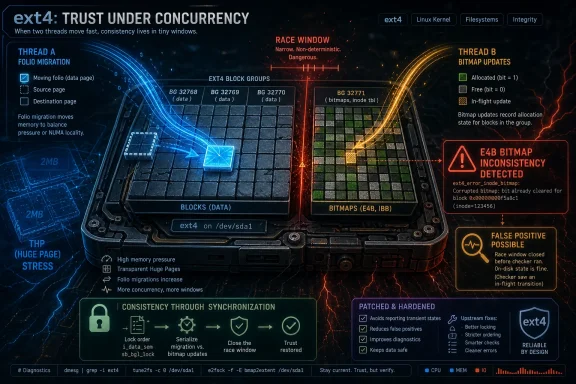
The reported failure pattern included e4b bitmap check complaints such as a group reporting one number of free clusters while a scan found another. In plain English, ext4’s accounting system and its bitmap view could briefly diverge because one thread was migrating a memory folio while another was modifying the bitmap. The race window was narrow, but the kernel fix notes make the crucial point: it was narrow enough to be considered unlikely, yet still wide enough to happen in real testing.
That distinction is where this CVE becomes interesting. Security teams often sort vulnerabilities by exploitability and score, but reliability bugs in storage code operate on a different axis. They may not hand an attacker a shell, yet they can corrode confidence in the most basic layer of the system.
The problem is that a reference count is not the same thing as an exclusion guarantee. The original fast path incremented the folio reference count, but that did not prevent concurrent folio migration. In the failure sequence described by the kernel change, migration could copy and remap the folio while ext4 was using it for bitmap work, leaving a tiny window for inconsistent observations.
The fix changes the decision point. If ext4 finds that the folio is locked, it no longer trusts the fast path. It drops into the slower path that obtains the lock, forcing synchronization with migration and closing the concurrency window.
That may sound like a mundane locking adjustment, but in kernel engineering these are the decisions that separate a harmless optimization from a latent production problem. A fast path is only correct if all the invariants it assumes remain true under real concurrency. CVE-2026-45942 is what happens when an optimization that looked safe under normal cache logic meets the memory-management realities of folio migration.
The false positive arose from another race window. One thread could load and initialize the bitmap, mark the folio uptodate, and then compare bitmaps while another thread, seeing the uptodate state, began using the folio without holding the folio lock. For a moment, the bitmap and the group descriptor could be legitimately in transition, but the checker could interpret that transitional state as corruption.
This is an especially awkward class of bug for administrators. A false corruption report can trigger emergency procedures: taking systems offline, scheduling fsck windows, restoring from backups, or escalating to vendors. Even when no data has been lost, a storage stack that cries wolf under load imposes real operational cost.
That is why the fix is not merely about suppressing a noisy warning. It tightens the assumptions around when ext4 can treat cached metadata as safe to use without locking. In a filesystem, a false alarm is not harmless if it causes humans and automation to react as if a disk is going bad.
The absence of a score should not be mistaken for the absence of risk. It means the record has not yet been fully classified by NVD’s enrichment process. Linux kernel CVEs increasingly arrive with detailed upstream fix context before downstream scanners and vulnerability databases have caught up with severity metadata.
That lag is not just bureaucratic. It changes how administrators should triage. A mature vulnerability program cannot wait for a neat numeric score when the affected component is a filesystem and the upstream patch is already available. The practical question is whether a deployed kernel contains the vulnerable code path and whether the workload can exercise it.
For most desktop Linux users, this issue will probably be invisible. For virtualized infrastructure, dense memory workloads, build farms, storage-heavy servers, and systems running aggressive memory management or huge-page configurations, the calculus is different. A rare race in a normal laptop workload can become a recurring log event in a stressed fleet.
For WSL users, the immediate risk depends on the kernel build Microsoft ships and how that build incorporates upstream fixes. WSL’s Linux filesystem behavior is not identical to a conventional distro install, but WSL 2 uses a real Linux kernel and commonly stores Linux distributions inside virtual disks formatted with Linux filesystems. That makes kernel filesystem fixes relevant even when the host operating system is Windows.
For Azure and hybrid administrators, the question is more routine but more urgent: which Linux images, vendor kernels, and long-term support branches have taken the ext4 patch? Cloud images often trail or customize upstream kernels, and enterprise distributions backport fixes without necessarily changing headline kernel versions. A simple
The Windows-heavy enterprise has also become a Linux-heavy enterprise by stealth. Security teams that patch Windows monthly but treat Linux appliances, containers hosts, and developer VMs as someone else’s domain are exactly the teams most likely to be surprised by a filesystem CVE that appears in a general vulnerability feed.
But minimizing it as “just a warning” would be equally sloppy. Filesystem integrity is not binary. A bug that causes internal accounting to disagree under stress deserves attention because the allocator is one of the places where small inconsistencies can have outsized consequences if left uncorrected.
The kernel maintainers treated the issue as worthy of stable backporting, and that is the signal administrators should heed. Stable backports are the kernel ecosystem’s way of saying this is not merely a development-branch cleanup. It is a fix that belongs in maintained kernels because real users may otherwise encounter it.
The right response is not panic. It is inventory, patch verification, and log review. If ext4 has been emitting bitmap inconsistency reports on systems running huge-page-heavy workloads, this CVE gives administrators a concrete line of inquiry.
Filesystems sit at the boundary between persistent state and volatile memory. They depend on the page cache, locking rules, migration behavior, and writeback semantics. When the memory-management layer evolves, old assumptions in filesystem code can become fragile.
CVE-2026-45942 is therefore a small example of a larger theme. Kernel performance work often improves throughput by avoiding locks, batching operations, and trusting state flags. Those techniques are essential for modern systems, but they increase the importance of exact synchronization rules.
The ext4 fix effectively says that “uptodate” is not enough when the folio is locked for another operation that may affect safe access. That is a narrow lesson in code, but a broad lesson in system design: cached correctness is not the same as concurrent correctness.
Administrators should treat this as a kernel maintenance issue with security implications rather than a classic perimeter vulnerability. It probably will not change firewall rules, identity policy, or endpoint isolation. It should change how teams think about kernel currency on systems that store important data on ext4.
The most exposed environments are not necessarily internet-facing. They are systems where high memory pressure, huge pages, virtualization, and sustained filesystem allocation churn overlap. Database servers, build infrastructure, container hosts, and VM-dense nodes are more interesting than lightly used desktops.
There is also a monitoring lesson here. If ext4 has been reporting bitmap check failures, administrators should not merely clear the logs after patching. They should correlate the timing with kernel versions, workload changes, memory pressure, and any filesystem repair events. A fixed race does not retroactively prove every prior warning was harmless.
This is where version-number thinking can mislead. A distribution may keep an older kernel version string while backporting the exact ext4 fix. Another may run a newer-looking kernel that has not yet incorporated the stable patch in its packaging. The only reliable answer is vendor advisory plus changelog confirmation.
For self-managed Linux systems, administrators can look for package updates that mention ext4, mballoc, folios, bitmap inconsistency, or the relevant stable commit. For vendor-managed platforms, the task is to confirm whether the provider has absorbed the patch into its supported kernel stream. For appliances, the harder question is whether the vendor even exposes enough kernel information to make that determination.
That opacity is not unique to this CVE, but filesystem bugs make it more consequential. If a network appliance, backup target, hypervisor host, or storage gateway uses ext4 internally, the administrator may have no easy way to inspect the kernel branch. Trust then shifts from upstream transparency to vendor responsiveness.
The harder part is distinguishing this issue from real corruption, hardware trouble, or unrelated ext4 bugs. Filesystem warnings are symptoms, not diagnoses. A kernel race can produce a frightening message, but so can bad RAM, failing storage, controller resets, firmware bugs, and power-loss events.
That means the response should be layered. Patch the kernel if the fix is applicable. Preserve logs before rebooting or repairing. Check storage health. Review whether the filesystem was remounted read-only or whether applications saw I/O errors. If repair tools were run, keep their output with the incident record.
The worst response is to assume that a CVE explaining a false positive means every warning was false. The second-worst response is to assume every warning means permanent corruption. Good operations lives between those extremes.
The patch does not redesign ext4. It does not introduce a dramatic new recovery mechanism. It adds a lock-state check to avoid a fast path when a folio may be involved in migration, then uses the slower locked path to restore ordering. That is exactly the kind of conservative change one wants in filesystem code.
There is a broader lesson for people who treat “stable” as a synonym for “unchanging.” Stable kernels change constantly because stability is maintained, not inherited. The alternative to carefully backported fixes is not safety; it is the indefinite preservation of known bugs.
For IT departments, that argues against both extremes. Blindly jumping to every new kernel can introduce regressions, but freezing kernels for long periods can strand systems on known filesystem flaws. The operational art is to run supported branches that receive fixes quickly enough, while testing them in workloads that resemble production.
CVE-2026-45942 will probably not be remembered as a landmark Linux vulnerability, and that is fine. Its importance is quieter: it shows how a narrow race in a high-trust subsystem can ripple into logs, maintenance windows, vulnerability dashboards, and cross-platform estates that increasingly blend Windows and Linux. The forward-looking lesson is simple enough to state and hard enough to practice: patch management has to understand what a bug touches, not merely how loudly a database scores it.
 Ext4’s New CVE Is Really a Story About Trust Under Concurrency
The useful way to read CVE-2026-45942 is not as a single scary identifier but as a reminder that mature filesystems are still living software. Ext4 has earned its reputation by being boring in the best possible sense: widely deployed, well understood, heavily tested, and conservative compared with more adventurous filesystems. But boring does not mean static.This issue sits in the allocator machinery, where ext4 tracks free and used space through block group bitmaps and buddy data. Under stress tests involving mixed huge-page workloads, ext4 could report that its view of free clusters did not match what the bitmap scan found. That kind of message is unnerving because filesystems trade on internal consistency; when metadata disagrees with itself, administrators have to assume something important may be wrong until proven otherwise.
The reported failure pattern included e4b bitmap check complaints such as a group reporting one number of free clusters while a scan found another. In plain English, ext4’s accounting system and its bitmap view could briefly diverge because one thread was migrating a memory folio while another was modifying the bitmap. The race window was narrow, but the kernel fix notes make the crucial point: it was narrow enough to be considered unlikely, yet still wide enough to happen in real testing.
That distinction is where this CVE becomes interesting. Security teams often sort vulnerabilities by exploitability and score, but reliability bugs in storage code operate on a different axis. They may not hand an attacker a shell, yet they can corrode confidence in the most basic layer of the system.
The Fast Path Took a Shortcut the Filesystem Could No Longer Afford
The core of the fix is almost deceptively small. Ext4’s buddy-loading path had a fast path that avoided taking the folio lock when it believed the cached folio was already usable. That is a classic kernel performance tradeoff: if the data is present and marked uptodate, avoid unnecessary locking and keep the hot path moving.The problem is that a reference count is not the same thing as an exclusion guarantee. The original fast path incremented the folio reference count, but that did not prevent concurrent folio migration. In the failure sequence described by the kernel change, migration could copy and remap the folio while ext4 was using it for bitmap work, leaving a tiny window for inconsistent observations.
The fix changes the decision point. If ext4 finds that the folio is locked, it no longer trusts the fast path. It drops into the slower path that obtains the lock, forcing synchronization with migration and closing the concurrency window.
That may sound like a mundane locking adjustment, but in kernel engineering these are the decisions that separate a harmless optimization from a latent production problem. A fast path is only correct if all the invariants it assumes remain true under real concurrency. CVE-2026-45942 is what happens when an optimization that looked safe under normal cache logic meets the memory-management realities of folio migration.
The False Positive Was Also a Real Bug
The CVE description includes a second wrinkle that is easy to miss: a DOUBLE_CHECK diagnostic could report corruption even when the report was a false positive. The message involved a mismatch between a bitmap copy and what was on disk or preallocated state. That matters because filesystem diagnostics are only valuable if operators can trust them.The false positive arose from another race window. One thread could load and initialize the bitmap, mark the folio uptodate, and then compare bitmaps while another thread, seeing the uptodate state, began using the folio without holding the folio lock. For a moment, the bitmap and the group descriptor could be legitimately in transition, but the checker could interpret that transitional state as corruption.
This is an especially awkward class of bug for administrators. A false corruption report can trigger emergency procedures: taking systems offline, scheduling fsck windows, restoring from backups, or escalating to vendors. Even when no data has been lost, a storage stack that cries wolf under load imposes real operational cost.
That is why the fix is not merely about suppressing a noisy warning. It tightens the assumptions around when ext4 can treat cached metadata as safe to use without locking. In a filesystem, a false alarm is not harmless if it causes humans and automation to react as if a disk is going bad.
NVD Has a Record, but Not Yet a Verdict
As of the CVE’s publication, NVD had marked CVE-2026-45942 as awaiting enrichment. That means there was a public CVE record and a kernel.org-sourced description, but no NVD-provided CVSS score, vector, or severity rating yet. For security programs that key dashboards off NVD scoring, this produces an uncomfortable pause.The absence of a score should not be mistaken for the absence of risk. It means the record has not yet been fully classified by NVD’s enrichment process. Linux kernel CVEs increasingly arrive with detailed upstream fix context before downstream scanners and vulnerability databases have caught up with severity metadata.
That lag is not just bureaucratic. It changes how administrators should triage. A mature vulnerability program cannot wait for a neat numeric score when the affected component is a filesystem and the upstream patch is already available. The practical question is whether a deployed kernel contains the vulnerable code path and whether the workload can exercise it.
For most desktop Linux users, this issue will probably be invisible. For virtualized infrastructure, dense memory workloads, build farms, storage-heavy servers, and systems running aggressive memory management or huge-page configurations, the calculus is different. A rare race in a normal laptop workload can become a recurring log event in a stressed fleet.
The Microsoft Angle Is WSL, Azure Images, and the Mixed Estate
WindowsForum readers do not need to run ext4 on bare metal to care about an ext4 kernel CVE. Ext4 is a Linux filesystem, but Linux now lives inside many Windows environments: Windows Subsystem for Linux, Hyper-V guests, Azure virtual machines, developer workstations, CI runners, appliances, and dual-boot systems. The boundary between “Linux issue” and “Windows shop issue” has been porous for years.For WSL users, the immediate risk depends on the kernel build Microsoft ships and how that build incorporates upstream fixes. WSL’s Linux filesystem behavior is not identical to a conventional distro install, but WSL 2 uses a real Linux kernel and commonly stores Linux distributions inside virtual disks formatted with Linux filesystems. That makes kernel filesystem fixes relevant even when the host operating system is Windows.
For Azure and hybrid administrators, the question is more routine but more urgent: which Linux images, vendor kernels, and long-term support branches have taken the ext4 patch? Cloud images often trail or customize upstream kernels, and enterprise distributions backport fixes without necessarily changing headline kernel versions. A simple
uname -r is useful, but it rarely tells the whole story.The Windows-heavy enterprise has also become a Linux-heavy enterprise by stealth. Security teams that patch Windows monthly but treat Linux appliances, containers hosts, and developer VMs as someone else’s domain are exactly the teams most likely to be surprised by a filesystem CVE that appears in a general vulnerability feed.
This Is Not the Ext4 Apocalypse, and That Is the Point
There is a temptation to frame every filesystem CVE as impending data loss. That would be irresponsible here. The available description points to bitmap inconsistency reports and diagnostic false positives under a narrow race involving folio migration and bitmap modification, not to a public exploit chain or a confirmed mass data-loss incident.But minimizing it as “just a warning” would be equally sloppy. Filesystem integrity is not binary. A bug that causes internal accounting to disagree under stress deserves attention because the allocator is one of the places where small inconsistencies can have outsized consequences if left uncorrected.
The kernel maintainers treated the issue as worthy of stable backporting, and that is the signal administrators should heed. Stable backports are the kernel ecosystem’s way of saying this is not merely a development-branch cleanup. It is a fix that belongs in maintained kernels because real users may otherwise encounter it.
The right response is not panic. It is inventory, patch verification, and log review. If ext4 has been emitting bitmap inconsistency reports on systems running huge-page-heavy workloads, this CVE gives administrators a concrete line of inquiry.
The Kernel’s Folio Era Still Has Sharp Edges
The appearance of folios in this story is not incidental. The Linux kernel’s memory-management work has been moving away from older page assumptions toward folios, which represent physically contiguous groups of pages and can reduce overhead in some paths. That modernization is necessary, but it also changes the terrain for subsystems that interact closely with cached metadata.Filesystems sit at the boundary between persistent state and volatile memory. They depend on the page cache, locking rules, migration behavior, and writeback semantics. When the memory-management layer evolves, old assumptions in filesystem code can become fragile.
CVE-2026-45942 is therefore a small example of a larger theme. Kernel performance work often improves throughput by avoiding locks, batching operations, and trusting state flags. Those techniques are essential for modern systems, but they increase the importance of exact synchronization rules.
The ext4 fix effectively says that “uptodate” is not enough when the folio is locked for another operation that may affect safe access. That is a narrow lesson in code, but a broad lesson in system design: cached correctness is not the same as concurrent correctness.
Enterprise Patch Management Has to Read Past the Score
If a vulnerability feed shows CVE-2026-45942 with no NVD score, many organizations will place it in a holding pattern. That is understandable, but it is also a habit attackers and outages both exploit. The most important information in this record is not a severity number; it is the affected subsystem, the workload trigger, and the existence of upstream stable commits.Administrators should treat this as a kernel maintenance issue with security implications rather than a classic perimeter vulnerability. It probably will not change firewall rules, identity policy, or endpoint isolation. It should change how teams think about kernel currency on systems that store important data on ext4.
The most exposed environments are not necessarily internet-facing. They are systems where high memory pressure, huge pages, virtualization, and sustained filesystem allocation churn overlap. Database servers, build infrastructure, container hosts, and VM-dense nodes are more interesting than lightly used desktops.
There is also a monitoring lesson here. If ext4 has been reporting bitmap check failures, administrators should not merely clear the logs after patching. They should correlate the timing with kernel versions, workload changes, memory pressure, and any filesystem repair events. A fixed race does not retroactively prove every prior warning was harmless.
Downstream Kernels Will Decide the Real Blast Radius
The upstream fix is only the beginning of the story. The real-world blast radius depends on which kernel branches contained the vulnerable code and which downstream vendors ship or backport the patch. Enterprise Linux distributions, cloud kernels, Android-derived kernels, NAS vendors, and appliance makers all move at different speeds.This is where version-number thinking can mislead. A distribution may keep an older kernel version string while backporting the exact ext4 fix. Another may run a newer-looking kernel that has not yet incorporated the stable patch in its packaging. The only reliable answer is vendor advisory plus changelog confirmation.
For self-managed Linux systems, administrators can look for package updates that mention ext4, mballoc, folios, bitmap inconsistency, or the relevant stable commit. For vendor-managed platforms, the task is to confirm whether the provider has absorbed the patch into its supported kernel stream. For appliances, the harder question is whether the vendor even exposes enough kernel information to make that determination.
That opacity is not unique to this CVE, but filesystem bugs make it more consequential. If a network appliance, backup target, hypervisor host, or storage gateway uses ext4 internally, the administrator may have no easy way to inspect the kernel branch. Trust then shifts from upstream transparency to vendor responsiveness.
The Log Line That Deserves a Second Look
The practical symptom that jumps out of the CVE record is the ext4 bitmap inconsistency report. Administrators who have seen messages about free clusters in group info not matching scanned blocks should treat those logs as more than generic noise. They may be evidence of this race, particularly if they appear under heavy allocation, migration, or huge-page activity.The harder part is distinguishing this issue from real corruption, hardware trouble, or unrelated ext4 bugs. Filesystem warnings are symptoms, not diagnoses. A kernel race can produce a frightening message, but so can bad RAM, failing storage, controller resets, firmware bugs, and power-loss events.
That means the response should be layered. Patch the kernel if the fix is applicable. Preserve logs before rebooting or repairing. Check storage health. Review whether the filesystem was remounted read-only or whether applications saw I/O errors. If repair tools were run, keep their output with the incident record.
The worst response is to assume that a CVE explaining a false positive means every warning was false. The second-worst response is to assume every warning means permanent corruption. Good operations lives between those extremes.
Ext4’s Reputation Survives Because Bugs Like This Get Boring Fixes
Ext4 is not trusted because it has no bugs. It is trusted because bugs are found, explained, reviewed, and backported through a mature maintenance pipeline. CVE-2026-45942 is a case study in that process working as intended, albeit after a race was reproducible enough to deserve a CVE.The patch does not redesign ext4. It does not introduce a dramatic new recovery mechanism. It adds a lock-state check to avoid a fast path when a folio may be involved in migration, then uses the slower locked path to restore ordering. That is exactly the kind of conservative change one wants in filesystem code.
There is a broader lesson for people who treat “stable” as a synonym for “unchanging.” Stable kernels change constantly because stability is maintained, not inherited. The alternative to carefully backported fixes is not safety; it is the indefinite preservation of known bugs.
For IT departments, that argues against both extremes. Blindly jumping to every new kernel can introduce regressions, but freezing kernels for long periods can strand systems on known filesystem flaws. The operational art is to run supported branches that receive fixes quickly enough, while testing them in workloads that resemble production.
The Small Race That Should Change the Patch Conversation
CVE-2026-45942 should push Linux patch discussions away from severity-score theater and back toward impact-aware maintenance.- Organizations should verify whether their supported kernel streams include the ext4 fix rather than waiting for NVD to assign a CVSS score.
- Systems using ext4 under heavy huge-page, virtualization, or allocation-heavy workloads deserve earlier attention than ordinary desktop installs.
- Administrators should review historical ext4 bitmap inconsistency messages before dismissing them as harmless diagnostics.
- WSL, Azure, Hyper-V Linux guests, and developer VMs make this relevant to Windows-centered environments as well as traditional Linux fleets.
- Vendor backports matter more than headline kernel version numbers when determining whether a system is actually fixed.
- A false-positive corruption report can still be operationally expensive, because it can trigger downtime, repair workflows, and loss of confidence.
CVE-2026-45942 will probably not be remembered as a landmark Linux vulnerability, and that is fine. Its importance is quieter: it shows how a narrow race in a high-trust subsystem can ripple into logs, maintenance windows, vulnerability dashboards, and cross-platform estates that increasingly blend Windows and Linux. The forward-looking lesson is simple enough to state and hard enough to practice: patch management has to understand what a bug touches, not merely how loudly a database scores it.
References
- Primary source: NVD / Linux Kernel
Published: 2026-05-28T01:08:22-07:00
NVD - CVE-2026-45942
 nvd.nist.gov
- Security advisory: MSRC
Published: 2026-05-28T01:08:22-07:00
Original feed URL
Security Update Guide - Microsoft Security Response Center
 msrc.microsoft.com
- Official source: nist.gov
National Vulnerability Database
NIST maintains the National Vulnerability Database (NVD), a repository of information on software and hardware flaws that can compromise computer security. This is a key piece of the nation’s cybersecurity infrastructure.www.nist.gov - Related coverage: security.snyk.io
Out-of-bounds Write in openexr | CVE-2021-45942 | Snyk
Medium severity (5.5) Out-of-bounds Write in openexr | CVE-2021-45942security.snyk.io - Related coverage: windowsforum.com
CVE-2026-31448 ext4 Infinite Loop: Extent/Xattr Bug and Patch Guidance | Windows Forum
The Linux kernel’s ext4 filesystem has a newly published vulnerability, CVE-2026-31448, that can trap the filesystem in an infinite loop under a narrow but...windowsforum.com - Related coverage: lists.openwall.net
- Related coverage: erofs.docs.kernel.org
- Related coverage: labs.cloudsecurityalliance.org
NVD Enrichment Triage: Enterprise Vulnerability Programs Must Adapt
PDF documentlabs.cloudsecurityalliance.org
- Related coverage: first.org
The National Vulnerability Database Ms. Tanya Brewer NVD Program Manager June 2024
PDF documentwww.first.org
